Lead Carrot vs Salesbot: Which Lead Gen Tool Wins in 2026?
Lead Carrot sells you a local-business lead database. Salesbot sells you an AI chat layer. They solve different halves of the same problem, so here's how they compare on data, price and fit, plus when neither is the right buy.
TL;DR
- Lead Carrot and Salesbot are not really competitors. Lead Carrot is a lead-sourcing database aimed at agencies selling to local businesses; Salesbot is an AI chat/automation layer that works leads you already have.
- If your problem is "I have no one to contact," Lead Carrot is the closer fit. If your problem is "I get traffic and replies but nobody follows up fast enough," Salesbot is the closer fit.
- Both tools inherit the same weakness: neither is built as a verification engine, so contact data quality is on you.
- Agencies and local-services sellers get the most out of Lead Carrot. SaaS and inbound-heavy teams get the most out of a Salesbot-style chat layer.
- The cheapest path for most outbound teams is a verified email source plus a sequencer, not a bundled suite. Budget roughly $50–$100/month for data before you buy any AI layer.
What are Lead Carrot and Salesbot, exactly?#
Start with the category confusion, because it drives most bad purchases here.
Lead Carrot (leadcarrot.io) is a prospecting database built around local and SMB businesses. You search by niche and geography, filter on signals like whether a business runs ads, has a website, or claims a Google listing, and export a list with business contact details. It was designed for the agency motion: "find 300 dentists in Phoenix without a mobile-friendly site, pitch them a redesign."
Salesbot is the trickier name. Depending on where you found it, "Salesbot" refers to either an AI chat agent bolted onto a CRM (the Kommo product uses this exact name for its automation builder) or one of several standalone AI sales-assistant products using the term. The common thread across all of them: a bot that qualifies, replies, books, and routes. It does not source strangers. It converts people who already raised a hand.
That distinction matters more than any feature grid. One tool fills the top of the funnel. The other compresses the middle.
Here is the clean split:
- Sourcing — building a list of companies and people who fit your ICP. Lead Carrot territory.
- Contact resolution — turning a company name into a deliverable email or phone number. Neither tool's core strength.
- Outreach — sending the first touch at volume. Sequencers own this.
- Conversation handling — replying, qualifying, booking. Salesbot territory.
- CRM hygiene — logging, routing, enriching. Mostly your CRM plus an enrichment API.
Most teams that say "Lead Carrot vs Salesbot" are actually missing step 2 and blaming steps 1 or 4.

How do Lead Carrot and Salesbot compare head-to-head?#
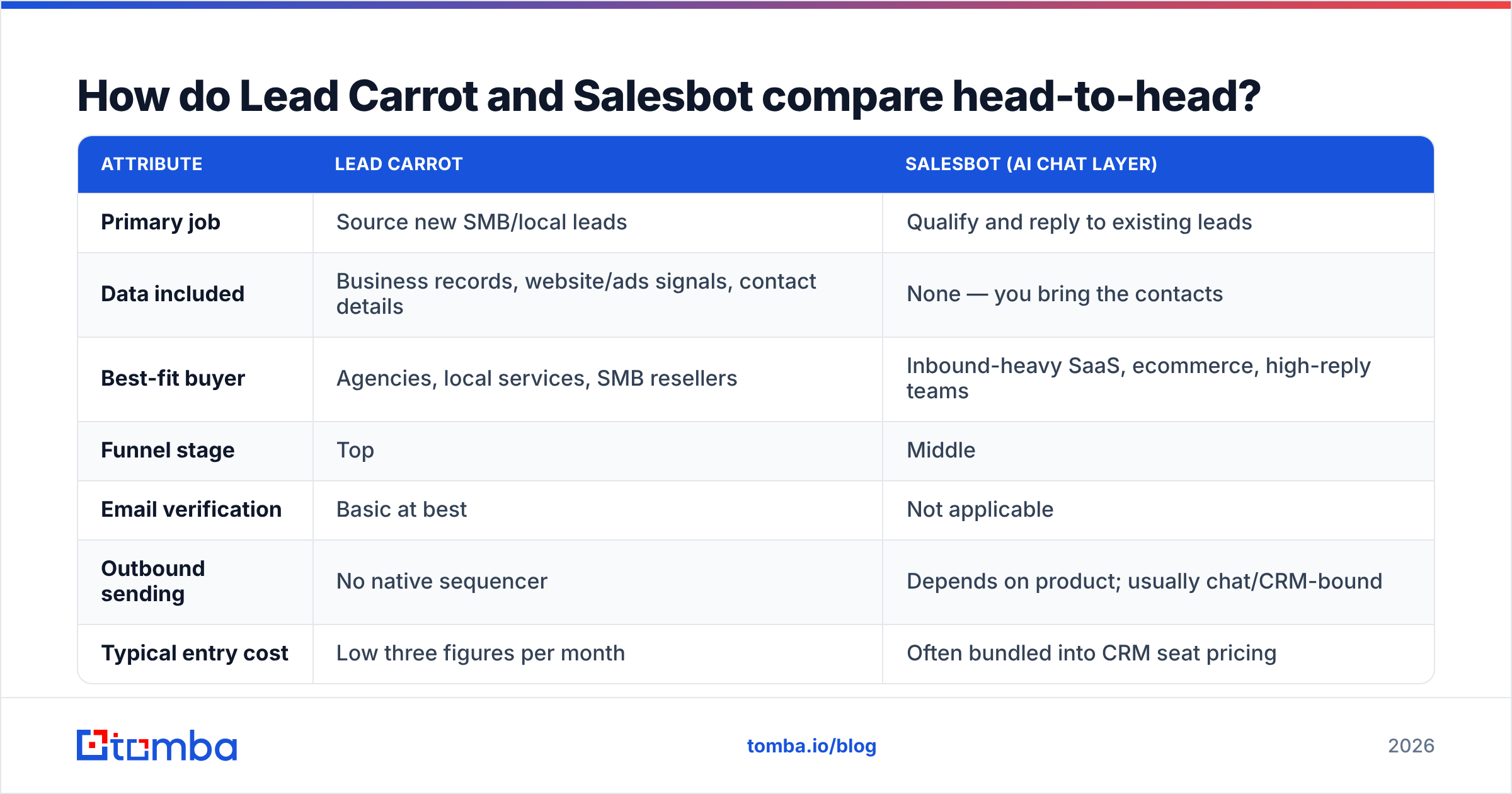
| Attribute | Lead Carrot | Salesbot (AI chat layer) |
|---|---|---|
| Primary job | Source new SMB/local leads | Qualify and reply to existing leads |
| Data included | Business records, website/ads signals, contact details | None — you bring the contacts |
| Best-fit buyer | Agencies, local services, SMB resellers | Inbound-heavy SaaS, ecommerce, high-reply teams |
| Funnel stage | Top | Middle |
| Email verification | Basic at best | Not applicable |
| Outbound sending | No native sequencer | Depends on product; usually chat/CRM-bound |
| Typical entry cost | Low three figures per month | Often bundled into CRM seat pricing |
| Fails when | Your ICP is enterprise or non-local | You have no inbound volume to work |
| Learning curve | Low — search, filter, export | Medium — flow building, intent design |
Read that table as a diagnosis, not a scoreboard. If your row-by-row answer keeps landing in the left column, you have a supply problem. If it keeps landing on the right, you have a throughput problem.
What does Lead Carrot do well, and where does it break?#
Where it's strong. The local-business filters are genuinely useful. Being able to slice by "has a Facebook page but no website" or "running paid ads in this ZIP" is the kind of buying signal that makes a cold pitch land. For an agency selling web design, SEO, or ad management to brick-and-mortar businesses, that filtering removes hours of manual Google Maps scraping every week.
Export is straightforward, the interface doesn't require training, and the pricing sits in the range a solo agency owner can absorb without a procurement conversation.
Where it breaks. Three places, consistently.
- Contact depth. Local business records often resolve to
info@,contact@, or a generic web form. Those are role addresses. They get filtered aggressively, they rarely reach a decision maker, and they drag down your sender reputation when they bounce. - ICP ceiling. The moment your target is a 200-person SaaS company, a regional manufacturer, or a VP inside an enterprise, the database thins out fast. It was not built for that.
- Freshness. SMB data decays hard. Businesses close, rebrand, and change phone numbers constantly. Any local database is fighting entropy, and no vendor wins that fight completely.
The fix for the first problem is not a different database. It's a verification and contact-resolution step layered on top. Running exported domains through a domain search turns "gulfcoastdental.com" into named people with role titles, and an email verifier pass strips the addresses that would have bounced before your sequencer ever touches them.
What does Salesbot do well, and where does it break?#
Where it's strong. Speed to lead is a real, measurable revenue lever. Response time to an inbound inquiry correlates directly with conversion, and research from vendors like HubSpot has pushed that finding into common knowledge for a decade. A bot that answers in nine seconds at 2 a.m. beats a rep who answers in four hours, and it does it every single night.
AI chat layers also handle the boring qualification script better than humans do. Budget, timeline, team size, current stack: the bot asks every time, never forgets, and writes the answers straight to the CRM record.
Where it breaks. Also three places.
- It needs volume. A bot that handles twelve website visitors a week is a $200/month rounding error. The ROI math only works above a certain traffic or reply threshold.
- Cold outbound mismatch. Most Salesbot-style products live inside a website widget or a CRM pipeline. They are not cold email engines. Pointing one at a list of strangers is using a receptionist as a door-to-door salesperson.
- Garbage in, garbage out. If the contact record it's enriching or routing is wrong, the bot confidently propagates the error into your CRM.
Which one should you buy for your motion?#
Use this as a decision list rather than a feature comparison:
- You sell to local businesses and you're list-starved. Buy Lead Carrot. Add a verification step immediately.
- You sell B2B software to named accounts. Skip both. You need an ICP-filtered B2B database plus contact resolution, not a local scraper.
- You get 500+ site visitors a week and reply speed is your bottleneck. Buy the Salesbot-style layer. The math works.
- You're running cold email at 1,000+ sends a month. Neither is your priority. Spend on verified data and deliverability first, because a 12% bounce rate will kill the channel before any bot matters.
- You're doing both motions at once. Sequence the purchases. Data first, outreach second, AI chat layer third. Buying the third before the first is the most common budget mistake in this category.
- You're an agency reselling leads. Lead Carrot plus a bulk verification workflow is the standard stack, and a bulk email finder run on exported domains is usually what makes the margins work.
How much do these tools actually cost in 2026?#
Published pricing changes often, and both vendors adjust tiers without much notice, so treat the figures below as ranges to verify on the vendor site rather than quotes.
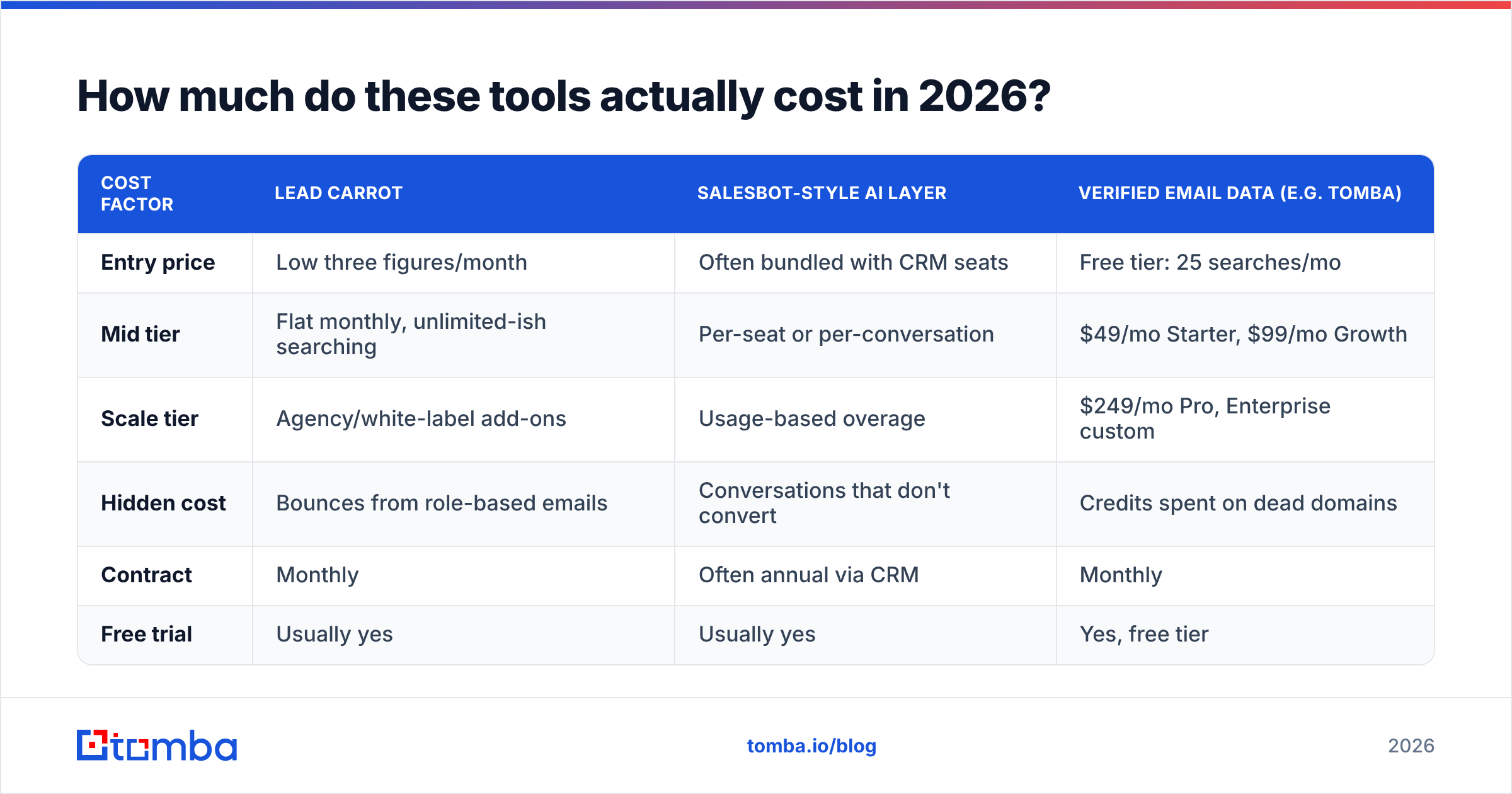
| Cost factor | Lead Carrot | Salesbot-style AI layer | Verified email data (e.g. Tomba) |
|---|---|---|---|
| Entry price | Low three figures/month | Often bundled with CRM seats | Free tier: 25 searches/mo |
| Mid tier | Flat monthly, unlimited-ish searching | Per-seat or per-conversation | $49/mo Starter, $99/mo Growth |
| Scale tier | Agency/white-label add-ons | Usage-based overage | $249/mo Pro, Enterprise custom |
| Hidden cost | Bounces from role-based emails | Conversations that don't convert | Credits spent on dead domains |
| Contract | Monthly | Often annual via CRM | Monthly |
| Free trial | Usually yes | Usually yes | Yes, free tier |
The hidden-cost row is the one people skip. A 5,000-record export at a 20% bounce rate does not cost you 1,000 wasted credits. It costs you a burned sending domain, which is a three-to-six-week recovery. You can see the full Tomba pricing breakdown for how the credit math works against that risk.

Is data quality the real differentiator here?#
Yes, and it's not close.
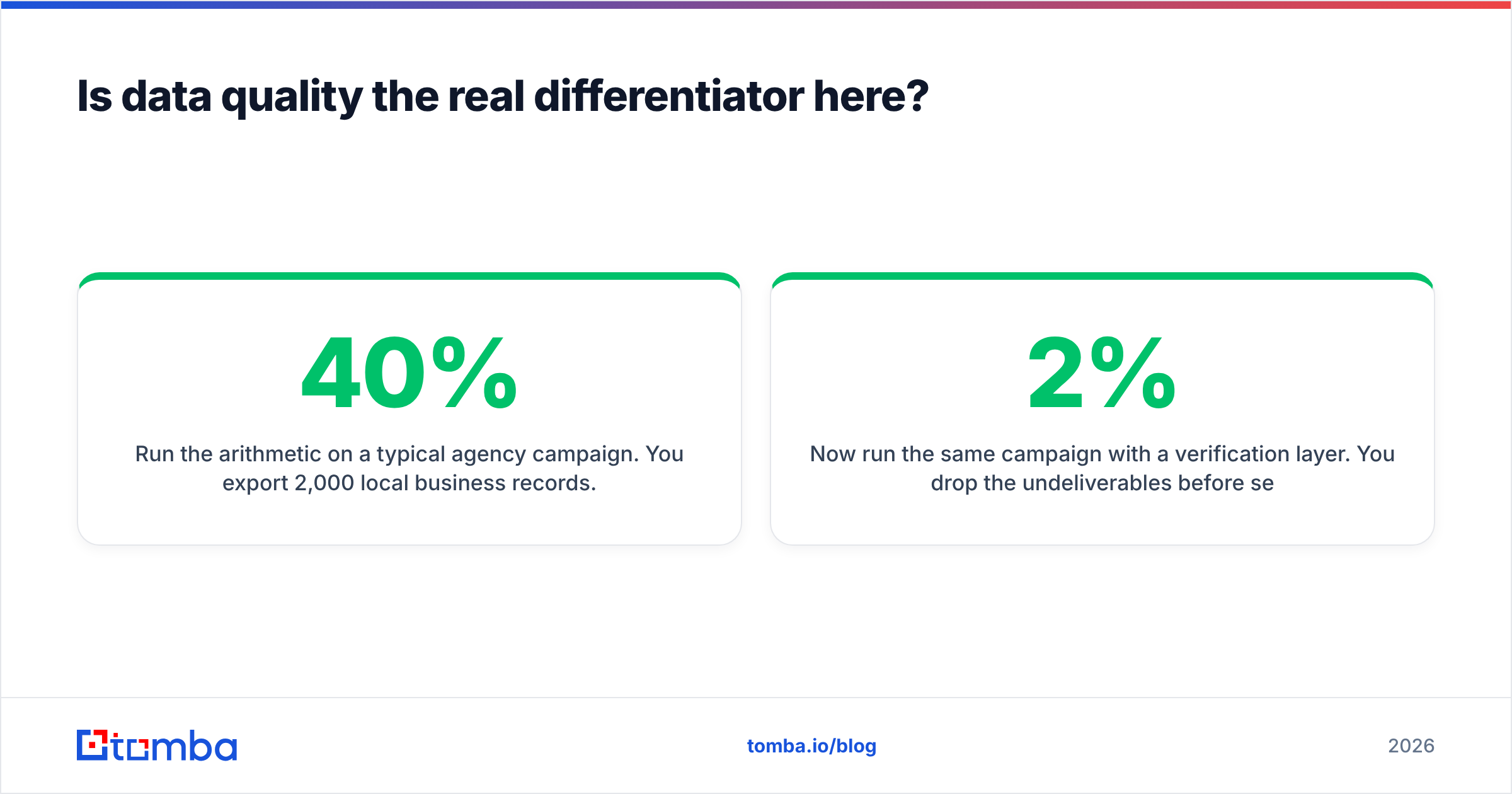
Run the arithmetic on a typical agency campaign. You export 2,000 local business records. Roughly 40% resolve to generic role inboxes. Of the remaining 1,200, maybe 15% are stale after 18 months of decay. You're sending to about 1,020 usable addresses, and the generic ones you did send to just pushed your bounce rate past the threshold where Google and Microsoft start throttling you.
Now run the same campaign with a verification layer. You drop the undeliverables before sending, resolve role addresses into named contacts where possible, and land at maybe 900 addresses with a sub-2% bounce rate. Fewer sends, more inbox placement, better sender reputation, and a channel you can still use next quarter.
That gap has nothing to do with whether your AI bot writes clever replies. Review aggregators like G2 are full of five-star sequencing tools deployed on top of two-star data, and the reviews reliably blame the sequencer.
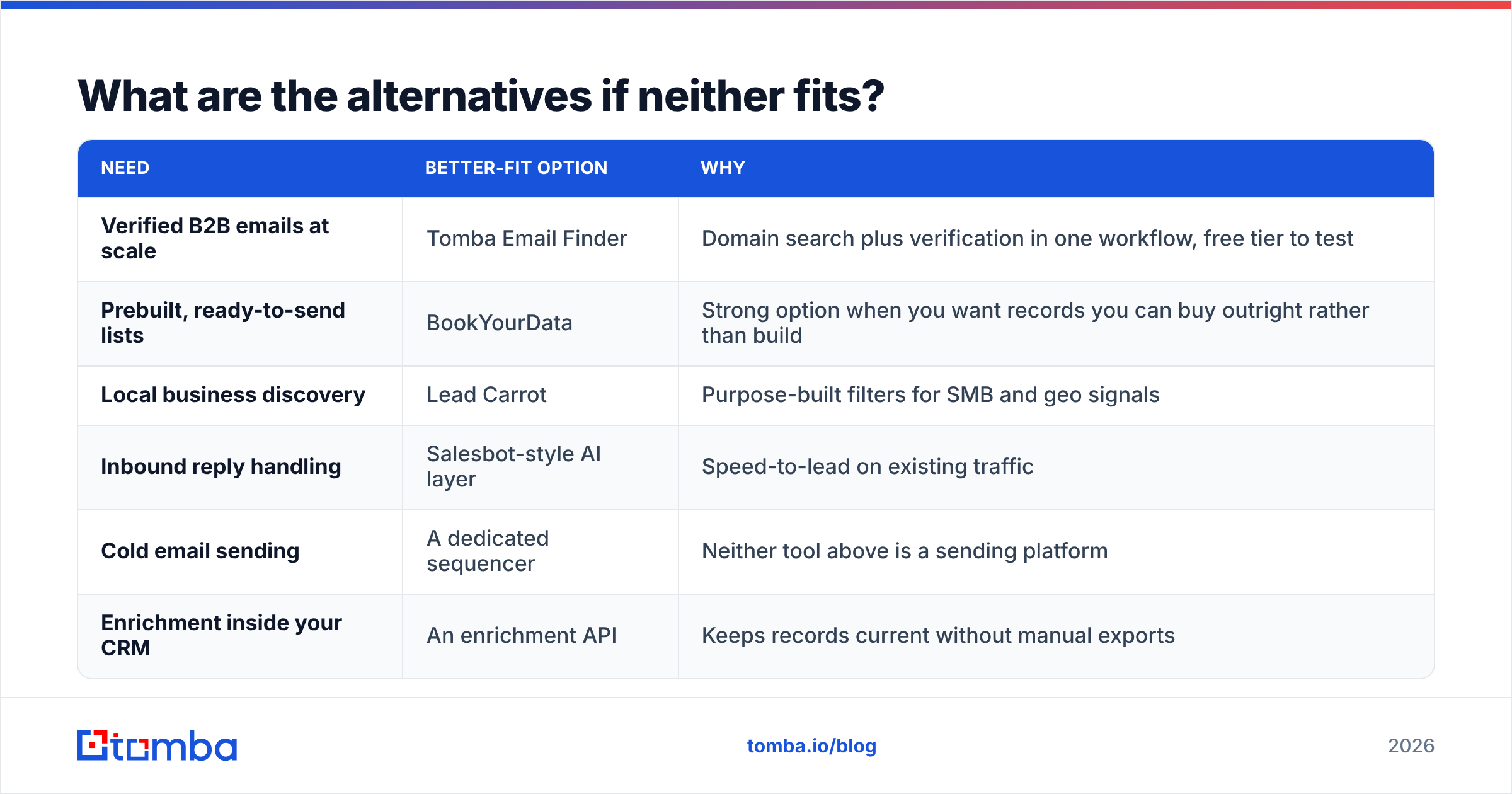
What are the alternatives if neither fits?#
| Need | Better-fit option | Why |
|---|---|---|
| Verified B2B emails at scale | Tomba Email Finder | Domain search plus verification in one workflow, free tier to test |
| Prebuilt, ready-to-send lists | BookYourData | Strong option when you want records you can buy outright rather than build |
| Local business discovery | Lead Carrot | Purpose-built filters for SMB and geo signals |
| Inbound reply handling | Salesbot-style AI layer | Speed-to-lead on existing traffic |
| Cold email sending | A dedicated sequencer | Neither tool above is a sending platform |
| Enrichment inside your CRM | An enrichment API | Keeps records current without manual exports |
BookYourData is worth a look if your preference is buying a finished list rather than assembling one. It solves a genuinely different problem from a search-and-filter database, and for teams without an ops person, prebuilt beats build-your-own more often than vendors admit.
For everyone else, the pattern that holds up is unglamorous: get a clean source of contacts, verify before sending, then automate the conversation once you have enough of them to justify it. Contact enrichment sits in the middle of that chain and quietly determines whether the rest of it works.
Frequently asked questions#
Can I use Lead Carrot and Salesbot together? Yes, and it's a reasonable stack for an agency with both inbound and outbound motions. Source with Lead Carrot, verify the exports, send with a sequencer, and let the AI layer handle replies and site chat. Just don't expect the chat layer to do anything with a cold list.
Does Lead Carrot verify emails? Not to the standard a cold email program needs. Treat every export as unverified until you've run it through a dedicated verification pass, especially given how many local business records resolve to role-based inboxes.
Is an AI sales bot worth it for a small team? Only above a traffic threshold. Under a few hundred qualified visitors or inbound replies a month, the same money spent on better contact data will produce more pipeline.
Which is better for enterprise prospecting? Neither. Local-business databases thin out above the SMB line, and chat layers only work on traffic you already have. You want an ICP-filtered database with named-contact resolution.
Where to start#
If the honest diagnosis is that your list is the weak link, fix that before you spend anything on automation. Run your target domains through Tomba Email Finder to resolve named contacts with confidence scores and verification built into the same flow. The free tier gives you 25 searches a month to test against your own accounts, and Starter is $49/month if the hit rate holds up. Verify first, automate second, and both Lead Carrot and Salesbot become tools you're choosing between rather than hoping for.
Related guides#
// get started
Find, verify and enrich your first contacts today
Start on the free plan with 25 searches a month, then scale when your team is ready.
Free plan · No credit card required · GDPR & CCPA
Get the Tomba newsletter
Product and data updates
// about the author