Lead Carrot vs Warpleads (2026): Which Lead Tool Wins?
Lead Carrot scrapes local business leads. Warpleads exports B2B lists in bulk. They solve different problems badly if you pick wrong — here's the honest breakdown of pricing, data quality, and who each one actually fits.
TL;DR
- These two tools are not really competitors. Lead Carrot is built for agencies selling to local businesses (dentists, roofers, gyms). Warpleads is built for high-volume B2B outbound teams who want large exported lists.
- Pick Lead Carrot if your ICP has a physical address and a Google Business Profile, and you sell websites, ads, or reputation services to them.
- Pick Warpleads if you run cold email at scale, need tens of thousands of B2B contacts per month, and already have a sending infrastructure that can absorb the volume.
- Neither is a verification layer. Both hand you raw contacts. If you send to an unverified export, your bounce rate — not the vendor's — is what gets your domain flagged.
- Most teams end up using a list source plus a finder/verifier stack. That combination almost always beats betting the whole pipeline on one database.
What are Lead Carrot and Warpleads?#
Lead Carrot is a local lead-generation tool. You search by business category and geography, and it returns business listings enriched with a website, phone number, an audit-style signal set (does the site have a Facebook pixel, is it mobile-friendly, does it rank locally), and sometimes a contact email. The core buyer is a digital marketing agency or freelancer who needs a reason to call a plumbing company in a specific ZIP code.
Warpleads sits at the other end of the funnel. It is an export-first B2B lead database, positioned around volume: filter by industry, title, company size, geography, then pull large lists out as CSV or push them into your sequencer. The core buyer is an outbound agency or SDR team burning through thousands of contacts a month and optimizing for cost-per-lead rather than per-lead research depth.
That distinction matters more than any feature table. Comparing them is like comparing a metal detector to a dump truck. One finds specific things in a specific place. The other moves a lot of material fast. Buying the wrong one is not a mild inefficiency — it means your prospecting motion has the wrong shape of data underneath it.
One honest caveat before the details: both vendors change packaging often, and neither publishes a fully transparent, audited accuracy figure. Treat every number below as directional, and confirm current terms on the vendor's own pricing page before you buy.
How do Lead Carrot and Warpleads compare head-to-head?#
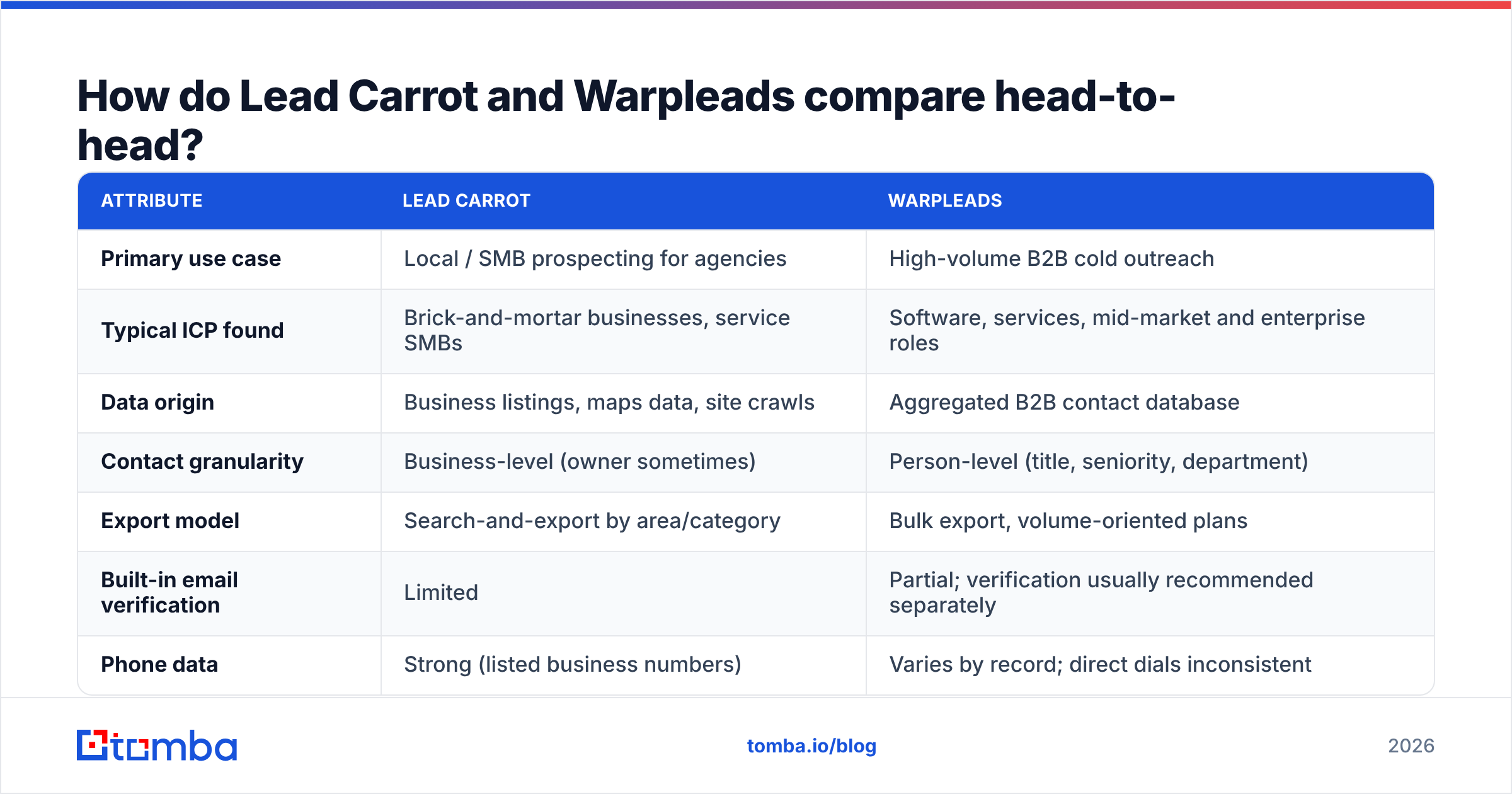
| Attribute | Lead Carrot | Warpleads |
|---|---|---|
| Primary use case | Local / SMB prospecting for agencies | High-volume B2B cold outreach |
| Typical ICP found | Brick-and-mortar businesses, service SMBs | Software, services, mid-market and enterprise roles |
| Data origin | Business listings, maps data, site crawls | Aggregated B2B contact database |
| Contact granularity | Business-level (owner sometimes) | Person-level (title, seniority, department) |
| Export model | Search-and-export by area/category | Bulk export, volume-oriented plans |
| Built-in email verification | Limited | Partial; verification usually recommended separately |
| Phone data | Strong (listed business numbers) | Varies by record; direct dials inconsistent |
| Enrichment signals | Website tech, review count, local SEO gaps | Firmographics, headcount, industry |
| Learning curve | Low — search, filter, export | Low, but filter discipline matters at volume |
| Approx. entry price | Around $97/mo (verify current) | Roughly $199/mo tier for high-volume export (verify current) |
The table hides one asymmetry worth naming. Lead Carrot's data is observable — a business either has a Google listing, a website, and a phone number, or it does not. You can spot-check it in thirty seconds. Warpleads' data is asserted — a claim that a named person holds a named title at a named company, which decays roughly 2 to 3% per month as people change jobs. Verifying it is a separate job that you, not the vendor, will end up doing.

How accurate is the data from each tool?#
Accuracy means two different things here, and conflating them causes most of the disappointment in reviews on sites like G2.
For Lead Carrot, accuracy means "does this business still exist and is this the right phone number." Listing data is refreshed frequently by the underlying sources, so the hit rate on the business itself is usually high. The weak point is the email. Small local businesses often use a generic info@ address, a Gmail account, or a contact form only. If your outreach plan depends on reaching the owner personally, expect to do extra work per record.
For Warpleads, accuracy means "is this person still in this role, and will this mailbox accept mail." Large aggregated databases carry real amounts of stale data, and the vendor's own claims about validation are not the same thing as an independent verification pass on your specific slice of the list. Export 10,000 contacts, send without checking, and you can watch a healthy domain deteriorate in a week.
The practical rule: never trust a list's self-reported validity. Run an independent email verifier over any export before the first send, and treat anything that comes back risky or catch-all as a separate, slower track. A catch-all verifier matters here because catch-all domains — extremely common in mid-market B2B — accept everything at the SMTP layer and tell you nothing useful.
What should you actually check before buying either one?#
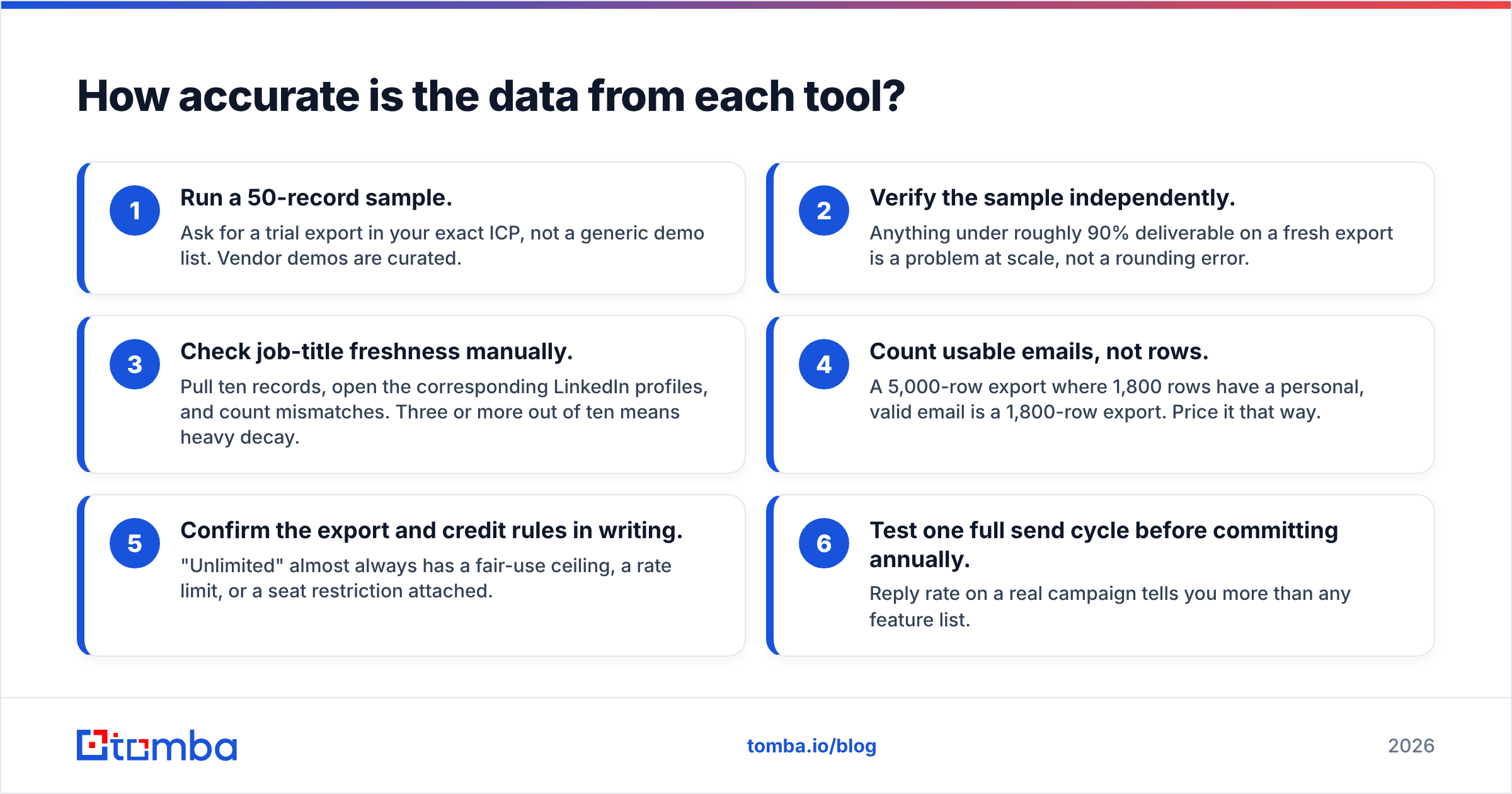
- Run a 50-record sample. Ask for a trial export in your exact ICP, not a generic demo list. Vendor demos are curated.
- Verify the sample independently. Anything under roughly 90% deliverable on a fresh export is a problem at scale, not a rounding error.
- Check job-title freshness manually. Pull ten records, open the corresponding LinkedIn profiles, and count mismatches. Three or more out of ten means heavy decay.
- Count usable emails, not rows. A 5,000-row export where 1,800 rows have a personal, valid email is a 1,800-row export. Price it that way.
- Confirm the export and credit rules in writing. "Unlimited" almost always has a fair-use ceiling, a rate limit, or a seat restriction attached.
- Test one full send cycle before committing annually. Reply rate on a real campaign tells you more than any feature list.
Which tool fits local and SMB prospecting?#
Lead Carrot, clearly — and it is not close.
If you sell web design, paid ads, SEO, or reputation management to local businesses, Lead Carrot's structure maps directly onto your sales motion. You search "HVAC contractors, Phoenix," get back a list with website status and review counts, and you have an opening line before you dial: "I noticed you have 412 reviews but your site loads in nine seconds on mobile." That is a pitch, not a list.
Warpleads is a poor fit for this. General B2B databases underrepresent small local businesses, because those businesses generate few of the digital signals that feed aggregated contact data. You can filter for "company size 1-10" all you want; the dentist who runs a two-chair practice is not in most B2B contact databases with a verified personal email.
Where Lead Carrot runs out of road is scale and role targeting. You cannot ask it for "VP of Engineering at Series B SaaS companies in Berlin." It does not think in those terms. If your ICP is defined by role rather than by location, you have picked the wrong tool.
Which tool fits high-volume B2B outbound?#
Warpleads, with a large asterisk on deliverability.
Volume-first plans make sense when your outbound model is genuinely a numbers game: broad ICP, short sequences, low per-lead research, high send volume. Here, cost per exported contact dominates the economics, and Warpleads is built for that math.
The asterisk is that volume amplifies everything, including mistakes. A 3% bounce rate on 500 sends is 15 bounces. On 40,000 sends it is 1,200 hard bounces, which is enough to damage sender reputation badly. Teams that succeed with bulk exports run an aggressive filtering stage between export and send: verification, deduplication, suppression of prior contacts, and removal of role accounts. Teams that fail skip that stage because the export felt like the finish line.
If you want the honest version: the bottleneck in high-volume outbound in 2026 is almost never lead supply. It is inbox placement and message relevance. Buying a bigger list does not fix either. HubSpot's sales research has been making roughly this point for years, and nothing about the current inbox-filtering environment argues against it.

What do they actually cost once you include the hidden work?#
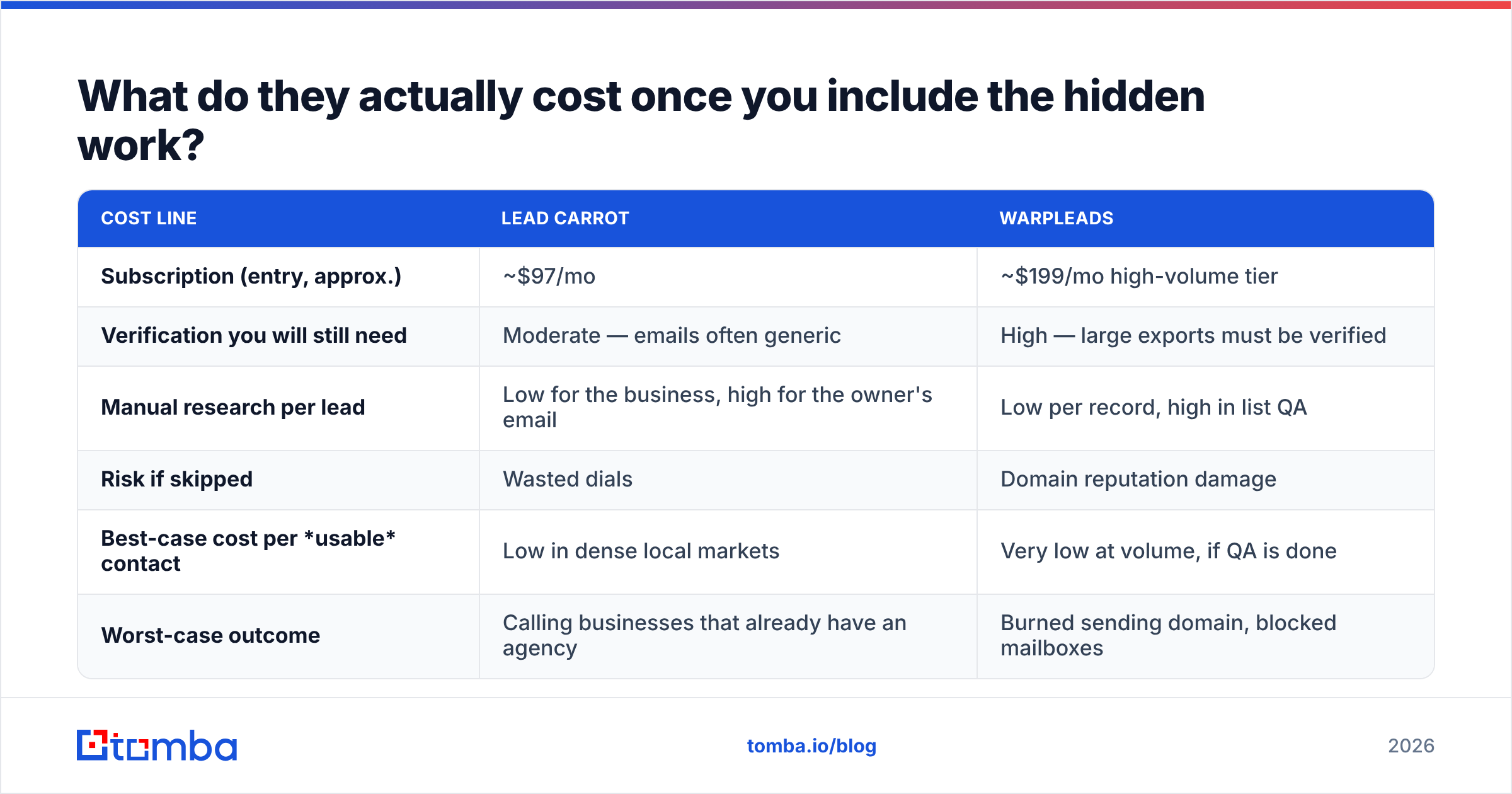
| Cost line | Lead Carrot | Warpleads |
|---|---|---|
| Subscription (entry, approx.) | ~$97/mo | ~$199/mo high-volume tier |
| Verification you will still need | Moderate — emails often generic | High — large exports must be verified |
| Manual research per lead | Low for the business, high for the owner's email | Low per record, high in list QA |
| Risk if skipped | Wasted dials | Domain reputation damage |
| Best-case cost per usable contact | Low in dense local markets | Very low at volume, if QA is done |
| Worst-case outcome | Calling businesses that already have an agency | Burned sending domain, blocked mailboxes |
Neither vendor is overpriced for what it does. The real cost is in the column labeled "verification you will still need," and that cost is invisible until your first campaign report comes back.
Is a third option better than either one?#
Often, yes — because the list and the contact data are separable problems, and you are allowed to solve them separately.
A common stack that outperforms "one database to rule them all" looks like this: use a source that is genuinely good at finding the companies you want (Lead Carrot for local, Warpleads for volume, or a compliant purchased list), then run a dedicated finder and verifier layer to get the actual person-level contact right. Domain search turns a list of company websites into named contacts with roles. A bulk email finder does that across thousands of rows at once. Data enrichment fills in the firmographic gaps your source left behind.
It is also worth naming a respected peer in this space: BookYourData takes a different approach again, selling verified B2B contacts on a pay-as-you-go basis with an accuracy guarantee attached. If you dislike subscriptions and want to buy exactly the slice you need with a quality commitment behind it, that model is a legitimately strong option and sits comfortably alongside a finder/verifier layer.
The point is not that any one vendor wins every scenario. It is that the "single source" assumption is what causes teams to overpay for a database whose strengths do not match their ICP. For a broader primer on how contact data gets assembled in the first place, Wikipedia's overview of web scraping is a useful, vendor-neutral starting point.
How should you decide between Lead Carrot and Warpleads?#
Answer three questions in order.
1. Is your ICP defined by geography or by role? Geography and business category point to Lead Carrot. Job title, seniority, and company stage point to Warpleads.
2. Is your constraint list volume or list quality? If you are running out of leads, volume tools help. If you have plenty of leads but low reply rates, more leads will make things worse, not better.
3. Who owns deliverability on your team? If nobody does, do not buy a bulk export plan yet. Fix verification and sending hygiene first, then scale the top of funnel.
If you answered "geography," "volume," and "we have someone watching bounce rates," Lead Carrot is your tool. If you answered "role," "volume," and the same deliverability answer, Warpleads is. If you answered "quality" to question two, the honest recommendation is that neither subscription is your next purchase — a verification and enrichment layer is.
You can also run a pragmatic hybrid: keep whichever list source matches your ICP, drop the second subscription, and spend that budget on making every contact you already have correct. That is usually cheaper than it sounds, and the reply-rate lift shows up within one campaign cycle.
Where does Tomba fit in this comparison?#
Tomba is not a replacement for a local-business scraper or a bulk B2B list. It is the layer that makes either one send-worthy.
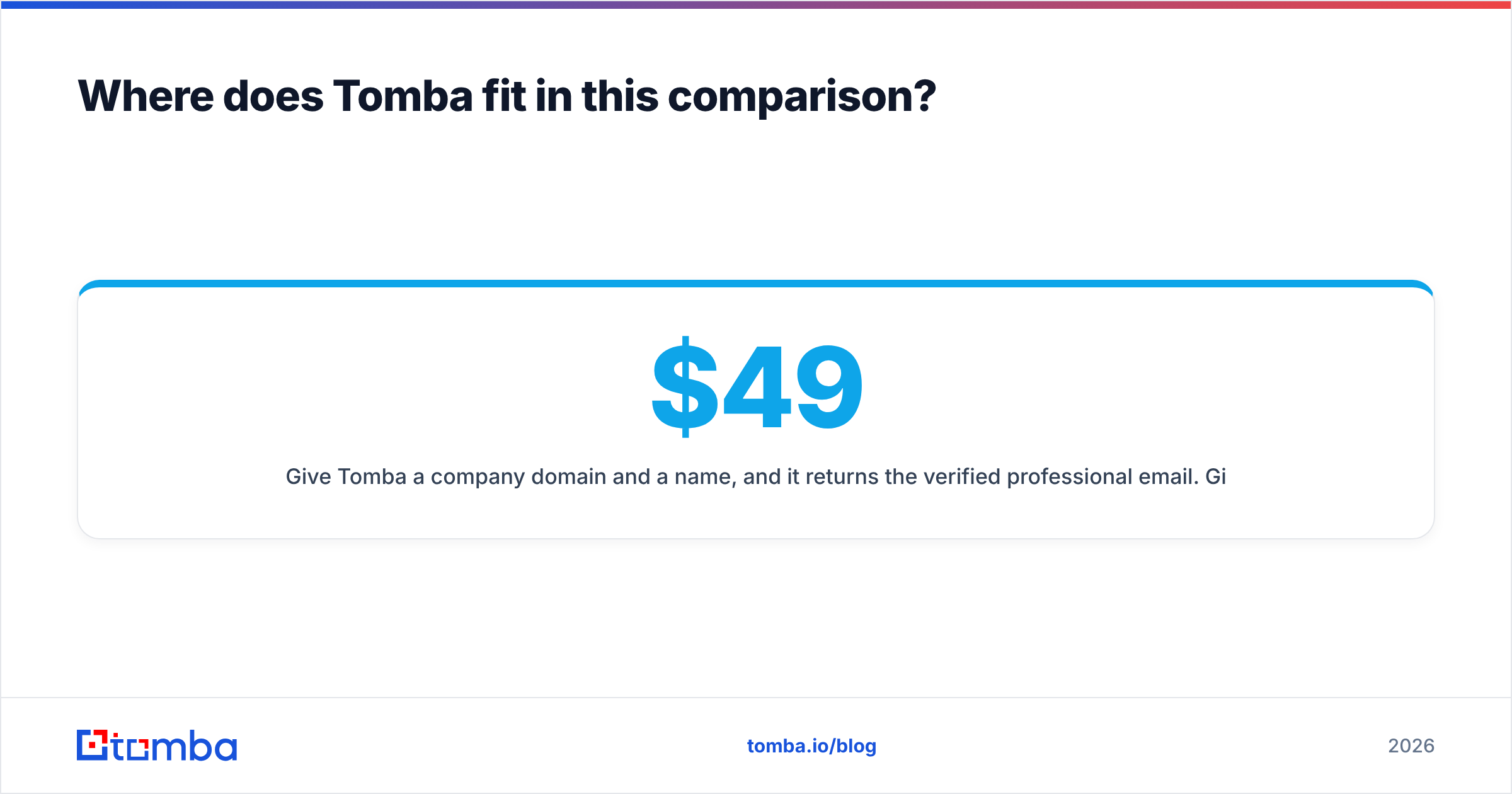
Give Tomba a company domain and a name, and it returns the verified professional email. Give it a domain alone, and it returns the contacts and the email pattern behind them. Feed it a Warpleads export and it will verify, correct, and enrich the rows before they ever reach your sequencer. Feed it a Lead Carrot list of local businesses and it will find the owner's actual address instead of the info@ catch-all sitting on the contact page. Pricing runs from a free tier at 25 searches per month through Starter at $49/mo, Growth at $99/mo, and Pro at $249/mo — see Tomba pricing for the current breakdown.
If your last export bounced harder than expected, start with the Tomba Email Finder. Run your existing list through it before you buy another database subscription. The odds are good that the leads you already paid for are the ones worth fixing first.
Related guides#
// get started
Find, verify and enrich your first contacts today
Start on the free plan with 25 searches a month, then scale when your team is ready.
Free plan · No credit card required · GDPR & CCPA
// about the author