Lead Database Free Trial: What You Actually Get in 2026
Most lead database free trials are credit-starved demos designed to hide bad data. Here's how to stress-test one in 30 minutes and spot the traps before your card is charged.
TL;DR
- A lead database free trial is a sampling window, not a shopping trip. Your goal is to measure data accuracy on accounts you already know — not to hoard credits.
- Watch for three traps: card-required signup, credits that only cover search (not verification), and export locks that stop you from checking the data outside the vendor's own UI.
- Test 50 contacts you can independently confirm. If a vendor's trial won't let you export or verify 50 rows, that's a signal about the data, not about the trial.
- Free tiers beat free trials for ongoing evaluation. Tomba's free tier gives 25 searches/month with no expiry; Apollo, Lusha, and others run 7–14 day clocks.
- Budget 30 minutes: 10 for the known-accounts test, 10 for a catch-all domain, 10 for export and CRM field-mapping.
Every B2B data vendor offers a lead database free trial. Almost none of them design that trial to help you evaluate data quality. They design it to get you attached to a workflow before the bill lands.
This guide flips that. Below is a repeatable 30-minute protocol for stress-testing any lead database trial, a comparison of what the major vendors actually hand you, and the specific red flags that predict a bad annual contract.
What is a lead database free trial, actually?#
A lead database free trial is a time-limited or credit-limited window in which you can query a vendor's contact database — searching for business emails, phone numbers, job titles, and firmographics — before paying.
The important distinction most buyers miss:
- Free trial — time-boxed (usually 7 or 14 days), often generous on credits, expires whether you use it or not. Frequently requires a credit card.
- Free tier — permanent, credit-boxed (e.g. 25 searches per month), renews monthly, rarely requires a card. Better for slow evaluation.
- Freemium-with-upsell — technically free, but the useful fields (direct dial, verified email status) are masked until you upgrade.
- Demo-gated trial — you cannot self-serve; a rep must "unlock" your account, which means the trial is really a sales call with extra steps.
- Credit-sandbox — you get credits but not exports, so the data stays inside their UI where you can't validate it against your CRM.
Types 3, 4, and 5 are where buyers get burned. If a vendor's trial fits one of those shapes, you are not evaluating data — you are watching a guided tour.

Why do most free trials hide data quality?#
Because accuracy is the only metric that matters and the only one that's expensive to fake.
A database of 275 million contacts sounds impressive until you learn that a meaningful share of those records were scraped years ago, never re-verified, and belong to people who changed jobs twice since. Gartner has long estimated that poor data quality costs organizations millions annually — and B2B contact data decays faster than almost any other category, roughly 2–3% per month as people switch roles.
So the trial is engineered around that weakness:
- Credits cover search, not verification. You find 100 emails. You have no idea which ones bounce. The verification API is a paid add-on.
- Export is locked or watermarked. You can't run the list through a third-party checker, so the vendor's own "95% accurate" badge is the only evidence you get.
- The trial pool is cherry-picked. Some platforms route trial queries toward their densest, freshest segments — usually US mid-market SaaS — where coverage genuinely is strong. Query a German manufacturer or a 30-person agency in Brazil and the picture changes.
- Catch-all domains get a free pass. A catch-all server accepts every address, so any tool can claim it "found" an email. Whether a human reads it is a different question. Run a catch-all verifier against those results before you believe them.
None of this is fraud. It's just marketing meeting a fragile product. Your job is to design a test the marketing can't survive.
How do you test a lead database in 30 minutes?#
Use accounts where you already know the answer. This is the single highest-leverage move in data evaluation, and almost nobody does it.
The known-accounts protocol:
- Build a 50-row truth set (10 min). Pull 50 contacts you can independently confirm — past customers, current customers, people in your own LinkedIn network, colleagues at former employers. You know their real email format and current employer.
- Query the trial blind (10 min). Feed name + company domain into the tool. Do not look at your truth set while you do it. Record what comes back, including confidence scores and "not found" results.
- Score three numbers, not one. Coverage (how many returned anything), precision (how many were correct), and false-confidence rate (how many wrong answers were marked high-confidence). That third number is the one that costs you domain reputation.
- Run one catch-all domain and one tiny company. A 20-employee firm on a Google Workspace catch-all is the stress case. Every vendor nails microsoft.com.
- Export and map to your CRM (10 min). If export is locked, the evaluation ends here — note it and move on.
- Re-verify externally. Take the exported emails and run them through a separate email verifier or free email checker. A vendor whose own results fail an independent check has told you everything.
A vendor that scores 70% coverage with 95% precision is far more useful than one that scores 95% coverage with 70% precision. The first wastes your time. The second wastes your sending domain.

Which lead database free trials are worth your time in 2026?#
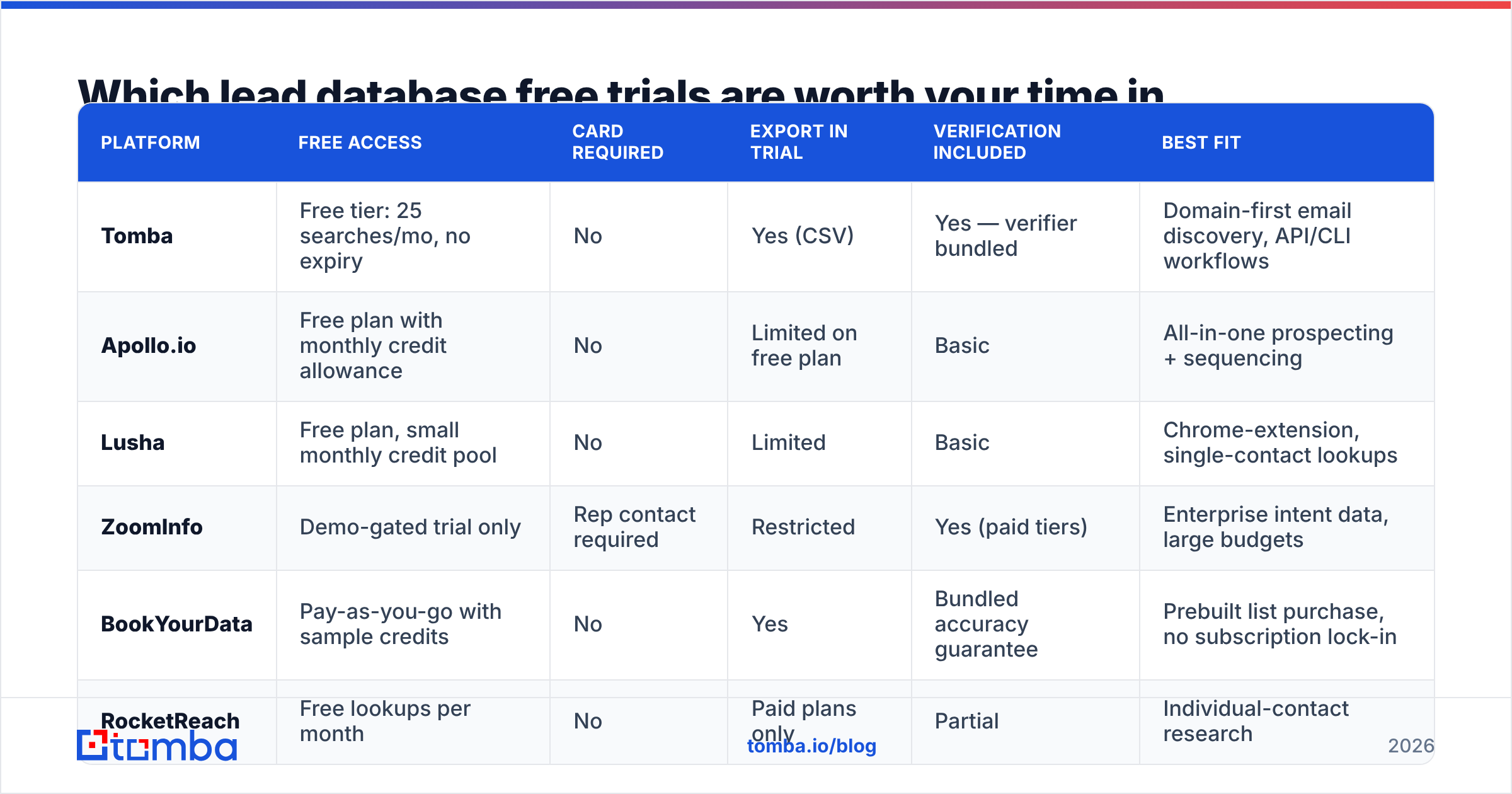
Here's what the major platforms actually give you at signup. Terms shift — always confirm on the vendor's own pricing page before committing.
| Platform | Free access | Card required | Export in trial | Verification included | Best fit |
|---|---|---|---|---|---|
| Tomba | Free tier: 25 searches/mo, no expiry | No | Yes (CSV) | Yes — verifier bundled | Domain-first email discovery, API/CLI workflows |
| Apollo.io | Free plan with monthly credit allowance | No | Limited on free plan | Basic | All-in-one prospecting + sequencing |
| Lusha | Free plan, small monthly credit pool | No | Limited | Basic | Chrome-extension, single-contact lookups |
| ZoomInfo | Demo-gated trial only | Rep contact required | Restricted | Yes (paid tiers) | Enterprise intent data, large budgets |
| BookYourData | Pay-as-you-go with sample credits | No | Yes | Bundled accuracy guarantee | Prebuilt list purchase, no subscription lock-in |
| RocketReach | Free lookups per month | No | Paid plans only | Partial | Individual-contact research |
Two observations from the table.
First: the demo gate is a filter, not a feature. ZoomInfo's approach works for enterprise buyers with procurement cycles and six-figure budgets. If you're a five-person sales team, a trial that requires two calls with an AE before you see a single record is a bad use of your week.
Second: pay-as-you-go beats trials for one-off list needs. BookYourData's model — buy the credits you need, keep them, no monthly floor — sidesteps the trial question entirely for teams who need a list once a quarter rather than a pipeline of continuous enrichment. Different shape of problem, different shape of answer.
If you want to compare subscription economics directly, Tomba pricing runs a free tier at 25 searches/month, Starter at $49/mo, Growth at $99/mo, and Pro at $249/mo, with Enterprise quoted custom. The relevant number during evaluation isn't the headline price — it's cost per verified contact, which is the only unit your pipeline actually consumes.

What red flags should end a trial early?#
Some signals are decisive enough that you can stop testing and move on.
- A card required for a "free" trial with auto-conversion. Legitimate for enterprise tooling; predatory for self-serve. Check the cancellation path before you enter card details, not after.
- No "not found" state. If a tool always returns something, it is guessing patterns. Pattern-guessing is fine when labeled as such — Tomba's own email permutator does it openly. It is not fine when dressed up as a verified record.
- Confidence scores with no methodology page. "98% confidence" means nothing without a definition. Vendors that publish their data sources are making a checkable claim; vendors that publish a number are making a marketing one.
- Credits burned on failed searches. Read the fine print. If a not-found result still costs a credit, your effective price per contact is much higher than advertised.
- Export requires a sales call. See above. This is the credit-sandbox pattern.
- No API access during trial. If you plan to run enrichment programmatically, a UI-only trial tells you nothing about rate limits, latency, or error handling. Check whether the vendor's API is open at trial tier.
How should you compare trials on cost, not credits?#
Convert everything to cost per verified, deliverable contact. Credits are a vendor abstraction designed to make comparison hard.
The arithmetic:
- Start with plan price ÷ credits. That's your nominal cost per credit.
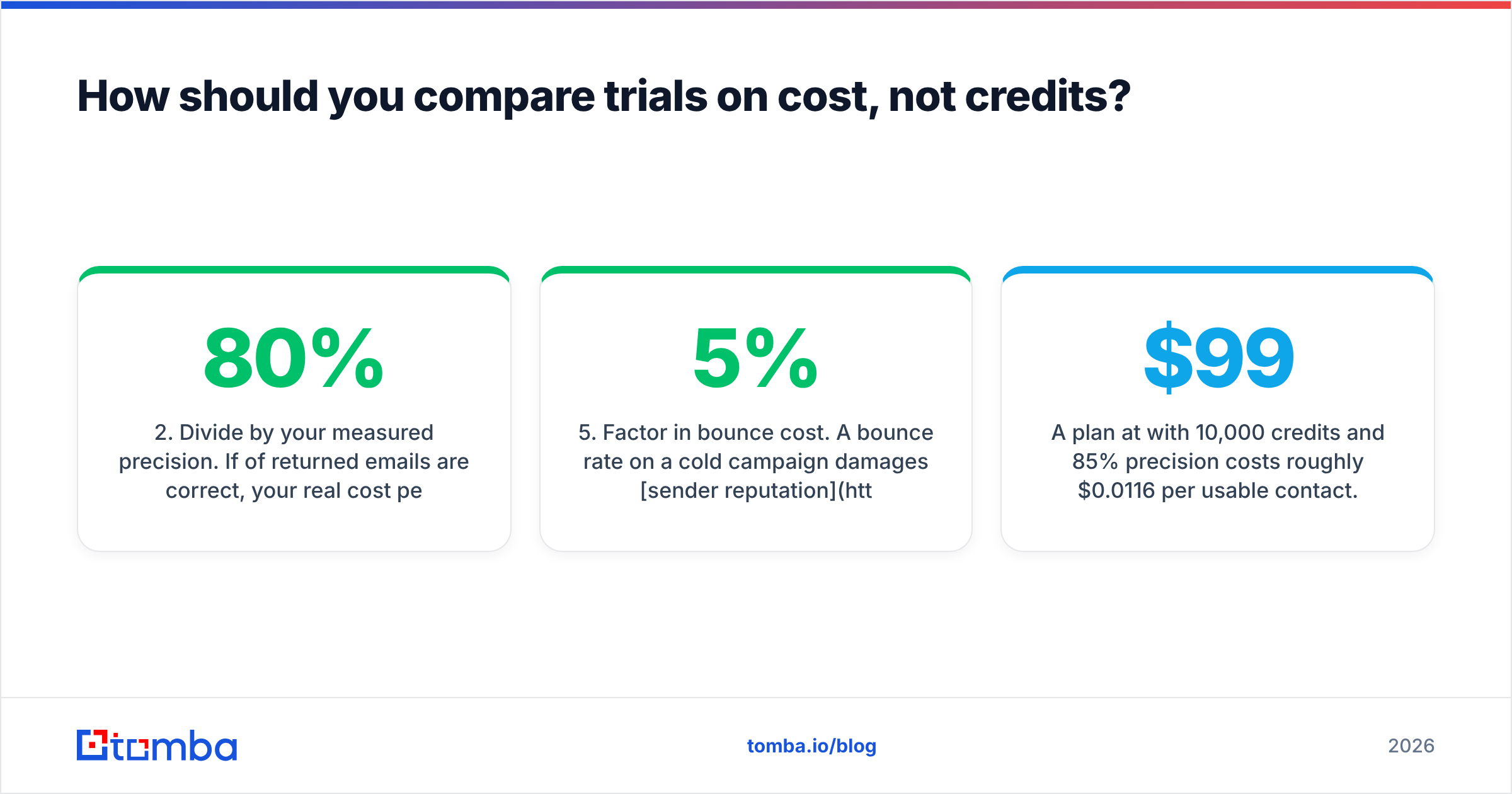
- Divide by your measured precision. If 80% of returned emails are correct, your real cost per usable contact is 1.25× the nominal.
- Add verification cost if it isn't bundled. Some platforms charge separately for the verify step, which can double the effective figure.
- Subtract nothing for "unlimited" claims. Unlimited plans almost always carry fair-use ceilings buried in the terms.
- Factor in bounce cost. A 5% bounce rate on a cold campaign damages sender reputation in ways that cost far more than the credits. Deliverability damage compounds; credit overspend doesn't.
A plan at $99/month with 10,000 credits and 85% precision costs roughly $0.0116 per usable contact. A plan at $49/month with 2,000 credits and 95% precision costs $0.0258. The cheaper-looking plan is more than twice the price per usable record — but the second plan may still win if your volume is low and bounce risk is high. Run the numbers on your actual monthly volume, not on the vendor's example.
For ongoing programs, also check whether bulk processing is available at your tier. Single-lookup pricing and bulk pricing often diverge sharply, and the trial rarely exposes the difference.
What about GDPR and data sourcing during a trial?#
Ask the sourcing question before the accuracy question if you sell into the EU or UK.
A lead database free trial gives you a short window to interrogate compliance posture, and most buyers skip it entirely. The questions worth asking:
- Where does the data originate? Public web crawling, user contribution (contact-sharing from browser extensions), partner licensing, and purchased lists carry very different legal profiles.
- Is there a documented legitimate-interest assessment? Under GDPR, B2B outreach typically relies on legitimate interest rather than consent — but the vendor should be able to point to their own documented position, not hand-wave it.
- How fast is a suppression request honored? Ask for the SLA in writing. "Promptly" is not an SLA.
- Can you get a data-processing agreement at trial tier? Some vendors only issue a DPA at enterprise contracts, which may block your legal review before you can even pilot.
- Is the data re-verified or just re-scraped? Re-scraping a stale record and re-timestamping it is not verification.
Vendor review platforms like G2 are useful for surfacing compliance complaints that never appear in marketing material — search reviews for "GDPR," "opt-out," and "suppression" specifically rather than reading the aggregate score.
What does a good trial outcome look like?#
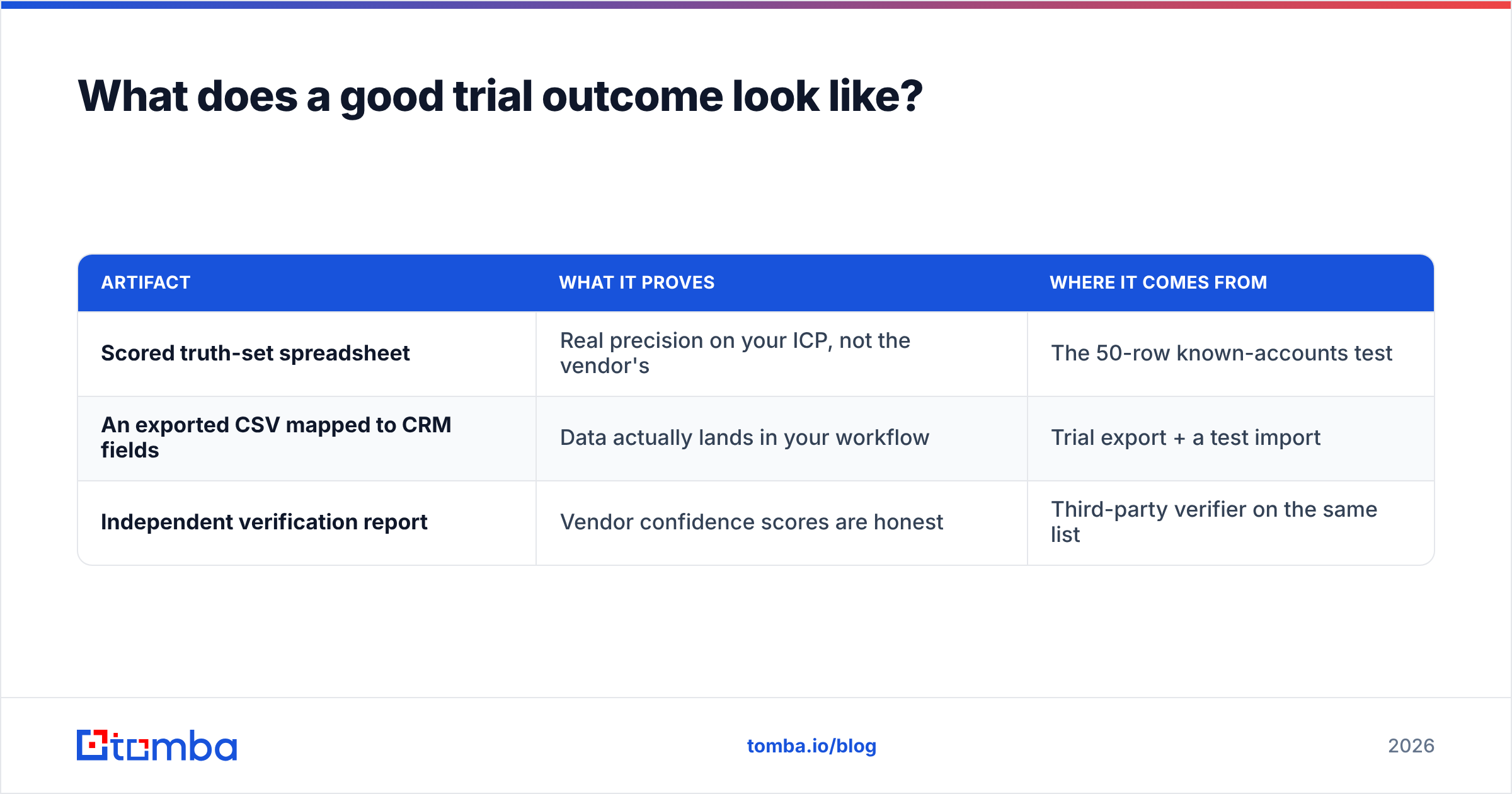
You should exit a trial with three artifacts, not a feeling.
| Artifact | What it proves | Where it comes from |
|---|---|---|
| Scored truth-set spreadsheet | Real precision on your ICP, not the vendor's | The 50-row known-accounts test |
| An exported CSV mapped to CRM fields | Data actually lands in your workflow | Trial export + a test import |
| Independent verification report | Vendor confidence scores are honest | Third-party verifier on the same list |
If you have all three and the numbers hold, buy. If you have a positive impression and no artifacts, you had a demo, not a trial.
One practical note: run your trial against the segment you'll actually prospect, not the one that's easiest to test. If you sell to European manufacturing, testing on US SaaS companies produces a number that flatters every vendor equally and tells you nothing about which one to pick. Coverage varies enormously by geography and company size, and the vendor with the best US mid-market data is frequently not the vendor with the best DACH SMB data.
Start your evaluation with a free tier, not a countdown clock#
A 14-day clock forces you to evaluate fast, which is exactly when you evaluate badly. A permanent free tier lets you test the same tool across three different campaigns, three different ICP segments, and three different weeks — which is how you actually find out whether the data holds up.
Tomba's Email Finder gives you 25 searches per month on the free tier with no card, no countdown, and no export lock, with verification bundled rather than sold separately. Run your 50-row truth set against it, export the results, check them independently, and compare the precision number to whatever else you're testing. If the numbers don't hold up, you'll know in 30 minutes — and that's the only outcome a trial should be judged on.
Related guides#
// get started
Find, verify and enrich your first contacts today
Start on the free plan with 25 searches a month, then scale when your team is ready.
Free plan · No credit card required · GDPR & CCPA
Get the Tomba newsletter
Product and data updates
// about the author