Lead411 vs No2bounce: Which B2B Email Tool Wins in 2026?
Lead411 builds your prospect list. No2bounce cleans it. They solve different halves of the same problem — and most teams buy the wrong one first. Here is the honest breakdown of cost, accuracy, and overlap.
TL;DR
- These tools are not substitutes. Lead411 is a B2B contact database with intent data. No2bounce is an email verification and list-hygiene service. One fills your list; the other protects it.
- Lead411 costs more per seat (published plans start around $99/user/month, billed annually) but bundles company data, triggers, and unlimited-style export allowances. No2bounce sells cheap credit packs that only clean addresses you already have.
- Buying both means paying twice for overlapping steps — Lead411 already runs its own validation before export, and you still pay No2bounce to re-check the same records.
- Accuracy claims from both vendors hover in the 95–98% range. Treat those numbers as marketing until you run your own 500-row sample test. Real-world deliverability is what matters.
- If your workflow is "find a contact, confirm it's live, send," a single platform that does discovery and verification in one API call — like Tomba's email finder — removes an entire vendor from the stack.
What is Lead411 and what is No2bounce?#
The fastest way to understand this matchup: Lead411 is a grocery store, No2bounce is a food-safety inspector. You need groceries to cook. You need the inspector to make sure nothing on the shelf is spoiled. Buying one does not give you the other.
Here's what each actually does:
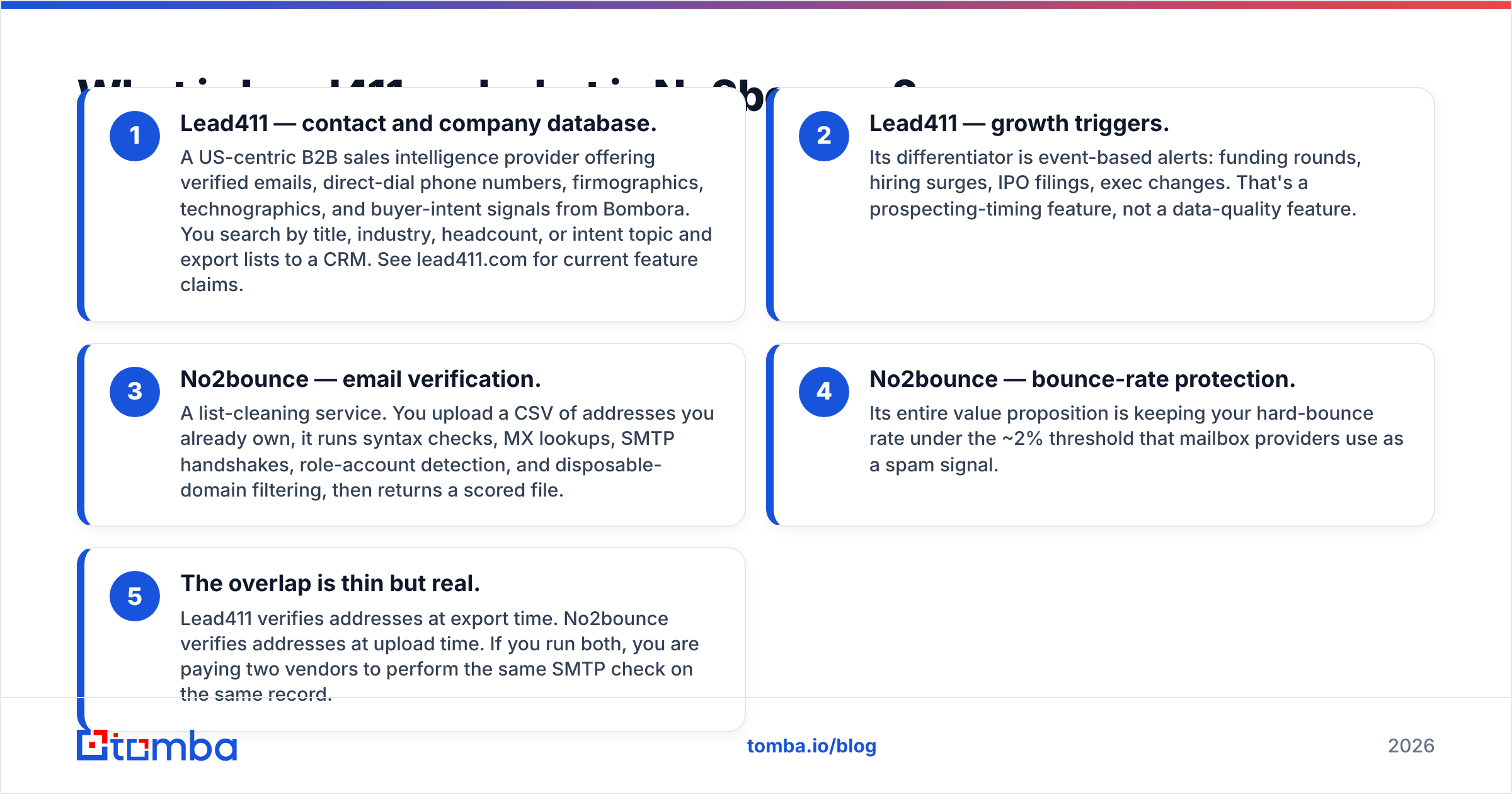
- Lead411 — contact and company database. A US-centric B2B sales intelligence provider offering verified emails, direct-dial phone numbers, firmographics, technographics, and buyer-intent signals from Bombora. You search by title, industry, headcount, or intent topic and export lists to a CRM. See lead411.com for current feature claims.
- Lead411 — growth triggers. Its differentiator is event-based alerts: funding rounds, hiring surges, IPO filings, exec changes. That's a prospecting-timing feature, not a data-quality feature.
- No2bounce — email verification. A list-cleaning service. You upload a CSV of addresses you already own, it runs syntax checks, MX lookups, SMTP handshakes, role-account detection, and disposable-domain filtering, then returns a scored file.
- No2bounce — bounce-rate protection. Its entire value proposition is keeping your hard-bounce rate under the ~2% threshold that mailbox providers use as a spam signal.
- The overlap is thin but real. Lead411 verifies addresses at export time. No2bounce verifies addresses at upload time. If you run both, you are paying two vendors to perform the same SMTP check on the same record.
That overlap is the crux of the entire Lead411 vs No2bounce decision. You are rarely choosing between them on features — you are deciding whether your stack needs two line items at all.
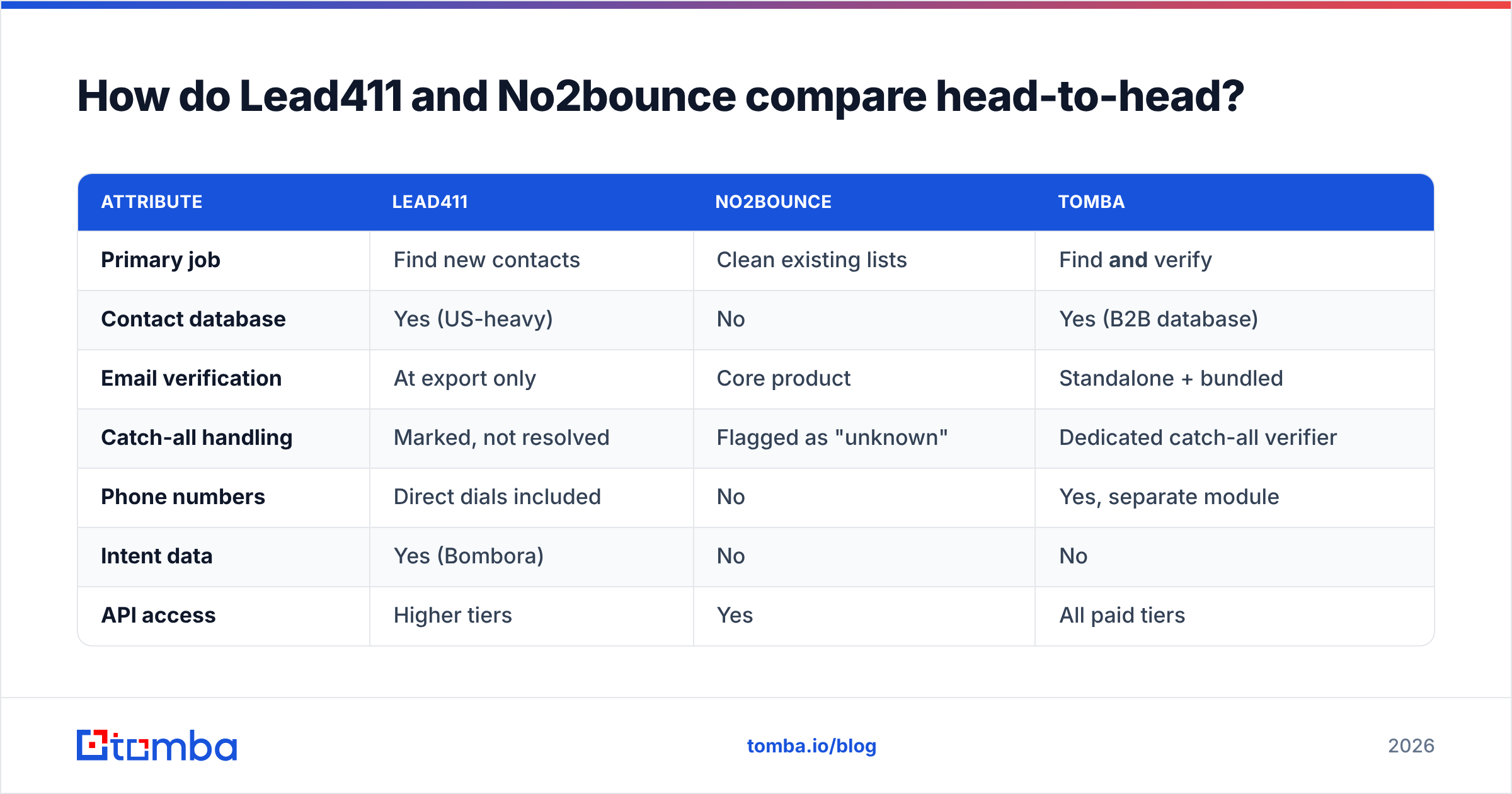
How do Lead411 and No2bounce compare head-to-head?#
| Attribute | Lead411 | No2bounce | Tomba |
|---|---|---|---|
| Primary job | Find new contacts | Clean existing lists | Find and verify |
| Contact database | Yes (US-heavy) | No | Yes (B2B database) |
| Email verification | At export only | Core product | Standalone + bundled |
| Catch-all handling | Marked, not resolved | Flagged as "unknown" | Dedicated catch-all verifier |
| Phone numbers | Direct dials included | No | Yes, separate module |
| Intent data | Yes (Bombora) | No | No |
| API access | Higher tiers | Yes | All paid tiers |
| Entry price | ~$99/user/mo (annual) | Credit packs, pay-as-you-go | Free tier, then $49/mo |
| Best for | Full-funnel US outbound | Cleaning purchased lists | Targeted discovery + hygiene |
Two honest observations from that table.
First, Lead411 and No2bounce barely compete. The only row where they truly collide is verification, and Lead411's version is a passive quality gate rather than a bulk-cleaning workflow. If you handed Lead411 a 40,000-row CSV from a trade-show scrape, it has no natural place to put it.
Second, price comparison is apples-to-oranges. Lead411 charges per seat for access to an asset (the database). No2bounce charges per record for a computation (the check). A $99/month Lead411 seat and a $99 No2bounce credit pack buy fundamentally different things, and a spreadsheet that puts them side by side will mislead you.
Which one has better data accuracy?#
Neither vendor will lose this on paper. Both advertise verification accuracy in the high nineties. That range has become table stakes across the category, which means the published number tells you almost nothing about how a tool will perform on your target accounts.

What actually separates tools in production:
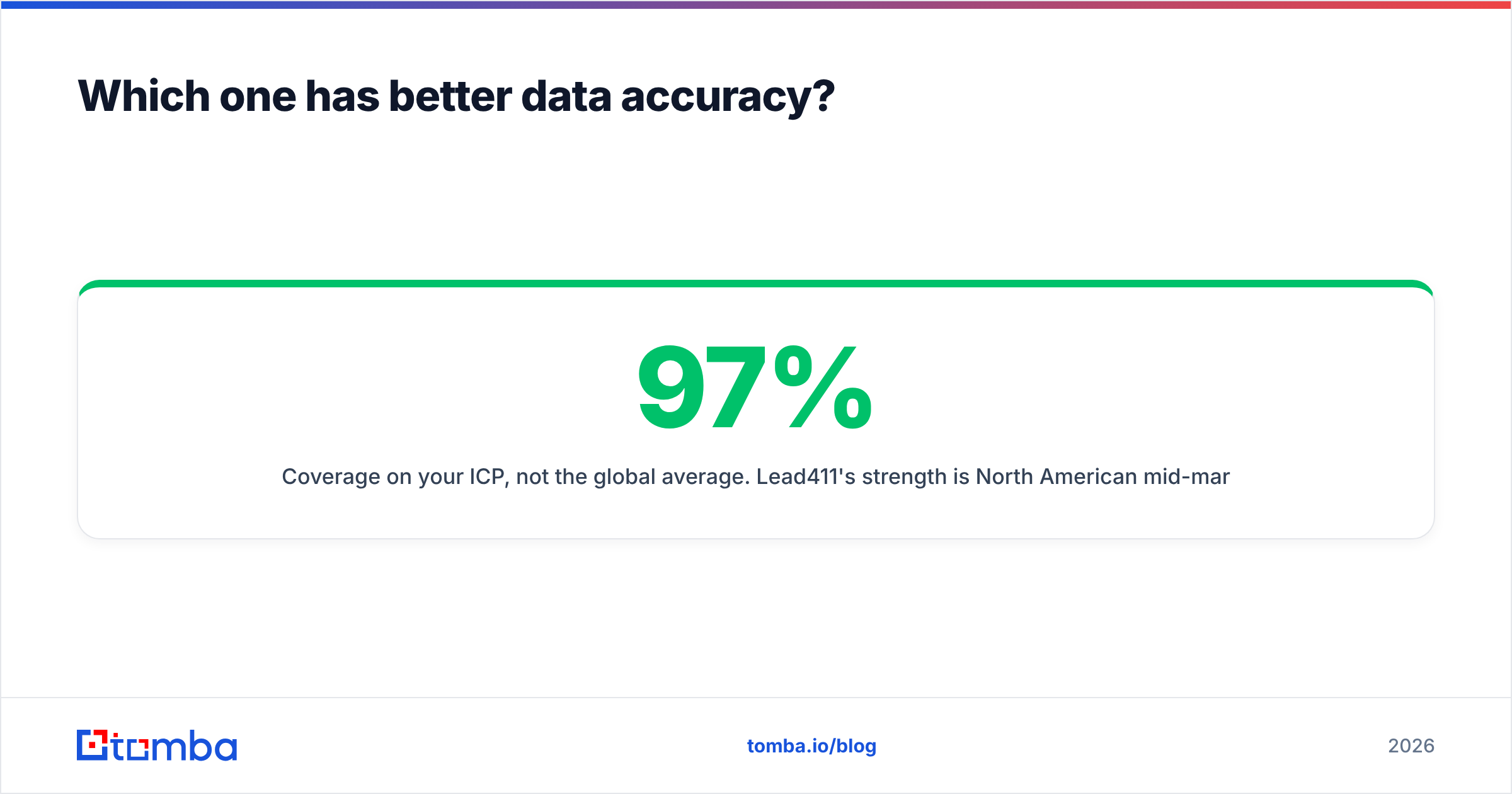
- Coverage on your ICP, not the global average. Lead411's strength is North American mid-market and enterprise. Ask it for Series A SaaS companies in Warsaw or Lagos and coverage thins out fast. A 97% accuracy rate on the 40% of your list it can match is not a 97% hit rate for you.
- Catch-all behavior. Roughly one in five business domains accepts every address at the SMTP layer, which makes a standard handshake useless. Most verifiers — No2bounce included — return "unknown" or "accept-all" and hand the risk back to you. How a tool treats that bucket is the single biggest accuracy differentiator in 2026, and it's the reason a separate catch-all finder exists as its own product category.
- Freshness of the source record. A verifier can only tell you the mailbox exists today. It cannot tell you the person left the company in March. Database vendors like Lead411 carry that risk; verifiers do not even try to solve it.
- Role-account and trap filtering. Both tools flag
info@andsales@. Spam-trap detection is murkier — no vendor can guarantee it, and any that claims to should be treated skeptically.
Run your own test before you sign anything. Take 500 known-good contacts from closed-won accounts. Feed them to each tool. Count matches, false positives, and "unknown" responses. Then send a real 200-address campaign from a warmed domain and measure actual hard bounces. That two-hour exercise beats every G2 badge — though G2's email verification category is a reasonable place to read unfiltered complaints first.
Does buying both tools make sense?#
Sometimes. Here's the decision logic, stripped of vendor spin.
Buy Lead411 alone if: your entire list comes from one source, that source is Lead411, and your bounce rate already sits under 2%. Re-verifying data the vendor just verified is duplicate spend with a thin marginal return.
Buy No2bounce alone if: your leads come from webinars, trade shows, form fills, scraped exports, or a CRM that hasn't been cleaned since 2022. You do not have a discovery problem. You have a hygiene problem, and a cheap credit pack fixes it. A bulk verify run is the same shape of job, whichever vendor performs it.
Buy both if: you run high-volume outbound (50k+ sends/month) across multiple data sources and your deliverability team treats verification as an independent control, not a vendor promise. That's a legitimate architecture — separation of duties is exactly why nobody lets the contractor sign off on their own building inspection. Just budget for it honestly.
Buy neither if: you're sending fewer than 2,000 emails a month to a tightly defined ICP. At that volume, a per-lookup email finder with verification built into the same response costs a fraction of a seat license and eliminates the handoff entirely.

How does pricing really compare in 2026?#

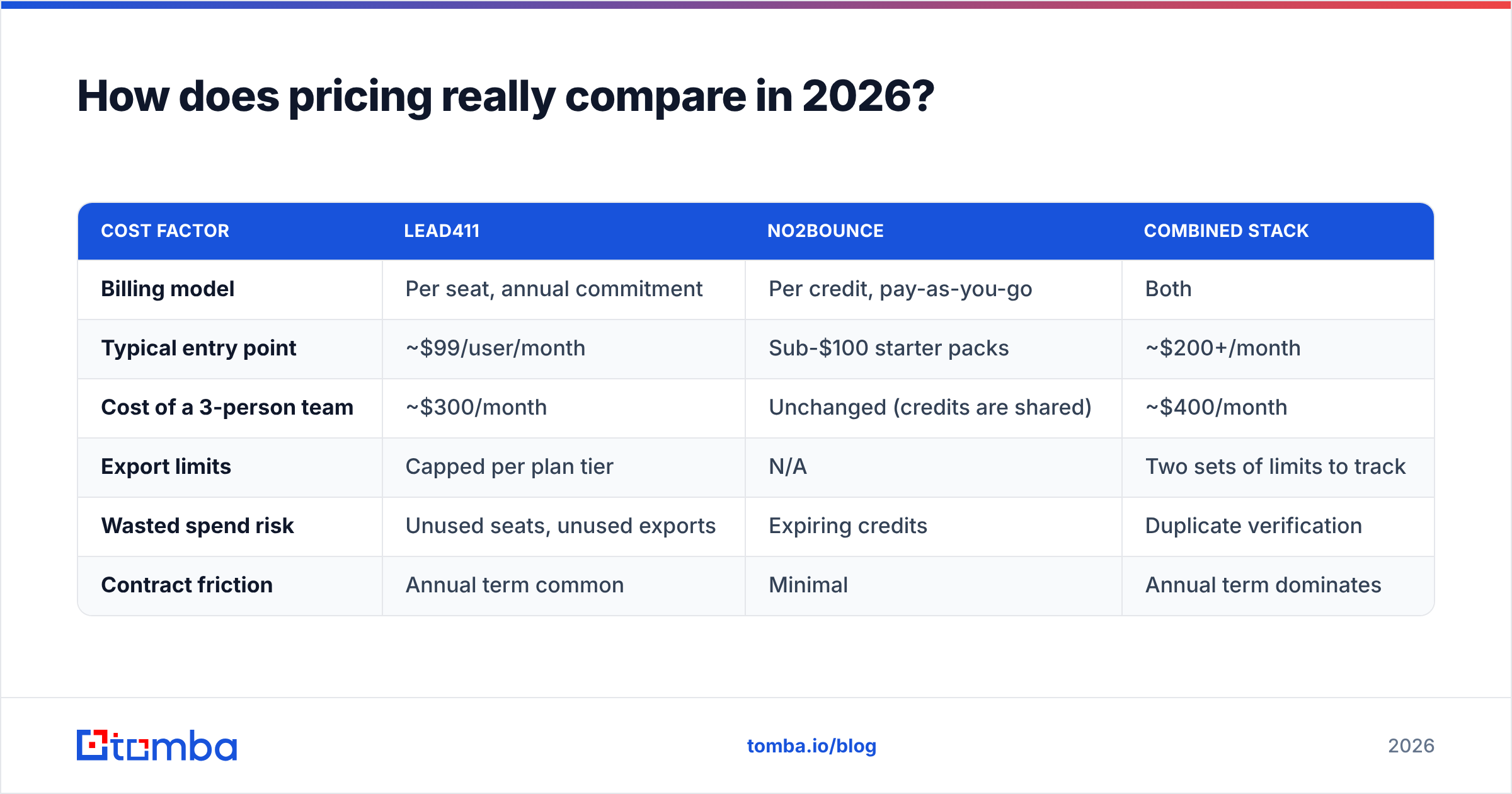
Published pricing moves, so verify current numbers on each vendor's site before you budget. As of early 2026 the structural picture looks like this:
| Cost factor | Lead411 | No2bounce | Combined stack |
|---|---|---|---|
| Billing model | Per seat, annual commitment | Per credit, pay-as-you-go | Both |
| Typical entry point | ~$99/user/month | Sub-$100 starter packs | ~$200+/month |
| Cost of a 3-person team | ~$300/month | Unchanged (credits are shared) | ~$400/month |
| Export limits | Capped per plan tier | N/A | Two sets of limits to track |
| Wasted spend risk | Unused seats, unused exports | Expiring credits | Duplicate verification |
| Contract friction | Annual term common | Minimal | Annual term dominates |
The hidden cost in the "buy both" path isn't the invoice — it's the workflow tax. Every list now travels: database export → CSV → verifier upload → download → CRM import. Four handoffs, four chances for a stale file to reach a sequence. Teams solve this with Zapier or a script, which is another thing to maintain.
For reference, Tomba's pricing collapses those line items: a free tier with 25 searches/month, Starter at $49/month, Growth at $99/month, Pro at $249/month, and custom Enterprise. Discovery and email verification draw from the same balance, so there's no second vendor to reconcile. That's not automatically the right answer — if you need Bombora intent signals, Lead411 does something Tomba doesn't — but it changes the math for teams whose only requirement is "correct address, confirmed deliverable."
Which tool fits which team?#
Match the tool to the constraint you actually have:
- Enterprise SDR team, US-focused, intent-driven plays. Lead411. The trigger alerts and direct dials justify the seat cost when quota depends on calling the right account in the right week.
- Agency cleaning client lists of unknown provenance. No2bounce or an equivalent verifier. You need throughput and a per-record price, not a database subscription.
- Founder-led outbound, 500–3,000 emails/month, global targets. A combined finder-verifier. Seat licensing is dead weight at this volume, and non-US coverage is where per-seat databases underperform hardest.
- RevOps enriching an existing CRM. Start with data enrichment against records you already own, then layer verification. Buying a net-new database before you've cleaned the one you have is backwards.
- Deliverability-first teams rebuilding sender reputation. Verification is non-negotiable and should be independent of your data source. This is the one scenario where paying two vendors is clearly defensible.
One more note on the market: the finder-versus-verifier split is narrowing everywhere. Providers like BookYourData have built strong reputations on bundled accuracy guarantees, and the category is converging on "we find it and we stand behind it." Evaluating a pure verifier in 2026 means asking whether that separate line item still earns its place — not whether the verifier is good at its job.
What should you do next?#
Conclusion first: if you need contacts, Lead411 is the better buy; if you need clean lists, No2bounce is the better buy; if you need both and you're not enterprise, buying two vendors is probably a mistake.
Run the 500-row test on whichever two candidates you shortlist. Measure match rate on your ICP, not the vendor's. Watch how each tool labels catch-all domains, because that bucket is where bounce rates get made. And price the workflow, not just the license — four handoffs between systems costs more in practice than the difference between two subscription tiers.
If the sane answer for your team is one tool instead of two, start with the Tomba Email Finder. Search by domain, name, or company, get a confidence score and verification status in the same response, and export straight to your CRM without a CSV round trip. The free tier gives you 25 searches a month — enough to run the accuracy test on your own ICP before you spend anything.
Related guides#
// get started
Find, verify and enrich your first contacts today
Start on the free plan with 25 searches a month, then scale when your team is ready.
Free plan · No credit card required · GDPR & CCPA
// about the author