Lead411 vs Salutary Data: B2B Contact Data Compared
Lead411 sells intent-rich contact records with a self-serve UI. Salutary Data sells curated, verified files you license in bulk. Here is which one actually fits your outbound motion — and what each really costs.
TL;DR
- Lead411 is a self-serve sales intelligence platform: search a UI, get contacts plus growth/hiring intent signals, export within seat-based credit limits. Best for SDR teams that want to prospect today.
- Salutary Data is a data aggregator/licensor: you buy a curated, multi-source-verified file (or an API feed) sized to your ICP. Best for RevOps, data teams, and agencies that need volume and ownership.
- They are not really competitors on features — they compete for the same budget line. The real question is "do I need a prospecting tool or a data supply?"
- Pricing shape differs completely: Lead411 is per-seat annual with export caps; Salutary is per-record/volume licensing, usually with a minimum commitment and negotiated terms.
- Neither replaces verification at send time. Whichever file you buy, re-verify before the campaign — that is where a dedicated email verifier earns its keep.
What exactly are Lead411 and Salutary Data?#
Different animals wearing similar collars.
Lead411 (lead411.com) has been around since 2001 and positions itself as an unlimited-ish B2B data platform with built-in buyer intent. You log into a web app, filter by title, industry, employee count, tech stack, or trigger event ("recently funded", "hiring for sales"), and pull contact records with verified emails and direct dials. It also ships a Chrome extension, CRM sync, and a light cadence tool. The product assumption is that a rep is doing the searching.
Salutary Data (salutarydata.com) is a B2B contact and company data supplier. The pitch is curation over scale: they aggregate from multiple upstream sources, cross-verify, and sell you a licensed file that matches a defined ICP — or deliver it via API/enrichment batch. There is no SDR-facing prospecting workspace in the Lead411 sense. You buy data, it lands in your warehouse, CRM, or sequencer, and your systems do the rest.
That distinction drives almost every downstream difference: contract shape, cost per contact, how you measure accuracy, and who on your team actually owns the tool.

How do Lead411 and Salutary Data compare head-to-head?#
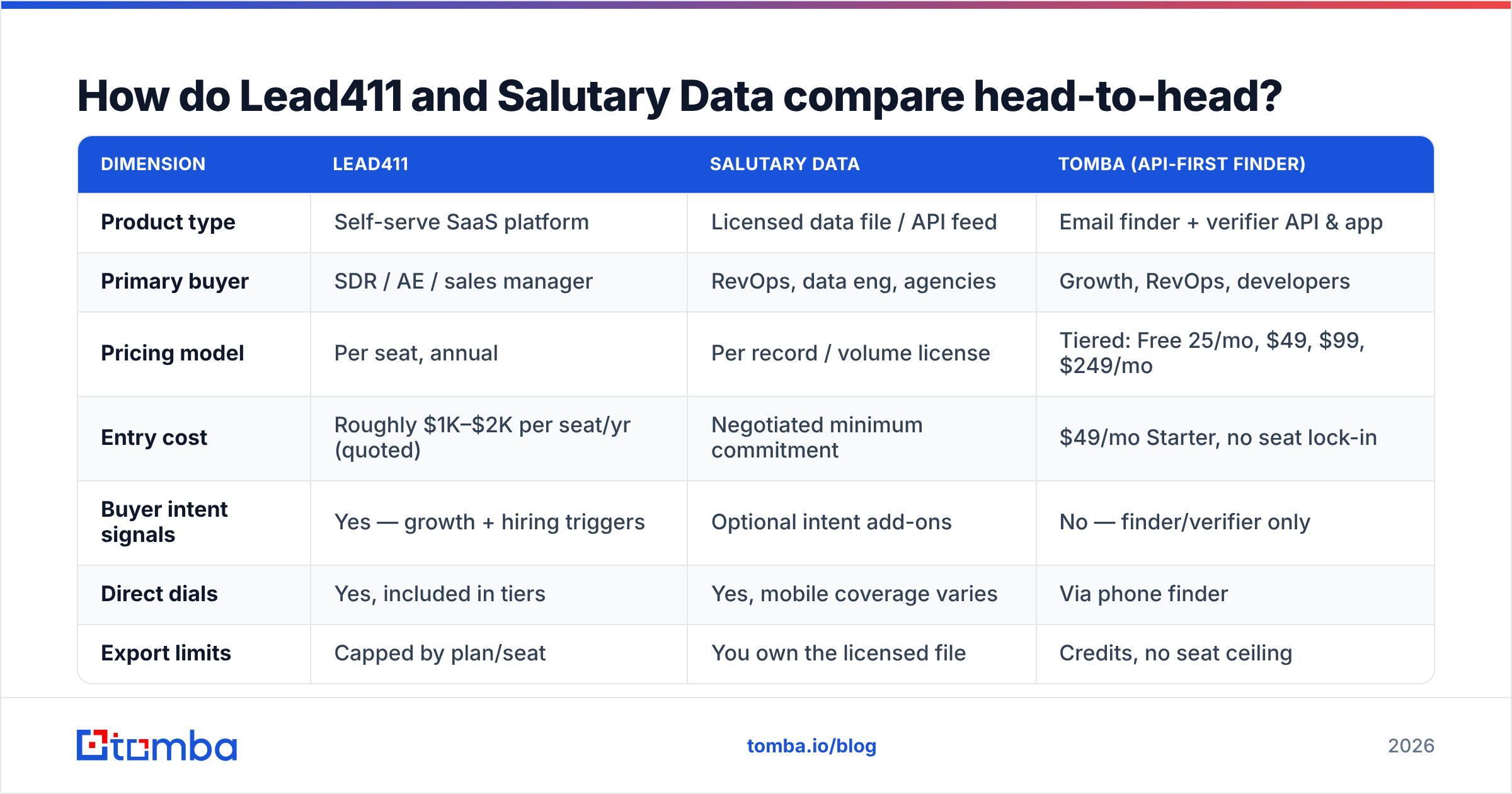
Here is the practical comparison, with a third column for the API-first option teams increasingly bolt on instead of replacing either.
| Dimension | Lead411 | Salutary Data | Tomba (API-first finder) |
|---|---|---|---|
| Product type | Self-serve SaaS platform | Licensed data file / API feed | Email finder + verifier API & app |
| Primary buyer | SDR / AE / sales manager | RevOps, data eng, agencies | Growth, RevOps, developers |
| Pricing model | Per seat, annual | Per record / volume license | Tiered: Free 25/mo, $49, $99, $249/mo |
| Entry cost | Roughly $1K–$2K per seat/yr (quoted) | Negotiated minimum commitment | $49/mo Starter, no seat lock-in |
| Buyer intent signals | Yes — growth + hiring triggers | Optional intent add-ons | No — finder/verifier only |
| Direct dials | Yes, included in tiers | Yes, mobile coverage varies | Via phone finder |
| Export limits | Capped by plan/seat | You own the licensed file | Credits, no seat ceiling |
| Data ownership after churn | Exported records only | Licensed per agreement terms | Exported records only |
| Verification depth | Platform-verified emails | Multi-source cross-verification | SMTP + catch-all verification |
| Best for | Reps prospecting daily | Bulk ICP files, enrichment | Targeted lookups + hygiene layer |
Two honest caveats about that table. First, both vendors quote rather than publish, so the cost lines are directional — get your own quote and compare on cost per usable contact, not sticker price. Second, "unlimited" in this category almost always means unlimited views with a capped export. Read the export clause before the demo ends.
Which one has better data accuracy?#
Neither wins on a blanket claim — they fail differently.
Lead411's accuracy is strongest where its intent layer is strongest: mid-market North American tech, recently funded companies, roles that churn publicly. Because records surface through a live UI, staleness shows up fast — a rep bounces an email and flags it. The weakness is long-tail coverage: niche verticals, non-US SMBs, and non-English company names get thin.
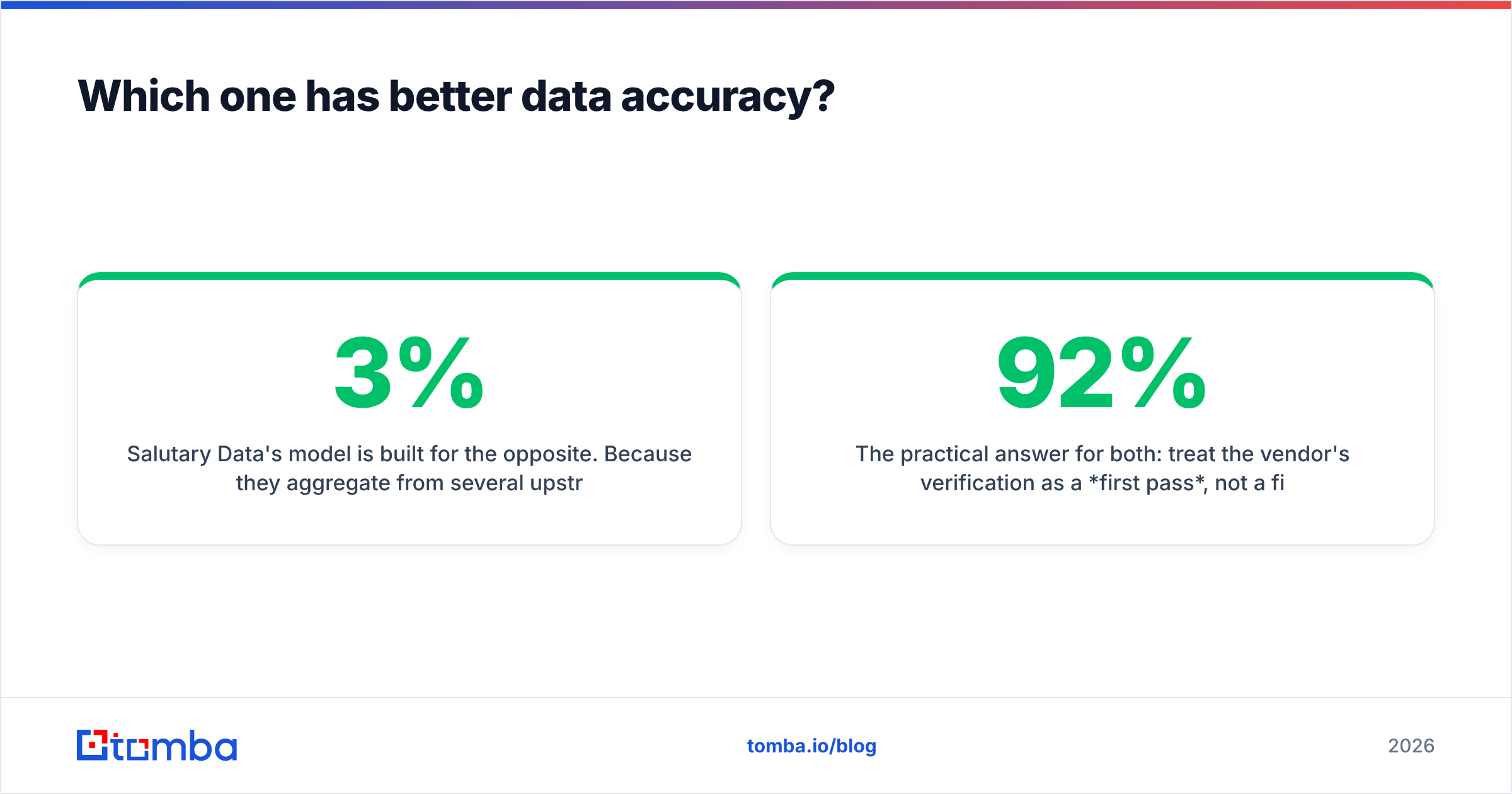
Salutary Data's model is built for the opposite. Because they aggregate from several upstream providers and reconcile conflicts before delivery, their strength is breadth and de-duplication across a defined segment. The weakness is time-in-transit: a file curated in March and delivered in April is already decaying, and B2B contact data decays at roughly 2-3% per month as people change jobs. Gartner and most RevOps practitioners put annual B2B database decay somewhere between 25% and 30% — which means any static file needs a refresh cadence baked into the contract.
The practical answer for both: treat the vendor's verification as a first pass, not a final one. Run the list through independent verification immediately before send. A 92%-accurate file that sits for 90 days is an 85%-accurate file by the time your sequence fires, and mailbox providers judge you on the bounce rate you actually produce, not the one your vendor promised. If you want the mechanics, our notes on email deliverability cover how bounce rate feeds sender reputation.
What does each one actually cost?#
Both vendors gate pricing behind a conversation, which is the first real cost: time.
Lead411 is seat-based and annual. Expect a quote in the low four figures per seat per year, scaling with the number of exports and whether you want intent and direct dials on. The economics work when a rep uses it daily — a single closed deal covers the seat. The economics break when you buy five seats and two people log in.
Salutary Data is volume-licensed. You define an ICP, they scope the record count, you negotiate a price per record that falls as volume rises, plus terms for refresh and usage rights. For a 100K-record ICP file this often lands cheaper per contact than any seat-based tool — but you are paying up front for records you may never touch, and the file starts decaying on delivery day.
Run the comparison this way instead of on list price:
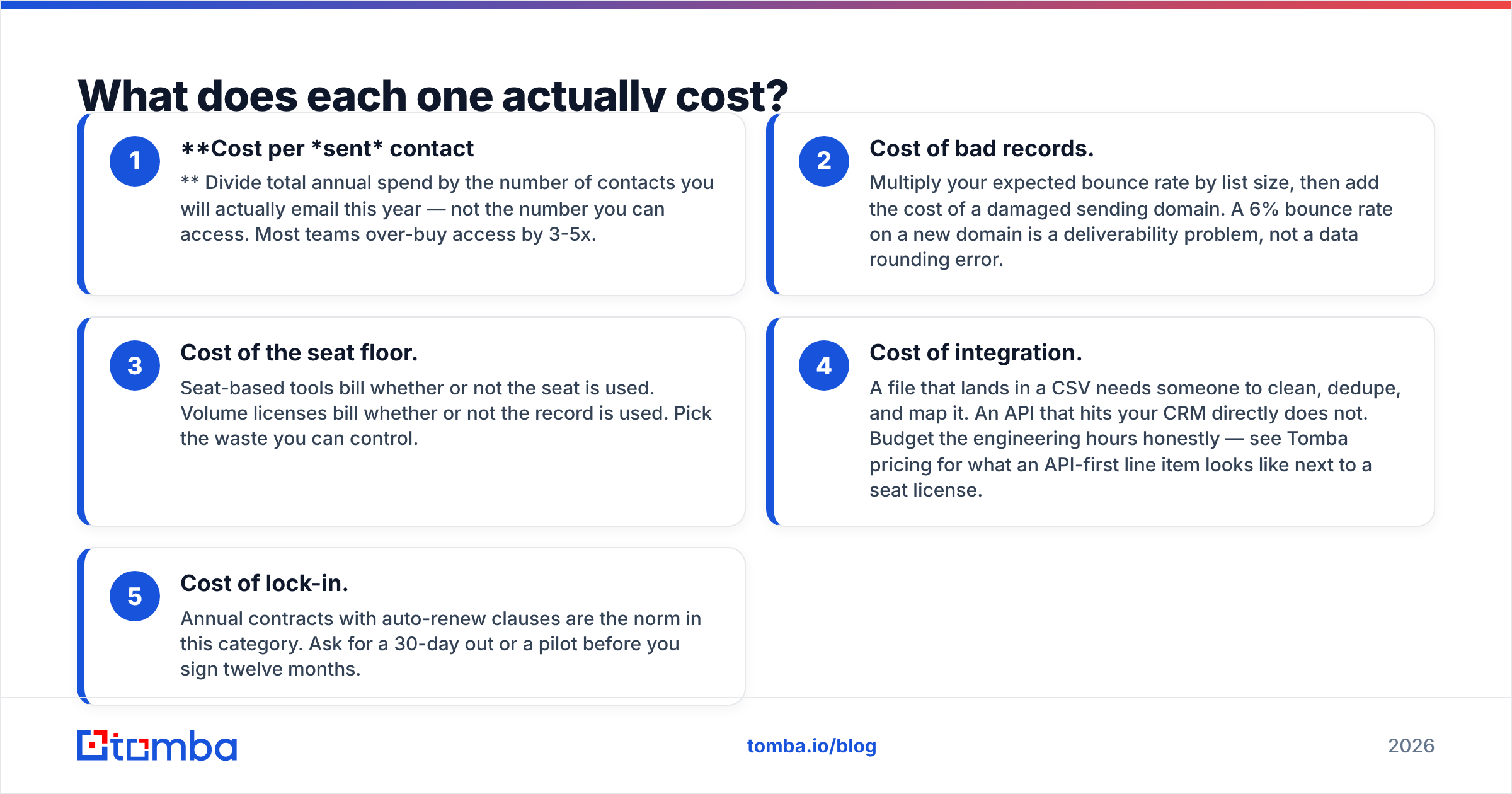
- Cost per sent contact. Divide total annual spend by the number of contacts you will actually email this year — not the number you can access. Most teams over-buy access by 3-5x.
- Cost of bad records. Multiply your expected bounce rate by list size, then add the cost of a damaged sending domain. A 6% bounce rate on a new domain is a deliverability problem, not a data rounding error.
- Cost of the seat floor. Seat-based tools bill whether or not the seat is used. Volume licenses bill whether or not the record is used. Pick the waste you can control.
- Cost of integration. A file that lands in a CSV needs someone to clean, dedupe, and map it. An API that hits your CRM directly does not. Budget the engineering hours honestly — see Tomba pricing for what an API-first line item looks like next to a seat license.
- Cost of lock-in. Annual contracts with auto-renew clauses are the norm in this category. Ask for a 30-day out or a pilot before you sign twelve months.
Is there a third path between a platform and a licensed file?#
Yes — and it is what most efficient teams in 2026 actually run.
The pattern: keep a narrow source of truth for who you want to reach (your ICP list, built from a platform, a licensed file, LinkedIn exports, conference attendee lists, or scraped signals), then resolve contact details on demand with an API rather than buying them in bulk ahead of time. You pay for the 4,000 people you will actually contact this quarter, not the 400,000 you filtered.
Concretely, that looks like:
- Source the accounts from whatever gives you the best signal — Lead411's intent triggers are genuinely good here, and so is a curated Salutary file for a defined vertical. So is a job-board scrape.
- Resolve the people with a domain search to pull every public pattern-matched address on a company domain, or a targeted email finder lookup by name plus domain.
- Verify before send, including catch-all domains, which are where most "verified" lists quietly leak bounces.
- Enrich in the CRM rather than in a spreadsheet, so records update instead of forking. Tomba's HubSpot integration and Tomba API both do this without a seat license.
This is not an argument that platforms are obsolete. It is an argument that the bulk purchase step is increasingly optional. G2's category data shows the sales-intelligence market fragmenting exactly along this line: heavyweight platforms on one end, composable API tooling on the other, and fewer teams buying a single monolith.

Who should pick Lead411?#
Pick Lead411 when the person who needs data is the person who will do the searching.
- You have 3-15 reps prospecting daily and want them self-sufficient.
- Buyer intent matters to your motion — you sell to companies right after they raise, hire, or adopt a specific technology.
- You want direct dials in the same workflow as emails, not in a second tool.
- Your ICP sits in North American tech/mid-market, where Lead411's coverage is deepest.
- You value a Chrome extension and CRM push over a raw data pipeline.
Skip it when your team is two founders doing outbound between customer calls, or when your ICP is European SMB, where coverage thins and per-seat cost stops making sense.
Who should pick Salutary Data?#
Pick Salutary Data when you need supply, not software.
- You run an agency or a multi-brand outbound operation and need records you can use across clients or systems (confirm usage rights explicitly in the agreement).
- You have a data team that will land, clean, and match the file — a CSV is a starting point, not a deliverable, for you.
- Your ICP is well-defined and stable enough to scope a file against.
- You want to negotiate on refresh cadence and per-record economics rather than accept a seat-count menu.
- You are enriching an existing CRM at scale rather than discovering net-new accounts one at a time.
Skip it when you cannot articulate your ICP tightly. Buying 250K records "to be safe" is how teams end up with a decaying file, a bloated CRM, and a bounce rate that torches a sending domain. It also worth noting that a curated-file vendor like Salutary — and comparable curated suppliers such as BookYourData, which sells verified, pay-as-you-go B2B lists with a similar emphasis on validation before delivery — are genuinely strong at the thing they do. The failure mode is almost always buyer scoping, not supplier quality.
How should you test both before signing?#
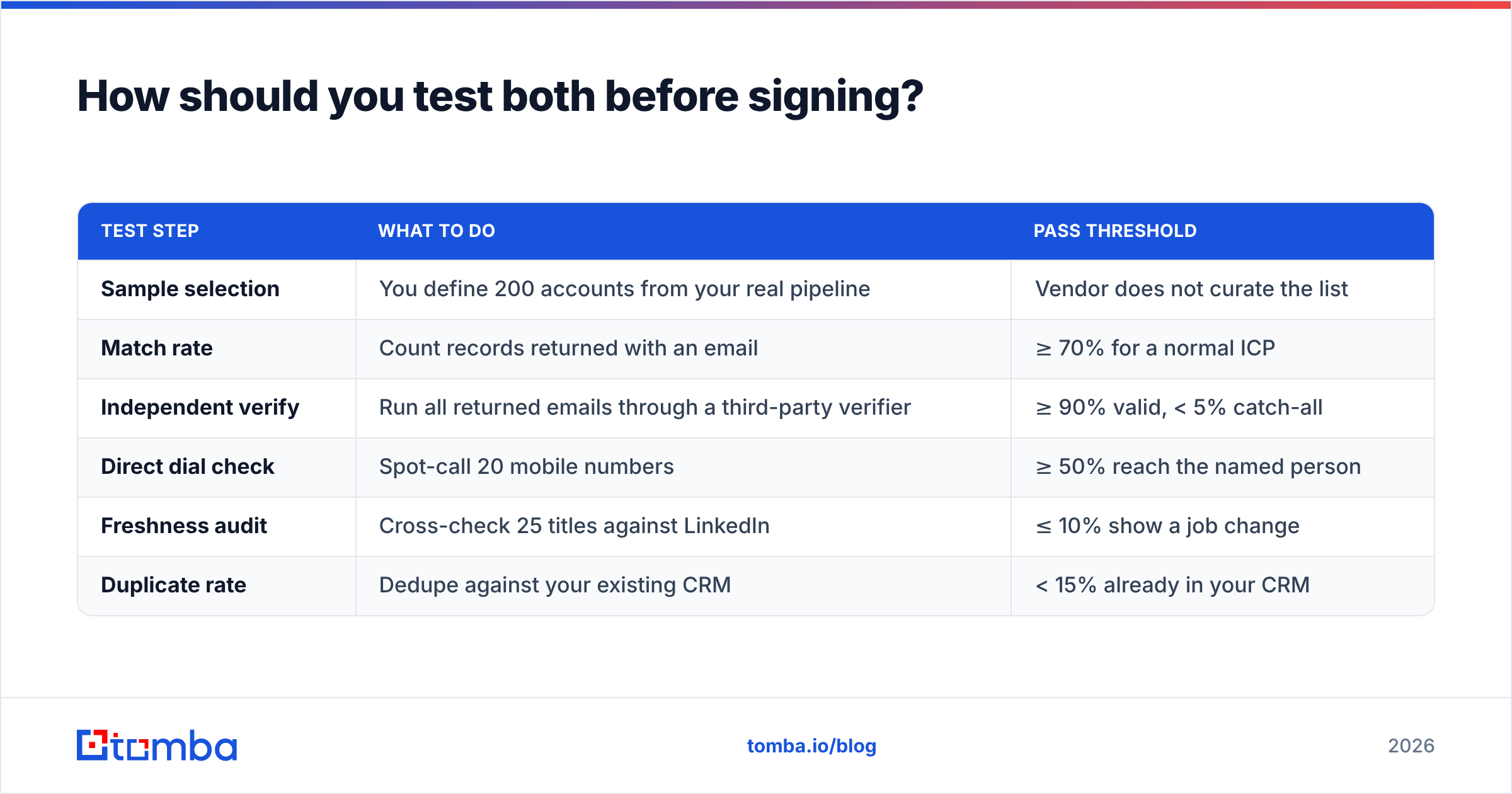
Run the same 200-record bake-off against each vendor. Do not let either pick the sample.
| Test step | What to do | Pass threshold |
|---|---|---|
| Sample selection | You define 200 accounts from your real pipeline | Vendor does not curate the list |
| Match rate | Count records returned with an email | ≥ 70% for a normal ICP |
| Independent verify | Run all returned emails through a third-party verifier | ≥ 90% valid, < 5% catch-all |
| Direct dial check | Spot-call 20 mobile numbers | ≥ 50% reach the named person |
| Freshness audit | Cross-check 25 titles against LinkedIn | ≤ 10% show a job change |
| Duplicate rate | Dedupe against your existing CRM | < 15% already in your CRM |
The last row is the one teams forget and the one that changes the math most. If 40% of a licensed file already exists in your CRM, your effective cost per new contact just went up 67%. Ask for the dedupe test in writing before the contract, not after.
For the verification step specifically, use something neutral — not the vendor's own checker. A free email checker gets you through a spot sample; a bulk verify run gets you through the full 200 in a few minutes.
What is the verdict?#
If you have reps who prospect daily and you sell into North American mid-market tech, Lead411 is the better buy. The intent triggers are the differentiator, and a self-serve UI beats a CSV handoff for anyone who is not a data person.
If you are RevOps, an agency, or a team enriching at scale against a tightly defined ICP, Salutary Data's licensing model gives you more contacts per dollar and more control over how the data lives in your stack.
If you are not sure yet — or your volumes are lumpy — do not sign either one this quarter. Build the account list from free and cheap signals, resolve contacts on demand through an API, verify at send time, and revisit the platform-versus-file decision when your monthly contact volume is stable enough to price properly. Most teams discover their real number is a fraction of what either vendor's minimum assumes.
One more thing worth saying plainly: all three approaches — platform, licensed file, API — depend on the same last mile. If the address is wrong, the intent signal, the curation, and the negotiation were all wasted. Verification is not a nice-to-have bolted onto the end of the process. It is the part that determines whether any of the rest mattered.
Ready to test contact data without a seat license?#
Start with the Tomba Email Finder. Run your first 25 lookups free — no seat commitment, no annual contract, no export cap to negotiate. Feed it a name and a domain, or point domain search at a target account and pull every public address on it, then verify before you send. If it fits, Starter is $49/mo and Growth is $99/mo, and the same credits work through the app, the API, the Chrome extension, and Google Sheets. Use it as your bake-off control against whatever Lead411 or Salutary Data quote you — at minimum you will know what you are really paying per usable contact.
Related guides#
Ready to find emails that actually work?
Join 150,000+ professionals who stopped guessing and started sending. Free credits on signup — no credit card required.
Get the Tomba newsletter
Practical outbound tactics and product updates — once every two weeks.
About the author