Lead411 vs Span Global Services: Which B2B Data Wins in 2026?
One is a self-serve sales intelligence subscription with intent signals. The other is a quote-based managed list vendor. Here is how Lead411 and Span Global Services actually differ on data, pricing, and risk.
TL;DR
- Lead411 is a self-serve sales intelligence subscription. You log in, build filters, export verified emails and direct dials, and get Bombora-powered intent plus growth triggers on top.
- Span Global Services is a managed data vendor. You brief a rep, they scope a targeted list (tech install-base, healthcare, industry), you get a quote and a file — plus append, cleansing, and campaign services.
- They are not really the same product. Lead411 sells access; Span Global sells deliverables. Comparing them on "price per record" misses the point.
- Both go stale the moment the file lands. B2B contact data decays roughly 25–30% a year, so re-verification before send is non-negotiable in either case.
- Our pick: Lead411 for repeatable inbound-adjacent outbound with a defined ICP. Span Global for one-off campaigns into niche or install-base segments where no self-serve tool has coverage. Either way, run the list through a verifier first.
What is Lead411 and who actually uses it?#
Lead411 is a B2B contact and company database you subscribe to. It has been around since 2001, which in data terms means a long history of crawling, licensing, and stitching together company records — and a long history of customers who use it as a cheaper alternative to ZoomInfo.
The product shape is familiar if you have used any modern sales intelligence tool:
- Filter-based search. Build a list by title, seniority, industry, headcount, revenue, location, and technology used.
- Verified emails and direct dials. Lead411 leans hard on mobile numbers as a differentiator, which matters if your team still calls.
- Intent data. Bombora-sourced topic surges tell you which accounts are researching your category this week.
- Growth triggers. Funding rounds, hiring spikes, and IPO signals fire as alerts so you can time outreach to an event rather than a calendar.
- Chrome extension and CRM sync. Push contacts into Salesforce, HubSpot, Pipedrive, or an outreach sequencer without a CSV round trip.
The typical buyer is a 5–50 seat SDR team with a defined ICP that they work continuously. You are paying for access — the ability to pull a fresh slice of the database every week as territories shift and reps burn through their lists.
What is Span Global Services and how is it different?#
Span Global Services sits in a different category entirely: it is a B2B data and demand generation services company. You do not log into a dashboard and self-serve. You talk to a rep, describe the audience, and receive a scoped file.
Their catalogue skews toward segments that self-serve platforms cover poorly:
- Technology install-base lists — companies running Oracle, SAP, Salesforce, Workday, and hundreds of other stacks, with the decision-makers attached.
- Healthcare and professional lists — physicians, nurses, hospital administrators, attorneys, accountants, segmented by specialty and license type.
- Industry and geography lists — manufacturing in the Midwest, logistics in the EU, that kind of brief.
- Data services — email and phone append, list cleansing, data enrichment against your existing CRM, and managed email or telemarketing campaign execution.
That last bullet is the real tell. Span Global is closer to an agency than a SaaS tool. If your team lacks the headcount to build lists, the services wrapper is the value. If you have an ops person who lives in filters, you are paying for labour you already have.
Lead411 vs Span Global Services: how do they compare head to head?#
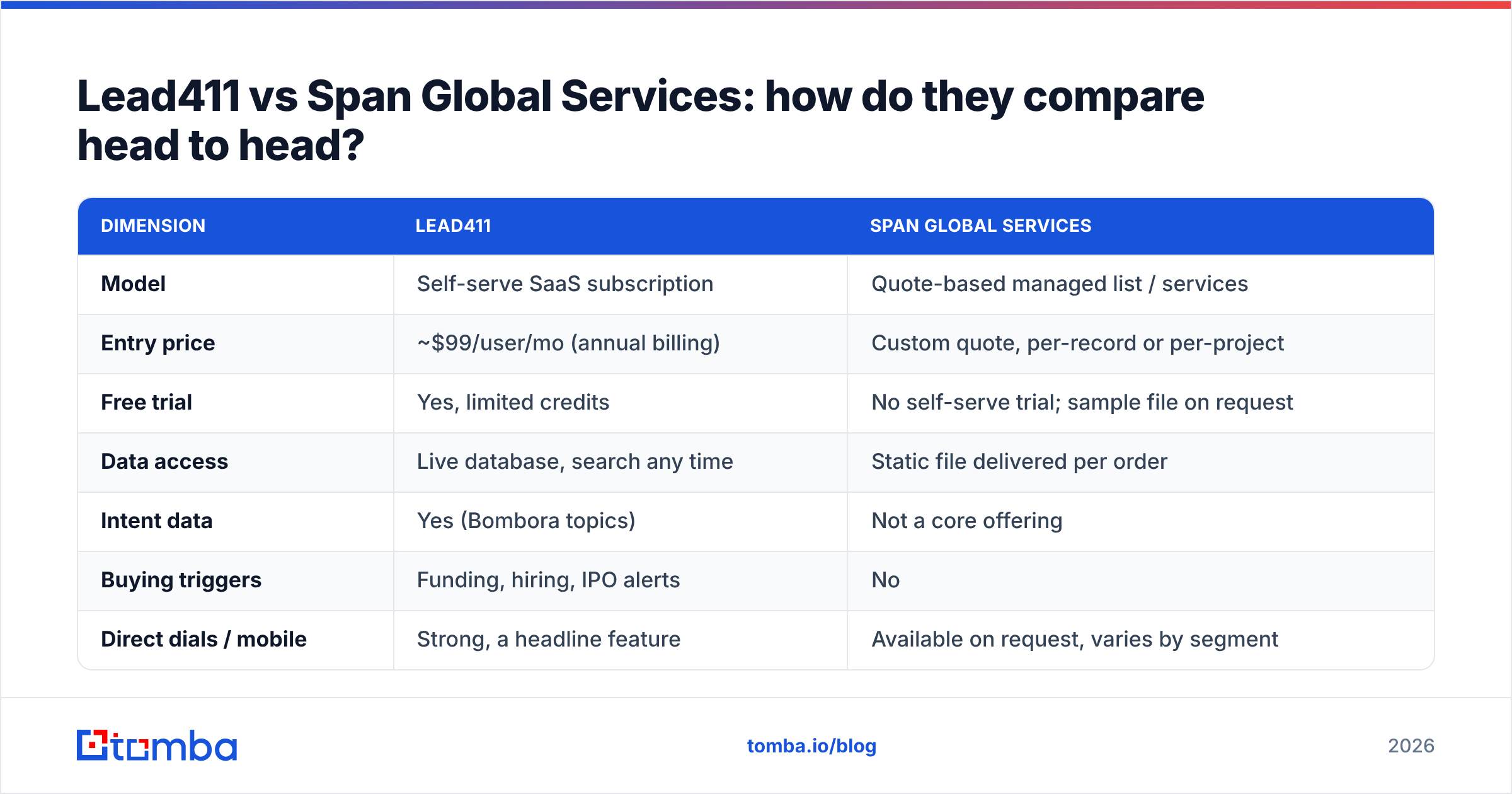
Here is the honest side-by-side. Pricing figures reflect publicly listed rates at the time of writing — always confirm directly, because both vendors negotiate.

| Dimension | Lead411 | Span Global Services |
|---|---|---|
| Model | Self-serve SaaS subscription | Quote-based managed list / services |
| Entry price | ~$99/user/mo (annual billing) | Custom quote, per-record or per-project |
| Free trial | Yes, limited credits | No self-serve trial; sample file on request |
| Data access | Live database, search any time | Static file delivered per order |
| Intent data | Yes (Bombora topics) | Not a core offering |
| Buying triggers | Funding, hiring, IPO alerts | No |
| Direct dials / mobile | Strong, a headline feature | Available on request, varies by segment |
| Install-base targeting | Basic technographics | Deep, a core specialty |
| Healthcare / licensed pros | Thin | Strong |
| CRM integrations | Salesforce, HubSpot, Pipedrive, sequencers | Manual file handoff, append services |
| API | Yes | Limited, services-led |
| Licensing | Seat-based, ongoing access | Often single-use or multi-use license terms |
| Best for | Continuous outbound on a fixed ICP | One-off campaigns into niche segments |
The row that trips up most buyers is licensing. A subscription means you can re-pull the same account in six months and get whatever the database knows then. A purchased file is a snapshot, and some list contracts restrict how many times you can mail it. Read the terms before you plug a purchased file into an always-on sequence.
Whose data is actually more accurate?#
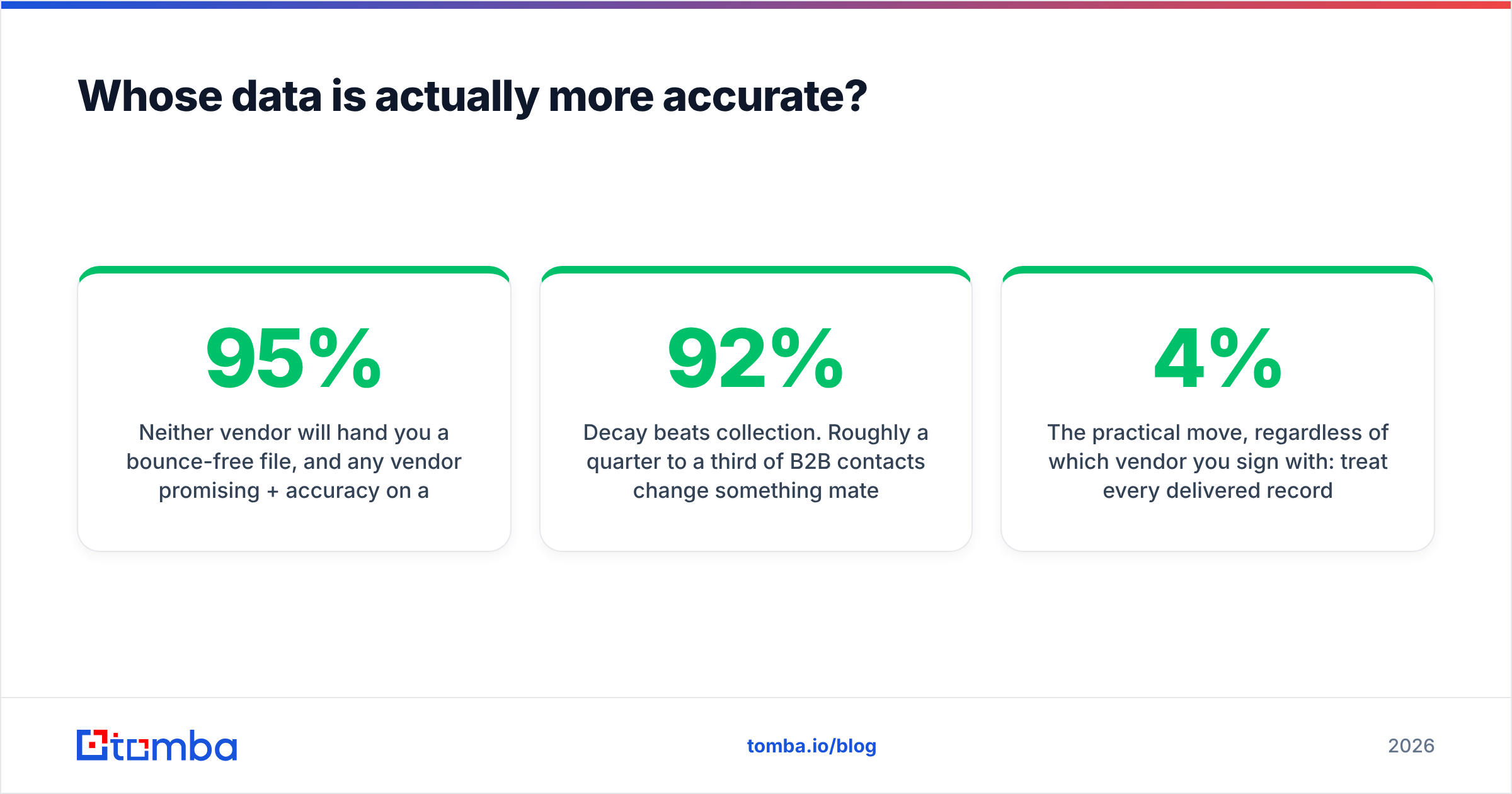
Neither vendor will hand you a bounce-free file, and any vendor promising 95%+ accuracy on a segment they have never sold before deserves a raised eyebrow.

What the benchmarks consistently show across the contact data market:
- Accuracy is segment-dependent, not vendor-dependent. Every provider is strong where it has a data pipeline and weak where it is guessing from patterns. Lead411 is solid on US tech and SMB; it thins out on EMEA mid-market and non-English markets. Span Global is strong exactly where it specialises and generic elsewhere.
- Decay beats collection. Roughly a quarter to a third of B2B contacts change something material — job, title, company, email — every year. A file that was 92% accurate at delivery is around 70% accurate a year later, whoever built it.
- "Verified" means different things. Some vendors mean SMTP-checked this week. Others mean a human confirmed it in 2023. Ask which, and ask when.
- Catch-all domains hide the truth. A large share of enterprise domains accept everything at the gateway, so a naive verifier reports "valid" and your bounce shows up three days later. A dedicated catch-all verifier is the only way to separate real mailboxes from black holes on those domains.
The practical move, regardless of which vendor you sign with: treat every delivered record as a hypothesis. Run the file through an independent email verifier before the first send and re-verify anything older than 60 days. A 4% bounce rate quietly destroys the sender reputation you spent three months building, and no data vendor refunds you for that.
How does pricing really compare?#
This is where the two models diverge hardest, and where the sticker price lies to you.
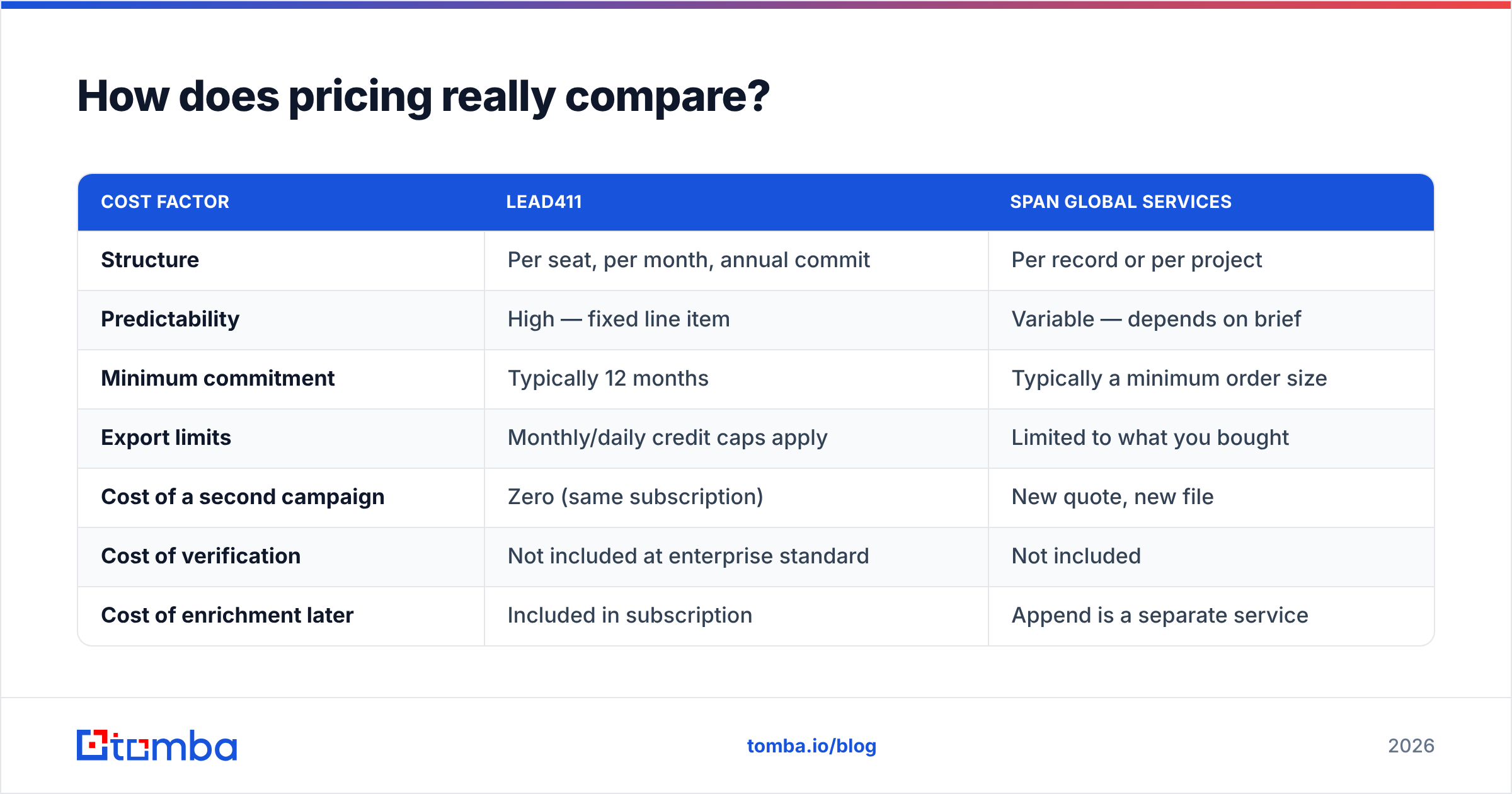
| Cost factor | Lead411 | Span Global Services |
|---|---|---|
| Structure | Per seat, per month, annual commit | Per record or per project |
| Predictability | High — fixed line item | Variable — depends on brief |
| Minimum commitment | Typically 12 months | Typically a minimum order size |
| Export limits | Monthly/daily credit caps apply | Limited to what you bought |
| Cost of a second campaign | Zero (same subscription) | New quote, new file |
| Cost of verification | Not included at enterprise standard | Not included |
| Cost of enrichment later | Included in subscription | Append is a separate service |
Two traps worth naming:
The unlimited-that-is-not-unlimited trap. Lead411's plans market unlimited viewing but meter exports. If your workflow is bulk export into a sequencer, you will hit the ceiling faster than the sales demo suggests. Ask for the exact monthly export number in writing.
The per-record trap. A quoted price of, say, $0.20 per record looks cheap next to a subscription until you compute effective cost. Buy 10,000 records at 78% deliverability and you paid $2,000 for 7,800 usable contacts — $0.26 each — before you spend anything on verification or the campaign itself. Always price on usable records, not delivered rows.
For reference on what a modern self-serve alternative costs, Tomba pricing runs a free tier at 25 searches a month, Starter at $49/mo, Growth at $99/mo, and Pro at $249/mo, with enterprise quotes above that. That gives you a clean benchmark to hold both vendors against.

Which one fits your go-to-market motion?#
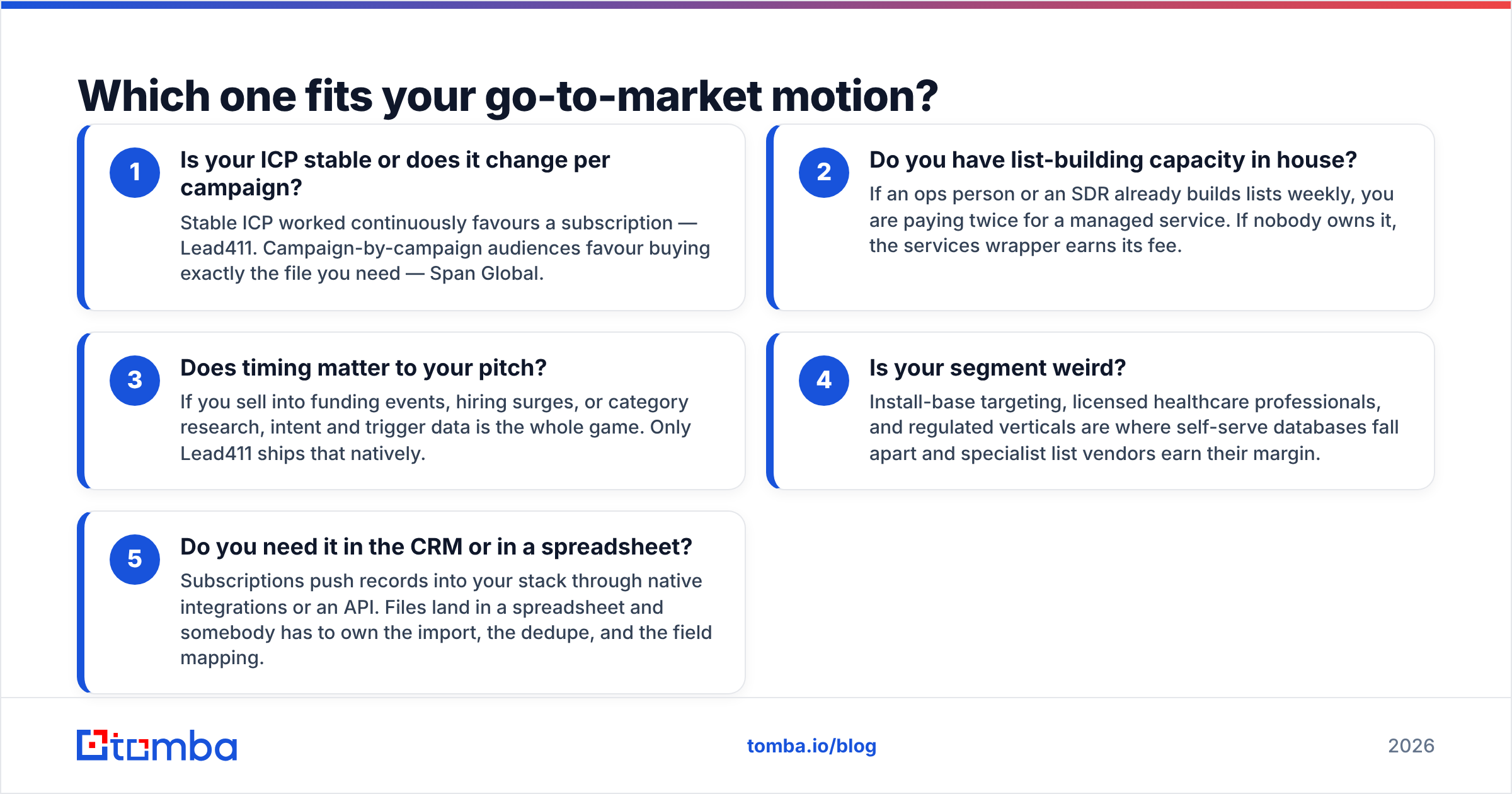
Skip the feature grid for a second and answer these five questions honestly.
- Is your ICP stable or does it change per campaign? Stable ICP worked continuously favours a subscription — Lead411. Campaign-by-campaign audiences favour buying exactly the file you need — Span Global.
- Do you have list-building capacity in house? If an ops person or an SDR already builds lists weekly, you are paying twice for a managed service. If nobody owns it, the services wrapper earns its fee.
- Does timing matter to your pitch? If you sell into funding events, hiring surges, or category research, intent and trigger data is the whole game. Only Lead411 ships that natively.
- Is your segment weird? Install-base targeting, licensed healthcare professionals, and regulated verticals are where self-serve databases fall apart and specialist list vendors earn their margin.
- Do you need it in the CRM or in a spreadsheet? Subscriptions push records into your stack through native integrations or an API. Files land in a spreadsheet and somebody has to own the import, the dedupe, and the field mapping.
If three or more of your answers point the same direction, you have your answer. If they split, you are probably looking at a hybrid: a subscription for the core motion, a purchased file for the one segment your subscription cannot reach.
What do buyers complain about in each?#
Read enough reviews on G2 and the patterns are consistent.
Common Lead411 friction:
- Export credits run out mid-month, which surprises teams that budgeted seats rather than volume.
- International coverage is noticeably weaker than North American coverage.
- Annual contracts with limited mid-term flexibility if headcount drops.
- Intent data is topic-level, not person-level — useful for prioritisation, not for personalisation.
Common managed-list friction (applies to Span Global and the category broadly):
- Turnaround time. A quote plus scoping plus delivery is days, not minutes.
- Sample files look better than the full delivery. Always request a random sample, not a curated one.
- Licensing restrictions that limit re-use.
- No live refresh — the file ages from day one and re-purchasing is the only fix.
Neither list is disqualifying. They are the predictable trade-offs of subscription access versus delivered files.
Is there a cheaper third option worth considering?#
Yes, and it is worth being blunt about when it applies.
If what you actually need is email addresses for accounts you have already identified, you do not need either platform. You need a lookup layer. That is a different purchase: you bring the company and person, the tool returns a verified address. A domain search pulls every discoverable address at a target company, and a bulk email finder runs a CSV of names and domains through in one pass. That workflow costs a fraction of a seat-based intelligence subscription because you are not paying for a database you barely filter.
If what you need is a prepaid, self-serve list with transparent per-record pricing — no sales call, no annual commit — BookYourData is a credible option in that middle ground, with pay-as-you-go credits and a published accuracy guarantee. It solves the "I want a file but I do not want a six-week procurement cycle" problem that sits awkwardly between Lead411 and Span Global.
And if the bottleneck is enrichment rather than discovery — you have 40,000 CRM records with missing fields — neither a subscription nor a list purchase is the right shape. Data enrichment against records you already own is the cheaper and faster fix.
So which one wins?#
Lead411 wins for most teams running continuous outbound, because access beats deliverables when your ICP does not change every month, and because intent plus triggers give you a reason to reach out that a static file cannot. The predictable line item also survives budget review more easily than a string of ad-hoc data invoices.
Span Global Services wins when the segment is the constraint. If you need everyone running a specific ERP in a specific region, or a clean physician list by specialty, a specialist vendor will beat a general-purpose database on coverage every time — and the services layer means you are not hiring someone to build it.
Neither wins on the thing that actually determines your results: whether the addresses still work on send day. That is a separate job, and it is the cheapest insurance in outbound. Verify at ingest, re-verify before every campaign, and never send to a record you have not checked in the last two months.
Start there. Whichever vendor you sign, run the file through the Tomba Email Finder and verifier stack before the first send — free tier covers 25 searches a month so you can pressure-test a sample of any vendor's list before you commit to a contract. It takes ten minutes and it will tell you more about data quality than any sales demo.
Related guides#
// get started
Find, verify and enrich your first contacts today
Start on the free plan with 25 searches a month, then scale when your team is ready.
Free plan · No credit card required · GDPR & CCPA
// about the author