Lead411 vs Techsalerator (2026): Which B2B Data Wins?
Lead411 sells seat-based sales intelligence. Techsalerator licenses bulk datasets. They solve different problems, and only one of them fits a lean outbound team. Here is the honest 2026 breakdown.
TL;DR
- These are not the same category. Lead411 is a seat-based sales intelligence platform for reps. Techsalerator is a data-as-a-service vendor that licenses bulk datasets to teams who want files, not dashboards.
- Lead411 wins for day-to-day prospecting — Chrome extension, CRM push, intent signals, and a UI a rep can use without asking data ops for help.
- Techsalerator wins for volume and geography — if you need 2 million German manufacturing contacts delivered as a flat file, a per-seat tool will fight you the whole way.
- Both are quote-and-contract shaped. Lead411 pushes annual billing; Techsalerator prices per dataset with no public rate card. Neither is a "swipe a card and start today" purchase.
- If you only need verified work emails at a predictable price, a dedicated finder like Tomba Email Finder starting at $49/mo covers the job without a procurement cycle.
What is Lead411?#
Lead411 is a B2B sales intelligence platform: a searchable contact and company database with verified emails, direct dial phone numbers, technographics, and buyer intent data layered on top. You log in, build a filter (title, industry, headcount, location, tech stack, growth signal), and export or push contacts into your CRM or sequencer.
Its positioning has been consistent for years — "unlimited" download allowances on its main plan, competitive pricing against ZoomInfo, and a heavy emphasis on trigger events like funding rounds, hiring spikes, and IPO activity. The official Lead411 site lists the current plan structure, and buyer reviews on G2 skew positive on ease of use and negative on contract flexibility.
Who it's built for: SDR teams, founders doing their own outbound, and small-to-mid revenue orgs that want one login covering search, enrichment, and intent.
What is Techsalerator?#
Techsalerator is a data provider, not a prospecting UI. It licenses structured datasets — B2B contacts, firmographics, consumer records, geospatial data, mobile identifiers, and industry-specific files — and delivers them as CSV, JSON, API feeds, or cloud bucket drops.
The pitch on techsalerator.com is breadth: country-level coverage across most of the world, including markets where the big US-centric vendors thin out badly (Southeast Asia, MENA, Latin America, Eastern Europe). You describe the segment you want, they scope it, quote it, and deliver a file.
Who it's built for: data teams, agencies building lists at scale, martech products that need to seed a database, and anyone running outbound in geographies where Lead411-style tools return 40 results for a filter that should return 4,000.
How do Lead411 and Techsalerator compare head to head?#
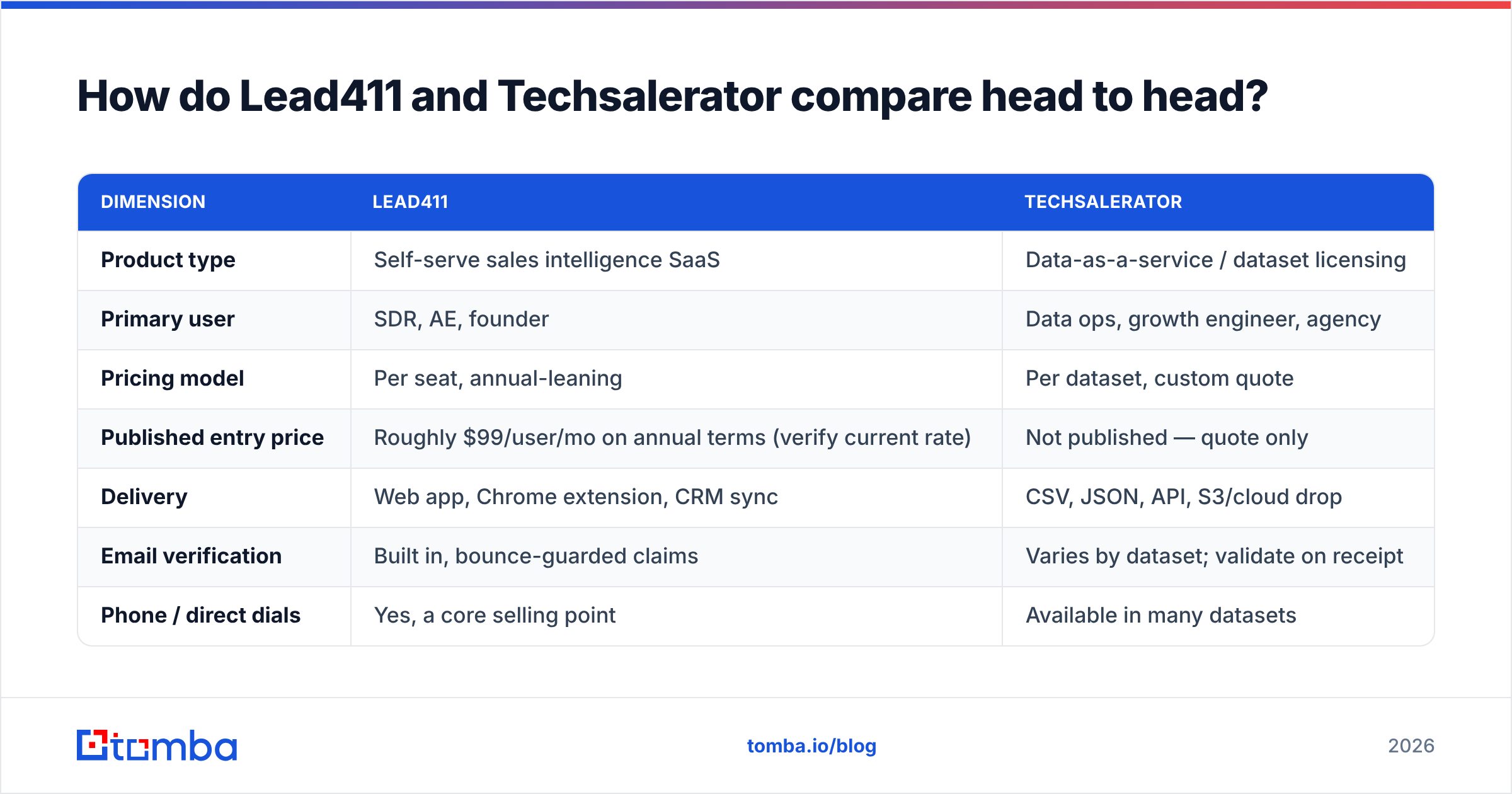
| Dimension | Lead411 | Techsalerator |
|---|---|---|
| Product type | Self-serve sales intelligence SaaS | Data-as-a-service / dataset licensing |
| Primary user | SDR, AE, founder | Data ops, growth engineer, agency |
| Pricing model | Per seat, annual-leaning | Per dataset, custom quote |
| Published entry price | Roughly $99/user/mo on annual terms (verify current rate) | Not published — quote only |
| Delivery | Web app, Chrome extension, CRM sync | CSV, JSON, API, S3/cloud drop |
| Email verification | Built in, bounce-guarded claims | Varies by dataset; validate on receipt |
| Phone / direct dials | Yes, a core selling point | Available in many datasets |
| Buyer intent data | Yes (Bombora-powered topics) | Not the core offering |
| Geographic strength | North America first | Global, strong outside the US |
| Best at | Working a list today | Building a list of 500k rows |
| Worst at | Bulk volume, exotic geographies | Single-rep, day-of prospecting |
The table makes the real answer obvious: "Lead411 vs Techsalerator" is rarely a true either/or. It's a question about which side of the workflow you're standing on. If your problem is "my reps need 40 good contacts before Thursday," Lead411 is the shape that fits. If your problem is "we need to seed a 300,000-row database for a new market," Techsalerator is the shape that fits — and trying to do it with per-seat exports will cost you more in credits and time than the file would.

What does each one actually cost in 2026?#
Here is where you should slow down, because the sticker price is not the spend.
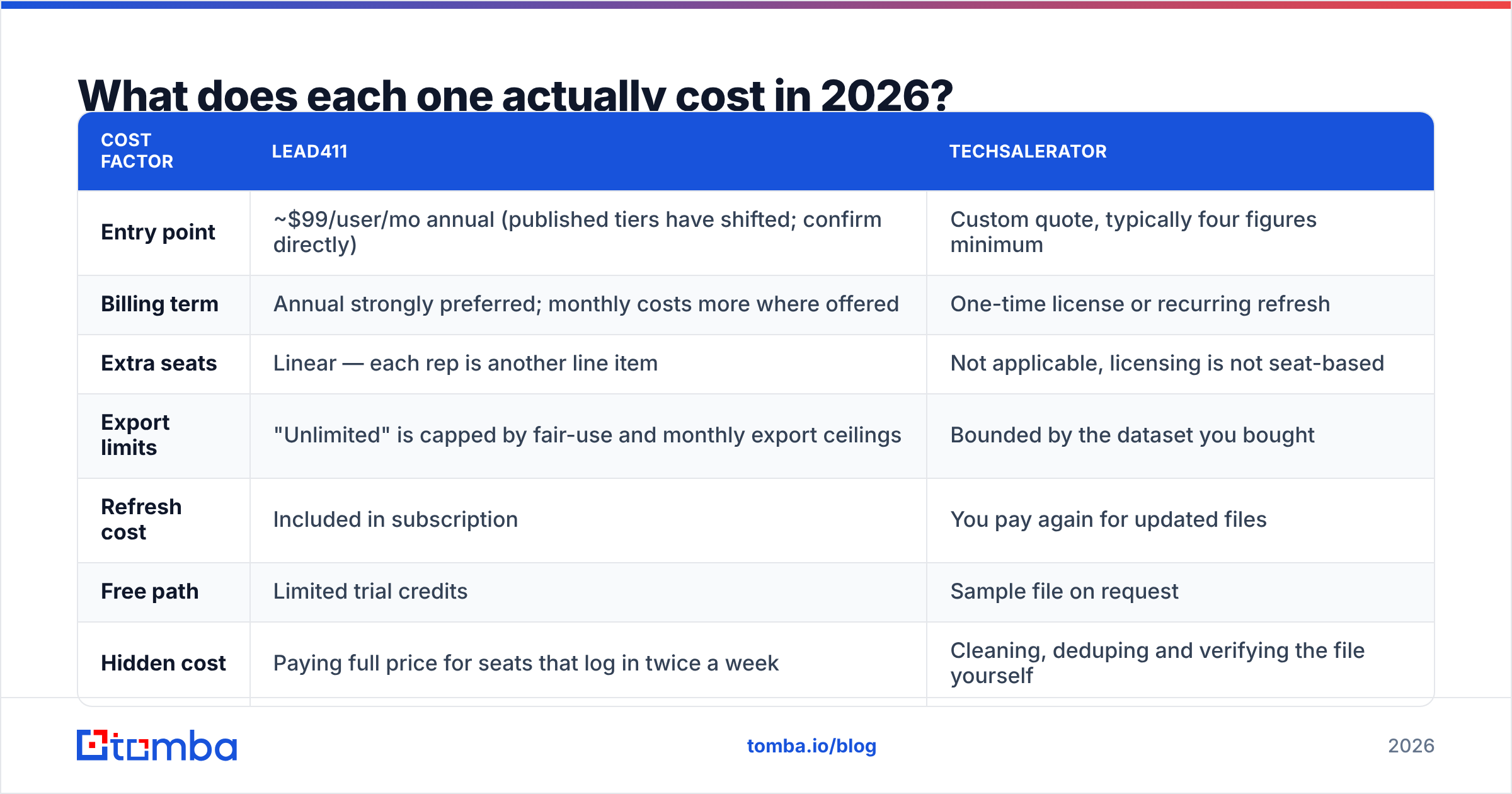
| Cost factor | Lead411 | Techsalerator |
|---|---|---|
| Entry point | ~$99/user/mo annual (published tiers have shifted; confirm directly) | Custom quote, typically four figures minimum |
| Billing term | Annual strongly preferred; monthly costs more where offered | One-time license or recurring refresh |
| Extra seats | Linear — each rep is another line item | Not applicable, licensing is not seat-based |
| Export limits | "Unlimited" is capped by fair-use and monthly export ceilings | Bounded by the dataset you bought |
| Refresh cost | Included in subscription | You pay again for updated files |
| Free path | Limited trial credits | Sample file on request |
| Hidden cost | Paying full price for seats that log in twice a week | Cleaning, deduping and verifying the file yourself |
Two honest notes. First, Lead411's published pricing has moved more than once, and annual-versus-monthly differences are significant — treat any number you read in a blog post (including this one) as a starting point for a quote, not a fact. Second, Techsalerator's cost is genuinely unknowable without a scoping call, because a 5,000-record niche file and a 4-million-record multi-country file are not the same purchase.
The cost most teams underestimate is the one at the bottom of that table: data decays. B2B contact data degrades somewhere around 2-3% per month as people change jobs. A file bought in January is measurably worse in June. With a subscription you at least get refreshed records; with a licensed file you're buying a photograph of a moving object. Run any purchased list through an email verifier before it touches your sending domain, regardless of which vendor it came from.
Which one has better data accuracy?#
Neither vendor will hand you an audited accuracy number, and you should be suspicious of any comparison post that claims otherwise. What you can reason about is how each one gets accuracy.
Lead411 runs continuous verification against its own database and markets bounce protection as part of the product. Because the records live in a subscription app, a bad email you flag can be corrected upstream and the correction benefits everyone. That feedback loop is real and it's the structural advantage of SaaS-delivered data.
Techsalerator's accuracy depends on the specific dataset and the specific source behind it. Some files are excellent — compiled from registries, licensed partnerships, and verified panels. Some are older aggregations. This is not a knock on the vendor; it's how dataset licensing works everywhere. The mitigation is simple and you should insist on it: request a sample, verify the sample yourself, and negotiate based on what the sample proves.
A practical benchmark to run on any sample, from either vendor:
- Pull 500 random rows, not the first 500 — vendors sometimes sort the good stuff to the top.
- Verify every email through an independent tool and record the valid / invalid / catch-all / unknown split.
- Check the catch-all bucket separately — a high catch-all rate isn't failure, but it does mean you need a catch-all verifier before sending, or your bounce rate will lie to you.
- Spot-check 25 job titles against LinkedIn to measure role drift, the failure mode verification cannot catch.
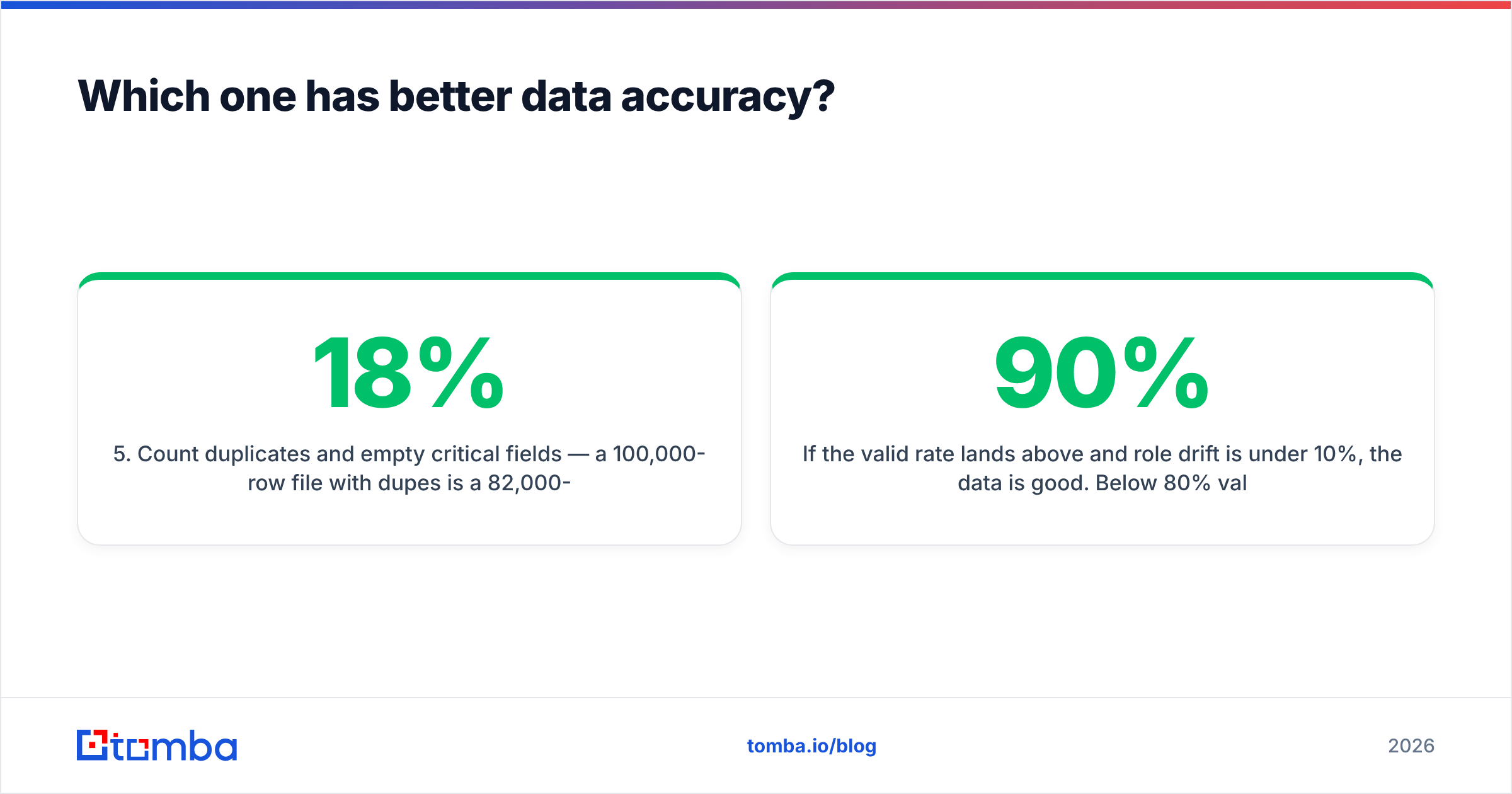
- Count duplicates and empty critical fields — a 100,000-row file with 18% dupes is a 82,000-row file at a 100,000-row price.
If the valid rate lands above 90% and role drift is under 10%, the data is good. Below 80% valid, walk away or renegotiate.
Which one fits your workflow?#
Use these five decision points instead of a feature checklist:
- Who touches the data first? If it's a rep, buy a UI (Lead411). If it's a script or a data engineer, buy a file (Techsalerator).
- How often does your list change? Weekly re-segmentation favors a subscription. One big market entry favors a license.
- Where are your buyers? North American mid-market is Lead411 territory. Cross-border, especially outside Western Europe, is where Techsalerator's coverage earns its quote.
- Do you need intent signals? Only one of the two treats intent and trigger events as a first-class feature, and it's Lead411.
- What's your procurement tolerance? Both involve a sales conversation. If you need data this afternoon without a contract, neither is your answer — a self-serve finder is.
That last point is the one teams discover too late. A lot of "Lead411 vs Techsalerator" searches are really "I need verified work emails and I don't want to sit through two demos" in disguise.

Where do both tools fall short?#
Lead411's weak spots: annual contracts that are hard to exit mid-term, "unlimited" allowances that turn out to have fair-use ceilings, and coverage that thins outside North America. Reviewers on G2 and Capterra consistently praise usability and consistently complain about renewal friction. Per-seat pricing also punishes the common pattern of one full-time prospector plus three occasional users.
Techsalerator's weak spots: no self-serve entry, no published pricing, and a delivery model that assumes you have somewhere to put a large file and someone to clean it. There is no Chrome extension moment where a rep looks up one person before a call. You also carry the compliance burden of documenting provenance for whatever you licensed — a real consideration under GDPR if any of those records are EU residents.
The shared weak spot: both sell you a database, and a database is a snapshot. Neither replaces a lookup you can run at the moment of need — the "I have this person's name and their company domain, get me their email right now" job. That's a different tool, and it's why most mature stacks run a database plus a finder rather than one or the other.
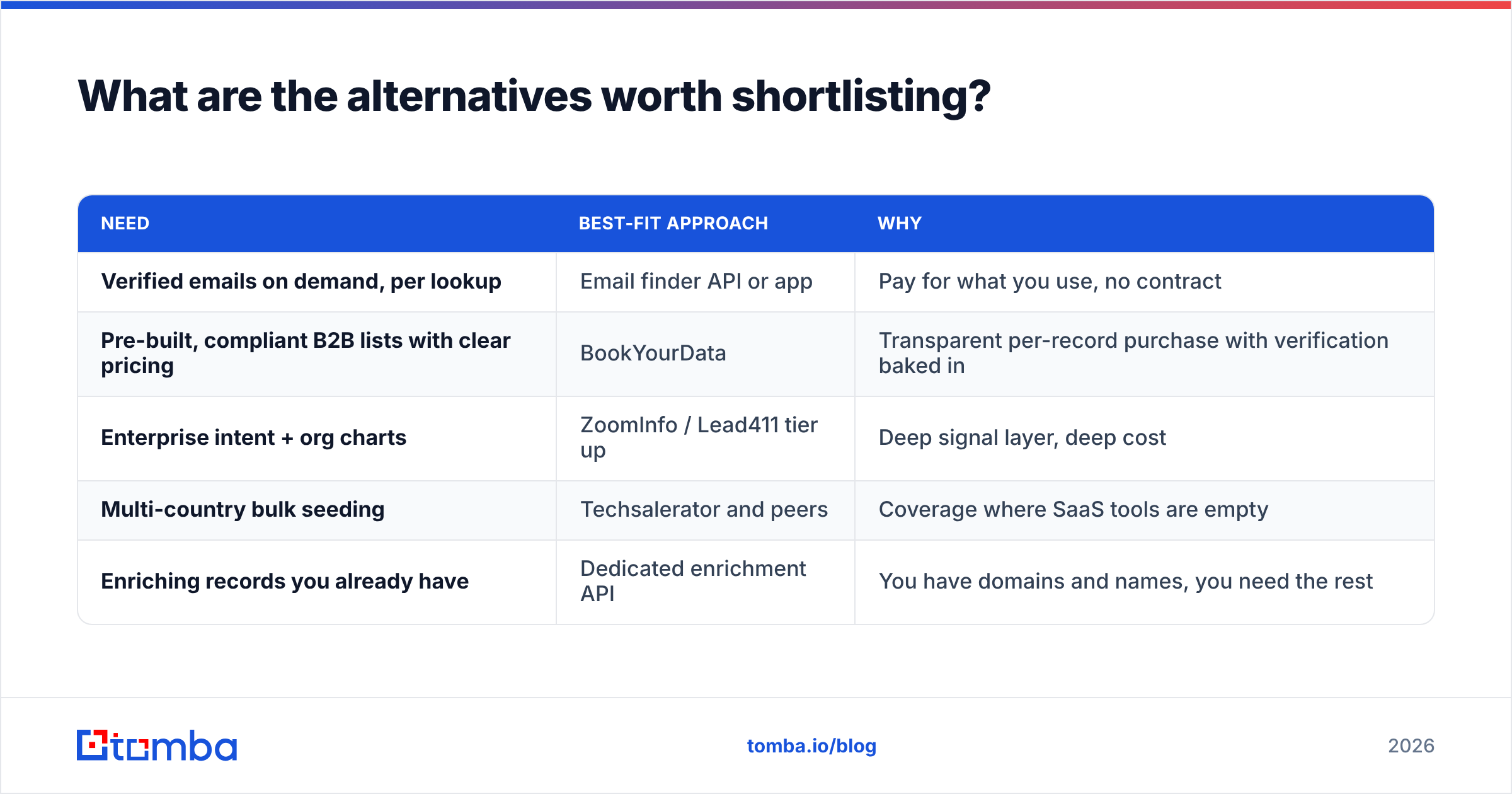
What are the alternatives worth shortlisting?#
If the head-to-head leaves you unconvinced, the adjacent options split cleanly by job:
| Need | Best-fit approach | Why |
|---|---|---|
| Verified emails on demand, per lookup | Email finder API or app | Pay for what you use, no contract |
| Pre-built, compliant B2B lists with clear pricing | BookYourData | Transparent per-record purchase with verification baked in |
| Enterprise intent + org charts | ZoomInfo / Lead411 tier up | Deep signal layer, deep cost |
| Multi-country bulk seeding | Techsalerator and peers | Coverage where SaaS tools are empty |
| Enriching records you already have | Dedicated enrichment API | You have domains and names, you need the rest |
BookYourData deserves a mention here because it occupies a genuinely useful middle ground: purchasable lists with published per-record pricing and verification guarantees, which removes the quote-call step that both Lead411 and Techsalerator require.
And if your gap is enrichment rather than discovery — you already have company domains from your CRM, your website visitors, or an event list — then data enrichment against those domains is cheaper and more accurate than buying a second database and trying to match it against your first one.
Is a dedicated email finder a better buy than either?#
For a specific and very common profile, yes.
If you are a team of one to ten doing targeted outbound — 200 to 2,000 well-researched contacts a month, not 200,000 — then the thing you actually need is: take a name and a company domain, return the verified work email, and do it reliably through an app, a spreadsheet, or an API. You do not need intent topics. You do not need a 3-million-row file. You need accuracy and a price you can predict.
That is what Tomba is built for, and the pricing is deliberately boring: Free at 25 searches a month, Starter at $49/mo, Growth at $99/mo, Pro at $249/mo, Enterprise on request. Full Tomba pricing is public — no demo gate, no annual lock-in to see a number. The Tomba API covers the same functions programmatically if you'd rather wire finding and verification into your own pipeline than log into another dashboard.
The honest boundary: Tomba is not a replacement for Techsalerator if you need to license a million-row consumer dataset for Indonesia, and it is not a replacement for Lead411's intent topics if intent is central to your motion. It replaces the part of both products that most teams actually use — finding and verifying work emails — at a fraction of the commitment.
So which should you choose?#
Choose Lead411 if reps are the primary users, your market is North America-heavy, intent and trigger events matter to your targeting, and you can live with an annual agreement.
Choose Techsalerator if you're buying data as raw material — bulk volume, international coverage, custom segments — and you have the technical capacity to clean, verify, and load what arrives.
Choose neither if what you're really solving is "get me verified emails for these specific people, this week, without a contract." That's a finder problem, not a database problem, and paying database prices for it is the most common overspend in the outbound stack.
Whatever you pick, verify before you send. Every list from every vendor, including the expensive ones, goes stale between the day it was compiled and the day it hits your sequencer. Verification is the cheapest insurance in the entire outbound budget.
Start with the part you can test in five minutes. Run the exact contacts you're about to buy through Tomba Email Finder — free for your first 25 searches, $49/mo when you're ready to scale. If the finder returns what the database was going to sell you, you just learned something useful about the quote sitting in your inbox.
Related guides#
// get started
Find, verify and enrich your first contacts today
Start on the free plan with 25 searches a month, then scale when your team is ready.
Free plan · No credit card required · GDPR & CCPA
// about the author