LeadGenius vs Tami AI: Which B2B Data Tool Wins in 2026?
LeadGenius sells human-verified custom datasets. Tami AI sells autonomous AI prospecting agents. Two very different bets on where B2B data is going — here's which one fits your GTM motion, and what both cost you.
TL;DR
- LeadGenius is a managed, human-in-the-loop data service. You brief a team, they build a custom dataset to your spec. Enterprise contracts, typically five figures annually, multi-week onboarding.
- Tami AI is an AI-agent prospecting platform. It researches accounts, scores intent signals, and drafts outreach autonomously. Faster to start, self-serve-ish pricing, less control over source data.
- They are not really competitors. LeadGenius wins when your ICP is weird and off-the-shelf databases fail. Tami AI wins when your ICP is standard and your bottleneck is rep capacity.
- Both are heavy for teams whose actual problem is "I have a list of companies and need verified emails." That's a $49/mo problem, not a $30K one.
- Budget reality: LeadGenius realistically starts around $2,000–$3,000/mo. Tami AI sits in the low hundreds to low thousands per seat. Neither publishes public pricing, which tells you something.
What problem are LeadGenius and Tami AI actually solving?#
Different ones. That's the whole article in a sentence.
Think of B2B data tooling like getting a suit. LeadGenius is the tailor: you give measurements, wait three weeks, and get something that fits nobody else. Tami AI is the smart personal shopper: it knows your size, scans the racks continuously, and hands you options every morning. One solves "nothing off the rack fits me." The other solves "I don't have time to shop."
LeadGenius has been around since 2011 (originally MobileWorks) and built its business on human-verified, custom-researched B2B data. The pitch: standard databases like ZoomInfo or Apollo cover firmographics everyone already has. LeadGenius researches the attributes nobody sells — whether a retailer uses a specific POS system, how many forklifts a warehouse operates, which hospitals have a dedicated telehealth budget line. Their company site leans hard into "custom data points" and Fortune 500 logos.
Tami AI is newer and sits in the 2025–2026 wave of AI SDR / agentic prospecting tools. The pitch: your reps waste 60% of their week on research and list-building, so let agents do account research, surface buying signals, and pre-draft the outreach. Reps approve and send.
The overlap is thin. Both end with "more qualified pipeline," but the mechanism, the cost structure, and the failure modes are unrelated.

How do LeadGenius and Tami AI compare head-to-head?#
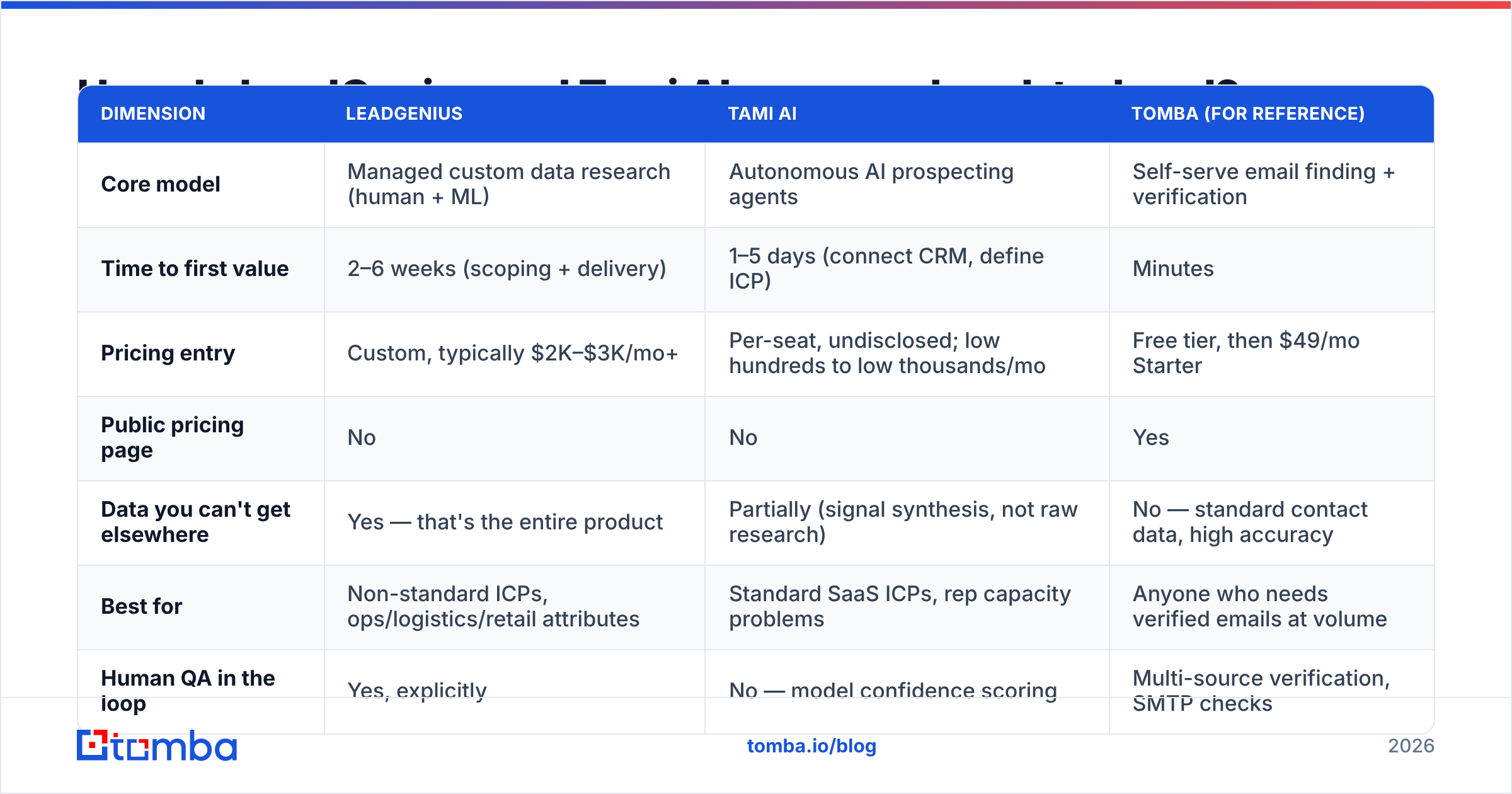
| Dimension | LeadGenius | Tami AI | Tomba (for reference) |
|---|---|---|---|
| Core model | Managed custom data research (human + ML) | Autonomous AI prospecting agents | Self-serve email finding + verification |
| Time to first value | 2–6 weeks (scoping + delivery) | 1–5 days (connect CRM, define ICP) | Minutes |
| Pricing entry | Custom, typically $2K–$3K/mo+ | Per-seat, undisclosed; low hundreds to low thousands/mo | Free tier, then $49/mo Starter |
| Public pricing page | No | No | Yes |
| Data you can't get elsewhere | Yes — that's the entire product | Partially (signal synthesis, not raw research) | No — standard contact data, high accuracy |
| Best for | Non-standard ICPs, ops/logistics/retail attributes | Standard SaaS ICPs, rep capacity problems | Anyone who needs verified emails at volume |
| Human QA in the loop | Yes, explicitly | No — model confidence scoring | Multi-source verification, SMTP checks |
| Contract commitment | Annual, typically | Annual or quarterly | Monthly, cancel anytime |
| API access | Yes, enterprise tier | Yes | Yes, on all paid plans |
| Team size fit | 20+ reps, enterprise GTM | 5–50 reps | 1–500, any size |
The row that matters most is "time to first value." If you need pipeline this quarter, a six-week data-scoping engagement is a different kind of decision than a five-day agent rollout.
Is LeadGenius worth the enterprise price tag?#
It depends entirely on whether your ICP is searchable.
Here's the test. Open any standard B2B database and try to build your target list. Can you filter to it using industry, headcount, revenue, tech stack, and location? If yes, LeadGenius is expensive overkill — you're paying custom-research rates for data that already exists in a $99/mo product.
If your answer is "no, I need companies that operate cold-chain logistics in three specific states and run SAP," then you've found LeadGenius's actual market. Nobody sells that filter. Someone has to go look.
Where LeadGenius genuinely wins:
- Custom attributes that require judgment. Does this manufacturer have an in-house sustainability team? A human can read the About page, check LinkedIn titles, and decide. A scraper can't.
- Data refresh on a schedule. Enterprise customers get re-verified datasets quarterly, which matters when your TAM churns.
- Coverage in thin markets. Non-US mid-market, industrial, healthcare ops — categories where Apollo and ZoomInfo density drops hard.
- Compliance posture. Human-sourced data with documented provenance is easier to defend in a GDPR conversation than "we scraped it."
- Ops integration. They'll deliver into your Salesforce or Snowflake, not just a CSV.
Where it doesn't:
- If you're under 20 reps, the contract minimum alone eats your entire tooling budget.
- Turnaround is measured in weeks. If your GTM experiments run in two-week sprints, you'll outrun the vendor.
- You're buying a service, not a tool. Self-serve iteration is not part of the deal.
For a sanity check on pricing and satisfaction, look at current G2 reviews for LeadGenius rather than the vendor's case studies — the review corpus is more honest about onboarding time.
Is Tami AI just another AI SDR?#
Mostly, yes — and that's not automatically a criticism.
The 2026 AI-SDR category has converged on a common shape: ingest your CRM, define an ICP, monitor signals (job posts, funding, tech changes, LinkedIn activity), draft personalized sequences, hand to a rep for approval. Tami AI executes this pattern. It differentiates on research depth — the agent reads company materials rather than just pattern-matching firmographics — and on how tightly it loops back into your existing sequencer.
What it's genuinely good at:
- Compressing research time. The 20-minute pre-call research ritual drops to reading a two-paragraph brief. That's real, measurable rep-hour recovery.
- Continuous signal monitoring. Humans check for triggers when they remember to. An agent checks always.
- Consistency. Your worst rep's research quality rises to roughly your median. That's a bigger lift than raising the top.
What to be skeptical about:
- Contact data is usually rented, not owned. Most AI SDR platforms license contact records from a data partner or build thin proprietary sets. Ask explicitly: where do the emails come from, what's the bounce rate, and who eats the cost when it's wrong? If the answer is vague, treat the contact layer as a weak point and plan to verify independently.
- "Personalization" quality is a coin flip. Agent-written opening lines that reference a company's blog post read as automated to any buyer who's seen three of them this week. Gartner's sales technology research has been flagging buyer fatigue with pseudo-personalization since 2024.
- Attribution is murky. When pipeline goes up after an AI SDR rollout, isolating the agent's contribution from the extra rep hours it freed is hard. Instrument this before you buy, not after.
- Undisclosed pricing. Neither vendor publishes rates, which historically correlates with per-customer price discovery.
Which one fits your team size and GTM motion?#
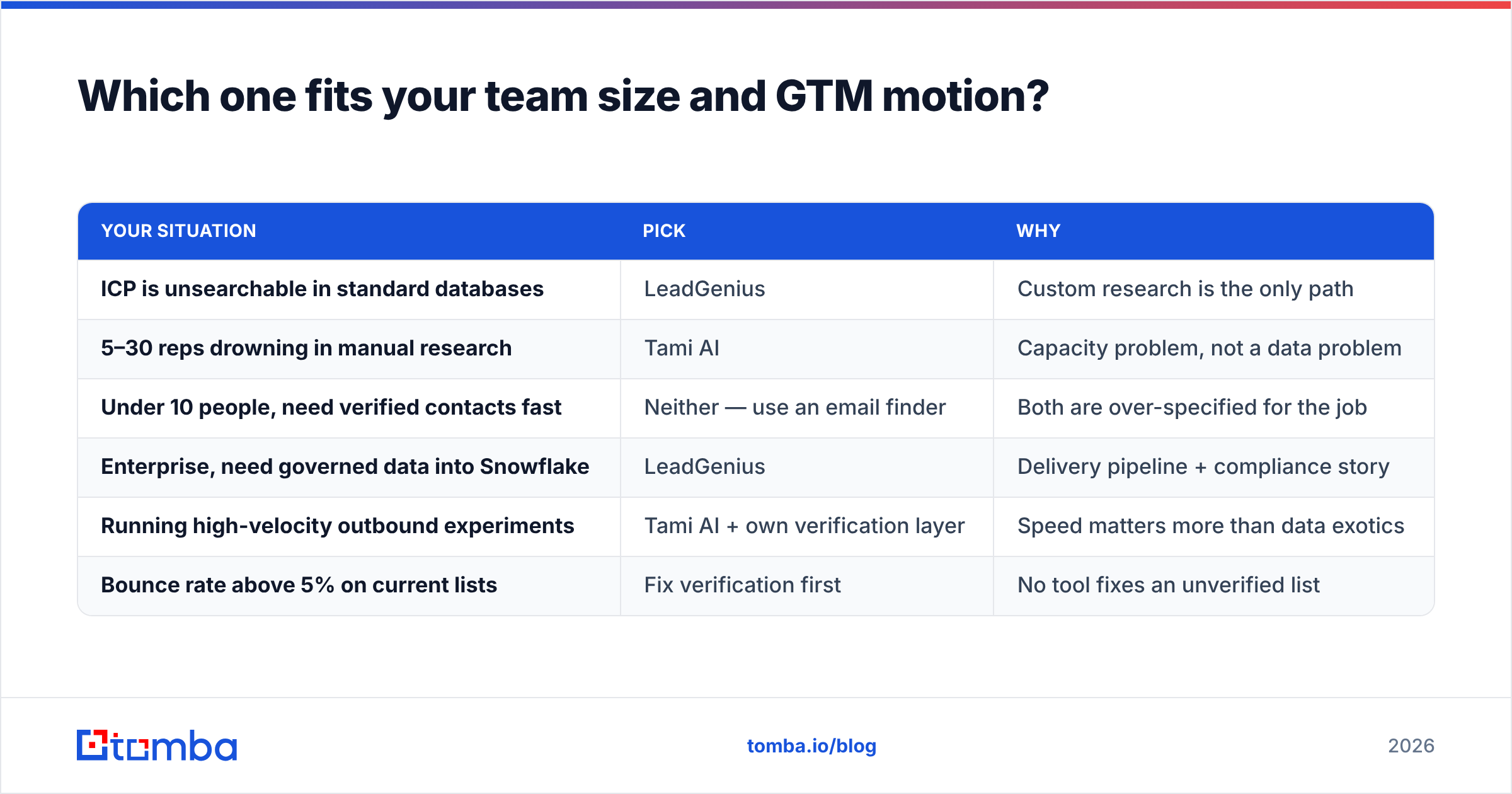
Use this as a decision grid rather than a ranking.
| Your situation | Pick | Why |
|---|---|---|
| ICP is unsearchable in standard databases | LeadGenius | Custom research is the only path |
| 5–30 reps drowning in manual research | Tami AI | Capacity problem, not a data problem |
| Under 10 people, need verified contacts fast | Neither — use an email finder | Both are over-specified for the job |
| Enterprise, need governed data into Snowflake | LeadGenius | Delivery pipeline + compliance story |
| Running high-velocity outbound experiments | Tami AI + own verification layer | Speed matters more than data exotics |
| Bounce rate above 5% on current lists | Fix verification first | No tool fixes an unverified list |
That last row is the one most teams skip. Buying an AI agent to send more emails from a list with a 9% bounce rate is spending money to damage your domain faster. Run the list through an email verifier before you scale anything.
What do both tools cost you beyond the license fee?#
Software line items are the cheap part. The expensive parts are:
LeadGenius hidden costs:
- Scoping time. Someone senior on your team spends 10–20 hours defining attributes, reviewing samples, and iterating. That's real headcount cost.
- Annual lock-in. If your ICP shifts mid-contract, you renegotiate or eat it.
- Ingestion engineering. Custom datasets need a home. Budget ops time for CRM mapping and dedupe.
Tami AI hidden costs:
- Approval overhead. Agent-drafted emails still need review. If reps rubber-stamp, quality collapses. If they edit carefully, you've recovered less time than the ROI deck promised.
- Deliverability exposure. More volume from the same domains means sender reputation risk. Watch your sender reputation weekly, not quarterly.
- Verification layer. Almost certainly a separate tool. Budget it.
Both:
- Data decay. B2B contact data degrades roughly 25–30% annually as people change jobs. Whatever you buy in Q1 is meaningfully stale by Q4. Re-verification is not optional; it's a recurring line item.
Are there cheaper alternatives that cover 80% of the need?#
For most teams, yes — because most teams don't actually have a LeadGenius problem or a Tami AI problem.
The common shape of the real problem: you already know which companies to target (from a conference list, a G2 category, an investor portfolio page, a scraped directory). What you don't have is reliable contact data for the right people at those companies. That's a fundamentally cheaper problem.
A lean stack that handles it:
- Company list source — free or near-free. Conference attendee lists, LinkedIn Sales Navigator exports, Crunchbase filters, public directories.
- Contact discovery — run the domains through domain search to pull every public email at each company with role and confidence scoring. Or go name-first with the email finder.
- Verification — SMTP-level validation before send, including catch-all verification for the domains that accept everything and tell you nothing.
- Enrichment — fill in titles, seniority, company size with data enrichment so your sequencing tool has fields to personalize on.
- Scale — when it works, push it through bulk email finder or the API rather than one lookup at a time.
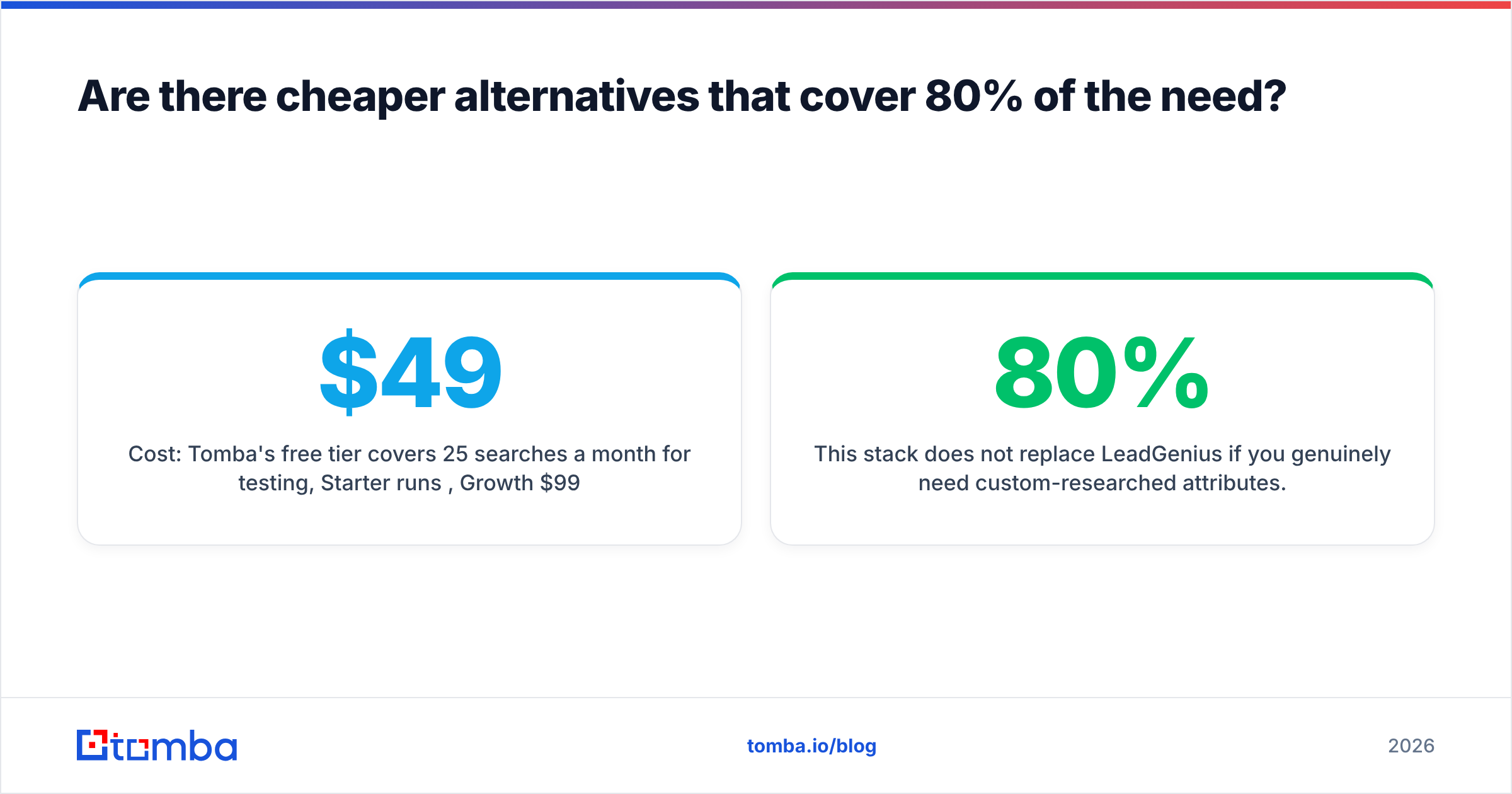
Cost: Tomba's free tier covers 25 searches a month for testing, Starter runs $49/mo, Growth $99/mo, and Pro $249/mo — full Tomba pricing is public, which is more than either vendor above will tell you without a call.
This stack does not replace LeadGenius if you genuinely need custom-researched attributes. Nothing self-serve does. It does replace roughly 80% of what teams think they need an enterprise data contract for.
Worth noting alongside these options: BookYourData takes a different and credible third approach — pay-as-you-go verified B2B lists with a bounce guarantee, no subscription. For teams that need a one-off list rather than an ongoing data pipeline, that model often makes more sense than either a managed research contract or an agent seat.
How should you run the evaluation?#
Don't demo. Test with your own data.
A four-step process that surfaces truth:
- Build a 100-record ground-truth list. Pick accounts where you already know the correct contact and email. Your existing closed-won accounts work well.
- Run each vendor against it blind. Measure match rate (how many records they return) and accuracy (how many are correct). Vendors optimize for match rate because it looks better. Accuracy is what costs you.
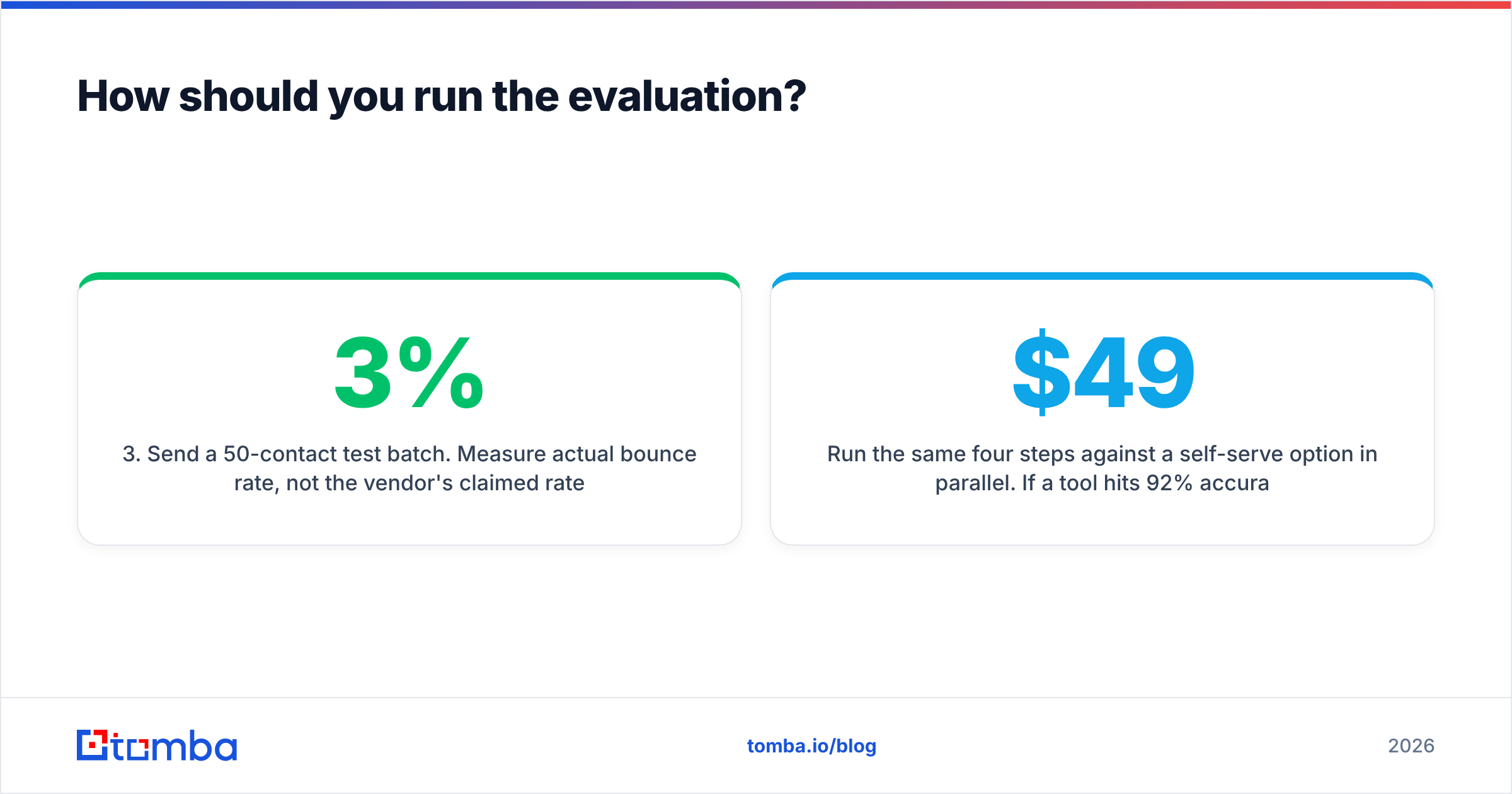
- Send a 50-contact test batch. Measure actual bounce rate, not the vendor's claimed rate. Anything above 3% on verified data is a problem.
- Time the workflow end to end. From "I want contacts at these 200 companies" to "sequence is live." Include every handoff. This number decides more than feature lists do.
Run the same four steps against a self-serve option in parallel. If a $49/mo tool hits 92% accuracy on your ground-truth list and the enterprise option hits 94%, you now know exactly what that two-point delta costs per year — and whether it's worth it.
The verdict#
Choose LeadGenius if your ICP requires attributes that do not exist in any database you can buy, you have enterprise budget, and you can absorb a multi-week delivery cycle. It's a real service solving a real problem that self-serve tools cannot touch. Just be honest about whether that's your problem.
Choose Tami AI if your reps are your bottleneck, your ICP is conventional, and you want research and drafting compressed. Budget for a separate verification layer and instrument attribution before rollout so you can prove or disprove the ROI in one quarter.
Choose neither if what you actually need is verified contact data at companies you've already identified. That's the majority case, and it's an order of magnitude cheaper to solve.
Start with the cheap experiment before the expensive one. Take 50 target company domains, run them through the Tomba Email Finder, verify the results, and send. If the accuracy and bounce numbers hold, you've solved your pipeline problem for $49/mo and can spend the enterprise budget somewhere it actually moves the number. If they don't hold, you'll have a precise, evidence-backed case for what custom data or AI agents need to deliver — and you'll negotiate from a much stronger position. The free tier gives you 25 searches to run that test today.
Related guides#
Ready to find emails that actually work?
Join 150,000+ professionals who stopped guessing and started sending. Free credits on signup — no credit card required.
Get the Tomba newsletter
Practical outbound tactics and product updates — once every two weeks.
About the author