LeadGenius vs Warpleads: Which B2B Lead Data Wins in 2026
LeadGenius sells managed, human-verified data at enterprise prices. Warpleads sells self-serve volume. Here is which one actually fits your pipeline in 2026, and when a cheaper email finder beats both.
LeadGenius vs Warpleads is a common shortlist, yet the two tools barely overlap. One sells custom research. The other sells volume at speed. Here is which one fits your budget, and when a cheaper email finder beats both.
TL;DR
- LeadGenius is a managed, human-in-the-loop data service. It builds custom fields no off-the-shelf database sells. Pricing is quoted, not published, and usually annual.
- Warpleads is a self-serve export platform for cold email operators and agencies. It sells large verified lists fast, with unlimited-export plans billed monthly.
- They are not really competitors. One sells research. The other sells volume. The choice is mostly about how unusual your ICP is.
- If your real problem is "no email addresses," neither tool is the cheapest fix. A dedicated email finder starts at $49/mo.
- Verification is the hidden variable. Both kinds of provider hand you catch-all domains. Both let you send to them at your own risk.
What are LeadGenius and Warpleads, exactly?#
LeadGenius has been around since roughly 2011. It sits at the "managed data" end of the market. You do not log in and run a search. You brief a team. They mix machine extraction with human researchers, then deliver a dataset built to your spec: headcount by department, store locations per retail brand, the SKUs a distributor carries, or the payment processor a company runs. That is the pitch. Custom attributes that Apollo, ZoomInfo, and Clearbit do not have columns for.
Warpleads is a much newer arrival, built for the cold-email era. It packages a large B2B contact database with on-demand list building. Higher tiers add unlimited exports. The pitch is blunt: get tens of thousands of verified B2B emails into your sequencer this week, with no sales call and no annual contract.
The mental model that helps: LeadGenius is a research agency wearing a SaaS jacket. Warpleads is a vending machine. Both dispense leads. Only one of them will ask what your ICP looks like.
How does each one actually build its data?#
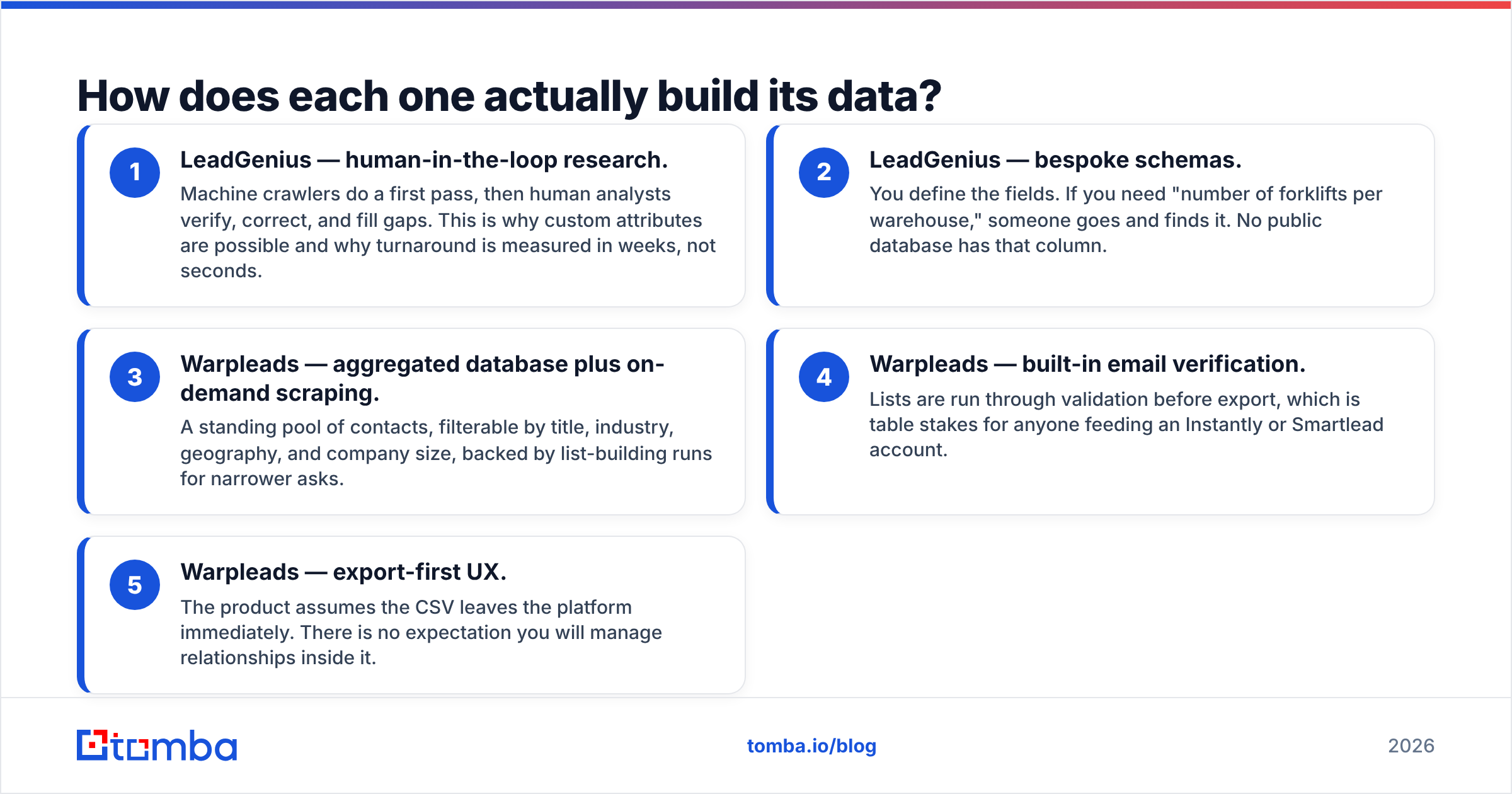
This is where the difference stops being marketing and starts affecting your pipeline. Here is what sits under each product:
- LeadGenius — human-in-the-loop research. Machine crawlers do a first pass, then human analysts verify, correct, and fill gaps. This is why custom attributes are possible and why turnaround is measured in weeks, not seconds.
- LeadGenius — bespoke schemas. You define the fields. If you need "number of forklifts per warehouse," someone goes and finds it. No public database has that column.
- Warpleads — aggregated database plus on-demand scraping. A standing pool of contacts, filterable by title, industry, geography, and company size, backed by list-building runs for narrower asks.
- Warpleads — built-in email verification. Lists are run through validation before export, which is table stakes for anyone feeding an Instantly or Smartlead account.
- Warpleads — export-first UX. The product assumes the CSV leaves the platform immediately. There is no expectation you will manage relationships inside it.
The practical consequence: LeadGenius data is narrower, deeper, and slower. Warpleads data is broader, shallower, and instant. Neither is wrong. They answer different questions.
LeadGenius vs Warpleads: how do they compare head-to-head?#
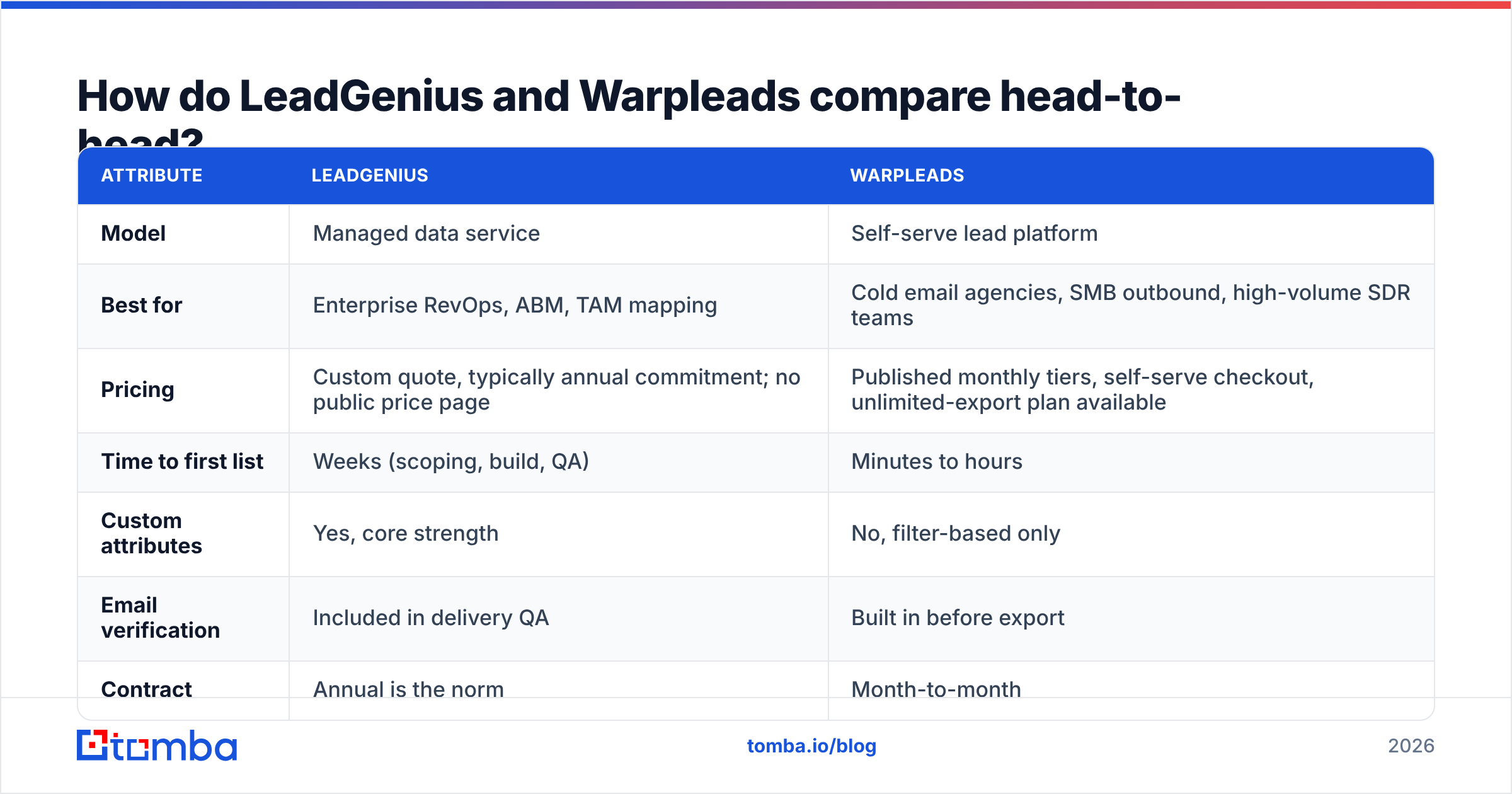
| Attribute | LeadGenius | Warpleads |
|---|---|---|
| Model | Managed data service | Self-serve lead platform |
| Best for | Enterprise RevOps, ABM, TAM mapping | Cold email agencies, SMB outbound, high-volume SDR teams |
| Pricing | Custom quote, typically annual commitment; no public price page | Published monthly tiers, self-serve checkout, unlimited-export plan available |
| Time to first list | Weeks (scoping, build, QA) | Minutes to hours |
| Custom attributes | Yes, core strength | No, filter-based only |
| Email verification | Included in delivery QA | Built in before export |
| Contract | Annual is the norm | Month-to-month |
| Free trial | Demo call, no open free tier | Limited self-serve entry, verify current terms |
| Who signs off | Procurement and RevOps leadership | A credit card and an SDR manager |
| Data refresh | Re-run as contracted | Continuous database updates |
Always confirm current pricing and terms on each vendor's own site before you budget. LeadGenius does not publish rates, and Warpleads has revised its tiers more than once since launch.
Which one is actually cheaper?#
Warpleads, by a wide margin, for almost every team under 50 reps. On price alone, LeadGenius vs Warpleads is not a close call. You are comparing a card-swipe SaaS tier against a service that pays human researchers.
But cheapest-per-record is the wrong metric, and this is where a lot of outbound budgets quietly go sideways. Three costs never show up on the invoice:
- Wasted sends. A 40,000-record list with a 12% bounce rate does not cost you 4,800 emails. It costs you domain reputation, and that costs you every campaign that follows. Run any bulk list through an independent email verifier before you send. Do not trust the exporter's own scoring.
- Rep time on bad fit. Volume providers filter on the attributes they have. Say your real qualifier is "uses a specific ERP" or "has more than three distribution centers." You cannot filter on it, so your reps qualify by hand. At 200 accounts a week, that is a headcount decision dressed up as a data decision.
- Onboarding drag. Managed data has a real ramp. Scoping, sample review, revisions, final delivery. If your quarter is already half over, LeadGenius will not save it.
The honest framing: LeadGenius costs more per record and less per qualified record when your ICP is genuinely hard to identify. Warpleads costs less per record and more per qualified record when your ICP is narrow. When your ICP is broad and title-based, Warpleads wins on both axes.
How accurate is the data from each?#
Every vendor in this category claims 95%+ accuracy. Treat those numbers as marketing until you test them.
What differs is how accuracy decays. Managed, human-verified data is accurate at delivery and then ages normally. Industry churn runs about 25-30% a year on B2B contacts. Aggregated databases are strong on the core they refresh often: large companies and common titles. They are much weaker on the long tail of sub-20-employee firms, non-English markets, and roles that changed last month.
The test that settles it, and the one most teams skip:
- Pull a 200-record sample from each provider against your real ICP, not a generic filter.
- Verify all 400 through a neutral third party so neither vendor grades its own homework.
- Split the results by company size band and region. This is where the gap appears.
- Check catch-all rates separately. A catch-all domain is not a valid email, it is an unknown, and counting it as "valid" is how vendors inflate accuracy claims. A catch-all verifier resolves the ones that can be resolved.
- Measure bounce rate on the first send, not the claimed rate.
If a provider will not give you a sample against your own ICP, that tells you something on its own.

Which fits your outbound motion?#
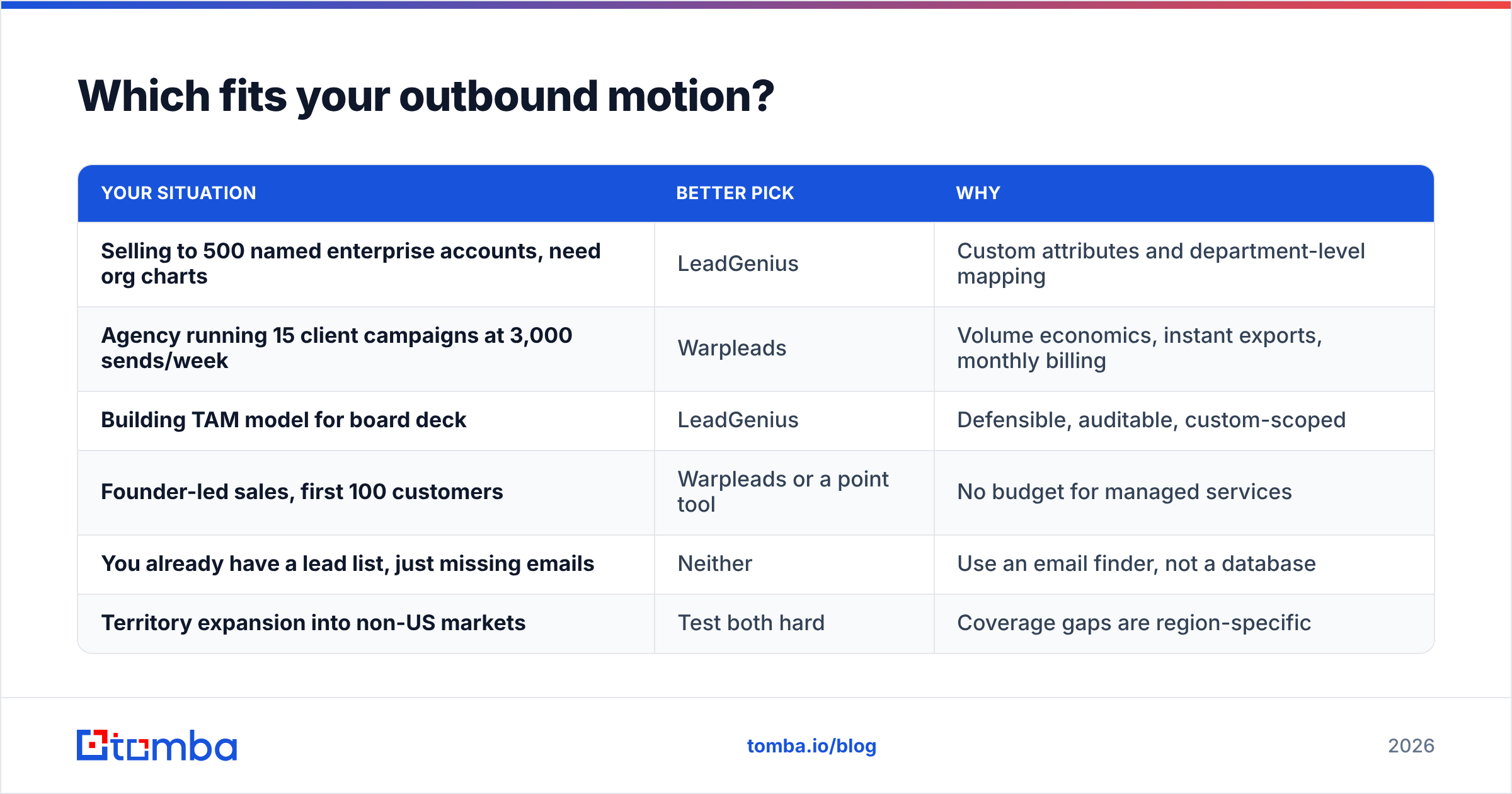
| Your situation | Better pick | Why |
|---|---|---|
| Selling to 500 named enterprise accounts, need org charts | LeadGenius | Custom attributes and department-level mapping |
| Agency running 15 client campaigns at 3,000 sends/week | Warpleads | Volume economics, instant exports, monthly billing |
| Building TAM model for board deck | LeadGenius | Defensible, auditable, custom-scoped |
| Founder-led sales, first 100 customers | Warpleads or a point tool | No budget for managed services |
| You already have a lead list, just missing emails | Neither | Use an email finder, not a database |
| Territory expansion into non-US markets | Test both hard | Coverage gaps are region-specific |
That fifth row deserves emphasis, because it describes more teams than anyone admits. A large share of "we need a data vendor" conversations are really "our CRM has 8,000 contacts with no verified email address." That is an enrichment problem, not a database problem. Buying a $30k contract to solve it is expensive. Running the file through data enrichment or a bulk email finder costs two orders of magnitude less.
What are the real limitations of each?#
LeadGenius limitations. No self-serve entry point, so evaluation requires a sales cycle. Pricing opacity makes budget planning hard and makes you a worse negotiator. Turnaround time is incompatible with opportunistic campaigns. Contract structure is annual, so a bad fit is a year-long bad fit. You also depend on the vendor's research capacity for refreshes, which is fine until you need the same dataset updated monthly.
Warpleads limitations. Filter-based search means your segmentation is only as good as their schema. Data depth on very small companies and non-English-speaking markets is thinner than on US mid-market. "Unlimited exports" is a real feature, but it is also a temptation: unlimited volume plus mediocre targeting is how teams burn sending domains. And because it is export-first, there is no relationship layer, no intent signal, and no account-level intelligence.
Both. Neither replaces a verification step you control. Neither gives you email deliverability infrastructure. Neither writes your sequences. Data is one input among several, and it is not usually the one limiting your reply rate.
Are there better alternatives in 2026?#
Depending on what you actually need, yes. A few worth comparing on G2 before committing:
- BookYourData is a strong option if you want prepaid, verified B2B contact lists with a pay-as-you-go structure and a bounce guarantee. It sits between the two tools in this post: more self-serve than LeadGenius, more list-purchase oriented than Warpleads. Worth a look for teams who want defined volume without a subscription.
- Apollo or Clay if you want database plus sequencing or database plus orchestration in one place.
- Tomba if the specific gap is finding and verifying work emails at scale from domains, names, or LinkedIn profiles, rather than buying a list.
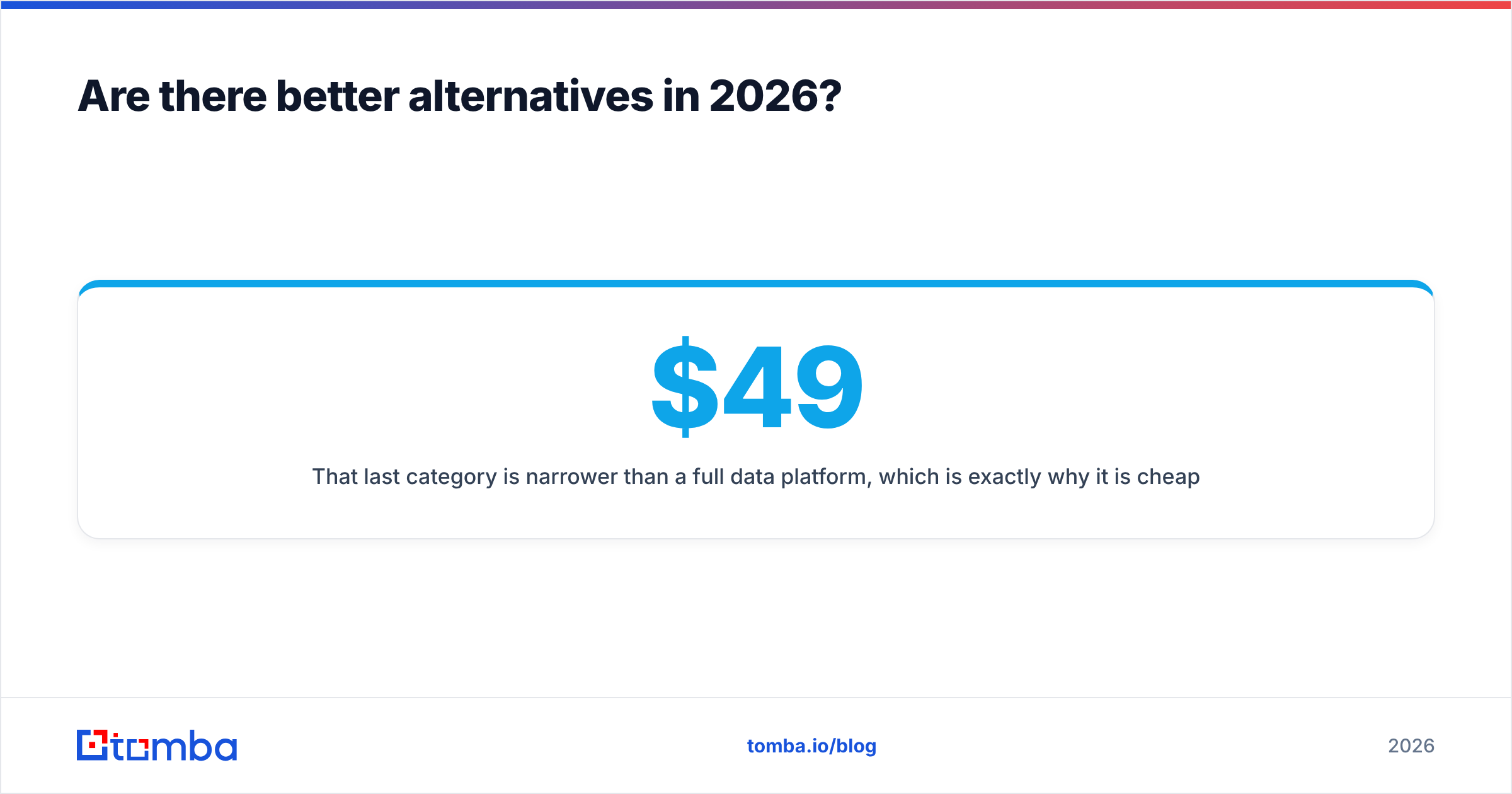
That last category is narrower than a full data platform, which is exactly why it is cheaper. Tomba pricing starts with a free tier at 25 searches per month, Starter at $49/mo, Growth at $99/mo, and Pro at $249/mo. The API and Chrome extension are included rather than sold separately. For a two-person outbound team that already knows who it wants to reach, that is the whole budget line.
So which should you choose?#
Most LeadGenius vs Warpleads decisions come down to three cases.
Choose LeadGenius if you have an enterprise budget, a genuinely unusual ICP definition, and a quarter of runway to onboard. The custom-attribute capability is real, and nothing self-serve replicates it.
Choose Warpleads if you run high-volume outbound, your ICP is defined by title and industry, and you need lists this week without a procurement cycle. The unlimited-export tiers are good economics for agencies.
Choose neither if your bottleneck is contact-level email data rather than account discovery. That is the most common case, and the easiest one to over-buy for.
Before you sign anything, run the 200-record test above. Two afternoons of verification will tell you more than four vendor demos, and it costs almost nothing.
Ready to fix the email gap without a contract? Start with the Tomba Email Finder. Drop in a domain, a name, or a company list and get verified professional email addresses back, with confidence scores and source attribution you can audit. The free tier gives you 25 searches a month to test accuracy against your own ICP, and Starter is $49/mo if it holds up. Test it against whatever list your current provider hands you, and let the bounce rate decide.
Related guides#
// get started
Find, verify and enrich your first contacts today
Start on the free plan with 25 searches a month, then scale when your team is ready.
Free plan · No credit card required · GDPR & CCPA
// about the author