LeadGenius vs ZoomInfo: Which B2B Data Platform Wins in 2026?
One sells you a giant database and a seat license. The other sells you a research team that builds the list you actually asked for. Here is how LeadGenius and ZoomInfo really compare on data, pricing, contracts, and fit.
TL;DR: the LeadGenius vs ZoomInfo choice comes down to custom data versus scale.
- LeadGenius is a managed data service. You name the accounts and fields you want. A mix of people and software builds that list. It is custom, slow to start, and priced like a service deal.
- ZoomInfo is a self-serve database at scale. You log in, filter, export, and push to your CRM. Breadth is the draw. Annual deals and seat pricing are the cost.
- Neither one posts a public price. Buyers report ZoomInfo deals from the mid-five figures a year. LeadGenius quotes are custom and land in the same bracket.
Two more points settle most LeadGenius vs ZoomInfo deals:
- Most teams under 50 reps are overbuying. Need work emails for firms you already know? A $49/mo email finder does that job.
- The split: odd, hard-to-find fields go to LeadGenius. Broad US tech coverage plus intent goes to ZoomInfo. Targeted, verified contacts on a budget go to a lighter tool like Tomba.
What is LeadGenius and who actually buys it?#
LeadGenius is a managed B2B data provider. You hand it a spec. It hands back a list built to that spec. The LeadGenius vs ZoomInfo call starts right here.
A spec might read like this: every mid-market logistics firm in DACH that runs SAP, plus the name and email of whoever owns warehouse ops. Software gathers what it can. Researchers verify the rest and fill the gaps that crawlers miss.
Think of a supermarket and a butcher. The supermarket stocks 40,000 items and you walk the aisles. The butcher stocks fewer, but cuts exactly what you ask for. He also tells you when a cut is not in stock this week.
The buyers who win here are easy to spot:
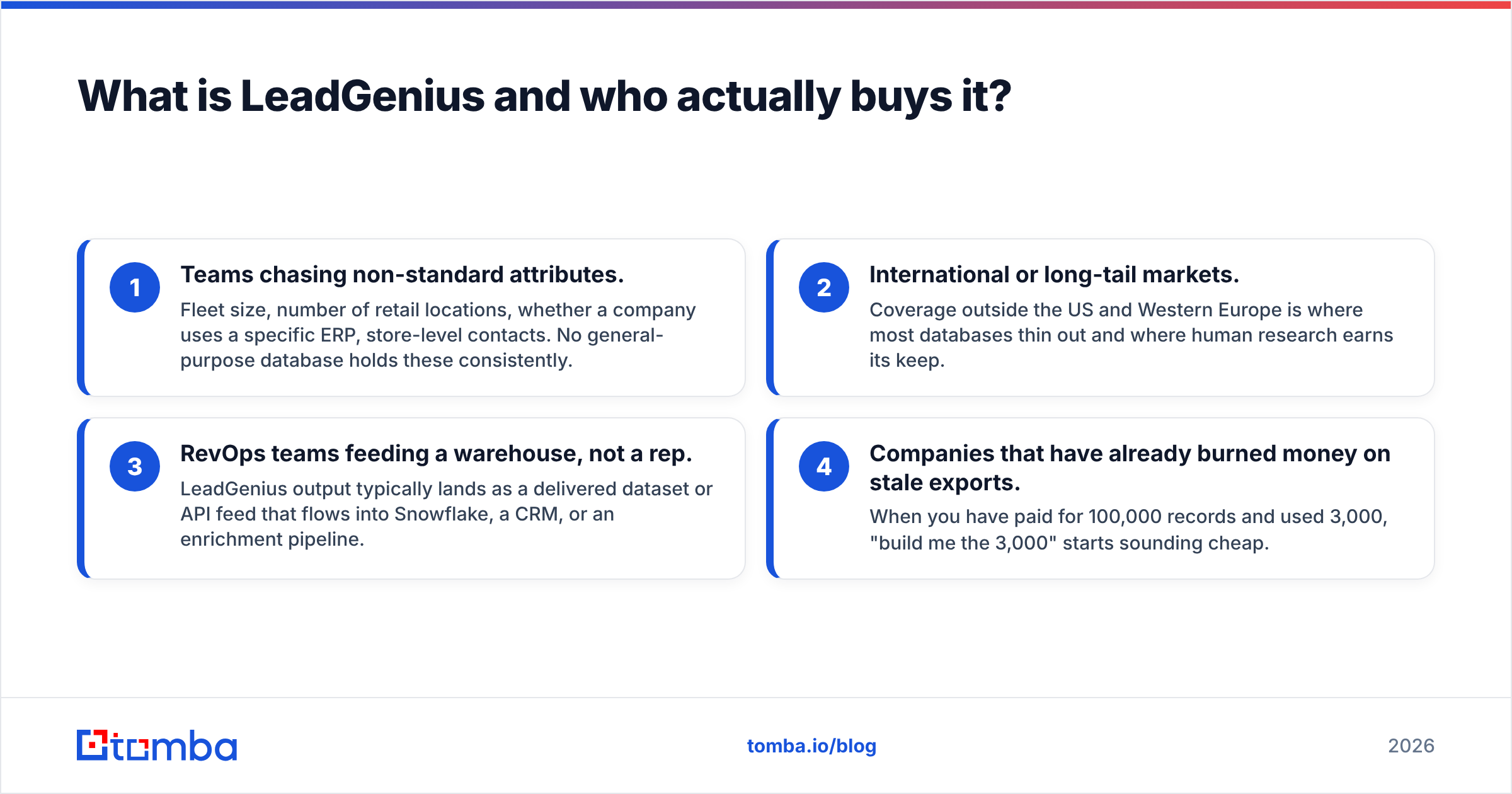
- Teams that need odd fields. Fleet size, store count, which ERP a firm runs, store-level contacts. No broad database holds these well.
- Long-tail or non-US markets. Coverage thins out fast outside the US and Western Europe. Human research earns its keep there.
- RevOps teams feeding a warehouse, not a rep. Output lands as a file or an API feed. It flows into Snowflake, a CRM, or an enrichment job.
- Firms burned by stale exports. You paid for 100,000 rows and used 3,000. "Build me the 3,000" starts to sound cheap.
The trade-off is speed. A custom list needs a scoping call, a pilot, and a delivery date. You cannot log in on a Tuesday and pull 500 contacts for a campaign you just dreamed up.
What is ZoomInfo and what does it give you?#
ZoomInfo is the 800-pound gorilla of this market, and the other half of the LeadGenius vs ZoomInfo matchup. It is a self-serve sales intelligence platform with a very large contact and company database.
Extra layers sit on top of that database. You get intent signals, website visitor ID, conversation intelligence, and a sales engagement module in the higher tiers.
The core promise is breadth and speed. Filter by industry, headcount, revenue, tech stack, seniority, and region. Get a list. Push it to Salesforce or HubSpot in one click. For a US SDR team selling software to software firms, the coverage is hard to beat. The G2 sales intelligence category shows how entrenched it is.
Friction shows up in three places:
- Opaque pricing. There is no public price list. Quotes mix seats, credits, modules, and data tiers. You cannot compare like for like until you are deep in a sales cycle.
- Contract terms. Annual minimums, auto-renewal, and mid-term upgrade pressure are the loudest complaints in public reviews. Budget for the renewal talk, not just year one.
- Decay on the long tail. Broad is not the same as even. Top US tech accounts look great. Small European makers and regional service firms look thin, and titles go stale fast.

LeadGenius vs ZoomInfo: how do they compare side by side?#
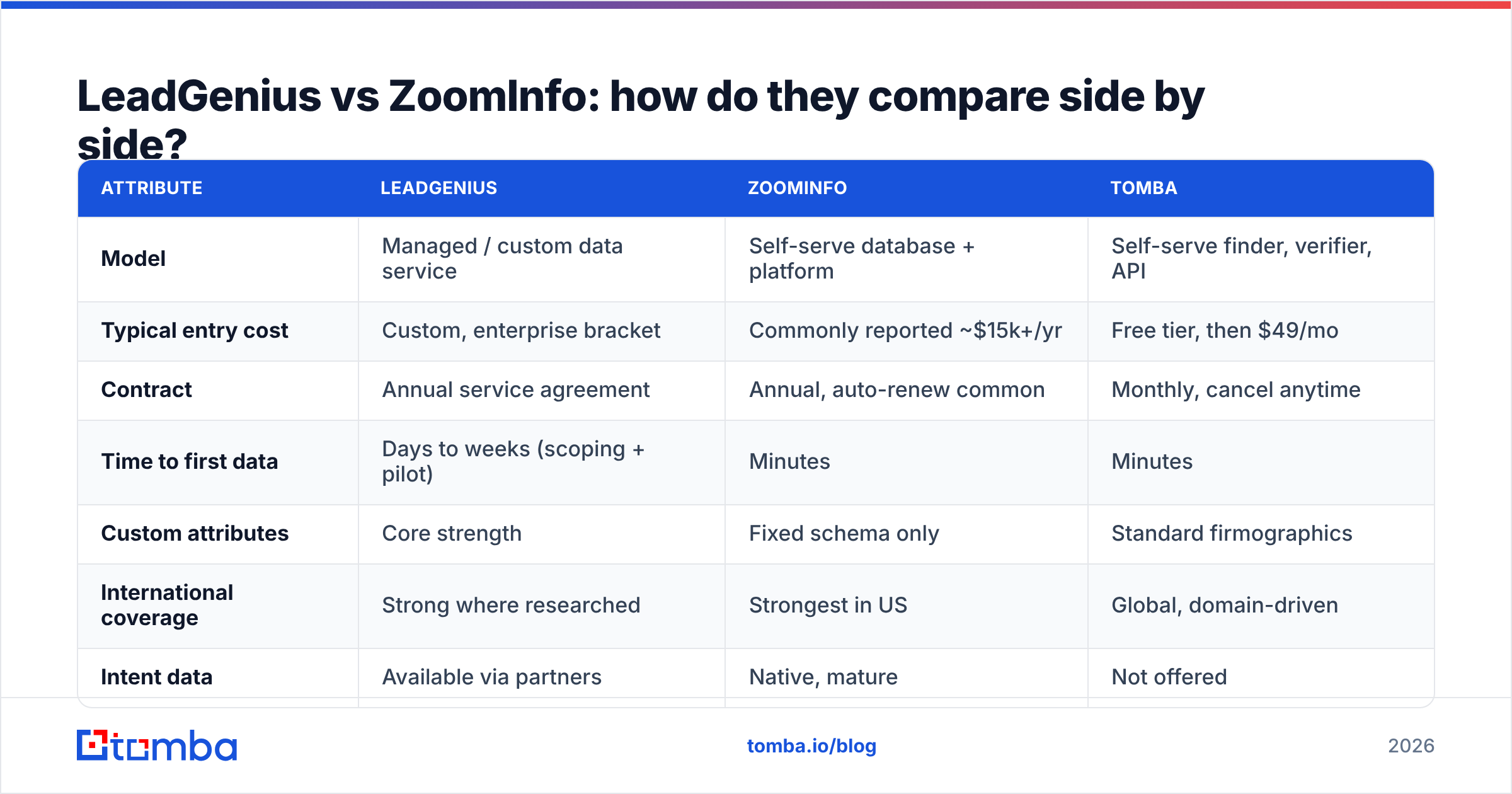
Here is the LeadGenius vs ZoomInfo comparison in one table. Prices are ranges that buyers report in public, not rate cards. Treat them as a rough guide and get your own quote.
| Attribute | LeadGenius | ZoomInfo | Tomba |
|---|---|---|---|
| Model | Managed custom data | Self-serve database | Finder, verifier, API |
| Entry cost | Custom, enterprise | ~$15k+/yr reported | Free tier, then $49/mo |
| Contract | Annual service deal | Annual, auto-renew | Monthly, cancel anytime |
| Time to data | Days to weeks | Minutes | Minutes |
| Custom fields | Core strength | Fixed schema | Standard firmographics |
| Global reach | Strong where researched | Strongest in US | Global, domain-driven |
| Intent data | Via partners | Native, mature | Not offered |
| Verification | Included | Included | Verifier plus catch-all |
| Best for | Hard-to-find fields | Broad US prospecting | Targeted verified data |
| Worst for | Ad-hoc list pulls | Non-US long tail | Enterprise intent work |
Two things jump out of the LeadGenius vs ZoomInfo grid.
First, these are not the same product. They are two answers to two different questions. The "vs" framing exists because both land on the same budget line.
Second, the gap between either one and a focused email finder is about 100x in price. So the real question is simpler. Do you need a data platform, or do you need contact data?
Is LeadGenius better than ZoomInfo for data accuracy?#
For the fields you ordered, yes. That is the whole point. A human-checked record built last month beats a row scraped on an unknown date.
Outside that spec, the answer flips. LeadGenius has nothing there. ZoomInfo has something. Accuracy is where most LeadGenius vs ZoomInfo debates get loud, so learn four facts before you argue rates with either sales team.
- Every vendor quotes its best segment. A 95% claim means nothing on its own. Ask which field, which region, measured how, and on what date.
- B2B contact data decays 25–30% a year from job moves alone. Any list you buy today is a wasting asset. Verify at send time instead of buying more rows.
Catch-all domains and bounce rates settle the rest of the argument.
- Catch-all domains break naive checks. Many large domains accept all mail. A simple SMTP ping returns "valid" for addresses that do not exist. That is why a catch-all verifier beats a headline accuracy number.
- Bounce rate is the only honest scoreboard. Run 500 records from each vendor through the same email verifier. Compare the deliverable share. That test costs a few dollars and ends the debate.
Run the pilot on your real ICP, not a generic sample. The winner on US SaaS VPs may lose badly on Spanish plant managers.
What do LeadGenius and ZoomInfo cost in 2026?#
Neither posts a price list. That is itself a data point. Opaque pricing exists to charge more to buyers who did not prepare.
Here is what buyers report on the LeadGenius vs ZoomInfo price gap.
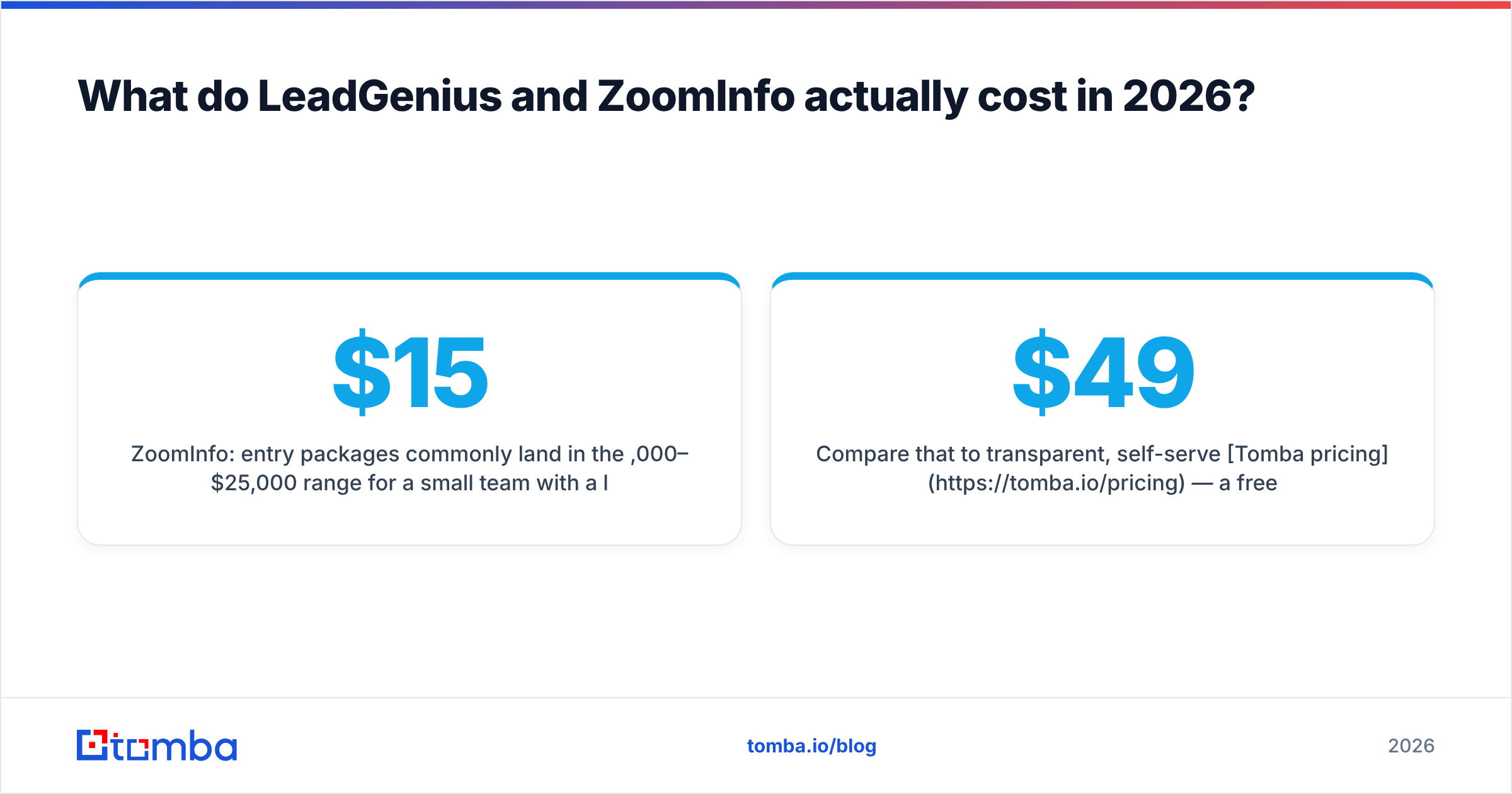
- ZoomInfo: entry packages often land at $15,000–$25,000 a year for a small team with limited credits. Add intent, websites, and engagement, and six figures is common. Credits burn on exports and enrichment, and overage talks tend to arrive in Q3.
- LeadGenius: priced per project or per ongoing data program. Cost scales with row volume and how hard the fields are to source, not with seats. Expect an annual commitment.
- Hidden costs on both sides: onboarding fees, CRM integration work, admin time to manage credits, and the year-two uplift.
Now compare that with self-serve Tomba pricing. There is a free tier with 25 searches a month, Starter at $49/mo, Growth at $99/mo, Pro at $249/mo, and custom Enterprise.
One model needs a procurement cycle to learn the number. The other shows the number before you type an email address.
None of that makes the big tools wrong. A 200-rep org with a real RevOps team gets value from intent data and CRM enrichment. A five-person team sending 300 emails a week does not.

Which one should you choose for your use case?#
Match the tool to the job, not to the logo on the G2 grid. That is the whole LeadGenius vs ZoomInfo call in one line.
Choose LeadGenius if your ICP rests on fields no database stores. It also fits when you enter markets where standard coverage falls apart, you have a data team to receive a feed, and you can wait weeks from scope to delivery.
Choose ZoomInfo if you sell to US mid-market and enterprise accounts. It fits when many reps pull lists daily, intent signals really change your order of work, and you have the budget plus the muscle to fight the renewal.
Choose neither if your block is simple. You know the 2,000 firms you want, and you just need verified contacts at them. That problem is solved for far less money.
Feed your target domains into a domain search, pull the right roles, verify in bulk, then start sending. Moving thousands of rows at once? The bulk email finder clears the list in one pass. The Tomba API drops the same power into the pipeline you already run.
The market is also wider than two names. Specialists like BookYourData sell verified, ready-to-use B2B lists with no managed-service deal. That is a fair middle path. Judge on your segment, not on brand recall.
How should you run the evaluation without wasting a quarter?#
Do this before your first demo call. You will negotiate from much firmer ground.
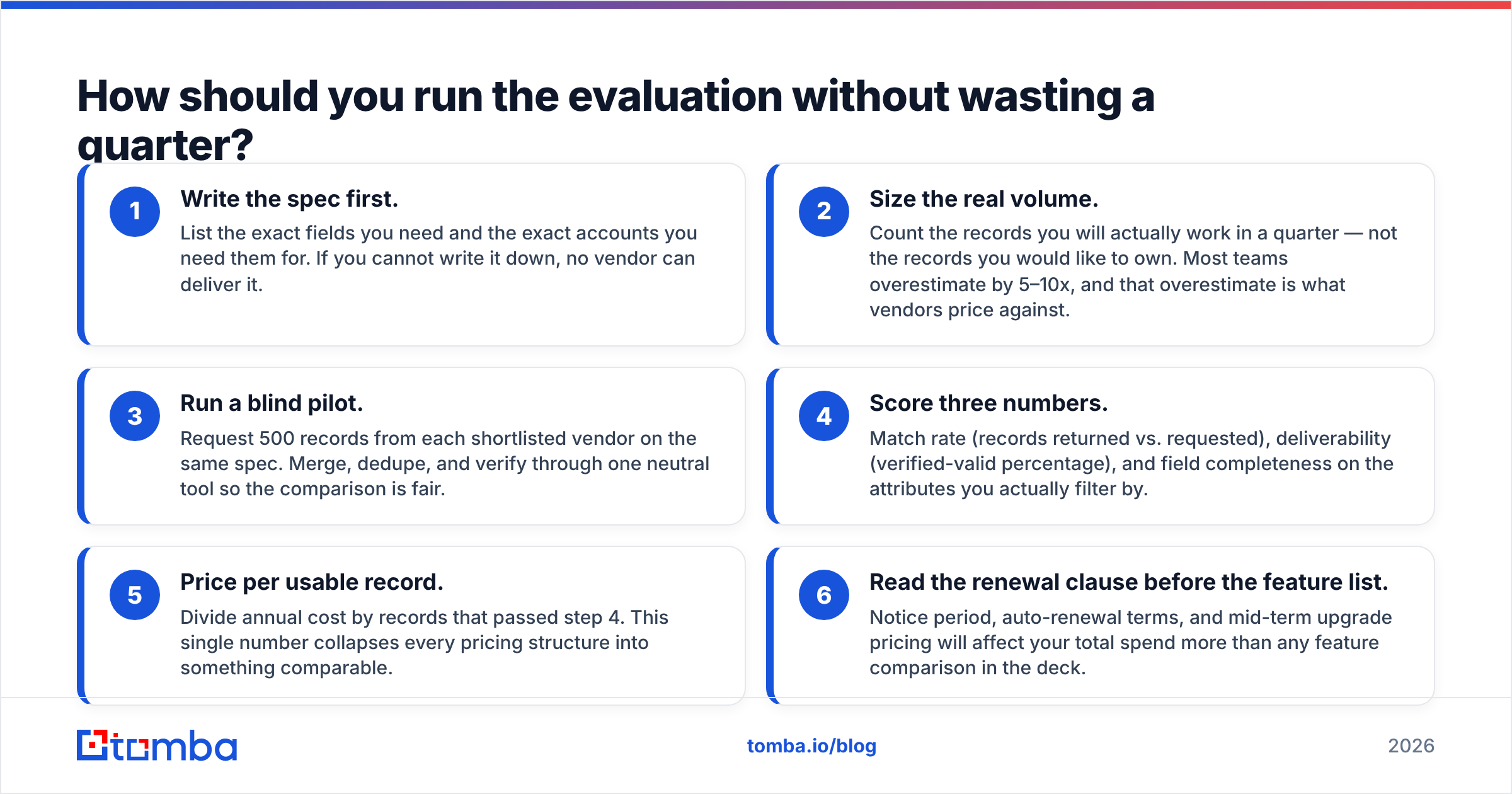
- Write the spec first. List the exact fields you need and the exact accounts you need them for. If you cannot write it down, no vendor can build it.
- Size the real volume. Count the rows you will work in a quarter, not the rows you would like to own. Most teams guess 5–10x high, and vendors price against that guess.
- Run a blind pilot. Ask each shortlisted vendor for 500 rows on the same spec. Merge, dedupe, and verify through one neutral tool.
The last three steps turn the LeadGenius vs ZoomInfo choice into plain arithmetic.
- Score three numbers. Match rate, deliverable share, and how complete the fields are that you actually filter by.
- Price per usable record. Divide the annual cost by the rows that passed step 4. One number, and every pricing model becomes comparable.
- Read the renewal clause first. Notice period, auto-renewal, and mid-term upgrade pricing move your total spend more than any feature chart.
Teams that run this process learn one of two things. Either one vendor is clearly worth the money for their segment, or the whole category solves a problem they do not have yet. Both answers are wins.
The bottom line#
Both tools are fair buys for the right buyer. LeadGenius wins when the data you need does not exist yet and someone has to go build it. ZoomInfo wins when breadth, speed, and CRM workflows across a big rep team pay for an annual deal.
Neither wins when you just need verified work emails for a list you already defined. That is a costly answer to a cheap question, and that is the LeadGenius vs ZoomInfo verdict for most small teams.
Start with the spec. Run the pilot. Price per usable record. The tool picks itself once those three things are on paper.
Need the contacts, not the contract? The Tomba Email Finder finds and verifies work emails by domain, name, or company. There is a free tier of 25 searches a month, and paid plans start at $49/mo with no annual lock-in. Run your 500-record pilot against it next to any enterprise quote, and let the bounce rate decide.
Related guides#
// get started
Find, verify and enrich your first contacts today
Start on the free plan with 25 searches a month, then scale when your team is ready.
Free plan · No credit card required · GDPR & CCPA
// about the author