LeadGibbon vs OutboundView: Which Lead Engine Wins in 2026?
One sells you contact data. The other sells you booked meetings. Here is an honest breakdown of LeadGibbon vs OutboundView, what each really costs, and which model fits your team in 2026.
TL;DR
- These two are not the same category. LeadGibbon is a self-serve B2B contact data tool. OutboundView is a done-for-you outbound agency that runs campaigns and books meetings for you. Comparing them is really a build-vs-buy decision.
- Pick LeadGibbon if you already have SDRs, a sequencer, and messaging that converts, and the missing piece is contact data you can export today.
- Pick OutboundView if you have budget but no outbound team, no playbook, and no appetite to hire and train SDRs for six months.
- The hidden variable in both cases is data quality. An agency retainer does not protect you from bounced sends, and a cheap list does not protect you from a burned domain.
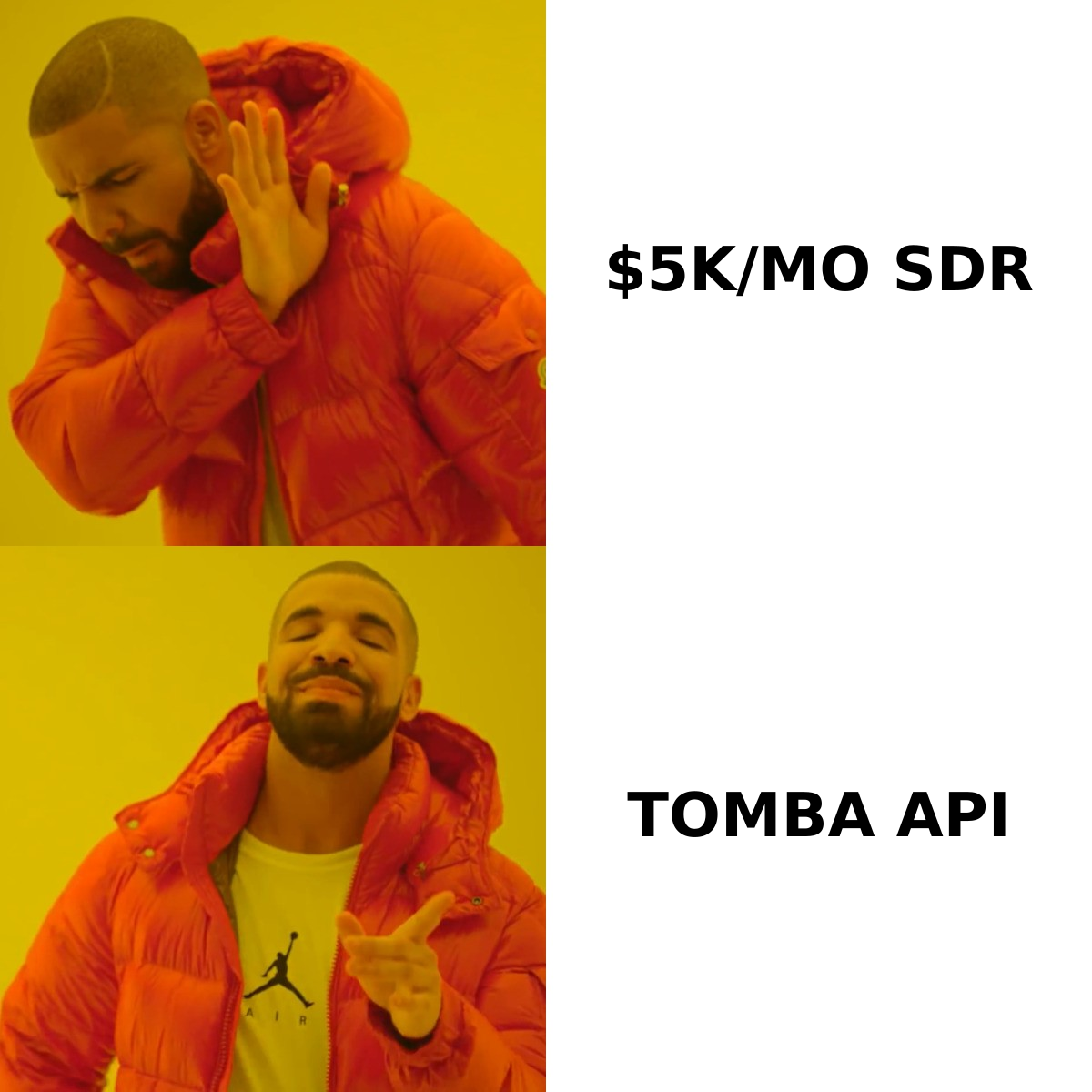
- The third path most teams land on in 2026: buy verified data on API (Tomba starts free, then $49/mo), plug it into a sequencer you already pay for, and keep the sending in-house.
What are LeadGibbon and OutboundView, exactly?#
They sit at opposite ends of the outbound supply chain.
LeadGibbon is a lead-data product. You search or filter for a company or persona, it returns business contacts with emails and job details, and you export the result to a CSV or Google Sheet. There is a browser-extension workflow for pulling contacts while you browse LinkedIn, plus list-building inside the app. You do everything downstream: write the copy, warm the domain, send the sequence, handle the replies.
OutboundView is a services firm. You sign a retainer, they build the target list, write the emails and call scripts, run the campaigns from their own or your infrastructure, and hand you qualified appointments. Their public positioning is appointment setting and outbound-as-a-service for B2B companies, including cold calling alongside email. You do very little downstream, and you also learn very little about the machine that produced the meetings.
So "LeadGibbon vs OutboundView" is not a feature fight. It is a question about where you want your outbound competence to live: inside your company, or on someone else's payroll.
How do LeadGibbon and OutboundView compare head-to-head?#
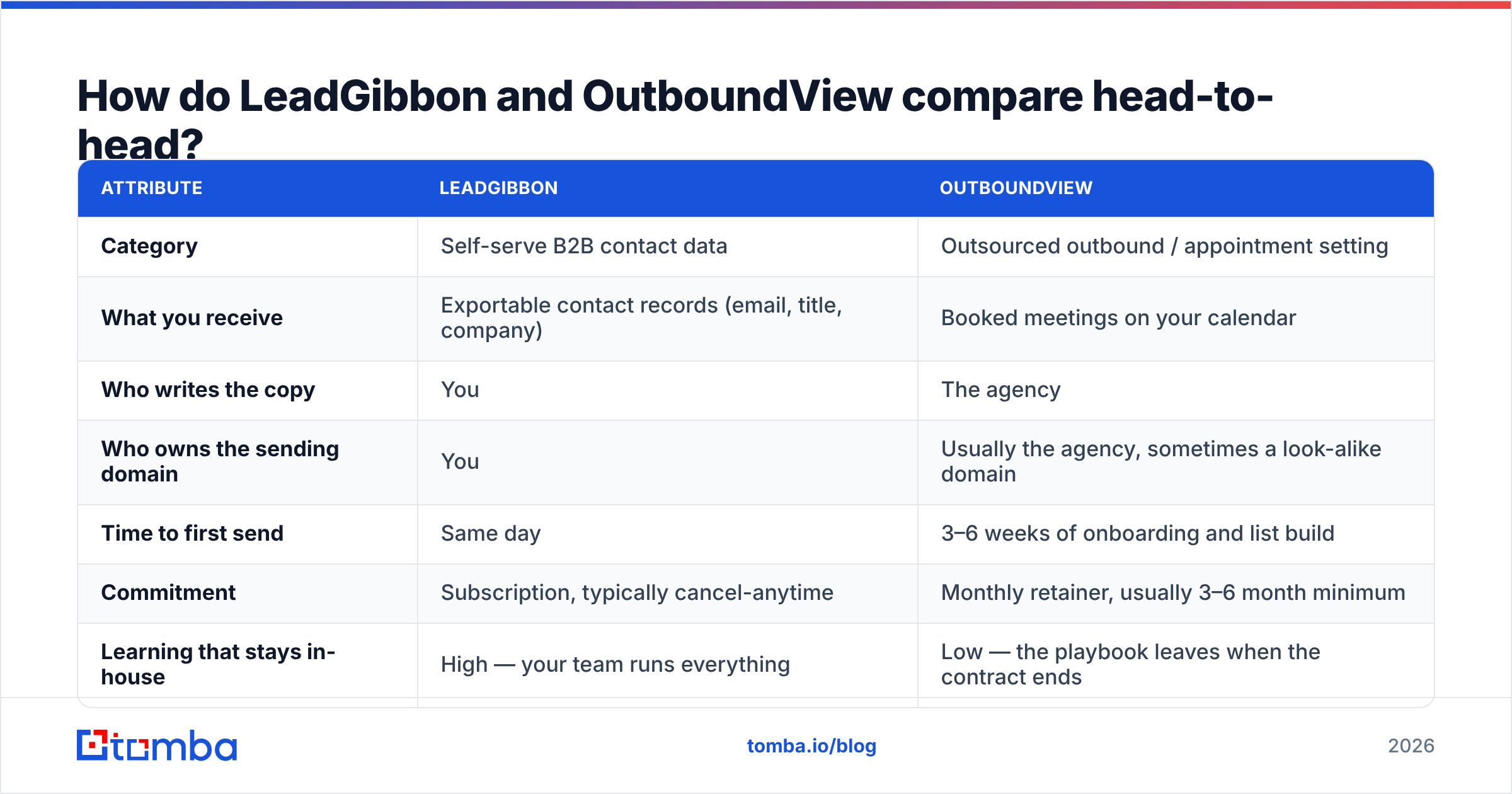
| Attribute | LeadGibbon | OutboundView |
|---|---|---|
| Category | Self-serve B2B contact data | Outsourced outbound / appointment setting |
| What you receive | Exportable contact records (email, title, company) | Booked meetings on your calendar |
| Who writes the copy | You | The agency |
| Who owns the sending domain | You | Usually the agency, sometimes a look-alike domain |
| Time to first send | Same day | 3–6 weeks of onboarding and list build |
| Commitment | Subscription, typically cancel-anytime | Monthly retainer, usually 3–6 month minimum |
| Learning that stays in-house | High — your team runs everything | Low — the playbook leaves when the contract ends |
| Scales by | Adding credits | Adding headcount you pay for indirectly |
| Best for | Teams with SDRs but no data | Teams with budget but no SDRs |
The row that decides most deals is the second-to-last one. Agencies are excellent at producing meetings in quarter one. They are less good at leaving behind a repeatable system. If your board expects an in-house outbound motion by next year, a pure agency engagement can quietly delay that by twelve months.
What does each model actually cost?#
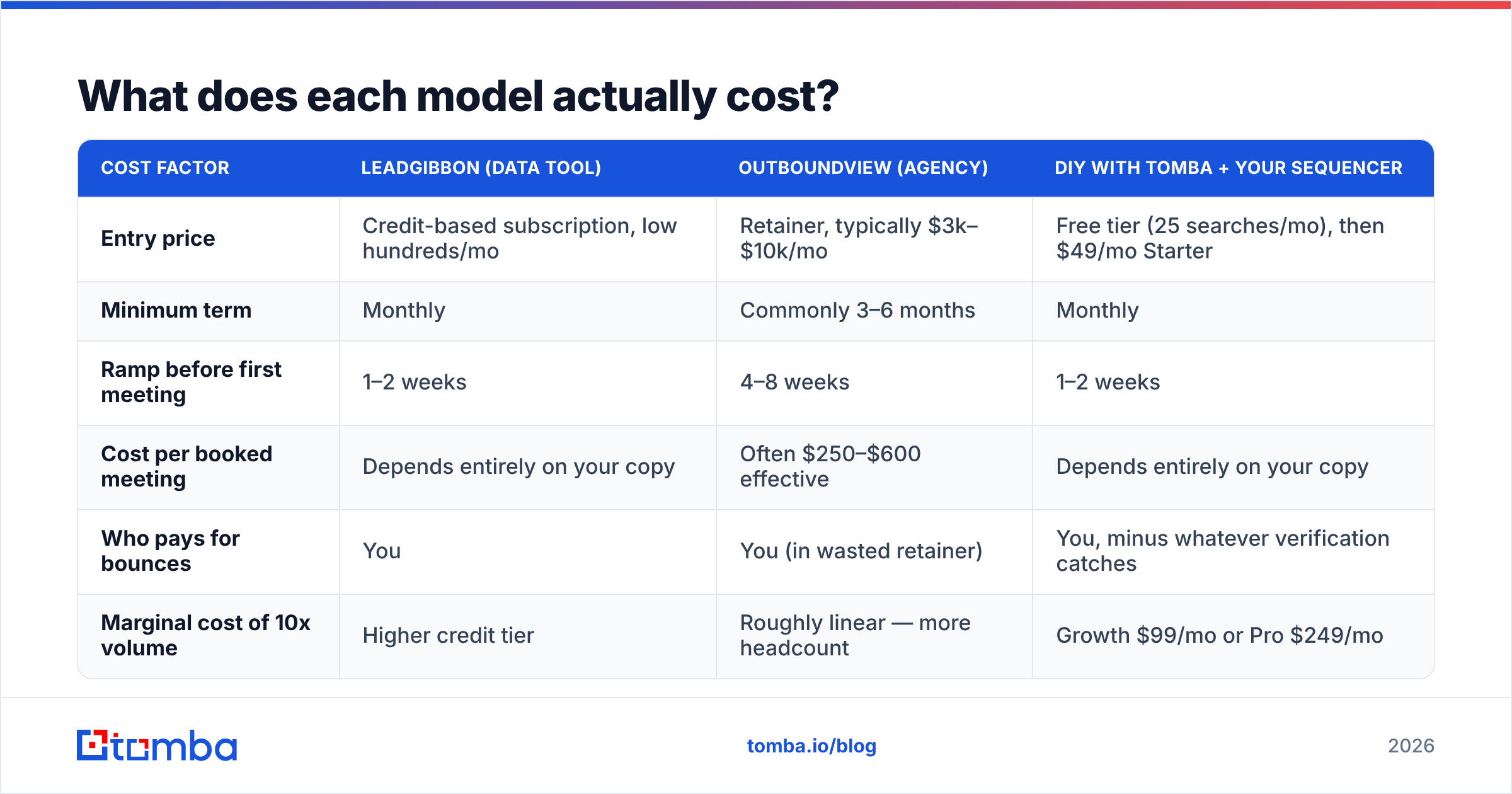
Public pricing is thin on both sides, so treat these as ranges rather than quotes, and confirm directly before you budget. Contact-data tools in LeadGibbon's tier generally publish entry plans in the low-hundreds-per-month band depending on credit volume. Outsourced SDR retainers in the North American market typically land between $3,000 and $10,000 per month, sometimes with a per-meeting component on top.
| Cost factor | LeadGibbon (data tool) | OutboundView (agency) | DIY with Tomba + your sequencer |
|---|---|---|---|
| Entry price | Credit-based subscription, low hundreds/mo | Retainer, typically $3k–$10k/mo | Free tier (25 searches/mo), then $49/mo Starter |
| Minimum term | Monthly | Commonly 3–6 months | Monthly |
| Ramp before first meeting | 1–2 weeks | 4–8 weeks | 1–2 weeks |
| Cost per booked meeting | Depends entirely on your copy | Often $250–$600 effective | Depends entirely on your copy |
| Who pays for bounces | You | You (in wasted retainer) | You, minus whatever verification catches |
| Marginal cost of 10x volume | Higher credit tier | Roughly linear — more headcount | Growth $99/mo or Pro $249/mo |
Two notes on reading that table honestly.
First, the agency's effective cost per meeting is not automatically worse. If your average contract value is $40,000 and the agency books eight qualified meetings a month, $6,000 is cheap. If your ACV is $4,000, the same math is a disaster.
Second, the DIY column hides labor. Tomba's pricing covers the data, not the person writing sequences at 9pm. Add a half-time SDR and the gap narrows considerably.
Which one gives you better data accuracy?#
Neither model guarantees it, and this is the part buyers consistently underweight.
When you buy from a data tool, you can inspect the data before you send. When you buy from an agency, the list is a black box. You find out about quality problems from your own domain reputation, weeks later, when reply rates fall off a cliff.
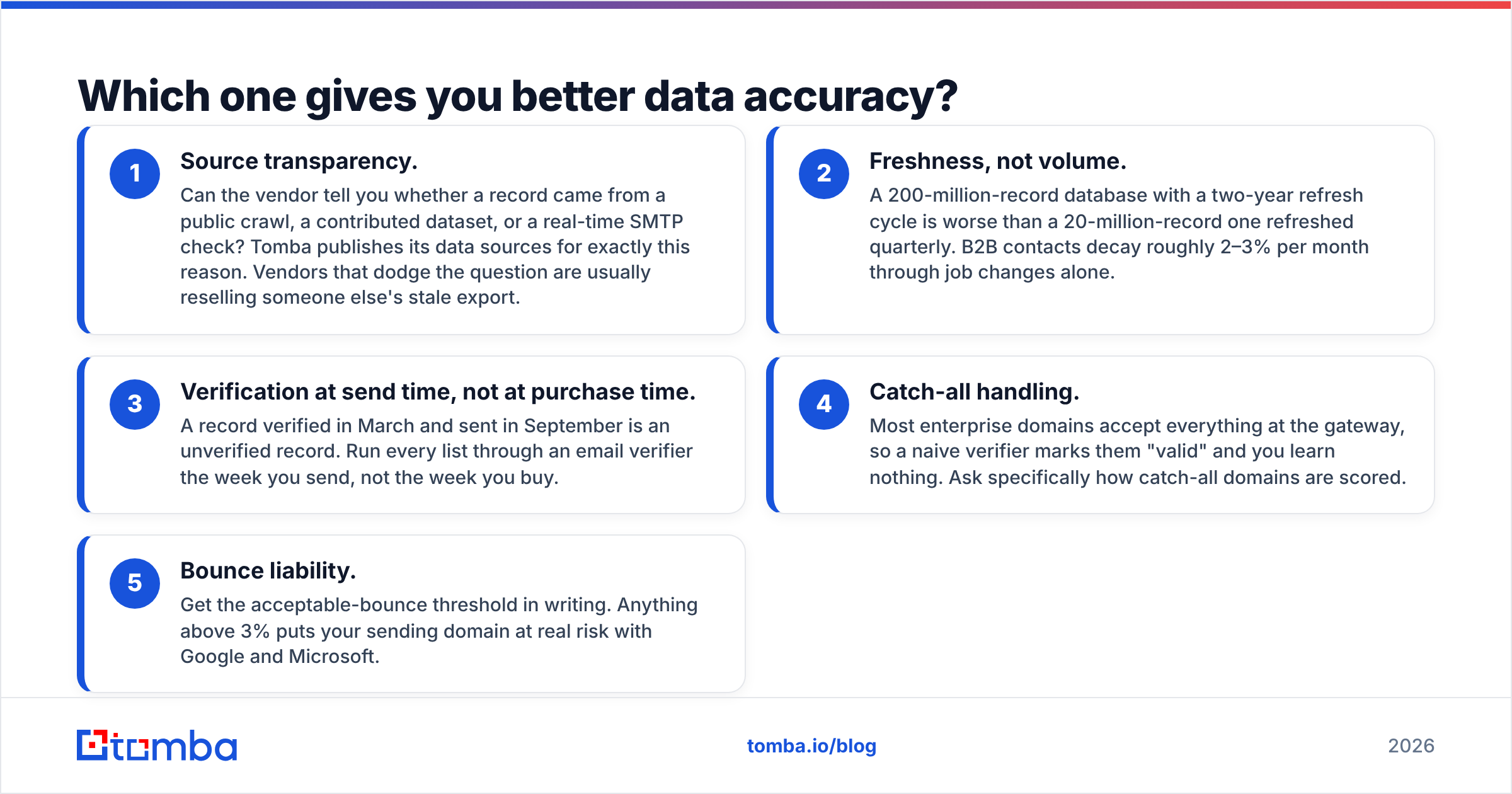
Here is what actually separates usable B2B data from list rot:
- Source transparency. Can the vendor tell you whether a record came from a public crawl, a contributed dataset, or a real-time SMTP check? Tomba publishes its data sources for exactly this reason. Vendors that dodge the question are usually reselling someone else's stale export.
- Freshness, not volume. A 200-million-record database with a two-year refresh cycle is worse than a 20-million-record one refreshed quarterly. B2B contacts decay roughly 2–3% per month through job changes alone.
- Verification at send time, not at purchase time. A record verified in March and sent in September is an unverified record. Run every list through an email verifier the week you send, not the week you buy.
- Catch-all handling. Most enterprise domains accept everything at the gateway, so a naive verifier marks them "valid" and you learn nothing. Ask specifically how catch-all domains are scored.
- Bounce liability. Get the acceptable-bounce threshold in writing. Anything above 3% puts your sending domain at real risk with Google and Microsoft.
If you are evaluating an agency, ask which data vendors they use and whether you can see a sample of 50 records before signing. A confident firm will show you. Agencies that refuse are often assembling lists from whichever source was cheapest that month.
Who should pick LeadGibbon?#
Choose the data-tool route when these are true:
- You have at least one person whose actual job is outbound, not "outbound plus three other things."
- You already pay for a sequencer (Instantly, Smartlead, Salesloft, Outreach, whatever) and your domains are warmed.
- Your ICP is specific enough that you can describe it in filters: industry, headcount, title, geography.
- You want the list to stay yours. Exported contacts go into your CRM and stay there after any vendor relationship ends.
- You are testing multiple messages per month and need fast iteration, which an agency's approval cycle will slow to a crawl.
The failure mode here is buying data and then not having the operational discipline to send well. A spreadsheet of 10,000 contacts that nobody sequences is a $200/month subscription producing zero pipeline. This is the single most common way self-serve tools "fail" — not accuracy, just neglect.
Who should pick OutboundView?#
Choose the agency route when these are true:
- Your ACV justifies a four-figure monthly spend with a 60–90 day payback window.
- You have no SDR, and hiring one would cost you $70k plus three months of ramp before the first meeting.
- You are entering a new market or segment and want someone who has cold-called it before.
- Leadership wants meetings on the calendar this quarter and is willing to pay a premium for speed.
- You can commit an internal owner. Agencies underperform overwhelmingly when the client treats the kickoff as the finish line. Someone on your side has to review messaging, join weekly calls, and give feedback on lead quality within 48 hours.
The failure mode here is attribution fog. Six months in, you have 40 meetings and no idea which segment, message, or channel produced them, because the reporting lives in the agency's stack. Negotiate raw campaign data access up front, not at renewal.
Is there a third option that beats both?#
For most teams between 5 and 50 employees, yes: keep the sending in-house and buy only the data layer on an API.
The logic is straightforward. The two genuinely hard parts of outbound are (a) finding accurate contacts at scale and (b) writing something a stranger wants to reply to. Part (a) is a solved, commoditized problem you should buy. Part (b) is your differentiator and you should never outsource it, because nobody understands your customer's pain as well as the people who talk to them daily.
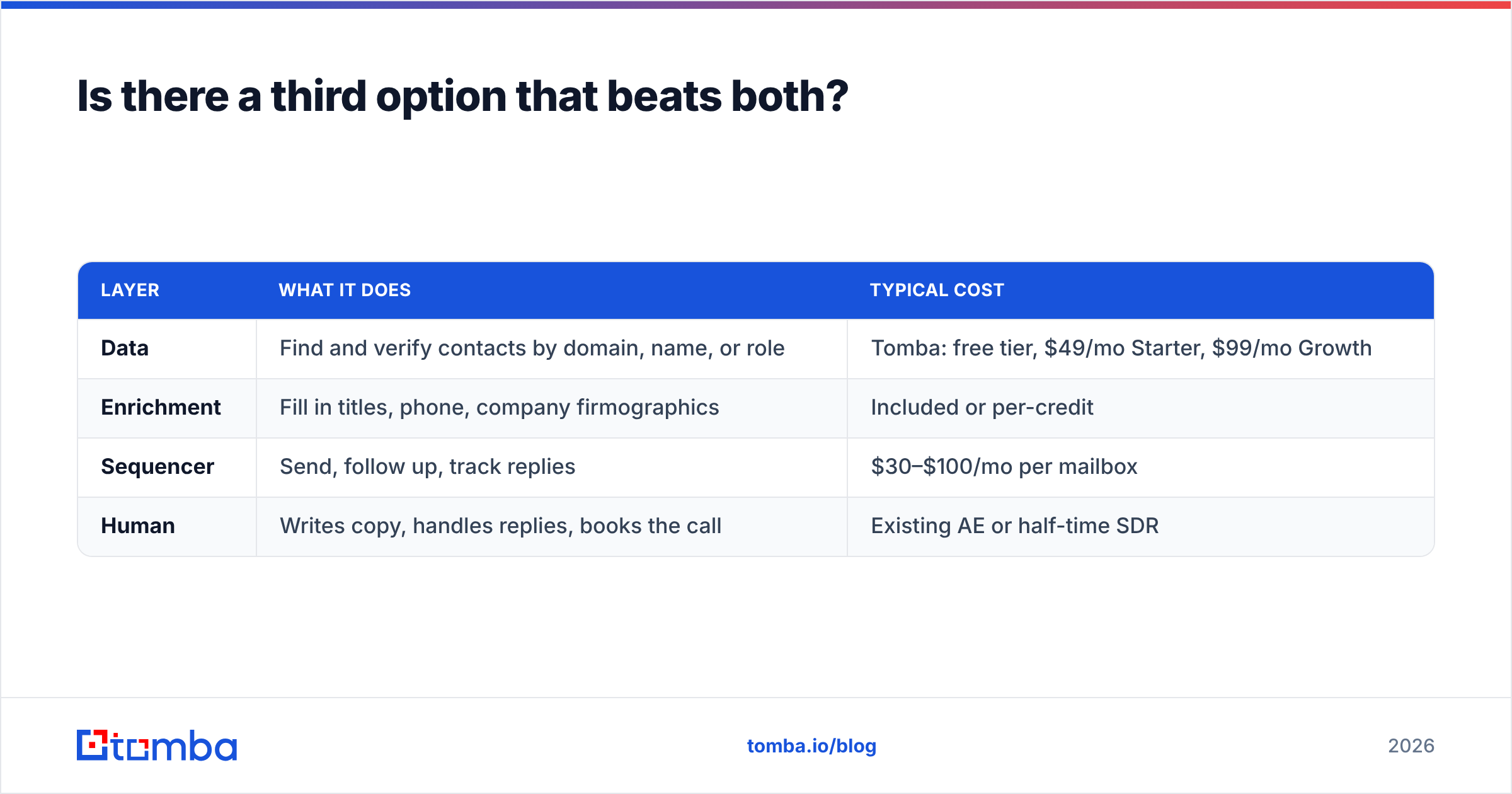
A practical stack looks like this:
| Layer | What it does | Typical cost |
|---|---|---|
| Data | Find and verify contacts by domain, name, or role | Tomba: free tier, $49/mo Starter, $99/mo Growth |
| Enrichment | Fill in titles, phone, company firmographics | Included or per-credit |
| Sequencer | Send, follow up, track replies | $30–$100/mo per mailbox |
| Human | Writes copy, handles replies, books the call | Existing AE or half-time SDR |
You build the list with a domain search across target accounts, push it through bulk verify the day before launch, and let your sequencer handle delivery. The entire data layer costs less than one day of agency retainer.
That is not a knock on agencies. Firms like OutboundView earn their fee when you genuinely have no outbound capability and need one fast. It is also worth noting that solid list vendors exist in this space — BookYourData, for instance, is a respected pay-as-you-go option if you prefer buying a list outright over a subscription. The question is simply which line item you are short on: people, or data.
What should you ask before signing either contract?#
Run this checklist against whichever vendor you are leaning toward. Most of it applies to both.
- What is the guaranteed bounce rate, and what happens if you exceed it? Get a number and a remedy.
- Can I see 50 sample records from my exact ICP before I pay? Sample quality predicts delivered quality better than any case study.
- Who owns the data and the domains at the end of the contract? For agencies specifically, this determines whether you keep anything.
- How are catch-all domains treated? "We filter them out" is a real answer. Silence is not.
- What is the cancellation term? Monthly for tools. For agencies, push hard against anything longer than three months on a first engagement.
- Is there API access? If you ever want to automate enrichment into your CRM, an email finder API matters far more than a prettier dashboard.
Cross-check both vendors on G2 before you commit, and weight recent reviews heavily. Data quality in this category changes faster than review scores do.
So which one actually wins?#
There is no universal winner, which is the honest answer even though it is the less satisfying one.
OutboundView wins when you need pipeline faster than you can build a team, your deal sizes are large enough to absorb a retainer, and you are comfortable renting a capability rather than owning it.
LeadGibbon wins when you have the people and the process and the only gap is contact data, and you want to keep every record you pay for.
Neither wins if your messaging is weak. No list and no agency fixes a value proposition that does not land. If your current reply rate is under 1% on a clean list, the problem is upstream of both vendors.
If you are leaning toward keeping outbound in-house, start with the data layer and prove the motion before you commit to a retainer. Run Tomba's Email Finder against your next 100 target accounts on the free tier, verify the results, and send one sequence. If the replies come, you just saved yourself a five-figure annual contract. If they do not, you learned that for free, which is considerably cheaper than learning it in month four of an agency engagement.
Related guides#
Ready to find emails that actually work?
Join 150,000+ professionals who stopped guessing and started sending. Free credits on signup — no credit card required.
Get the Tomba newsletter
Practical outbound tactics and product updates — once every two weeks.
About the author