LeadIQ vs LeadZen.ai (2026): Pricing, Data Quality and Our Pick
LeadIQ and LeadZen.ai both put a contact-reveal button inside LinkedIn, but they are built for different teams, budgets and regions. Here's how they compare on credits, phone data, CRM sync and total cost.
LeadIQ vs LeadZen.ai is a common choice for teams that prospect on LinkedIn. Both tools reveal emails and phone numbers. They differ on price, phone data and CRM workflow. Here's how to pick the right one.
TL;DR
- LeadIQ suits SDR teams that live in Salesforce, HubSpot, Outreach or Salesloft. It captures contacts from LinkedIn, pushes them straight into sequences, and adds job-change tracking and AI email drafting (Scribe).
- LeadZen.ai suits smaller teams and founders who want verified emails and phone numbers on LinkedIn profiles without buying a full sales-engagement stack. It has a free Chrome extension with 50 starter credits, and its phone data is a big part of the pitch.
- Pricing works differently. LeadIQ charges per seat, and a phone number costs 10 credits compared with 1 for an email. LeadZen.ai sells monthly credit bundles, which third-party listings put at $133/month for 300 credits on the entry plan.
- In LeadIQ vs LeadZen.ai, neither tool wins everywhere. If CRM workflow is your bottleneck, choose LeadIQ. If you need a lightweight way to reveal contacts, trial LeadZen.ai. If you mostly need emails found by domain or name at a low cost per contact, a dedicated email finder is usually cheaper than either.
LeadIQ vs LeadZen.ai: what are these two tools?#
Both tools solve the same first problem. You're on a LinkedIn profile, you want to reach that person, and LinkedIn doesn't show you their work email or direct dial. Each one adds a browser extension that reveals the contact details and saves them somewhere useful. What happens after the reveal is where they differ.
LeadIQ is a San Francisco prospecting platform built for outbound sales teams. Its Chrome extension works on LinkedIn and Sales Navigator. It captures a prospect's email and phone number. It checks whether the record already exists in your CRM. Then it sends it to Salesforce, HubSpot, Outreach or Salesloft in one click.
Around that core, LeadIQ adds job-change tracking, so you know when a champion moves to a new company. It also offers Scribe, an AI assistant that drafts personal outreach from the prospect's profile.
LeadZen.ai is an AI-driven B2B lead-generation platform. It also has a LinkedIn Chrome extension that shows verified emails, phone numbers and what it calls AI-generated buyer intelligence on profiles and Sales Navigator pages. It sells mostly on simplicity: install the extension for free, use your first 50 credits, and upgrade to a credit bundle when you need more volume. It works less like a workflow layer on top of your CRM and more like a contact-data tool with a friendly front end.
In short, LeadIQ vs LeadZen.ai comes down to this: LeadIQ is a pipeline workflow tool that includes contact data. LeadZen.ai is a contact-data tool that includes a workflow layer.
LeadIQ vs LeadZen.ai: how do they compare feature by feature?#
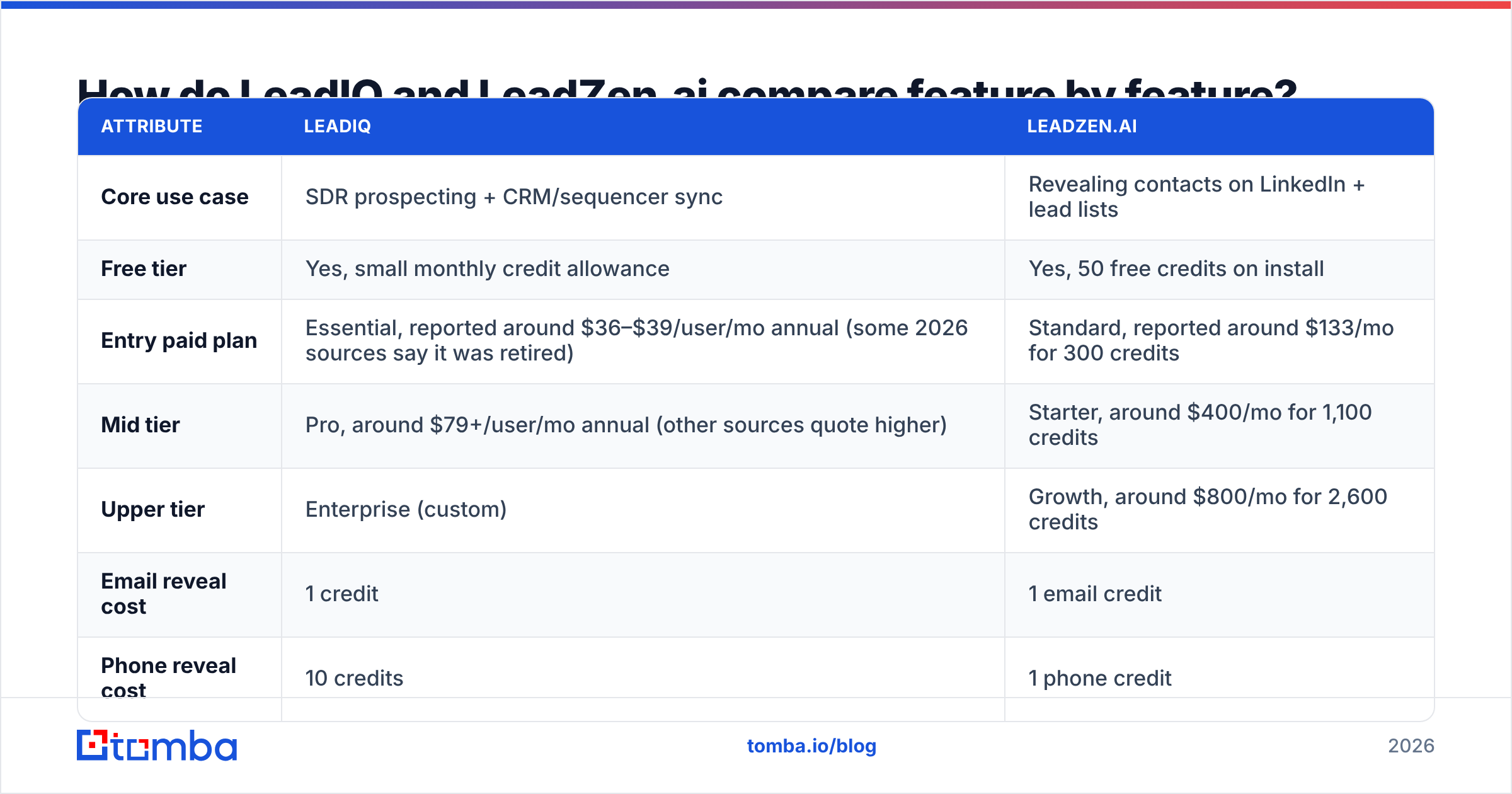
The table below reflects each vendor's public positioning and third-party listings at the time of writing (September 2026). Plans change often, and LeadIQ's tiers have moved around this year, so check both pricing pages before you commit.
| Attribute | LeadIQ | LeadZen.ai |
|---|---|---|
| Core use case | SDR prospecting + CRM/sequencer sync | Revealing contacts on LinkedIn + lead lists |
| Free tier | Yes, small monthly credit allowance | Yes, 50 free credits on install |
| Entry paid plan | Essential, reported around $36–$39/user/mo annual (some 2026 sources say it was retired) | Standard, reported around $133/mo for 300 credits |
| Mid tier | Pro, around $79+/user/mo annual (other sources quote higher) | Starter, around $400/mo for 1,100 credits |
| Upper tier | Enterprise (custom) | Growth, around $800/mo for 2,600 credits |
| Email reveal cost | 1 credit | 1 email credit |
| Phone reveal cost | 10 credits | 1 phone credit |
| Credit rollover | Generally no | Check plan terms |
| CRM sync | Salesforce, HubSpot (native) | Export + integrations; lighter than LeadIQ |
| Sequencer sync | Outreach, Salesloft, others | Limited |
| Job-change tracking | Yes | No dedicated equivalent |
| AI features | Scribe AI email writer | AI buyer insights on profiles |
| Best for | Mid-market and enterprise SDR teams | Founders, small teams, phone-heavy outreach |
Sources: LeadIQ pricing on G2, LeadZen.ai on Capterra, and each vendor's website.
The phone rows matter most for your budget. LeadIQ charges 10 credits for a phone number and 1 for an email. LeadZen.ai splits phone and email into separate credit types at one credit per reveal. If your motion depends on calling, the same headline credit count buys very different amounts of phone data on each tool.

LeadIQ vs LeadZen.ai: which has better data accuracy?#
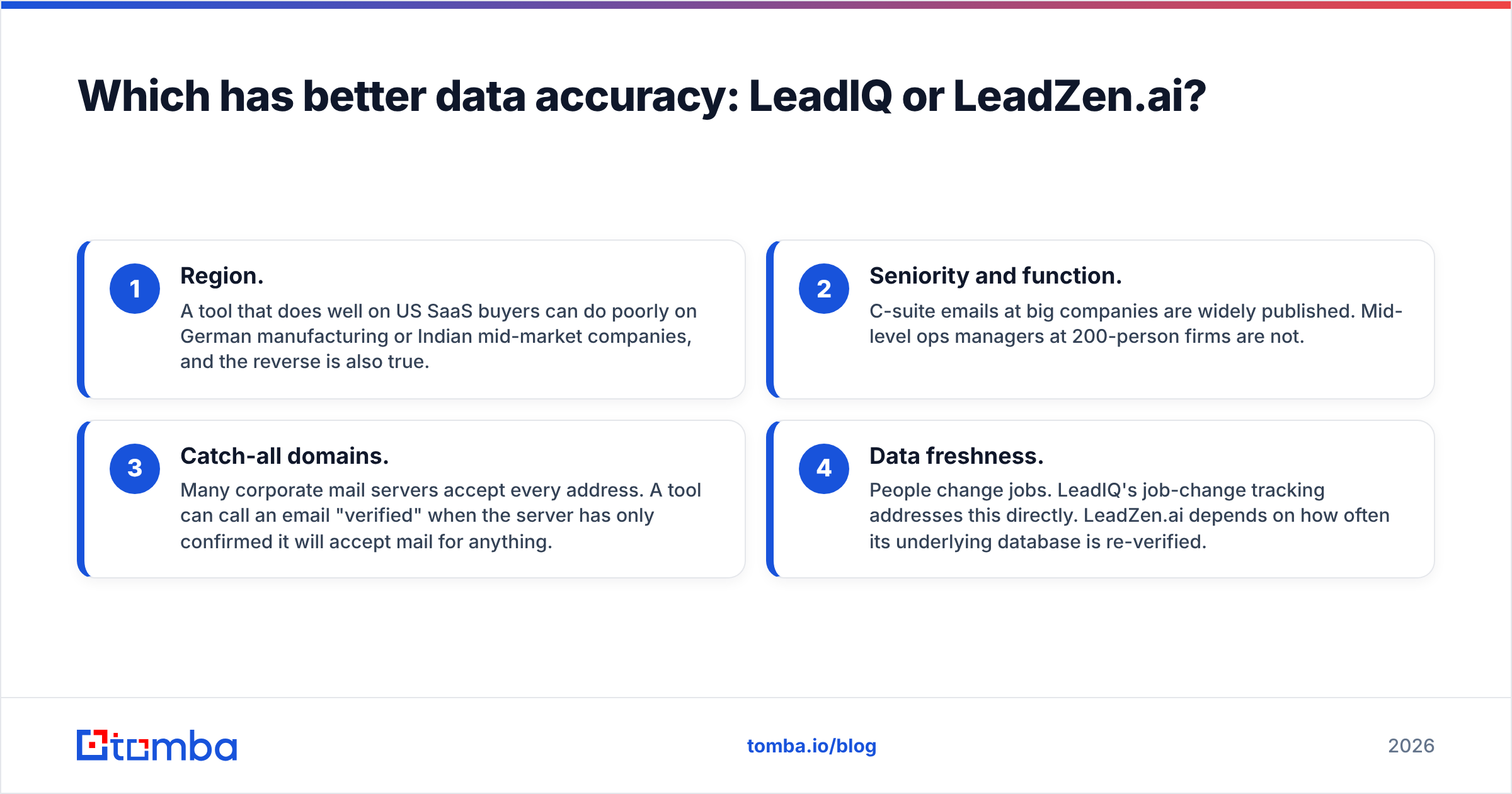
No independent, reproducible benchmark ranks these two tools head to head, so be careful with any article that gives you a single accuracy percentage for either one. Accuracy depends heavily on:
- Region. A tool that does well on US SaaS buyers can do poorly on German manufacturing or Indian mid-market companies, and the reverse is also true.
- Seniority and function. C-suite emails at big companies are widely published. Mid-level ops managers at 200-person firms are not.
- Catch-all domains. Many corporate mail servers accept every address. A tool can call an email "verified" when the server has only confirmed it will accept mail for anything.
- Data freshness. People change jobs. LeadIQ's job-change tracking addresses this directly. LeadZen.ai depends on how often its underlying database is re-verified.

Don't rely on vendor claims. Run the same test on both tools:
- Pick 100 real prospects from your actual ICP, not a demo list.
- Reveal them in both tools during the free tier or trial.
- Run every returned email through an independent email verifier so neither vendor grades its own work.
- Send a small, well-warmed batch and track the hard-bounce rate. Try to stay under 2%.
- For phones, have an SDR dial 20 numbers from each tool and log how many connect to the right person.
The winner of that test is the right tool for you, whatever any review says, including this one.
Is LeadIQ better than LeadZen.ai for sales teams?#
For a team of five or more SDRs working a CRM-centric outbound motion, LeadIQ is usually the stronger choice. The reasons:
- Duplicate detection before capture. LeadIQ shows whether a contact or account already exists in Salesforce or HubSpot, so two reps don't prospect the same person.
- Direct push to sequences. You capture a prospect and drop them into an Outreach or Salesloft cadence without a CSV step.
- Job-change signals. Former customers and champions who move to new companies are some of the warmest leads outbound gets. LeadIQ turns those moves into alerts.
- Scribe. Opinions differ on AI-drafted first lines, but having the draft ready right after capture removes a context switch.
The trade-offs are cost and credit maths. Per-seat pricing adds up quickly for a large team. At 10 credits per phone number, a phone-heavy SDR can use up a monthly allowance in days. Reviewers on G2 regularly mention credit limits and plan changes as their main frustration.
Is LeadZen.ai better for small teams and founders?#
LeadZen.ai makes more sense when you're one to three people, don't run a formal sales-engagement platform, and mostly want to see a verified email and mobile number on a LinkedIn profile.
Where it stands out:
- Low-friction start. The extension is free, and 50 free credits is enough to judge data quality on your own ICP.
- Phone-friendly credit model. Separate phone credits at one per reveal make the maths easier if calling is a large part of your outreach.
- Buyer insights on the profile. The AI summary gives you a quick read on the person before you reach out, which helps if you personalise by hand.
Where it falls short:
- Lighter CRM and sequencer integration. Expect more exporting and importing than with LeadIQ.
- Bundle pricing is expensive for email-only users. If the reported $133 for 300 credits is accurate, that's about $0.44 per reveal on the entry plan. That's reasonable for phone numbers but expensive if you only need emails.
- Smaller review footprint. LeadZen.ai has far fewer third-party reviews than LeadIQ, so you have less outside evidence on data quality in your specific market. The trial test above matters even more here.
How much does each tool really cost per usable contact?#
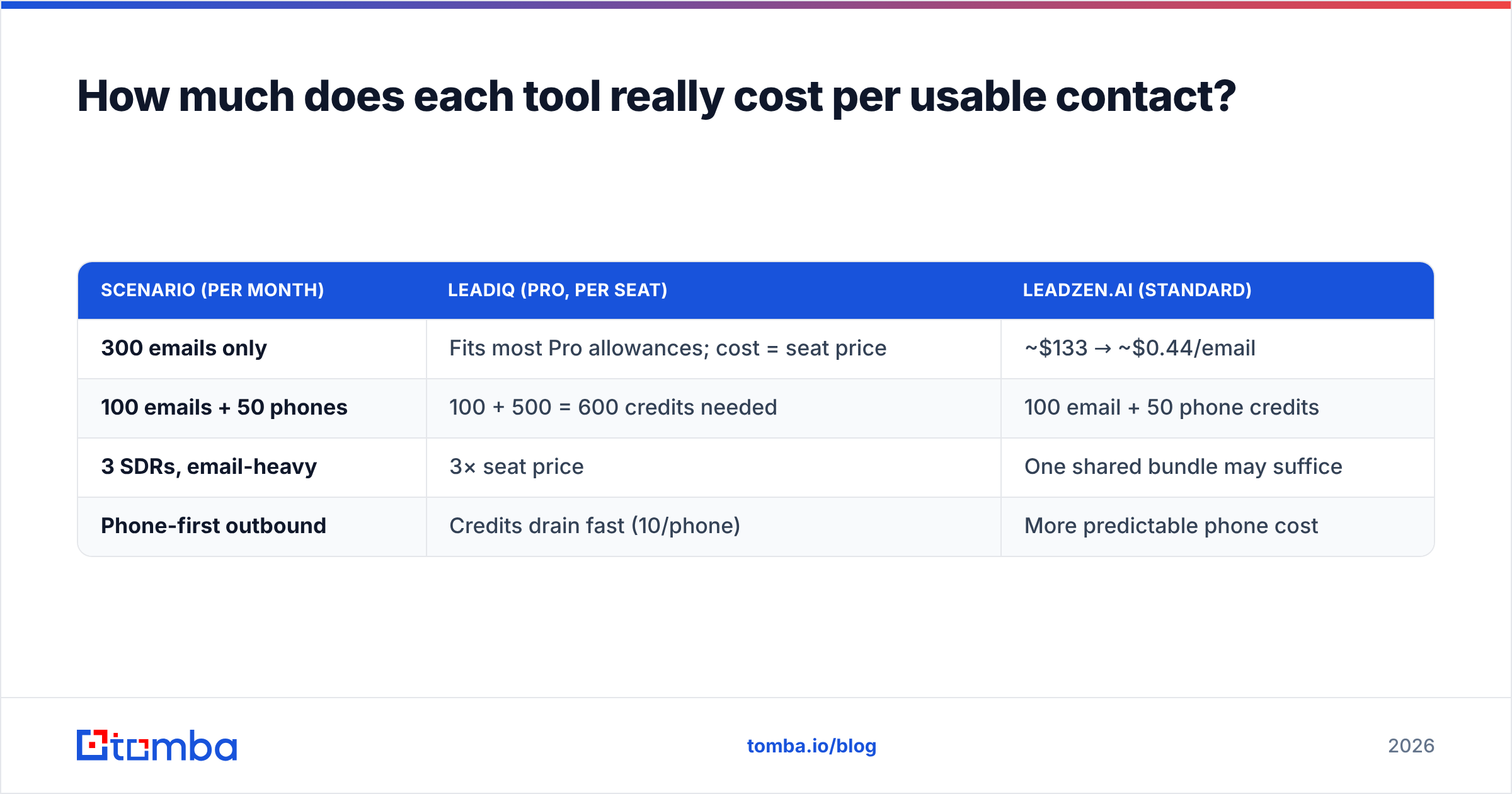
List price tells you little. What you should compare is cost per contact you can actually reach. Here's a simple way to calculate it using each tool's published model (plug in your own trial numbers):
| Scenario (per month) | LeadIQ (Pro, per seat) | LeadZen.ai (Standard) |
|---|---|---|
| 300 emails only | Fits most Pro allowances; cost = seat price | ~$133 → ~$0.44/email |
| 100 emails + 50 phones | 100 + 500 = 600 credits needed | 100 email + 50 phone credits |
| 3 SDRs, email-heavy | 3× seat price | One shared bundle may suffice |
| Phone-first outbound | Credits drain fast (10/phone) | More predictable phone cost |
Then divide by your verified-and-delivered rate. If a tool returns 300 emails and 20% bounce, you paid for 240 usable contacts, not 300. This is why an independent verification step belongs in the maths, not only in your process.

Where do LeadIQ and LeadZen.ai sit among other email finders?#
Both tools compete in a crowded category. Alongside them you'll find database-first platforms (Apollo, ZoomInfo, BookYourData, which is a well-regarded choice for pre-built B2B lists), LinkedIn-first extensions (Wiza, ContactOut), and domain-first email finders (Tomba, Hunter).

The domain-first group matters here because many teams shopping for "LeadIQ vs LeadZen.ai" mainly need emails, not phone numbers or sequencer sync. If that describes you, compare on these points:
- Input flexibility. Can you find emails by name + domain, by domain alone, from a LinkedIn URL, and in bulk from a spreadsheet? LinkedIn-only tools stop working once your prospect list comes from somewhere else.
- Catch-all handling. Does the tool tell you when a domain accepts every address, or does it mark those emails "valid"?
- Source transparency. Does it show where it found an email (public web pages, patterns), so you can judge confidence?
- API and spreadsheet access. Can your RevOps team call it from a script, Google Sheets or a CRM workflow, or does everything go through a browser extension?
- Price per email at your real volume. Not the headline plan, but what 1,000 or 10,000 lookups actually costs.
For a fuller view of how LeadIQ compares with lower-cost options, see our LeadIQ alternative breakdown.
LeadIQ vs LeadZen.ai: which should you choose?#
Match the tool to how your team actually works:
- Choose LeadIQ if you run an SDR team inside Salesforce or HubSpot with Outreach or Salesloft, you care about avoiding duplicate outreach, and job-change signals are part of your pipeline strategy. Its value is the workflow more than the raw data.
- Choose LeadZen.ai if you're a founder or small team prospecting on LinkedIn, phone numbers matter as much as emails, and you want to test quality on 50 free credits before paying.
- Choose neither (or add a dedicated email finder) if most of your outreach is email, your prospects come from sources other than LinkedIn, or you need API and bulk access at a predictable per-email price.
Whichever you pick, don't skip the 100-contact test. The vendor that wins on your ICP in your region is the one worth paying for. Only a trial on your own list can show you that, not a comparison table.
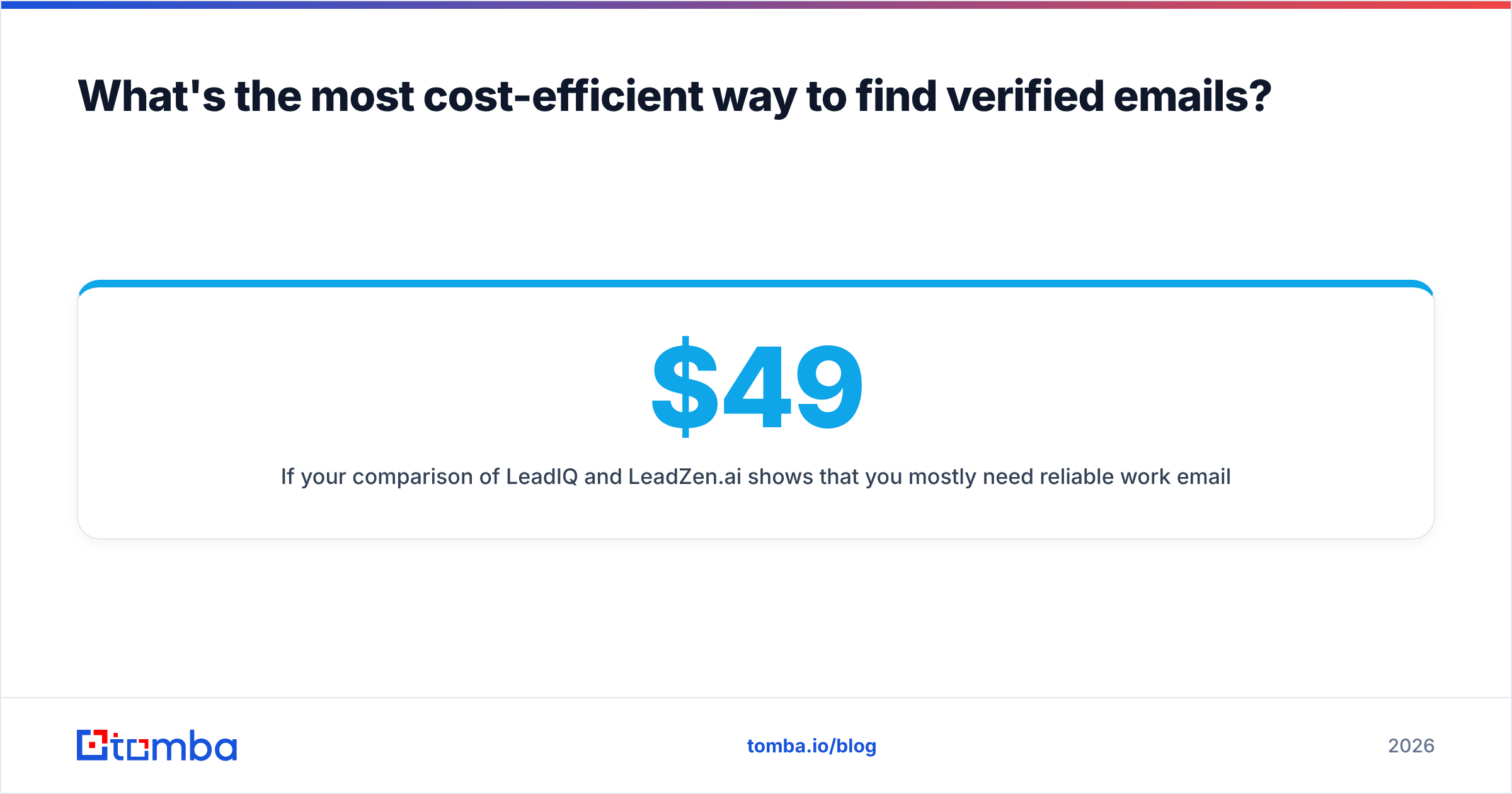
What's the most cost-efficient way to find verified emails?#
Your LeadIQ vs LeadZen.ai test may show that you mostly need reliable work emails, not a full prospecting suite. If so, look at Tomba Email Finder. You can find work emails by name + domain, by company domain, or from a LinkedIn profile. Verification and catch-all checks are built in. An API, Chrome extension and spreadsheet add-ons are also available.
The free plan includes 25 searches a month, and paid plans start at $49/month. See Tomba pricing for Growth ($99/mo) and Pro ($249/mo) volumes. If you need phone numbers too, add the phone finder without switching tools. Run the same 100-contact test against LeadIQ and LeadZen.ai, then compare cost per delivered email yourself.
Related guides#
// get started
Find, verify and enrich your first contacts today
Start on the free plan with 25 searches a month, then scale when your team is ready.
Free plan · No credit card required · GDPR & CCPA
// about the author