LeadIQ vs Mattermark: Prospecting Data vs Startup Intelligence
LeadIQ captures contacts for sales reps. Mattermark tracked startup growth for investors. Here is what each tool actually does in 2026, where each one falls short, and which to pick for your use case.
TL;DR
- LeadIQ is a sales prospecting tool. It captures contact data (emails, direct dials) from LinkedIn and company sites and pushes it into your CRM and sequencer.
- Mattermark is a company intelligence database. It was built to track startup growth signals like headcount, funding, and web traffic, mostly for VCs and people selling to startups.
- The two tools answer different questions. LeadIQ tells you who to contact and how. Mattermark tells you which companies are worth watching.
- FullContact acquired Mattermark in 2017, and the product has changed very little in public since then. Check that it's still active and how fresh its data is before you sign anything in 2026.
- If you just need verified emails for accounts you've already picked, a dedicated email finder costs less than either one.
What is the real difference between LeadIQ and Mattermark?#
People compare these two because both show up in searches for "B2B data tools." They were built for different jobs, though.
LeadIQ is a people-first tool. A sales rep opens a LinkedIn or Sales Navigator profile, clicks the LeadIQ Chrome extension, and gets the prospect's work email and sometimes a phone number. The contact goes straight into Salesforce, HubSpot, Outreach, or Salesloft. The whole product is designed to shorten the time between "this person looks relevant" and "this person is in a sequence."
Mattermark is a company-first tool. It became known for its "Growth Score," which combined signals like employee count changes, web traffic, social mentions, and funding events into a single momentum number. VC associates used it to source deals. Sales teams targeting startups used it to find companies that had just raised money and were probably about to buy software.
A simple way to picture it: Mattermark gives you the map, and LeadIQ gives you the phone book. You might want both, but they aren't substitutes for each other.
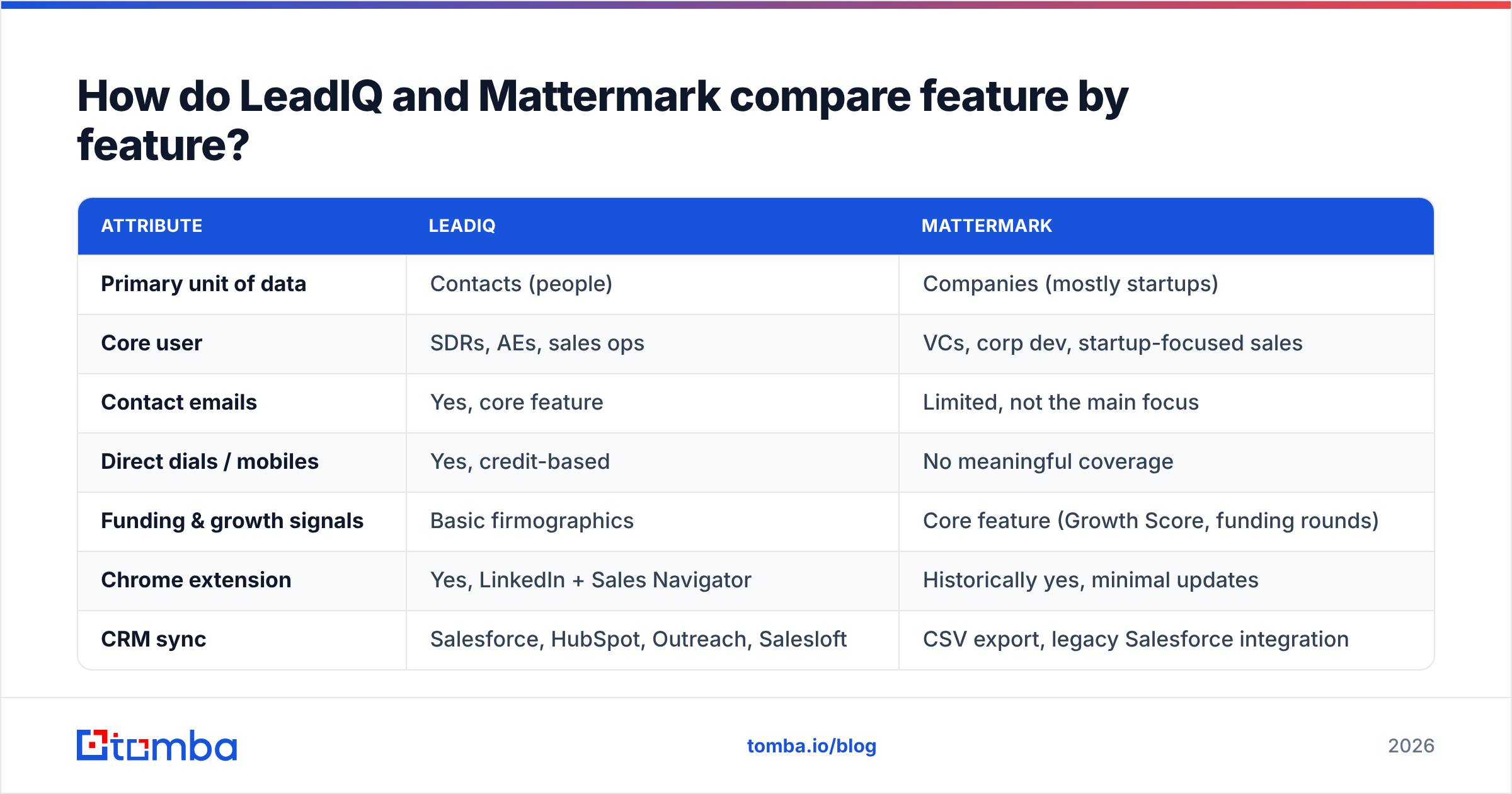
How do LeadIQ and Mattermark compare feature by feature?#
Here's how the two stack up on the things buyers usually ask about.
| Attribute | LeadIQ | Mattermark |
|---|---|---|
| Primary unit of data | Contacts (people) | Companies (mostly startups) |
| Core user | SDRs, AEs, sales ops | VCs, corp dev, startup-focused sales |
| Contact emails | Yes, core feature | Limited, not the main focus |
| Direct dials / mobiles | Yes, credit-based | No meaningful coverage |
| Funding & growth signals | Basic firmographics | Core feature (Growth Score, funding rounds) |
| Chrome extension | Yes, LinkedIn + Sales Navigator | Historically yes, minimal updates |
| CRM sync | Salesforce, HubSpot, Outreach, Salesloft | CSV export, legacy Salesforce integration |
| AI writing | Scribe (AI email drafting) | None |
| Job-change tracking | Yes (Track) | No |
| Free plan | Yes, limited credits | No public free tier |
| Ownership | Independent (founded 2015) | FullContact (acquired 2017) |
| Active development in 2026 | Regular releases | Little visible product change |
The last row is the most important one. LeadIQ has kept shipping features: AI email writing, job-change alerts, and deeper sequencer integrations. Mattermark still has a website and existing customers, but since the acquisition, FullContact has put its effort into identity resolution and its own enrichment products, not the old Mattermark dashboard.
Which signals does each tool actually give you?#
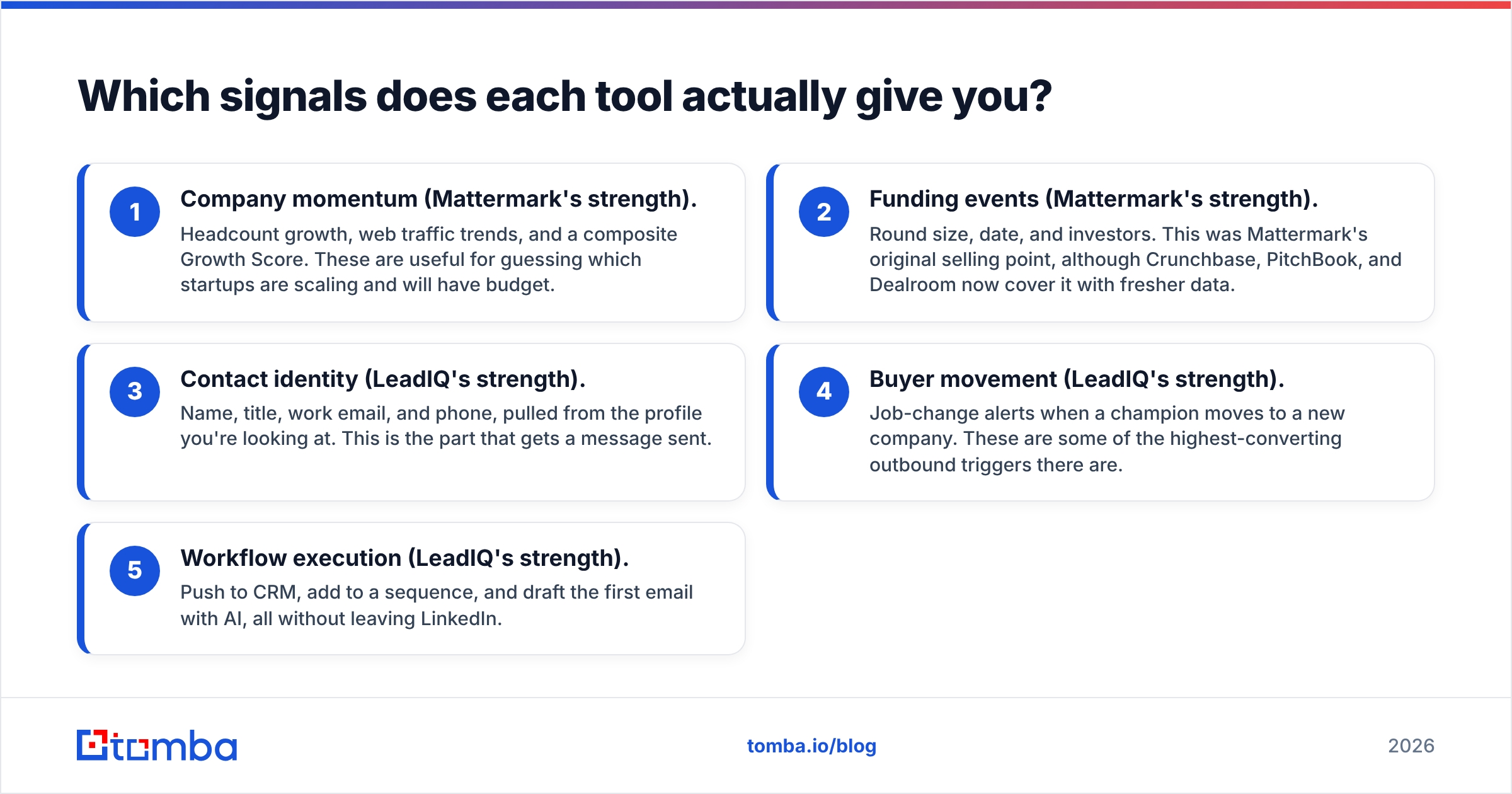
Mattermark is often described as "a lead gen tool," which undersells how different it is from LeadIQ. Here's what each one tells you about a target, grouped by type of signal:
- Company momentum (Mattermark's strength). Headcount growth, web traffic trends, and a composite Growth Score. These are useful for guessing which startups are scaling and will have budget.
- Funding events (Mattermark's strength). Round size, date, and investors. This was Mattermark's original selling point, although Crunchbase, PitchBook, and Dealroom now cover it with fresher data.
- Contact identity (LeadIQ's strength). Name, title, work email, and phone, pulled from the profile you're looking at. This is the part that gets a message sent.
- Buyer movement (LeadIQ's strength). Job-change alerts when a champion moves to a new company. These are some of the highest-converting outbound triggers there are.
- Workflow execution (LeadIQ's strength). Push to CRM, add to a sequence, and draft the first email with AI, all without leaving LinkedIn.
If your pipeline problem is "we don't know which accounts to target," signals 1 and 2 matter. If your problem is "we know the accounts but can't reach the people," you need 3 through 5, and Mattermark doesn't meaningfully cover those.

How accurate and fresh is the data in each tool?#
LeadIQ builds its contact data from several sources and verifies emails before it shows them. Reviews on G2 are generally positive about email accuracy for mid-market and enterprise contacts in North America. Phone coverage and non-US data get more complaints. That pattern is common for credit-based prospecting tools.
Mattermark has a bigger problem than accuracy: how fresh the data is. Company intelligence loses value quickly. A startup's headcount, funding stage, and traffic can look completely different after 12 months. A database needs constant re-crawling and ongoing product investment to stay current, and Mattermark has had little of either in public since 2017. Its historical data may be fine. The question is whether last quarter's numbers are there.
Before you rely on Mattermark for anything, test it:
- Pick 20 startups you know well that raised money in the last six months.
- Check whether Mattermark shows those rounds, the right amounts, and current headcount.
- Run the same 20 through Crunchbase or a similar source.
If more than a few are missing or stale, you have your answer.
What does LeadIQ vs Mattermark cost in 2026?#
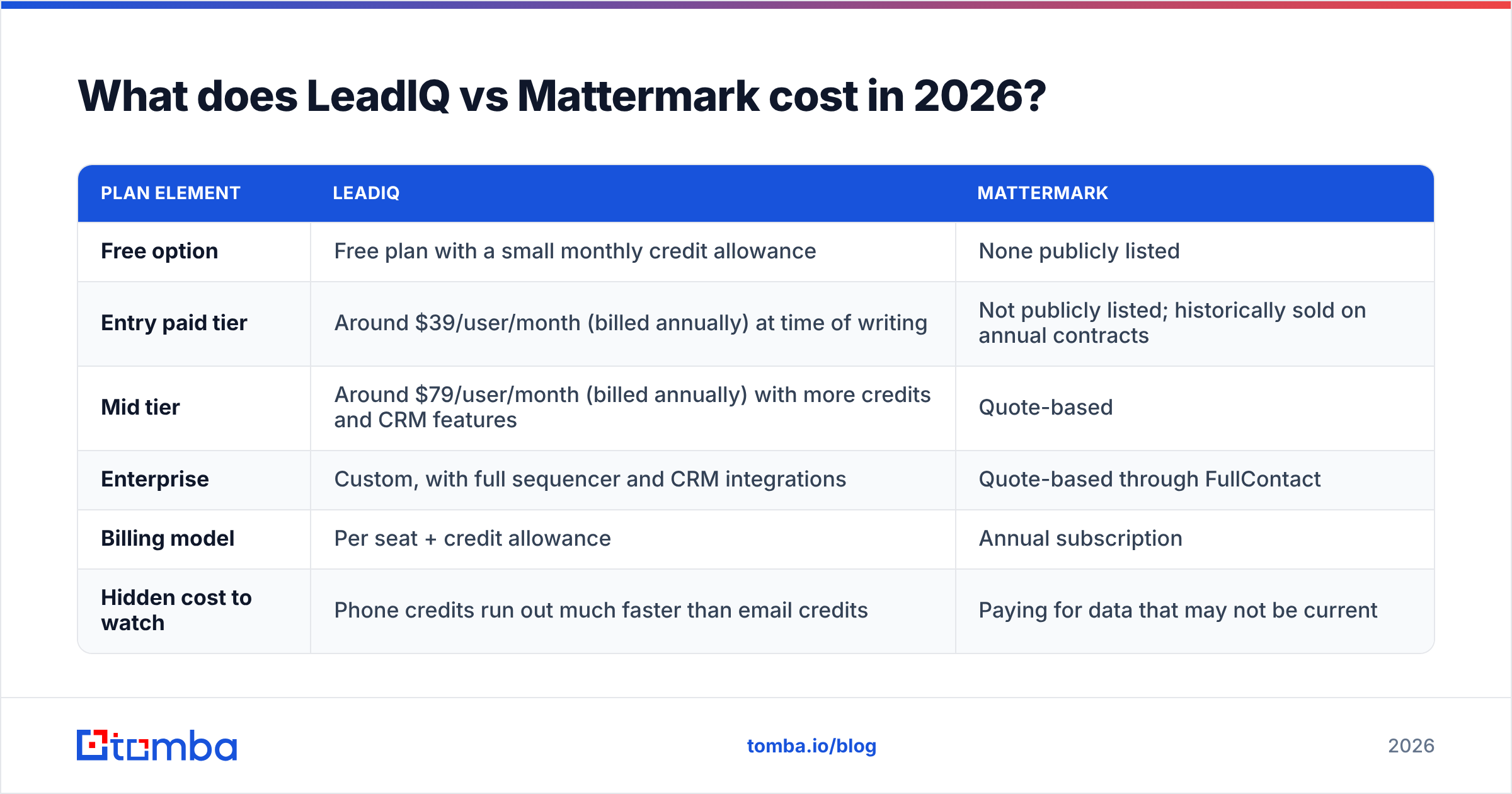
Pricing changes often, so treat these numbers as a starting point and check each vendor's site before you buy.
| Plan element | LeadIQ | Mattermark |
|---|---|---|
| Free option | Free plan with a small monthly credit allowance | None publicly listed |
| Entry paid tier | Around $39/user/month (billed annually) at time of writing | Not publicly listed; historically sold on annual contracts |
| Mid tier | Around $79/user/month (billed annually) with more credits and CRM features | Quote-based |
| Enterprise | Custom, with full sequencer and CRM integrations | Quote-based through FullContact |
| Billing model | Per seat + credit allowance | Annual subscription |
| Hidden cost to watch | Phone credits run out much faster than email credits | Paying for data that may not be current |
LeadIQ's public pricing is on leadiq.com. Mattermark doesn't publish comparable current pricing, so you'll probably need to contact sales, and the quote will likely be an annual commitment. For a small team, that's a lot of risk to take on for an unproven dataset.
Is LeadIQ better than Mattermark?#
For a sales team in 2026, yes, in most cases. That's not because LeadIQ is a better version of Mattermark. It's because LeadIQ solves the problem most sales teams actually have.
Pick LeadIQ if:
- Your reps live in LinkedIn Sales Navigator and lose time copying contacts into the CRM by hand.
- You run sequences in Outreach or Salesloft and want captured contacts to land there automatically.
- Job-change tracking would give your team a steady supply of warm outbound triggers.
- You want AI-drafted first touches as a starting point, not a replacement for a rep.
Consider Mattermark only if:
- You already have a contract and a workflow built around its Growth Score.
- You need historical startup growth data for research, not live prospecting.
- You've run the freshness test above and it passed.
For anyone starting fresh with startup-focused deal sourcing, the realistic comparison isn't LeadIQ vs Mattermark. It's Mattermark vs Crunchbase, PitchBook, or Dealroom. Most new buyers pick one of those three for company intelligence.
What are the pros and cons of each tool?#
LeadIQ pros
- Very low-friction capture from LinkedIn
- Strong native integrations with the major CRMs and sequencers
- Job-change tracking is useful for expansion and re-engagement plays
- Free plan lets you test before you commit a budget
LeadIQ cons
- Credit limits get tight quickly for high-volume teams
- Phone and international coverage is weaker than US email coverage
- Per-seat pricing gets expensive across a large SDR floor
Mattermark pros
- Growth Score was a useful idea: one number for startup momentum
- Deep historical data on startups from the 2012–2017 period
- Suits VCs and analysts who think in terms of companies, not contacts
Mattermark cons
- Little visible product development since the FullContact acquisition
- No meaningful contact-level email or phone data
- Pricing isn't transparent, and contracts tend to be annual
- Newer competitors cover funding and growth data with fresher updates
If LeadIQ's per-seat model doesn't fit your team, our LeadIQ alternative breakdown compares options with different pricing. If you came to Mattermark by way of FullContact, the FullContact alternative page covers enrichment-focused replacements.
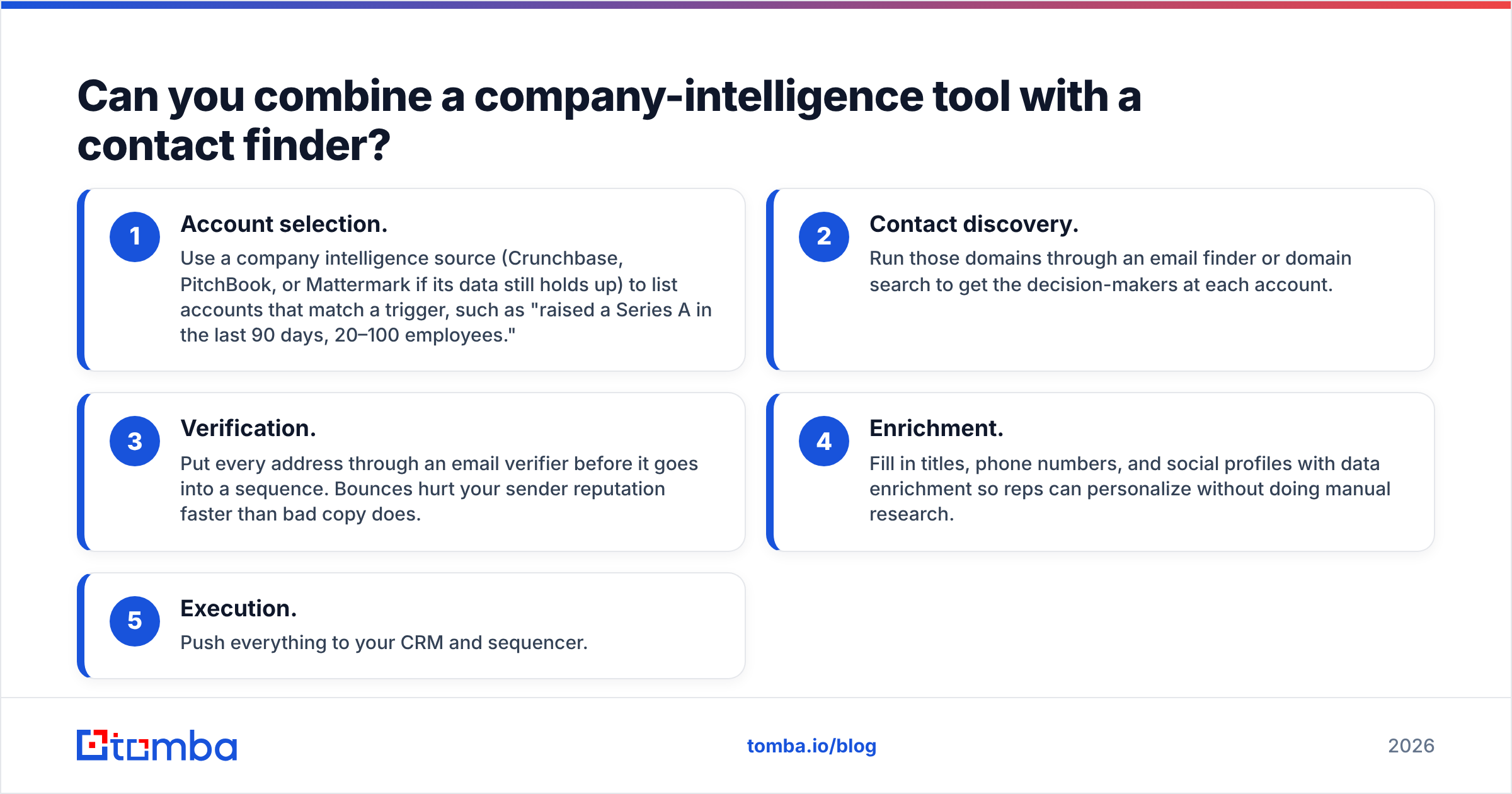
Can you combine a company-intelligence tool with a contact finder?#
Yes, and many good outbound teams do exactly this. A typical stack looks like this:
- Account selection. Use a company intelligence source (Crunchbase, PitchBook, or Mattermark if its data still holds up) to list accounts that match a trigger, such as "raised a Series A in the last 90 days, 20–100 employees."
- Contact discovery. Run those domains through an email finder or domain search to get the decision-makers at each account.
- Verification. Put every address through an email verifier before it goes into a sequence. Bounces hurt your sender reputation faster than bad copy does.
- Enrichment. Fill in titles, phone numbers, and social profiles with data enrichment so reps can personalize without doing manual research.
- Execution. Push everything to your CRM and sequencer.
LeadIQ covers steps 2, 4, and 5 well when the rep is working one profile at a time on LinkedIn. It's less efficient when you have a list of 500 domains from step 1 and need contacts in bulk. That's where a domain-based finder with a bulk upload fits better.

What should you check before buying either tool?#
Run the same short checklist for either vendor. It takes about an hour and can save you an annual contract you'll regret.
- Run a 50-record accuracy test. Take 50 contacts or companies you already know well, run them through the tool, and count the hits, misses, and stale records.
- Calculate your real credit burn. Multiply reps × contacts per rep per day × working days. Compare that number to the plan's allowance, especially for phone numbers.
- Confirm integration depth. "Integrates with Salesforce" can mean anything from a native bi-directional sync to a CSV you upload by hand. Ask for a live demo on your own instance.
- Ask about data refresh cadence. How often do they re-verify emails and re-crawl company data? A vague answer is itself an answer.
- Read the renewal terms. Auto-renewal clauses and seat minimums matter more than the list price.
Frequently asked questions#
Is Mattermark still available in 2026?#
Mattermark still has a web presence and is owned by FullContact, but there has been little public product development since the 2017 acquisition. Contact their team directly to confirm current availability, pricing, and data refresh cadence before you commit.
Does LeadIQ provide company funding data?#
LeadIQ shows basic firmographics like industry, size, and location next to contact records, but it isn't a funding or growth-signal database. For round sizes, investors, and growth metrics, you need a dedicated company intelligence source.
Which is better for selling to startups, LeadIQ or Mattermark?#
Ideally you'd use both kinds of tool. Mattermark-style data helps you pick which startups to target, and LeadIQ-style data helps you reach the people there. If you can only afford one, a contact tool usually pays for itself faster, because you can build account lists from free sources like press releases and funding announcements.
Is there a cheaper option than LeadIQ for finding emails?#
Yes. If you mainly need verified work emails and don't need LinkedIn-native capture or sequencer sync, a standalone email finder is usually cheaper per contact. Compare Tomba plans, which start with a free tier of 25 searches per month and paid plans from $49/month, against your expected monthly volume.
The verdict: which should you choose?#
In the LeadIQ vs Mattermark matchup, LeadIQ is the clear pick for sales teams in 2026. It's actively developed, has transparent pricing, and fits how reps prospect today. Mattermark was a useful company-intelligence tool in its time, and it may still work for historical startup research. For new buyers, though, its unclear roadmap and data freshness make it hard to recommend over newer company databases.
Many teams find that what they actually need is something simpler: a reliable way to turn a list of target companies into verified email addresses. Tomba Email Finder does that. You enter a domain, a name, or a company, and it returns professional emails with a verification status, available in bulk, through the API, or from the browser extension. Pair it with whichever company-intelligence source you trust. Start on the free plan and test it against the same 50 records you'd use to evaluate LeadIQ.
Related guides#
Ready to find emails that actually work?
Join 150,000+ professionals who stopped guessing and started sending. Free credits on signup — no credit card required.
Get the Tomba newsletter
Practical outbound tactics and product updates — once every two weeks.
About the author