LeadIQ vs PrivCo (2026): Contact Data or Private Company Intel?
LeadIQ tells you who to email. PrivCo tells you whether the company behind the email is worth your time. Here's how to pick the one that fits your team, and when you need both.
LeadIQ vs PrivCo comes down to one question: do you need to reach people, or judge companies? LeadIQ finds contact data. PrivCo digs into private company finances. Here's how they compare.
TL;DR: LeadIQ vs PrivCo
- LeadIQ is a prospecting tool for contact data. It grabs verified emails and mobile numbers from LinkedIn and sends them to your CRM and sequencer.
- PrivCo is a research tool for private companies. It shows revenue estimates, funding, M&A, and investors for firms that don't publish their numbers.
- Choose LeadIQ if your problem is reaching people. Choose PrivCo if your problem is deciding which private companies are worth chasing.
- Pricing works differently. LeadIQ sells per-seat plans and has a free tier. PrivCo mostly sells quote-based annual contracts.
- Many teams pair one company data source with a cheaper email finder. That split is often better value than forcing one tool to do both jobs.
What is the real difference between LeadIQ and PrivCo?#
A lot of LeadIQ vs PrivCo comparisons go wrong. They treat these as two versions of the same product. They aren't. Both sell B2B data, but they answer different questions.
- LeadIQ answers "who, and how do I reach them?" You find a VP of Operations on LinkedIn and click the extension. In seconds you get a work email, often a mobile number, and a new CRM record.
- PrivCo answers "what is this company, and is it worth it?" You look up a family-owned manufacturer or a VC-backed startup. You see estimated revenue, headcount trends, funding, acquisitions, and who owns it.
Think of it as a phone book versus a credit report. The phone book gets the call connected. The credit report tells you if the call is worth making. Sales teams need the first every day. Deal teams need the second. That means bankers, PE associates, and corporate development.
So before you compare LeadIQ vs PrivCo feature by feature, ask which question is costing you pipeline right now.
What is LeadIQ?#
LeadIQ is a sales prospecting platform built around a Chrome extension. It works on LinkedIn, Sales Navigator, and company websites. SDRs and AEs use it to save contacts while they research, with no copy and paste.
Core capabilities:
- One-click contact capture from LinkedIn and Sales Navigator profiles, with work emails and phone numbers where available
- CRM and sequencer sync to Salesforce, HubSpot, Outreach, and Salesloft, with duplicate checks so reps don't create records that already exist
- Job change tracking, which flags when past champions or customers move to a new company
- AI-assisted messaging (LeadIQ's Scribe) for drafting personal outreach from profile details
- Team controls such as credit allocation, usage reports, and territory-friendly workflows
LeadIQ's strength is workflow. It isn't the biggest database on the market. But it removes friction between spotting a prospect and adding them to a sequence. Review sites like G2 often praise its ease of use and CRM sync. Common complaints are gaps outside North America and patchy mobile numbers in some regions.
LeadIQ tells you very little about a company's financial health. You'll see basics like industry and headcount range. You won't see a revenue estimate you'd trust for a pricing talk or a deal thesis.
What is PrivCo?#
PrivCo is a financial data platform for privately held companies. Public companies file 10-Ks. Private companies don't. PrivCo estimates and gathers what's otherwise hidden: revenue, growth, ownership, funding rounds, M&A history, and investor portfolios.
Core capabilities:
- Private company financials: revenue estimates and ranges, often with historical trends
- Funding and M&A data: rounds, valuations where disclosed, acquirers, and exit history
- Investor profiles: VC and PE firms, their portfolios, and deal activity
- Screening and list building: filter by revenue band, industry, geography, ownership type, and growth
- Company research reports that bankers and consultants can drop straight into pitch materials
PrivCo's main buyers are investment banks, PE and VC firms, consultancies, corporate development teams, and business schools. Some sales teams use it too. These are mostly enterprise or mid-market teams selling to private companies. For them, revenue size decides if an account is worth a year-long sales cycle.
PrivCo does show key executives for many companies. But it isn't built to find contacts. Say you need a verified work email for the CFO of a $40M private distributor. PrivCo will get you the company and probably the name. Getting the inbox usually takes a separate tool.

How do LeadIQ and PrivCo compare side by side?#
This table covers what buyers ask about most. Pricing reflects public information as of 2026. Both vendors change their plans, so check current numbers on their sites before you budget.
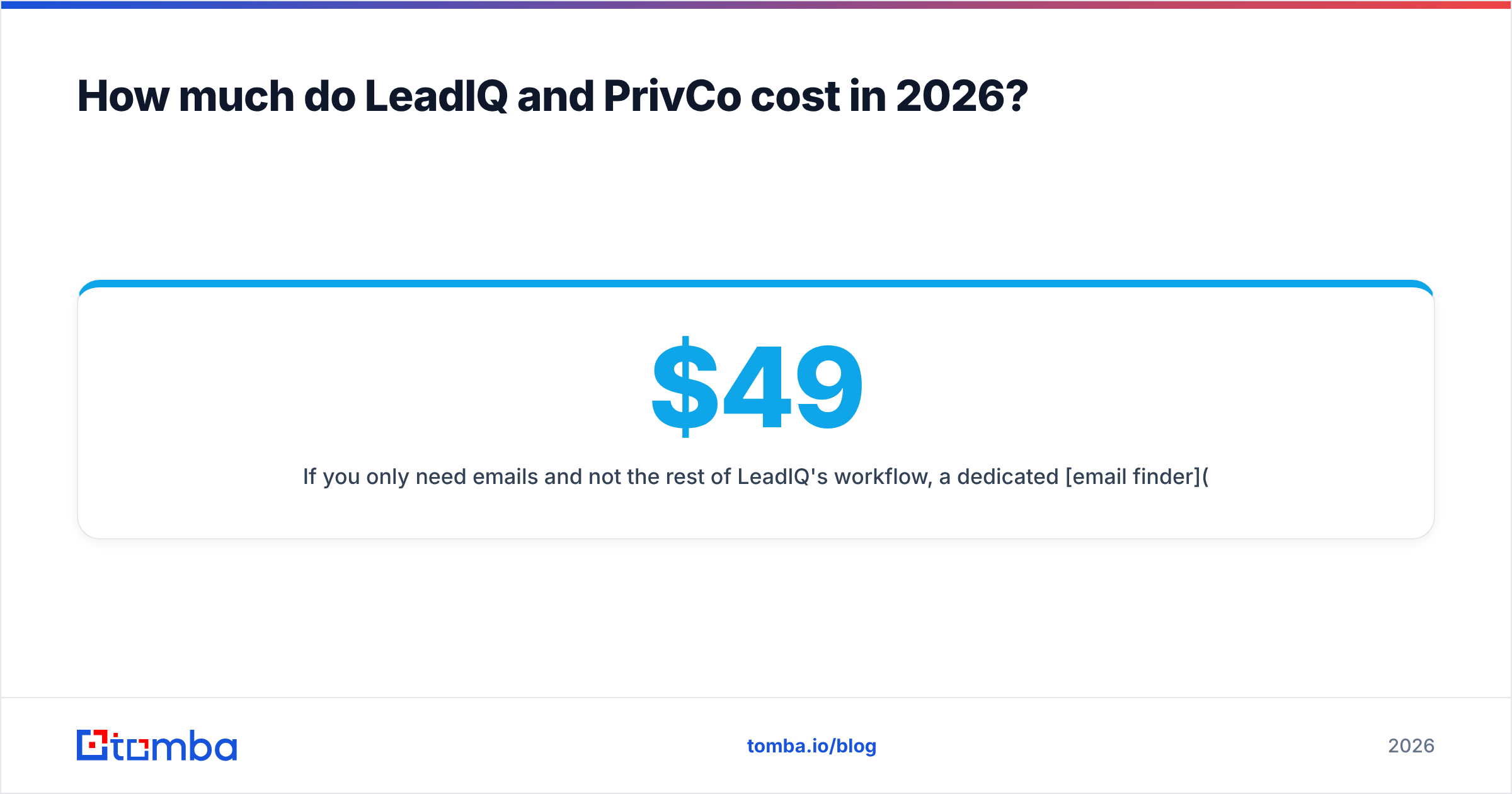
| Attribute | LeadIQ | PrivCo |
|---|---|---|
| Primary job | Find and capture contact data | Research private company financials |
| Core data | Work emails, mobile numbers, job titles, job changes | Revenue estimates, funding, M&A, ownership, investors |
| Typical user | SDRs, AEs, sales managers | Bankers, PE/VC analysts, corp dev, strategy consultants |
| Main interface | Chrome extension + web app | Web research platform + screening tools |
| Free tier | Yes, limited monthly credits | No meaningful self-serve free tier |
| Pricing model | Per-seat monthly/annual plans | Quote-based annual subscriptions |
| CRM integrations | Salesforce, HubSpot, Outreach, Salesloft | Limited; mostly export-based |
| Email verification | Built in on captured contacts | Not a core feature |
| Private company revenue | Not a focus | Core strength |
| Best for | Filling sequences quickly | Qualifying and valuing private targets |
The pattern is clear. The tools overlap on basic company data and little else. Most "which is better" questions go away once you name the job you need the tool to do.
Which tool gives you more reliable data for your use case?#
Accuracy depends on what you measure. Each tool is reliable at different things, and each has clear weak spots.
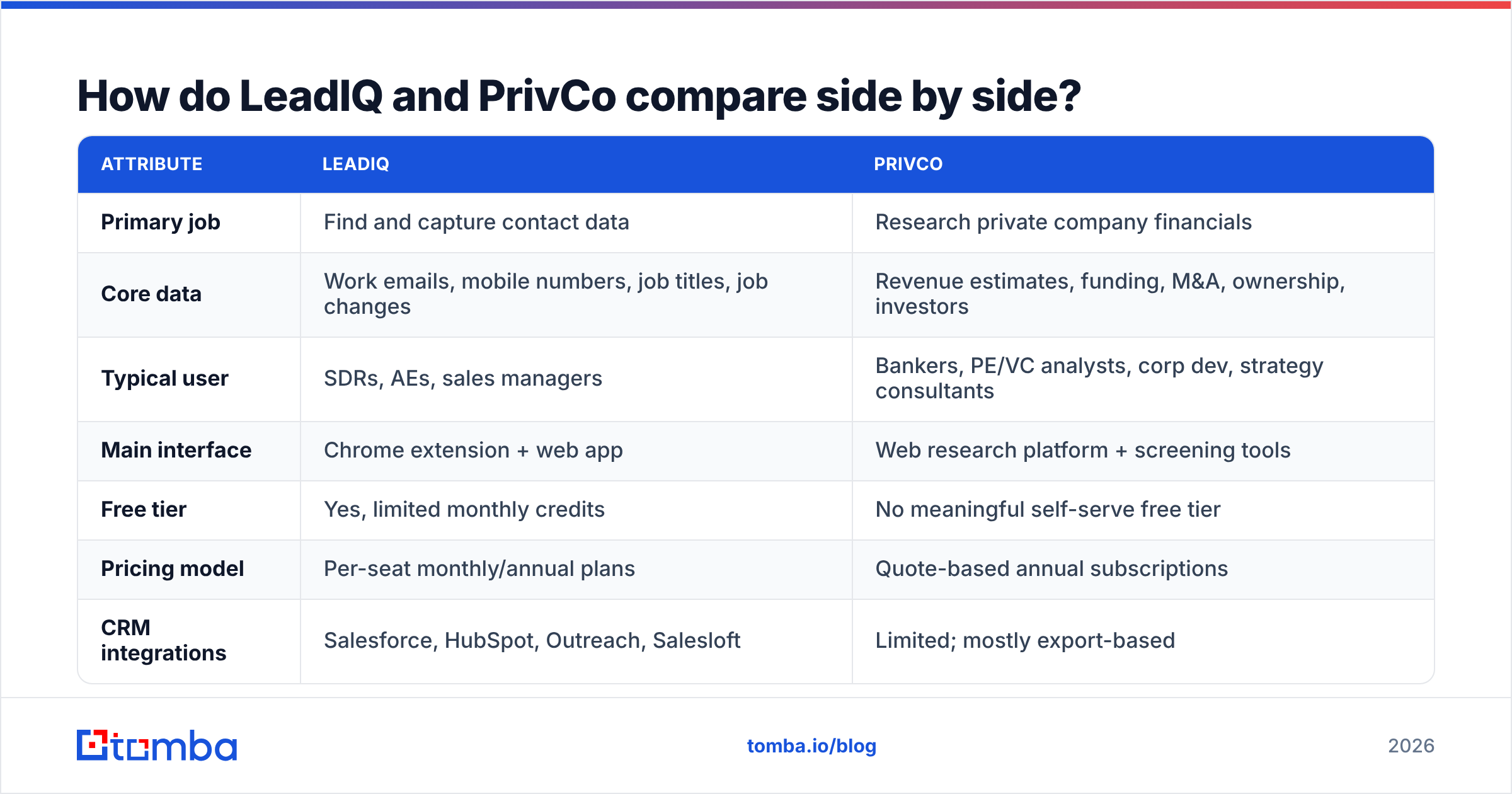
- Email accuracy (LeadIQ wins). LeadIQ checks emails before handing them over. Its whole workflow is built around contacts you can actually reach. PrivCo isn't competing here. For outreach, what matters is how many emails bounce. With any contact tool, run a second pass through an email verifier before big sends, especially on catch-all domains.
- Revenue accuracy (PrivCo wins). Private revenue is always an estimate. Still, PrivCo's method and track record on private firms beat the rough, headcount-based revenue bands most contact tools show. Treat its numbers as ranges, not audited figures.
Those are the two headline gaps in LeadIQ vs PrivCo. The next three are narrower but still matter.
- Freshness of people data (LeadIQ is stronger). LeadIQ tracks job changes and captures data right from the profile. So it reflects role moves faster. Company databases update people data less often, since people aren't their focus.
- Deal and ownership history (PrivCo is stronger). When was a company acquired? Who backs it? When did it last raise? This is PrivCo's core data, and it changes how you pitch. A PE-backed company four years into a hold buys differently from a founder-owned business.
- Geographic coverage (it depends). Both are strongest in North America. If most of your territory is EMEA or APAC, test both on 50 real targets before you sign an annual deal.
The honest takeaway: neither tool is "more accurate" in general. Each is accurate for its own job.
How much do LeadIQ and PrivCo cost in 2026?#
LeadIQ pricing is fairly clear. There's a free plan with a small monthly allowance of email and phone credits. Paid plans are priced per seat. Entry plans have historically cost tens of dollars per user per month. Higher tiers add more credits, mobile numbers, and CRM features. Enterprise is custom. The per-seat model adds up fast. A 10-rep team on a mid-tier plan becomes a real annual cost, and mobile credits are usually the limit.
PrivCo generally doesn't publish prices for its main plans. You go through sales, and contracts are usually annual. Its pricing has sat in the premium research-tool range, closer to other private-market data platforms than to prospecting tools. Academic and enterprise licenses are negotiated separately.
Some practical budgeting rules for LeadIQ vs PrivCo:
- Don't compare list prices directly. A per-rep prospecting seat and an annual research license are different kinds of spend.
- Model cost per useful record. For LeadIQ, divide monthly cost by contacts that actually reach an inbox. For PrivCo, divide annual cost by the deals or accounts it truly helped you qualify.
- Watch credit limits. Most contact tools charge by credit. Heavy users hit caps mid-month and then either wait or upgrade.
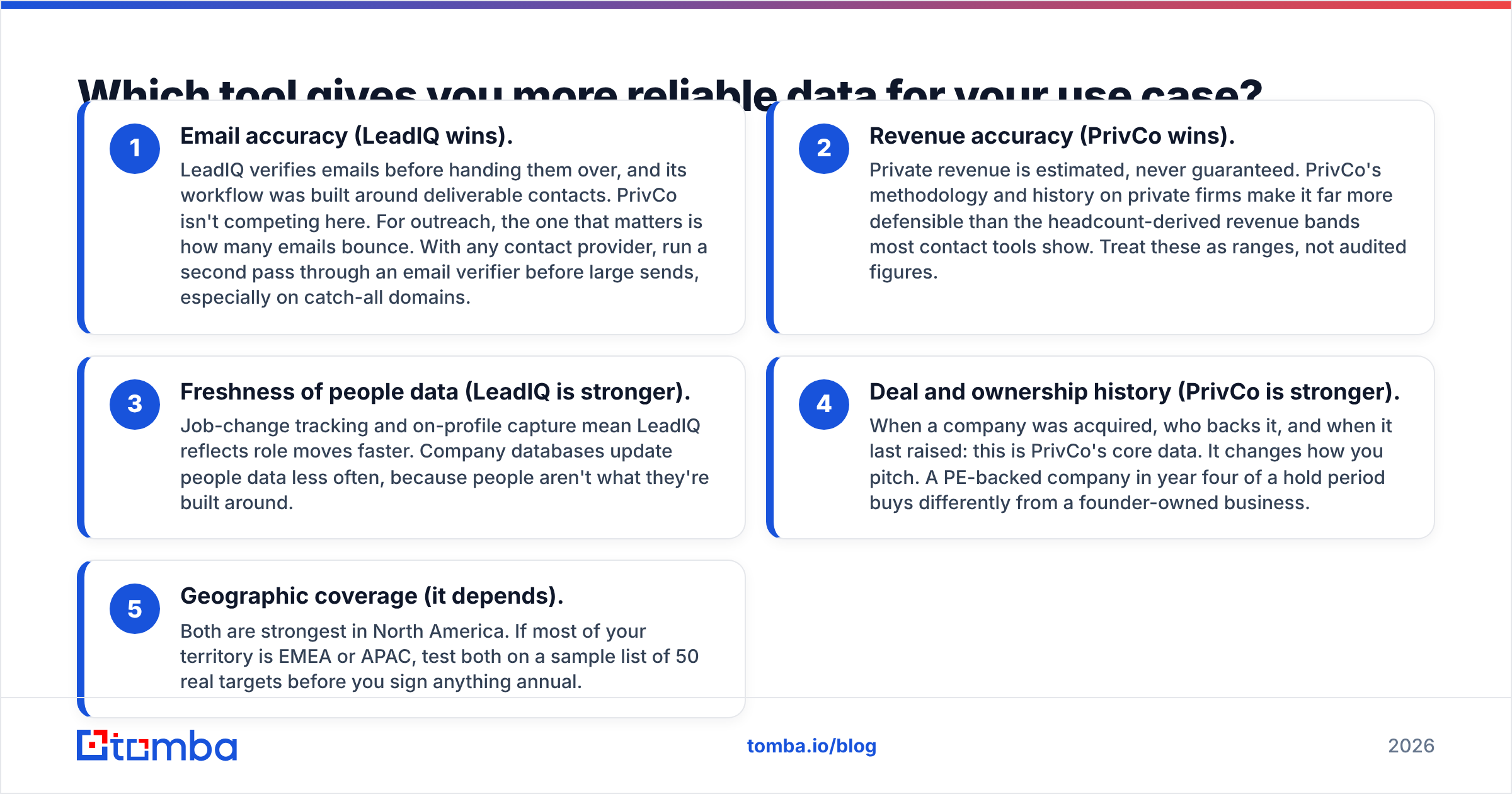
If you only need emails and not the rest of LeadIQ's workflow, a dedicated email finder is often much cheaper per contact. Tomba pricing, for example, starts with a free tier of 25 searches a month. Then it's Starter at $49/mo, Growth at $99/mo, and Pro at $249/mo. Those plans aren't priced per rep like most sales tools.
Who should choose LeadIQ?#
LeadIQ is the better fit if:
- Your team lives in LinkedIn and Sales Navigator. The extension is where LeadIQ is fastest.
- You run Outreach or Salesloft sequences. Native sync removes an export/import step that causes messy data.
- Champion tracking matters. When a former buyer changes jobs, that's one of the warmest signals in B2B, and LeadIQ surfaces it well.
- You measure SDRs on activity and meetings booked. Faster capture means more at-bats per day.
It's the weaker choice if you sell to lots of small private companies and waste time on accounts too small to close. LeadIQ will help you reach those people very quickly, including the ones you shouldn't be spending time on.
If LeadIQ's per-seat costs or coverage don't work for you, this guide to LeadIQ alternative options compares tools with different pricing models.
Who should choose PrivCo?#
PrivCo is the better fit if:
- You're on the deal side. Sourcing acquisition targets, building comp sets, or preparing a pitch book for a private company.
- Your ICP is defined by revenue, not headcount. "Private companies between $20M and $200M in revenue" is a PrivCo query. It's a guessing game in most contact databases.
- Ownership changes your pitch. Selling to PE portfolio companies, founder-led firms, or recently acquired businesses takes different messaging, and PrivCo shows you which one you're dealing with.
- You need numbers you can defend in internal investment memos or client deliverables.
It's the weaker choice for a high-volume SDR team. PrivCo won't fill your sequencer. It doesn't push contacts into your CRM the way prospecting tools do. And its price only makes sense if company research is the core job.
Can you use LeadIQ and PrivCo together?#
Yes. For enterprise sales teams selling to private mid-market companies, using both is often the right setup. The workflow looks like this:
- Screen in PrivCo. Build a list of private companies that match your revenue band, growth rate, and ownership profile.
- Prioritize. Tier accounts by fit, for example recently funded, recently acquired, or growing fast.
- Map contacts in LeadIQ. Open each account on LinkedIn and capture the buying committee.
- Sequence. Push contacts to Outreach or Salesloft with messaging that references the company context you found in step 1.
The catch is cost. Two premium data contracts plus seats can easily cost more than a smaller team can justify. A leaner setup keeps the research layer and swaps the contact layer for a cheaper finder. It can run domain search on every shortlisted company at once, instead of one profile click at a time.

That's the core limit of any company data tool. A revenue estimate won't book a meeting. At some point you still need a working inbox for a real person, verified before you send.
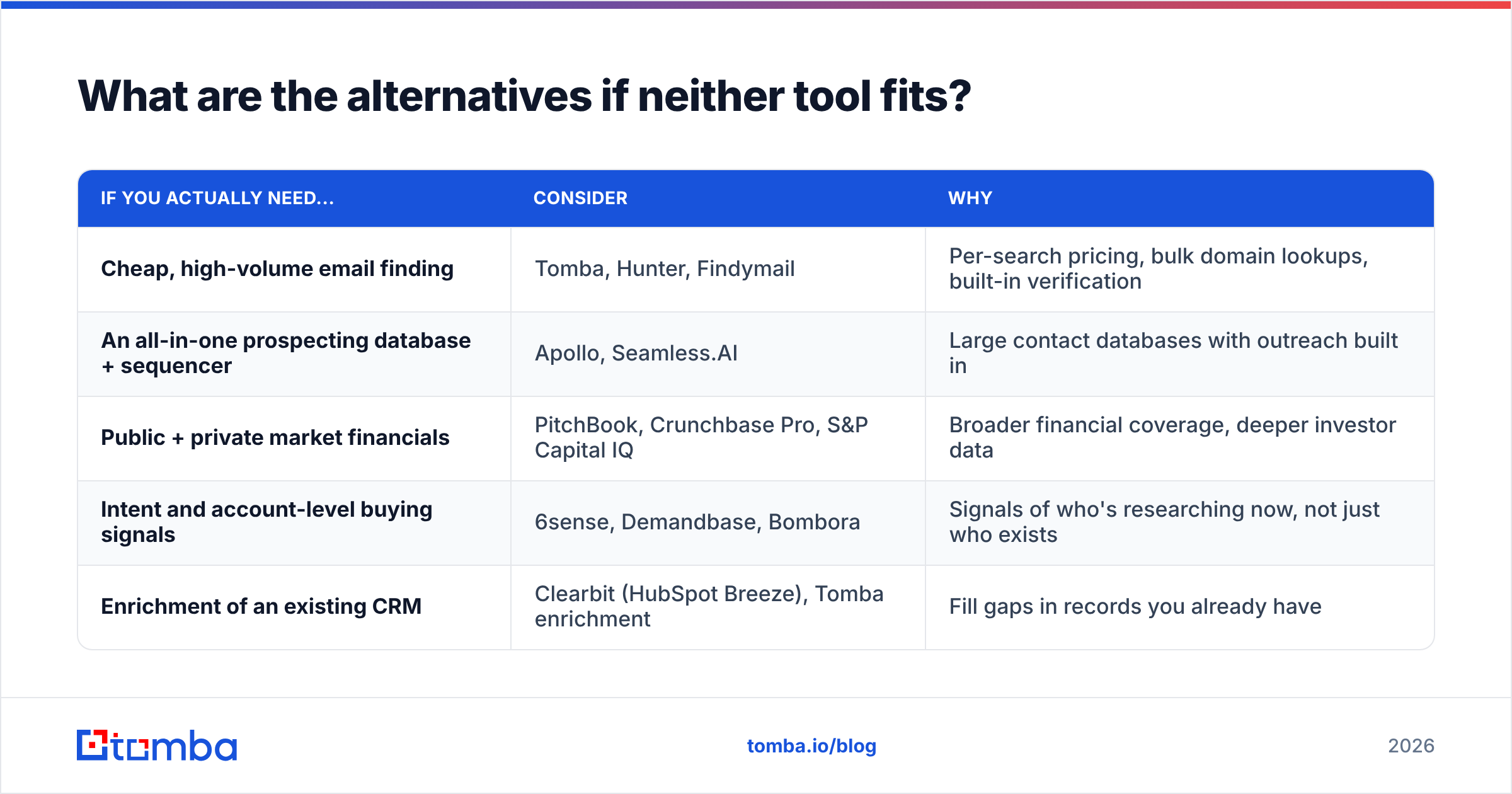
What are the alternatives if neither tool fits?#
If you're weighing LeadIQ vs PrivCo and neither fits cleanly, you probably need one of these instead:
| If you actually need... | Consider | Why |
|---|---|---|
| Cheap, high-volume email finding | Tomba, Hunter, Findymail | Per-search pricing, bulk domain lookups, built-in verification |
| An all-in-one prospecting database + sequencer | Apollo, Seamless.AI | Large contact databases with outreach built in |
| Public + private market financials | PitchBook, Crunchbase Pro, S&P Capital IQ | Broader financial coverage, deeper investor data |
| Intent and account-level buying signals | 6sense, Demandbase, Bombora | Signals of who's researching now, not just who exists |
| Enrichment of an existing CRM | Clearbit (HubSpot Breeze), Tomba enrichment | Fill gaps in records you already have |
Crunchbase deserves a mention as a middle ground. It covers funding and startup data for less than PrivCo. But it's weaker on revenue estimates for older private businesses that never raised venture money.
What do buyers usually ask about LeadIQ vs PrivCo?#
Does PrivCo have email addresses?#
PrivCo lists key executives for many private companies. Verified contact data at scale isn't its core product. Most teams pair it with a separate contact tool for outreach.
Does LeadIQ show company revenue?#
LeadIQ shows basic company context like industry and size. It doesn't try to provide the private company revenue estimates, funding detail, or ownership history PrivCo is built around.
Is LeadIQ or PrivCo better for startups?#
For a startup selling software, LeadIQ or a cheaper email finder is usually the better first buy. Your problem is reaching buyers. PrivCo makes sense once your ICP depends on a target's revenue or ownership.
Which is better for investment banking?#
PrivCo, clearly. It's designed for sourcing, comps, and target research on private companies. LeadIQ has no real role in that workflow beyond contacting owners once targets are chosen.
The LeadIQ vs PrivCo verdict: which should you pick?#
Pick based on your bottleneck. Do reps have plenty of target accounts but struggle to reach the right people? LeadIQ fixes that. Does your team reach people fine but waste quarters on private companies too small to buy? PrivCo fixes that. If you're a deal team, PrivCo is the tool and LeadIQ is optional.
Maybe you need both company research and contact data but can't justify two premium contracts. Then keep the research source you trust and use a cheaper contact layer. Tomba Email Finder finds verified work emails by name, domain, or company. It runs in the browser, in bulk, or through the API. Plans start with a free tier and $49/mo Starter pricing instead of per-seat licenses. Run your PrivCo shortlist through it, verify before you send, and spend the savings on meetings.
Related guides#
// get started
Find, verify and enrich your first contacts today
Start on the free plan with 25 searches a month, then scale when your team is ready.
Free plan · No credit card required · GDPR & CCPA
Get the Tomba newsletter
Product and data updates
// about the author