LeadIQ vs SourceScrub: Sales Prospecting vs Deal Sourcing in 2026
LeadIQ and SourceScrub both sell B2B data, but they're built for different jobs. One helps SDRs book meetings. The other helps investors find private companies before competitors do. Here's how to tell which one your team needs.
TL;DR
- LeadIQ is a sales prospecting tool. It captures contacts from LinkedIn, finds verified emails and phone numbers, and pushes them into your CRM and sequencer. It's built for SDRs and AEs.
- SourceScrub is a private-company intelligence platform. It's built for private equity, investment banking, and corporate development teams who need to find founder-owned and growth-stage companies to acquire or invest in.
- They rarely compete head-to-head. If you're asking "who do I email?", LeadIQ fits. If you're asking "which companies should we buy?", SourceScrub fits.
- LeadIQ publishes self-serve pricing with a free tier. SourceScrub is sold through sales on annual contracts, with pricing by quote.
- If you only need verified contact emails for a company list you already have, a dedicated email finder is usually the cheaper route.
People search "LeadIQ vs SourceScrub" because both vendors describe themselves as B2B data platforms, and a lot of buying committees shortlist anything with "data" in the pitch. The two products answer different questions, though. This guide covers what each tool does, where they overlap, what they cost, and which kinds of teams should pick which.
What is LeadIQ?#
LeadIQ is a prospecting and contact-capture platform for outbound sales teams. Its main surface is a Chrome extension that runs on LinkedIn and Sales Navigator. You open a profile, click capture, and LeadIQ returns work emails and direct dials. You can then push that contact to Salesforce, HubSpot, Outreach, or Salesloft without leaving the page.
LeadIQ's main features:
- Contact capture from LinkedIn and Sales Navigator, one at a time or in bulk from search lists.
- Email and phone data, with verification status shown before you spend credits.
- CRM and sequencer sync. Captured leads go straight into cadences, and LeadIQ checks for duplicates against the CRM.
- Job-change tracking. It alerts you when champions or past buyers move to a new company, which is one of the most reliable warm-outbound triggers.
- AI-assisted personalization. It drafts first-touch emails using profile and company context.
LeadIQ is designed around a person, not a company. The unit of work is "get this human's contact data into my pipeline." Company-level firmographics exist, but only to support that workflow.
What is SourceScrub?#
SourceScrub is a deal-sourcing and private-market intelligence platform. Its customers are mostly private equity firms, growth equity investors, M&A advisors, and corporate development teams. They use it to find companies that don't show up in the usual venture databases: bootstrapped, founder-owned, lower-middle-market businesses.
SourceScrub's main features:
- Private company profiles covering a large universe of businesses, with headcount, estimated revenue signals, growth trends, ownership, and industry tags.
- Conference and trade show data. It pulls exhibitor and attendee lists from industry events, which is one of the best ways to find niche operators.
- Buyer lists and industry lists from associations, rankings, and awards.
- Growth signals such as headcount changes, hiring velocity, and web traffic, used to prioritize outreach to owners.
- Contact data for executives and owners, so deal teams can reach founders directly.
- CRM integrations with deal-focused systems such as DealCloud and Salesforce.
SourceScrub's unit of work is a company. Contacts exist so a deal professional can reach the owner, not so an SDR team can run 5,000-person sequences.
How do LeadIQ and SourceScrub compare side by side?#
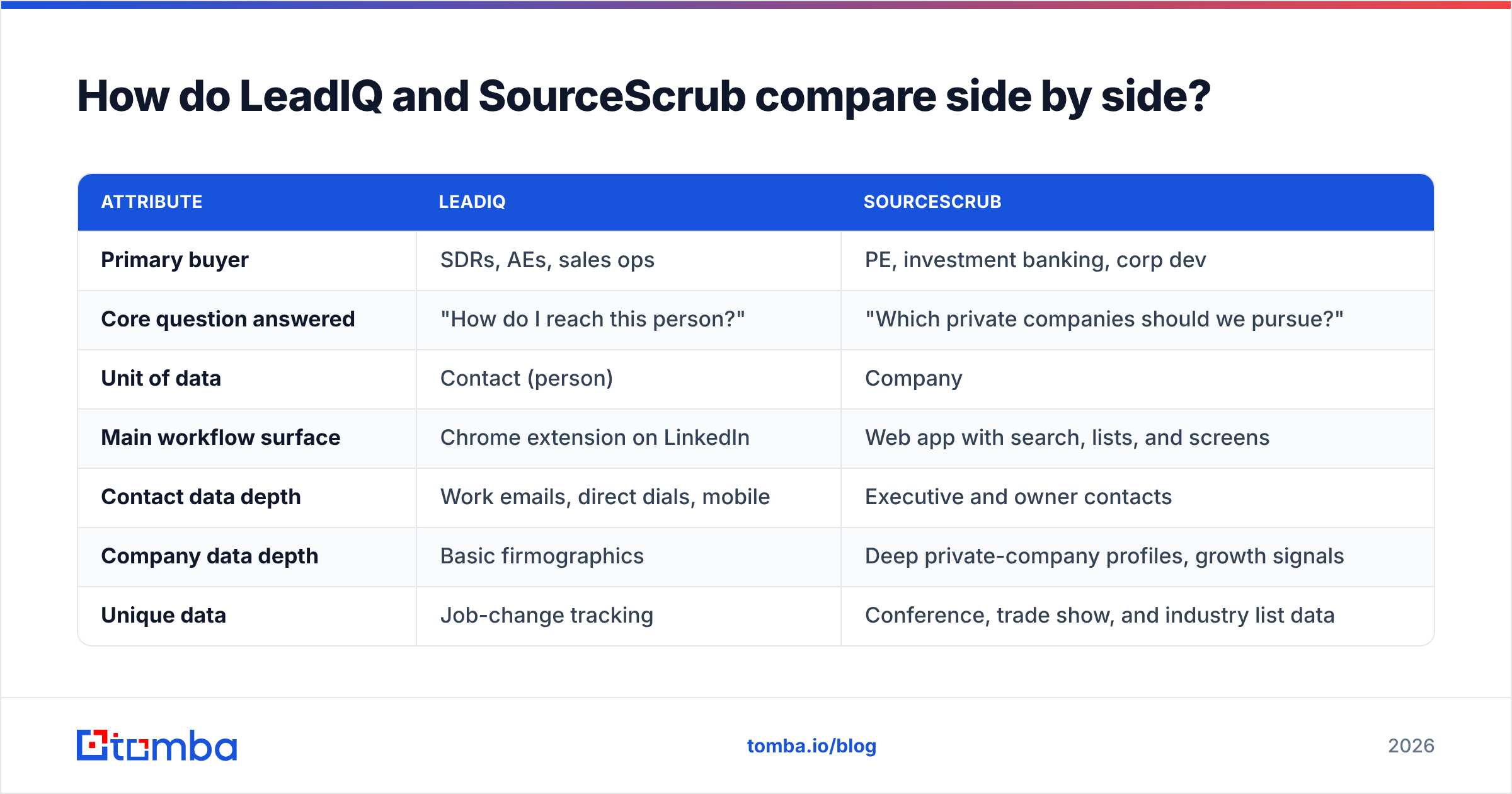
The table below compares the attributes that usually decide a purchase.
| Attribute | LeadIQ | SourceScrub |
|---|---|---|
| Primary buyer | SDRs, AEs, sales ops | PE, investment banking, corp dev |
| Core question answered | "How do I reach this person?" | "Which private companies should we pursue?" |
| Unit of data | Contact (person) | Company |
| Main workflow surface | Chrome extension on LinkedIn | Web app with search, lists, and screens |
| Contact data depth | Work emails, direct dials, mobile | Executive and owner contacts |
| Company data depth | Basic firmographics | Deep private-company profiles, growth signals |
| Unique data | Job-change tracking | Conference, trade show, and industry list data |
| Integrations | Salesforce, HubSpot, Outreach, Salesloft | DealCloud, Salesforce, other deal CRMs |
| Pricing model | Self-serve tiers plus enterprise | Quote-based annual contracts |
| Free option | Yes, limited free plan | No public free tier |
| Best for | High-volume outbound prospecting | Proprietary deal origination |
A quick analogy helps. LeadIQ is a phone book with a fast dialer attached. SourceScrub is a scouting report on businesses you haven't heard of yet. You can find phone numbers in a scouting report, and you can learn a bit about a company from a phone book, but neither is doing the other's main job.
Which tool has better contact data?#
For contact data specifically, LeadIQ is the stronger product. That's what it's built for. Its capture flow, verification signals, and direct-dial coverage are tuned for reps who need to reach people at volume. It has a dedicated contact-data pipeline and it handles things SourceScrub doesn't try to, like checking whether a lead already exists in Salesforce under a different owner.
SourceScrub's contact data is narrower, and that's intentional. For a founder-owned HVAC distributor with 60 employees, what a deal team needs is the owner's email and maybe the CFO's. SourceScrub covers that well for the companies in its universe. Its value comes from knowing the company exists and is growing, which LeadIQ can't tell you.
Contact accuracy on either platform depends on segment. Enterprise tech contacts are easier to verify than owners of small private businesses, who often run catch-all mail servers or use personal domains. Whichever tool you pick, run exported emails through an independent email verifier before a large send. This matters most for lower-middle-market targets.

Which tool has better company intelligence?#
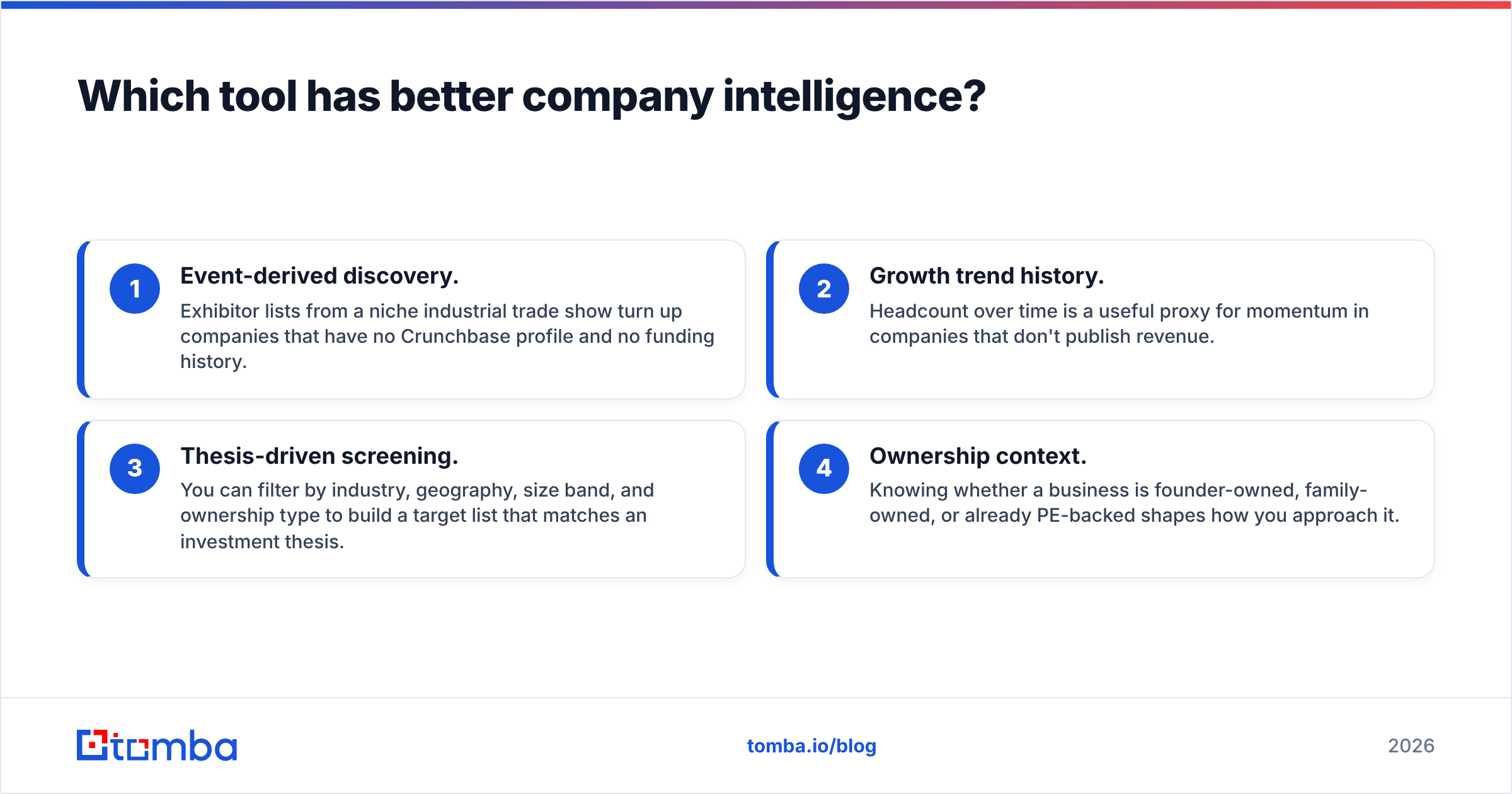
SourceScrub, by a wide margin. This is where it earns its price. It's hard to replicate these things with a sales tool:
- Event-derived discovery. Exhibitor lists from a niche industrial trade show turn up companies that have no Crunchbase profile and no funding history.
- Growth trend history. Headcount over time is a useful proxy for momentum in companies that don't publish revenue.
- Thesis-driven screening. You can filter by industry, geography, size band, and ownership type to build a target list that matches an investment thesis.
- Ownership context. Knowing whether a business is founder-owned, family-owned, or already PE-backed shapes how you approach it.
LeadIQ's company data exists to qualify accounts for sellers: size, industry, location, sometimes tech signals. It won't help you find a $15M-revenue specialty manufacturer that has never raised capital.
How much do LeadIQ and SourceScrub cost?#
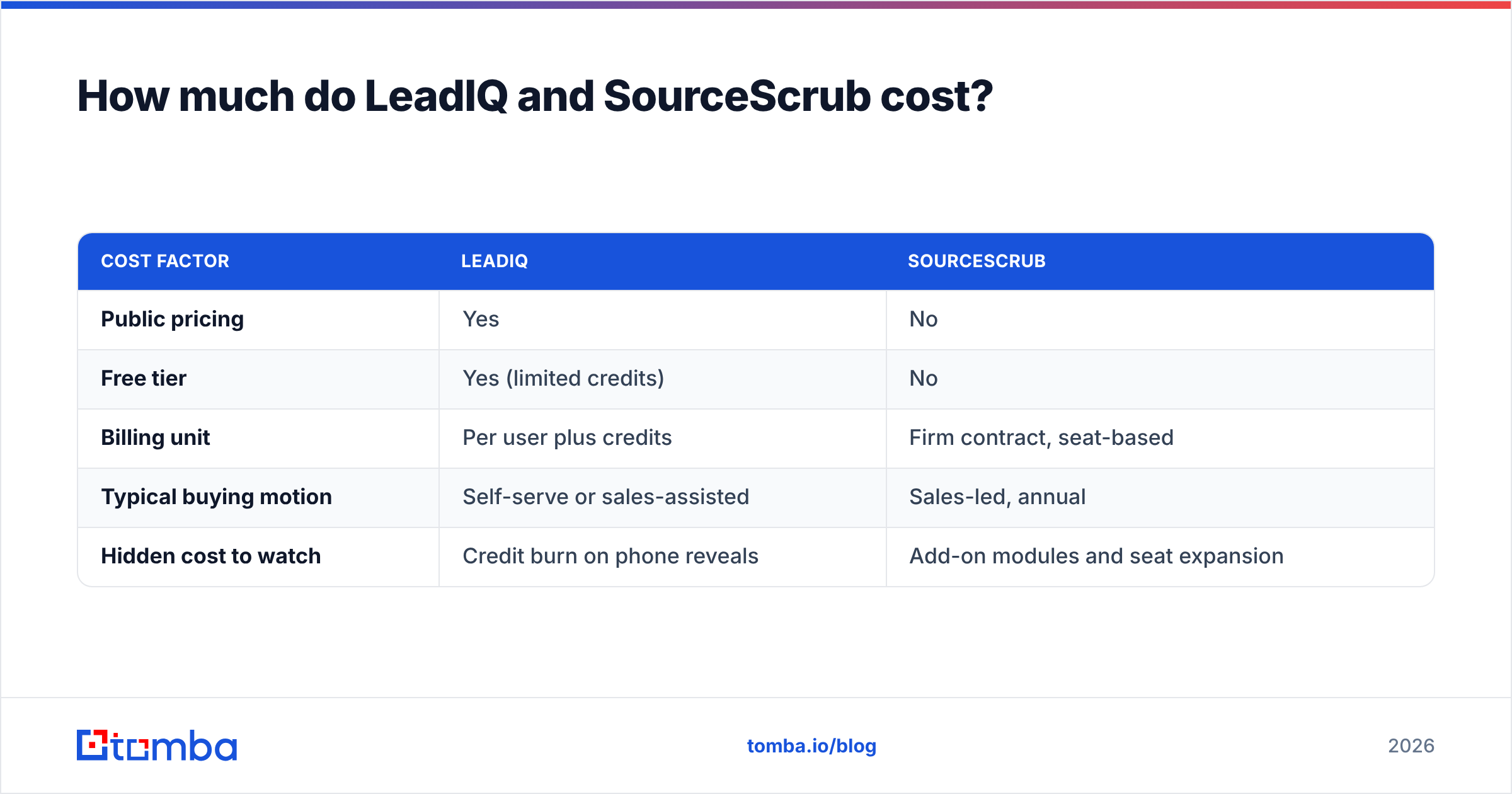
The pricing models reflect the different buyers.
LeadIQ publishes tiered pricing on its site. There's a free plan with a small monthly credit allowance. Paid tiers have been listed at roughly $39 and $79 per user per month on annual billing, with an enterprise tier for larger teams that need advanced admin, governance, and higher credit volumes. Plans are credit-based, and email and phone reveals draw from separate or weighted pools depending on tier. Check the current plan page before you budget, because credit rules change more often than headline prices.
SourceScrub doesn't publish pricing. It's sold through a sales-led process on annual contracts, with cost depending on seats, data modules, and integrations. Expect a demo, a scoping conversation, and a firm-level contract rather than a credit card checkout. Its target customers usually budget it as deal-team infrastructure, next to other market-intelligence subscriptions.
| Cost factor | LeadIQ | SourceScrub |
|---|---|---|
| Public pricing | Yes | No |
| Free tier | Yes (limited credits) | No |
| Billing unit | Per user plus credits | Firm contract, seat-based |
| Typical buying motion | Self-serve or sales-assisted | Sales-led, annual |
| Hidden cost to watch | Credit burn on phone reveals | Add-on modules and seat expansion |
User reviews on G2 are useful here. Compare what buyers say about renewal pricing and credit limits, not only the headline number on the vendor's site.
Is LeadIQ better than SourceScrub?#
For a sales team, yes. For a deal team, no. That isn't a hedge. The products are built for different jobs.
Choose LeadIQ if:
- You run outbound from LinkedIn and need contacts in your sequencer in seconds.
- Your reps care about job-change alerts and CRM deduplication.
- You want to start on a free plan or with per-seat monthly pricing.
- Your targets are mostly employees at companies that are easy to find, not hidden private businesses.
Choose SourceScrub if:
- Your job is to find private companies before other buyers do.
- You build target lists from industry theses, not from LinkedIn searches.
- Conference, association, and trade show data is part of how you source.
- You need company growth signals to prioritize owner outreach.
Some firms use both. A PE firm's portfolio operations team may buy LeadIQ seats for a portfolio company's sales team while the deal team uses SourceScrub. They're separate budgets for separate jobs.
What are the main limitations of each tool?#
LeadIQ limitations
- LinkedIn dependency. The core workflow assumes your prospects have good LinkedIn profiles. That gets weaker in industries where decision-makers barely use LinkedIn.
- Credit math. Phone numbers usually cost more than emails, and heavy dialing teams can run out of credits quickly.
- Shallow company research. It's fine for qualifying accounts, but you can't use it to build a thesis-driven market map.
- Per-seat scaling. Costs grow linearly with headcount, which adds up for large SDR teams.
SourceScrub limitations
- Price opacity. No public pricing makes it hard to compare quickly, and smaller firms may find the minimum contract steep.
- Not an outbound engine. It gets you to the owner, but it isn't built to run multi-step sequences at SDR volume.
- Niche audience. Features are tuned for investors and acquirers. A typical B2B sales team would pay for capabilities it never uses.
- Contact coverage at the long tail. Very small, owner-run businesses are hard for any vendor to cover. Plan to verify and supplement contacts.

What if you just need emails for a list of companies?#
This is the gap many buyers run into after the demo. A corp dev analyst has 300 target companies from a thesis list, or a founder has a spreadsheet of accounts from a trade show. They don't need a full deal-sourcing platform or a per-seat LinkedIn tool. They need verified emails for the right people at those domains.
A dedicated email finder is usually the most cost-effective option for that job:
- Domain-first search. Run a domain search on each target website to see known contacts and the company's email pattern.
- Name plus domain lookup. If you know the owner's name from a company profile or event list, an email finder returns the most likely address with a confidence score.
- Bulk processing. Upload the full list instead of clicking through profiles one by one.
- Enrichment. Add titles, social profiles, and company attributes with data enrichment so the list is usable in your CRM.
Tomba fits this "I already know which companies, I need the people" workflow. Plans start with a free tier of 25 searches a month, then Starter at $49/mo, Growth at $99/mo, and Pro at $249/mo, with Enterprise on custom terms. It's billed per account rather than per seat. If LeadIQ's per-user model is what's pushing you to look around, this LeadIQ alternative comparison covers that trade-off in more detail.
Tomba doesn't replace SourceScrub's private-company discovery, and it doesn't try to. If your firm's edge depends on finding companies nobody else is tracking, pay for a deal-sourcing platform. If the companies are already chosen, a lighter contact layer is often all you need.
How should you run a fair evaluation?#
Don't pick based on demos. Use a test that reflects your real work:
- Build a 50-record test set from your actual target market. For deal teams, use real thesis-fit companies. For sales teams, use real ICP accounts.
- Measure coverage. For how many records does each tool return a usable contact or company profile?
- Measure accuracy. Verify every returned email independently and track bounces, catch-alls, and invalid addresses.
- Time the workflow. How many minutes does it take to go from target to contact in your CRM?
- Model a full year of cost at your real volume, including credit overages and seat growth.
Most teams find the answer is obvious by step two. The tool built for your question returns far more useful records.
Frequently asked questions#
Is SourceScrub a LeadIQ competitor?#
Only at the edges. Both sell B2B data and both provide contact information, but LeadIQ serves outbound sales teams and SourceScrub serves investors and acquirers. Most buyers evaluating one have no real need for the other.
Does SourceScrub have a Chrome extension like LeadIQ?#
SourceScrub is mainly a web application built around company search, lists, and CRM sync. LeadIQ's main workflow runs in its Chrome extension on LinkedIn. If in-browser capture is a hard requirement, LeadIQ is the closer fit.
Can a sales team use SourceScrub?#
It can, especially one selling into lower-middle-market private companies, where SourceScrub's coverage of hidden businesses helps. For most SDR teams, though, the price and feature set are tuned for deal origination, not high-volume prospecting.
Which is cheaper, LeadIQ or SourceScrub?#
LeadIQ is cheaper to start with because it offers a free plan and published per-seat tiers. SourceScrub uses quote-based annual contracts aimed at firm-wide budgets. For a single user who only needs emails, a standalone email finder is usually cheaper than either.
Which should you pick?#
Start from the question your team answers every day. If it's "how do I reach this person?", go with LeadIQ or a leaner contact tool. If it's "which private companies should we pursue?", go with SourceScrub. If you already have the companies and only need verified contacts for the right people, the Tomba Email Finder finds and verifies professional emails by domain, name, or company, in bulk or one at a time. The free tier lets you test it on your own target list before you commit to a contract. See the full Tomba pricing to match a plan to your volume.
Related guides#
// get started
Find, verify and enrich your first contacts today
Start on the free plan with 25 searches a month, then scale when your team is ready.
Free plan · No credit card required · GDPR & CCPA
// about the author