LeadIQ vs Zintlr: Which Prospecting Tool Fits Your Team in 2026?
LeadIQ is built around CRM and sequencer workflows for US and EU sales teams. Zintlr is built around India and APAC contact data and buyer personality insights. This guide shows which one fits your pipeline and what you should test before paying.
TL;DR
- Pick LeadIQ if your reps live in LinkedIn Sales Navigator, Salesforce or HubSpot, and Outreach or Salesloft. Its strength is moving contacts into the tools you already use, and it adds job-change tracking and AI email drafting on top.
- Pick Zintlr if a large share of your prospects are in India or wider APAC. Its biggest differences are regional phone and email coverage and DISC-style personality insights on each contact.
- Both charge by credits, with seats on top. How much you pay per contact you can actually use depends on your region, how you prospect and how many results bounce, not on the headline plan price.
- Test both on the same 100 contacts before you sign anything annual. Accuracy differs a lot by region and role, and neither vendor's marketing numbers will tell you how it performs on your own list.
- If you mostly need verified work emails, look at a dedicated email finder like Tomba. It starts at $49/mo, has no per-seat pricing, and comes with a verifier. It can sit next to either tool or replace one.
What are LeadIQ and Zintlr?#
On a shortlist, the two look alike: both have a Chrome extension, both find emails and phone numbers, and both push contacts into your CRM. They were built for different sales teams, though, and that shows up once you use them.
LeadIQ is a US-founded prospecting platform aimed at SDR and BDR teams. The main workflow is capturing a contact from LinkedIn or Sales Navigator, enriching it with email and phone, and sending it to Salesforce, HubSpot, Outreach, Salesloft or Gong Engage in one click. Around that it adds job-change alerts on your existing customers and champions, plus an AI writing assistant (Scribe) that drafts personalised outreach.
Zintlr is a B2B contact intelligence platform based in India. It also has a browser extension and a contact database, but it sets itself apart in two ways. It covers Indian and APAC decision-makers deeply, including mobile numbers, which Western tools often find thin. It also attaches personality and communication-style insights to each profile, so you can see how a prospect is likely to want to be approached before you write.
Put simply, LeadIQ is about moving data from LinkedIn into your sales stack cleanly. Zintlr is about finding hard-to-reach contacts in its home regions and working out how to talk to them.
How do LeadIQ and Zintlr compare feature by feature?#
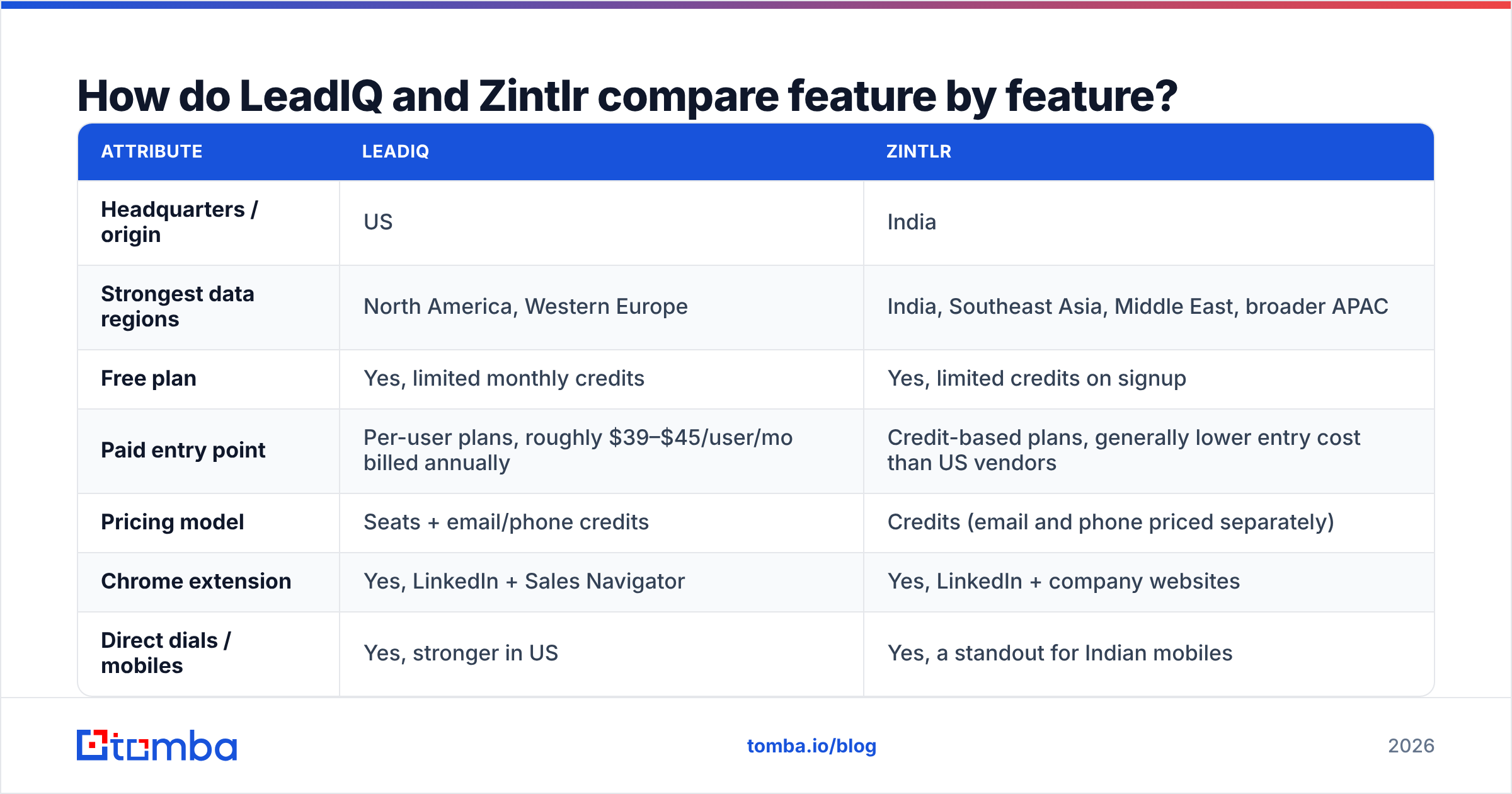
The table below compares the attributes that usually decide the choice. Pricing changes often, so check each vendor's current page before you budget. The numbers here reflect published plans at the time of writing and are rounded.
| Attribute | LeadIQ | Zintlr |
|---|---|---|
| Headquarters / origin | US | India |
| Strongest data regions | North America, Western Europe | India, Southeast Asia, Middle East, broader APAC |
| Free plan | Yes, limited monthly credits | Yes, limited credits on signup |
| Paid entry point | Per-user plans, roughly $39–$45/user/mo billed annually | Credit-based plans, generally lower entry cost than US vendors |
| Pricing model | Seats + email/phone credits | Credits (email and phone priced separately) |
| Chrome extension | Yes, LinkedIn + Sales Navigator | Yes, LinkedIn + company websites |
| Direct dials / mobiles | Yes, stronger in US | Yes, a standout for Indian mobiles |
| CRM sync | Salesforce, HubSpot (deep, field-level mapping) | Salesforce, HubSpot, Zoho and others via CSV/integrations |
| Sequencer sync | Outreach, Salesloft, Gong Engage, Apollo | Limited native; mostly export-based |
| Job-change tracking | Yes, a core feature | Not a core feature |
| AI email writing | Yes (Scribe) | Personality-based messaging guidance |
| Personality insights | No | Yes (DISC-style profiles) |
| Best fit | US/EU SDR teams with an established stack | Teams selling into India/APAC, founder-led sales |
The table shows the main trade-off. LeadIQ's value is in the integration layer. Zintlr's value is in the data itself, specifically in regions where most US databases are weak.

Which tool has more accurate contact data?#
The honest answer is that it depends on where your prospects are. Anyone who gives you a single accuracy percentage for either tool is oversimplifying.
Contact data accuracy has three separate parts:
- Coverage: out of 100 people you search for, how many come back with any email or phone at all.
- Validity: of the emails returned, how many actually deliver instead of bouncing.
- Freshness: how quickly the database notices when someone changes jobs.
LeadIQ tends to do well on coverage and validity for North American and Western European tech, SaaS and services companies, because that's where its user base, and so its data feedback loop, is concentrated. Job-change tracking also helps with freshness: when champions move, you hear about it, and the old record gets flagged.
Zintlr's advantage shows up when you search for Indian enterprise buyers, founders at Indian startups, or decision-makers in the Gulf and Southeast Asia. Many Western databases return a generic info@ address or nothing at all for these people. Zintlr's regional sourcing and mobile coverage are the reason teams selling into these markets try it.

The benchmark above compares dedicated email finders. It shows how widely accuracy varies from tool to tool, and that variation gets larger once you look region by region. Treat any vendor's accuracy claim as a starting hypothesis and test it on your own list.
How to run a fair accuracy test#
- Build a test list of 100 contacts that matches your real ICP: same regions, seniority and company sizes you actually sell to.
- Run all 100 through both tools on free or trial credits, and record what each one returns.
- Verify every returned email with an independent email verifier so neither vendor is grading its own output.
- Count usable contacts, meaning valid email or a connected phone, not just "found" results.
- Divide the credits spent by usable contacts. That gives you your real cost per lead, and it's the number to compare.
This takes about an hour and can save you from signing a five-figure annual contract for data that bounces.
How does pricing actually compare?#
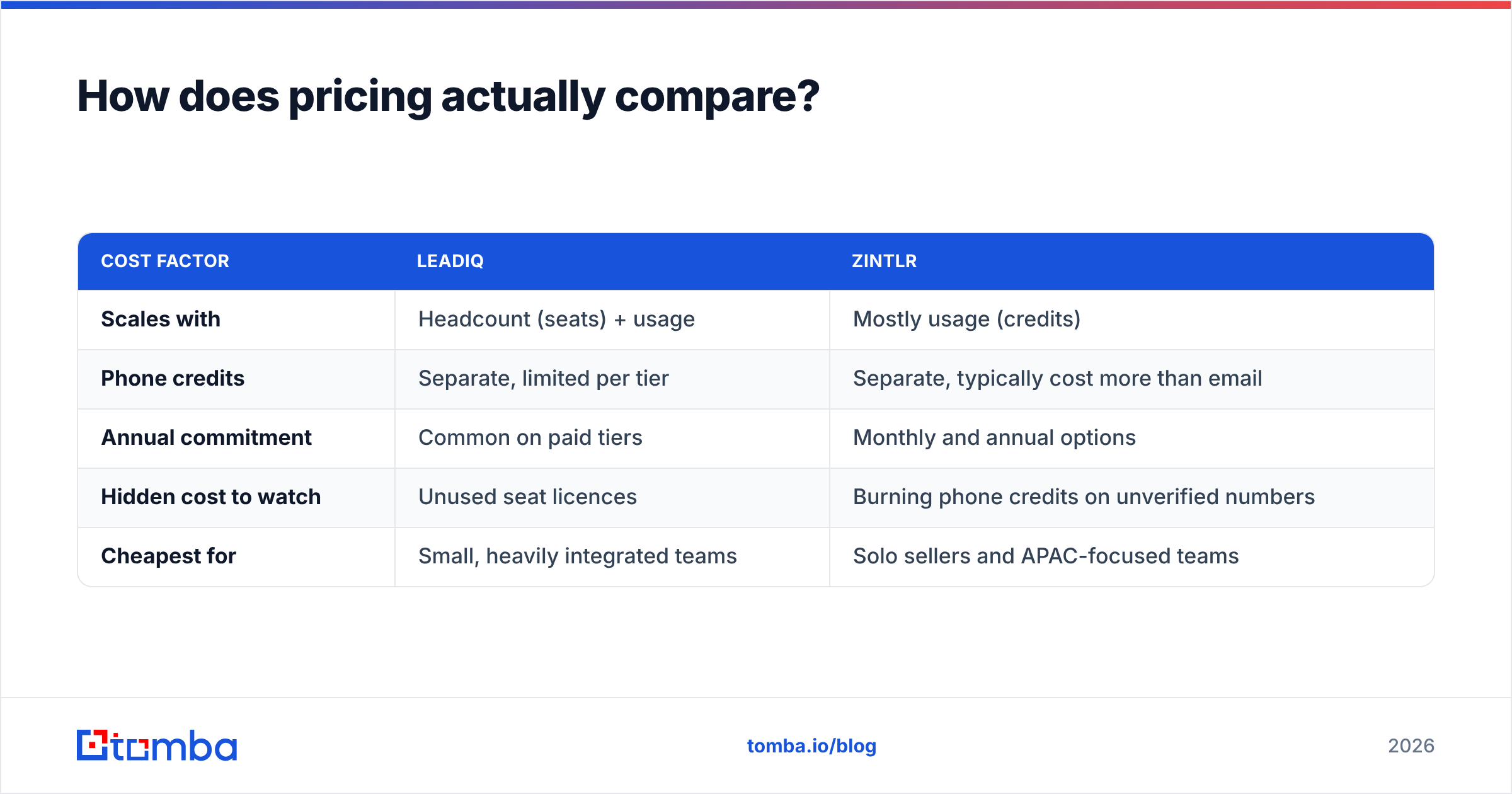
The two tools price differently, which makes a straight comparison hard.
LeadIQ uses a seat-plus-credits model. Each rep needs a seat, and each seat comes with a monthly pool of email and phone credits. The entry paid tier has typically been around $39–$45 per user per month billed annually. A higher Pro tier adds more credits and advanced integrations, and Enterprise is custom. For a team of 10 SDRs, the seat cost adds up quickly before anyone has run out of credits.
Zintlr leans harder on credits. Plans are sold as bundles of credits, and phone numbers usually cost more credits than emails, which is normal across the category. The entry cost is usually lower than US per-seat tools, which suits founders and small teams. Its pricing page is the only reliable source for current figures, and they can differ by region and currency.
| Cost factor | LeadIQ | Zintlr |
|---|---|---|
| Scales with | Headcount (seats) + usage | Mostly usage (credits) |
| Phone credits | Separate, limited per tier | Separate, typically cost more than email |
| Annual commitment | Common on paid tiers | Monthly and annual options |
| Hidden cost to watch | Unused seat licences | Burning phone credits on unverified numbers |
| Cheapest for | Small, heavily integrated teams | Solo sellers and APAC-focused teams |
What matters is cost per usable contact. A tool that is half the price but gives you twice the bounces costs you more, both in money and in sender reputation.
Which one integrates better with your sales stack?#
LeadIQ clearly wins here.
LeadIQ's integrations are its core product, not an add-on. You can capture a prospect in Sales Navigator and push them straight into a specific Outreach or Salesloft sequence in one step, with duplicate checks against Salesforce or HubSpot so reps don't prospect into accounts that are already owned. Field-level mapping means the data lands where your RevOps team wants it. For companies where the CRM is the single source of truth, that matters more than a few points of accuracy.
Zintlr covers the main CRMs and supports CSV export for everything else, which works if your workflow is to build a list, export it and upload it to a sequencer. You get less of the "one click from LinkedIn to live sequence" experience. If your team runs sales automation through tightly connected tools, expect more manual steps with Zintlr.
Reviews on G2 show the same pattern. LeadIQ reviewers mostly praise workflow speed and CRM sync. Zintlr reviewers mostly praise data depth in India and the personality insights.
Are Zintlr's personality insights actually useful?#
They're a real differentiator, and they're useful as long as you treat them as a guide rather than a rule.
Zintlr builds communication-style profiles, loosely based on DISC-type frameworks, from public signals. For each prospect you might see that they prefer short, data-driven messages, or that they respond to relationship-led openers. For a rep writing 30 personalised emails a day, that gives a quick starting point for tone.
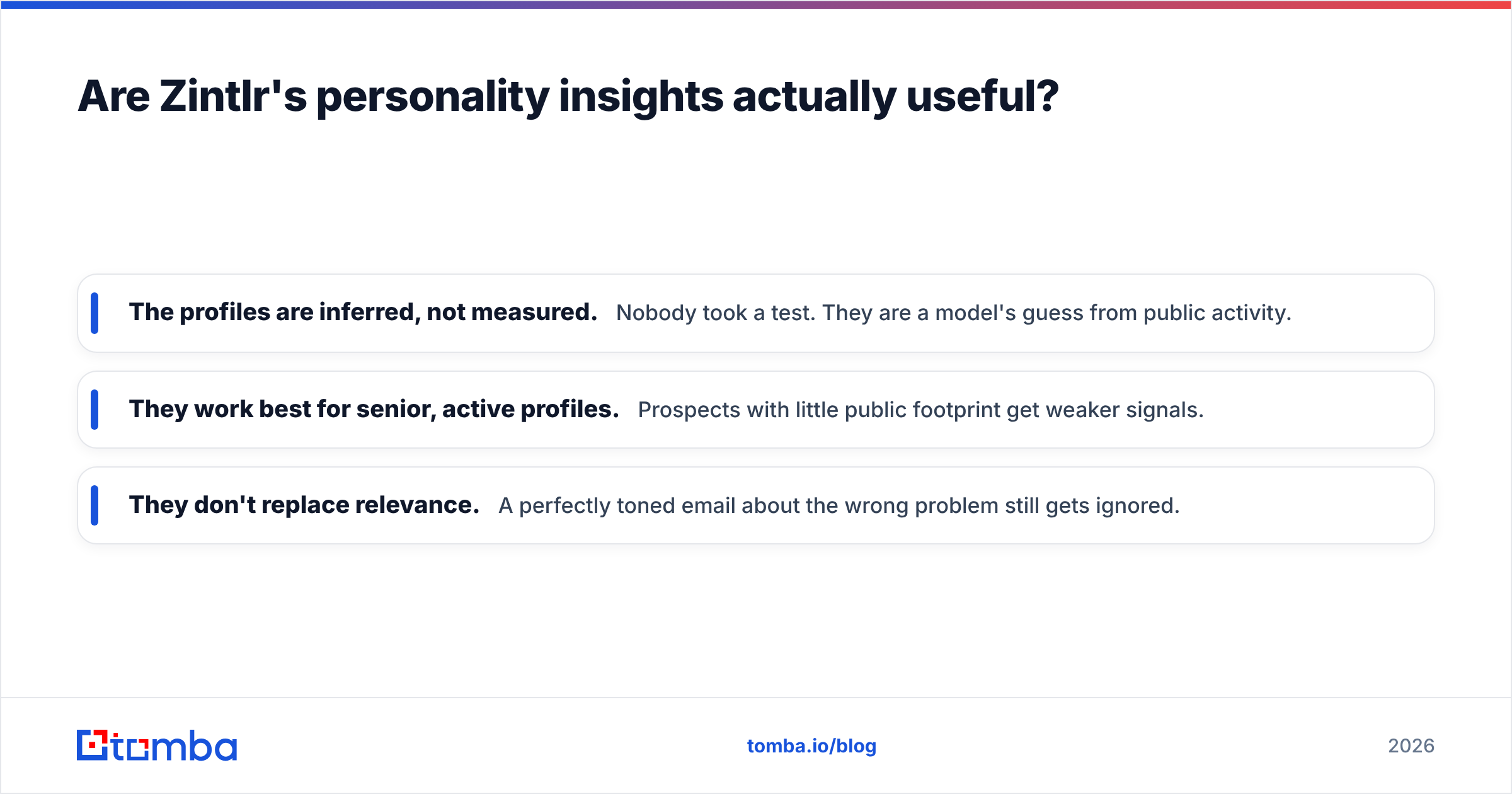
There are limits:
- The profiles are inferred, not measured. Nobody took a test. They are a model's guess from public activity.
- They work best for senior, active profiles. Prospects with little public footprint get weaker signals.
- They don't replace relevance. A perfectly toned email about the wrong problem still gets ignored.
LeadIQ approaches the same problem differently. Scribe generates drafts from the prospect's role, company and trigger events, so personalisation comes from context rather than personality. Which approach works better depends on your reps. Experienced sellers tend to get more from personality cues, while newer SDRs usually benefit more from AI drafts they can edit.
Who should choose LeadIQ?#
LeadIQ fits best when:
- Your territory is mainly North America or Western Europe. That's where its data is strongest.
- You run Outreach, Salesloft or Gong Engage. The native sequence push saves real time per contact.
- Job changes are a pipeline source for you. Tracking champions who move to new companies is one of the highest-converting outbound plays, and LeadIQ builds it in.
- RevOps cares about CRM hygiene. Duplicate detection and field mapping keep Salesforce clean.
It's a weaker fit if you're a solo founder, if most of your buyers are in India or APAC, or if you want to pay only for data rather than per seat.
Who should choose Zintlr?#
Zintlr fits best when:
- You sell into India, the Gulf or Southeast Asia. Its regional coverage, especially mobiles, is the main reason to buy it.
- You're a small team or founder doing your own sales. Credit-based pricing fits uneven prospecting volume better than annual seats.
- Phone is a primary channel. In many APAC markets a WhatsApp or phone touch beats cold email, and Zintlr's mobile data supports that.
- Your reps want help with tone. The personality insights give you a quick read on each prospect before you write.
It's a weaker fit if you need deep, native sequencer integrations or if most of your ICP is US mid-market SaaS.
Is there a simpler option if you mostly need verified emails?#
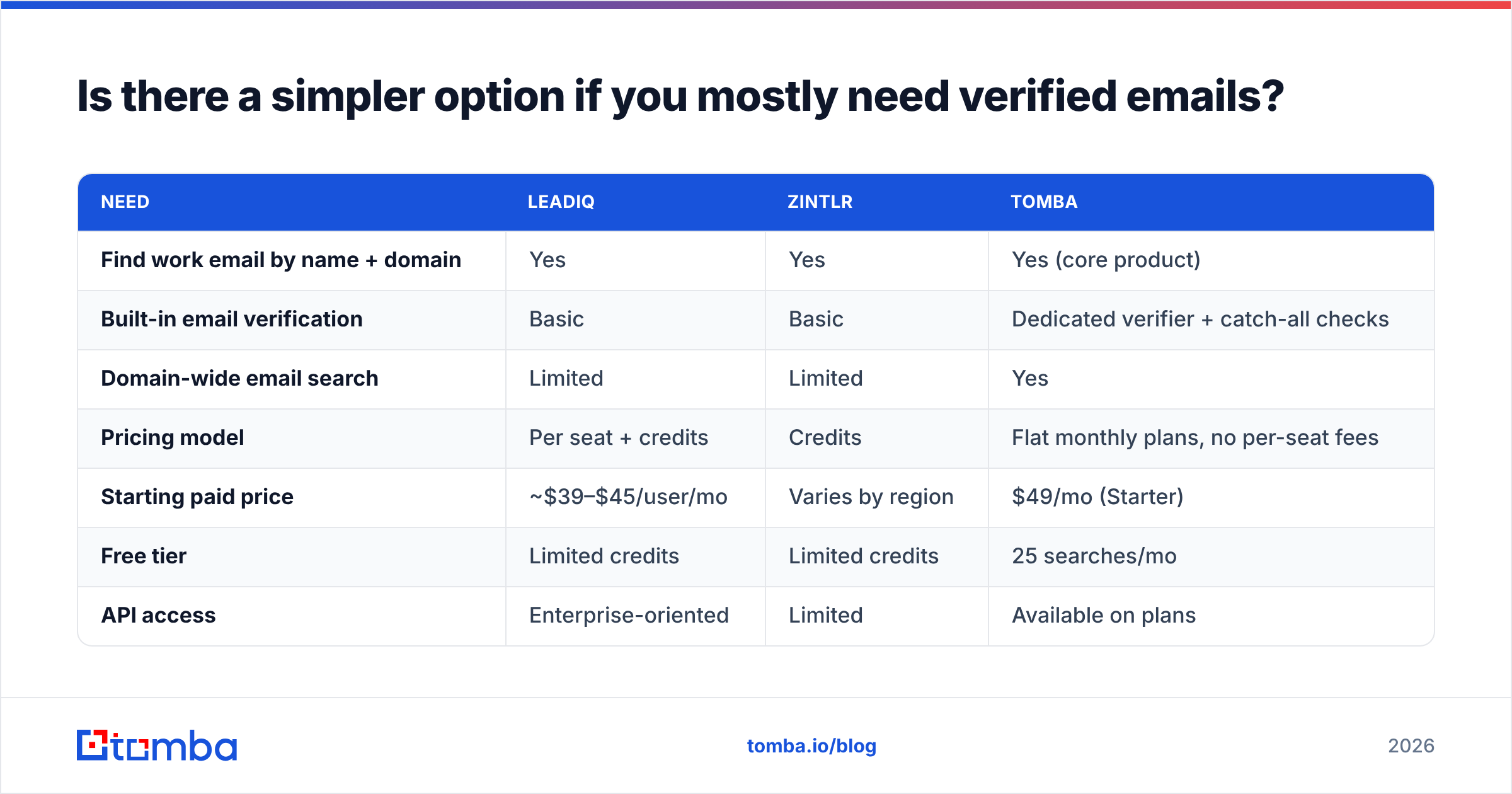
Yes. Many teams comparing LeadIQ and Zintlr find that what they need most is accurate work emails at a predictable cost. Job-change tracking and personality profiles are useful extras, not the core need.
That's what dedicated email finders are for. Here's how they compare with the two platforms on that job:

| Need | LeadIQ | Zintlr | Tomba |
|---|---|---|---|
| Find work email by name + domain | Yes | Yes | Yes (core product) |
| Built-in email verification | Basic | Basic | Dedicated verifier + catch-all checks |
| Domain-wide email search | Limited | Limited | Yes |
| Pricing model | Per seat + credits | Credits | Flat monthly plans, no per-seat fees |
| Starting paid price | ~$39–$45/user/mo | Varies by region | $49/mo (Starter) |
| Free tier | Limited credits | Limited credits | 25 searches/mo |
| API access | Enterprise-oriented | Limited | Available on plans |
| Best at | CRM/sequencer workflow | India/APAC coverage | Verified emails at scale |
Tomba doesn't try to be a sequencer connector or a personality engine. If those features matter to you, LeadIQ or Zintlr earns its place. But if your stack already covers sequencing and you only need the email layer, a dedicated email finder with built-in verification is usually cheaper per usable contact. Plans run from a free tier (25 searches/mo) through Starter at $49/mo, Growth at $99/mo and Pro at $249/mo, with Enterprise on custom terms. Full details are on the Tomba pricing page.
Many teams use a hybrid setup: LeadIQ or Zintlr for workflow or regional phone data, and Tomba to fill email gaps and verify everything before it enters a sequence. If LeadIQ's per-seat model is what's putting you off, our LeadIQ alternative breakdown goes into more detail.
What's the final verdict on LeadIQ vs Zintlr?#
There's no universal winner. The right choice depends on who you sell to.
- Choose LeadIQ if your buyers are mainly in the US or EU, your team runs a mature CRM-plus-sequencer stack, and you'll use job-change tracking. The per-seat cost is worth it for the time it saves reps.
- Choose Zintlr if your pipeline runs through India or APAC, phone matters as much as email, and you want flexible credit-based pricing. Its regional data is hard to match.
- Choose neither as your only data source if deliverability is critical. Always verify emails independently before sending, whichever tool found them.
Run the 100-contact test described above. The tool with the lowest cost per verified, usable contact for your ICP is the right one, whatever its feature list says.
Ready to get verified emails without per-seat pricing?#
If your comparison showed that email accuracy matters more than extra workflow features, try Tomba Email Finder. You can find professional email addresses by name, domain or company, check them with a built-in verifier, and pay one flat monthly plan instead of a licence per rep. Start with 25 free searches, run them against the same test list you used for LeadIQ and Zintlr, and compare the results.
Related guides#
// get started
Find, verify and enrich your first contacts today
Start on the free plan with 25 searches a month, then scale when your team is ready.
Free plan · No credit card required · GDPR & CCPA
// about the author