LeadIQ vs ZoomInfo: Pricing, Data Quality, and Which to Pick in 2026
LeadIQ is a fast prospecting tool for reps. ZoomInfo is a large B2B database with intent data and an enterprise price tag. Here is how they compare on data, workflow, and total cost, and when neither one is the right buy.
TL;DR
- LeadIQ is a prospecting tool built for SDRs. It captures contacts from LinkedIn and pushes them into your CRM and sequencer in one click. Pricing is published, and small teams can get started quickly.
- ZoomInfo is a full B2B intelligence platform: a large contact and company database, intent signals, org charts, technographics and website visitor data. It's sold on annual contracts that usually start in the five figures.
- Pick LeadIQ if your reps already build lists in Sales Navigator and mainly need verified emails and phone numbers pushed into Salesforce, HubSpot, Outreach or Salesloft.
- Pick ZoomInfo if you run account-based motions across a large territory, need intent data and account-level search, and can justify a contract that often runs past $15,000 a year.
- If you mostly need accurate work emails at a predictable cost, a dedicated email finder such as Tomba (from $49/month) covers that for a fraction of the price of either platform.
What is the real difference between LeadIQ and ZoomInfo?#
LeadIQ and ZoomInfo get compared all the time, but they were built to answer different questions.
LeadIQ asks: "I'm looking at a prospect right now. How do I get their contact details into my workflow in five seconds?" It lives mostly in a Chrome extension that sits on top of LinkedIn and Sales Navigator. You find the person, click capture, and LeadIQ returns their work email (and a phone number, if available), then sends the record to your CRM or sales engagement tool. It also offers job-change tracking and an AI email writer, but the core is fast, rep-level contact capture.
ZoomInfo asks: "Which accounts in my market should we go after, who works there, and who is showing buying intent this week?" It's a database-first platform. You search by industry, headcount, revenue, technology stack, location and intent topics, build account and contact lists, and then work them. Contact data is only one layer. Company intelligence, intent signals, org charts and visitor identification sit on top of it.
So the comparison isn't really "which has better emails". It's about whether you need a capture tool or an intelligence platform. Once that's clear, most buying decisions answer themselves.
How do LeadIQ and ZoomInfo compare feature by feature?#
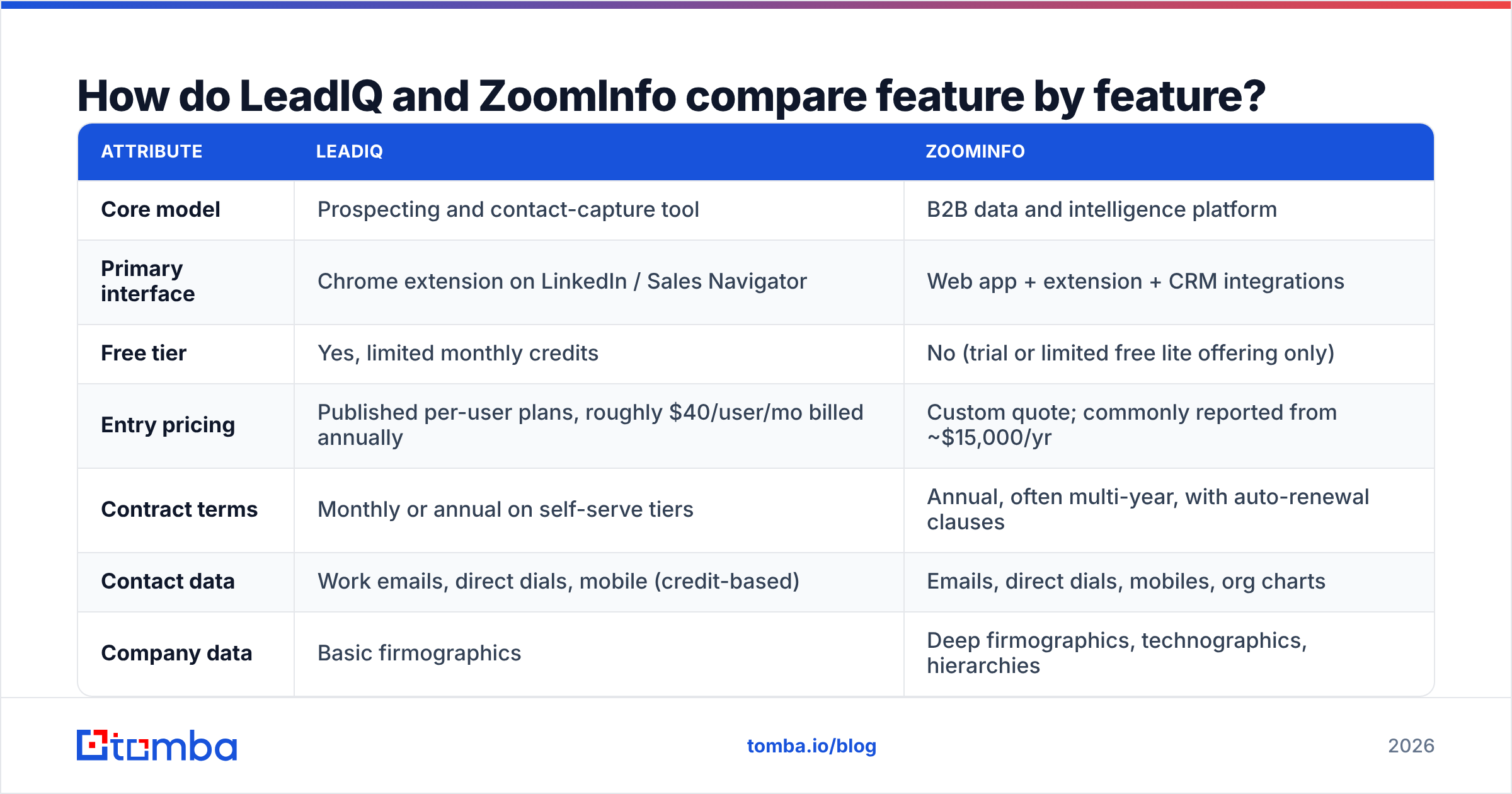
Here's the side-by-side on the attributes buyers actually ask about in demos. Pricing reflects publicly available information and commonly reported contract ranges at the time of writing. Always confirm current numbers on LeadIQ's site and with the ZoomInfo sales team.
| Attribute | LeadIQ | ZoomInfo |
|---|---|---|
| Core model | Prospecting and contact-capture tool | B2B data and intelligence platform |
| Primary interface | Chrome extension on LinkedIn / Sales Navigator | Web app + extension + CRM integrations |
| Free tier | Yes, limited monthly credits | No (trial or limited free lite offering only) |
| Entry pricing | Published per-user plans, roughly $40/user/mo billed annually | Custom quote; commonly reported from ~$15,000/yr |
| Contract terms | Monthly or annual on self-serve tiers | Annual, often multi-year, with auto-renewal clauses |
| Contact data | Work emails, direct dials, mobile (credit-based) | Emails, direct dials, mobiles, org charts |
| Company data | Basic firmographics | Deep firmographics, technographics, hierarchies |
| Intent data | No native buyer intent | Yes, topic-based intent signals |
| Job-change tracking | Yes, a core strength | Yes, via alerts and tracking |
| AI writing | Scribe, an AI email writer | Copilot / AI features on higher tiers |
| CRM / sequencer sync | Salesforce, HubSpot, Outreach, Salesloft, Gong Engage | Salesforce, HubSpot, Outreach, Salesloft, many more |
| Best fit | SDR teams of 1–50 prospecting on LinkedIn | Mid-market and enterprise RevOps, ABM teams |
The pattern is clear. LeadIQ wins on speed, transparency and cost of entry. ZoomInfo wins on breadth, depth and account-level intelligence.

Which has better data accuracy: LeadIQ or ZoomInfo?#
Neither vendor publishes a neutral, audited accuracy rate you can take at face value. Here's what the market consistently reports.
- ZoomInfo has the larger raw database and stronger coverage of North American mid-market and enterprise contacts, especially direct dials. Its weak spots, according to user reviews on G2, are stale records at fast-changing companies and thinner coverage outside the US.
- LeadIQ doesn't try to be a massive static database. It looks up and verifies contacts when you capture them, which helps with freshness for the specific people you're prospecting. Coverage depends on its underlying data sources, and mobile numbers are hit-or-miss, as they are with most vendors.
In practice, accuracy depends more on your segment than on the brand name. A tool that performs well on US SaaS VPs can drop sharply on European manufacturing or APAC SMBs. The only reliable test is to run the same list of 200–500 known contacts through each tool and measure bounces.

Whichever platform you pick, run an email verifier before sequencing. Even well-maintained databases decay by an estimated 20–30% a year as people change jobs, and a single bad batch can hurt your sender reputation for weeks.
How much do LeadIQ and ZoomInfo actually cost?#
This is where the two tools are furthest apart.
LeadIQ publishes its pricing. There's a free plan with a small number of monthly credits, then per-user paid plans (Essential, Pro) with more email and phone credits, CRM sync and job tracking, plus an Enterprise tier with custom terms. A five-person SDR team can usually get going for a few thousand dollars a year, and you can start on a card without talking to sales.
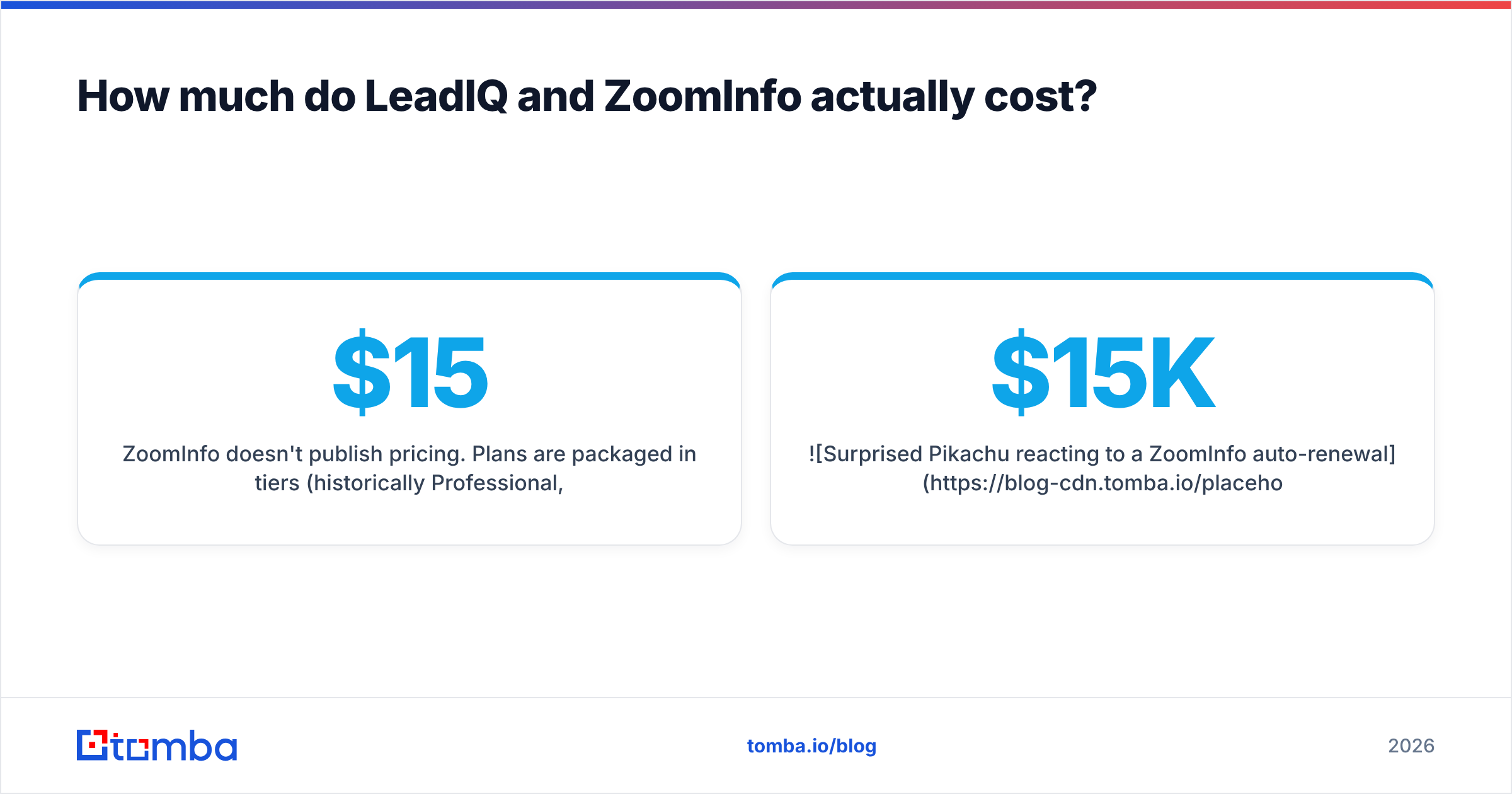
ZoomInfo doesn't publish pricing. Plans are packaged in tiers (historically Professional, Advanced and Elite) with add-ons for intent, visitor tracking, conversation intelligence and engagement. Reported contracts for small teams commonly start around $15,000 a year. Mid-market deals regularly run $30,000–$60,000+, and enterprise contracts go well beyond that. The bigger costs are often structural:
- Seat and credit limits. Credits are allocated per seat, per year. Heavy users run out, and extra credits cost more.
- Add-on creep. Intent, WebSights and Engage are often priced separately, so the platform you saw in the demo can cost more than the base quote.
- Auto-renewal clauses. Many buyers report tight cancellation windows (often 60–90 days before renewal). Miss the window and you're committed to another year.
- Multi-year discounts. The lowest per-year price usually requires a two- or three-year commitment, which cuts your flexibility if your team shrinks or your ICP shifts.

None of this makes ZoomInfo a bad deal. For a 100-seat revenue org that uses intent data to prioritize territories, the math can work. It does mean you should compare total cost of ownership over 24 months, not the headline quote.
Which one fits your sales workflow better?#
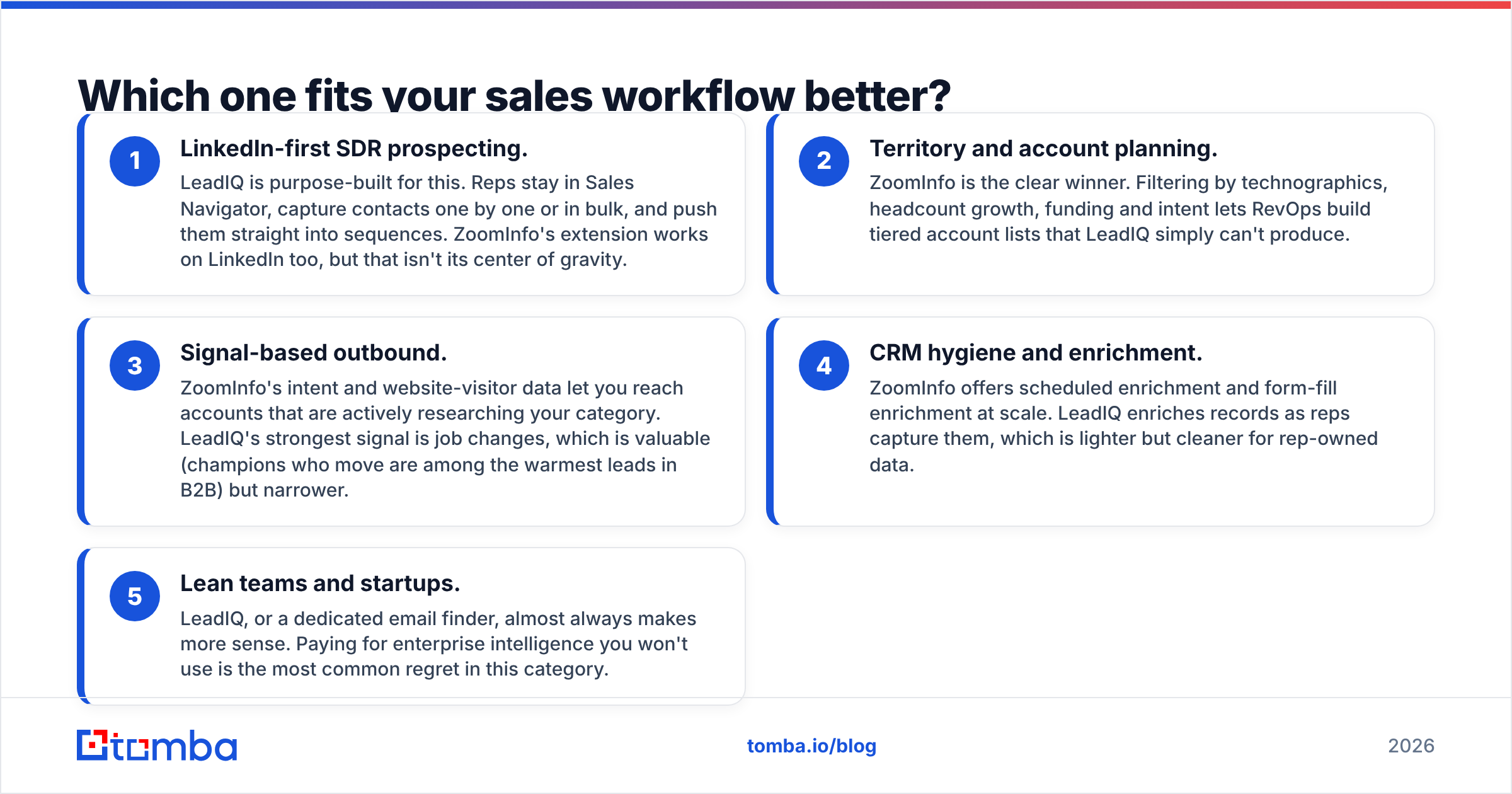
Map each tool against how your team actually works day to day.
- LinkedIn-first SDR prospecting. LeadIQ is purpose-built for this. Reps stay in Sales Navigator, capture contacts one by one or in bulk, and push them straight into sequences. ZoomInfo's extension works on LinkedIn too, but that isn't its center of gravity.
- Territory and account planning. ZoomInfo is the clear winner. Filtering by technographics, headcount growth, funding and intent lets RevOps build tiered account lists that LeadIQ simply can't produce.
- Signal-based outbound. ZoomInfo's intent and website-visitor data let you reach accounts that are actively researching your category. LeadIQ's strongest signal is job changes, which is valuable (champions who move are among the warmest leads in B2B) but narrower.
- CRM hygiene and enrichment. ZoomInfo offers scheduled enrichment and form-fill enrichment at scale. LeadIQ enriches records as reps capture them, which is lighter but cleaner for rep-owned data.
- Lean teams and startups. LeadIQ, or a dedicated email finder, almost always makes more sense. Paying for enterprise intelligence you won't use is the most common regret in this category.
If you're weighing LeadIQ against other capture tools too, our breakdown of the best LeadIQ alternative options covers pricing and coverage trade-offs in more detail.
Is ZoomInfo worth it compared to LeadIQ?#
ZoomInfo is worth it when three conditions hold at once:
- You have enough sellers (roughly 15+) to spread the contract cost across real usage.
- You'll actually use the account-level layers (intent, technographics, org charts), not just contact lookups.
- Your ICP sits mainly in North America, where ZoomInfo's coverage is deepest.
If one of those is missing, you're mostly paying for a premium contact database, and LeadIQ or a leaner email finder will give you most of the value for far less.
LeadIQ is worth it when your reps spend most of their prospecting time in LinkedIn, need clean contacts synced to a sequencer without manual CSV work, and value job-change alerts. Its limits show up when you need to build large, filtered account lists from scratch or want intent signals to decide who to target.
What are the pros and cons of each?#
LeadIQ pros
- Very fast capture workflow inside LinkedIn and Sales Navigator
- Transparent, self-serve pricing with a free plan
- Strong job-change tracking for champion-based outbound
- Clean sync to Salesforce, HubSpot, Outreach and Salesloft
LeadIQ cons
- Limited firmographic and technographic search
- No native buyer intent data
- Phone and mobile coverage varies a lot by region
ZoomInfo pros
- One of the largest B2B contact and company databases available
- Intent data, website visitor identification and org charts in one platform
- Strong direct-dial coverage in North America
- Deep enrichment and RevOps tooling
ZoomInfo cons
- High, opaque pricing with multi-year contract pressure
- Auto-renewal terms that catch teams off guard
- Record freshness varies, so verification is still required
- Too much platform for teams that just need emails
When should you consider an alternative to both?#
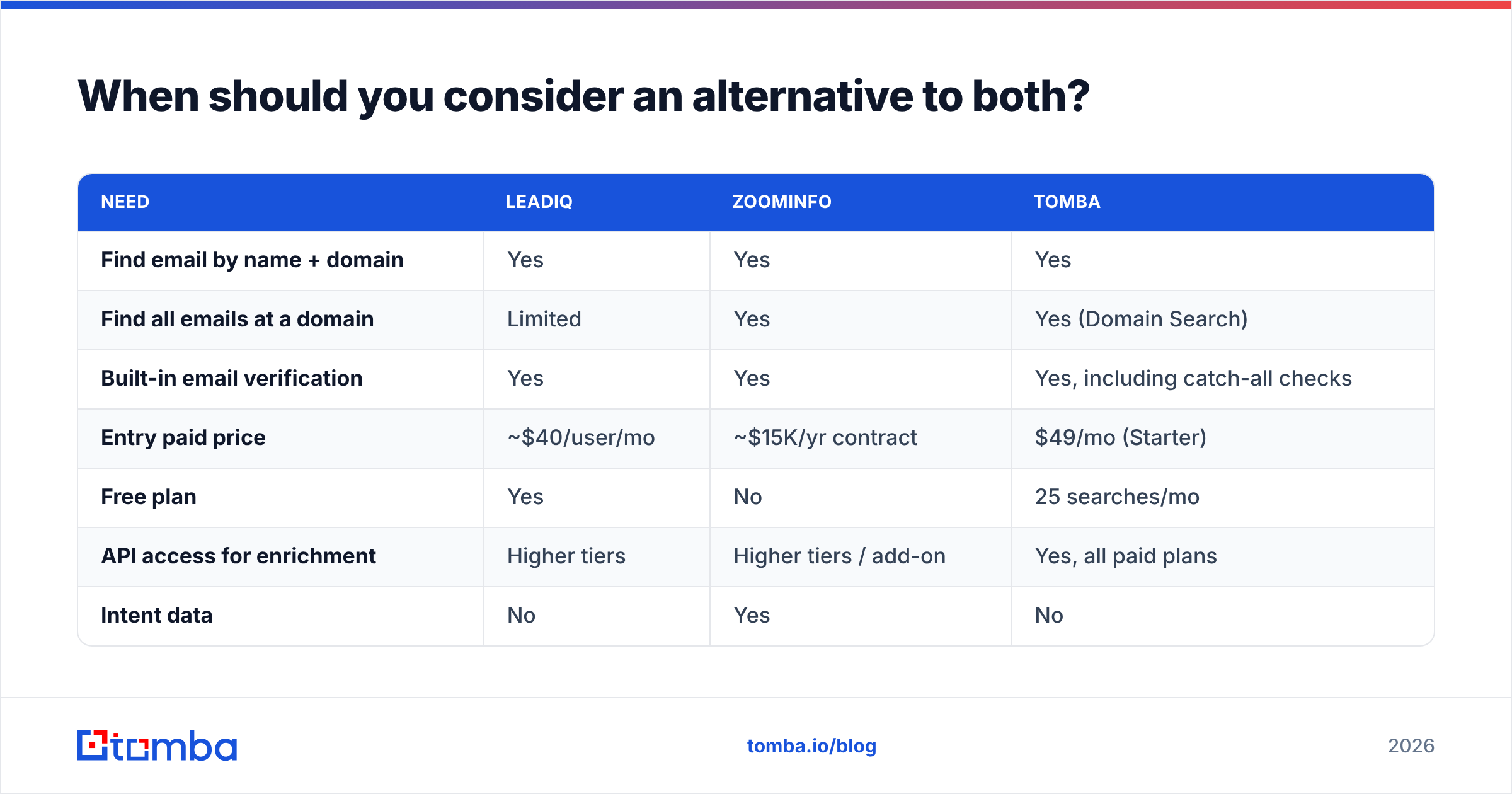
Many teams find that their real bottleneck is "I have company names and people, and I need accurate work emails", not "I need a database of 100 million contacts" or "I need a LinkedIn capture tool". For that job, a dedicated email finder is usually the most cost-effective choice.
Here's how the three approaches compare on the attributes that matter for a lean outbound motion:
| Need | LeadIQ | ZoomInfo | Tomba |
|---|---|---|---|
| Find email by name + domain | Yes | Yes | Yes |
| Find all emails at a domain | Limited | Yes | Yes (Domain Search) |
| Built-in email verification | Yes | Yes | Yes, including catch-all checks |
| Entry paid price | ~$40/user/mo | ~$15K/yr contract | $49/mo (Starter) |
| Free plan | Yes | No | 25 searches/mo |
| API access for enrichment | Higher tiers | Higher tiers / add-on | Yes, all paid plans |
| Intent data | No | Yes | No |

To be clear, Tomba is not a replacement for ZoomInfo's intent and account intelligence. If you need those, you need a platform like ZoomInfo. But if 80% of your usage is contact lookup, verification and data enrichment of existing lists, paying enterprise prices for the other 20% rarely makes sense. Tomba plans scale from Starter at $49/month through Growth ($99/month) and Pro ($249/month), with Enterprise available on request. Full Tomba pricing is public.
A common and sensible setup is a hybrid: a lightweight capture or email-finding tool for reps, plus a single enterprise data seat (or none) for RevOps account planning.
How should you run a fair LeadIQ vs ZoomInfo trial?#
Don't decide based on demos. Run a structured bake-off:
- Build a truth set. Pull 300 contacts from your CRM who replied or booked meetings in the last 90 days. Their emails are confirmed valid.
- Strip the emails and run names and companies through each tool.
- Measure three numbers: find rate (how many returned an email), accuracy (how many matched the known email) and verified-invalid rate (how many would have bounced).
- Segment the results by region and company size. The overall averages hide where each tool is weak.
- Price it per valid contact. Divide the annual cost by the number of accurate contacts you'd realistically pull in a year.
That last step usually settles the debate. Cost per accurate, sendable contact is the only number your CFO will care about.
Frequently asked questions#
Is LeadIQ cheaper than ZoomInfo? Yes, by a wide margin for most teams. LeadIQ publishes per-user pricing and has a free plan. ZoomInfo is quote-based, with contracts commonly reported from around $15,000 a year.
Does LeadIQ use ZoomInfo data? LeadIQ aggregates and verifies data from several sources. It doesn't publicly describe itself as reselling ZoomInfo's database. Treat the two as independent datasets and test both on your own segment.
Can I use LeadIQ and ZoomInfo together? Yes. Some enterprise teams use ZoomInfo for account planning and intent, and LeadIQ for rep-level capture and job-change tracking. The trade-off is paying for two data contracts.
Which is better for startups? LeadIQ or a dedicated email finder. Startups rarely have the seat count or the ABM maturity to get value from a full ZoomInfo contract.
So, LeadIQ or ZoomInfo?#
If your reps live in LinkedIn and need contacts in their sequencer fast, choose LeadIQ. If you run territory-based or account-based motions at scale and will use intent and company intelligence every week, choose ZoomInfo, and read the renewal clause before you sign.
If what you actually need is accurate work emails at a price you can predict, start with Tomba Email Finder. You can find verified professional emails by name, domain or company, check catch-all addresses before they bounce, and enrich lists through the extension, Google Sheets or the API. Try it on the free plan with 25 searches a month, then run your own bake-off against LeadIQ and ZoomInfo on the same truth set. Start with Tomba Email Finder.
Related guides#
// get started
Find, verify and enrich your first contacts today
Start on the free plan with 25 searches a month, then scale when your team is ready.
Free plan · No credit card required · GDPR & CCPA
// about the author