Leadmine vs OutboundView: Self-Serve Data or Done-For-You Outbound?
Leadmine is self-serve lead-data software. OutboundView is an agency that books meetings for you. This comparison shows which one fits your budget, team, and market.
TL;DR
- These two products solve different problems. Leadmine is self-serve prospecting software (contact database, email finder, Chrome extension). OutboundView is a B2B sales development agency that runs cold calling and appointment setting for you.
- Pick Leadmine if you already have reps or founders doing outreach and just need contact data at a low entry cost. It has a free tier with 10 credits a month.
- Pick OutboundView if you sell into HR and want meetings on the calendar without hiring SDRs. Its TalentView database of verified HR buyers is the main differentiator.
- Neither one replaces email verification. Whichever you choose, check addresses before you send so your domain stays out of spam folders.
- Our pick: start with software for most teams under $1M in pipeline. Bring in an agency like OutboundView once you have a repeatable message and want to scale it with outside capacity.
What is Leadmine?#
Leadmine is a lead generation and sales prospecting platform. It says more than 1,000 companies use it, and the pitch is simple: search a B2B contact database, find emails and phone numbers, and push the results into your CRM.
The core pieces:
- Contact database. Leadmine advertises more than 200 million B2B contacts that you can filter by industry, job title, and location.
- Email finder. Enter a name and a company domain and it returns a likely professional email address.
- Chrome extension. Pulls name, email, position, and social profiles from Crunchbase pages and Google search results while you browse.
- CRM integrations. Exports leads into common CRMs so reps don't have to copy and paste.
- Free tier. You get 10 credits a month at no cost, with paid plans that scale by credit volume.
Reviews on Capterra and similar directories tend to mention the same things: it's easy to use, support is responsive, and it's quick to get running. Leadmine is a tool. You still write the emails, build the sequences, make the calls, and handle the replies.
What is OutboundView?#
OutboundView is a B2B sales development and lead generation agency based in Franklin, Tennessee. Blake Johnston founded it in 2017 and is its CEO. It isn't a database you log into. It's a team you hire to book qualified meetings for your account executives.
Its services come in three offers:
- Scale. Outsourced appointment setting with dedicated cold-calling teams.
- Dialworks. Cold-calling infrastructure for teams that want to run the dials themselves on OutboundView's stack.
- Launch. Consulting for companies building their first inside sales team.
The main differentiator is TalentView, a proprietary database of roughly 550,000 to 675,000 HR buyers in North America. It's human-verified and includes validated email addresses. That tells you where OutboundView is strongest: it leans heavily toward companies selling to HR leaders, though it also lists clients in technology, healthcare, asset management, and manufacturing. Client reviews are on its Clutch profile.
Leadmine vs OutboundView: how do they compare side by side?#
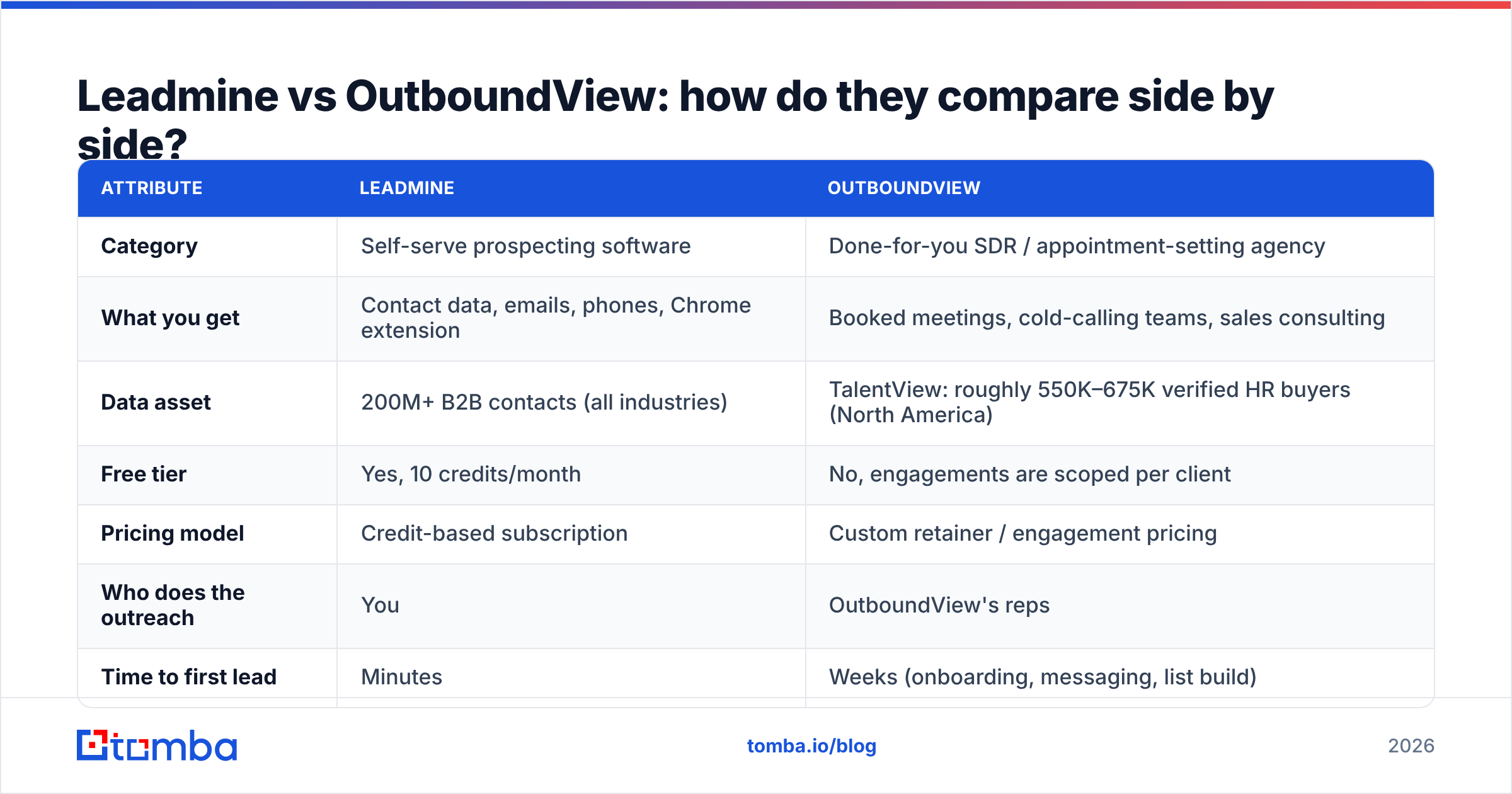
Most "vs" posts compare two products in the same category. This one is different, because the real question is whether you should buy data or buy outcomes. The table puts both on the same attributes so you can see where they split.
| Attribute | Leadmine | OutboundView |
|---|---|---|
| Category | Self-serve prospecting software | Done-for-you SDR / appointment-setting agency |
| What you get | Contact data, emails, phones, Chrome extension | Booked meetings, cold-calling teams, sales consulting |
| Data asset | 200M+ B2B contacts (all industries) | TalentView: roughly 550K–675K verified HR buyers (North America) |
| Free tier | Yes, 10 credits/month | No, engagements are scoped per client |
| Pricing model | Credit-based subscription | Custom retainer / engagement pricing |
| Who does the outreach | You | OutboundView's reps |
| Time to first lead | Minutes | Weeks (onboarding, messaging, list build) |
| Best fit | Founders, SDR teams, agencies needing raw data | HR tech / HR services vendors, teams without SDR capacity |
| Main risk | Data quality varies, so you must verify | Less control over messaging; higher fixed cost |
| Where to see reviews | Capterra, G2, GetApp | Clutch |
If you read only one row, read "Who does the outreach." With Leadmine, your cost is a subscription plus your team's hours. With OutboundView, you're paying for someone else's hours and expertise, so the price reflects labor, not just data.
How do the cost models actually differ?#
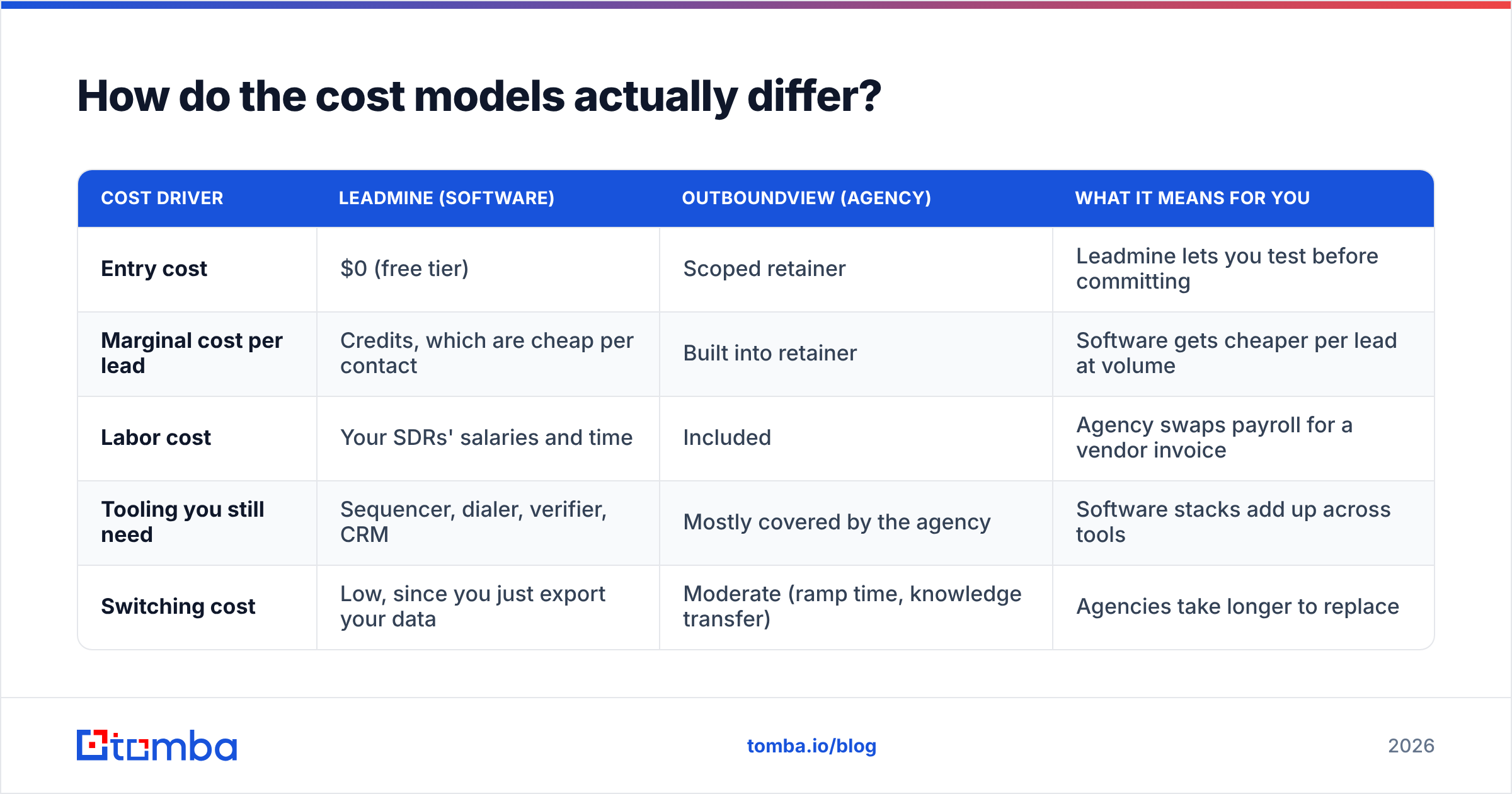
We won't make up a price for either vendor. OutboundView quotes custom engagements, and Leadmine's paid tiers change often enough that you should check its site directly. What we can compare is how the cost structure behaves as you scale, and that matters more than the sticker price anyway.
| Cost driver | Leadmine (software) | OutboundView (agency) | What it means for you |
|---|---|---|---|
| Entry cost | $0 (free tier) | Scoped retainer | Leadmine lets you test before committing |
| Marginal cost per lead | Credits, which are cheap per contact | Built into retainer | Software gets cheaper per lead at volume |
| Labor cost | Your SDRs' salaries and time | Included | Agency swaps payroll for a vendor invoice |
| Tooling you still need | Sequencer, dialer, verifier, CRM | Mostly covered by the agency | Software stacks add up across tools |
| Switching cost | Low, since you just export your data | Moderate (ramp time, knowledge transfer) | Agencies take longer to replace |
Here's the honest version. A tool like Leadmine is cheap until you count the fully loaded cost of the person using it. An in-house SDR in the US costs well into five figures a year before tools, and ramping one usually takes about a quarter. An agency like OutboundView moves that cost off your payroll and puts people with a proven process on day one. You pay a premium for that, and you give up some control.
Which one gives you better data quality?#
This is where the two differ in kind, not just in degree.
Leadmine's data is broad. Two hundred million contacts across every industry means you can build almost any list you want. The tradeoff is the one every large self-serve database has: some records decay. People change jobs, companies rebrand, and catch-all domains accept any address, which makes a guessed email look valid when it isn't. Broad databases need a verification step before anything goes into a sequence.
OutboundView's TalentView data is narrow and deep. A human-verified set of a few hundred thousand HR buyers can't cover a list of CFOs at logistics companies. Inside its niche, though, human verification usually beats a purely algorithmic database on accuracy. If HR is your market, that focus is a real advantage and not just a talking point.
Whichever you use, run the list through an email verifier before sending. Bounce rates above about 2% start to hurt your email deliverability, and mailbox providers like Google now enforce stricter bulk-sender requirements on authentication and spam rates. Verification protects the domain you're sending from, whoever supplied the list.
Who should choose Leadmine?#
Leadmine makes sense when the bottleneck is data, not people. You're a good fit if:
- You already have founders, AEs, or SDRs who write and send their own outreach.
- You prospect across several industries and need a wide database instead of one vertical.
- You want to test a new segment cheaply before committing budget. The free 10 credits a month are enough to sanity-check a list.
- You research on Crunchbase or Google and want a browser extension that captures contacts in place.
- You run an agency yourself and need raw data to power client campaigns.
Where Leadmine falls short is everything after the lead. It won't write your copy, sequence your follow-ups, handle objections on the phone, or tell you your positioning is off. If your outbound isn't producing meetings, buying more contacts rarely fixes it.
Who should choose OutboundView?#
OutboundView makes sense when the bottleneck is people and process. You're a good fit if:
- You sell to HR leaders (CHROs, VPs of People, benefits and talent leaders) in North America.
- You have AEs who can close but not enough qualified meetings to keep them busy.
- You'd rather not recruit, train, and manage an SDR team, or you tried and it didn't work.
- Phone matters in your motion. OutboundView is built around cold calling, which still works well for HR buyers who are hard to reach by email alone.
- You're standing up inside sales for the first time and want consulting (Launch) instead of guessing.
Where OutboundView is a weaker fit: very early-stage companies still figuring out their ICP, teams that want tight daily control over every message, and anyone selling outside its core verticals who needs a huge cross-industry list.
How do you decide between a tool and an agency?#
If you're still undecided, work through these five questions in order. The first one where you answer "no" usually settles it.
- Do you have a proven message? If you can't yet say which pitch books meetings, stay in-house with a tool like Leadmine and iterate cheaply. Agencies scale what already works. They can't invent product-market fit for you.
- Do you have someone to run outreach every day? Software sitting unused is the most expensive software you'll own. If nobody owns outbound full-time, an agency fills that gap.
- Is your market HR or a narrow vertical? If yes, OutboundView's TalentView data and HR focus are a structural advantage that a general database won't match.
- Can you absorb a fixed monthly commitment? Agency retainers are predictable but not cheap. Credit-based software lets you scale spend up and down with your results.
- How much control do you need? Regulated industries and brands with strict tone guidelines usually want messaging in-house. Credit data plus your own sequencer gives you that control.
Plenty of teams end up with a hybrid: an agency books top-of-funnel meetings in one core segment while in-house reps use self-serve data to test new segments. The two models work together fine.
What are the pros and cons of each?#
| Leadmine | OutboundView | |
|---|---|---|
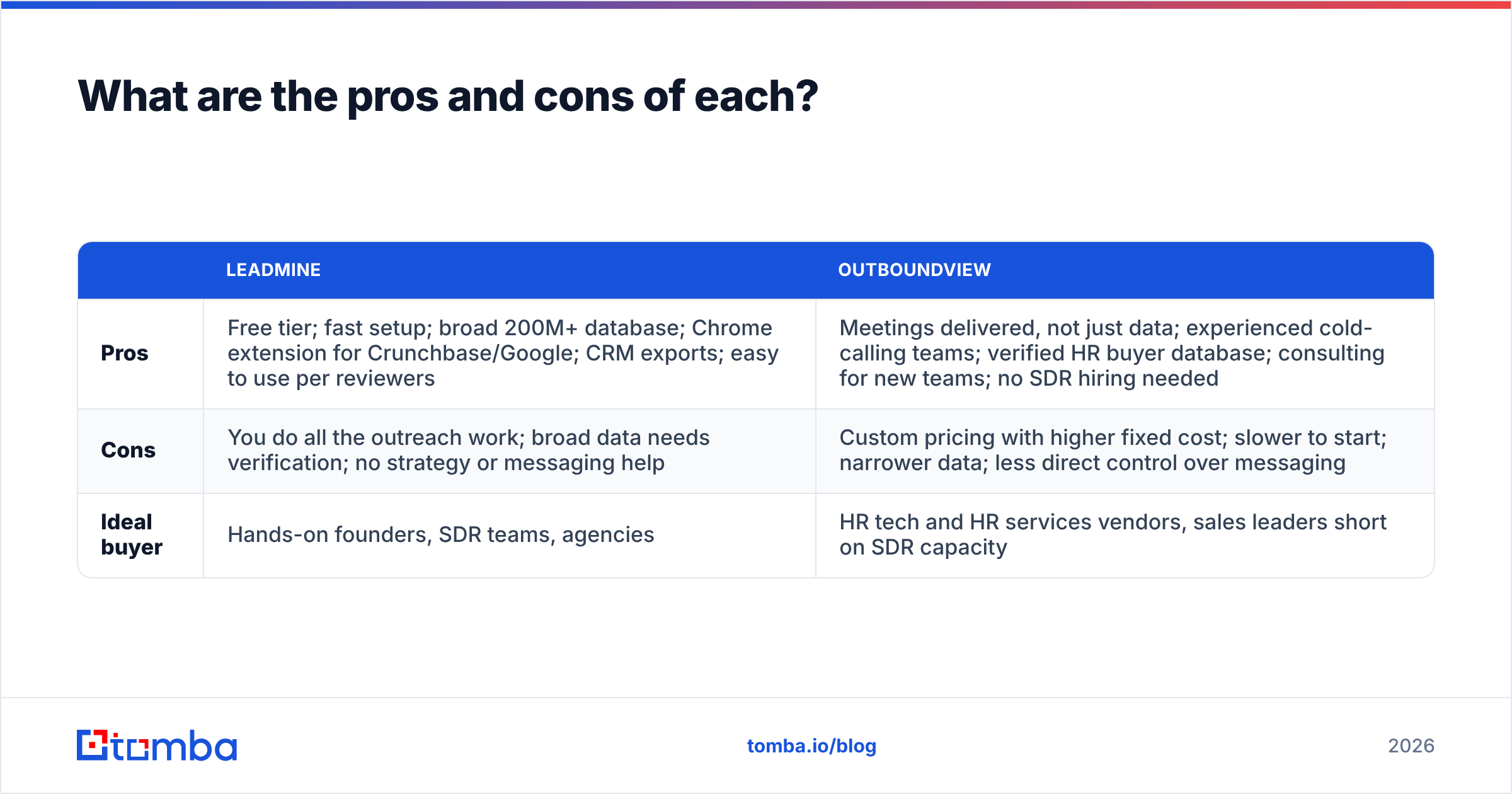
| Pros | Free tier; fast setup; broad 200M+ database; Chrome extension for Crunchbase/Google; CRM exports; easy to use per reviewers | Meetings delivered, not just data; experienced cold-calling teams; verified HR buyer database; consulting for new teams; no SDR hiring needed |
| Cons | You do all the outreach work; broad data needs verification; no strategy or messaging help | Custom pricing with higher fixed cost; slower to start; narrower data; less direct control over messaging |
| Ideal buyer | Hands-on founders, SDR teams, agencies | HR tech and HR services vendors, sales leaders short on SDR capacity |
Where does Tomba fit in this decision?#
If you're leaning toward the self-serve route, Leadmine is one option among many, and the email-finder market is crowded in 2026. Tomba sits in the same self-serve category with a different emphasis. The Tomba Email Finder finds addresses by name, domain, or company. Domain search, catch-all verification, phone finder, and enrichment all run on the same account, so you aren't paying for three tools to finish one list.
It's useful even if you hire an agency. Teams working with outbound agencies often keep a self-serve finder and verifier in-house so they can check agency-supplied lists, run their own side campaigns, and hold onto their contact data when the engagement ends. Tomba pricing starts with a free tier of 25 searches a month, then Starter at $49/mo, Growth at $99/mo, and Pro at $249/mo, with custom Enterprise plans for larger teams.

What's the final verdict on Leadmine vs OutboundView?#
There's no universal winner, because these two aren't competing for the same budget line.
- Choose Leadmine if you need affordable, self-serve B2B contact data and have people ready to use it. Start on the free tier, verify every list, and scale credits once a segment converts.
- Choose OutboundView if you sell into HR, need booked meetings more than raw contacts, and would rather pay for a proven outbound team than build one.
- Choose neither yet if you haven't validated your message. Hand-build 50 to 100 highly targeted contacts, send personally, and learn what lands before paying for scale.
The trap is treating data as a substitute for execution, or execution as a substitute for good data. Successful outbound programs get both right: accurate contacts, and a team (yours or an agency's) that works them consistently.
If you're going self-serve, you need contact data you can trust before the first email goes out. Tomba Email Finder finds professional addresses by name, domain, or company, and built-in verification helps keep bounces from damaging your sender reputation. Start with 25 free searches a month and upgrade only when your pipeline justifies it.
Related guides#
Ready to find emails that actually work?
Join 150,000+ professionals who stopped guessing and started sending. Free credits on signup — no credit card required.
Get the Tomba newsletter
Practical outbound tactics and product updates — once every two weeks.
About the author