Leadrocks vs SMARTe: Pricing, Data Coverage, and Which to Choose
Leadrocks sells cheap, self-serve contact data for volume prospecting. SMARTe sells quote-based, phone-heavy global data to sales teams. Here is how they compare on coverage, accuracy, pricing, and workflow, and which one fits your team.
TL;DR
- Leadrocks is a self-serve B2B contact database with a LinkedIn-focused Chrome extension. It suits founders, agencies, and small SDR teams that want a lot of contacts on a small budget.
- SMARTe is a sales-intelligence platform aimed at mid-market and enterprise revenue teams. It focuses on direct dials, mobile numbers, and global coverage (especially outside North America), and it's sold through custom quotes.
- Neither tool removes the need to verify. Run anything you export through an email verifier before it touches a sending domain.
- Pick Leadrocks if price per contact matters most. Pick SMARTe if phone coverage, EMEA/APAC reach, and CRM enrichment at scale justify an annual contract.
- If you mainly need accurate professional emails by domain or name at predictable prices, a dedicated email finder is often the better fit than either one.
What are Leadrocks and SMARTe?#
The two tools overlap on the surface. Both sell B2B contact data, both have a browser extension, and both promise emails and phone numbers for your ideal customer profile. The overlap ends there, because they were built for different buyers.
Leadrocks is a self-serve contact database. Its model is simple: search a large pool of professional profiles by title, company, industry, and location, reveal contact details with credits, and export to CSV or your outreach tool. Most people use it through the Chrome extension on LinkedIn and Sales Navigator pages. The pitch is volume at a low cost per contact.
SMARTe is a sales-intelligence platform. It sells verified emails, direct dials, and mobile numbers, along with firmographic and technographic data, CRM enrichment, and a prospecting interface. SMARTe leans hard on international coverage, especially in Europe and Asia-Pacific, where many US-centric databases get thin. You'll typically buy it through a sales conversation and an annual agreement.
Put simply: Leadrocks is closer to a prospecting utility, and SMARTe is closer to a data platform your RevOps team owns.
How do Leadrocks and SMARTe compare feature by feature?#
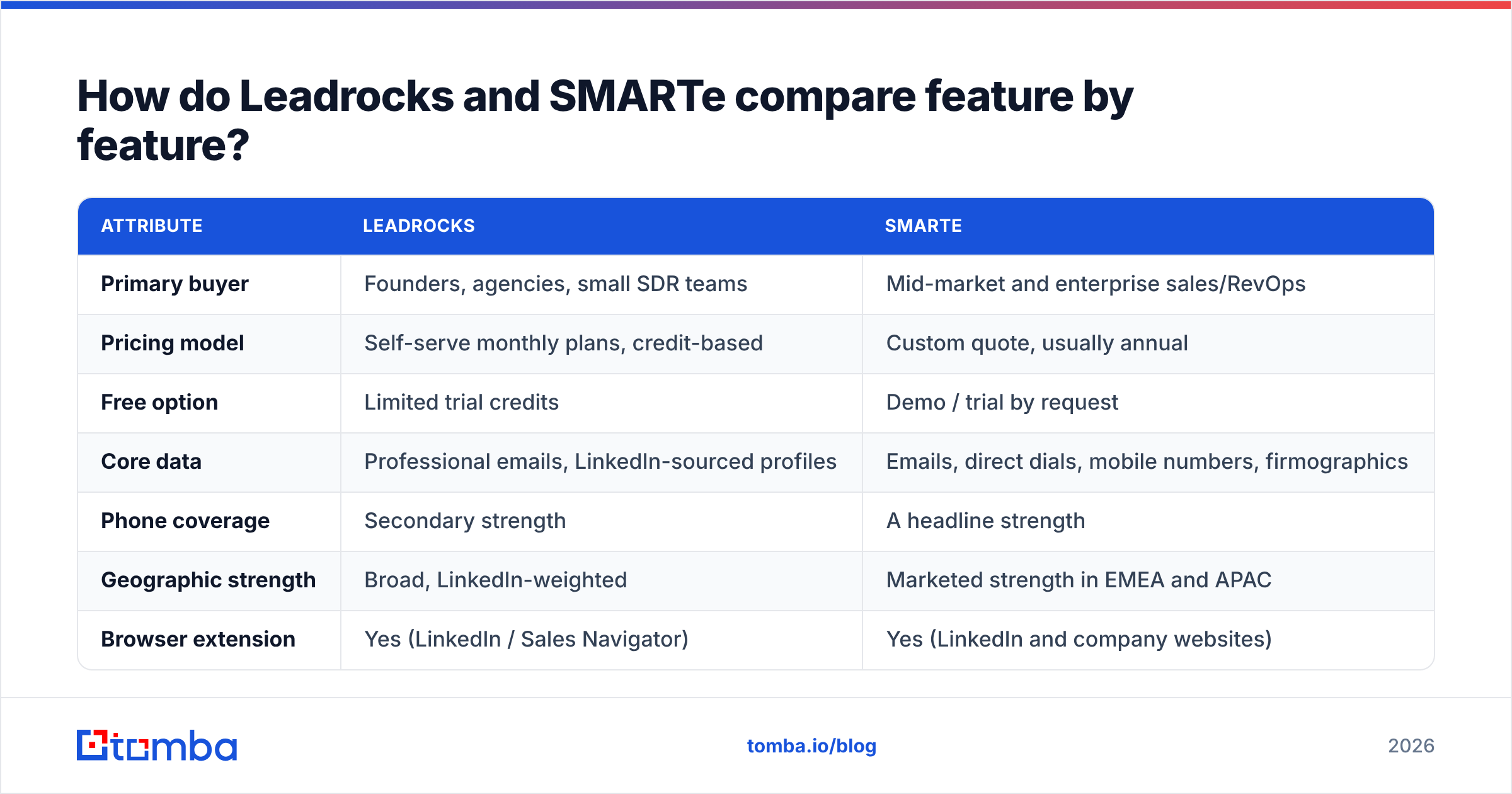
Here's the side-by-side. Pricing models and feature sets change often, so check each vendor's current pricing page before you sign anything.
| Attribute | Leadrocks | SMARTe |
|---|---|---|
| Primary buyer | Founders, agencies, small SDR teams | Mid-market and enterprise sales/RevOps |
| Pricing model | Self-serve monthly plans, credit-based | Custom quote, usually annual |
| Free option | Limited trial credits | Demo / trial by request |
| Core data | Professional emails, LinkedIn-sourced profiles | Emails, direct dials, mobile numbers, firmographics |
| Phone coverage | Secondary strength | A headline strength |
| Geographic strength | Broad, LinkedIn-weighted | Marketed strength in EMEA and APAC |
| Browser extension | Yes (LinkedIn / Sales Navigator) | Yes (LinkedIn and company websites) |
| CRM enrichment | Basic exports and integrations | Native CRM enrichment (e.g., Salesforce, HubSpot) |
| Bulk export | CSV-oriented | Platform and CRM-oriented |
| Best for | High-volume cold email on a budget | Multichannel outbound with calling, global territories |
The biggest difference isn't in any single row. It's the operating model. With Leadrocks, you pull a list, clean it, and load it into a sequencer the same afternoon. With SMARTe, you connect it to your CRM, set enrichment rules, and your reps work from records that stay updated over time.
Which tool has better data accuracy?#
Accuracy is where comparison posts usually get vague, so here's the honest version: nobody outside these companies can give you one universal accuracy number. Accuracy depends on region, seniority, industry, company size, and how recently each record was checked.
What you can say is how each vendor's model shapes accuracy:
- Leadrocks gets its breadth from a very large profile pool tied to LinkedIn activity. That gives you strong coverage on titles and companies. Email deliverability varies more, especially at smaller companies and on catch-all domains, where a server accepts mail for any address and SMTP checks can't confirm that a mailbox exists.
- SMARTe puts a lot of effort into verification and phone data, and its enterprise pricing pays for that effort. Expect higher contact-level quality on direct dials and mobiles, but lower raw volume per dollar.

Independent benchmarks like the one above show the same thing across the whole category: the gap between the best and worst tools on a given sample is wide, and every tool returns some bad or unverifiable addresses. Budget for verification no matter which you pick. Running exports through an email verifier before sending is the cheapest insurance you can buy for your sender reputation. If your ICP skews toward mid-size companies with permissive mail servers, add a catch-all verifier step too. That's where most silent bounces come from.
A practical way to test either tool: take 200 contacts you already know are valid (closed-won customers work well), run them through the tool, and compare. It's a small, fair sample and it takes an hour.

How much do Leadrocks and SMARTe cost?#
The two tools price in completely different ways, and that difference often decides the purchase before features come up.
Leadrocks is self-serve. You pick a monthly plan, get a set number of credits, and reveal contacts until you run out. Entry-level plans are cheap, and the cost per revealed contact is among the lowest in the category. That's the main reason agencies and lean outbound teams choose it. The catch is the usual one with credit-based tools: you pay per reveal, not per valid contact, so your real cost per deliverable email is higher than the sticker price.
SMARTe is quote-based. Pricing depends on seats, credit volume, which data types you need (mobile numbers usually cost more), and whether you're buying CRM enrichment. Annual contracts are the norm. That makes SMARTe harder to trial casually, but predictable once it's in the budget.
How to compare them fairly:
- Calculate cost per usable contact, not per credit. Take the plan price, divide by the credits, then divide again by the share of contacts that verify as deliverable or answer the phone.
- Price the phone data separately. If your team doesn't cold call, SMARTe's strongest asset is money you won't recover.
- Count the tooling around the database. Leadrocks users often add a verifier, an enrichment tool, and a CRM sync. SMARTe bundles more of that.
- Check contract flexibility. Monthly plans let you stop after a bad quarter. Annual plans lower the unit price but lock you in.
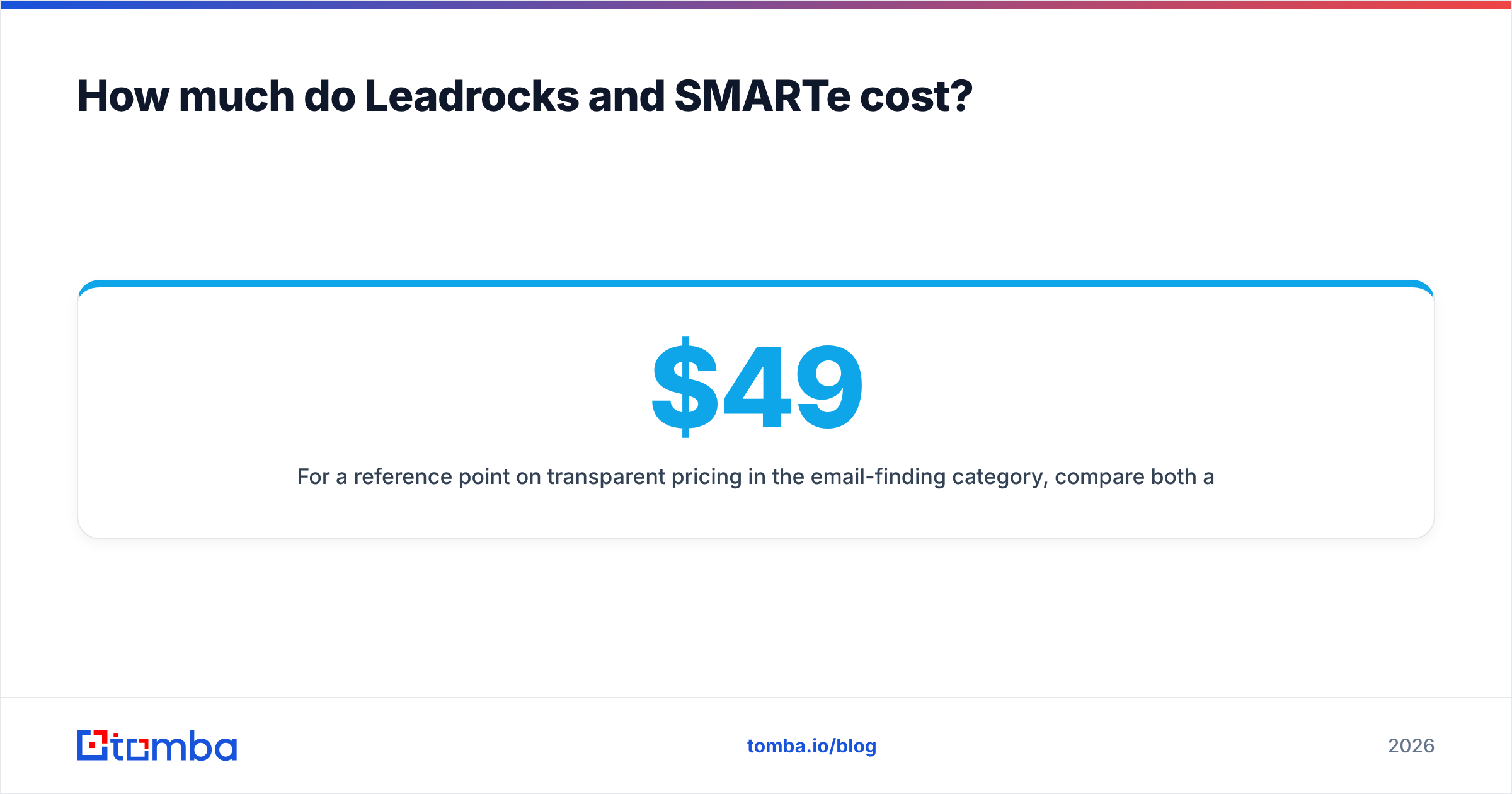
For a reference point on transparent pricing in the email-finding category, compare both against Tomba plans: a free tier with 25 searches a month, Starter at $49/mo, Growth at $99/mo, Pro at $249/mo, and custom Enterprise. That's a different product scope, but it's a useful benchmark for what a verified email should cost you.
Is Leadrocks better than SMARTe for cold email?#
For pure cold email, Leadrocks is usually the better value, with one condition: you have to treat its output as raw material, not a finished list.
Cold email runs on volume and cost per contact. You need a lot of addresses, you need them fast, and each one is worth little until someone replies. That's the use case Leadrocks was built for. The LinkedIn extension makes it easy to build lists from a Sales Navigator search, and the self-serve plans mean nobody has to approve a purchase order.
What you have to add yourself:
- Verification. Run the whole list through a verifier and drop invalid and risky addresses.
- Catch-all handling. Put catch-all contacts in a separate, lower-volume sending pool.
- Deduplication against your CRM, so you don't cold email existing customers.
- Enrichment of company data (headcount, tech stack, funding) if you personalize beyond first name and company.
SMARTe also works for cold email, but you're paying for things a pure email program doesn't use: phone data, deep CRM enrichment, and global coverage you may not need.
Is SMARTe better than Leadrocks for enterprise sales teams?#
Yes, in most enterprise setups. The reasons are operational, not just about data quality.
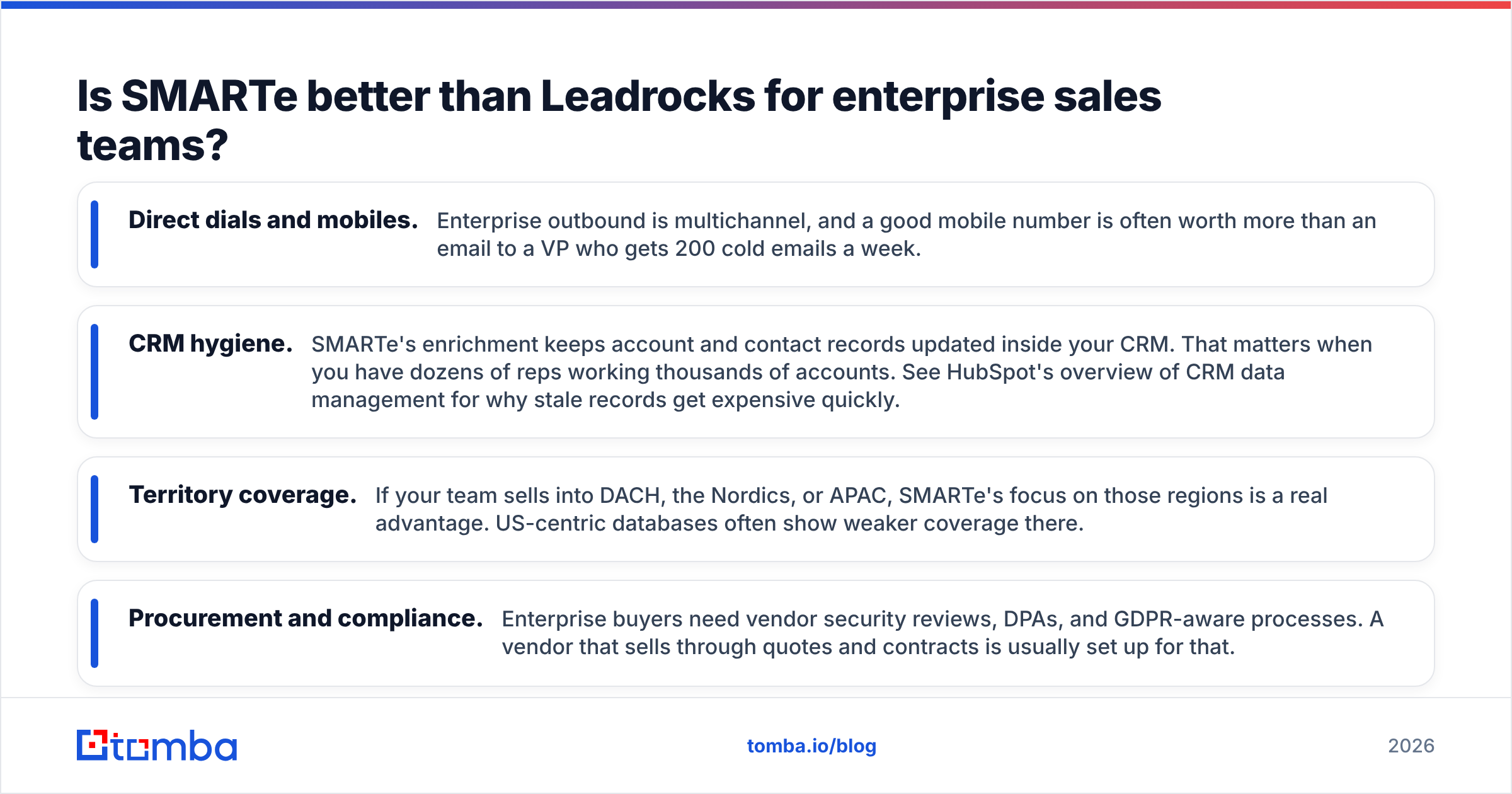
Enterprise sales teams care about things a self-serve database doesn't prioritize:
- Direct dials and mobiles. Enterprise outbound is multichannel, and a good mobile number is often worth more than an email to a VP who gets 200 cold emails a week.
- CRM hygiene. SMARTe's enrichment keeps account and contact records updated inside your CRM. That matters when you have dozens of reps working thousands of accounts. See HubSpot's overview of CRM data management for why stale records get expensive quickly.
- Territory coverage. If your team sells into DACH, the Nordics, or APAC, SMARTe's focus on those regions is a real advantage. US-centric databases often show weaker coverage there.
- Procurement and compliance. Enterprise buyers need vendor security reviews, DPAs, and GDPR-aware processes. A vendor that sells through quotes and contracts is usually set up for that.
Leadrocks can still help enterprise teams as a tactical tool, for example for one-off list builds or event prospecting. It's just not designed to be the system of record.
What do users say about Leadrocks and SMARTe?#
Review platforms like G2 are the best public signal, as long as you read the actual reviews and not just the star ratings. The common themes are consistent:
Leadrocks, commonly praised for:
- Low cost per contact and generous credit volume
- A fast, simple LinkedIn extension
- No sales process to get started
Leadrocks, common complaints:
- Email accuracy varies by segment
- Limited enrichment depth beyond basic contact fields
- Some records feel older in fast-changing markets
SMARTe, commonly praised for:
- Strong mobile and direct-dial coverage
- International data quality, especially in Europe
- Responsive customer success and CRM integrations
SMARTe, common complaints:
- No public pricing; you have to talk to sales
- Annual commitments are a lot for smaller teams
- The interface has more to learn than lightweight tools
Neither profile is surprising. Each tool gets praised and criticized for the same design choices that separate it from the other.

Leadrocks vs SMARTe: which one should you choose?#
Base the decision on your motion, not the feature list.
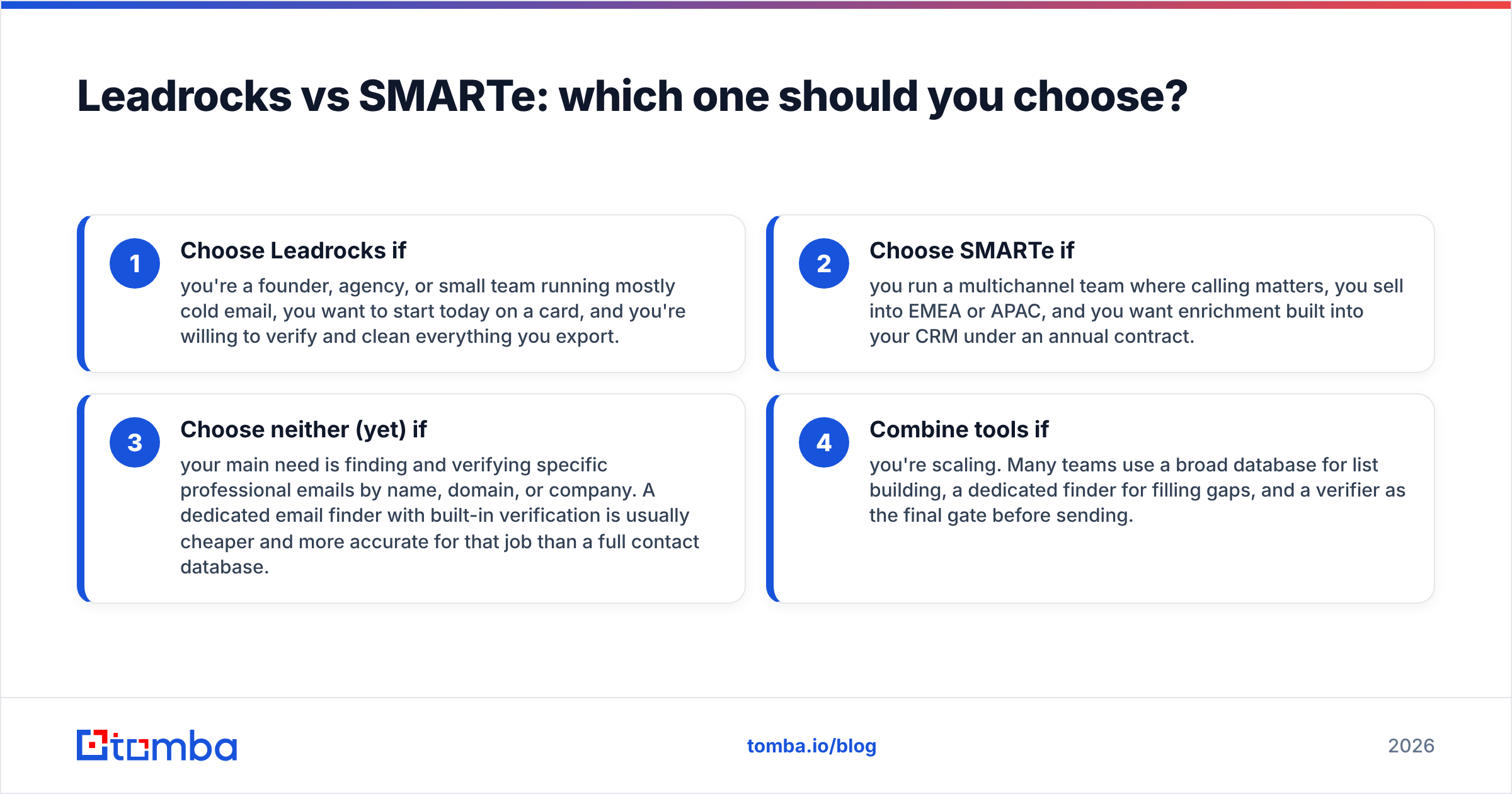
- Choose Leadrocks if you're a founder, agency, or small team running mostly cold email, you want to start today on a card, and you're willing to verify and clean everything you export.
- Choose SMARTe if you run a multichannel team where calling matters, you sell into EMEA or APAC, and you want enrichment built into your CRM under an annual contract.
- Choose neither (yet) if your main need is finding and verifying specific professional emails by name, domain, or company. A dedicated email finder with built-in verification is usually cheaper and more accurate for that job than a full contact database.
- Combine tools if you're scaling. Many teams use a broad database for list building, a dedicated finder for filling gaps, and a verifier as the final gate before sending.

How does a dedicated email finder fit alongside these tools?#
Most teams end up with more than one data source, and the question is which one you trust last.
A contact database is like a phone book: broad, fast to browse, and partly out of date on the day you open it. An email finder works more like a directory lookup: you give it a specific person and company, and it returns the most likely address with a confidence score and verification status. The two do different jobs.
In practice, the strongest outbound stacks look like this:
- Source accounts and people in a database (Leadrocks, SMARTe, or your CRM).
- Fill missing or low-confidence emails with a dedicated finder that searches by name and domain.
- Verify everything before sequencing, and separate out catch-all contacts.
- Enrich company and contact fields with data enrichment so personalization and lead scoring have something to work with.
This layered setup is also the most forgiving. If one source degrades in a region or segment, the others catch it before your bounce rate does.
Final verdict: Leadrocks or SMARTe?#
Leadrocks wins on price, speed, and self-serve access. It's a practical choice for cold email teams that treat data as something to process, not a finished product. SMARTe wins on phone data, international coverage, and enterprise workflow. It's a better fit for revenue teams that call, sell globally, and want their CRM to stay accurate without manual work.
Neither is the wrong choice. The wrong choice is buying the one that doesn't match how your team actually sells.
If what your pipeline really needs is accurate professional emails, found by name, domain, or company and verified before you hit send, try the Tomba Email Finder. It searches by domain or by person, returns deliverability status with every result, and works alongside whatever database you already use. The free tier gives you 25 searches a month, enough to test it on a list you know and compare the results yourself.
Related guides#
// get started
Find, verify and enrich your first contacts today
Start on the free plan with 25 searches a month, then scale when your team is ready.
Free plan · No credit card required · GDPR & CCPA
Get the Tomba newsletter
Product and data updates
// about the author