LeadzenAI vs NinjaPear (2026): Contact Data or Company Intel?
LeadzenAI sells revealed contacts to sales reps. NinjaPear sells company intelligence to developers. We compare their data, pricing, lock-in and fit so you can pick the right one.
TL;DR
- LeadzenAI is a prospecting app for sales reps. You search for people and companies, reveal phone numbers and emails with credits, and export lists. Third-party listings put paid plans at roughly $133–$800 per user per month.
- NinjaPear is an API-first company intelligence platform built by the team behind Proxycurl. It answers questions like "who are this company's customers and competitors?" It does not sell a large contact database, and its plans reportedly require a 12-month commitment.
- The two tools do different jobs. LeadzenAI tells you who to call. NinjaPear tells you which accounts matter and why.
- Our pick: choose LeadzenAI if non-technical SDRs need phone numbers, especially in India and APAC. Choose NinjaPear if you have engineers building account-mapping or competitive-intel workflows.
- Neither tool is cheap for simple email lookup. If verified work emails are all you need, a dedicated email finder costs a fraction of either.
What is LeadzenAI?#
LeadzenAI (sometimes written Leadzen.ai) is an AI-assisted B2B lead generation platform. You describe your ideal prospect with filters such as industry, title, geography and company size, or with a natural-language prompt. You get back a list of matching people. To see a contact's mobile number or email, you spend a credit to "reveal" it.
Its core audience is sales and business development teams that want to work from a UI rather than an API. The typical workflow:
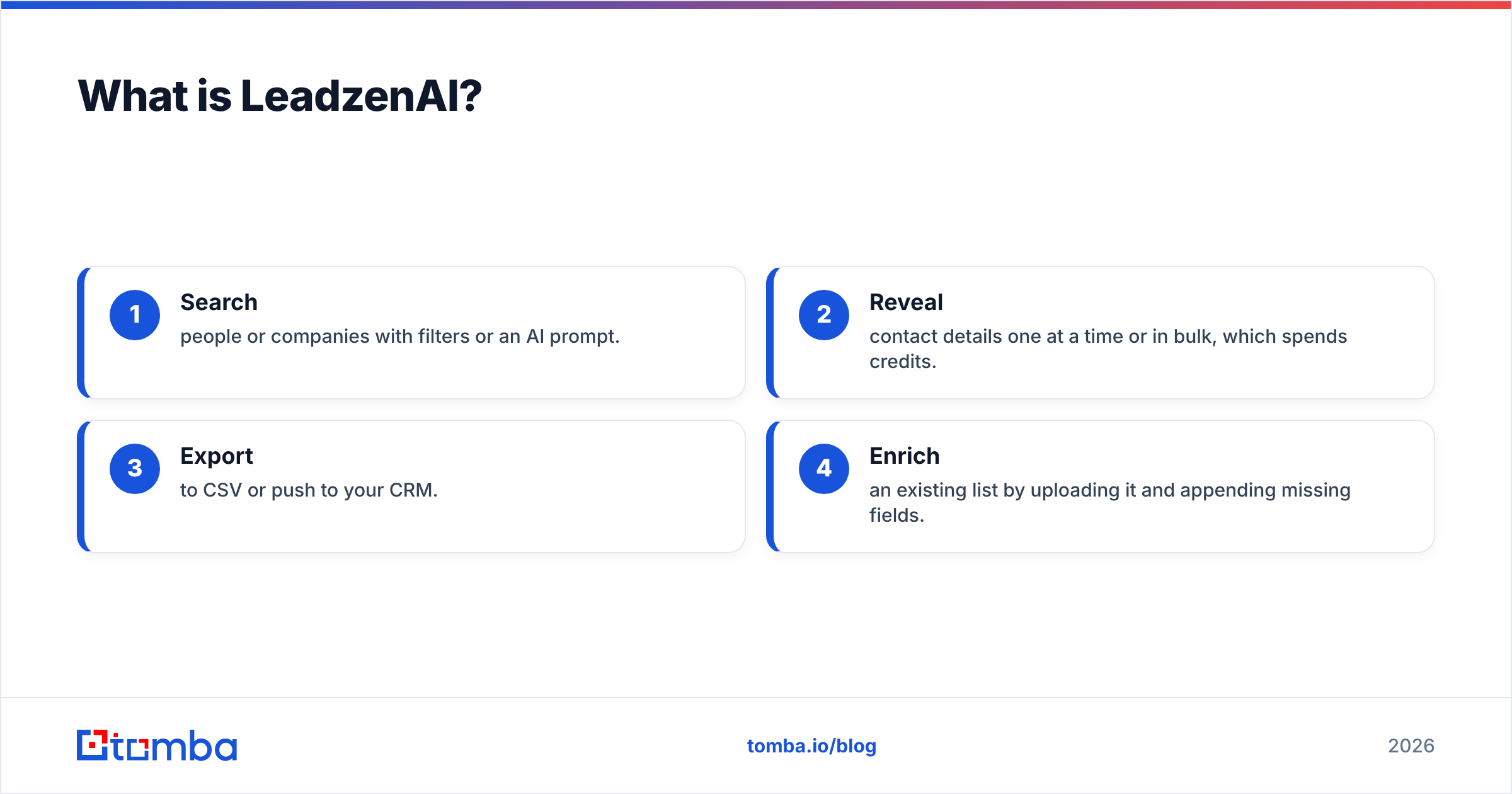
- Search people or companies with filters or an AI prompt.
- Reveal contact details one at a time or in bulk, which spends credits.
- Export to CSV or push to your CRM.
- Enrich an existing list by uploading it and appending missing fields.
LeadzenAI's reputation rests on phone coverage, particularly for Indian and wider APAC decision-makers. Many Western-first databases are thin in those regions. User reviews on G2 generally praise the ease of use and the depth of mobile numbers. They also mention that credits run out quickly at the lower tiers.
What is NinjaPear?#
NinjaPear is a B2B company intelligence API. It comes from the same team that ran Proxycurl, the LinkedIn-profile enrichment API that shut down in mid-2025 after legal pressure from LinkedIn. NinjaPear is not a relaunched Proxycurl. The team explicitly positions it as aggregating data from the public web, and it says it does not scrape LinkedIn.
NinjaPear's product line is organised around company-level questions:
- Customer API: which companies are customers of a given vendor.
- Competitor API: who a company competes with.
- Company API: firmographics such as size, industry, location and description.
- Employee API: people associated with a company.
- Monitor API: RSS-style tracking of changes at target accounts.
Think of it like the difference between a phone book and a market-research analyst. LeadzenAI is the phone book: it gives you a name and a number. NinjaPear is the analyst: it tells you that Company X just became a customer of your competitor and that three similar firms are likely next. On its own, it won't give you the CFO's mobile number.

How do LeadzenAI and NinjaPear compare side by side?#
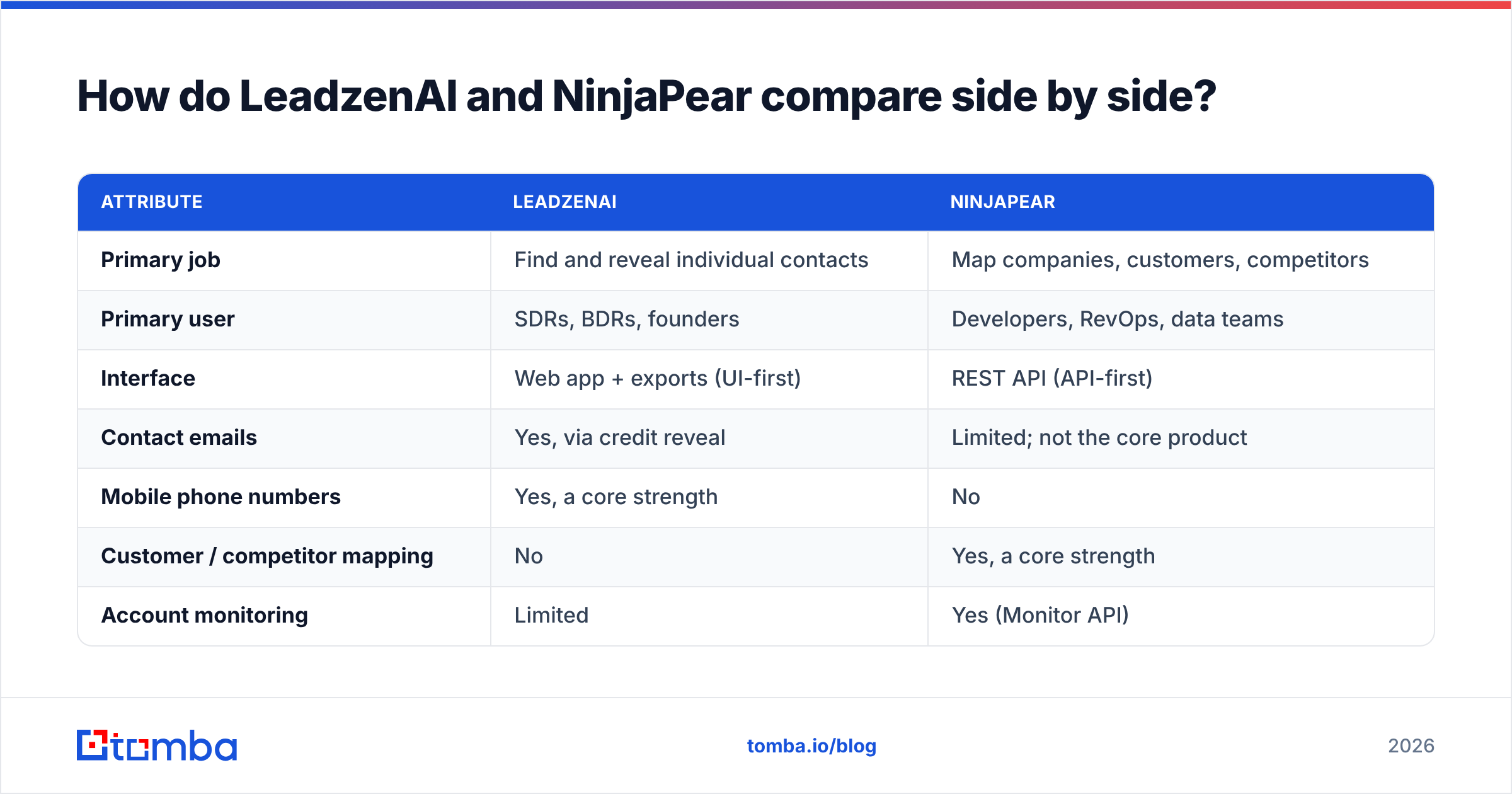
The fastest way to see the gap is to put the attributes in one table. Pricing comes from public listings and third-party reviews as of 2026. Both vendors change plans often, so confirm on their sites before you buy.
| Attribute | LeadzenAI | NinjaPear |
|---|---|---|
| Primary job | Find and reveal individual contacts | Map companies, customers, competitors |
| Primary user | SDRs, BDRs, founders | Developers, RevOps, data teams |
| Interface | Web app + exports (UI-first) | REST API (API-first) |
| Contact emails | Yes, via credit reveal | Limited; not the core product |
| Mobile phone numbers | Yes, a core strength | No |
| Customer / competitor mapping | No | Yes, a core strength |
| Account monitoring | Limited | Yes (Monitor API) |
| Geographic strength | India and APAC strong; global available | Global, company-level |
| Entry paid plan | ~$133/user/mo (~300 credits) | ~$49/mo entry tier |
| Mid tiers | ~$400 (1,100 credits), ~$800 (2,600 credits) | ~$299, ~$899, ~$1,899/mo |
| Free option | No permanent free plan; demo/trial varies | 3-day trial with ~10 credits |
| Contract | Monthly/annual options listed | Reportedly 12-month commitment on all plans |
| Best for | Outbound calling and email lists | Account intelligence and TAM building |
Two rows in that table should drive your decision more than the others: who is the primary user and contract terms. A tool your reps can't use without an engineer is shelfware. A 12-month commitment on a tool you're still testing is a real financial risk.
Is LeadzenAI better than NinjaPear for finding contacts?#
Yes, by a wide margin, because contact finding is what LeadzenAI is built for and NinjaPear isn't.
If your KPI is "booked meetings from cold calls and cold emails," you need:
- Direct dials and mobiles: LeadzenAI has them, and NinjaPear doesn't sell them.
- Work emails at scale: LeadzenAI reveals them per credit. NinjaPear's employee data is not built as an email database.
- A UI your reps live in: LeadzenAI is click-and-export. NinjaPear expects you to write code.
The caveat is cost per contact. At the ~$133 tier with ~300 credits, you pay roughly $0.44 per reveal before any bulk discount. That is reasonable for a verified mobile number in a hard-to-cover region. It is expensive if you mostly need emails, which cheaper tools can find and verify for a few cents each.
Always run revealed emails through an email verifier before you load them into a sequencer. Every vendor's data decays. Roughly a quarter to a third of B2B contact data goes stale each year as people change jobs, and one bad batch can hurt your sender reputation for weeks.
Is NinjaPear better than LeadzenAI for account intelligence?#
Yes. NinjaPear's customer and competitor endpoints do things a contact database can't.
Here's where it earns its price:
- Competitive displacement lists. Pull every known customer of a competitor, then score and prioritise those accounts for a "switch" campaign.
- Lookalike TAM building. Start with your best customers, map their competitors, and you have a list of accounts that look like your wins.
- Trigger-based outreach. Monitor target accounts and fire alerts into Slack or your CRM when something changes.
- Product and data enrichment. If you run a SaaS product, NinjaPear can enrich signups with firmographics and competitive context through an API call.
What you won't get is the person-level layer. After NinjaPear tells you which 200 accounts to target, you still need another tool to find the right people at each one and get their contact details. For most teams, that means running NinjaPear alongside a contact tool.
How does pricing actually compare?#
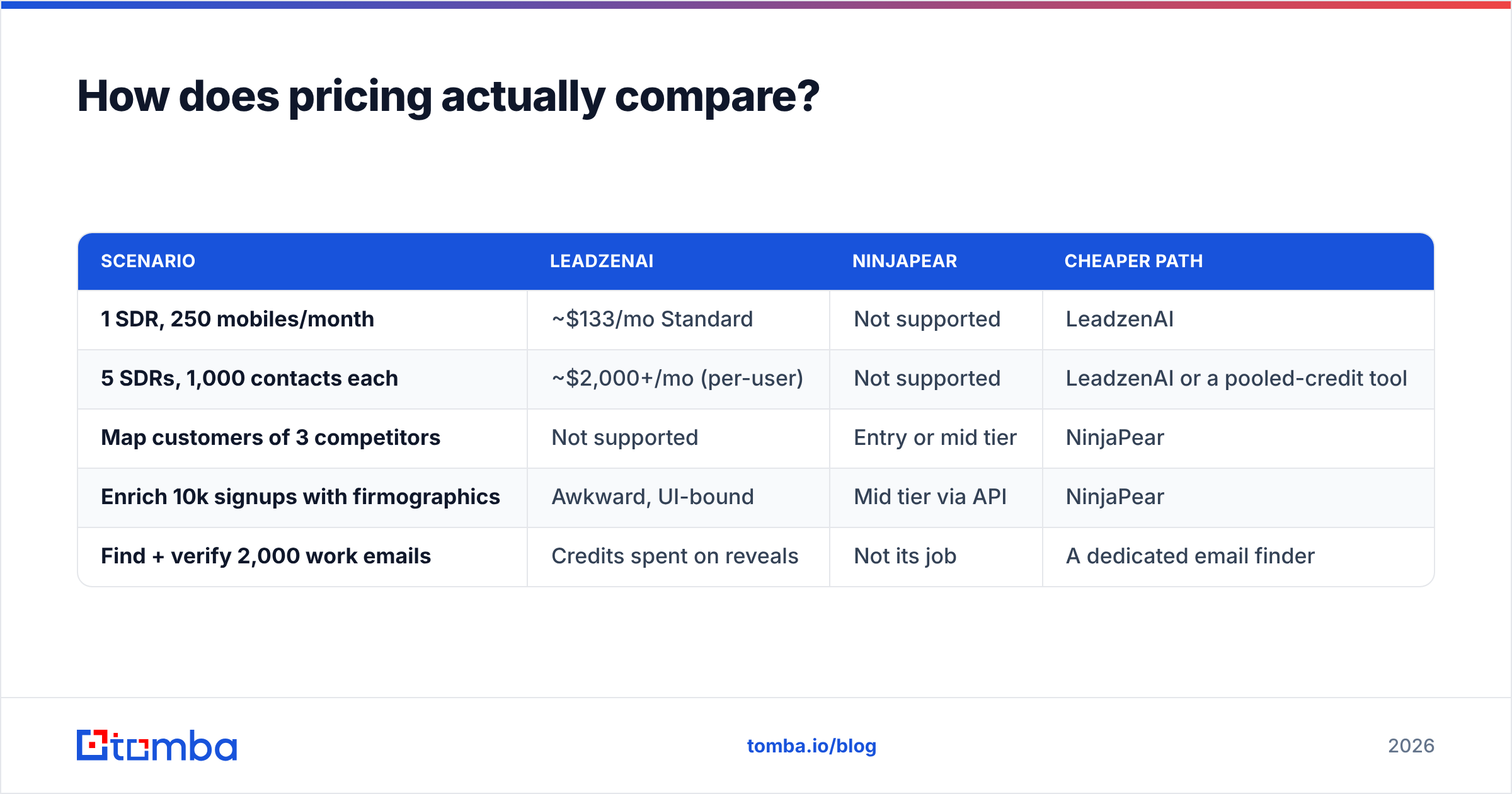
Headline prices don't line up well, because the two tools charge for different units. LeadzenAI charges per contact reveal. NinjaPear charges per API credit, and different endpoints consume different amounts.
A more useful way to compare is by scenario:
| Scenario | LeadzenAI | NinjaPear | Cheaper path |
|---|---|---|---|
| 1 SDR, 250 mobiles/month | ~$133/mo Standard | Not supported | LeadzenAI |
| 5 SDRs, 1,000 contacts each | ~$2,000+/mo (per-user) | Not supported | LeadzenAI or a pooled-credit tool |
| Map customers of 3 competitors | Not supported | Entry or mid tier | NinjaPear |
| Enrich 10k signups with firmographics | Awkward, UI-bound | Mid tier via API | NinjaPear |
| Find + verify 2,000 work emails | Credits spent on reveals | Not its job | A dedicated email finder |
Watch for three hidden costs:
- Per-user pricing (LeadzenAI). Credits are listed per user, so costs climb linearly with team size. Ask whether credits can be pooled.
- Annual lock-in (NinjaPear). Third-party reviews report a 12-month commitment on every plan. That is a bigger bet than a monthly subscription, especially while the product is still young after the Proxycurl transition.
- Endpoint credit multipliers (NinjaPear). Heavier endpoints, such as customer listings, can cost more credits per call than simple company lookups. Model your real usage before you pick a tier.
Which data is more reliable and compliant?#
This is where the Proxycurl history matters. After Proxycurl's shutdown, many buyers became wary of any vendor whose data might depend on scraping LinkedIn. NinjaPear has addressed this directly by rebuilding around public-web sources and stating that it doesn't scrape LinkedIn. That is a meaningful change, but you should still ask for its data-provenance documentation during procurement.
LeadzenAI aggregates contact data from multiple sources. If you prospect in the EU or UK, ask about its lawful basis under GDPR and its opt-out handling. Ask the same of any contact vendor, whichever you choose.
In both cases, the practical safeguards are the same:
- Verify before you send. Treat every revealed email as unverified until it passes an SMTP-level check.
- Suppress opt-outs globally. Sync unsubscribes across all tools, not just the one that sourced the contact.
- Log provenance. Keep a field in your CRM for where each contact came from, so you can answer data-subject requests quickly.

Who should choose LeadzenAI?#
Pick LeadzenAI if most of these are true:
- Your reps are non-technical and need a search-reveal-export workflow.
- Phone numbers are central to your outbound motion, and cold calling is a real channel for you.
- You sell into India or APAC, where LeadzenAI's coverage stands out.
- You're fine with per-user pricing and can forecast reveal volume.
Who should choose NinjaPear?#
Pick NinjaPear if most of these are true:
- You have engineering or RevOps resources to integrate an API.
- Your strategy is account-based: competitive displacement, lookalike targeting, TAM mapping.
- You want programmatic monitoring of target accounts.
- You're comfortable with an annual commitment after using the trial.
- You already have, or will add, a separate tool for person-level contact data.
Can you use both together?#
Yes, and for mature outbound teams this is often the right architecture. Think of it as a relay race:
- NinjaPear picks the accounts. It pulls customers of your top competitors, filtered by firmographics.
- A contact tool finds the people. LeadzenAI for mobiles, or a lower-cost email tool for work emails.
- A verifier cleans the list. Remove invalid and risky addresses before sequencing.
- Your sequencer runs the outreach. Only verified contacts go in.
The weak link in that relay is usually step 2. If you pay LeadzenAI rates for emails you could have found and verified for much less, the stack gets expensive fast. Many teams keep LeadzenAI seats for the reps who dial. Everyone else uses a domain-based email finder to cover the rest of the buying committee.
What's the final verdict on LeadzenAI vs NinjaPear?#
There is no universal winner, because these tools aren't really competitors. They sit at different layers of the go-to-market stack.
- LeadzenAI wins for contact-level prospecting, especially phone-heavy outbound into APAC markets, run by reps who don't write code.
- NinjaPear wins for company-level intelligence, such as customer maps, competitor maps and account monitoring, when you have engineers to build on its API.
If you're a small team choosing just one, start with the question you most need answered. "Who do I call?" points to LeadzenAI. "Which accounts should we chase?" points to NinjaPear. If your real need is simpler, such as finding and verifying work emails for a known list of companies, you may not need either at these price points.
Where does Tomba fit if you just need verified emails?#
If the gap in your stack is the person-level email layer, Tomba is built for exactly that job. The Tomba Email Finder returns professional email addresses from a name and a company or domain. It ships with built-in verification, so you don't have to buy a separate tool before you hit send. Plans start with a free tier of 25 searches a month. Paid plans run from $49/mo on Starter to $99 on Growth and $249 on Pro, with no per-seat multiplier. See the full breakdown on Tomba pricing. Teams that pair it with an account-intelligence API like NinjaPear can call the Tomba API in the same pipeline. Start with the free tier, run it against your current target list, and compare the cost per verified email with what you pay now.
Related guides#
// get started
Find, verify and enrich your first contacts today
Start on the free plan with 25 searches a month, then scale when your team is ready.
Free plan · No credit card required · GDPR & CCPA
// about the author