LeadzenAI vs Salutary Data: Which B2B Data Source Fits You?
LeadzenAI sells self-serve AI prospecting with a Chrome extension. Salutary Data licenses curated US contact data by the file or API. Here is who should buy which, and what each one costs you.
This LeadzenAI vs Salutary Data comparison covers pricing, coverage, delivery, and who should buy which.
TL;DR
- LeadzenAI is a self-serve AI prospecting tool. You get search filters, a Chrome extension, "trending leads" feeds, and outreach tools. It suits SDR teams that want to find and contact leads the same day. It's strongest on Indian company data.
- Salutary Data is a boutique data licensing company. It sells curated US-only B2B contact and company data by file or API. It suits data teams, platforms, and enterprises that need raw data at scale.
- The pricing models differ. LeadzenAI has a free plan and monthly seat plans. Salutary Data quotes custom contracts, and marketplace listings start around $5,000.
- Pick LeadzenAI if you're a sales rep building lists. Pick Salutary Data if you're a RevOps, data, or product team loading records into your own systems.
- Neither one replaces a real-time email finder and verifier. Budget for one if deliverability matters.
LeadzenAI vs Salutary Data: what is the real difference?#
"LeadzenAI vs Salutary Data" sounds like two vendors competing for the same deal. Most of the time they aren't. They answer different questions.
LeadzenAI answers: "Who should my rep email this afternoon, and what's their address?" Salutary Data answers: "Can we license 100 million clean US contact records and load them into our warehouse, CRM, or product?"
Think of it this way: LeadzenAI is a grocery store where you pick items off the shelf. Salutary Data is a wholesale distributor that ships pallets to your loading dock. Both sell food, but you wouldn't send a line cook to the distributor or a restaurant chain to the corner store.
If you keep that framing in mind, the rest of this comparison falls into place. The sections below break down coverage, pricing, workflow, and data quality, then give you a clear recommendation by buyer type.
What is LeadzenAI?#
LeadzenAI (written Leadzen.ai) is an AI-driven lead generation platform. It gives you a searchable B2B and professional database with filters for industry, location, company size, and role. On top of that it adds:
- Bulk search for building lists in batches instead of one profile at a time
- A Chrome extension that pulls email addresses and phone numbers while you browse profiles and company pages
- Trending leads: feeds of recently funded companies and active angel investors, useful for timing outreach around funding events
- Real-time signals such as geolocation and competitor content monitoring
- A multi-channel outreach layer covering email, LinkedIn DMs, WhatsApp, and dialing
Independent reviewers agree its biggest strength is Indian market coverage. Company records use official registry (MCA) data. US-focused tools rarely match that. If your territory is India or South Asia, that matters a lot.
On pricing, LeadzenAI promotes a freemium plan on its own pricing page. Review sites such as TrustRadius list paid tiers from about $133/month for the Standard plan up to around $800 at the top end. Annual plans get discounts. Treat these figures as a guide. Prices in this category change often, so confirm them with the vendor.
What is Salutary Data?#
Salutary Data describes itself as a boutique B2B contact and company data provider. It doesn't give you a prospecting UI to live in all day. It sells data products:
- US B2B contact data: the vendor states 171M+ curated contacts, US only
- Company data: millions of firmographic records covering name, industry, employee count, revenue, and website
- Email data: validated business and personal emails
- Technology install data: which companies run which software
- Delivery options: email, S3 bucket, SFTP, UI export, and REST API, in JSON, CSV, or XLS
Its stated use cases go well beyond sales: marketing, recruiting and HR, identity resolution, and ML/AI training. It also publishes field-level fill rates, which is a good transparency signal. You can see how often a field is actually populated before you sign.
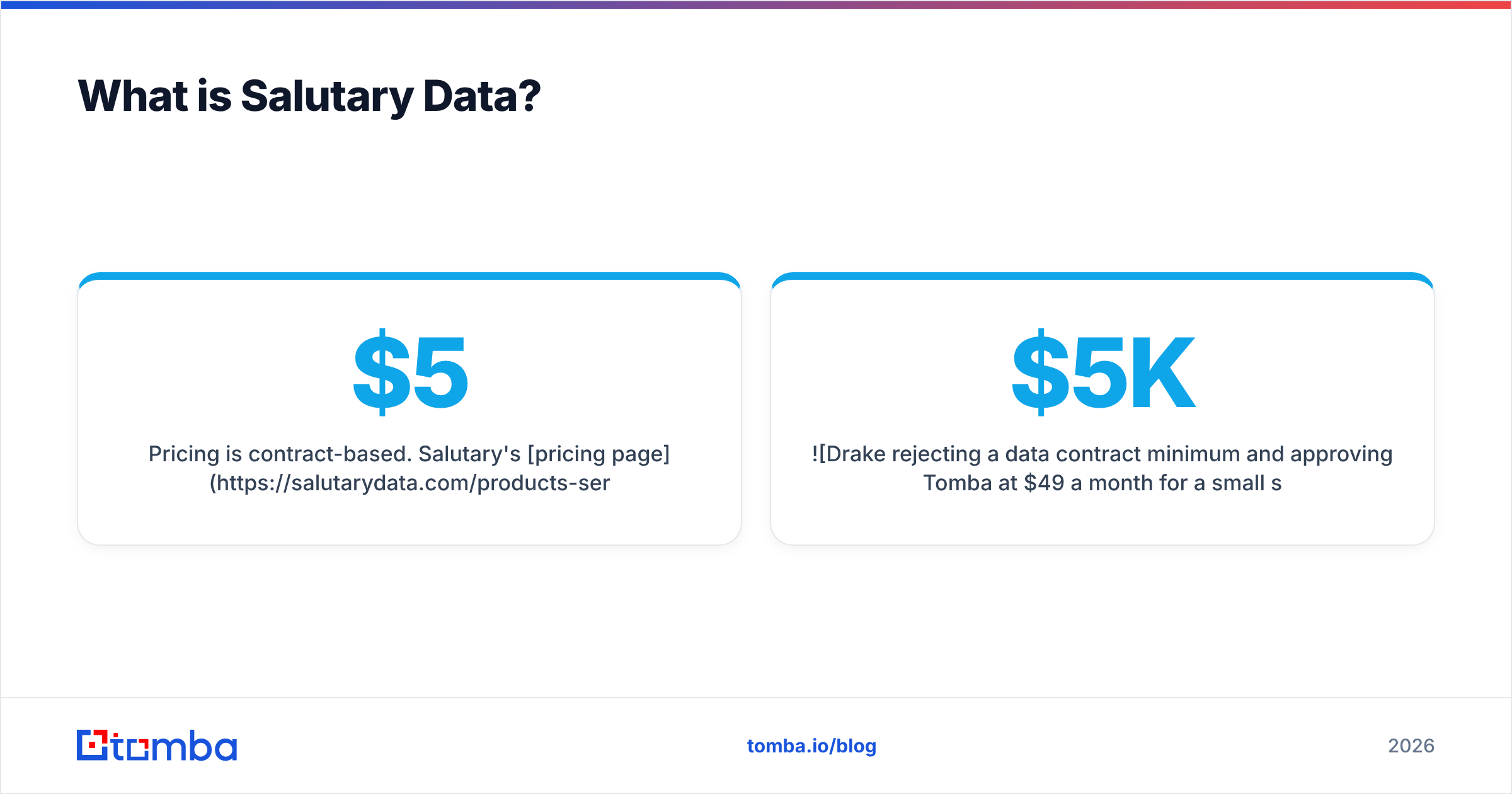
Pricing is contract-based. Salutary's pricing page lists annual plans, paid up front, monthly, or quarterly. It also offers usage-based options like pay-per-match and per-contact downloads. Data marketplace listings put API and dataset deals at around $5,000 to start. Free samples are available, and you should use them.

How do LeadzenAI and Salutary Data compare feature by feature?#
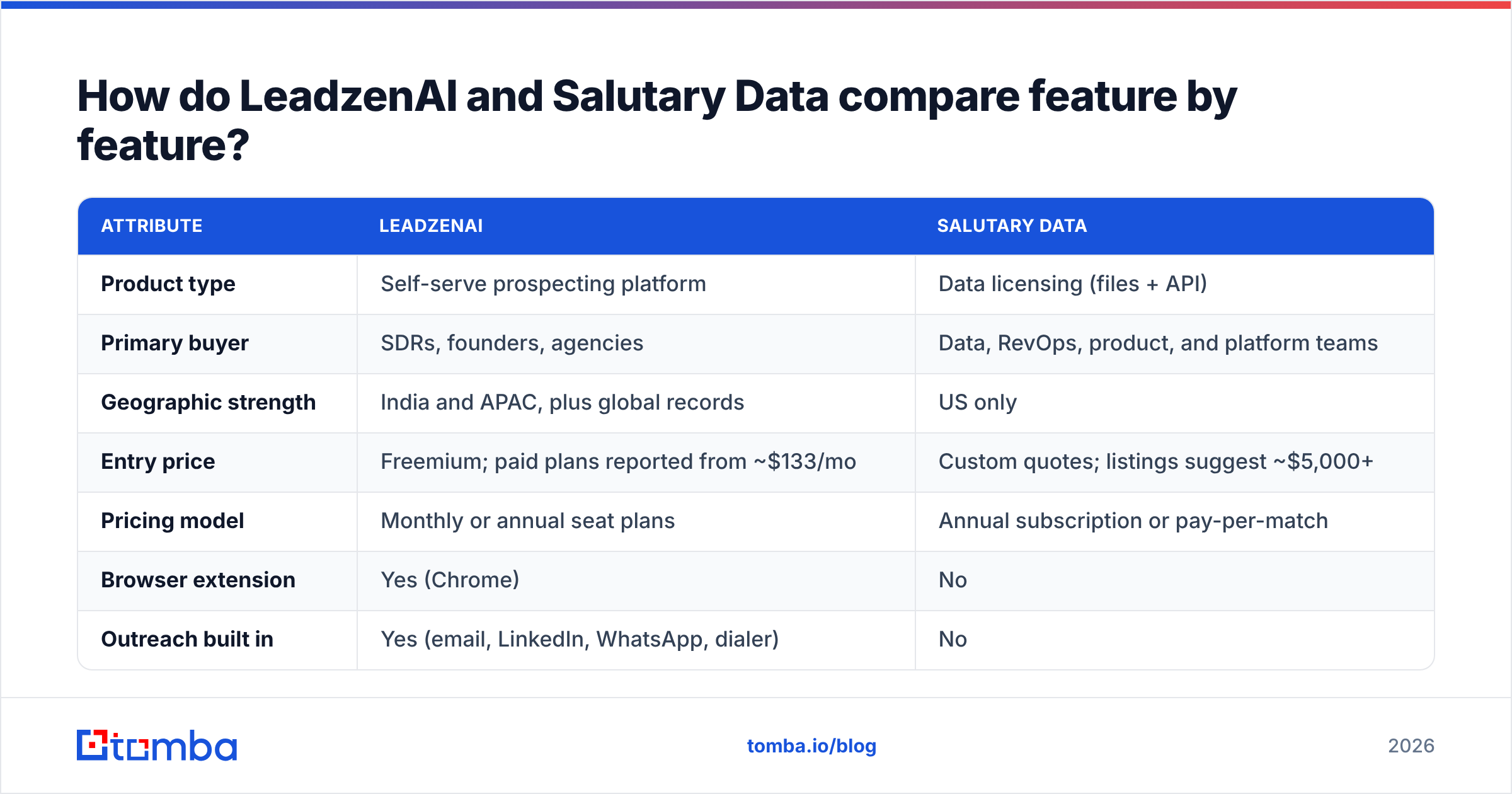
Here's the LeadzenAI vs Salutary Data side-by-side on the attributes that decide most purchases:
| Attribute | LeadzenAI | Salutary Data |
|---|---|---|
| Product type | Self-serve prospecting platform | Data licensing (files + API) |
| Primary buyer | SDRs, founders, agencies | Data, RevOps, product, and platform teams |
| Geographic strength | India and APAC, plus global records | US only |
| Entry price | Freemium; paid plans reported from ~$133/mo | Custom quotes; listings suggest ~$5,000+ |
| Pricing model | Monthly or annual seat plans | Annual subscription or pay-per-match |
| Browser extension | Yes (Chrome) | No |
| Outreach built in | Yes (email, LinkedIn, WhatsApp, dialer) | No |
| Bulk delivery (S3/SFTP) | No, exports from the UI | Yes |
| REST API | Limited or plan-dependent | Yes, a core product |
| Buying signals | Funding feeds, investor activity | Tech install data |
| Fill-rate transparency | Not published in detail | Published per field |
| Free sample / trial | Freemium plan | Free data samples |
The table makes one thing clear. The only row where they truly compete is "B2B contact data." Everything else, from who uses it to how it's delivered and billed, points to different buyers.
Which has better data coverage?#
In the LeadzenAI vs Salutary Data coverage race, it depends entirely on your territory.
For India and APAC, LeadzenAI has the edge. Registry-backed company data, local phone numbers, and coverage of fast-growing startup ecosystems are its home turf. Salutary Data doesn't cover these markets at all, since its datasets are US only.
For the United States, Salutary Data is the deeper pool. A curated 171M+ contact file with published fill rates is built for coverage completeness. LeadzenAI has US records too, but they aren't its differentiator, and you should test match rates on your own ICP before you commit.
For Europe and other markets, neither one is a natural fit. You'll probably need a global email finder or a regional provider.
A practical test beats any marketing claim. Take 200 accounts from your real target list. Run them through LeadzenAI's trial and request a matched sample from Salutary Data. Then compare three numbers:
- Match rate: what percentage of your accounts returned contacts at all?
- Role relevance: what percentage of those contacts actually hold the titles you sell to?
- Valid email rate: after you run the emails through an independent email verifier, what percentage come back deliverable?
That third number is the one most teams skip, and it's the one that decides whether your domain reputation survives the campaign.
How does pricing actually play out?#
Headline prices hide the real cost of LeadzenAI vs Salutary Data. The two vendors bill against different units.
LeadzenAI bills per seat and plan tier, with credit or usage limits depending on the plan. For a team of one to five reps, you're looking at a predictable monthly line item. The freemium plan lets you validate fit before paying. The catch is that seat-based tools scale linearly with headcount, so a 20-rep team pays 20 times.
Salutary Data bills against data volume and delivery. A $5,000+ starting point sounds steep next to a $133 plan. But look at the cost per record. If you license millions of records for a product or a full warehouse refresh, each record can cost far less than with any per-seat tool. If you only need 2,000 contacts this quarter, though, you'd be overpaying badly.
A simple rule of thumb:
- Under ~10,000 contacts a year, used by reps directly: seat-based tools like LeadzenAI, or a pay-as-you-go email finder, win on cost.
- Hundreds of thousands to millions of records, loaded into systems: licensed data like Salutary wins on cost per record.
- In between: consider an API-first finder and verifier that charges per lookup, so you only pay for records you actually use.
Which one fits your workflow better?#
Workflow fit is usually what decides the deal once pricing is out of the way.
Choose LeadzenAI if:
- Your reps build their own lists. The Chrome extension and search UI are designed for individual contributors.
- You sell into India or APAC. Local company data is its strongest asset.
- You want outreach in the same tool. Email, LinkedIn, WhatsApp, and dialing sit next to the data.
- Timing signals matter. Funding and investor feeds help you reach accounts right after they raise.
Choose Salutary Data if:
- You have a data or engineering team. S3/SFTP delivery and a REST API assume someone will build pipelines.
- Your market is the US. Its coverage is deep but deliberately single-country.
- You're enriching a CRM or warehouse at scale. Bulk licensing beats per-seat tools here.
- You're building a product. Identity resolution, recruiting platforms, and ML training sets are named use cases.
Don't see yourself in either list? Say you're a small US agency sending 500 cold emails a week. You probably need neither. A lightweight finder with a free tier and a solid verifier is likely enough.
What about data quality and compliance?#
Every B2B data vendor decays. Industry estimates put B2B contact data decay at about 20-30% a year. People change jobs, companies rebrand, and domains lapse. That affects both vendors in different ways.
Static licensed files decay after delivery. When you buy a Salutary dataset, it starts ageing the day it lands in your bucket. That's why refresh cadence belongs in your contract. Ask how often updated files ship and whether refreshes are included or billed separately.
Self-serve platforms decay between refreshes of their index. LeadzenAI surfaces records at query time, but the underlying data is only as fresh as its last crawl or update. Test email validity yourself rather than trusting "verified" badges.
On compliance, check three things with either vendor:
- Sourcing: where the data comes from and whether you can document that under GDPR, CCPA, or India's DPDP Act where relevant
- Personal vs business emails: Salutary explicitly offers both, and personal email use in B2B outreach carries higher regulatory and deliverability risk
- Opt-out handling: how suppression requests flow through to your copy of the data
Bad addresses hurt more than bounce stats. See how mailbox providers score sender reputation. For a broader view of how analysts evaluate data vendors, Gartner's sales technology research is a useful reference.

Is LeadzenAI better than Salutary Data?#
Neither wins the LeadzenAI vs Salutary Data matchup overall. Each is better for a specific buyer.
LeadzenAI wins for sales teams. It's faster to start, cheaper at small volume, stronger in India, and it comes with outreach tools. A founder or SDR can get value on day one without writing code or signing a contract.
Salutary Data wins for data teams. It offers deeper US coverage, transparent fill rates, flexible bulk delivery, and better unit economics at scale. If you're feeding a warehouse or a product, it's built for exactly that job.
The worst outcome is buying the wrong category. A five-person sales team that signs a five-figure data license ends up with CSVs nobody opens. A data platform that tries to license through a seat-based prospecting tool hits export limits within a week.
Where does a real-time email finder fit in?#
Both options leave a gap: point-in-time accuracy on the exact person you're about to email.
Licensed files age. Prospecting databases refresh on their own schedule. For high-value outreach, the most reliable approach is to look up and verify the address right before you send. That's where a dedicated finder and verifier helps. Use it as your main source or as a quality layer on top of LeadzenAI or Salutary data.
With Tomba, you can:
- Find emails by name and company using the email finder when a record is missing or looks stale
- Pull every public contact for a company with domain search to fill gaps in account coverage
- Verify before sending, including catch-all domains, so decayed records never reach your sequencer
- Automate it through the Tomba API if you're enriching a CRM or warehouse, which makes it a natural complement to a Salutary-style bulk file
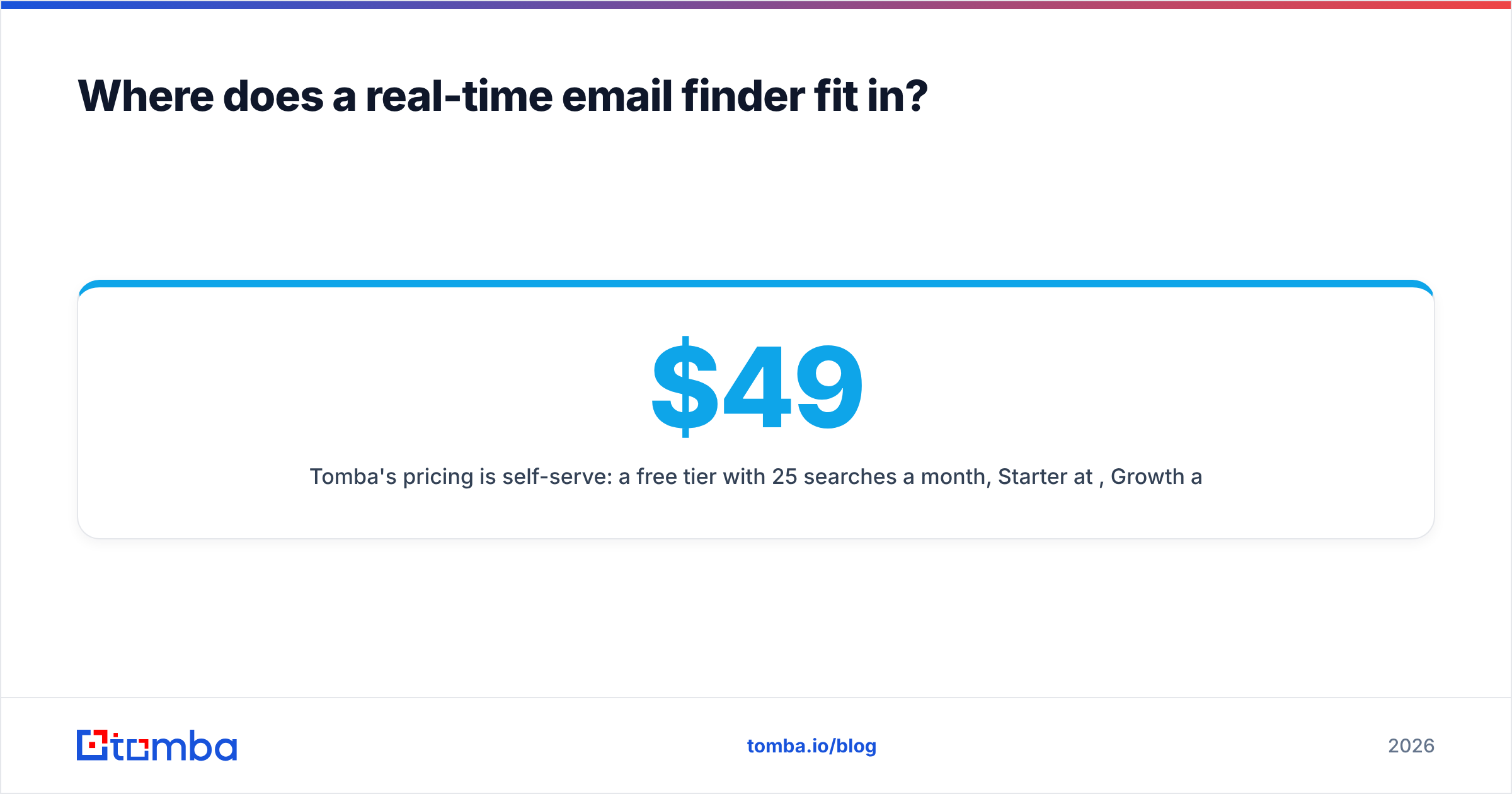
Tomba's pricing is self-serve: a free tier with 25 searches a month, Starter at $49/mo, Growth at $99/mo, Pro at $249/mo, and custom Enterprise plans. That puts it between a freemium prospecting tool and a five-figure data license, which is where many small and mid-sized teams actually sit.
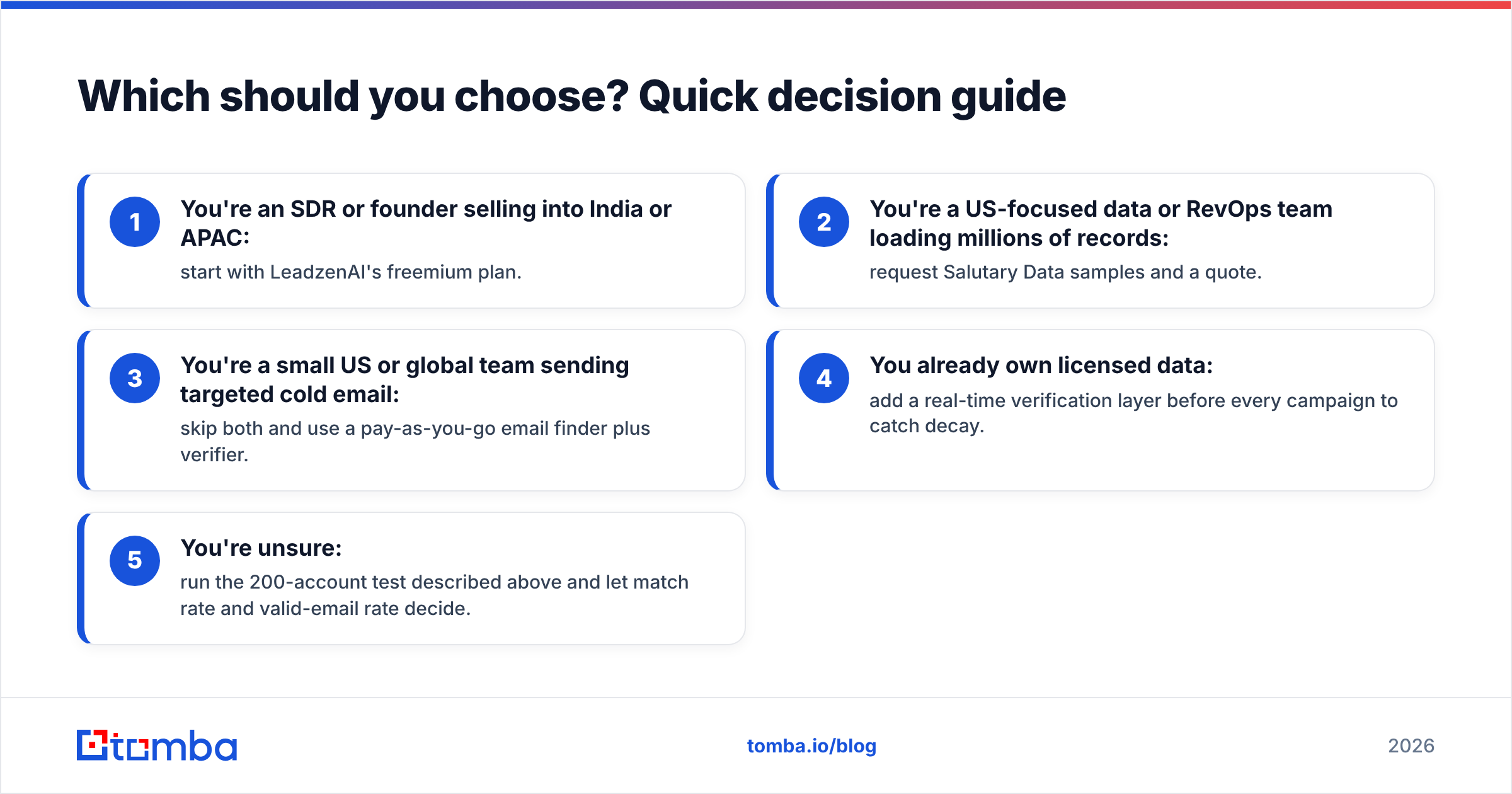
Which should you choose? Quick decision guide#
Use this LeadzenAI vs Salutary Data checklist:
- You're an SDR or founder selling into India or APAC: start with LeadzenAI's freemium plan.
- You're a US-focused data or RevOps team loading millions of records: request Salutary Data samples and a quote.
- You're a small US or global team sending targeted cold email: skip both and use a pay-as-you-go email finder plus verifier.
- You already own licensed data: add a real-time verification layer before every campaign to catch decay.
- You're unsure: run the 200-account test described above and let match rate and valid-email rate decide.
Ready to find emails you can actually trust?#
Whichever side of LeadzenAI vs Salutary Data you land on, the last step before you hit send should be a live lookup. Tomba Email Finder finds work emails by name, domain, or company in seconds. It verifies them on the spot and starts free with 25 searches a month. Use it on its own or as the accuracy layer on top of your existing data. Try it on your next target list and compare the bounce rate.
Related guides#
// get started
Find, verify and enrich your first contacts today
Start on the free plan with 25 searches a month, then scale when your team is ready.
Free plan · No credit card required · GDPR & CCPA
Get the Tomba newsletter
Product and data updates
// about the author