LeadzenAI vs Techsalerator: Prospecting Tool or Data Vendor?
LeadzenAI and Techsalerator both sell B2B contact data, but in different ways. One is a self-serve AI prospecting app and the other is a bulk data vendor. This guide explains which one fits your team, your budget and your workflow.
- LeadzenAI is a self-serve, AI-assisted prospecting app. You describe your ideal buyer, it returns matching people with emails and phone numbers, and you pay in credits.
- Techsalerator is a data-as-a-service vendor. It sells firmographic, technographic and contact datasets in bulk, through an API, files or data marketplaces, usually on a custom quote.
- Pick LeadzenAI if individual reps need contacts this week. Pick Techsalerator if a data, RevOps or product team needs large datasets to load into a warehouse or an app.
- Neither tool removes the need to verify. Run every export through an email verifier before it touches your sending domain.
- If what you really need is "find this person's work email, verified, at a predictable price," a dedicated email finder is often cheaper and simpler than either.
What is the real difference between LeadzenAI and Techsalerator?#
These two products are often compared, but they don't really compete for the same job.
LeadzenAI (leadzen.ai) is a prospecting tool built for salespeople. You log in, type a search in plain language or set filters (role, industry, location, company size), and get a list of leads with contact details. There is a Chrome extension for pulling contacts while you browse LinkedIn profiles, and you pay per contact revealed. The whole product assumes a person is building a list for outreach.
Techsalerator (techsalerator.com) is a data vendor. It collects and packages company and contact data across many countries and sells it as datasets: firmographics, technographics, contact records and related attributes. Those datasets reach you through an API, bulk file deliveries or third-party data marketplaces. The product assumes a system is consuming the data, whether that's a CRM, a warehouse, an internal scoring model or your own SaaS product.
Put simply, LeadzenAI sells finished lists to sales reps, and Techsalerator sells raw data to the people who build pipelines for sales reps. Most "which is better" questions go away once you know which of those two buyers you are.
How do LeadzenAI and Techsalerator compare side by side?#
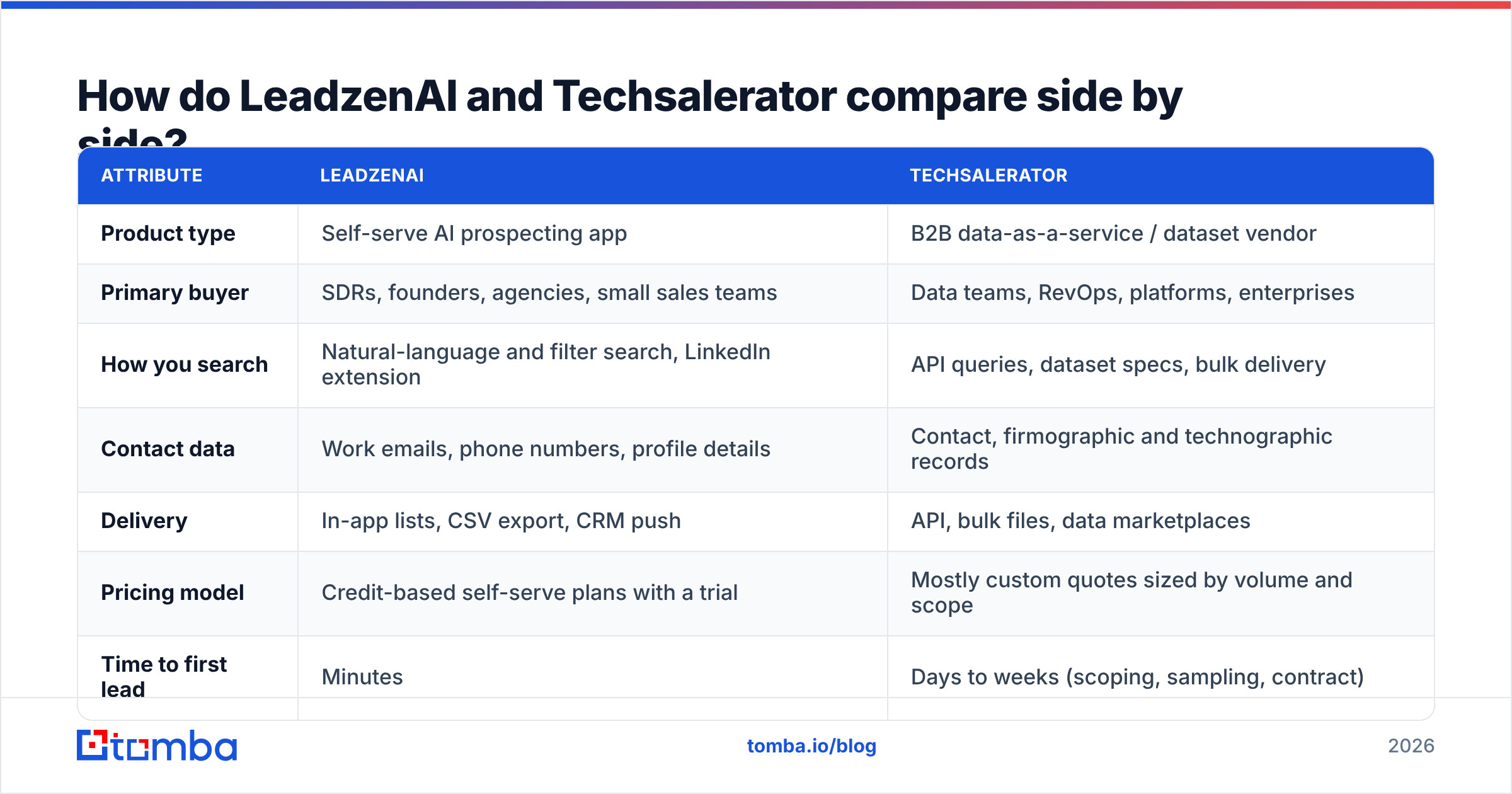
The table below compares the attributes that matter most for a buying decision. Pricing structures change often, so confirm current numbers on each vendor's site before you sign anything.
| Attribute | LeadzenAI | Techsalerator |
|---|---|---|
| Product type | Self-serve AI prospecting app | B2B data-as-a-service / dataset vendor |
| Primary buyer | SDRs, founders, agencies, small sales teams | Data teams, RevOps, platforms, enterprises |
| How you search | Natural-language and filter search, LinkedIn extension | API queries, dataset specs, bulk delivery |
| Contact data | Work emails, phone numbers, profile details | Contact, firmographic and technographic records |
| Delivery | In-app lists, CSV export, CRM push | API, bulk files, data marketplaces |
| Pricing model | Credit-based self-serve plans with a trial | Mostly custom quotes sized by volume and scope |
| Time to first lead | Minutes | Days to weeks (scoping, sampling, contract) |
| Best at | Fast, targeted list building | Large-scale coverage and enrichment feeds |
| Weak spot | Not built for millions of records | Overkill for a rep who needs 50 contacts |
If you're weighing both, check user reviews on G2 as well. Reviewer mix matters here: LeadzenAI reviews tend to come from individual users, while Techsalerator feedback usually comes from teams that bought data programmatically.
How does LeadzenAI work day to day?#
For an individual rep, LeadzenAI's workflow is short.
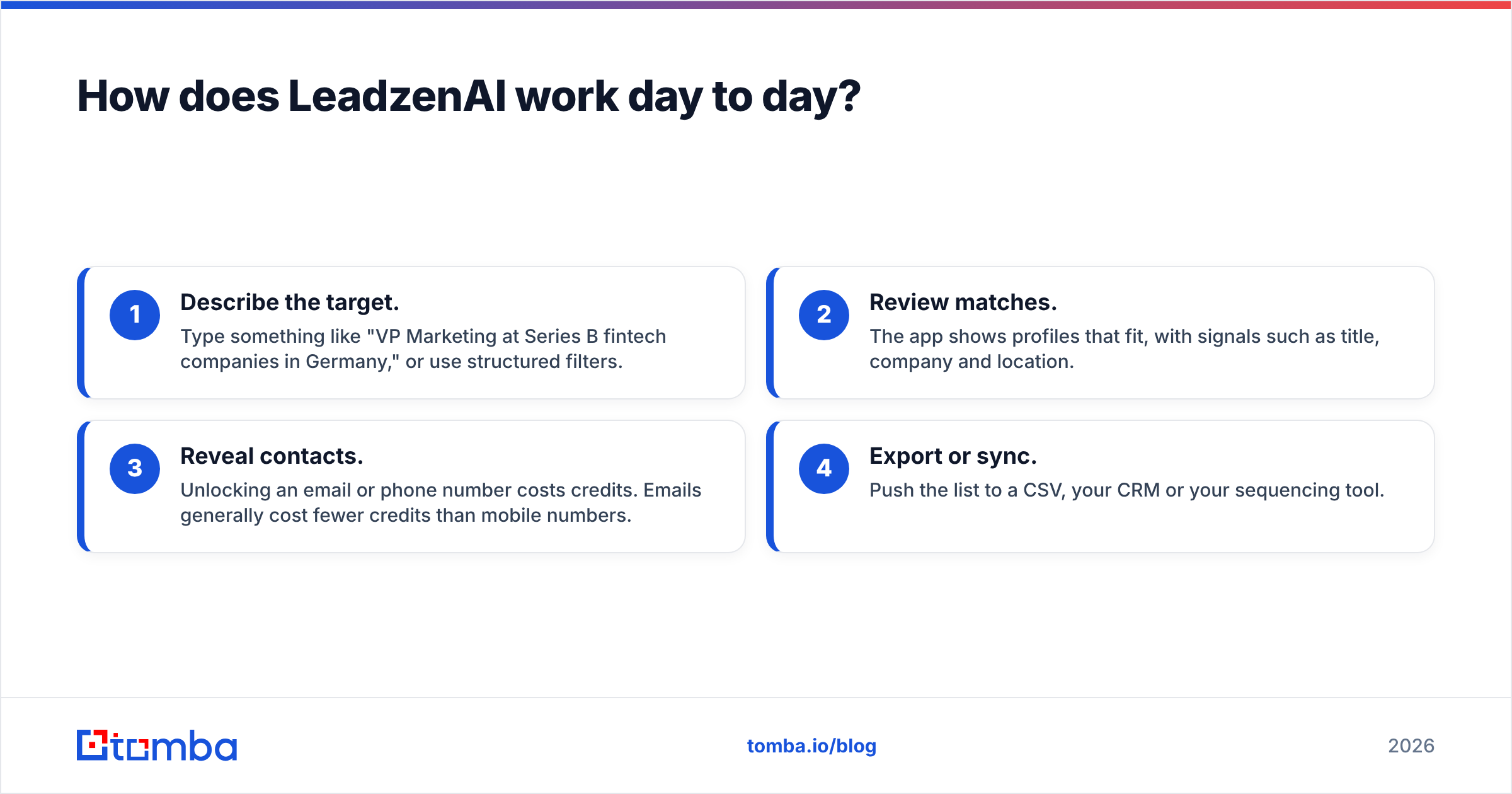
- Describe the target. Type something like "VP Marketing at Series B fintech companies in Germany," or use structured filters.
- Review matches. The app shows profiles that fit, with signals such as title, company and location.
- Reveal contacts. Unlocking an email or phone number costs credits. Emails generally cost fewer credits than mobile numbers.
- Export or sync. Push the list to a CSV, your CRM or your sequencing tool.
The AI search is the main selling point. Instead of stacking eight filters, you describe the persona the way you would to a colleague. That makes it easier for founders and new SDRs who haven't learned the filter logic of heavier tools.
The trade-off is scale and control. Credit-based apps are designed for lists in the hundreds or low thousands, not for refreshing a 2-million-row account table every month. You also get less visibility into where each record came from and when it was last checked, which matters if compliance or data freshness is on your checklist.

How does Techsalerator work for data teams?#
Techsalerator starts from the dataset, not the person. A typical engagement looks like this:
- Scope the data. You specify countries, industries, company sizes, fields (for example, technologies used or employee counts) and whether you need contact-level records.
- Sample and evaluate. Serious buyers request a sample and test it against their own CRM to measure match rate, fill rate and accuracy.
- Contract and deliver. Data arrives through an API, scheduled file drops or a marketplace listing. Pricing depends on volume, fields and refresh frequency.
- Integrate. Your team loads it into a warehouse, enrichment layer or product.
This model is strong when you need breadth across many countries or market segments and want to own the data inside your own systems. It suits companies building a TAM model, feeding a lead-scoring engine, or embedding company data in their own software.
It's a poor fit for a three-person sales team that wants to send 200 personalized emails next Tuesday. Nobody on that team will scope a dataset, and they shouldn't have to.
Which one has better data accuracy?#
There's no universal answer, and you should distrust any vendor that gives you a single accuracy percentage without explaining how it was measured.
Accuracy depends on three things that change from segment to segment:
- Geography. Coverage and freshness in the US and UK are usually better than in smaller or less digitized markets. A vendor can be excellent in one region and patchy in another.
- Seniority and function. Executives at mid-market companies are easier to find than individual contributors at enterprises with strict email conventions.
- Record age. People change jobs often enough that a contact record verified many months ago carries real risk. Data decays whether or not the vendor has touched it.
The only reliable approach is to test on your own ICP. Take 200 contacts you already know are correct, run them through each vendor, and measure three things: match rate (did it return anything?), correctness (is the email the right person's current address?), and deliverability (does it pass verification?).
Whichever tool you choose, verify before you send. Bounces damage your sender reputation, and one bad list can undo weeks of domain warmup. Running exports through an email verifier catches invalid, disposable and risky addresses before your sending infrastructure does.
How do pricing models compare?#
The two vendors differ most in how they charge.
LeadzenAI uses self-serve credit plans. You pick a monthly tier, get a set number of credits, and spend them on revealing contacts. This is predictable and easy to expense. One caveat: work out your effective cost per usable contact, not the cost per credit. If a phone reveal uses several credits and a share of emails later bounce, your real per-lead cost is higher than the plan page implies.
Techsalerator mostly uses custom pricing. Cost depends on how many records you want, which fields, how many countries, and how often the data refreshes. For large volumes the per-record cost can be very low. However, the contract minimum can exceed an entire small team's tooling budget, and procurement adds time.
A practical way to decide:
| Your situation | Likely better fit |
|---|---|
| Under 2,000 contacts per month, reps build their own lists | LeadzenAI |
| Need to enrich an existing CRM of 100K+ accounts | Techsalerator |
| Building a product that displays company data | Techsalerator |
| Agency running outbound for several small clients | LeadzenAI |
| Need verified work emails for known names and domains | A dedicated email finder |
The last row is where many teams overspend. If you already know who you want (from LinkedIn, event lists, or your CRM) and only need their email, you don't need AI persona search or a bulk dataset. You need a finder that takes a name and domain and returns a verified address. For reference, Tomba pricing starts with a free tier of 25 searches per month, then Starter at $49/mo, Growth at $99/mo and Pro at $249/mo. That's a useful benchmark when you compare per-contact costs.
What are the pros and cons of each?#
LeadzenAI pros
- Fast setup. You can sign up and have a list the same day.
- Natural-language search. Lowers the learning curve for non-specialists.
- Emails and phones in one place. Useful for multichannel sequences.
- Budget-friendly entry. Credit plans suit small teams and solo founders.
LeadzenAI cons
- Not built for bulk. It isn't designed to enrich or refresh very large databases.
- Little provenance detail. You get limited insight into data sources and refresh dates.
- Credits disappear quickly if you reveal phone numbers heavily.
Techsalerator pros
- Broad international coverage. Useful for global TAM and market analysis.
- Rich company attributes. Firmographic and technographic fields go beyond contact data.
- Flexible delivery. API, files and marketplaces all fit into data-engineering workflows.
- Economies of scale. Per-record cost at high volume can be low.
Techsalerator cons
- Slow to start. Scoping, sampling and contracting take time.
- Needs technical ownership. Someone has to ingest, dedupe and maintain the data.
- Too much for small teams. It doesn't help a rep who needs 50 contacts today.

Who should choose LeadzenAI?#
Choose LeadzenAI if most of these apply:
- Your outbound is run by individual reps or founders, not a data team.
- You build lists by persona ("CMOs at DTC brands") rather than enriching an existing database.
- You want emails and phone numbers in one self-serve tool.
- You need results this week and can't wait for procurement.
Test it with a trial on a slice of your ICP, then measure bounce rate after verification before you commit to an annual plan.
Who should choose Techsalerator?#
Choose Techsalerator if most of these apply:
- You have a data engineer, RevOps lead or analytics team who will own ingestion.
- You need firmographic or technographic coverage across many countries.
- You're enriching or refreshing a large CRM, warehouse or product database.
- You're comfortable with a custom contract in exchange for volume pricing.
Before you sign, ask for a sample that matches your ICP and run it against records you know are correct. Also ask directly about refresh frequency, field-level fill rates and how the vendor handles GDPR and other privacy obligations for contact-level data.
Is there a simpler option than either?#
Often, yes. Many teams comparing LeadzenAI and Techsalerator are solving a narrower problem: they know the companies and often the people, and they need accurate, verified work emails at a sensible price.
For that job, a specialized email finder is usually a better fit:
- Domain search. Enter a company domain and see the email addresses and patterns found for it. This is useful for account-based outreach where you already have a target account list. Domain search handles this in one step.
- Name + domain lookup. Returns the most likely address with a confidence signal and verification status.
- Bulk processing. Upload a CSV of names and domains and get verified emails back without scoping a data contract.
- API access. If you do have engineering resources, an API lets you enrich leads inside your own workflows without buying an entire dataset.
This isn't a replacement for Techsalerator's broad company data or LeadzenAI's persona discovery. It covers the step that most directly affects deliverability and reply rates: getting the right address for the right person.
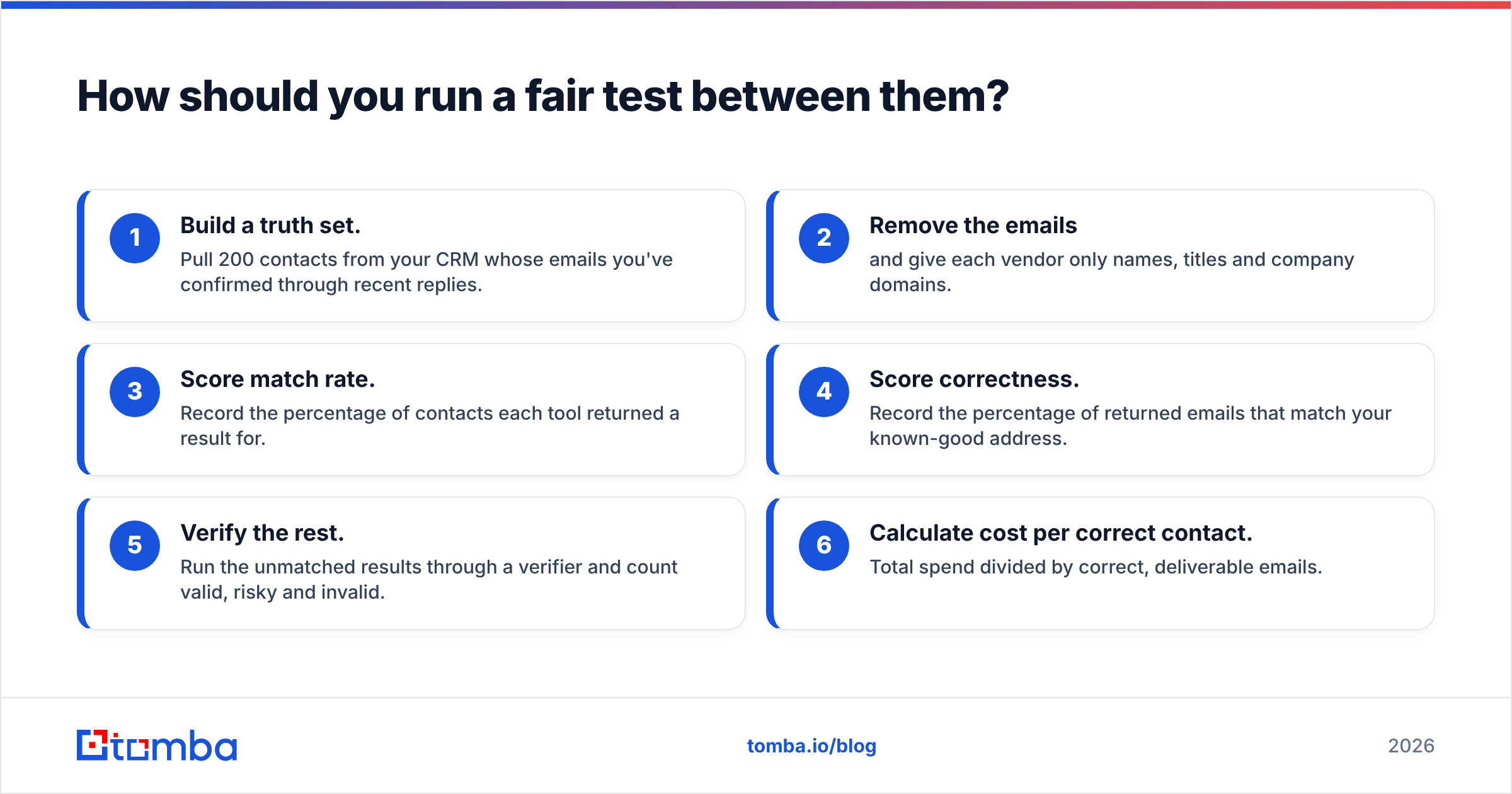
How should you run a fair test between them?#
If you still want a head-to-head evaluation, use the same test for both so the results are comparable.
- Build a truth set. Pull 200 contacts from your CRM whose emails you've confirmed through recent replies.
- Remove the emails and give each vendor only names, titles and company domains.
- Score match rate. Record the percentage of contacts each tool returned a result for.
- Score correctness. Record the percentage of returned emails that match your known-good address.
- Verify the rest. Run the unmatched results through a verifier and count valid, risky and invalid.
- Calculate cost per correct contact. Total spend divided by correct, deliverable emails.
Cost per correct contact is the number that settles most debates. A cheap vendor with a 60% correctness rate can end up costing more than a pricier one at 90%, especially once you add the reputation cost of bounces.
Final verdict: LeadzenAI or Techsalerator?#
LeadzenAI is for people who prospect. Techsalerator is for teams who build data infrastructure. If you're an SDR, founder or agency that needs targeted contacts quickly, LeadzenAI is the more practical choice. If you're a data or RevOps team feeding warehouses, models or products at scale, Techsalerator fits the job better.
Neither choice removes the basics. Test on your own ICP, verify before you send, and measure cost per correct contact rather than cost per record.
If your real bottleneck is finding the right work email for specific people and companies, you may not need either platform. Tomba Email Finder finds professional email addresses by name, domain or company, checks deliverability, and starts with a free tier of 25 searches per month before paid plans from $49/mo. Run your 200-contact truth set through it next to the tools above and compare the cost per correct contact.
Related guides#
// get started
Find, verify and enrich your first contacts today
Start on the free plan with 25 searches a month, then scale when your team is ready.
Free plan · No credit card required · GDPR & CCPA
// about the author