Leadzen.ai vs Thomson Data (2026): Which B2B Data Source Wins?
Leadzen.ai lets you search and export contacts yourself. Thomson Data builds lists for you. This comparison shows which model fits your outbound motion, your budget and your data-freshness needs in 2026.
TL;DR
- Leadzen.ai is a self-serve, AI-assisted prospecting platform. You search, filter and export contacts yourself, and you pay through credit-based plans.
- Thomson Data is a managed B2B data vendor. It builds prebuilt and custom lists (healthcare, technology users, C-suite and so on), runs data appends, and quotes each project.
- Pick Leadzen.ai if your SDRs prospect every day and need contacts on demand. Pick Thomson Data if you run a big campaign on a fixed schedule and want someone else to build the list.
- Neither one replaces a verification step. Whatever you buy decays at roughly 2–3% a month, so check it before you send.
- If what you actually need is to find and verify emails for named accounts, a dedicated email finder is often cheaper than either option.
People who search "leadzenai vs thomson data" usually think they're comparing two versions of the same product. They aren't. The two companies sell B2B contact data in very different ways, and that difference matters more than any feature checklist. This guide covers how each one works, what it costs, where each is strong, and which buyer should pick which.
What is Leadzen.ai?#
Leadzen.ai is a B2B lead-generation platform built around search. You describe your ideal customer with filters or a natural-language prompt. The platform returns matching people and companies, then reveals their contact details (work email, and phone numbers where available) in exchange for credits.
The main pieces you'll use:
- AI-assisted search. You filter by role, seniority, industry, location and company size, or type a plain-language description of your target buyer.
- Profile enrichment. Contacts are enriched from public professional profiles and company data.
- Browser extension. You can pull contact details while you browse professional profiles.
- Exports and integrations. CSV export plus CRM connections, so records move into your sales stack.
The company started in the Indian market, and users often say its coverage there and across wider APAC is a strength. Coverage in North America and Europe exists, but you should test it against your own target list before you commit to an annual plan.
Pricing is credit-based with tiered plans. Plans and credit allowances have changed more than once, so check the vendor's pricing page directly and don't rely on figures quoted in older reviews.
What is Thomson Data?#
Thomson Data is a traditional B2B data provider. It doesn't give you a search box. It sells data products and services:
- Prebuilt industry lists, such as healthcare professionals, technology install-base users, C-level executives and manufacturing contacts.
- Custom lists built to your specification: titles, geographies, SIC/NAICS codes, company revenue, technologies used.
- Data appending, which fills in missing emails, phone numbers or firmographics on records you already own.
- Data cleansing, which deduplicates and updates an ageing CRM database.
You work with an account team. You describe the segment, they give you counts and a quote, and you receive a file. Pricing is almost always quote-based and depends on record count, segment and data fields, so you won't find a public per-seat price.
This model suits marketing teams running large, planned campaigns, such as an event invite to 40,000 hospital administrators or a direct-mail-plus-email push to IT decision makers. It suits a rep who needs five more contacts before lunch much less well.
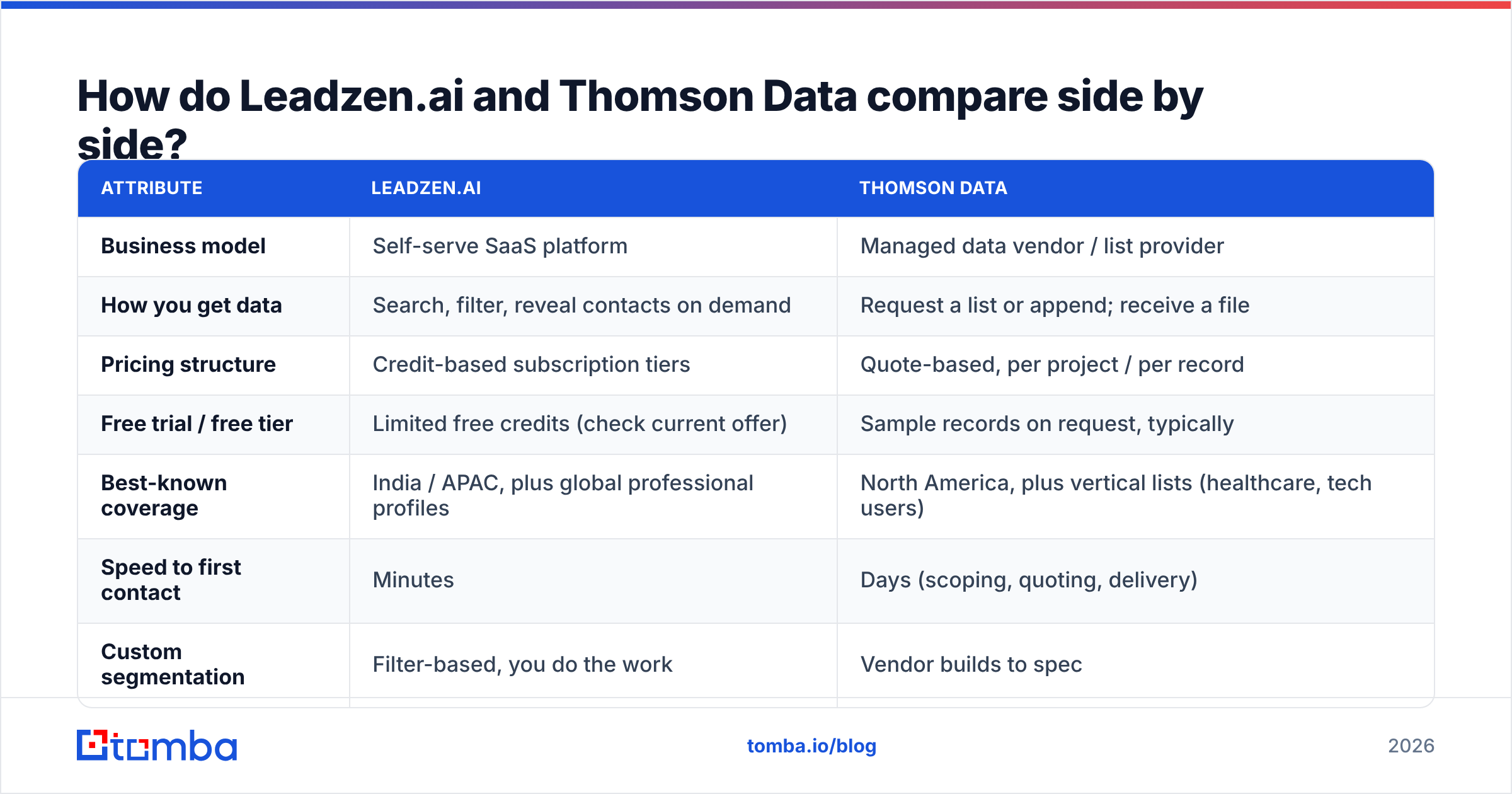
How do Leadzen.ai and Thomson Data compare side by side?#
This table compares how you actually buy and use each product, not just their headline features.
| Attribute | Leadzen.ai | Thomson Data |
|---|---|---|
| Business model | Self-serve SaaS platform | Managed data vendor / list provider |
| How you get data | Search, filter, reveal contacts on demand | Request a list or append; receive a file |
| Pricing structure | Credit-based subscription tiers | Quote-based, per project / per record |
| Free trial / free tier | Limited free credits (check current offer) | Sample records on request, typically |
| Best-known coverage | India / APAC, plus global professional profiles | North America, plus vertical lists (healthcare, tech users) |
| Speed to first contact | Minutes | Days (scoping, quoting, delivery) |
| Custom segmentation | Filter-based, you do the work | Vendor builds to spec |
| Data append / CRM cleanse | Enrichment of records you search | Core service offering |
| Browser extension | Yes | No (not a tool-based product) |
| Ideal user | SDRs, founders, small sales teams | Demand-gen and marketing ops teams |
| Main risk | Coverage gaps outside core regions | List ages between delivery and use |
The gap is structural. Leadzen.ai charges you for access to data, and Thomson Data charges you for delivery of data. One behaves like a library card, the other like a book order.
Which factors should decide between them?#
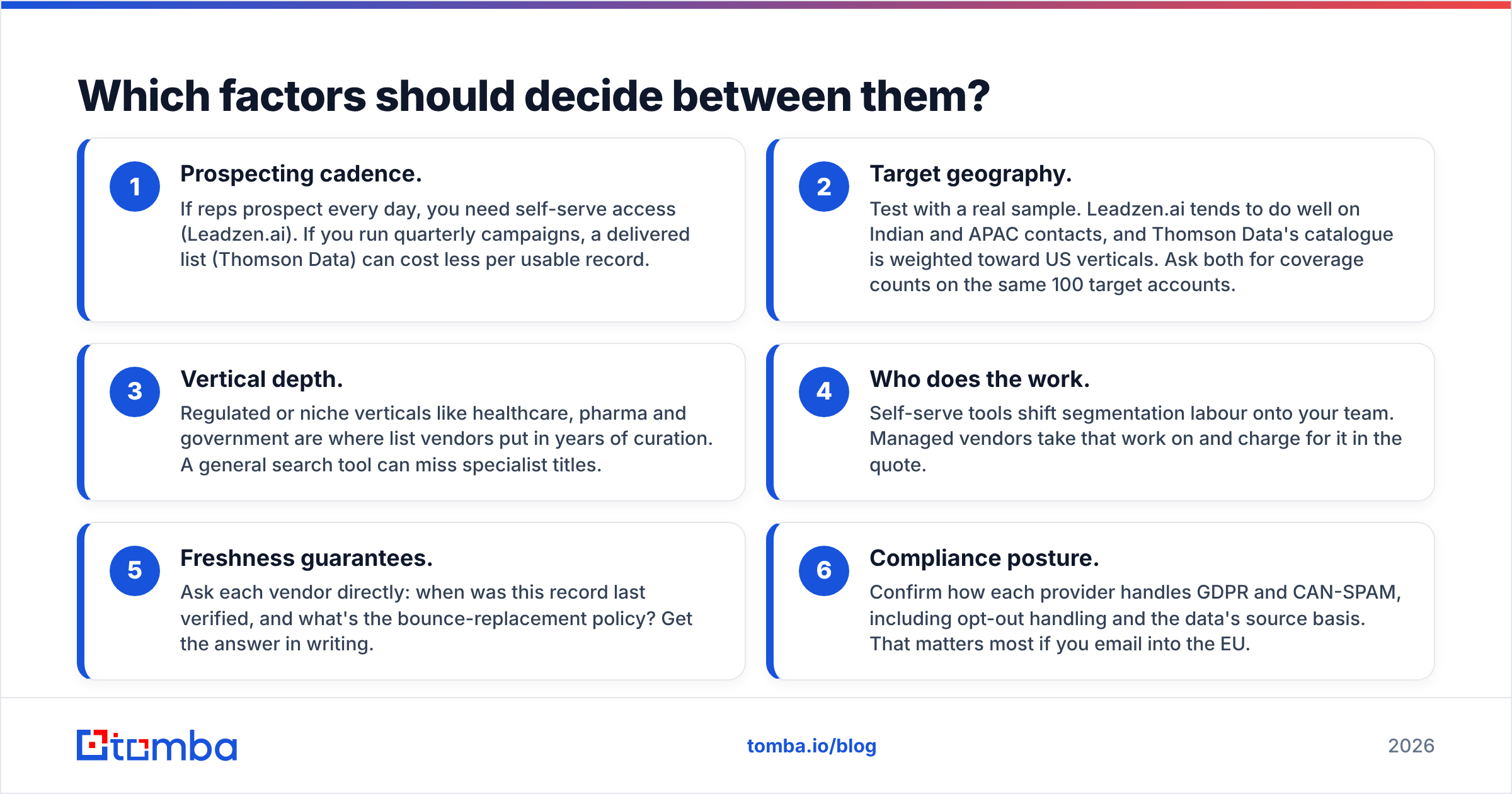
Before you look at demos, score your team on these five criteria. They tell you more than any feature grid.
- Prospecting cadence. If reps prospect every day, you need self-serve access (Leadzen.ai). If you run quarterly campaigns, a delivered list (Thomson Data) can cost less per usable record.
- Target geography. Test with a real sample. Leadzen.ai tends to do well on Indian and APAC contacts, and Thomson Data's catalogue is weighted toward US verticals. Ask both for coverage counts on the same 100 target accounts.
- Vertical depth. Regulated or niche verticals like healthcare, pharma and government are where list vendors put in years of curation. A general search tool can miss specialist titles.
- Who does the work. Self-serve tools shift segmentation labour onto your team. Managed vendors take that work on and charge for it in the quote.
- Freshness guarantees. Ask each vendor directly: when was this record last verified, and what's the bounce-replacement policy? Get the answer in writing.
- Compliance posture. Confirm how each provider handles GDPR and CAN-SPAM, including opt-out handling and the data's source basis. That matters most if you email into the EU.
Is Leadzen.ai better than Thomson Data for SDR teams?#
For most SDR and founder-led sales teams, yes. The workflow suits them better.
An SDR's day is reactive. A target account visits the pricing page, a new VP gets hired, a competitor's customer posts a complaint. The rep needs that contact now, not after a scoping call. Leadzen.ai gets you from signal to contact in minutes, and the browser extension keeps prospecting inside the rep's normal browsing.
A few caveats:
- Credit burn is real. Reps who reveal contacts carelessly will run through a monthly allowance in a week. Set team-level limits.
- Coverage varies by region. Don't assume your US mid-market list will perform like the vendor's showcase examples. Run a pilot on 200 of your actual target accounts.
- Verify before sending. Revealed emails still go stale. Pass exports through an email verifier before they enter a sequence, especially for catch-all domains.
Is Thomson Data better than Leadzen.ai for marketing campaigns?#
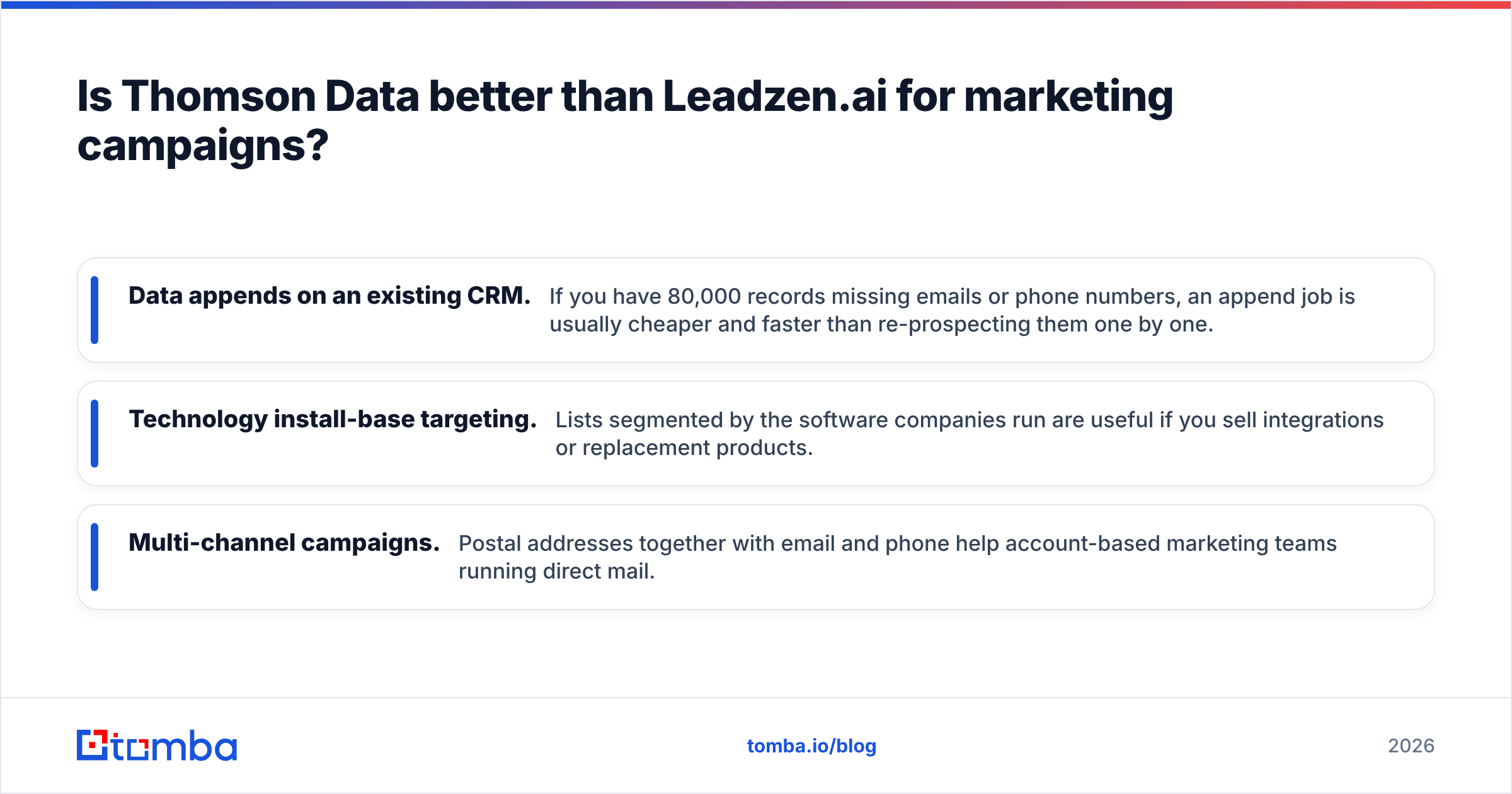
For large, planned, segment-based campaigns, often yes.
If you run a webinar for 25,000 US healthcare IT buyers, you don't want marketers clicking "reveal" 25,000 times. You want a vendor to hand you a segmented, deduplicated file with the fields you specified, ready to load into your marketing automation platform. That's Thomson Data's core business.
Other areas where Thomson Data fits better:
- Data appends on an existing CRM. If you have 80,000 records missing emails or phone numbers, an append job is usually cheaper and faster than re-prospecting them one by one.
- Technology install-base targeting. Lists segmented by the software companies run are useful if you sell integrations or replacement products.
- Multi-channel campaigns. Postal addresses together with email and phone help account-based marketing teams running direct mail.
The trade-off is time and flexibility. Once a file is delivered, it starts ageing. If the campaign slips two months, part of the list will already bounce. Industry studies of B2B data decay, including research regularly cited by HubSpot, suggest contact databases lose a meaningful share of accuracy every year as people change jobs. Plan to re-verify before every send, not just the first one.
What does each option really cost?#
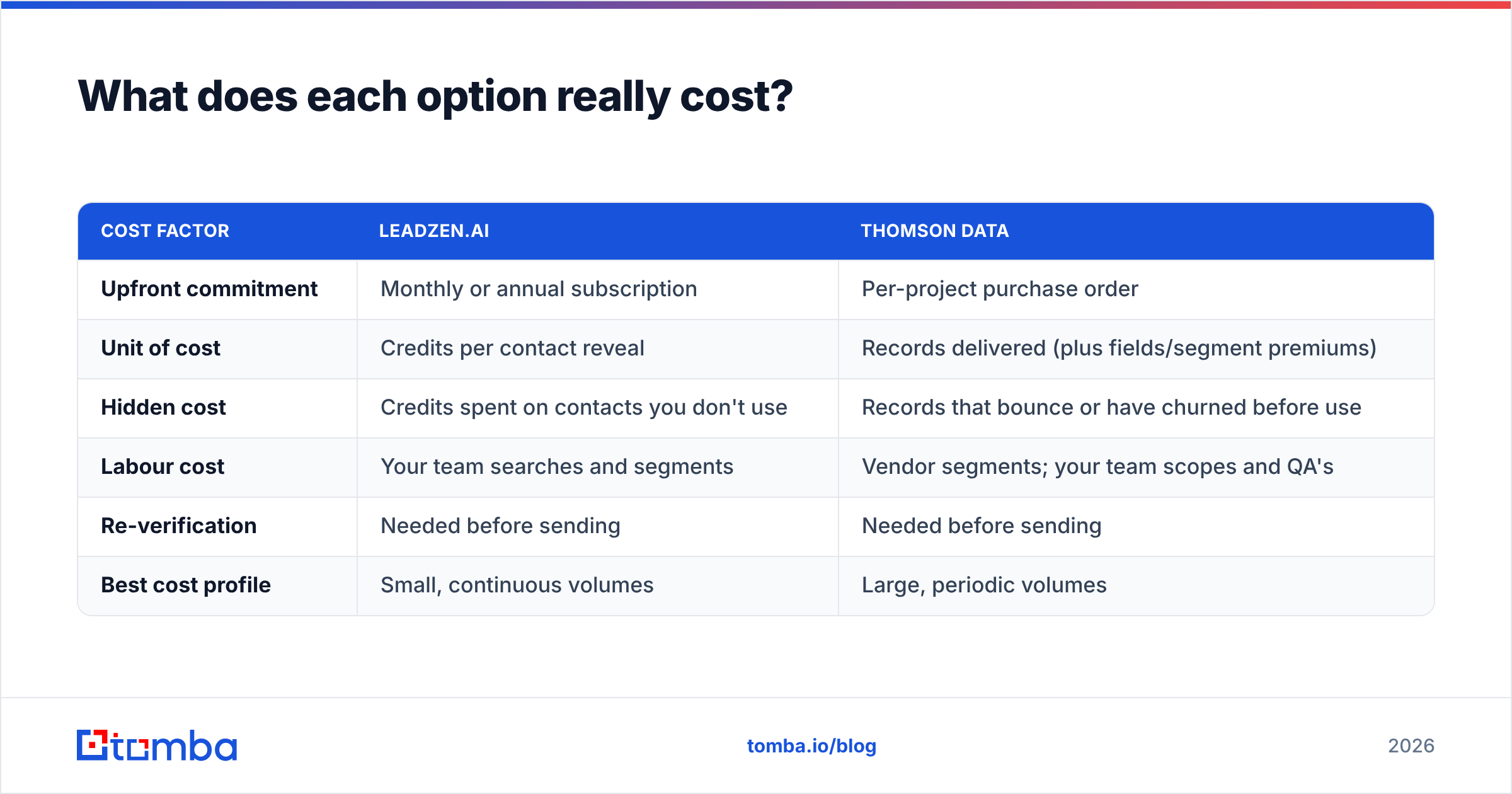
Neither vendor publishes a simple "cost per valid email", so work out your own.
| Cost factor | Leadzen.ai | Thomson Data |
|---|---|---|
| Upfront commitment | Monthly or annual subscription | Per-project purchase order |
| Unit of cost | Credits per contact reveal | Records delivered (plus fields/segment premiums) |
| Hidden cost | Credits spent on contacts you don't use | Records that bounce or have churned before use |
| Labour cost | Your team searches and segments | Vendor segments; your team scopes and QA's |
| Re-verification | Needed before sending | Needed before sending |
| Best cost profile | Small, continuous volumes | Large, periodic volumes |
A simple formula works for both:
True cost per usable contact = total spend ÷ (records delivered × verified-valid rate × ICP-match rate)
A cheap list with a 60% valid rate and a 50% ICP match costs more per usable contact than a pricier source at 90% and 85%. Run the numbers on a pilot before you sign anything annual.
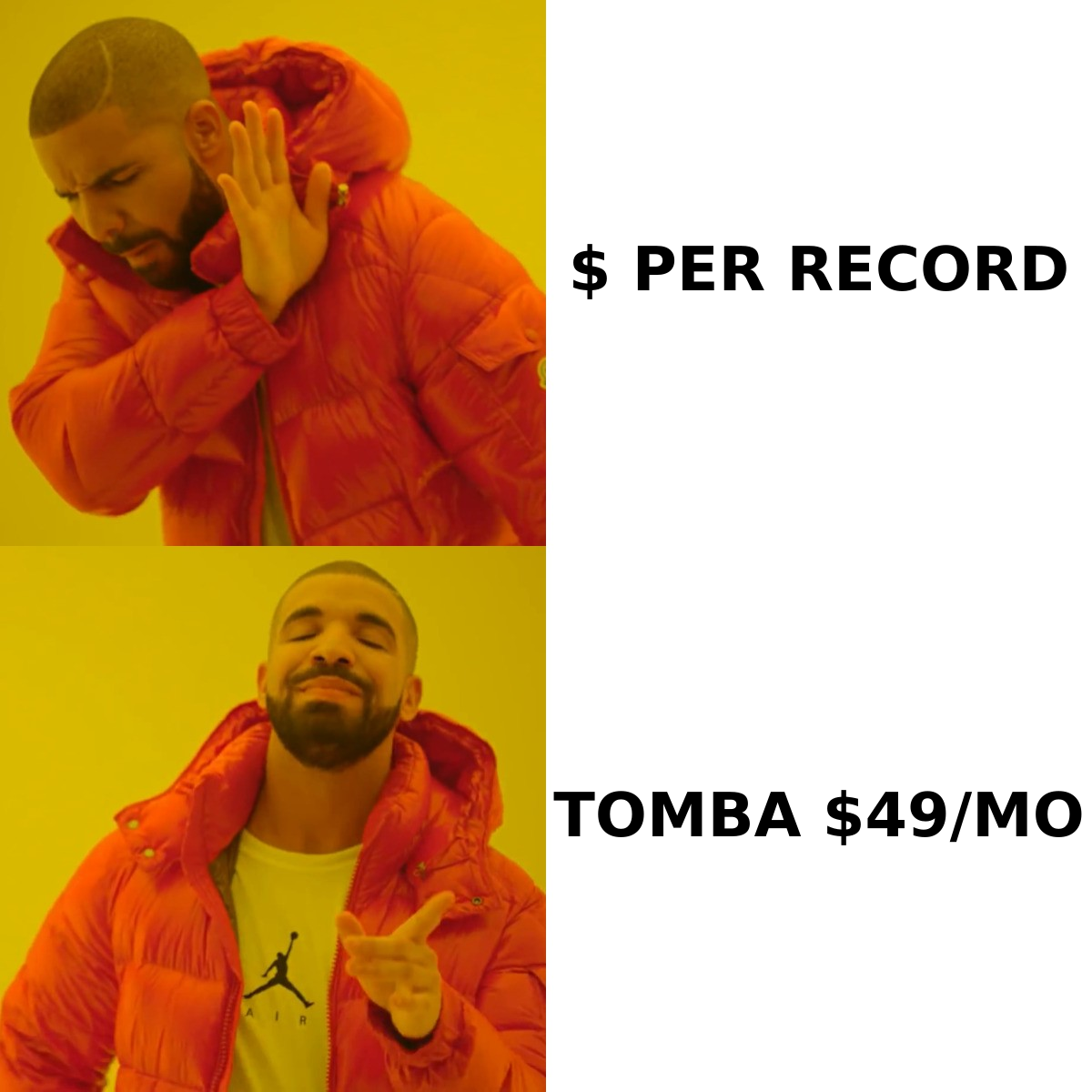
For a reference point from a pure email-finding tool, Tomba pricing starts with a free tier of 25 searches a month, then Starter at $49/mo, Growth at $99/mo and Pro at $249/mo. Enterprise pricing is custom. That isn't a like-for-like match with either vendor, but it helps if all you need is verified emails for companies you've already chosen.

What are the pros and cons of each?#
Leadzen.ai: pros
- Self-serve, so you go from idea to contact in minutes
- AI-assisted search lowers the filter-building learning curve
- Browser extension fits into daily prospecting
- Reported to be strong on India and APAC coverage
Leadzen.ai: cons
- Credit-based costs can climb with heavy use
- Coverage in some Western mid-market segments needs piloting
- Segmentation quality depends on how well your team builds filters
Thomson Data: pros
- Managed service, so the vendor builds the segment
- Deep vertical lists, especially healthcare and technology users
- Append and cleansing services for existing CRM data
- Large single-file deliveries suit marketing automation imports
Thomson Data: cons
- Quote-based pricing makes budgeting and comparison slower
- Delivery takes days, not minutes
- Static files start decaying immediately
- Not built for individual reps' on-demand prospecting
Independent reviews on G2 are worth reading for both, but filter by company size and region. A 10-person Bangalore agency and a 2,000-person US enterprise will describe very different experiences with the same vendor.
Are there alternatives worth considering?#
Yes, depending on which part of the problem you're solving.
- If you need contacts at specific named accounts: a domain-based email finder is usually the most efficient option. You enter a company domain, get the people and patterns, and verify on the spot. Tomba's domain search is built for this.
- If you need to fill gaps in an existing CRM: a self-serve data enrichment tool that you run by API or bulk upload can replace a one-off append project and keep records fresh continuously.
- If you need large vertical lists: Thomson Data competes with other established list providers, including respected peers such as BookYourData. Collect quotes and sample files from two or three and compare them on your own validation run.
- If you need an all-in-one sales engagement suite: platforms that bundle a database with sequencing may simplify your stack, but lock-in and data quality vary a lot.
Which one should you choose?#
Here's the short version:
- Choose Leadzen.ai if you're an SDR team, agency or founder who prospects every day, targets India/APAC heavily, and wants to control your own searches.
- Choose Thomson Data if you're a marketing or demand-gen team running large, scheduled campaigns, especially in healthcare or technology verticals, and you'd rather pay a vendor to build and append lists.
- Use neither alone. Whichever you pick, put a verification step between the data source and your sending tool. Your domain's sender reputation depends more on that step than on where the data came from.
Many mature teams end up with a mix: a list vendor for big campaign segments, and a self-serve finder and verifier for the daily, account-by-account work reps do.
Frequently asked questions#
Is Leadzen.ai a list provider like Thomson Data? No. Leadzen.ai is a self-serve platform where you search and reveal contacts. Thomson Data is a vendor that builds and delivers lists and runs data appends.
Which is cheaper, Leadzen.ai or Thomson Data? It depends on volume. Leadzen.ai usually costs less for small, continuous prospecting. Thomson Data can cost less per record for large one-off segments. Compare cost per usable contact, not per record.
Do I still need to verify emails from these providers? Yes. B2B contact data decays constantly. Verify every list shortly before sending, and re-verify if a campaign is delayed.
Can I use both? Yes. A common setup is a list vendor for campaign-scale segments plus a self-serve finder for daily prospecting.
Ready to find verified emails without buying a whole list?#
If what you actually need is the right email address at the right company, verified before it goes near your sequence, try the Tomba Email Finder. Search by name and company, or pull every public contact on a domain, and verify each result in the same workflow. You can start free with 25 searches a month, then move to Starter at $49/mo when your pipeline needs more.
Related guides#
// get started
Find, verify and enrich your first contacts today
Start on the free plan with 25 searches a month, then scale when your team is ready.
Free plan · No credit card required · GDPR & CCPA
// about the author