LeadzenAI vs Xverum: Prospecting App or Bulk B2B Data Feed?
LeadzenAI and Xverum both sell B2B contact data, but they solve different problems. One is a prospecting app for sales reps. The other licenses bulk datasets to data teams. Here's how to tell which one your team needs before you sign anything.
TL;DR
- LeadzenAI is a prospecting app for sales reps. You search for leads in plain language, pull contact details through a web app and a browser extension, and pay with credits.
- Xverum is a data provider. It licenses large company and professional-profile datasets to data, product, and analytics teams, usually as bulk files or feeds with custom pricing.
- They only look alike. The real question is whether you need contacts for reps this week or raw records for a data warehouse.
- Neither one replaces email verification. Records go stale fast, so check emails before any send.
- If you need verified professional emails on demand, without a data-licensing contract, a lighter email finder like Tomba is often the simpler route.
What is the real difference between LeadzenAI and Xverum?#
Comparisons of "LeadzenAI vs Xverum" usually put the two in the same bucket: "B2B data." That's why buyers pick the wrong one. They sell to different people.
Think of the difference between a grocery store and a wholesale food distributor. Both sell food. You walk into the grocery store, grab what you need for dinner, and pay at the till. The distributor delivers pallets to restaurants that already have a kitchen, staff, and storage. If you're cooking one meal, the distributor is overkill. If you run a restaurant chain, the grocery store is far too slow.
- LeadzenAI is the grocery store. A sales rep logs in, finds 50 decision-makers at mid-market SaaS companies, reveals their contact details, and exports them to a CRM or outreach tool.
- Xverum is the distributor. A data or product team licenses millions of records, loads them into a warehouse, and builds something on top: a lead-scoring model, an enrichment pipeline, a market map, or a data product of their own.
Both can be the right answer. You just need to know which kitchen you're running.
What is LeadzenAI?#
LeadzenAI is an AI-assisted B2B lead generation platform. Its main pitch is that you describe your ideal customer in plain language instead of building filters, and the platform returns matching companies and people with contact data attached.
Based on its public positioning, the core pieces are:
- AI-driven lead search. You type something like "HR heads at fintech companies with 200–1,000 employees" and get back a list of companies and contacts.
- Contact reveal. Professional emails and, where available, phone numbers, unlocked with credits.
- Browser extension. Pulls contact data while you browse LinkedIn profiles and company websites.
- Exports and integrations. CSV export plus CRM connections for moving leads into your pipeline.
- Regional focus. LeadzenAI's marketing leans heavily on India and the wider APAC region, where many Western-built databases have thinner coverage.
It's built for individual reps, SDR teams, founders doing their own outbound, and agencies running campaigns for clients. You don't need a data engineer to get value out of it.
What is Xverum?#
Xverum is a B2B data-as-a-service provider. It doesn't sell a prospecting interface for reps. It sells the data itself: company firmographics, professional and employee profiles, and related datasets, delivered in bulk or through data feeds.
Here's what Xverum's model usually looks like:
- Large-scale datasets. Company records and professional profiles meant for analytics, modeling, and enrichment at scale. You don't reveal records one at a time.
- Bulk delivery. Data usually arrives as files (CSV, JSON, or similar) through cloud storage, a data feed, or an API, on a one-off or refresh schedule.
- Marketplace availability. Xverum lists its datasets on third-party data marketplaces, where data buyers compare providers side by side.
- Custom commercial terms. Pricing is usually quote-based and depends on record count, fields, geography, and how often you want refreshes.
- Compliance positioning. Like most European-facing data vendors, Xverum puts GDPR compliance front and center in its sales material.
The typical buyer is a data team, a sales-intelligence startup building its own product, a VC or market-research firm mapping an industry, or a RevOps team with the engineering support to host and maintain a large dataset.

How do LeadzenAI and Xverum compare feature by feature?#
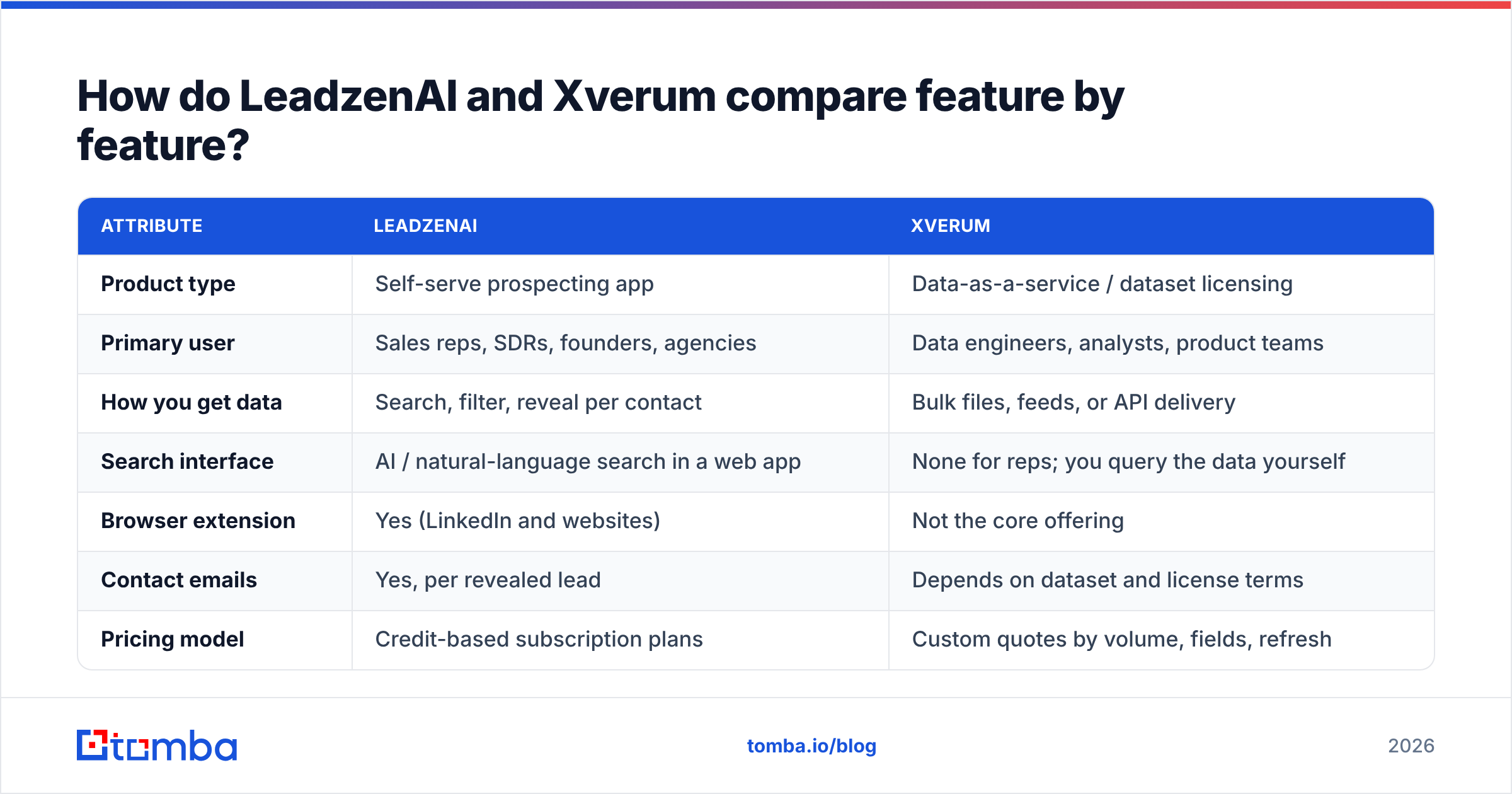
The table below compares how each product is built to be used. Vendors update feature lists often, so confirm specifics with each vendor before you buy.
| Attribute | LeadzenAI | Xverum |
|---|---|---|
| Product type | Self-serve prospecting app | Data-as-a-service / dataset licensing |
| Primary user | Sales reps, SDRs, founders, agencies | Data engineers, analysts, product teams |
| How you get data | Search, filter, reveal per contact | Bulk files, feeds, or API delivery |
| Search interface | AI / natural-language search in a web app | None for reps; you query the data yourself |
| Browser extension | Yes (LinkedIn and websites) | Not the core offering |
| Contact emails | Yes, per revealed lead | Depends on dataset and license terms |
| Pricing model | Credit-based subscription plans | Custom quotes by volume, fields, refresh |
| Time to first lead | Minutes | Days to weeks (contract, delivery, ingestion) |
| Technical skill needed | Low | Medium to high |
| Best at | Getting reps a targeted list fast | Powering models, products, and market analysis |
The pattern is clear. LeadzenAI gives up scale in exchange for speed and ease of use. Xverum gives up ease of use in exchange for scale and control over the raw data.
How does pricing work for LeadzenAI and Xverum?#
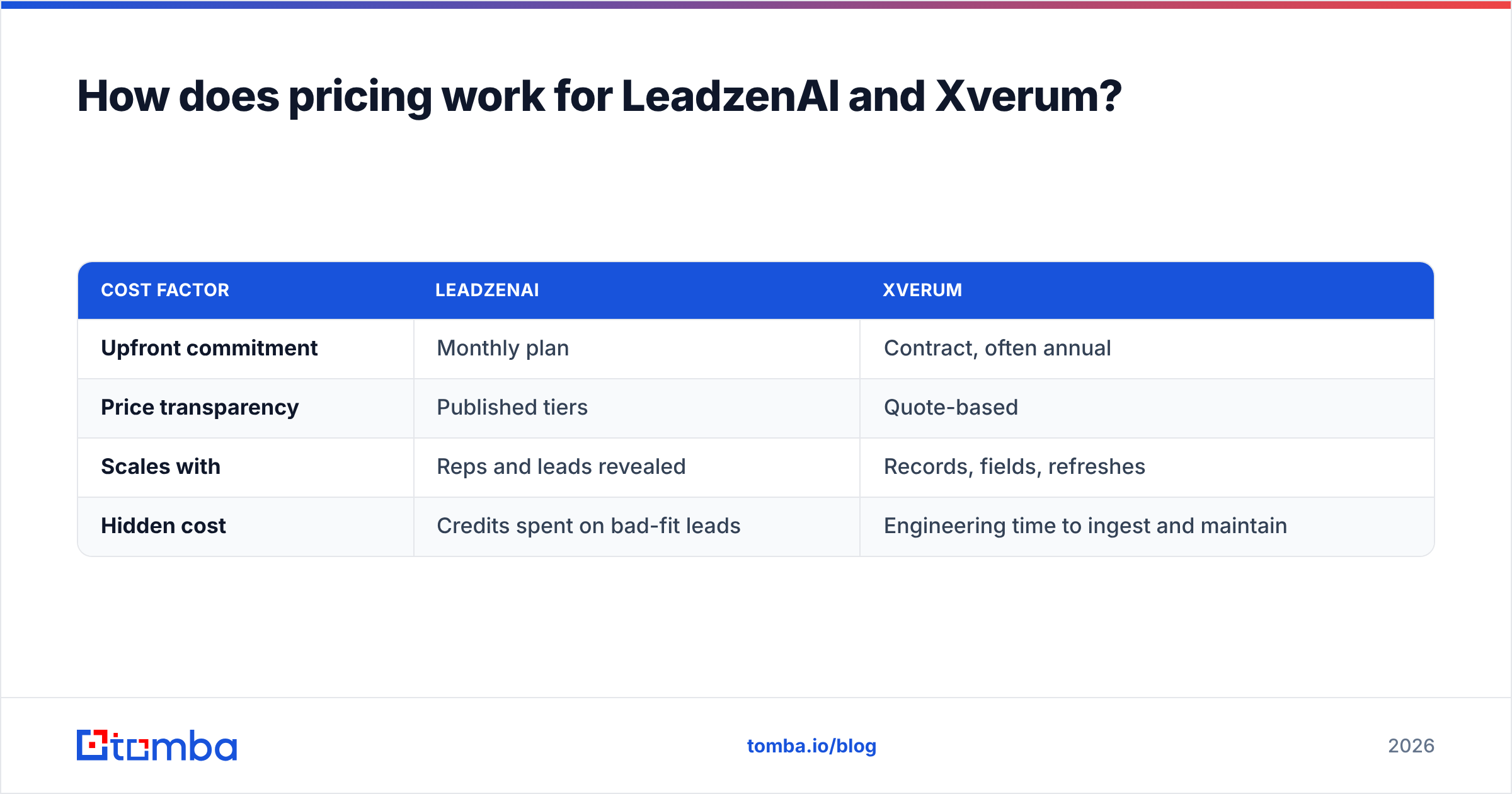
You can't compare the two on price per record. The units are different, and so is the hidden cost of each.
LeadzenAI runs on credits. You pick a plan, get a monthly credit allowance, and spend credits to reveal contact details. What you pay is visible upfront, and your cost scales with how many leads your reps actually use. Check LeadzenAI's site for current plan limits. Credit-based tools change their tiers often, and any number printed here would be out of date within a quarter.
Xverum quotes per deal. The price depends on:
- Record volume. How many companies or profiles you license.
- Field depth. Basic firmographics cost less than rich profile data with work history and contact fields.
- Geography. Global coverage costs more than a single region.
- Refresh cadence. A one-time snapshot costs less than monthly or quarterly refreshes.
- Usage rights. Internal use only is usually cheaper than rights to resell or build a commercial product on the data.
The hidden cost matters most with Xverum. A dataset is only useful once you can store it, deduplicate it, match it to your CRM, and keep it fresh. If you don't have a data engineer, a large license turns into a large CSV nobody opens. With LeadzenAI the hidden cost is smaller but still real: wasted credits on leads that bounce or don't fit your ICP.
| Cost factor | LeadzenAI | Xverum |
|---|---|---|
| Upfront commitment | Monthly plan | Contract, often annual |
| Price transparency | Published tiers | Quote-based |
| Scales with | Reps and leads revealed | Records, fields, refreshes |
| Hidden cost | Credits spent on bad-fit leads | Engineering time to ingest and maintain |
Which one has better data quality and freshness?#
Neither vendor can promise that every record is accurate. Nobody can. B2B contact data decays every time someone changes jobs, gets promoted, or their company rebrands its email domain. Industry estimates usually put yearly B2B data decay in the 20–30% range. Whatever you buy, part of it is going stale while you read this.
What matters more is when the data gets checked:
- LeadzenAI shows data at the moment you reveal it. That's closer to on-demand, but emails still come from a stored database, so you should verify them before sending.
- Xverum delivers a snapshot. Records are as fresh as the last refresh in your contract. A quarterly refresh means some records are already months old by the time a rep touches them.
Your campaign results depend less on which vendor has "better data" and more on whether you run email verification before every send. Mailbox providers treat high bounce rates as a warning sign. A few campaigns at 8–10% bounces can hurt your sender reputation more than any data vendor can make up for.
A practical rule: whichever source you use, treat its emails as unverified until a verifier says they're deliverable. For bulk datasets like Xverum's, run a verification pass before a record ever reaches an outreach sequence.
How do LeadzenAI and Xverum handle compliance?#
Both vendors say they're compliant. You're still responsible for how you use the data. Under the GDPR, the company doing the outreach needs a lawful basis, usually legitimate interest for B2B prospecting, plus a clear way for people to opt out.
Questions to ask either vendor:
- Where does the data come from? Public web sources, partner data, user-contributed data, or a mix?
- Can you honor deletion requests? If someone asks you to erase their data, can the vendor confirm it's removed from future refreshes too?
- What does the license let you do? This matters most with Xverum, since resale and product-building rights are negotiated separately.
- Which regions are covered, and under which laws? EU, UK, US state privacy laws, and India's DPDP Act each add their own requirements.
With LeadzenAI, compliance mostly means how your reps use the leads. With Xverum, it also covers how you store, process, and pass on a large volume of personal data, which is a much bigger surface to govern.
Who should choose LeadzenAI, and who should choose Xverum?#
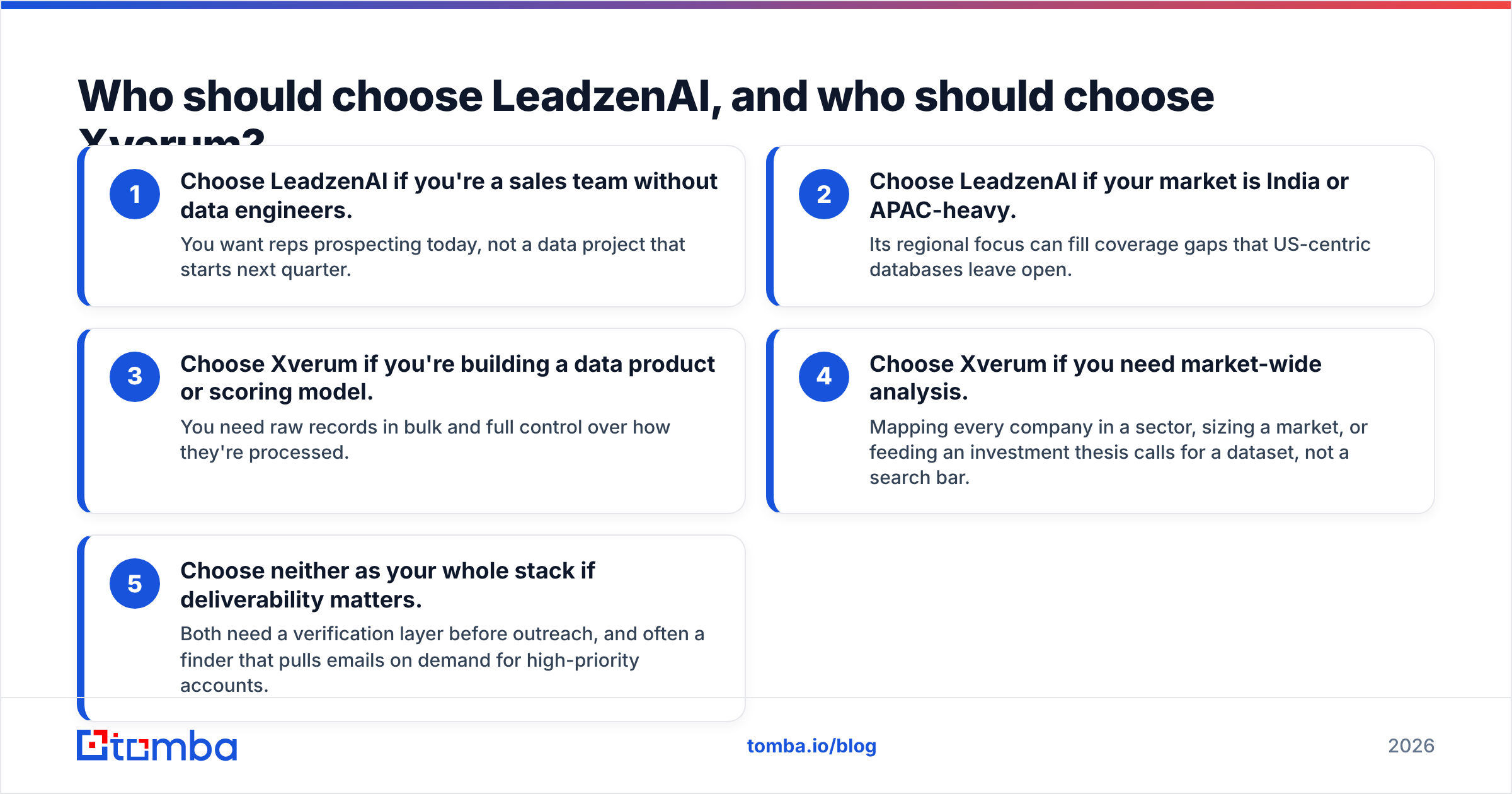
Here's the short version by team profile:
- Choose LeadzenAI if you're a sales team without data engineers. You want reps prospecting today, not a data project that starts next quarter.
- Choose LeadzenAI if your market is India or APAC-heavy. Its regional focus can fill coverage gaps that US-centric databases leave open.
- Choose Xverum if you're building a data product or scoring model. You need raw records in bulk and full control over how they're processed.
- Choose Xverum if you need market-wide analysis. Mapping every company in a sector, sizing a market, or feeding an investment thesis calls for a dataset, not a search bar.
- Choose neither as your whole stack if deliverability matters. Both need a verification layer before outreach, and often a finder that pulls emails on demand for high-priority accounts.
If you're not sure which camp you're in, ask one question: Who opens this data first, a rep or a pipeline? If it's a rep, you want a prospecting tool. If it's a pipeline, you want a data provider.
Where does Tomba fit between LeadzenAI and Xverum?#
Many teams who end up comparing LeadzenAI and Xverum don't need a full lead-gen suite or a data license. They need one thing: the correct professional email for a specific person at a specific company, checked before they hit send.
That's the gap a focused email finder fills. With Tomba you look up emails by domain, by name and company, or straight from LinkedIn through the browser extension. Every result can go through the built-in verifier. There's no data contract, no ingestion work, and no need to guess from a months-old snapshot.
It also works alongside either tool:
- Alongside LeadzenAI. Use it as a second source when a revealed email looks risky, or verify LeadzenAI exports before they go into a sequence.
- Alongside Xverum. Run data enrichment and verification over bulk records to fill missing emails and flag invalid ones before they reach a rep. Data teams can do this programmatically through the Tomba API.
Pricing is published and self-serve: a free tier with 25 searches a month, Starter at $49/mo, Growth at $99/mo, Pro at $249/mo, and custom Enterprise plans. The full breakdown is in Tomba pricing.

To be fair about the tradeoffs: Tomba isn't trying to be a market-mapping dataset like Xverum, and it doesn't have LeadzenAI's natural-language ICP search. If you need millions of firmographic rows for a model, a data provider is the right tool. If your reps want to describe an ideal customer in a sentence and get a list back, a prospecting app does that better. Tomba's job is narrower: accurate, verified emails on demand.
What are common questions about LeadzenAI vs Xverum?#
Is LeadzenAI or Xverum better for cold email?#
For most cold email teams, LeadzenAI. It's built for reps who need contacts fast. Xverum's data can feed cold email too, but only after someone has ingested, filtered, deduplicated, and verified it. Whichever you choose, verify emails before sending to protect your domain.
Can a small team use Xverum?#
Yes, but it's usually not efficient. Bulk data licensing pays off when you have engineering capacity and a use case for large volumes. A five-person sales team will usually get more value from a self-serve prospecting tool or email finder.
Does LeadzenAI offer bulk data like Xverum?#
LeadzenAI supports exports and list building, but it's built around searching and revealing leads, not licensing large datasets. If you need millions of records with refresh schedules, a data provider is a better fit.
Do I still need an email verifier with either tool?#
Yes. Both tools draw on stored data that decays over time. Verifying before each campaign is the cheapest protection against bounces and damage to your sender reputation.
How do I test data quality before committing?#
Ask for a sample. Take 200–500 records that match your ICP, run them through a verifier, and check a random subset by hand against LinkedIn and company websites. Compare the valid rate, bounce risk, and title accuracy. Don't rely on the vendor's headline claims.
Which should you pick?#
LeadzenAI and Xverum don't really compete. LeadzenAI puts leads in a rep's hands quickly. Xverum puts raw B2B data into a pipeline at scale. Pick based on who uses the data first, count the hidden costs (wasted credits on one side, engineering time on the other), and verify everything before it reaches an inbox.
If what you actually need is the right email for the right person without signing a data contract, try the Tomba Email Finder. Search by domain, name, or LinkedIn profile, verify results as you go, and start with 25 free searches a month before upgrading to Starter at $49/mo.
Related guides#
// get started
Find, verify and enrich your first contacts today
Start on the free plan with 25 searches a month, then scale when your team is ready.
Free plan · No credit card required · GDPR & CCPA
// about the author