LeadzenAI vs ZeroBounce: Lead Finder or Email Verifier in 2026?
LeadzenAI finds prospects. ZeroBounce checks whether their inboxes exist. We compare the two on what each does, how the pricing works and where each fits in a 2026 outbound stack, so you pay only for what you need.
TL;DR
- LeadzenAI and ZeroBounce do different jobs. LeadzenAI is an AI-assisted prospecting tool that finds companies, decision-makers and their contact details. ZeroBounce is mainly an email verification and deliverability platform that checks whether an address is safe to send to.
- Pick LeadzenAI if your problem is an empty pipeline and you need new contacts. Pick ZeroBounce if you already have a list and your bounce rate is hurting sender reputation.
- The pricing models are different too. ZeroBounce sells verification credits (pay-as-you-go or monthly). LeadzenAI sells prospecting and contact-reveal credits on a subscription.
- Many teams end up using both, which means two bills, two credit pools and a CSV export between them. An all-in-one finder plus verifier can remove that step.
- Check both vendors' pricing pages before you buy. Plans and credit allowances change often, and the figures below are ranges, not quotes.
What is the real difference between LeadzenAI and ZeroBounce?#
Most searches for "LeadzenAI vs ZeroBounce" begin with a mistaken assumption: that the two tools compete for the same budget line. For the most part, they don't.
LeadzenAI is a lead generation platform. You describe your ideal customer by industry, geography, company size and job title. It returns matching companies and people and lets you reveal their contact details. It also offers a Chrome extension for pulling contact data while you browse LinkedIn profiles. Its output is new contacts that weren't in your CRM yesterday.
ZeroBounce is an email validation platform. You upload a list, or call its API, and it tells you whether each address is valid, invalid, catch-all, a spam trap, abuse-prone or disposable. Over the years it has added deliverability tools such as inbox placement testing, blacklist monitoring, DMARC monitoring and email warmup, plus a smaller email-finder feature. Its output is a cleaner list that doesn't damage your domain.
One way to think about it: LeadzenAI tells you who to contact and ZeroBounce tells you whether it's safe to hit send. They sit at different points in the same workflow.
How do LeadzenAI and ZeroBounce compare feature by feature?#
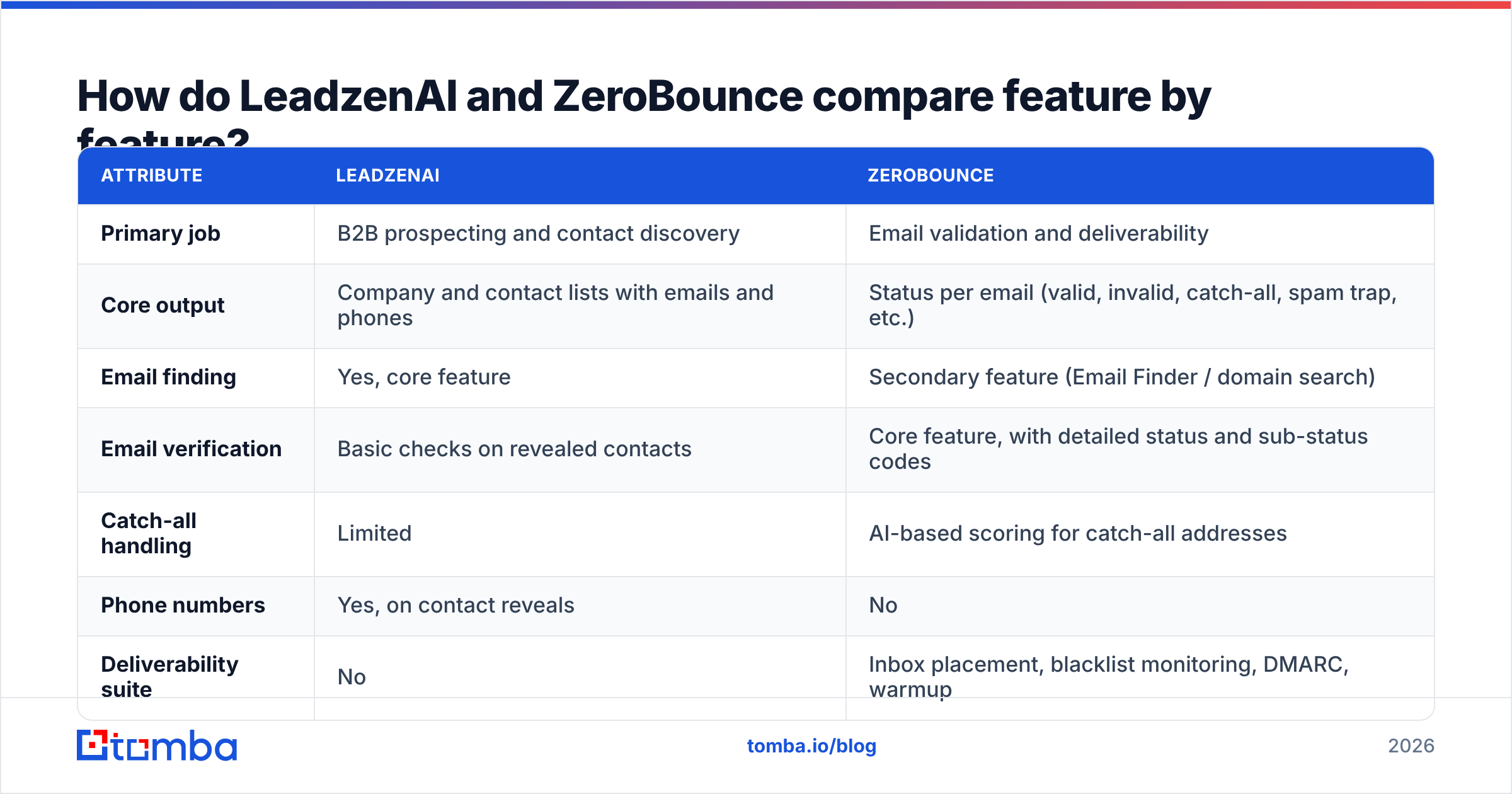
This table sets the two platforms next to each other on the attributes that affect a buying decision. Pricing is approximate and changes often, so confirm on each vendor's site.
| Attribute | LeadzenAI | ZeroBounce |
|---|---|---|
| Primary job | B2B prospecting and contact discovery | Email validation and deliverability |
| Core output | Company and contact lists with emails and phones | Status per email (valid, invalid, catch-all, spam trap, etc.) |
| Email finding | Yes, core feature | Secondary feature (Email Finder / domain search) |
| Email verification | Basic checks on revealed contacts | Core feature, with detailed status and sub-status codes |
| Catch-all handling | Limited | AI-based scoring for catch-all addresses |
| Phone numbers | Yes, on contact reveals | No |
| Deliverability suite | No | Inbox placement, blacklist monitoring, DMARC, warmup |
| Browser extension | Yes (LinkedIn prospecting) | Yes (verification-focused) |
| API | Available | Mature, well-documented API |
| Pricing model | Subscription with contact-reveal credits | Pay-as-you-go credits or monthly subscription |
| Free option | Trial credits | Small monthly free verification allowance |
| Best for | Founders, SDRs, agencies building net-new lists | Marketers and ops teams cleaning existing lists |
Two things matter most in that table. First, only one of these tools creates leads. Second, only one gives you detailed, auditable verification results that you can hand to a deliverability consultant or an email service provider's compliance team.
Which workflow does each tool actually fit?#
A structured view of the four outbound jobs most teams run, and which tool handles each:
- Building a target account list. LeadzenAI's AI search and firmographic filters are made for this. ZeroBounce isn't.
- Finding a named person's work email. LeadzenAI handles this as part of prospecting. ZeroBounce's finder can guess an address from a name and domain, but it's a side feature, not the main product.
- Cleaning a list you already own. This is ZeroBounce's home ground. You upload a CSV of old webinar registrants or an aging CRM export and get each address sorted into send, don't send, or send with caution.
- Protecting sender reputation over time. ZeroBounce's blacklist monitoring, inbox placement tests and warmup cover this. LeadzenAI doesn't try to.
- Enriching contacts with phone numbers. LeadzenAI includes phone data on reveals. ZeroBounce doesn't deal with phones.
If your team runs jobs 1 and 2 most weeks, you're a LeadzenAI buyer. If you mostly run jobs 3 and 4, you're a ZeroBounce buyer. If you run all five, keep reading.

How accurate is each tool?#
Accuracy means different things for these two products, so compare each against the right standard.
For ZeroBounce, accuracy means classification quality: does "valid" actually deliver, and does "invalid" actually bounce? ZeroBounce publicly claims 99%+ accuracy on the addresses it can classify definitively. In practice, what counts is how it handles the grey zone. Catch-all domains accept every address at the SMTP level, so no verifier can confirm them with certainty. ZeroBounce's AI scoring gives those addresses a likelihood rating instead of a flat "unknown", which helps you decide whether to include them in a campaign.
For LeadzenAI, accuracy means data quality: is the person still at the company, is the title current, and does the email exist? Any prospecting database drifts over time. People change jobs, companies rebrand domains, and roles get restructured. Treat every revealed contact as a candidate, not a certainty, until it has been verified.
That second point is why so many teams pair a finder with a verifier. The finder gives you breadth and the verifier gives you confidence. The cost is an extra step. You export from one tool, import into the other, and reconcile the results, so a slow handoff can leave contacts sitting a day or two before anyone emails them.
You can check public reviews yourself on G2, where both products have user reviews that go into data coverage and support. Filter by company size and region to find reviewers whose situation matches yours.
How does pricing work for LeadzenAI vs ZeroBounce?#
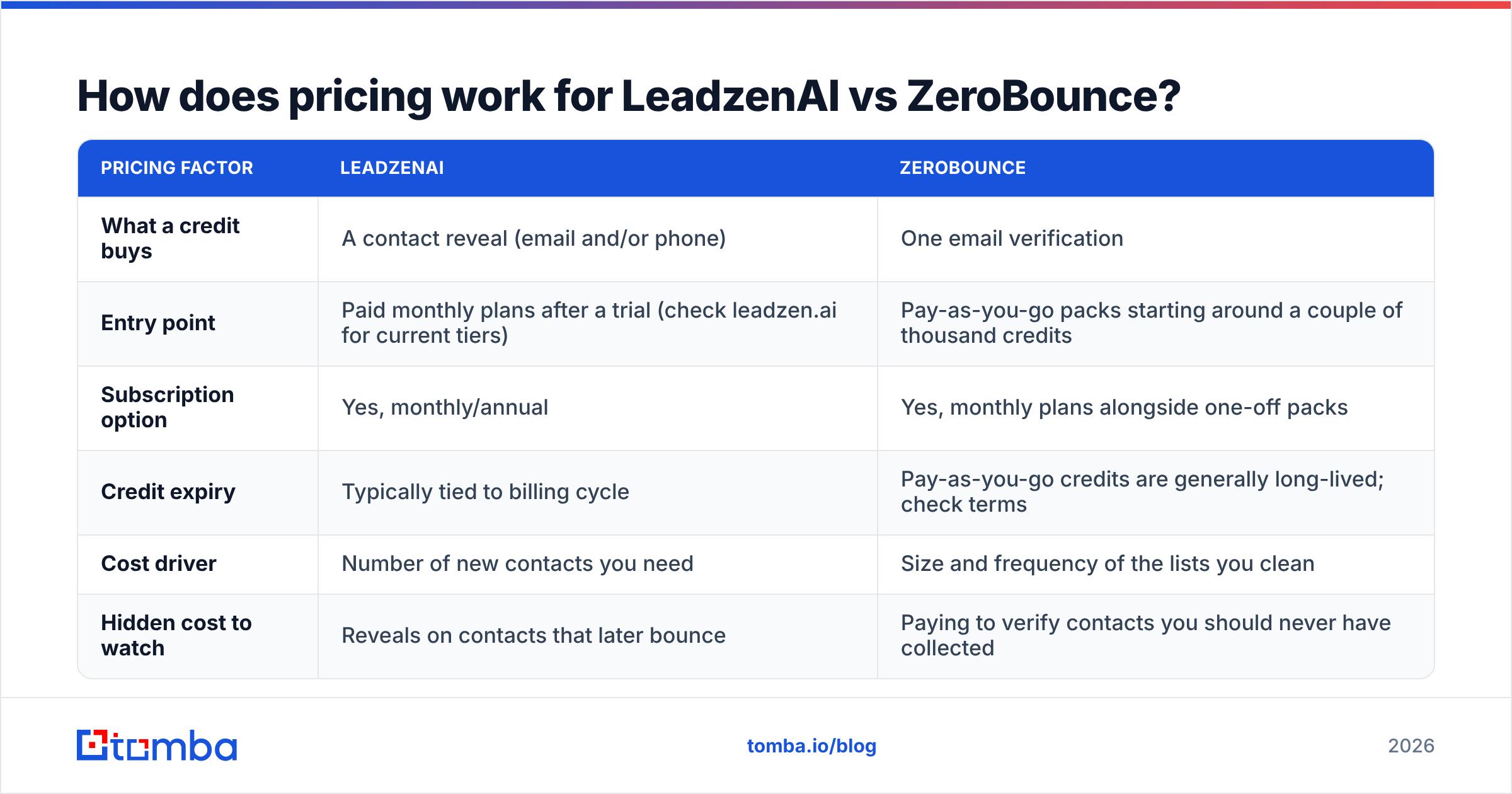
The two tools charge for different units of work, so a direct price comparison can mislead you.
| Pricing factor | LeadzenAI | ZeroBounce |
|---|---|---|
| What a credit buys | A contact reveal (email and/or phone) | One email verification |
| Entry point | Paid monthly plans after a trial (check leadzen.ai for current tiers) | Pay-as-you-go packs starting around a couple of thousand credits |
| Subscription option | Yes, monthly/annual | Yes, monthly plans alongside one-off packs |
| Credit expiry | Typically tied to billing cycle | Pay-as-you-go credits are generally long-lived; check terms |
| Cost driver | Number of new contacts you need | Size and frequency of the lists you clean |
| Hidden cost to watch | Reveals on contacts that later bounce | Paying to verify contacts you should never have collected |
What this means for your budget:
- High-volume cleaning, low prospecting. ZeroBounce alone is usually the cheaper choice. Verification credits cost less per unit than contact reveals.
- High prospecting, low existing data. LeadzenAI is where most of your spend should go, but add a verification pass before sending, either through its built-in checks or an external verifier.
- Both, at scale. You're paying two vendors for what is really one pipeline. This is where an integrated tool becomes worth pricing out.
Can ZeroBounce find emails, or can LeadzenAI verify them?#
Each tool has some overlap with the other, but in both cases it's a secondary feature.
ZeroBounce's email finder takes a first name, last name and domain, then returns the most likely address based on known company patterns. It works for one-off lookups. It isn't a prospecting database, though. You still need to know who to look for before you can use it.
LeadzenAI runs checks on the contacts it reveals, so you're not handed obviously dead addresses. It doesn't offer the detailed status taxonomy (spam traps, abuse accounts, toxic domains, catch-all scoring) that a dedicated verifier returns, and it isn't designed to clean a 50,000-row CSV that you imported from somewhere else.
So if you need serious finding and serious verification, neither tool covers both fully on its own.
What are the pros and cons of each?#
LeadzenAI: pros
- Builds net-new lists from ICP filters, which ZeroBounce can't do
- AI-assisted search lowers the effort of list building for small teams
- Includes phone numbers alongside emails
- LinkedIn extension fits naturally into SDR research
LeadzenAI: cons
- Verification depth is lighter than a dedicated verifier
- Coverage varies by region and industry, so test with your own ICP before committing
- Reveal credits cost more per unit than verification credits
ZeroBounce: pros
- Detailed, well-established email validation with granular status codes
- Catch-all scoring helps you decide on risky addresses
- Deliverability extras (blacklist monitoring, inbox placement, warmup) in one account
- Flexible pay-as-you-go pricing suits irregular list cleaning
ZeroBounce: cons
- Not a prospecting tool, so you need another source for leads
- The email finder is limited compared with a full finder or database
- Deliverability add-ons can overlap with tools you already pay for

Is there a way to avoid paying for two tools?#
Yes, if your use case allows it. The finder-then-verifier handoff exists because most prospecting tools don't verify deeply and most verifiers don't prospect. Some platforms now do both in one credit pool.
Tomba is one of them. Its core product is an email finder that works by name, company or domain, and it sits next to a dedicated email verifier and a catch-all verifier in the same account. You find a contact, verify it and export it without the CSV round trip. It also includes domain search, phone finder and enrichment if you want to consolidate further.
Tomba isn't the right answer for everyone:
- If you need ZeroBounce's full deliverability suite (inbox placement testing, DMARC monitoring), a dedicated deliverability platform will still go deeper.
- If your main need is AI-driven account discovery from loose ICP descriptions, a prospecting-first tool like LeadzenAI may suit your workflow better.
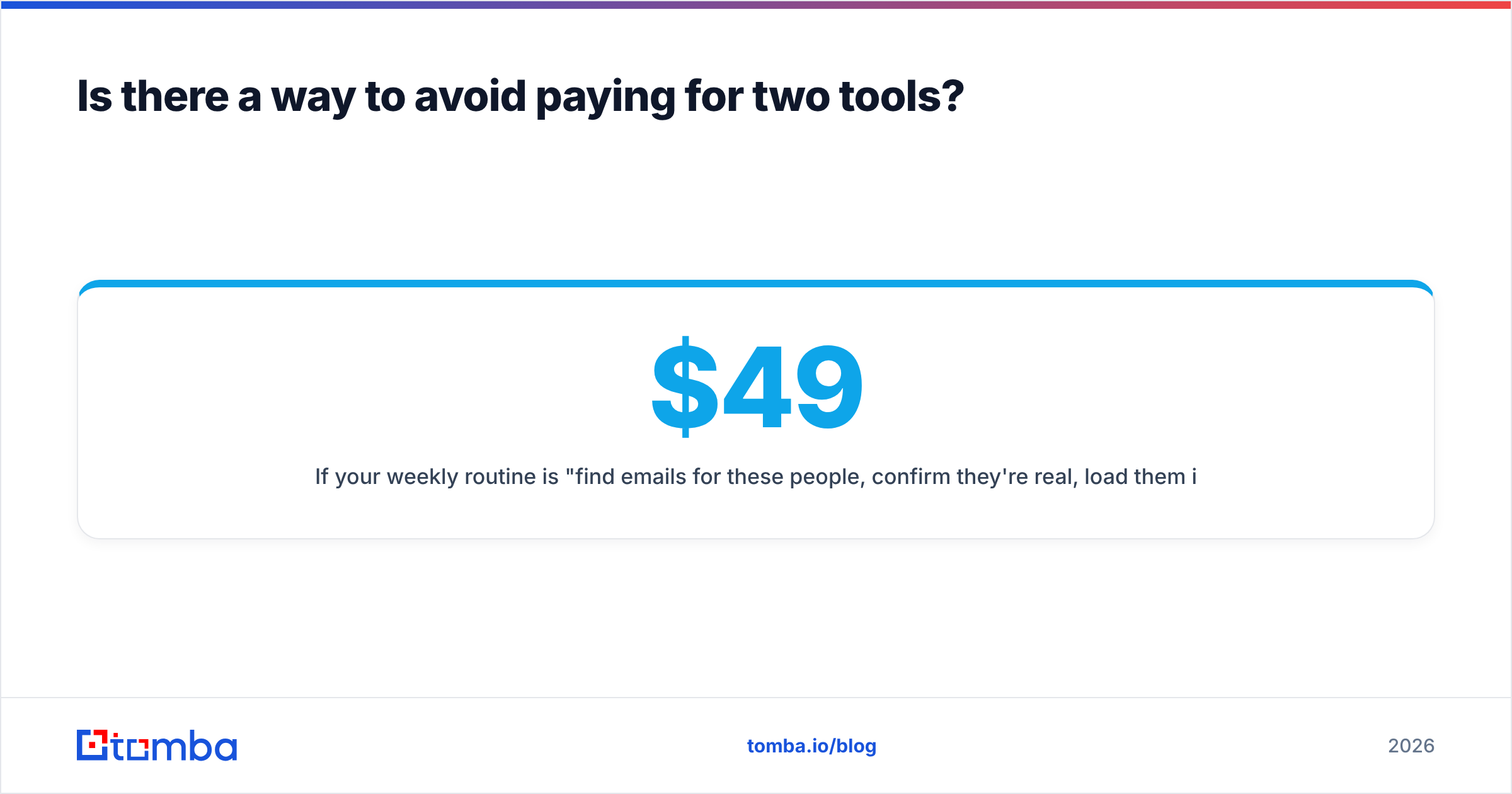
If your weekly routine is "find emails for these people, confirm they're real, load them into the sequencer", one tool is usually simpler and cheaper than two. You can compare Tomba plans: a free tier with 25 searches a month, Starter at $49/mo, Growth at $99/mo, Pro at $249/mo, and custom Enterprise.
If ZeroBounce is the tool you're reconsidering, our ZeroBounce alternative breakdown goes deeper on verification-only comparisons.
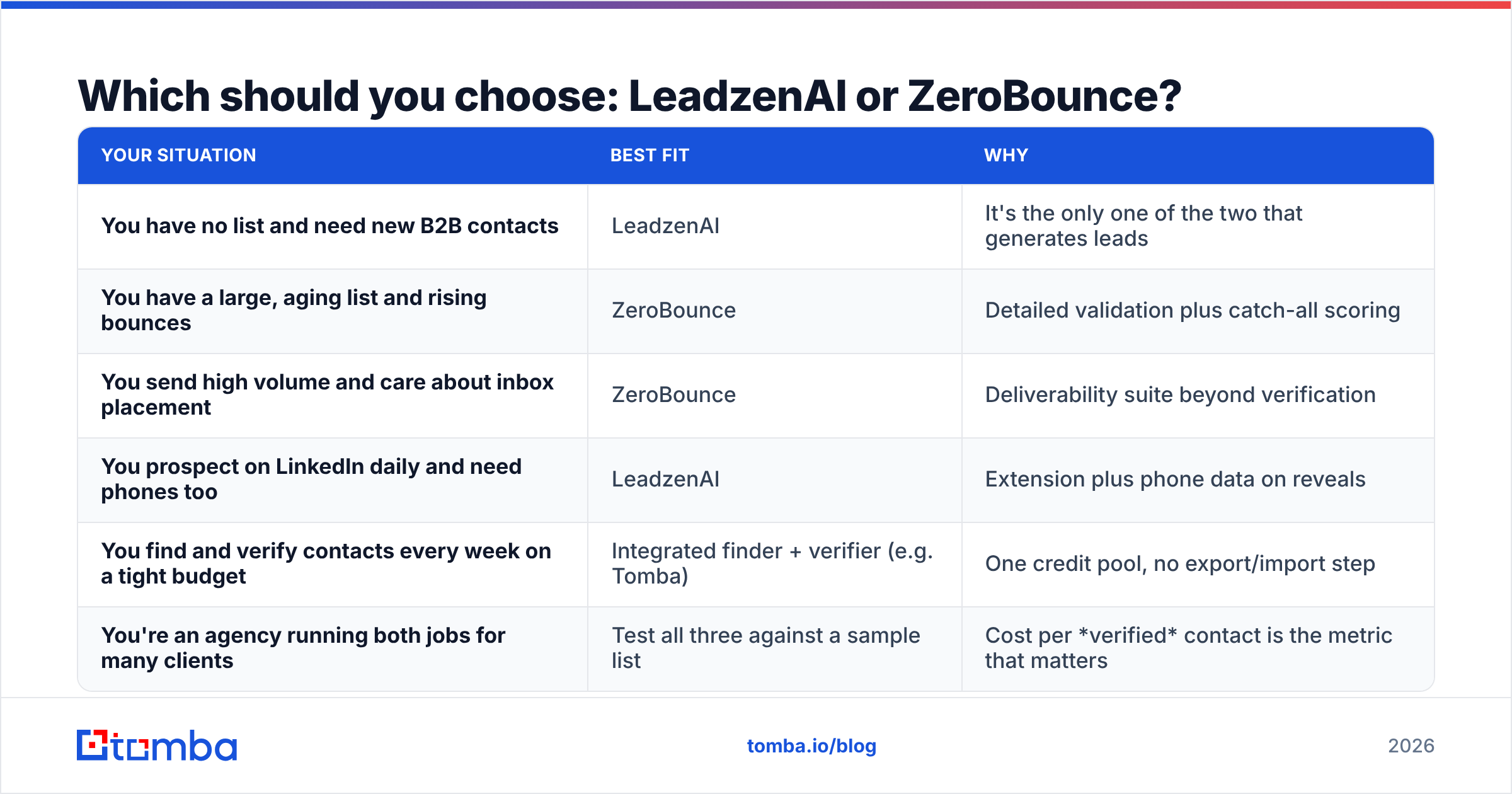
Which should you choose: LeadzenAI or ZeroBounce?#
Use this decision table:
| Your situation | Best fit | Why |
|---|---|---|
| You have no list and need new B2B contacts | LeadzenAI | It's the only one of the two that generates leads |
| You have a large, aging list and rising bounces | ZeroBounce | Detailed validation plus catch-all scoring |
| You send high volume and care about inbox placement | ZeroBounce | Deliverability suite beyond verification |
| You prospect on LinkedIn daily and need phones too | LeadzenAI | Extension plus phone data on reveals |
| You find and verify contacts every week on a tight budget | Integrated finder + verifier (e.g. Tomba) | One credit pool, no export/import step |
| You're an agency running both jobs for many clients | Test all three against a sample list | Cost per verified contact is the metric that matters |
The best way to settle it is to run a test before you commit. Take 200 contacts from your real ICP. Run them through LeadzenAI's finder and note how many it returns. Then verify the results in ZeroBounce and note how many come back valid. Run the same 200 through any integrated tool you're considering. Compare cost per verified, sendable contact, not cost per credit. That one number tells you more than any feature matrix.
What's the bottom line?#
Comparing LeadzenAI and ZeroBounce is really a choice between two parts of the pipeline. LeadzenAI fills the top of the funnel and ZeroBounce protects what goes out of it. Buy LeadzenAI if you're short on leads, ZeroBounce if you're short on list hygiene, and both only if the combined cost still beats an integrated option on your own test data.
If what you want is verified work emails without juggling two subscriptions, try the Tomba Email Finder. Search by name, company or domain, verify each result in the same account, and start on the free tier with 25 searches a month before moving to a paid plan.
Related guides#
Ready to find emails that actually work?
Join 150,000+ professionals who stopped guessing and started sending. Free credits on signup — no credit card required.
Get the Tomba newsletter
Practical outbound tactics and product updates — once every two weeks.
About the author