LetsExtract vs SMARTe: Email Extraction or B2B Contact Data?
LetsExtract pulls emails from the open web. SMARTe sells a curated B2B contact database with direct dials. They solve different problems, and picking the wrong one wastes budget. Here is how to choose.
TL;DR
- LetsExtract is an extraction tool first. It crawls websites, search results, and pages to collect email addresses, and it has since added email finding and verification. It suits solo operators and small teams who want a lot of raw contacts for little money.
- SMARTe is a curated B2B contact data platform. It focuses on verified emails, mobile numbers, and direct dials, with CRM enrichment and coverage outside North America. It suits sales teams that want enterprise-grade data and are fine with sales-led pricing.
- The real choice is between harvesting data yourself and buying data someone else has already verified. That decision matters more than any single feature.
- Whatever you pick, verify before you send. Scraped lists especially need a verification pass to protect your sender reputation.
- If you mainly need accurate professional emails by name or domain at a transparent price, a dedicated email finder such as Tomba (from $49/mo) sits between the two.
What is LetsExtract?#
LetsExtract started as desktop software for pulling email addresses out of the web. You give it keywords, URLs, or search queries. It crawls the matching pages and returns every email address, phone number, and social link it can parse. The product has since grown to include a web app, a Chrome extension, an email finder that works from a name plus domain, and a built-in verifier.
The core idea hasn't changed: LetsExtract collects publicly visible contact data at scale. You decide where it looks, and it gathers what's there.
That approach has clear strengths:
- Volume per dollar. One crawl can return thousands of addresses from niche directories, association member pages, or local business listings.
- Long-tail coverage. Plumbers in Ohio, independent dental clinics, or Shopify stores in a small vertical rarely show up in enterprise B2B databases. They do show up on the open web.
- Control. You pick the sources, so you understand where every contact came from.
It also has predictable weaknesses. Scraped results include a lot of generic inboxes (info@, sales@, support@), old addresses left on stale pages, and contacts with no job title or seniority attached. You get a list of addresses, not a list of qualified buyers.
What is SMARTe?#
SMARTe is a B2B sales intelligence platform. It sells access to a curated database of company and contact records. Its pitch centres on data quality, especially mobile numbers and direct dials, plus stronger coverage in EMEA and APAC than many US-centric providers.
SMARTe's typical workflow looks like this:
- Search a database by firmographics (industry, headcount, revenue, location) and persona filters (title, seniority, department).
- Use a Chrome extension to pull contact details while you browse LinkedIn or company websites.
- Enrich and refresh the existing records in your CRM, usually Salesforce or HubSpot, so reps work from current data.
- Export to your sequencing tool.
This is buyer-centric data. Each record normally comes with a name, title, company, and contact channels, and the vendor handles collection, verification, and compliance work. The tradeoff is cost and flexibility. SMARTe is sales-led, so you usually talk to a rep to get pricing, and plans are built for teams rather than individuals testing the waters.

How do LetsExtract and SMARTe compare side by side?#
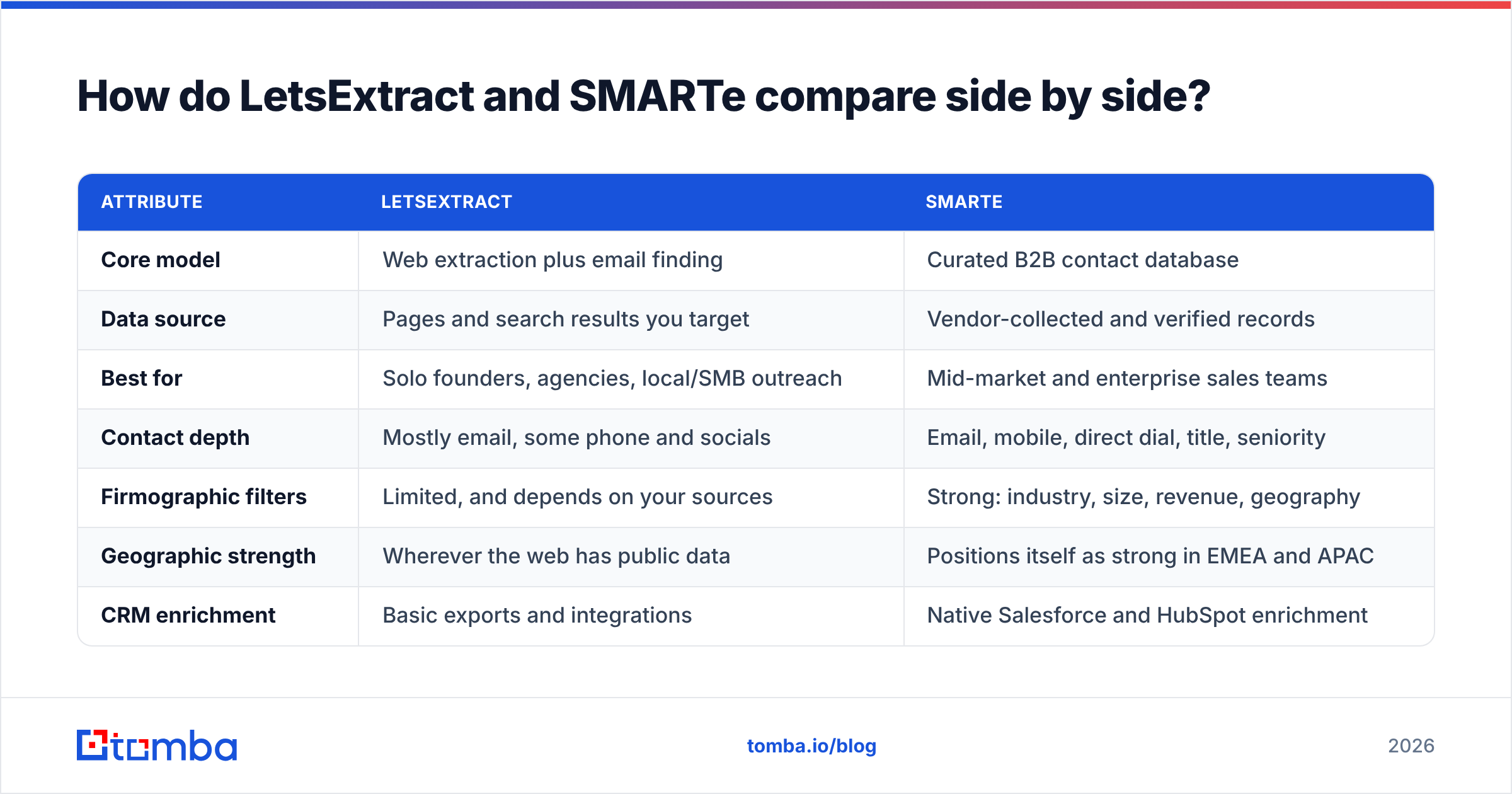
Here is the comparison by the attributes that actually drive a buying decision. Pricing and plan details change often, so treat the pricing rows as structure rather than a quote, and check both vendors' sites before you commit.
| Attribute | LetsExtract | SMARTe |
|---|---|---|
| Core model | Web extraction plus email finding | Curated B2B contact database |
| Data source | Pages and search results you target | Vendor-collected and verified records |
| Best for | Solo founders, agencies, local/SMB outreach | Mid-market and enterprise sales teams |
| Contact depth | Mostly email, some phone and socials | Email, mobile, direct dial, title, seniority |
| Firmographic filters | Limited, and depends on your sources | Strong: industry, size, revenue, geography |
| Geographic strength | Wherever the web has public data | Positions itself as strong in EMEA and APAC |
| CRM enrichment | Basic exports and integrations | Native Salesforce and HubSpot enrichment |
| Pricing model | Low entry cost, self-serve | Quote-based, sales demo |
| Learning curve | Moderate (crawl settings, filters) | Low for reps, but admin setup needed |
| Main risk | Stale, generic, or unverified addresses | Cost, and paying for seats you underuse |
The table points to one conclusion: these tools don't really compete head to head. LetsExtract helps you build lists nobody sells. SMARTe gives you lists that are already qualified and enriched.
Which tool gives more accurate emails?#
On a per-record basis, SMARTe should come out ahead, simply because of how each tool gets its data. SMARTe verifies and refreshes records as part of its product. LetsExtract returns what it finds on the page, and a page can be years out of date.

That doesn't make LetsExtract data useless. It makes it raw material. A typical scraped list has three layers:
- Valid personal addresses for real decision makers. This is the value.
- Role-based addresses (info@, hello@). They deliver, but reply rates are low and some spam filters treat them with suspicion.
- Dead or risky addresses. Bounces, spam traps, and catch-all domains that accept everything and tell you nothing.
Before any of it goes into a sequence, you need to strip out layer three and decide what to do with layer two. Run the list through a dedicated email verifier and suppress anything that comes back invalid or unknown. Sending scraped data without verification is the fastest way to damage a domain you spent weeks warming up.
Curated data needs checking too. B2B contact data decays constantly because people change jobs, companies rebrand, and domains lapse. If an enriched record is more than a few months old, re-verify it before a big send, even if it came from a premium provider.
How does pricing compare?#
The pricing philosophies differ as much as the products do.
LetsExtract is self-serve and cheap to start. You can buy a plan without a sales call and have a list the same afternoon. Total cost stays low if you're comfortable with manual work: configuring crawls, cleaning results, deduplicating, and verifying.
SMARTe uses quote-based pricing. Expect a demo, a conversation about seats and credits, and usually an annual commitment. The price covers the data plus the verification, compliance, and enrichment work you would otherwise do yourself. For a team of ten reps calling into Europe, that can be very good value. For a solo founder sending 200 emails a week, it's probably overkill.
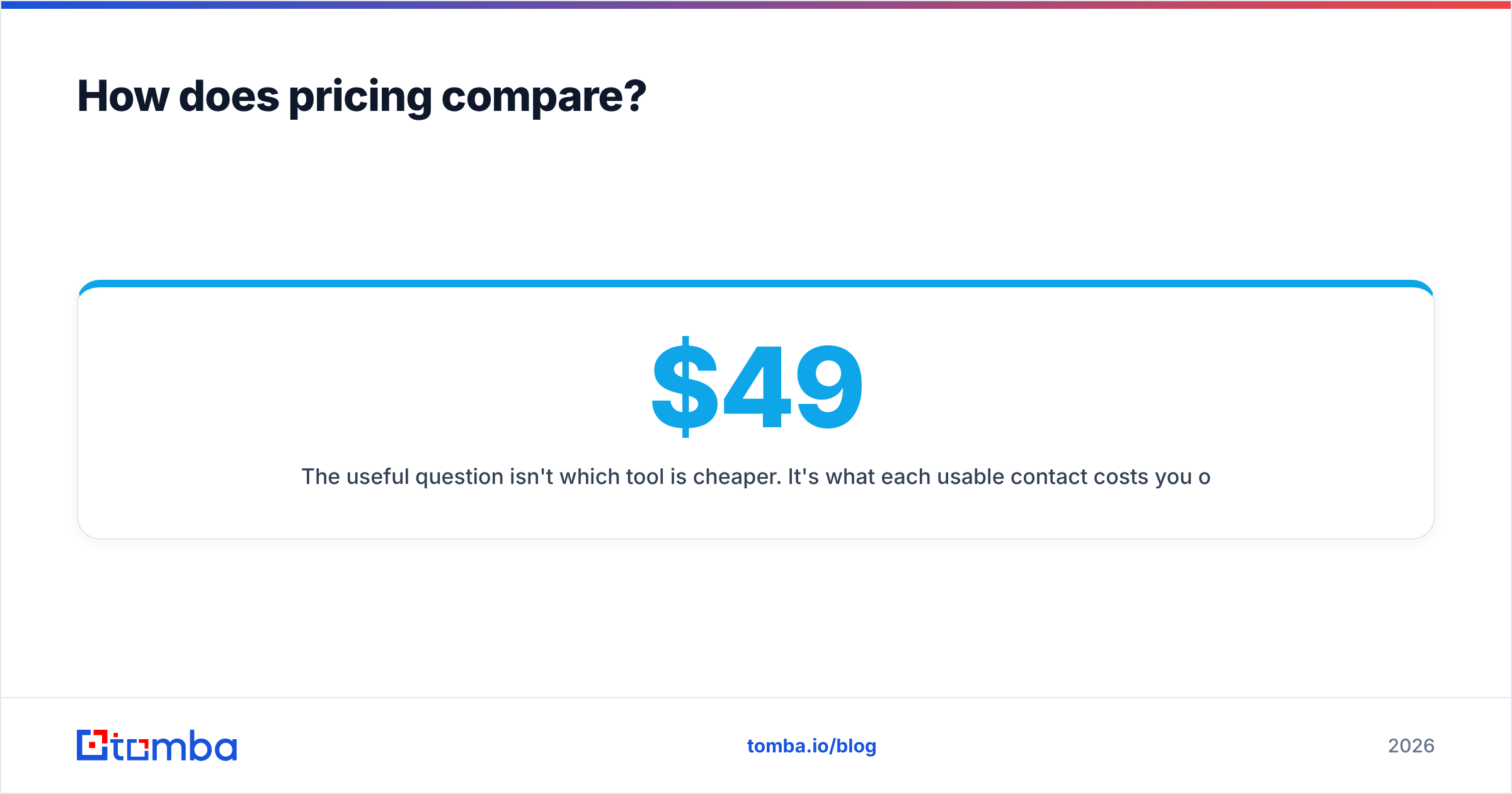
The useful question isn't which tool is cheaper. It's what each usable contact costs you once your time is included. Say a cheap scrape yields 5,000 addresses and only 1,200 of them are verified, relevant decision makers. Add three hours of cleanup and the unit cost isn't as low as the sticker price suggests. For reference, dedicated email finders sit in the middle: Tomba's plans start with a free tier (25 searches/mo) and go up through Starter at $49/mo, Growth at $99/mo, and Pro at $249/mo, all published on the Tomba pricing page.
Who should choose LetsExtract?#
LetsExtract fits you if most of these are true:
- Your market is long-tail. Local businesses, niche ecommerce, creators, associations, or regional SMBs that enterprise databases cover poorly.
- You're budget-constrained. Bootstrapped founders and small agencies that need volume without a four-figure contract.
- You're comfortable doing the ops. You'll deduplicate, filter out role accounts, and verify every list before it goes anywhere near your outbox.
- You mainly need email. Phone numbers and deep firmographics are nice to have, not essential.
- You want source transparency. Knowing exactly which page an address came from helps with compliance reviews and personalization.
Link-building and PR teams also get a lot out of extraction tools, because the contacts they need (editors, bloggers, site owners) are often published right on the page.
Who should choose SMARTe?#
SMARTe fits you if most of these are true:
- You sell into defined accounts. You have an ICP with clear firmographics and want to filter by title, seniority, and company size.
- Phone matters. Your motion depends on cold calling, and you need mobile numbers and direct dials, not just a switchboard.
- You sell outside the US. SMARTe's positioning around EMEA and APAC coverage is a real differentiator if that's your territory.
- Your CRM is the source of truth. You want records in Salesforce or HubSpot enriched and refreshed automatically rather than through CSV imports.
- You have budget and headcount. The value grows with the number of reps using the data every day.
Before you sign, check independent reviews on G2 for your specific region and segment. Data coverage varies a lot by geography and industry, so a provider that works well for US SaaS may perform differently for German manufacturing.
Is there a middle ground between scraping and enterprise data?#
Yes, and it's where many teams end up. Plenty of outbound teams don't need a full sales intelligence suite and don't want to babysit a crawler either. What they need is simple: give me the right person's verified work email, fast, at a price I can see.
That's the job of a dedicated email finder. Instead of harvesting whatever is on a page, or licensing an entire database, you look up exactly the contacts you want:
- Name plus company lookup. You already know who you want to reach, and the finder returns the most likely address with a confidence score.
- Domain-level discovery. A domain search lists the known addresses at a company, so you can find the right department head.
- Built-in verification. Addresses are checked before export, which cuts the risk of bounces.
- Integrations. A Chrome extension, Sheets add-on, and API let you work where you already are.
- Transparent credits. You pay for what you look up, on a published plan.

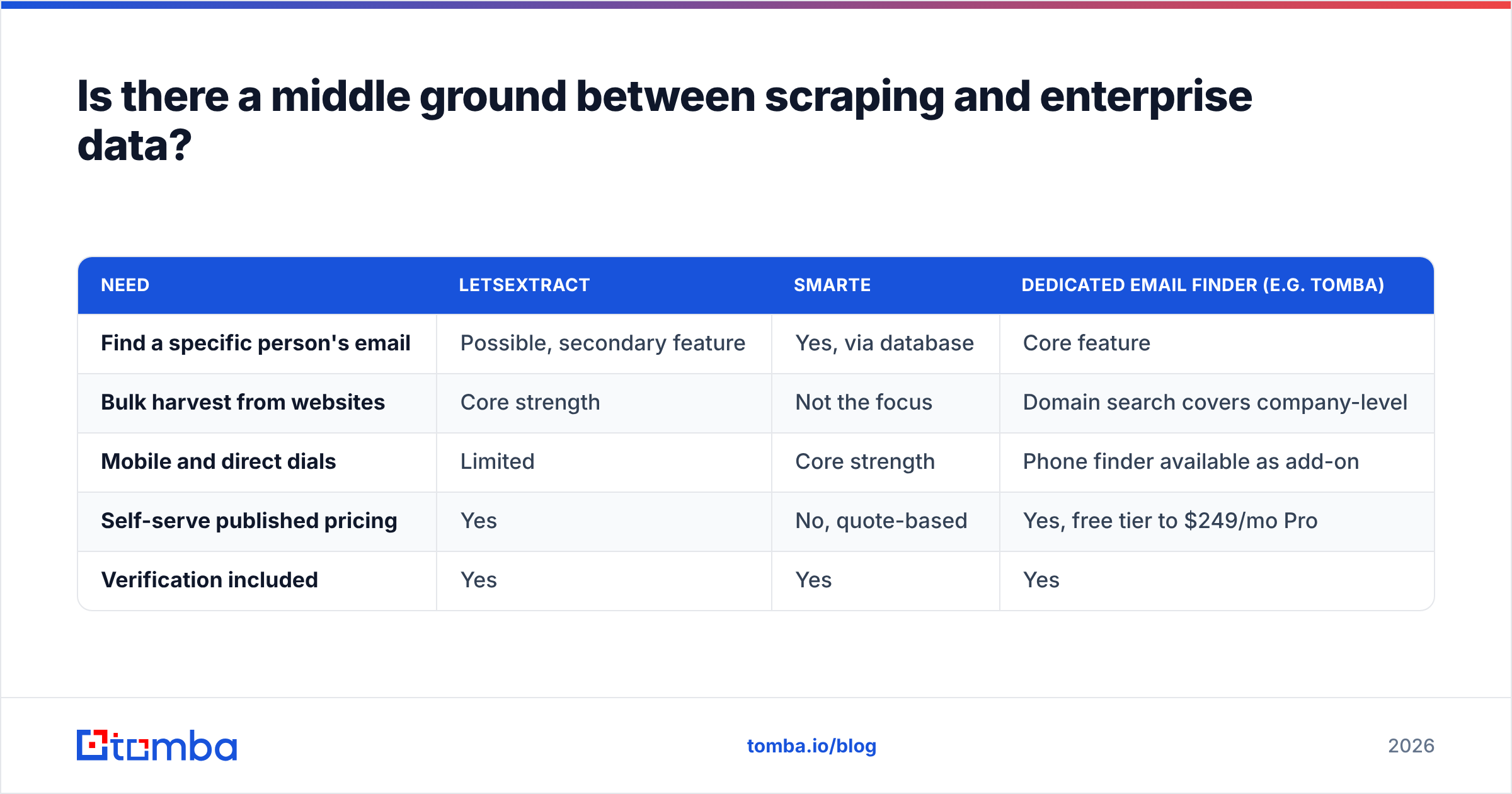
Here's how the three approaches line up for a typical small-to-mid outbound team:
| Need | LetsExtract | SMARTe | Dedicated email finder (e.g. Tomba) |
|---|---|---|---|
| Find a specific person's email | Possible, secondary feature | Yes, via database | Core feature |
| Bulk harvest from websites | Core strength | Not the focus | Domain search covers company-level |
| Mobile and direct dials | Limited | Core strength | Phone finder available as add-on |
| Self-serve published pricing | Yes | No, quote-based | Yes, free tier to $249/mo Pro |
| Verification included | Yes | Yes | Yes |

How should you decide between LetsExtract and SMARTe?#
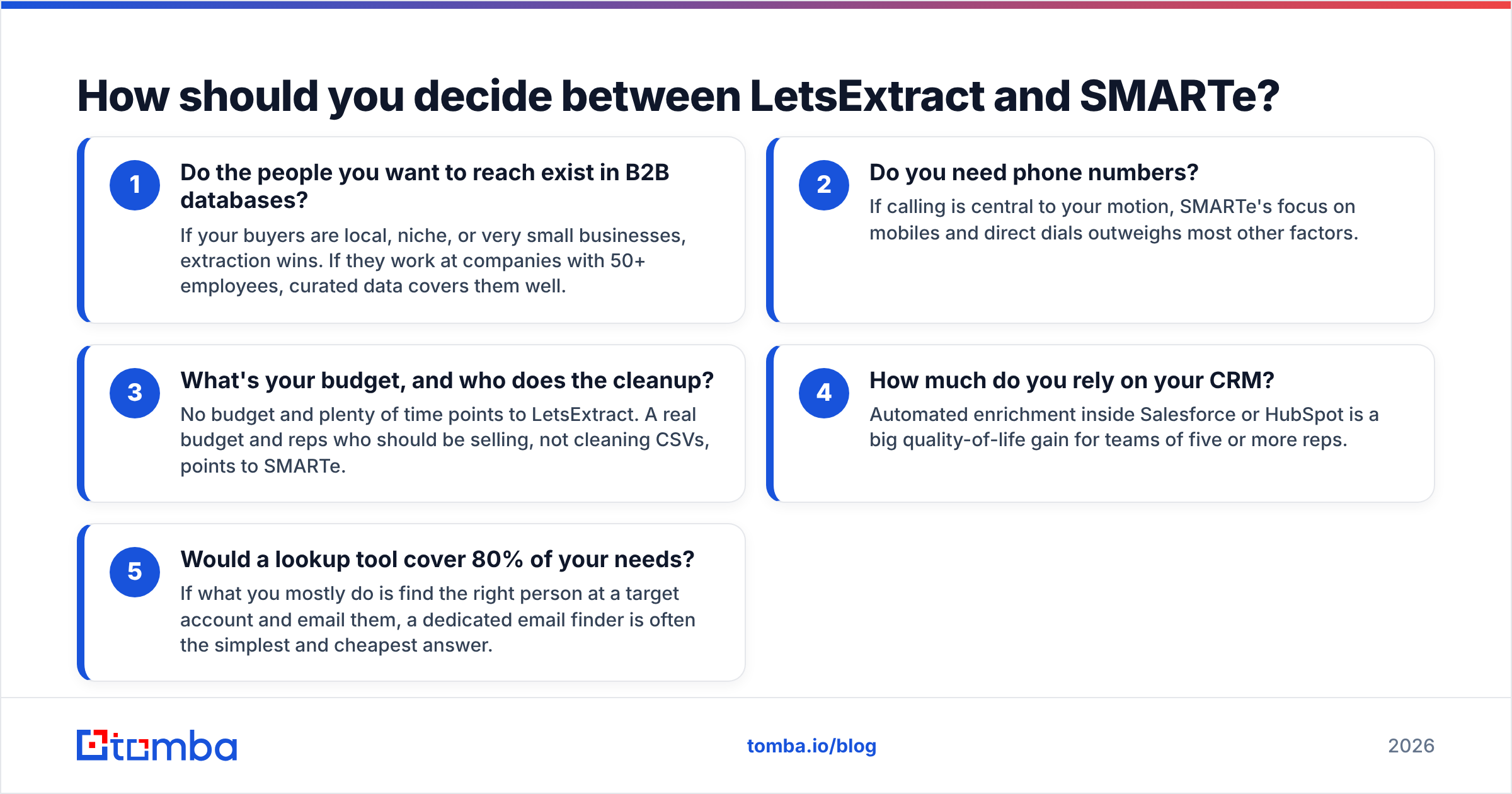
Work through these questions in order. Most teams have their answer by question three.
- Do the people you want to reach exist in B2B databases? If your buyers are local, niche, or very small businesses, extraction wins. If they work at companies with 50+ employees, curated data covers them well.
- Do you need phone numbers? If calling is central to your motion, SMARTe's focus on mobiles and direct dials outweighs most other factors.
- What's your budget, and who does the cleanup? No budget and plenty of time points to LetsExtract. A real budget and reps who should be selling, not cleaning CSVs, points to SMARTe.
- How much do you rely on your CRM? Automated enrichment inside Salesforce or HubSpot is a big quality-of-life gain for teams of five or more reps.
- Would a lookup tool cover 80% of your needs? If what you mostly do is find the right person at a target account and email them, a dedicated email finder is often the simplest and cheapest answer.
A practical tip: whichever tool you trial, run the same 100-contact sample through it. Use a list of target accounts and personas you know well, then measure how many verified, correctly titled contacts come back. Vendor accuracy claims are marketing. Your own sample is evidence.
What is the final verdict on LetsExtract vs SMARTe?#
LetsExtract is the better choice when you need cheap, high-volume contacts from corners of the web that databases ignore, and you're willing to verify and clean everything yourself.
SMARTe is the better choice when you're a funded sales team selling to defined accounts, especially internationally, and you need verified emails plus direct dials fed straight into your CRM.
Neither is objectively better. They sit at opposite ends of the same range, with DIY extraction at one end and fully managed data at the other. Most teams get the best results by being honest about where their market lives and how much operational work they can absorb.
If your real need is somewhere in the middle, meaning accurate professional emails for specific people and companies without a crawler to manage or an enterprise contract to negotiate, try Tomba Email Finder. You can look up a contact by name, domain, or company, get a verified address with a confidence score, and start on the free tier before moving up to Starter at $49/mo when your outbound volume grows.
Related guides#
// get started
Find, verify and enrich your first contacts today
Start on the free plan with 25 searches a month, then scale when your team is ready.
Free plan · No credit card required · GDPR & CCPA
Get the Tomba newsletter
Product and data updates
// about the author