LFBBD Lead for Business vs SignalHire: Which Source Wins in 2026?
One sells you a finished, researched lead list. The other gives you a Chrome extension and a monthly pile of credits. Here's how LFBBD Lead for Business and SignalHire differ, and which one fits your outbound motion.
TL;DR
- LFBBD (Lead for Business) is a done-for-you data vendor. You send it an ICP brief and it delivers a researched list, usually as a CSV within about 24–48 hours. Pricing is quoted per project.
- SignalHire is a self-serve contact finder. You get a Chrome extension, a search database, and monthly credits, with public plans starting around $69/mo.
- Pick LFBBD for a one-off, niche list (eCommerce sellers, Amazon sellers, local verticals) that you don't want to build yourself. Pick SignalHire if reps need to look up contacts every day while they prospect.
- Both have the same weak spot: the data starts going stale the day it's exported. Verify every email before you send, whichever vendor you use.
- If you mostly need business emails by domain or by name, a dedicated email finder with built-in verification usually costs less per usable contact than either one.
What is LFBBD Lead for Business?#
Lead for Business, which operates from lfbbd.com, calls itself a lead generation agency. It supplies B2B, eCommerce, and Amazon seller data, including contact-person emails and direct dial or mobile numbers. According to its Datarade provider profile, it claims more than 250 million business contacts, "manually researched and verified" records, and delivery in 24–48 hours.
What matters for this comparison is the service model. LFBBD doesn't give you a search box. You describe who you want to reach (for example "Shopify store owners in the US doing $1M+ revenue" or "HVAC company owners in Texas"), the team builds the list, and you receive a spreadsheet. Datarade lists purchases from roughly $100 up to $40,000, depending on volume and how specific the request is. Free samples are available on request.
This model suits certain buyers well:
- Agencies building a campaign for a client in a vertical they don't know yet
- eCommerce SaaS companies that need seller or store-owner contacts, which general B2B databases cover poorly
- Founders who want a list delivered and don't want to spend 20 hours in a prospecting tool
The trade-off is visibility. You can't see how a record was sourced before you pay, the public review base is small (a few dozen reviews on Trustpilot, not thousands), and each list is a snapshot rather than a live feed.
What is SignalHire?#
SignalHire is a self-serve contact-finding platform that started out serving recruiters and grew into sales prospecting. It has three main parts:
- Browser extension. Open a LinkedIn profile or company page and reveal emails and phone numbers.
- Search database. Filter people by title, company, location, and industry, then reveal contacts in bulk.
- API and bulk enrichment. Upload a list of names or profile URLs and get contact data back.
Public pricing at the time of writing (per SignalHire's pricing page and recent third-party reviews):
- Free: 5–10 credits to test
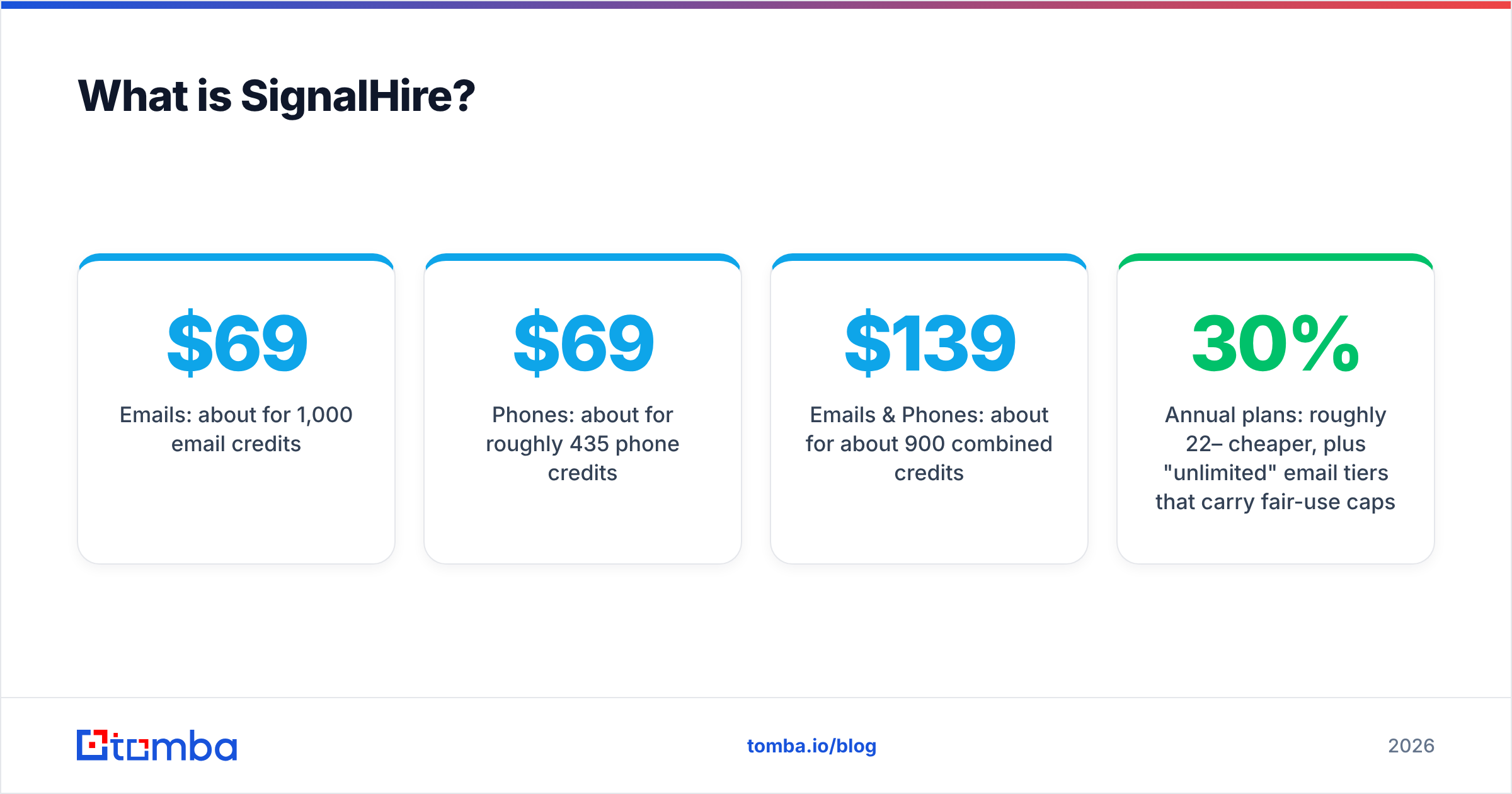
- Emails: about $69/mo for 1,000 email credits
- Phones: about $69/mo for roughly 435 phone credits
- Emails & Phones: about $139/mo for about 900 combined credits
- Annual plans: roughly 22–30% cheaper, plus "unlimited" email tiers that carry fair-use caps
SignalHire is strongest at individual-level lookups tied to a professional profile. It's weaker when your target market barely exists on LinkedIn, such as small eCommerce operators, local trades, or Amazon sellers.
How do LFBBD and SignalHire compare side by side?#
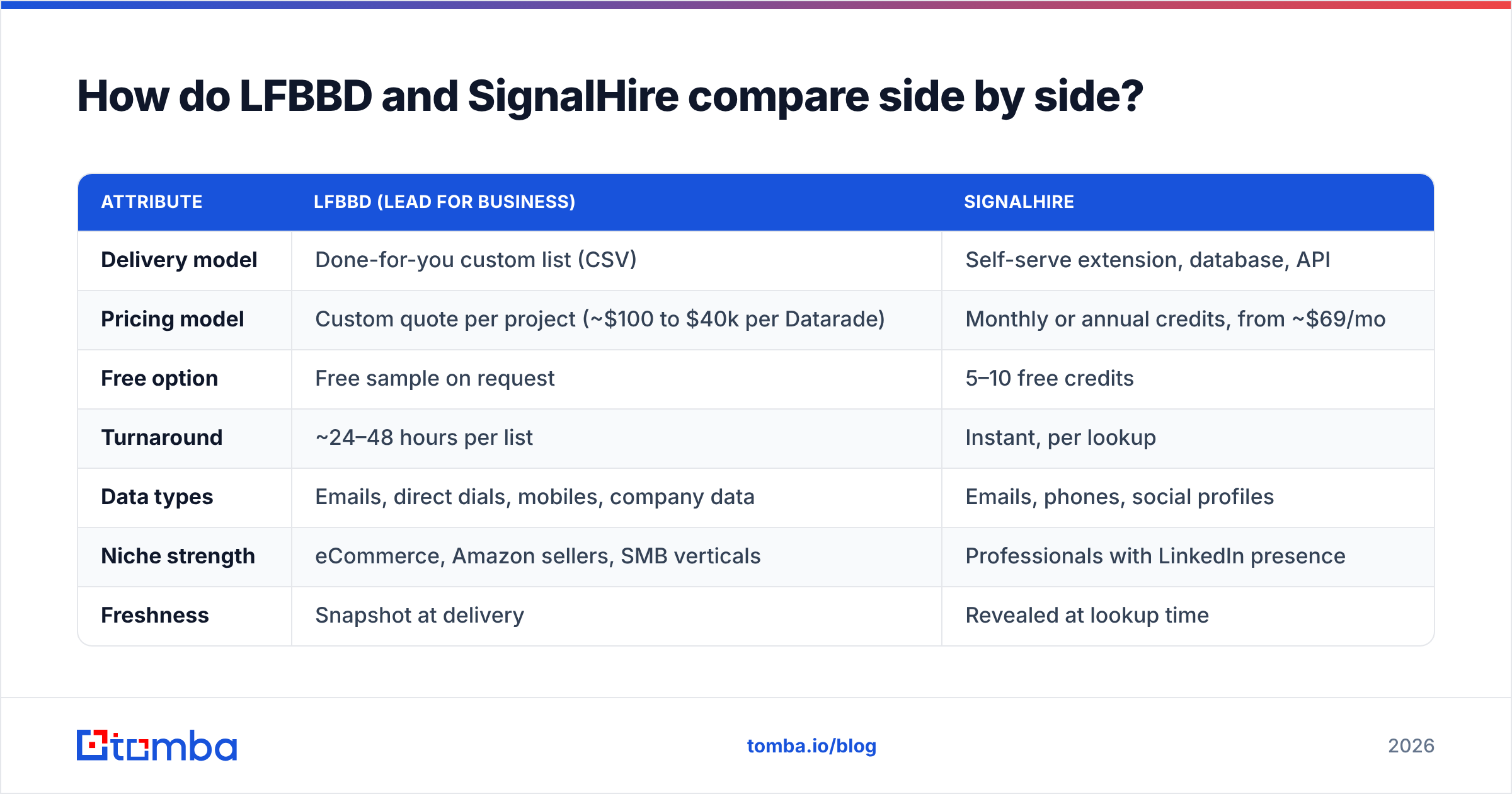
The two products don't really compete on features. They compete for the same budget line, "we need contacts to email and call." This table shows where each one fits:
| Attribute | LFBBD (Lead for Business) | SignalHire |
|---|---|---|
| Delivery model | Done-for-you custom list (CSV) | Self-serve extension, database, API |
| Pricing model | Custom quote per project (~$100 to $40k per Datarade) | Monthly or annual credits, from ~$69/mo |
| Free option | Free sample on request | 5–10 free credits |
| Turnaround | ~24–48 hours per list | Instant, per lookup |
| Data types | Emails, direct dials, mobiles, company data | Emails, phones, social profiles |
| Niche strength | eCommerce, Amazon sellers, SMB verticals | Professionals with LinkedIn presence |
| Freshness | Snapshot at delivery | Revealed at lookup time |
| Integrations | Spreadsheet export | Extension, API, ATS/CRM exports |
| Best for | One-off campaigns, agencies, niche ICPs | Daily rep prospecting, recruiting |
| Main risk | Opaque sourcing, list decay | Credit burn, fair-use caps |
In short, LFBBD sells an outcome (a list) and SignalHire sells a capability (lookups). If you'd rather buy the outcome, you're also paying for the team's time. If you'd rather buy the capability, you're paying with your reps' time instead.
Which one has better data quality?#
No independent, public benchmark compares these two vendors head to head, so treat accuracy claims from either side (including "100% verified") as marketing until you test them. What you can do is predict where each one is likely to fail.
LFBBD's likely failure modes:
- List decay after delivery. B2B contact data decays by an estimated 20–30% a year as people change jobs. A list bought in January is noticeably worse by June.
- Pattern-guessed emails. Manually researched lists often fill gaps with
first.last@domainguesses. Those look valid and then bounce, or they land on catch-all domains that accept anything and never reach anyone. - Small-business churn. eCommerce stores and small agencies close or rebrand often, so domain-level data goes bad faster there than in enterprise lists.
SignalHire's likely failure modes:
- Personal vs. work email mix. Many reveals return personal addresses (Gmail and similar). That works for recruiting. For cold sales email it's a compliance and deliverability problem.
- Thin coverage outside LinkedIn-heavy roles. If the person has no strong professional profile, the result is often empty or low-confidence.
- Credit burn on misses. Depending on the plan, a reveal that returns something unusable can still cost you a credit.
Either way, the fix is the same: run every address through an email verifier before it goes into a sequence. Sending unverified purchased data is the fastest way to hurt your sender reputation, and neither vendor pays for the damage.
How should you test LFBBD and SignalHire before buying?#
Don't pick a vendor from its landing page. Run a small, structured trial:
- Build a 100-contact control set. Take 100 people you already know are correct: current customers, closed-won contacts, colleagues at partner companies. These are your ground truth.
- Request the same ICP from both. Ask LFBBD for a free sample that matches your real target. On SignalHire, use your free credits on the same titles and industries.
- Verify everything. Run all returned emails through a verifier and count valid, invalid, catch-all, and unknown separately. A vendor with 80% "valid" and 15% catch-all is worse than it looks.
- Check role accuracy. Pick 20 records at random and confirm on LinkedIn or the company site that the person still holds that title at that company.
- Calculate cost per usable contact. Divide total spend by the number of contacts that are verified valid, correct-role, and inside your ICP. That number is the one you should compare.
In most teams' tests, cost per usable contact is 1.5–3x the headline cost per record. The gap between vendors shows up in that multiplier, not in the sticker price.
Is LFBBD cheaper than SignalHire?#
It depends on volume and how often you buy.
For a single campaign of 2,000–5,000 contacts in a niche vertical, LFBBD can come out cheaper in total effort. You pay once, you skip the tool subscription, and nobody on your team spends a week building the list. If the vertical is eCommerce or Amazon sellers, SignalHire may not be able to produce the list at all.
For ongoing prospecting, SignalHire's subscription usually works out better. At about $69/mo for 1,000 email credits, a rep doing 40–50 lookups a day stays inside one plan and always gets data revealed at the moment of outreach, which is fresher than any purchased snapshot.
Where both get expensive:
- LFBBD: buying the same segment again every quarter because the last list decayed
- SignalHire: phone credits, which cost roughly twice as much per contact as email credits, plus the fair-use caps on "unlimited" plans
If your main need is business email addresses, not phone numbers or niche eCommerce data, compare both against a pay-per-found email finder. With Tomba pricing, there's a free tier of 25 searches a month and paid plans starting at $49/mo. Verification is built into the workflow, so you aren't paying for a second tool to clean up the first one's output.
Who should choose LFBBD Lead for Business?#
LFBBD is a good fit if:
- You run an agency and keep needing lists in verticals you don't know well
- Your ICP is eCommerce or Amazon sellers. This is a real gap in LinkedIn-first tools, and LFBBD markets itself directly at it.
- You need a list once, not every day. A product launch, event follow-up, or market test.
- Nobody on your team owns prospecting tools and you'd rather pay for finished work
Watch out for:
- Paying up front for a large list before validating a sample
- Assuming "manually verified" means verified today. Ask for the verification date on each record.
- Treating the list as a permanent asset. Budget to re-verify it before each campaign.
Who should choose SignalHire?#
SignalHire is a good fit if:
- Your reps prospect every day and want contact data one click from a LinkedIn profile
- You recruit as well as sell. SignalHire's roots are in recruiting and it's still strong there.
- You want predictable monthly spend instead of project quotes
- You need phone numbers for individuals, not just company switchboards
Watch out for:
- Personal emails in the results if you're doing B2B cold email under GDPR or CAN-SPAM rules
- Credit consumption on plans where misses still cost you
- Fair-use caps behind the word "unlimited"

Is there a better option than either LFBBD or SignalHire?#
It depends on what you're actually missing. Neither product is bad. Each solves a different problem, and many teams buy one of them when the real bottleneck is something else:
- If you know the companies but not the people, a domain search returns every public business email at a domain, with source links, in seconds. You don't need a custom list or a LinkedIn-dependent extension.
- If you know the person's name and company, a name-plus-domain lookup in an email finder is cheaper and fresher than buying that record inside a list.
- If you already have a CRM full of half-complete records, data enrichment fills in missing emails, titles, and company data without starting over.
- If you have a purchased list and don't trust it, bulk verification catches the bounces and catch-alls before your domain pays for them.
The most robust setup for many B2B teams uses layers: a niche list vendor like LFBBD for verticals nobody else covers, a lookup tool for day-to-day prospecting, and a verification step before any send. Where this goes wrong is when one vendor's output goes straight into a sequencer with no check in between.
What is the final verdict on LFBBD Lead for Business vs SignalHire?#
Choose LFBBD Lead for Business if you want a finished, niche list, especially eCommerce or Amazon seller data, and you're buying for a specific campaign rather than an ongoing motion. Get a sample first, verify it, and ask when each record was last checked.
Choose SignalHire if your team prospects every day from LinkedIn, needs individual phone numbers, or also recruits. The self-serve model and monthly credits suit a steady flow of lookups better than repeated list purchases.
Choose neither as your only source if B2B email is your main channel. Stale lists and personal-email reveals both cause bounces, and bounces hurt deliverability for every campaign after that.
If business emails are what you need most, try Tomba Email Finder. Search by domain, by name, or by company, see the public sources behind each address, and verify before you send. The free tier gives you 25 searches a month to run the 100-contact test above against LFBBD and SignalHire before you spend anything.
Related guides#
// get started
Find, verify and enrich your first contacts today
Start on the free plan with 25 searches a month, then scale when your team is ready.
Free plan · No credit card required · GDPR & CCPA
Get the Tomba newsletter
Product and data updates
// about the author