LimeLeads vs SMARTe (2026): Pricing, Data Coverage and Our Pick
LimeLeads sells cheap, self-serve US contact credits. SMARTe sells global mobile data on annual contracts. Here's how they compare on price, coverage and workflow, and which team each one fits.
TL;DR
- LimeLeads is a self-serve B2B contact database focused mostly on the US. Published plans start at $99/mo for 500 credits, unused credits roll over, and you can sign up without talking to sales.
- SMARTe is a sales intelligence platform built around verified mobile numbers and global coverage (200+ countries). Third-party reviews put its entry point at about $5,000/year, or roughly $0.50 per record on usage-based plans.
- Pick LimeLeads if you're a small US-focused outbound team that mainly needs emails and a cheap list-building workflow.
- Pick SMARTe if phone-first prospecting, EMEA/APAC coverage and intent signals (Bombora) justify an annual contract.
- If you mostly need to find and verify emails for accounts you've already chosen, a dedicated email finder is usually cheaper per contact than either database.
LimeLeads and SMARTe both sell B2B contact data, but they're aimed at different buyers. One is a credit-based list builder you can buy with a card in five minutes. The other is a sales intelligence platform that expects a demo, a quote and a yearly commitment. This comparison covers what each one does well, where each falls short, and which kind of team should buy which.
What is LimeLeads?#
LimeLeads is a B2B lead database where you filter companies and contacts by industry, company size, job title, location and similar fields, then spend credits to unlock contact details. One credit unlocks one contact. According to its Capterra listing and published pricing, the lineup looks like this:
- Pro — $99/mo, 500 credits, 1 seat
- Business — $150/mo, 1,500 credits, 2 seats
- Enterprise — $400/mo, 5,000 credits, 5 seats
Annual billing brings the price down by about 35%. The detail most reviewers point out is that unused credits roll forward instead of expiring at the end of the month. If your outbound volume swings from month to month, that makes a real difference.
The data leans heavily toward US companies, and email addresses are verified at the moment you reveal them. That cuts down on hard bounces, but you only get what the database already holds. If a prospect isn't in LimeLeads, you can't find them there.
What is SMARTe?#
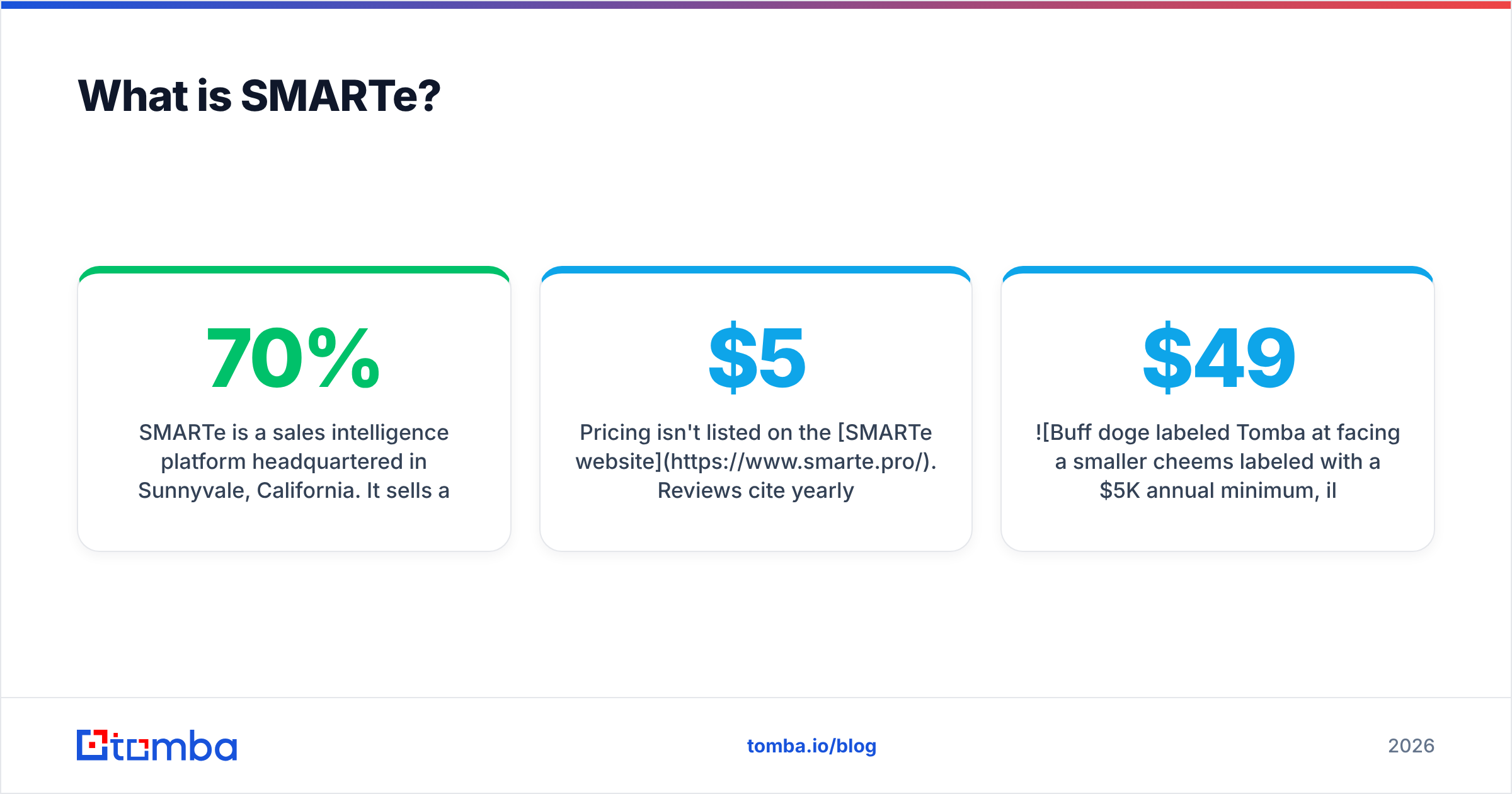
SMARTe is a sales intelligence platform headquartered in Sunnyvale, California. It sells access to a large global contact graph. Recent third-party reviews put that at 229M–289M contacts and 60M+ companies across 200+ countries. SMARTe's main selling point is mobile numbers. It claims roughly 70% mobile coverage for North American contacts and around 50% internationally.
Beyond contact data, SMARTe includes:
- Intent signals powered by Bombora
- Technographic data (what software a company runs)
- CRM enrichment and a Chrome extension for prospecting on LinkedIn and company websites
- Integrations with engagement platforms such as Salesloft and Apollo
Pricing isn't listed on the SMARTe website. Reviews cite yearly licenses starting around $5,000, with usage-based options near $0.50 per record. Expect to go through a demo and a quote before you get access.

How do LimeLeads and SMARTe differ at the core?#
Think of LimeLeads as a vending machine: you put in a coin (a credit) and get one contact. SMARTe works more like a wholesale membership. You pay upfront for access to a bigger warehouse that also stocks phone numbers, intent data and international inventory.
That analogy breaks down into five practical differences:
- Buying motion — LimeLeads is self-serve with published prices. SMARTe is sales-led, with custom quotes and yearly contracts as the default.
- Geographic depth — LimeLeads is strongest in the US. SMARTe markets itself on global coverage, including EMEA and APAC contacts that US-centric databases often lack.
- Channel focus — LimeLeads is mostly an email-list tool. SMARTe is built for teams that dial, and verified mobile numbers are its headline feature.
- Signals and context — SMARTe includes Bombora intent and technographics. LimeLeads offers firmographic filters and not much more.
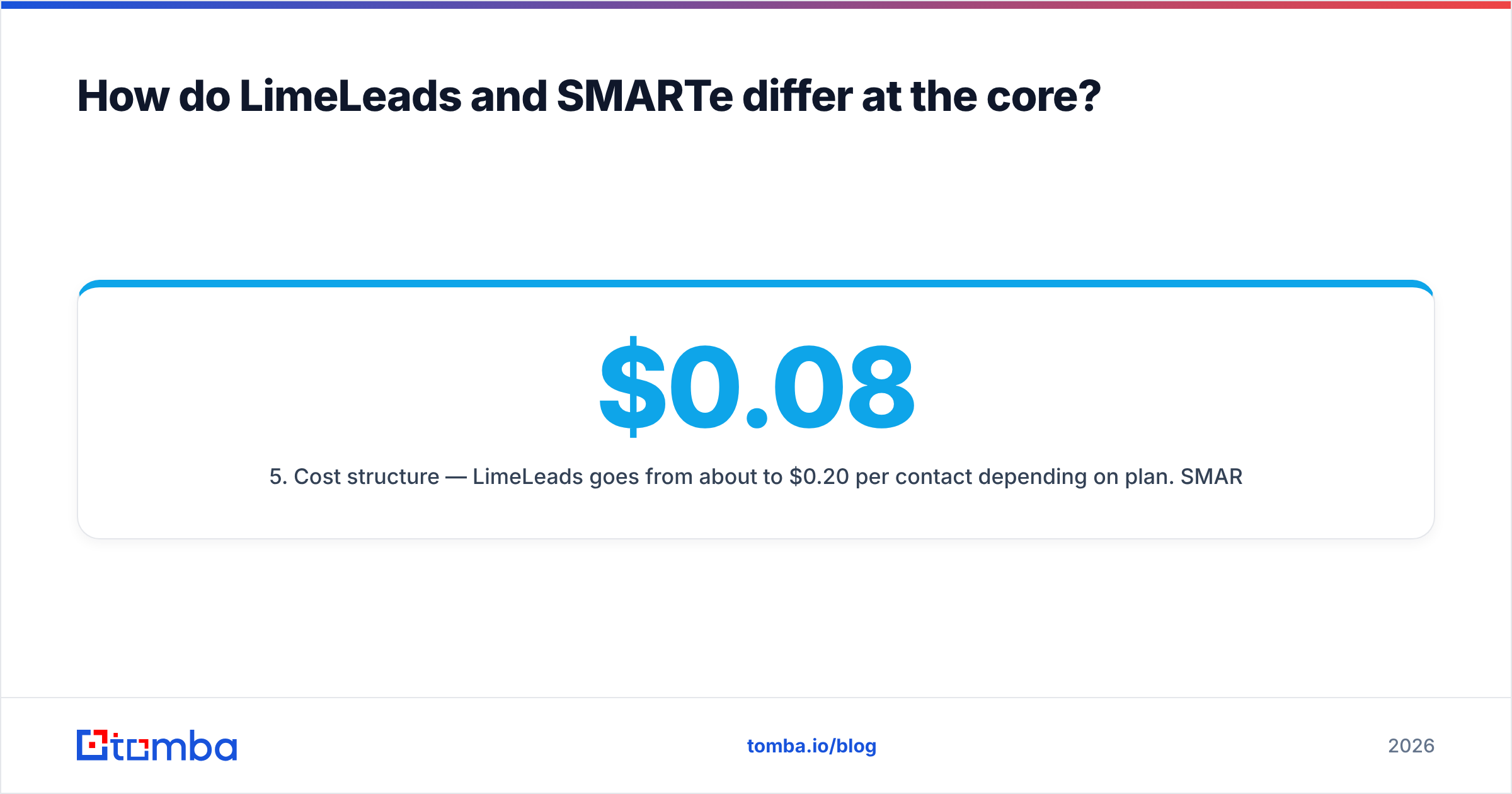
- Cost structure — LimeLeads goes from about $0.08 to $0.20 per contact depending on plan. SMARTe's usage pricing lands around $0.50 per record, but each record carries more data (mobile, intent context).
How do LimeLeads and SMARTe compare feature by feature?#
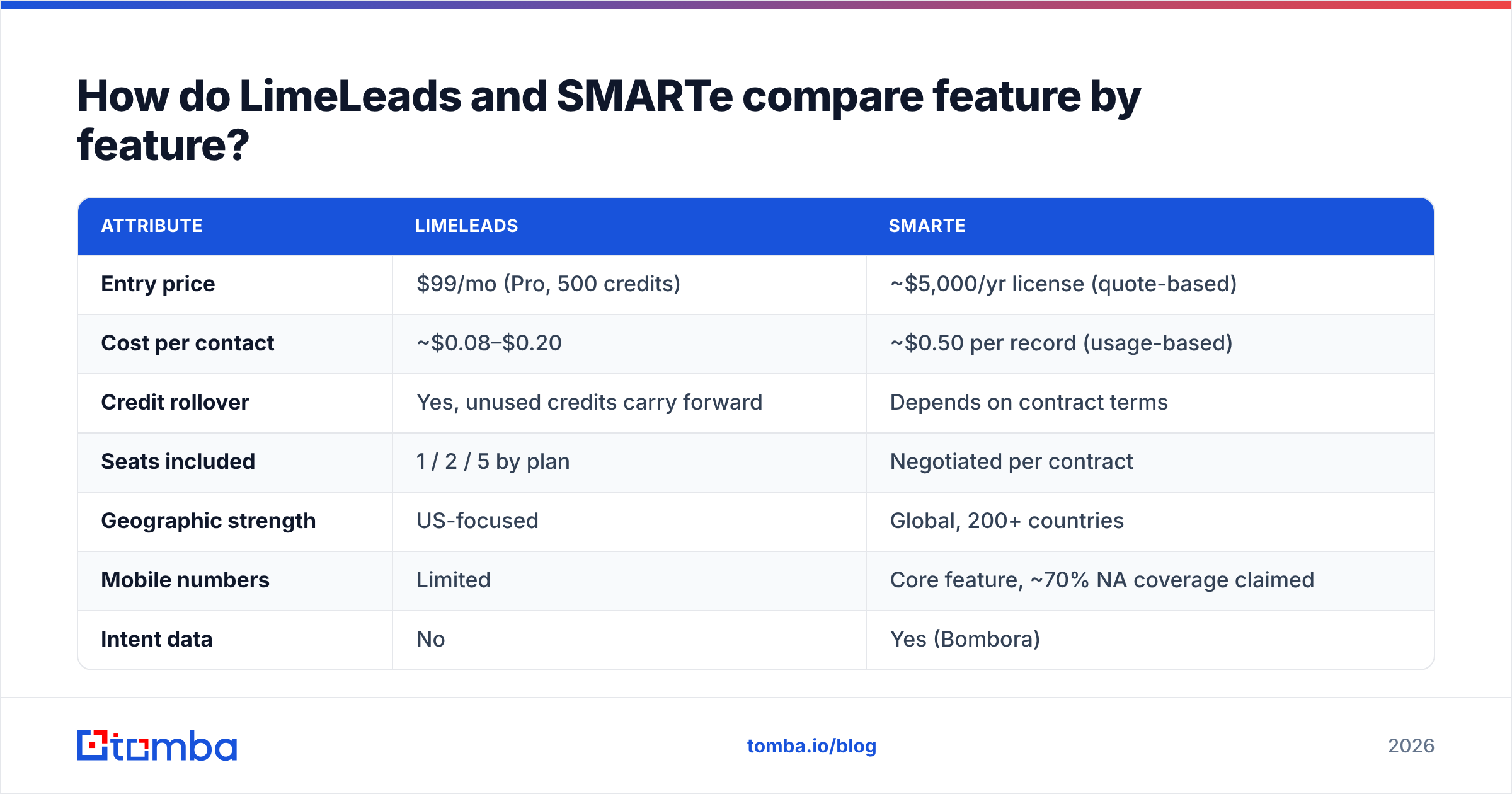
| Attribute | LimeLeads | SMARTe |
|---|---|---|
| Entry price | $99/mo (Pro, 500 credits) | ~$5,000/yr license (quote-based) |
| Cost per contact | ~$0.08–$0.20 | ~$0.50 per record (usage-based) |
| Credit rollover | Yes, unused credits carry forward | Depends on contract terms |
| Seats included | 1 / 2 / 5 by plan | Negotiated per contract |
| Geographic strength | US-focused | Global, 200+ countries |
| Mobile numbers | Limited | Core feature, ~70% NA coverage claimed |
| Intent data | No | Yes (Bombora) |
| Technographics | No | Yes |
| Email verification | At reveal | Verified business emails |
| Buying process | Self-serve, card checkout | Demo + quote |
| Best for | Small US outbound teams, agencies | Mid-market/enterprise, phone-heavy, global SDR teams |
A few caveats about this table. SMARTe's pricing comes from third-party reviews, not a public price page, so your quote may be different. LimeLeads' prices are from its published plans at the time of writing. Both vendors change their packaging from time to time, so check both sites before you budget.
Is LimeLeads better than SMARTe for small teams?#
For most teams under five reps working the US market, yes. The reasons are mostly about money and time:
- You can start today. No demo, no procurement cycle, no yearly commitment.
- Rollover credits cut waste. Seasonal or campaign-based teams don't lose money in quiet months.
- Cost per contact is low. On the Enterprise plan, 5,000 contacts cost $400. At SMARTe's reported usage rate, that $400 buys about 800 records.
The weak spots show up once you need more than emails. If your reps cold call, LimeLeads' limited phone coverage means you'll need a second tool anyway. If you sell into Germany, the UK or Singapore, US-weighted coverage leaves gaps. And LimeLeads has no buying signals, so you won't know which accounts are in-market this quarter.
Is SMARTe worth the higher price?#
It depends on how much of your pipeline comes from the phone. Connect rates on direct mobile numbers are much higher than on switchboard numbers, which is why phone-first SDR teams pay for mobile data. If each rep books even one or two extra meetings a month because they reach decision-makers directly, a $5,000/yr license can pay for itself quickly.
SMARTe also makes more sense when:
- You run global territories. International mobile coverage is hard to find, and SMARTe competes directly on it.
- You prioritize accounts with intent. Bombora topics tell you which accounts are researching your category, so SDRs can focus there first.
- You need CRM enrichment at scale. Filling in and refreshing Salesforce or HubSpot records is a platform job, not a list-building job.
It's not worth it if your team sends email only, works a narrow US ICP, or can't commit to a yearly contract. You'd be paying for mobile data and intent signals you won't use. For more context, G2 and Capterra review pages for both tools are worth skimming for recent comments on data freshness in your specific region. The G2 sales intelligence category is a useful starting point.
What about data accuracy and bounce rates?#
Neither vendor publishes an independent, audited accuracy benchmark, so be careful with any headline accuracy number. What you can control is how you use the data:
- Verify before you send. Even data that was verified at reveal goes stale. People change jobs every couple of years, and B2B contact data decays steadily as a result. Run exports through an email verifier right before a campaign, not weeks earlier.
- Watch for catch-all domains. Many mid-market and enterprise companies accept all mail at the server level, so a "valid" result can still bounce later. Treat catch-all results as their own risk tier.
- Test with a small batch. Before you commit to either vendor, pull 100–200 contacts from your real ICP, verify them, and count how many are valid. That number tells you more than any vendor claim.
A simple way to run the test: pick 20 target accounts, pull every matching contact from each tool's trial or starter tier, and compare valid-email rate, mobile-number hit rate, and how many titles are out of date. You'll learn in an afternoon which database actually covers your market.
Where do dedicated email finders fit in?#
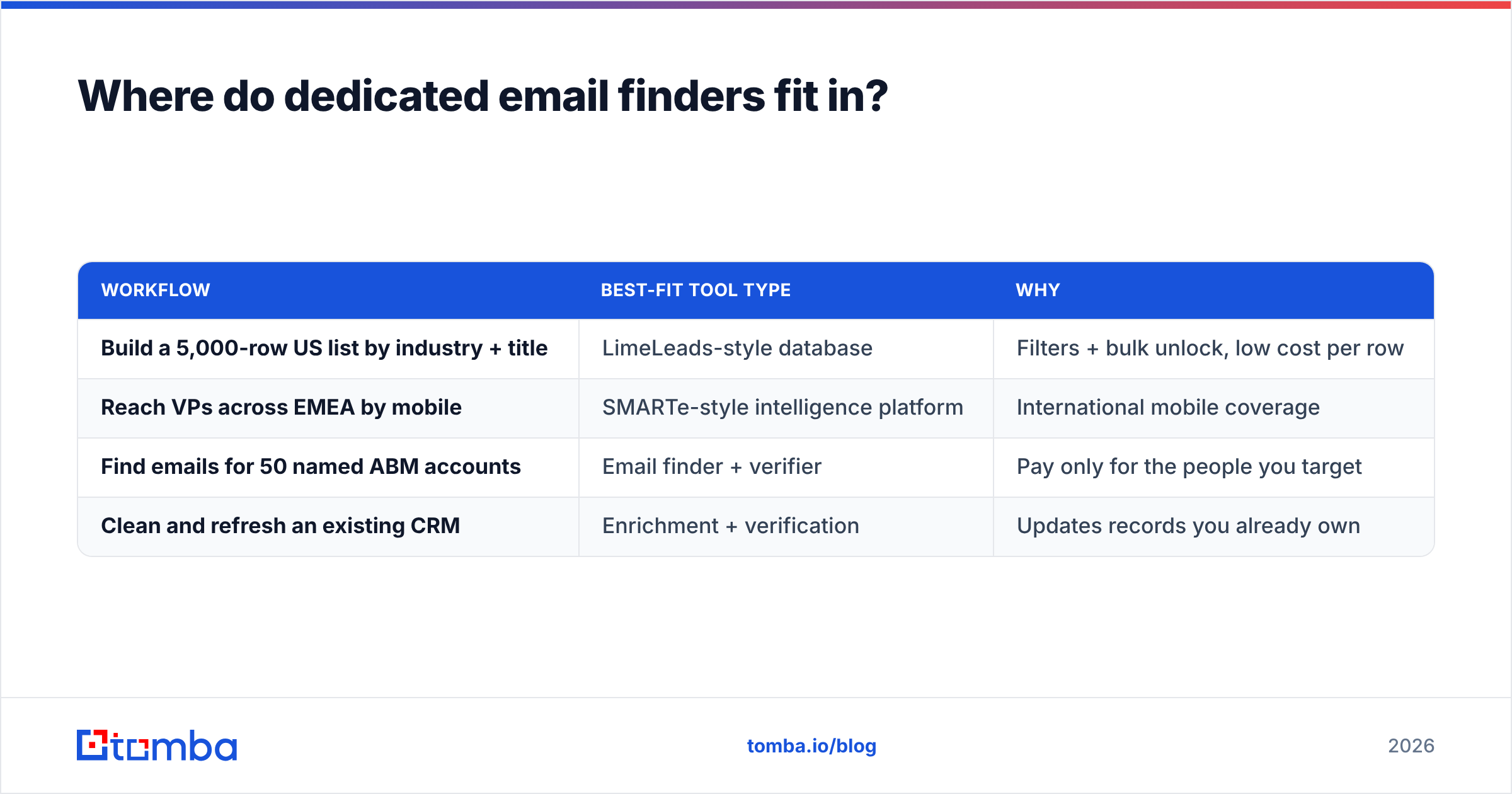
Both LimeLeads and SMARTe are database-first. You search their records and unlock what they've already collected. That works well for building net-new lists. It works less well when you already know the account and the person, and you just need their email.
That's what an email finder does. You enter a name and a company domain, and the tool works out the address from known email patterns and public sources, then verifies it. For account-based outbound, where reps research 30 named accounts rather than downloading 3,000 filtered rows, a finder is often cheaper and more precise than a database license.
| Workflow | Best-fit tool type | Why |
|---|---|---|
| Build a 5,000-row US list by industry + title | LimeLeads-style database | Filters + bulk unlock, low cost per row |
| Reach VPs across EMEA by mobile | SMARTe-style intelligence platform | International mobile coverage |
| Find emails for 50 named ABM accounts | Email finder + verifier | Pay only for the people you target |
| Clean and refresh an existing CRM | Enrichment + verification | Updates records you already own |
Plenty of teams combine them: a database or intelligence platform for discovery, and a finder plus verifier for gaps and final checks. If cost is the main concern, look at Tomba pricing. Plans start with a free tier of 25 searches per month, then Starter at $49/mo, Growth at $99/mo and Pro at $249/mo, all on self-serve monthly billing.

Which should you choose: LimeLeads or SMARTe?#
Use this as a quick decision guide:
- Choose LimeLeads if you're a founder, small agency or 1–5 rep team selling mainly into the US, you prospect mostly by email, and you want predictable monthly spend with credits that don't expire.
- Choose SMARTe if you run an SDR team that relies on phone, sells across multiple regions, wants intent-based prioritization, and has the budget and procurement process for a yearly contract.
- Choose neither (yet) if your motion is account-based and you already know who you want to reach. Start with an email finder and verifier, measure reply rates, and only buy a full database once list building becomes the bottleneck.
The most common mistake is buying for features you think you'll use instead of the workflow your reps actually run. A team that never dials doesn't need 70% mobile coverage. A global team gets little from a US-heavy database, however cheap it is.
Frequently asked questions#
Does LimeLeads have international data? It has some non-US records, but its coverage and positioning are clearly US-focused. If more than a quarter of your pipeline is outside North America, test coverage for your target countries before you buy.
Can you buy SMARTe month to month? Reviews describe yearly licenses as the standard entry point, with usage-based options available. Ask about pilot terms during the demo. Many sales intelligence vendors will agree to a short paid pilot for qualified buyers.
Do LimeLeads credits expire? Based on published plan details, unused credits roll forward to the next billing cycle, which sets it apart from many credit-based competitors.
Which has better phone data? SMARTe, by design. Mobile numbers are its main differentiator, while LimeLeads is primarily an email and firmographic list tool.
Ready to find the exact emails you need?#
If LimeLeads feels too US-only and SMARTe's annual contract is more than your team needs, start with precision instead of volume. Tomba Email Finder lets you find professional email addresses by name, domain or company, verify them in the same step, and pay only for the contacts you actually want. There's a free tier to test it against your own ICP and self-serve plans from $49/mo. Run it on your next 50 target accounts and compare the results with whichever database you're evaluating.
Related guides#
Ready to find emails that actually work?
Join 150,000+ professionals who stopped guessing and started sending. Free credits on signup — no credit card required.
Get the Tomba newsletter
Practical outbound tactics and product updates — once every two weeks.
About the author