LimeLeads vs Soleadify: Contact Data vs Company Data in 2026
LimeLeads sells verified US contacts. Soleadify sells company intelligence crawled from the web. They solve different problems, and picking the wrong one wastes your budget. Here's how to choose.
LimeLeads vs Soleadify comes down to one choice: do you need people to contact, or companies to map?
TL;DR
- LimeLeads and Soleadify aren't really rivals. LimeLeads sells verified contacts at US companies (names, titles, emails, phones). Soleadify sells company-level data. It builds that data by crawling millions of business websites.
- Choose LimeLeads if you need people to email next week and your market is mostly North American. Paid plans start at $99/mo for 500 verified contacts.
- Choose Soleadify to size a market, list SMBs across many countries, or feed company data into a product or model.
- Neither one covers the whole job alone. Soleadify gives you accounts without decision-makers. LimeLeads gives you contacts with thin firmographics outside the US.
- A common stack: build the account list in a company-data tool. Then use a domain-based email finder to get the right people at each account.
What is the real difference between LimeLeads and Soleadify?#
The first question isn't which tool is better. It's what you're buying.
A comparison of LimeLeads vs Soleadify is a bit like comparing a phone book with a business registry. The phone book tells you who to call. The registry tells you which businesses exist, what they do, and where they operate. Both are useful, but they answer different questions.
LimeLeads is a B2B contact database built for outbound sales. You filter by industry, location, company size, and job title, then unlock individual contacts. The company says each email is verified in real time before export. You're only charged for contacts that pass.
Soleadify is a company-data platform. It uses machine learning to crawl company websites (the "About", "Contact", and "Products" pages). It then turns what it finds into structured company records. According to its Datarade profile, it covers over 70 million active SMBs and private companies. That spans roughly 200 countries and 20 languages. The team behind Soleadify now sells much of its enterprise data under the Veridion brand. So you may see both names when you research it.
Put simply, LimeLeads works at the person level and Soleadify works at the company level. Most of the other differences come from that.
How do LimeLeads and Soleadify compare feature by feature?#
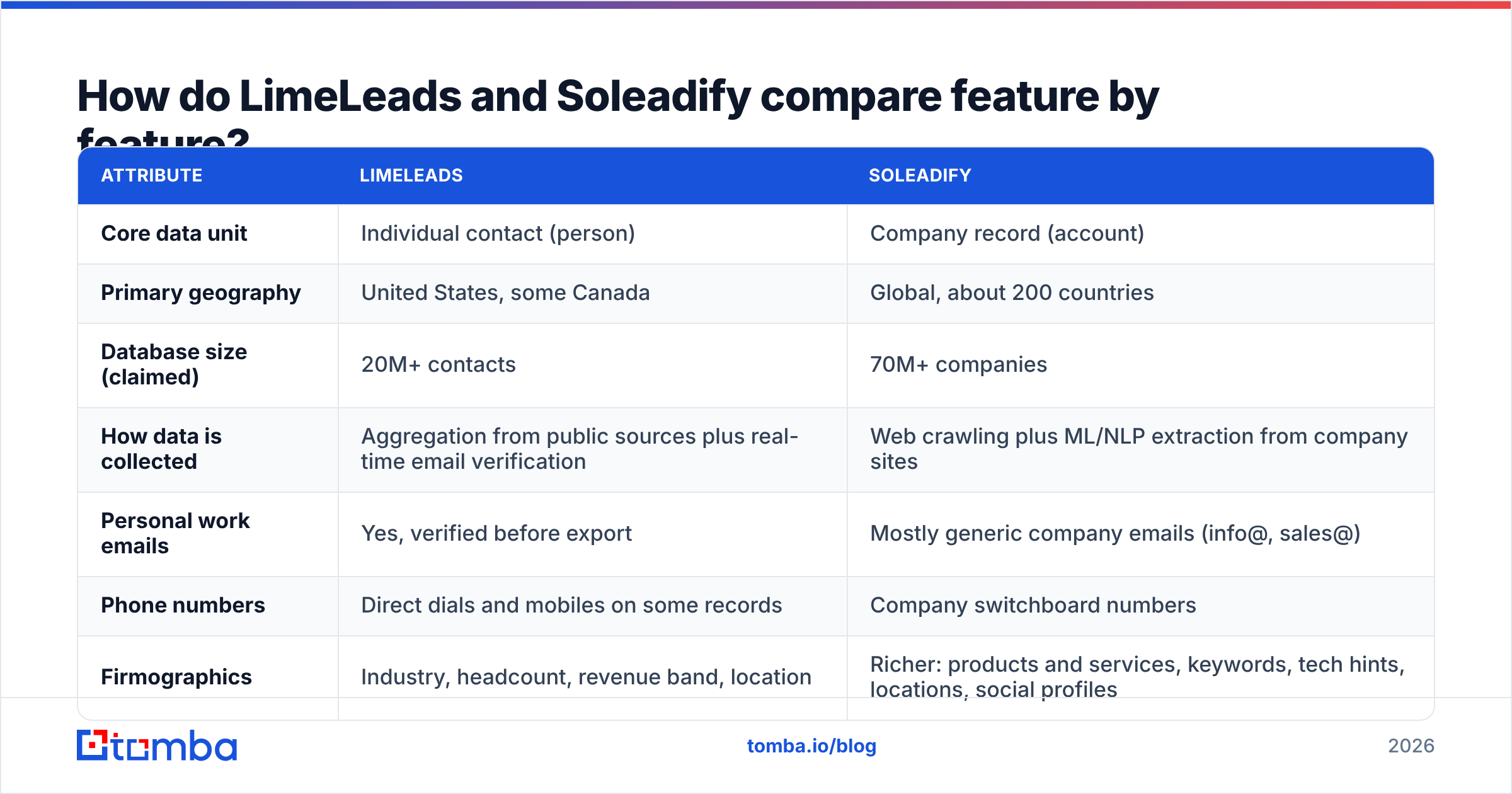
Here's the LimeLeads vs Soleadify comparison on the attributes that matter when you're choosing a data vendor:
| Attribute | LimeLeads | Soleadify |
|---|---|---|
| Core data unit | Individual contact (person) | Company record (account) |
| Primary geography | United States, some Canada | Global, about 200 countries |
| Database size (claimed) | 20M+ contacts | 70M+ companies |
| How data is collected | Aggregation from public sources plus real-time email verification | Web crawling plus ML/NLP extraction from company sites |
| Personal work emails | Yes, verified before export | Mostly generic company emails (info@, sales@) |
| Phone numbers | Direct dials and mobiles on some records | Company switchboard numbers |
| Firmographics | Industry, headcount, revenue band, location | Richer: products and services, keywords, tech hints, locations, social profiles |
| Entry paid price | $99/mo (Pro, 500 credits) | From about $99/mo on self-serve listings; datasets and API are custom-quoted |
| Credit model | 1 credit = 1 verified contact; unused credits reportedly roll over | Volume-based; datasets priced per company record |
| Best for | SDR teams running cold email and calls into the US | Market mapping, SMB account lists, data products |
The table makes the trade-off clear. LimeLeads is narrow and deep on people. Soleadify is broad and deep on companies. If your main goal is meetings booked, LimeLeads fits better. If your main goal is to understand your whole market, Soleadify does.
How much does LimeLeads cost compared with Soleadify?#
Pricing is where most LimeLeads vs Soleadify decisions go wrong. The two vendors don't use the same unit of value.
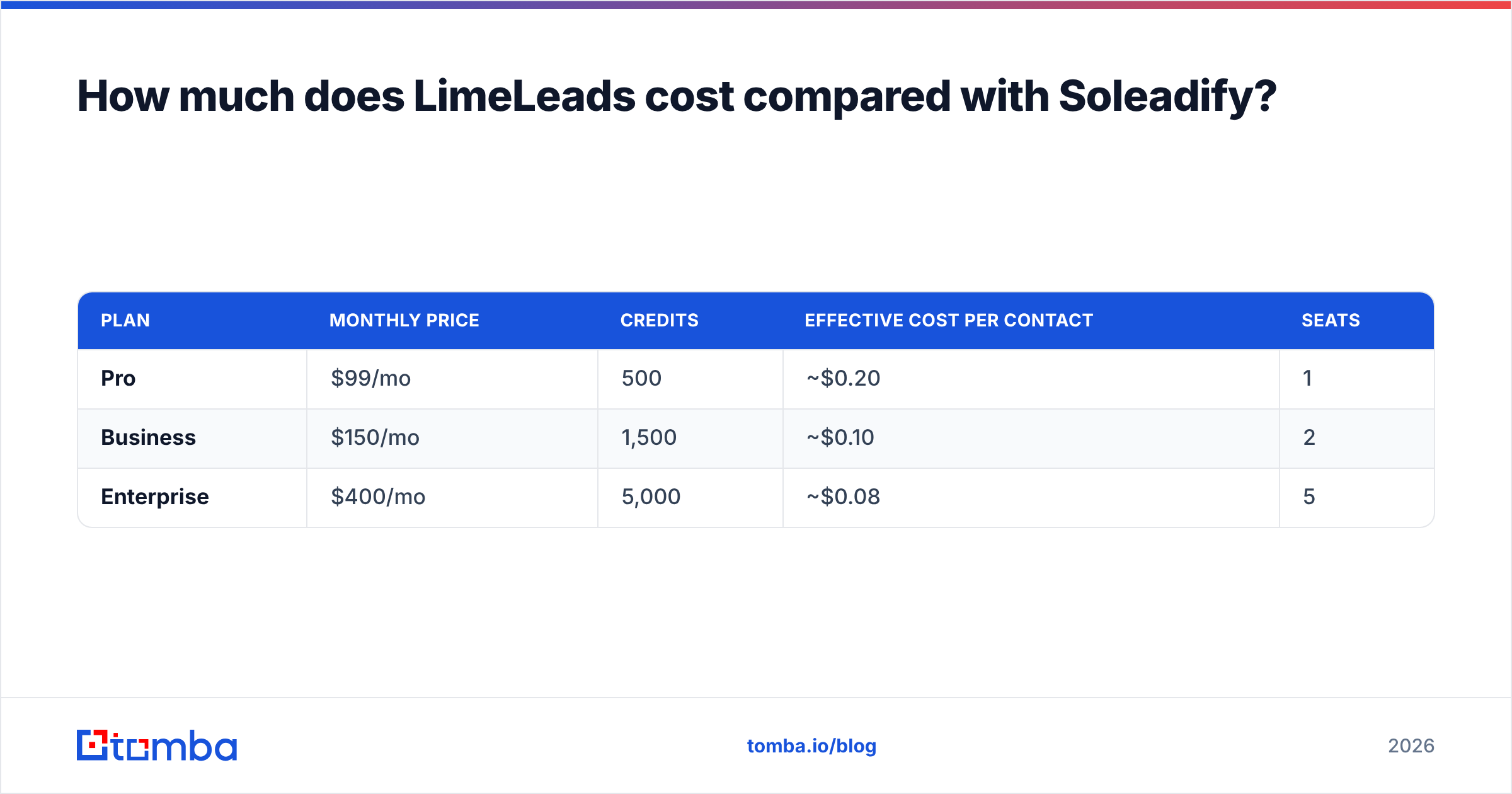
LimeLeads pricing (at the time of writing):
| Plan | Monthly price | Credits | Effective cost per contact | Seats |
|---|---|---|---|---|
| Pro | $99/mo | 500 | ~$0.20 | 1 |
| Business | $150/mo | 1,500 | ~$0.10 | 2 |
| Enterprise | $400/mo | 5,000 | ~$0.08 | 5 |
Third-party pricing trackers report a discount of around 35% for annual billing. Overage rates also get cheaper on higher tiers. Two policies are worth noting. You're only charged for contacts that pass verification, and unused credits reportedly carry forward. Check both on the live pricing page before you commit. Vendors change these terms without much notice.
Soleadify pricing is harder to pin down. Listings such as Capterra show a starting price of about $99 with a free trial. Costs then scale with the number of leads you pull. For bulk datasets and the API, pricing is custom and based on volume. Datarade lists datasets from roughly $2.50 per company record per year.
That per-record figure is where budgets fall apart. $2.50 sounds cheap until you do the math. A slice of 200,000 European SMBs costs $500,000 a year. And that's before you've found a single decision-maker's email. At the other end, a focused list of a few thousand accounts is very affordable. Scope your export before you ask for a quote.
A quick way to compare cost: work out cost per useful conversation, not cost per record. Say a $0.10 LimeLeads contact reaches the VP of Operations directly. It can beat a $0.02 company record that only gives you an info@ address. A generic inbox rarely gets your message to a buyer.
Which tool has better data accuracy?#
In a LimeLeads vs Soleadify accuracy check, both vendors claim high scores. But they measure different things.
LimeLeads measures accuracy by whether an email is deliverable. It verifies every contact before export and only charges for valid ones. Review sites cite a 98%+ accuracy guarantee and weekly database refreshes. For cold email, this is the number that protects your sender reputation. A high bounce rate damages your domain much faster than a low reply rate does.
One caveat: "verified" usually means the mailbox passed a server check at export time. Catch-all domains accept every address. On those, verification can't confirm the specific person exists. If many of your target accounts use catch-all mail servers, test a sample first. Then run those addresses through a dedicated catch-all verifier.
Soleadify measures accuracy by whether the company record is current. Is the business still active? Does it still offer that product line? Is the address right? The data comes straight from company websites and is refreshed by constant crawling. So it tends to be fresh for small businesses that older databases miss. Think of a regional HVAC installer or a 12-person software agency in Lisbon. The weakness is built in. A website tells you what a company does. It rarely tells you who the head of procurement is or what their email address is.
So on contact accuracy, LimeLeads wins because Soleadify doesn't really compete there. On company coverage and freshness outside the US, Soleadify is the stronger dataset.
Who should pick LimeLeads?#
LimeLeads is a good fit if most of these are true for you:
- You sell into the US market. The database is built around North American businesses, and its filters and coverage are strongest there.
- You run outbound sequences every week. Credit-based pricing suits a steady rhythm: pull a few hundred contacts, sequence them, and repeat.
- You're a small team. The Pro plan has one seat and the Business plan has two. That suits founders and small SDR pods, not 40-rep sales floors.
- You want pricing you can predict. Fixed monthly tiers are easier to forecast than custom data contracts.
- You care more about bounce rate than company detail. Pay-per-verified-contact keeps your list clean without extra tools.
Where LimeLeads falls short: thin coverage outside the US, no built-in sequencing, and basic company data. User reviews on G2 and Capterra generally praise the simplicity and complain about gaps in niche verticals.
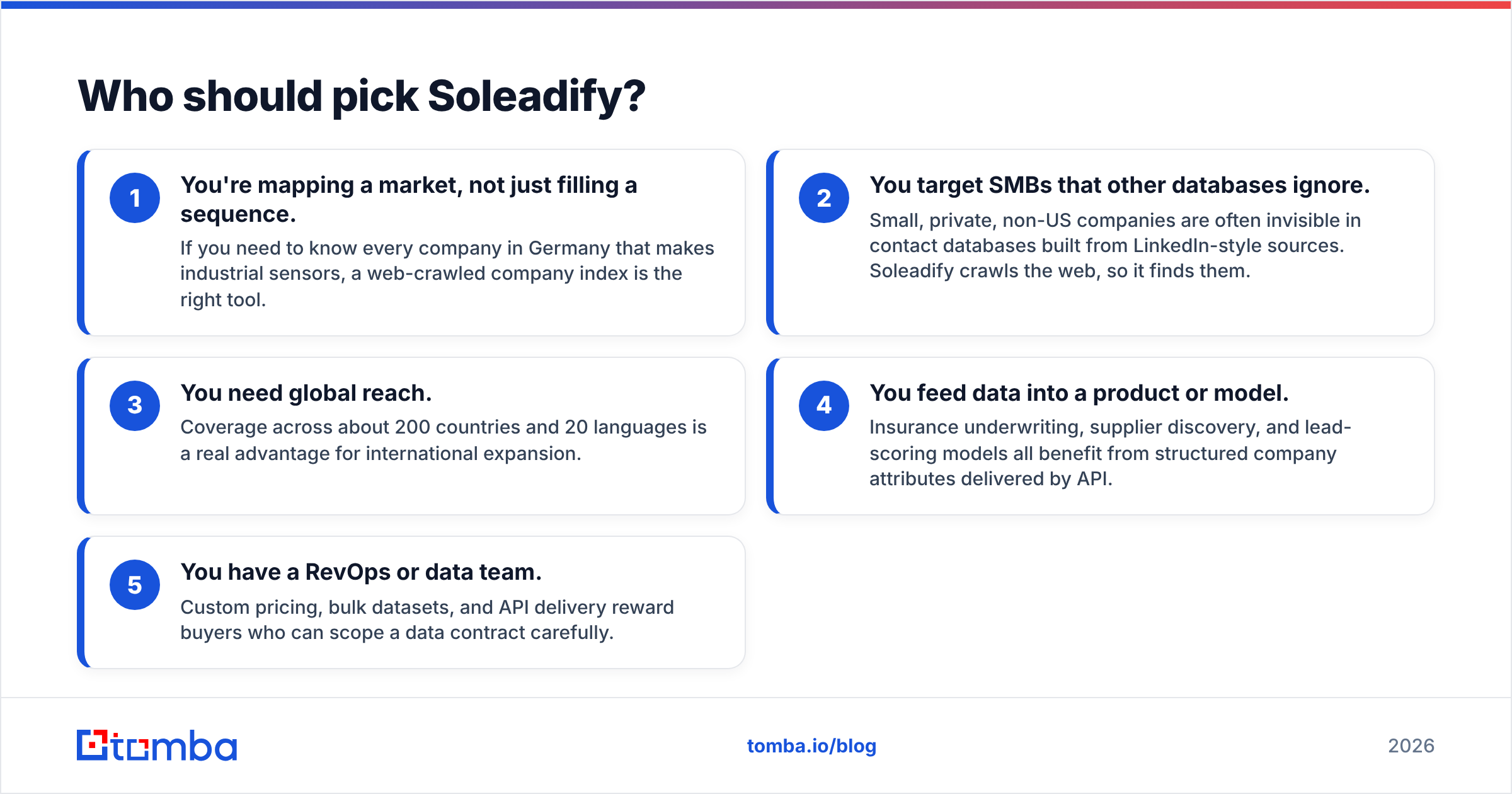
Who should pick Soleadify?#
Soleadify earns its place in a different kind of workflow:
- You're mapping a market, not just filling a sequence. Say you need every company in Germany that makes industrial sensors. A web-crawled company index is the right tool.
- You target SMBs that other databases ignore. Small, private, non-US companies are often missing from contact databases built from LinkedIn-style sources. Soleadify crawls the web, so it finds them.
- You need global reach. Coverage across about 200 countries and 20 languages is a real advantage for international expansion.
- You feed data into a product or model. Insurance pricing, supplier discovery, and lead scoring all benefit from clean company data delivered by API.
- You have a RevOps or data team. Custom pricing, bulk datasets, and API delivery reward buyers who can scope a data contract carefully.
Where Soleadify falls short for sales reps: you get the company, its website, a switchboard number and a generic inbox. You still need a second step to reach a named decision-maker. It also has few reviews. Capterra shows a strong rating, but on only a handful of reviews. So you're relying more on a trial than on crowd evidence.
Can you use LimeLeads and Soleadify together?#
Yes. For teams that sell into SMBs internationally, the combination often works better than either tool alone. The workflow looks like this:
- Build the account universe. Pull a filtered company list from a company-data source like Soleadify, based on industry, geography, products offered, and size signals.
- Prioritize the accounts. Score them against your ICP in your CRM or spreadsheet. Leave out anything that doesn't match your best-customer profile.
- Find the people. For US accounts, a contact database like LimeLeads may already have the decision-makers. For everything else, run the domains through a domain search to see the named, role-based emails published for each company.
- Verify before you send. Clean every address with an email verifier, especially for domains outside the US, where catch-all servers are common.
- Sequence and measure. Track reply rate by source so you know which data layer is actually producing meetings.
This split of company data first and contact data second is how most mature outbound teams run things, whatever vendors they choose. The account layer tells you where to fish, and the contact layer puts the line in the water.
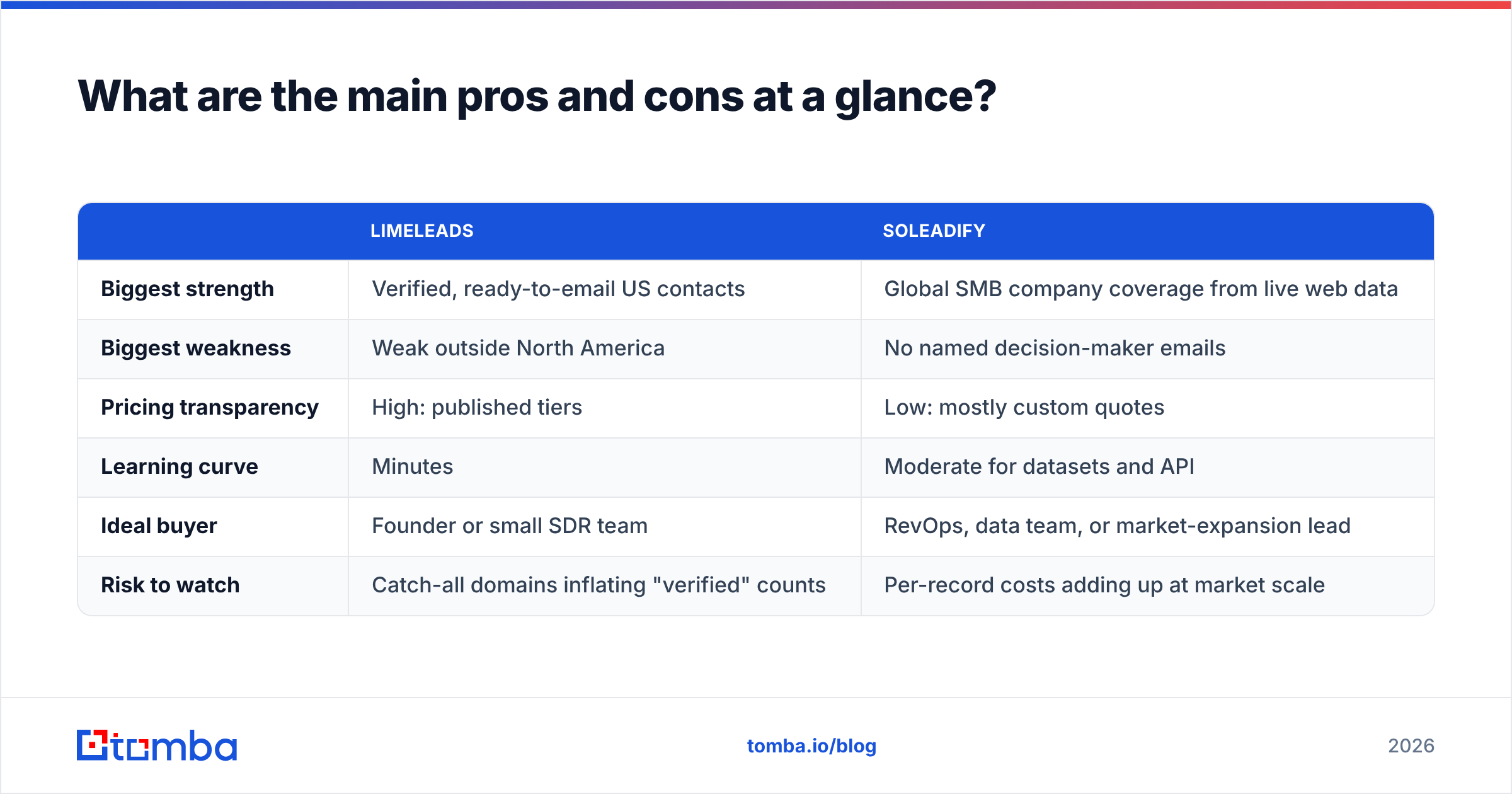
What are the main pros and cons at a glance?#
| LimeLeads | Soleadify | |
|---|---|---|
| Biggest strength | Verified, ready-to-email US contacts | Global SMB company coverage from live web data |
| Biggest weakness | Weak outside North America | No named decision-maker emails |
| Pricing transparency | High: published tiers | Low: mostly custom quotes |
| Learning curve | Minutes | Moderate for datasets and API |
| Ideal buyer | Founder or small SDR team | RevOps, data team, or market-expansion lead |
| Risk to watch | Catch-all domains inflating "verified" counts | Per-record costs adding up at market scale |
LimeLeads vs Soleadify: which one should you choose?#
It comes down to what you'll actually do with the data on Monday morning.
If the plan is to write cold emails to US buyers, LimeLeads is the more direct choice. It's cheaper to start, faster to use, and built around deliverable contacts. Maybe the plan is to understand a market or find small companies across dozens of countries. Or you need to feed company data into a system. Then Soleadify gives you something LimeLeads can't.
If you're choosing on price alone, don't. A 500-contact LimeLeads plan and a $99 Soleadify entry point look similar on a pricing page but deliver different kinds of data. Match the data type to the job. Run a small paid test with each vendor, and judge them on replies and meetings rather than record counts.
Maybe you already have an account list from Soleadify, a CRM export, or a spreadsheet of target domains. If you now need the actual decision-makers at those companies, Tomba Email Finder covers that step. Enter a name and domain, or bulk-upload a list. Tomba returns professional email addresses with confidence scores and source URLs, and verification is included. There's a free tier with 25 searches a month for testing, and paid plans start at $49/mo. See the full Tomba pricing to size it against your pipeline.
Related guides#
// get started
Find, verify and enrich your first contacts today
Start on the free plan with 25 searches a month, then scale when your team is ready.
Free plan · No credit card required · GDPR & CCPA
// about the author