Line2 vs RingCentral: Business Phone Comparison for Sales Teams
Line2 gives you a cheap second business number on the phone you already carry. RingCentral gives you a full cloud phone system. Here's how each one holds up for outbound sales teams, and where each one falls short.
- Line2 is a second-line app. It puts a business number on the smartphone and laptop you already use, and it costs roughly $10–$22 per line per month depending on plan and billing cycle. It's a good fit for solo reps, founders and very small teams.
- RingCentral (RingEX) is a full UCaaS platform. It costs $20–$35 per user per month on annual billing, or $30–$45 billed monthly, and bundles calling, video, team chat, call queues, analytics and native CRM integrations.
- For outbound sales, RingCentral wins once you need call recording at scale, supervisor monitoring, or Salesforce/HubSpot logging. Line2 wins when all you need is a clean, cheap business number.
- Neither tool makes your calls connect. Your connect rate depends on the quality of the numbers you dial, so budget for verified contact data whichever phone system you choose.
What are Line2 and RingCentral, really?#
People compare these two tools all the time, but they sit in different categories.
Line2 has been around since the early smartphone era. Its job is simple: give you a second phone number, local or toll-free, that runs as an app on your existing iPhone, Android or desktop. You get calls, texts, voicemail and forwarding without buying a second device or setting up a PBX. The upper plans add an auto attendant, call recording and voicemail transcription.
RingCentral is one of the largest unified communications as a service (UCaaS) vendors. Its phone product, RingEX (formerly RingCentral MVP), is a cloud PBX for businesses with anywhere from five to several thousand users. You get extensions, ring groups, call queues, IVR menus, video meetings, team messaging, analytics dashboards and a large integration marketplace. You can see the full plan breakdown on RingCentral's official pricing page.
An analogy helps. Line2 is like adding a dedicated business drawer to your own desk. RingCentral is like leasing a furnished office floor with a reception desk. Both let you work, but they solve different sizes of problem.
How do Line2 and RingCentral compare feature by feature?#
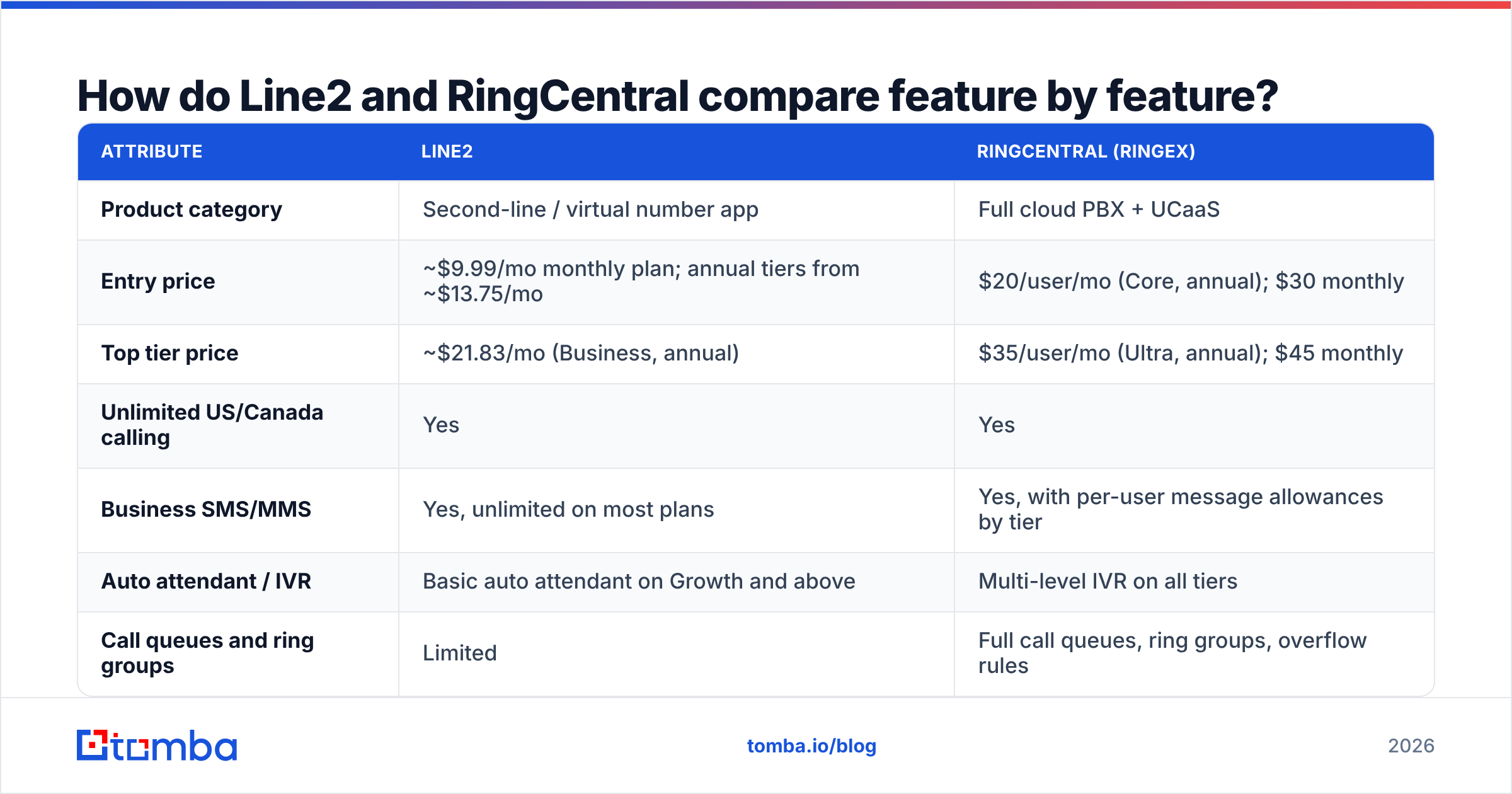
Here's the side-by-side view for a sales team evaluating both in 2026. Prices reflect published list pricing at the time of writing. Both vendors change plans often, so check before you buy.
| Attribute | Line2 | RingCentral (RingEX) |
|---|---|---|
| Product category | Second-line / virtual number app | Full cloud PBX + UCaaS |
| Entry price | ~$9.99/mo monthly plan; annual tiers from ~$13.75/mo | $20/user/mo (Core, annual); $30 monthly |
| Top tier price | ~$21.83/mo (Business, annual) | $35/user/mo (Ultra, annual); $45 monthly |
| Unlimited US/Canada calling | Yes | Yes |
| Business SMS/MMS | Yes, unlimited on most plans | Yes, with per-user message allowances by tier |
| Auto attendant / IVR | Basic auto attendant on Growth and above | Multi-level IVR on all tiers |
| Call queues and ring groups | Limited | Full call queues, ring groups, overflow rules |
| Call recording | Business tier | On-demand on Core; automatic on Advanced and Ultra |
| Supervisor monitor / whisper / barge | No | Advanced and Ultra |
| Native CRM integrations | Minimal | Salesforce, HubSpot, Zendesk and many more (Advanced+) |
| Video meetings | No | Included (100–200 participants by tier) |
| Team chat | No | Included |
| Admin console and user management | Light | Full, with roles, sites, analytics |
| Best fit | Solo reps, founders, 1–5 person teams | SDR/AE teams of 5+, call centers, multi-location businesses |
The pattern is clear. Line2 costs less and does less. RingCentral costs more and covers everything a managed sales floor needs, plus a lot a two-person startup will never touch.
What does each tool actually cost a sales team?#
List prices look close for a single seat. They drift apart quickly as you add people and features.
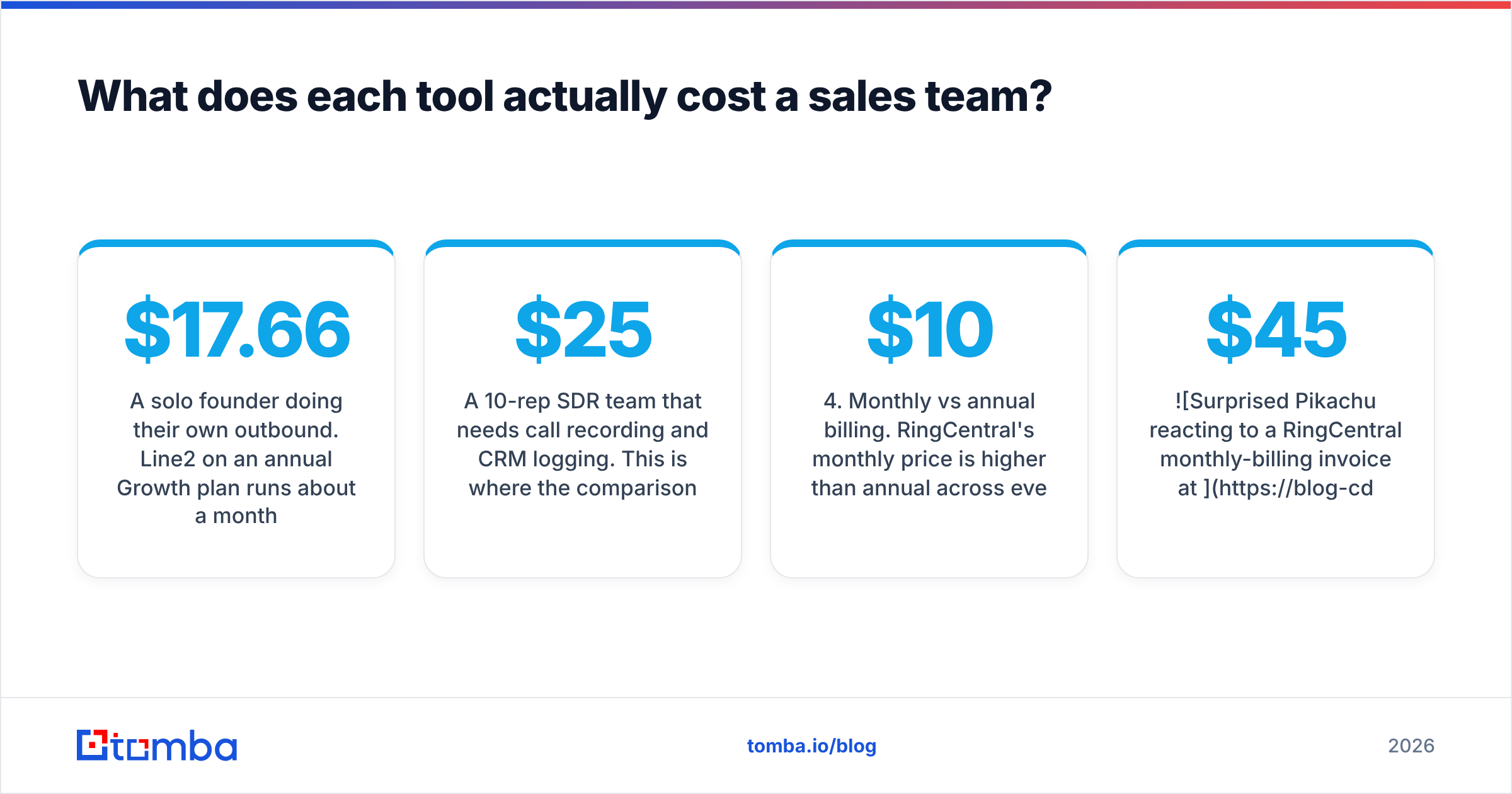
A solo founder doing their own outbound. Line2 on an annual Growth plan runs about $17.66 a month, or roughly $212 a year. RingCentral Core on annual billing is $20 a month, or $240 a year. The gap is small, but on Core you'd be paying for video, chat and admin tooling you probably won't use.
A 10-rep SDR team that needs call recording and CRM logging. This is where the comparison changes. Line2 has no real answer for supervisor features or native CRM activity logging, so you'd be layering on third-party tools. RingCentral Advanced at $25/user/month annual comes to $3,000 a year for 10 seats, and it includes automatic recording, call monitoring and CRM integrations out of the box.
The hidden costs on both sides:
- Additional numbers. Both vendors charge extra for more local or toll-free numbers beyond what the plan includes.
- Toll-free minutes. Toll-free inbound usage is often metered or capped on lower tiers.
- A2P 10DLC registration. If you send business texts to US numbers, carrier registration fees apply regardless of vendor. The Campaign Registry process is the same whichever platform you use.
- Monthly vs annual billing. RingCentral's monthly price is $10 per user higher than annual across every tier. On a 20-seat team that's $2,400 a year for flexibility.
- Add-ons. RingCentral sells AI features, extra storage and contact-center capabilities as add-ons or higher tiers. Price the bundle you'll actually run, not just the headline plan.
That line can be misread, so to be precise: the meme placeholder goes here.
Is Line2 good enough for cold calling?#
For a single rep, often yes. Line2 does the basics well:
- A local presence number in the area code you're prospecting, which tends to lift pickup rates compared with an unfamiliar out-of-state number.
- Unlimited calling and texting across the US and Canada, so you're not watching a minute counter during a heavy dial day.
- Separation of personal and business lines on one device, which matters when you're following up from your phone between meetings.
- Voicemail transcription and recording on the Business tier, which covers basic coaching and compliance for small teams.
Where Line2 struggles is anything that needs a manager. There's no live call monitoring, no whisper coaching, no queue-level reporting, and no native way to push call activity into your CRM. If you have a head of sales who needs to see who dialed what, how long calls lasted and what got logged, you'll end up exporting data by hand or building Zapier glue.
Line2 also doesn't include a power dialer. For high-volume outbound (100+ dials per rep per day), you'll need a separate dialer tool whichever phone system you pick. RingCentral's native dialing is also not a true parallel dialer, but its integration ecosystem makes plugging one in much easier.
Is RingCentral overkill for a small team?#
It can be. RingCentral is built to scale, and the admin console shows it. Setting up extensions, call-handling rules, business hours and IVR trees takes longer than activating a Line2 number, which you can do in about five minutes.
RingCentral earns its price when you have any of the following:
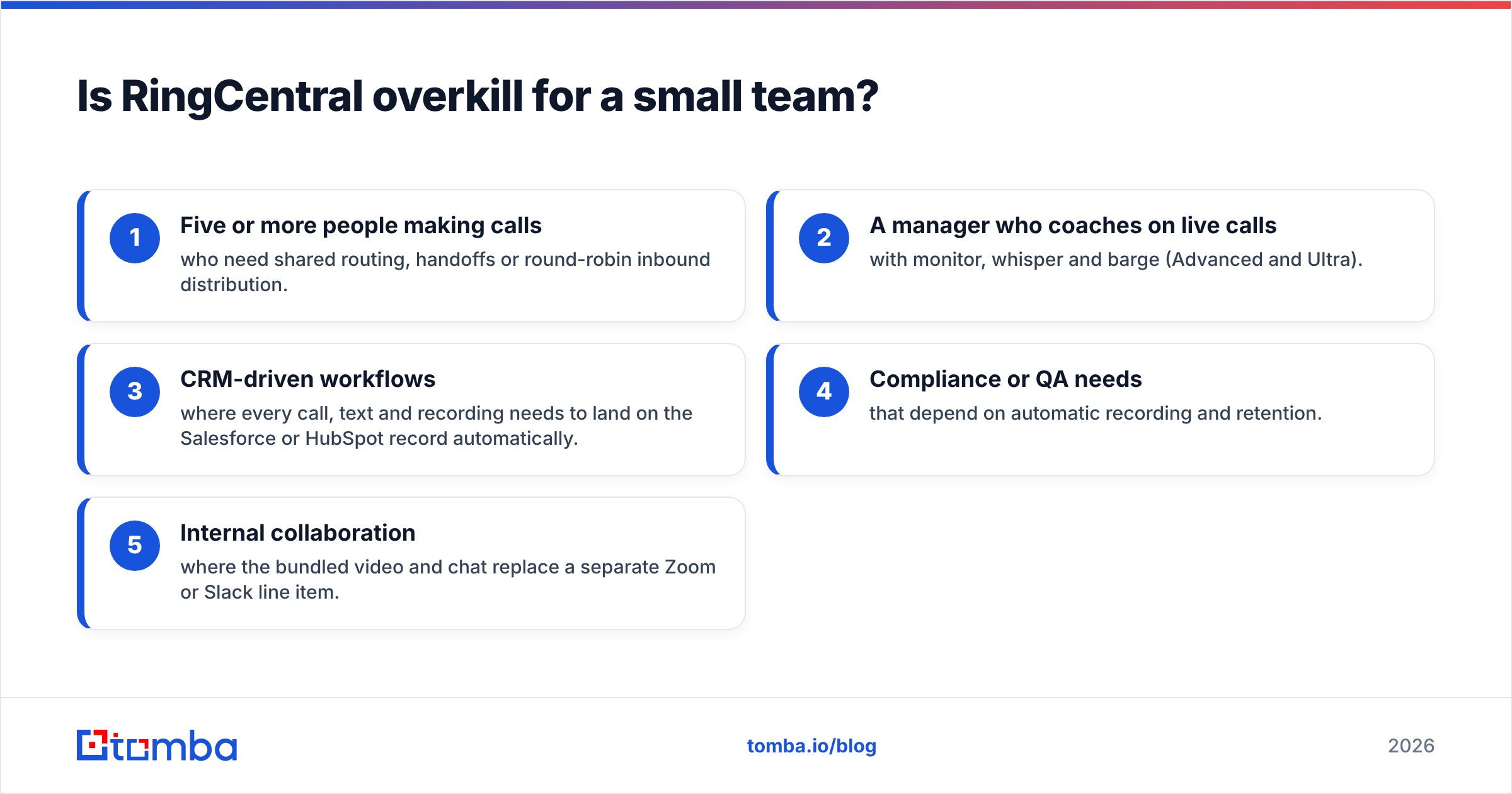
- Five or more people making calls who need shared routing, handoffs or round-robin inbound distribution.
- A manager who coaches on live calls with monitor, whisper and barge (Advanced and Ultra).
- CRM-driven workflows where every call, text and recording needs to land on the Salesforce or HubSpot record automatically.
- Compliance or QA needs that depend on automatic recording and retention.
- Internal collaboration where the bundled video and chat replace a separate Zoom or Slack line item.
If none of those apply, RingCentral's extra capability is shelf-ware. A two-person agency that just needs a professional number is better served by Line2 or a similar lightweight app.
Reviews reflect the same split. On G2's Line2 listing, users praise simplicity and price and criticize occasional call-quality issues and thin business tooling. RingCentral reviews tend to praise breadth and reliability and complain about admin complexity and support wait times.
Which one integrates better with a sales tech stack?#
RingCentral, and it isn't close.
RingCentral's App Gallery lists hundreds of integrations, including native connectors for Salesforce, HubSpot, Zendesk, Microsoft Teams and Google Workspace. On Advanced and above, calls can auto-log to CRM records, click-to-dial works inside the CRM, and recordings attach to activity timelines. RingCentral also exposes a mature developer API for custom workflows.
Line2's integration story is minimal. It's designed as a standalone communication app rather than a node in a revenue stack. You can work around that with manual logging or automation platforms, but every workaround is a place where data gets lost.
For teams that care about revenue operations, clean activity data matters as much as the calls do. If your forecasting, lead scoring or attribution depends on call outcomes reaching the CRM, you're choosing RingCentral or another UCaaS platform with deep CRM connectors.
Why does your contact data matter more than your phone system?#
This is the part most "Line2 vs RingCentral" comparisons skip. The phone system is the pipe. What flows through it, meaning the numbers your reps actually dial, decides whether the pipe is worth paying for.
Run the math. A rep on RingCentral Advanced costs $25 a month in seat fees and several thousand dollars a month in salary. If 30% of the numbers in their list are disconnected, wrong-person or reception switchboards, you're burning roughly a third of that salary on dead dials. No IVR tree or call-recording feature fixes a bad list.

A practical data hygiene workflow for any phone system:
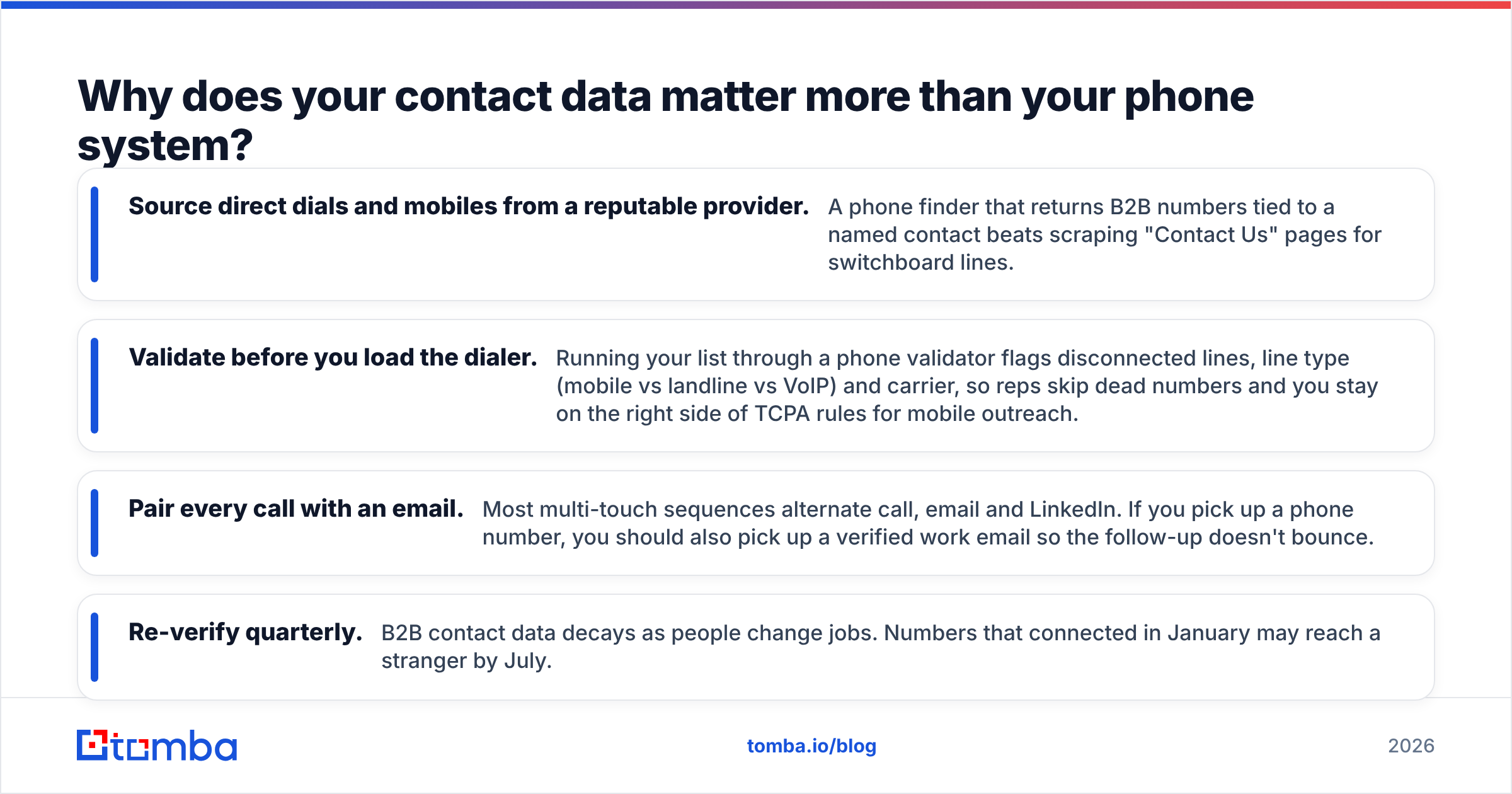
- Source direct dials and mobiles from a reputable provider. A phone finder that returns B2B numbers tied to a named contact beats scraping "Contact Us" pages for switchboard lines.
- Validate before you load the dialer. Running your list through a phone validator flags disconnected lines, line type (mobile vs landline vs VoIP) and carrier, so reps skip dead numbers and you stay on the right side of TCPA rules for mobile outreach.
- Pair every call with an email. Most multi-touch sequences alternate call, email and LinkedIn. If you pick up a phone number, you should also pick up a verified work email so the follow-up doesn't bounce.
- Re-verify quarterly. B2B contact data decays as people change jobs. Numbers that connected in January may reach a stranger by July.
This applies equally to both tools. Line2 users tend to be scrappy founders pulling numbers by hand, which makes validation even more important. RingCentral teams usually dial at volume, so every percentage point of bad data compounds across seats.
Which should you choose: Line2 or RingCentral?#
Here's the decision framework in plain terms.
Pick Line2 if:
- You're a solo seller, founder or consultant who needs a professional business number on your existing phone.
- Your budget is under $25 a month per line and you want it running today.
- You don't need call queues, supervisor tools or CRM auto-logging.
- You mostly call and text one-to-one, not at call-center volume.
Pick RingCentral if:
- You manage five or more reps, or plan to within the next year.
- You need automatic call recording, live coaching or queue analytics.
- Your CRM is the source of truth and every call needs to land there automatically.
- You want video, chat and phone under one vendor and one invoice.
Consider neither if your main motion is high-velocity outbound dialing. Look at a dedicated sales dialer (Aircall, JustCall, Orum, Nooks and similar) that plugs into your CRM and adds power or parallel dialing. RingCentral can be the company phone system while the SDR team runs on a specialized dialer.
A good rule: if your current pain is "I don't want to give prospects my personal cell," you need Line2. If it's "I can't see what my team is doing on the phones," you need RingCentral.
What are the pros and cons at a glance?#
Line2 pros
- Low price and fast setup
- Runs on the device you already carry
- Unlimited US/Canada calling and texting
- Local and toll-free numbers available
Line2 cons
- Limited team and admin features
- Minimal CRM integration
- No live call coaching
- Call recording only on the top tier
RingCentral pros
- Complete cloud PBX with IVR, queues and routing
- Deep CRM and productivity integrations
- Supervisor monitoring, whisper and barge on Advanced+
- Bundled video meetings and team messaging
RingCentral cons
- Higher per-seat cost, especially on monthly billing
- Steeper admin learning curve
- Key sales features locked to Advanced and Ultra
- Add-ons can inflate the final bill
Frequently asked questions#
Can I port my existing number to Line2 or RingCentral?#
Yes. Both support number porting from most US carriers. Porting usually takes one to three weeks, and you should keep your old service active until the port completes.
Does RingCentral have a free trial?#
RingCentral has historically offered time-limited trials on RingEX. Line2 offers a free trial and a money-back window on annual plans. Check each vendor's site for current terms, since both change them periodically.
Is Line2 HIPAA compliant?#
Line2 is not generally positioned for regulated healthcare communication. RingCentral supports HIPAA-conforming configurations and will sign a BAA on eligible plans. If you handle protected health information, confirm compliance details directly with the vendor.
Can I use either tool for SMS marketing?#
Both support business texting, but US A2P 10DLC registration is required for application-to-person messaging. Neither is a bulk SMS marketing platform. For one-to-one sales texting they work fine. For broadcast campaigns, use a dedicated SMS tool.
Which is better for international calling?#
Both offer international calling at per-minute rates. RingCentral also offers local numbers in many countries and is a better fit for teams spread across regions. Line2 focuses on the US and Canada.
The bottom line#
Line2 and RingCentral aren't really rivals. They're answers to different questions. Line2 is the smart, cheap pick for a solo seller who needs a business number without the overhead. RingCentral is the right platform for sales teams that need routing, coaching, recording and CRM-connected call data. Pick by team size and management needs, not by the headline price.
Whichever phone system you pick, the numbers and emails in your list still decide your results. Tomba Email Finder finds verified professional emails by name, domain or company, and it pairs with Tomba's phone finder and validator so every prospect you dial also has a working inbox for follow-up. Start on the free tier with 25 searches a month, or see the Tomba pricing plans from $49/mo when your team is ready to scale.
Related guides#
// get started
Find, verify and enrich your first contacts today
Start on the free plan with 25 searches a month, then scale when your team is ready.
Free plan · No credit card required · GDPR & CCPA
// about the author