Listkit vs Xverum (2026): Lead Lists or Raw B2B Data Feeds?
Listkit sells verified lead lists your SDRs can export today. Xverum sells bulk web datasets your data team has to process first. Here's how to tell which one fits your team, and what each costs in 2026.
TL;DR
- Listkit is a self-serve lead list builder for outbound teams. You filter contacts, export them with emails that are verified when you export, and load them into a sequencer the same afternoon.
- Xverum is a data provider. It sells large structured datasets and APIs covering people, companies, jobs and locations, mostly on custom contracts, and it's built for data engineers, not SDRs.
- Pricing works very differently. Listkit uses monthly credit plans. Xverum quotes per dataset, and its marketplace listings start around $1,000/month.
- Pick Listkit if you want campaign-ready contacts this week. Pick Xverum if you're building a product, model or internal data warehouse that needs millions of records.
- If you only need verified emails for specific people or domains, a pay-per-lookup email finder is usually cheaper than either.
What is the real difference between Listkit and Xverum?#
Most "Listkit vs Xverum" searches start from a false premise. People expect two tools that do the same job. They don't. They sit at opposite ends of the B2B data supply chain.
Think of it like groceries. Listkit is a meal kit: portioned, labelled, ready to cook tonight. Xverum is a wholesale supplier: huge volume and better unit economics, but you need a kitchen, staff and a plan before any of it becomes a meal.
In practice:
- Listkit gives you a search interface over a contact database it advertises at 710M+ contacts. You filter by title, industry, headcount and location, then export leads with emails that are verified at the moment of export. Its whole product is built around cold email.
- Xverum collects, cleans and structures public web data on individuals, companies, job postings and points of interest. Its Datarade profile cites 750M individual profiles, 50M+ company records, 230M+ POIs and tens of millions of job postings processed every day. Data ships as JSON or CSV files or through an API.
So the useful question is which layer of the stack you're buying for.
How do Listkit and Xverum compare on core capabilities?#
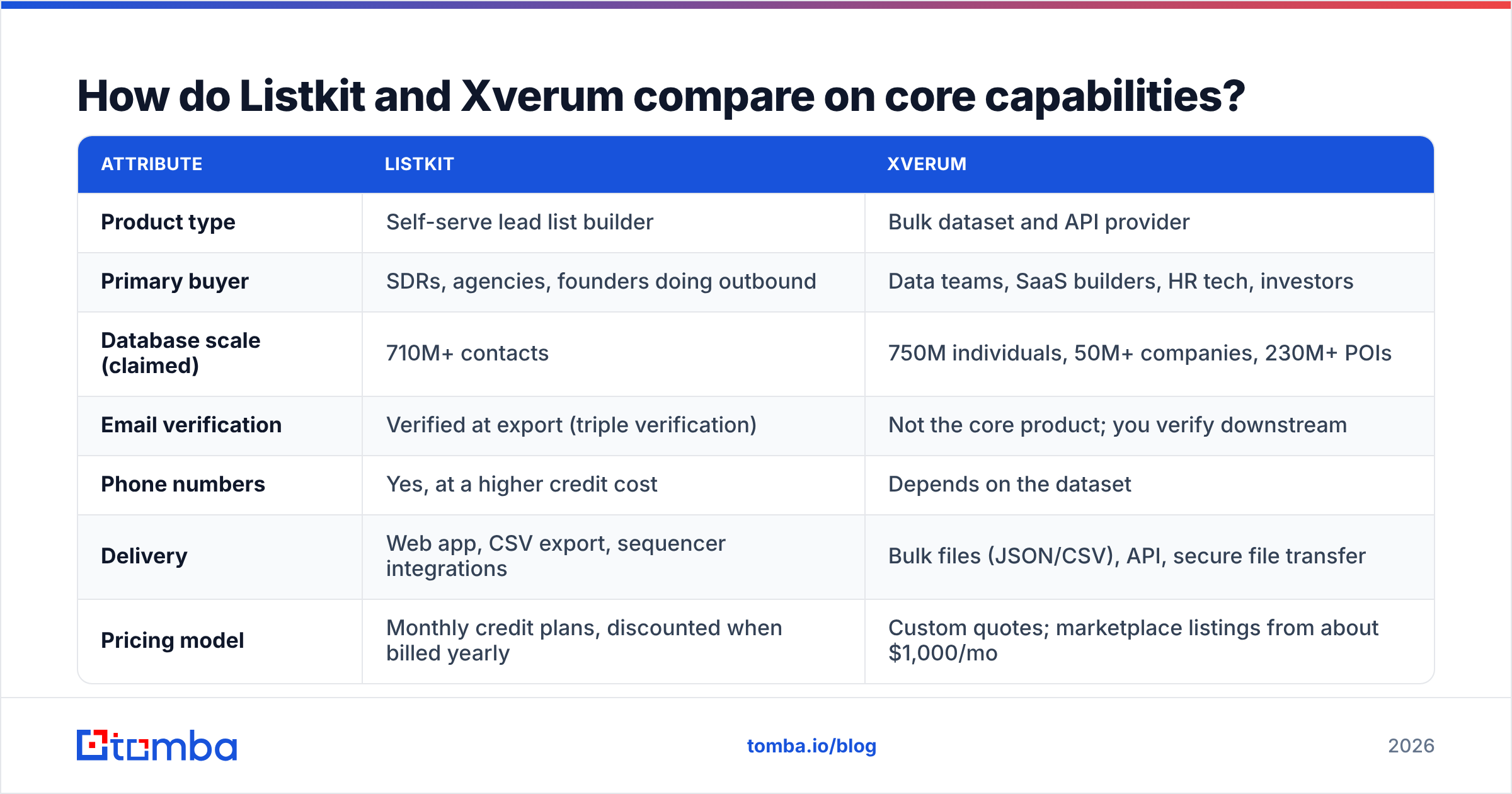
Here's the side-by-side view. Numbers come from each vendor's public materials and marketplace listings as of 2026. Plans change, so confirm current details before you buy.
| Attribute | Listkit | Xverum |
|---|---|---|
| Product type | Self-serve lead list builder | Bulk dataset and API provider |
| Primary buyer | SDRs, agencies, founders doing outbound | Data teams, SaaS builders, HR tech, investors |
| Database scale (claimed) | 710M+ contacts | 750M individuals, 50M+ companies, 230M+ POIs |
| Email verification | Verified at export (triple verification) | Not the core product; you verify downstream |
| Phone numbers | Yes, at a higher credit cost | Depends on the dataset |
| Delivery | Web app, CSV export, sequencer integrations | Bulk files (JSON/CSV), API, secure file transfer |
| Pricing model | Monthly credit plans, discounted when billed yearly | Custom quotes; marketplace listings from about $1,000/mo |
| Free option | Free plan with limited credits | Free data samples on request |
| Time to first campaign | Hours | Weeks (ingestion, mapping, enrichment) |
| Best at | Fast, targeted cold email lists | Broad coverage for analytics, models, products |
The gap that matters most is time to first campaign. Listkit is designed so a sales rep can go from filter to export to sequence in one sitting. Xverum assumes somebody on your team will ingest the files, dedupe them, map them to your schema, and then work out which rows are worth contacting.

How does Listkit's pricing actually work?#
Listkit runs on credits, and what a credit buys depends on the data type:
- A business email export costs about 1 credit.
- A phone number costs several credits. Published breakdowns put it at 3 to 5 credits per number.
- A fully enriched contact can use up to about 10 credits.
Independent pricing breakdowns from 2026 list paid tiers from roughly $83/month up to $500+/month on yearly billing. Monthly billing costs more per credit. The official Listkit pricing page is the source of truth because tiers and bundles have changed several times.
The catch is the same one every credit-based list builder has: your headline credit count is not your lead count. If your campaigns need emails plus direct dials, a 2,000-credit month might produce only a few hundred usable contacts. Before you commit, work out your real cost per lead from your actual data mix.
What you get for that price is convenience. Verification happens at export, so you avoid paying a separate verifier for most records. That is also what protects your email deliverability when you're sending from new domains.
How does Xverum's pricing work?#
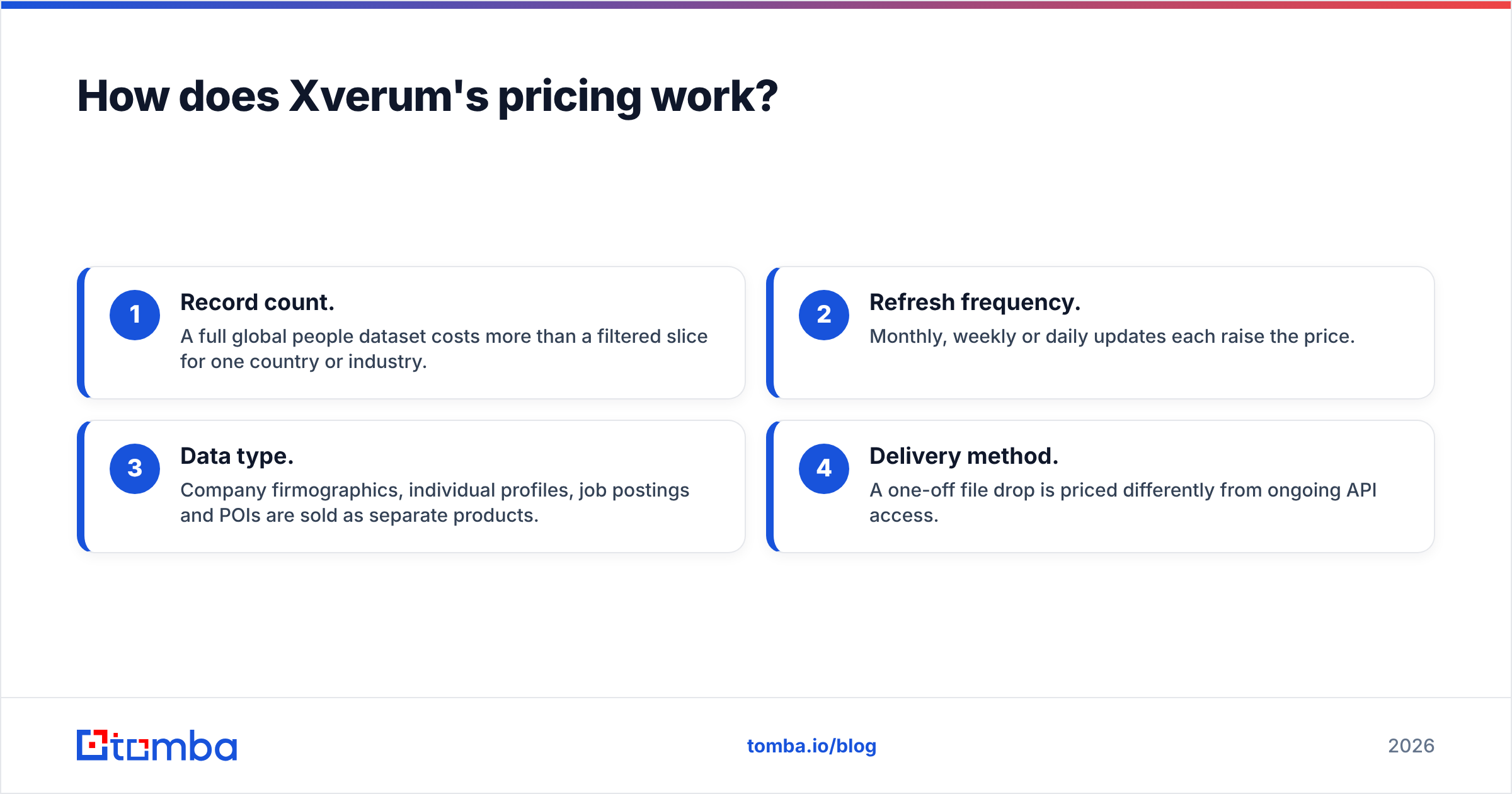
Xverum doesn't publish a self-serve price list. Marketplace listings put its datasets and APIs between about $1,000/month and five-figure annual contracts. The final price depends on:
- Record count. A full global people dataset costs more than a filtered slice for one country or industry.
- Refresh frequency. Monthly, weekly or daily updates each raise the price.
- Data type. Company firmographics, individual profiles, job postings and POIs are sold as separate products.
- Delivery method. A one-off file drop is priced differently from ongoing API access.
Xverum offers free samples, and you should always ask for one. Run it through your own matching logic and measure how many records hit your ICP, how many have usable contact fields, and how fresh the job titles are.
The price per record can be very low. That is not the same as a low cost per contactable lead. Once you add engineering time, storage and a verification layer, the total cost of ownership for a pure outbound use case is often higher than a list builder.
Which tool gives you more accurate contact data?#
The two vendors mean different things by "accurate," so it's worth separating the questions.
Listkit defines accuracy at the email level. Its pitch is that each email is checked when you export it, which lowers bounce rates on cold campaigns. Reviews on G2 mostly praise it for deliverability-safe exports. The usual complaints are about credit burn and coverage gaps in niche verticals and outside North America.
Xverum defines accuracy at the record and attribute level: structured fields, standardized values and frequent refreshes. For a talent-intelligence product or an investment model, what matters is whether the job title and company are current. Whether an inbox will accept a cold email is a separate question. If you plan to send email to Xverum-sourced contacts, plan to add your own email verification step.
A practical rule:
- Measuring outreach outcomes (bounce rate, reply rate): Listkit's model fits better.
- Measuring dataset quality (coverage, freshness, field completeness): Xverum's model fits better.
Who should choose Listkit?#
Listkit is the better fit when these describe your team:
- You run cold email as a core channel. Agencies, lead-gen shops and founder-led sales teams get the most value from export-time verification.
- You don't have data engineers. Everything happens in a browser. No pipelines, no schema mapping.
- Your campaigns are ICP-filtered and mid-volume. Thousands of contacts per month, not tens of millions.
- You want predictable monthly spend. Credit plans make budgeting easy, as long as you model credit burn honestly.
Where it falls short: very niche industries, regions outside its strongest coverage, and use cases that need the full record (work history, skills, company signals) instead of a lead row.
Who should choose Xverum?#
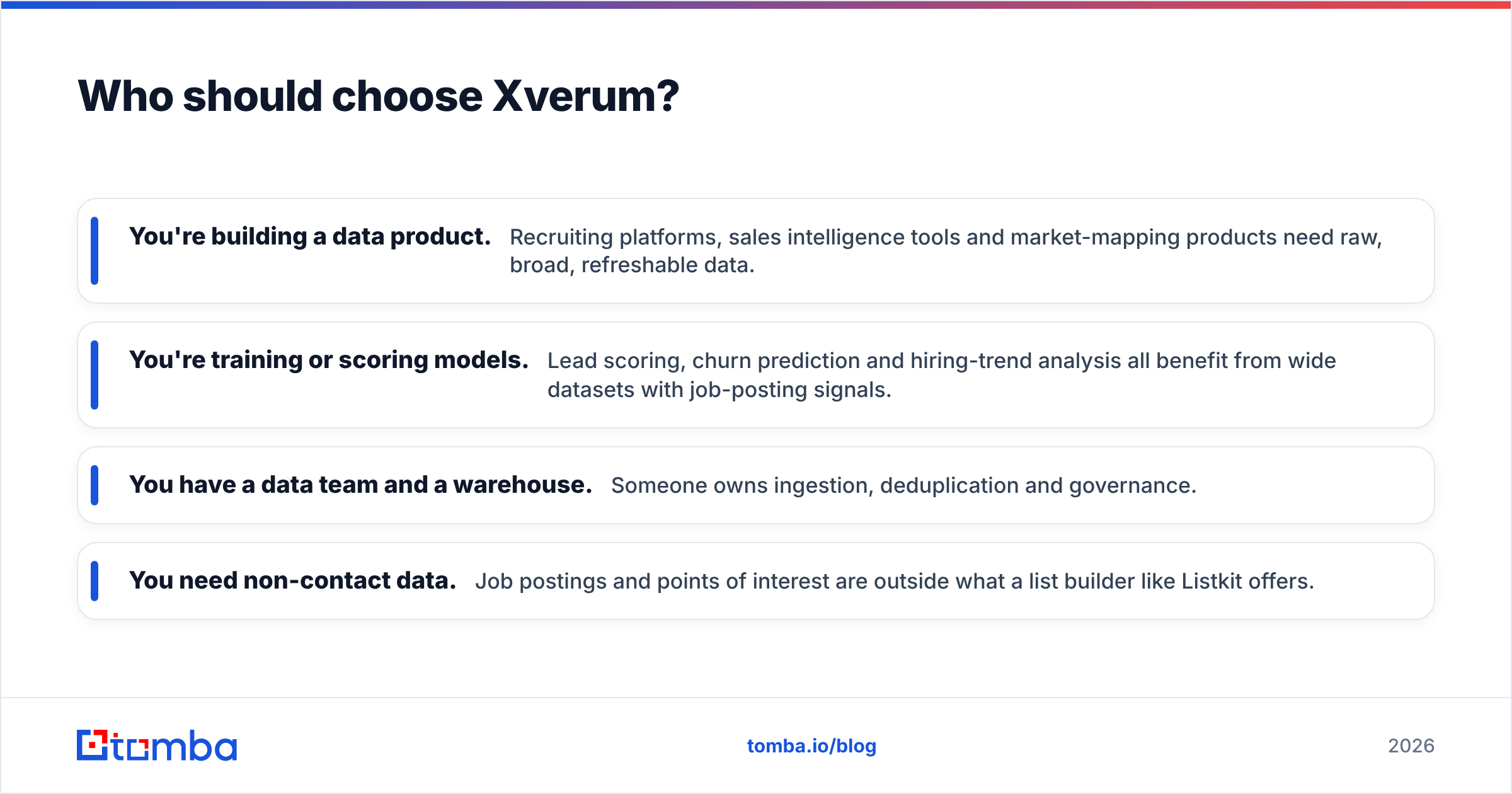
Xverum makes more sense when:
- You're building a data product. Recruiting platforms, sales intelligence tools and market-mapping products need raw, broad, refreshable data.
- You're training or scoring models. Lead scoring, churn prediction and hiring-trend analysis all benefit from wide datasets with job-posting signals.
- You have a data team and a warehouse. Someone owns ingestion, deduplication and governance.
- You need non-contact data. Job postings and points of interest are outside what a list builder like Listkit offers.
Where it falls short: SDRs can't use it directly, there's no built-in verification of sendable emails, and there's a real minimum spend and integration cost before you see any value.
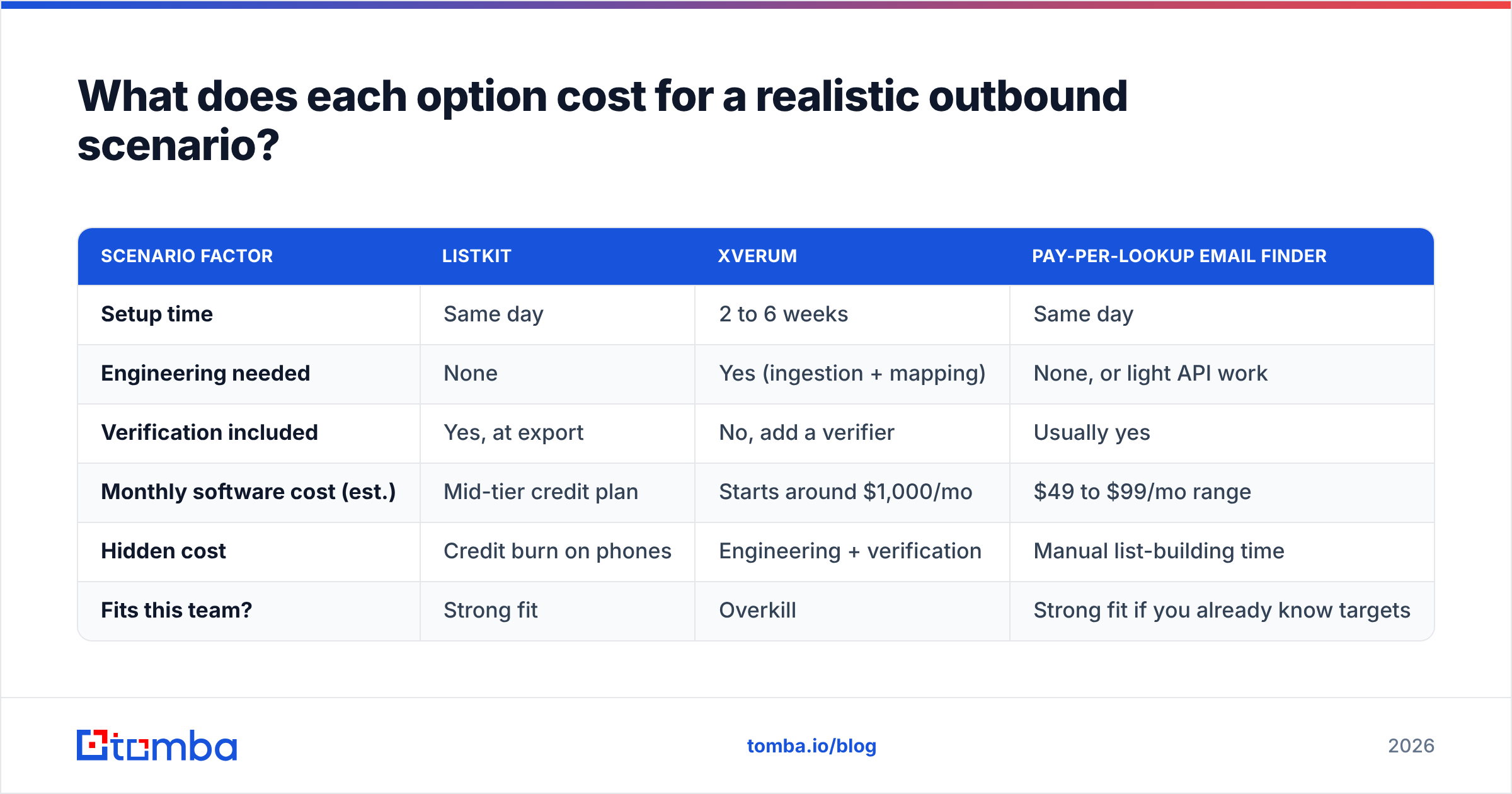
What does each option cost for a realistic outbound scenario?#
Take a typical case: a 3-person SDR team that needs 2,000 new verified contacts per month for cold email, and phone numbers for about 20% of them.
| Scenario factor | Listkit | Xverum | Pay-per-lookup email finder |
|---|---|---|---|
| Setup time | Same day | 2 to 6 weeks | Same day |
| Engineering needed | None | Yes (ingestion + mapping) | None, or light API work |
| Verification included | Yes, at export | No, add a verifier | Usually yes |
| Monthly software cost (est.) | Mid-tier credit plan | Starts around $1,000/mo | $49 to $99/mo range |
| Hidden cost | Credit burn on phones | Engineering + verification | Manual list-building time |
| Fits this team? | Strong fit | Overkill | Strong fit if you already know targets |
For this team Xverum is the wrong tool. That's not a knock on its data. It's built for a different job. Listkit fits if you need to discover who to contact. An email finder fits if you already know the accounts and people you want to reach and only need the verified address.

Can you combine Listkit or Xverum with other tools?#
Yes, and most mature teams do. Common setups:
- Xverum + an email finder + a verifier. Use Xverum's company and people data to build and score your account universe, then run shortlisted people through an email finder to get sendable addresses, then verify before sending.
- Listkit + CRM enrichment. Export targeted lists from Listkit, push them into your CRM, and use a data enrichment layer to fill firmographic gaps over time.
- Domain-first prospecting. When you already have a target account list, a domain search returns every public email at a company in one query. That's often faster and cheaper than paying for a full contact export.
What connects all three: keep discovery (who fits your ICP), contact data (how to reach them) and verification (whether the email will deliver) as separate steps you can measure. Buying one vendor for all three is convenient, but you give up visibility into which step is failing.
What questions should you ask before signing with either vendor?#
Ask these before you pay for any B2B data product:
- What's the refresh cadence for the fields I care about? Job titles go stale fastest.
- How is an email marked "verified," and when? At collection, at export, or never?
- What happens to unused credits or undelivered records? Rollover rules vary and change.
- Can I test on my own ICP? Ask Xverum for a sample and use the Listkit free plan, then measure match rate against 100 of your real target accounts.
- What are the compliance terms? Confirm GDPR and CCPA handling, lawful basis for processing, and opt-out mechanics, especially if you email EU contacts.
Listkit vs Xverum: which should you pick?#
For outbound sales, Listkit is the more practical choice. It turns a filter into a sendable, verified list with no engineering work, and its pricing matches how SDR teams actually use data.
For data infrastructure, Xverum is the more capable choice. If you're building a product, a model or a warehouse that needs hundreds of millions of refreshable records across people, companies, jobs and locations, a lead list builder can't replace it.
Many teams need neither in full. If your target accounts are already defined and you need the right person's verified email, full-database access is more than you need.
Need verified emails without a data contract?#
If your bottleneck is getting a working email for a known person or company, not discovering millions of records, try the Tomba Email Finder. Enter a name and domain, or a company, and get a professional email address with a confidence score. You don't need to model credit burn or sign a dataset contract first. There's a free tier with 25 searches a month to test against your own ICP, and paid plans start at $49/month. Compare options on the Tomba pricing page, run a batch of your real target accounts through it, and compare the results with whatever list you're using now.
Related guides#
// get started
Find, verify and enrich your first contacts today
Start on the free plan with 25 searches a month, then scale when your team is ready.
Free plan · No credit card required · GDPR & CCPA
// about the author