Logvalid vs Seamless.AI (2026): Email Verifier or Sales Database?
Logvalid cleans lists you already have for fractions of a cent per address. Seamless.AI sells you new contacts per seat on an annual contract. Here's which one your team actually needs, and when you need neither.
TL;DR
- Logvalid and Seamless.AI aren't the same kind of tool. Logvalid is an email verifier: it checks addresses you already have. Seamless.AI is a prospecting database: it finds new contacts for you.
- Logvalid is cheap. Public listings show a free plan with 500 verification credits, and paid credits start at around $1 for 2,000. Seamless.AI's Basic plan is reported at about $147 per user per month, billed annually.
- Pick Logvalid if your list-building already works and your problem is bounces. Pick Seamless.AI if you have no contacts and need a searchable B2B database with a Chrome extension.
- Most outbound teams need both jobs done: find the address, then verify it before you send. Buying two separate tools for that is often the most expensive way to do it.
- If you want finding and verification under one plan, a combined email finder and verifier tier ($49/mo on Tomba Starter) is usually cheaper than a single Seamless seat.
What is the real difference between Logvalid and Seamless.AI?#
People search "Logvalid vs Seamless.AI" as if the two compete head to head. For most of what they do, they don't. You're comparing a list-cleaning utility with a lead-sourcing platform, and the right choice depends on which of those two problems you have.
Logvalid is an email validation service. You upload a CSV or call its API, and it tells you which addresses are valid, invalid, disposable, or risky. Its Capterra listing describes real-time validation, format and domain checks, spam-trap detection, free-vs-professional classification, and import/export for bulk lists. It won't give you a single new contact.
Seamless.AI is a sales intelligence platform. You search by company, title, industry, or location, or you use its Chrome extension on LinkedIn, and it reveals emails and phone numbers for a credit each. Its homepage pitches it as a real-time search engine for B2B contacts. It checks deliverability as part of the lookup, but it isn't a bulk list-cleaning tool.
Here's an analogy. Logvalid is the metal detector at the door, checking whether what's already in your hand is real. Seamless.AI is the recruiter bringing new people to the door in the first place.
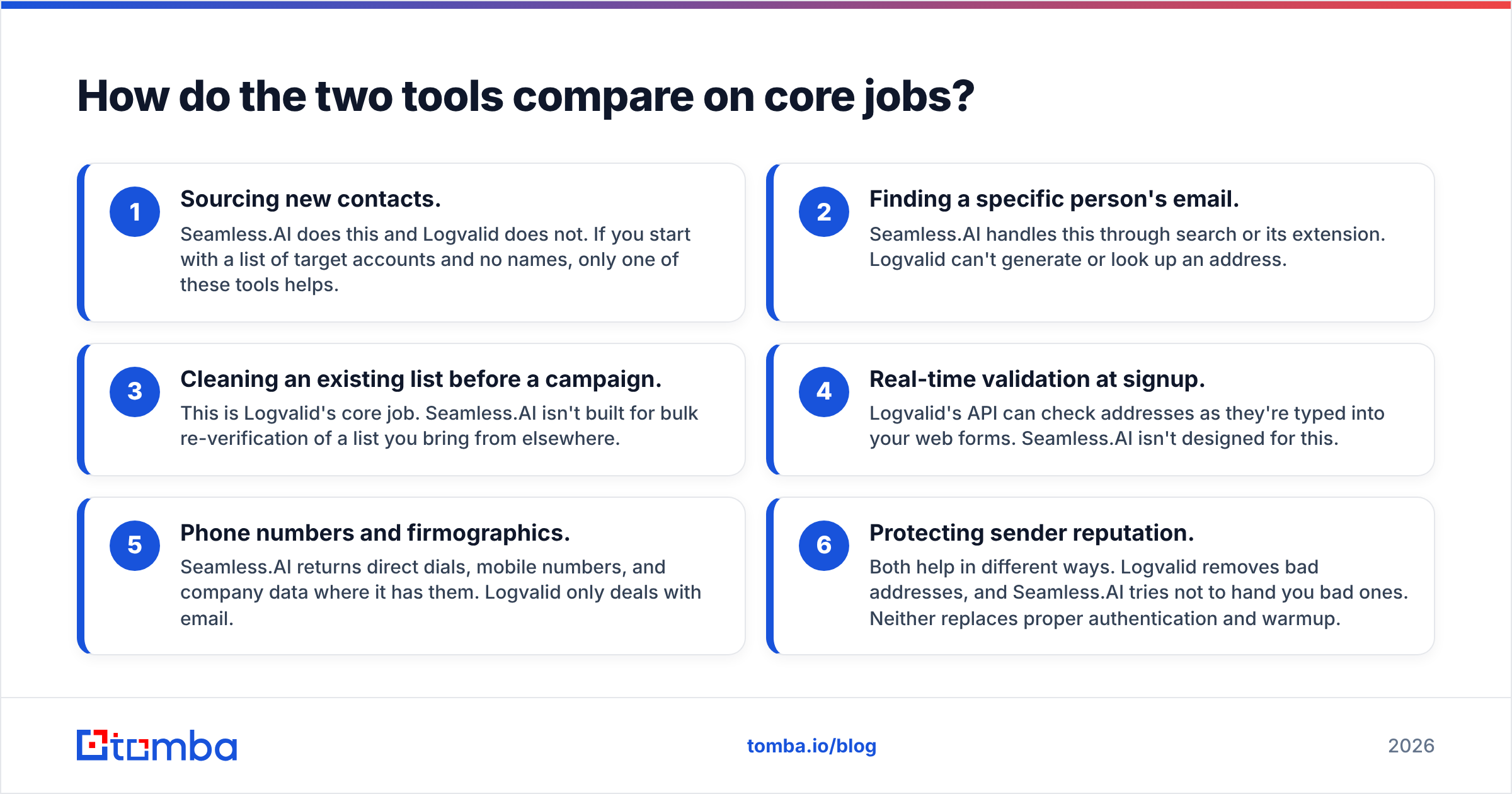
How do the two tools compare on core jobs?#
The fastest way to see where each one fits is to break outbound data work into the jobs you actually pay for:
- Sourcing new contacts. Seamless.AI does this and Logvalid does not. If you start with a list of target accounts and no names, only one of these tools helps.
- Finding a specific person's email. Seamless.AI handles this through search or its extension. Logvalid can't generate or look up an address.
- Cleaning an existing list before a campaign. This is Logvalid's core job. Seamless.AI isn't built for bulk re-verification of a list you bring from elsewhere.
- Real-time validation at signup. Logvalid's API can check addresses as they're typed into your web forms. Seamless.AI isn't designed for this.
- Phone numbers and firmographics. Seamless.AI returns direct dials, mobile numbers, and company data where it has them. Logvalid only deals with email.
- Protecting sender reputation. Both help in different ways. Logvalid removes bad addresses, and Seamless.AI tries not to hand you bad ones. Neither replaces proper authentication and warmup.
If you nodded at items 1, 2, and 5, you're shopping for a database. If you nodded at 3 and 4, you're shopping for a verifier.
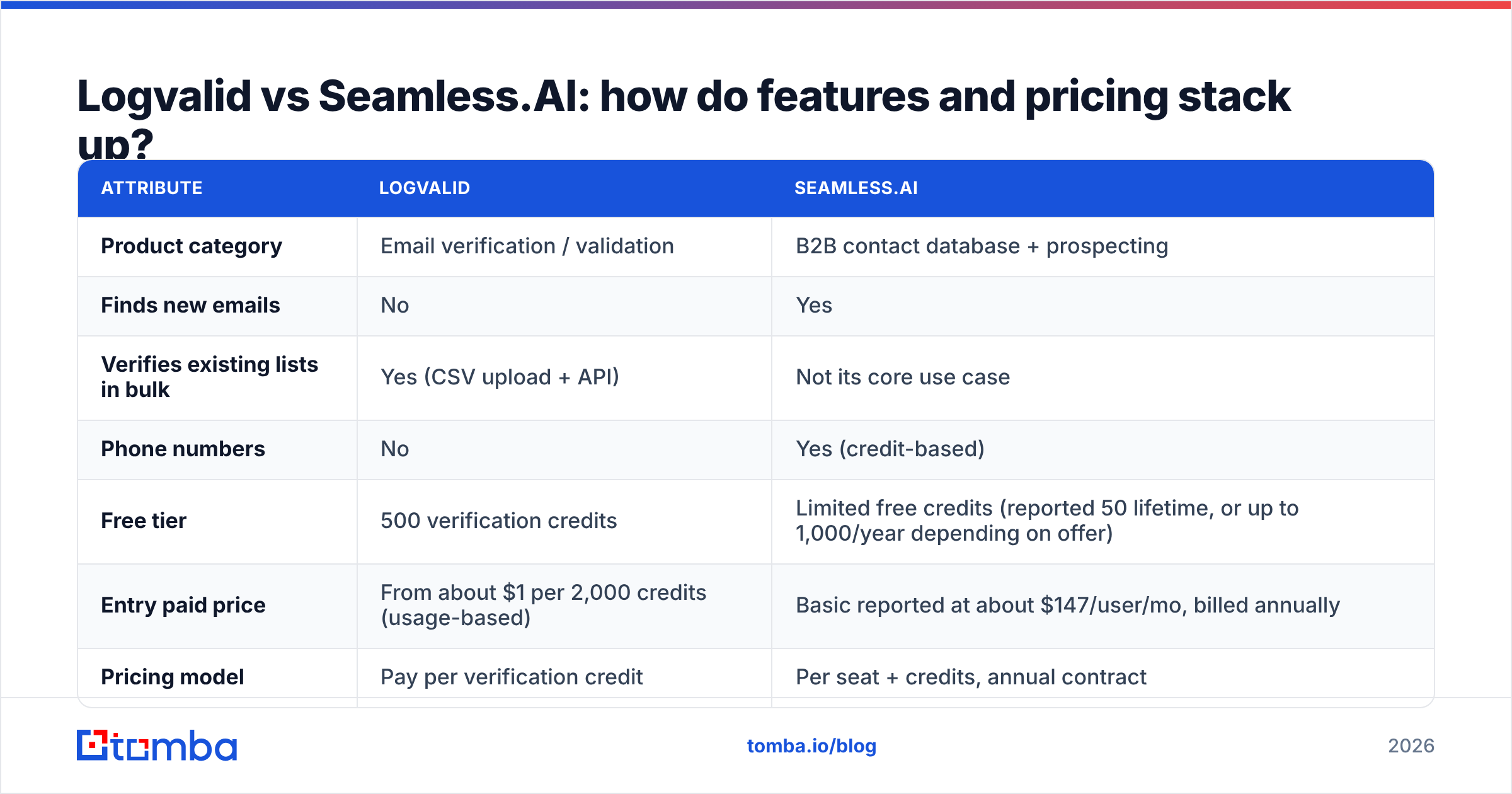
Logvalid vs Seamless.AI: how do features and pricing stack up?#
The table below uses publicly listed information as of 2026. Seamless.AI doesn't publish most of its paid pricing, so the numbers come from its pricing page and several independent 2026 breakdowns. Treat them as ranges and confirm with a quote.
| Attribute | Logvalid | Seamless.AI |
|---|---|---|
| Product category | Email verification / validation | B2B contact database + prospecting |
| Finds new emails | No | Yes |
| Verifies existing lists in bulk | Yes (CSV upload + API) | Not its core use case |
| Phone numbers | No | Yes (credit-based) |
| Free tier | 500 verification credits | Limited free credits (reported 50 lifetime, or up to 1,000/year depending on offer) |
| Entry paid price | From about $1 per 2,000 credits (usage-based) | Basic reported at about $147/user/mo, billed annually |
| Pricing model | Pay per verification credit | Per seat + credits, annual contract |
| Contract | Pay as you go | Annual, with a reported 60-day cancellation notice |
| API | Yes, core offering | Available, reported as a paid add-on |
| Chrome / LinkedIn extension | No | Yes |
| Best for | Marketers, ops teams, form validation | SDR/BDR teams building lists from scratch |
| Main drawback | Doesn't create pipeline on its own | Cost scales with seats; add-ons inflate TCO |
Two things stand out. First, the pricing units are different: Logvalid sells verifications, and Seamless.AI sells seats that come with credits. Second, Seamless.AI's cheapest plan still costs more per month than most teams spend on verification in a year.

How much will each tool actually cost you?#
Sticker prices mislead in both directions, so work out the cost for a realistic month.
Scenario: one SDR sending 2,000 cold emails a month.
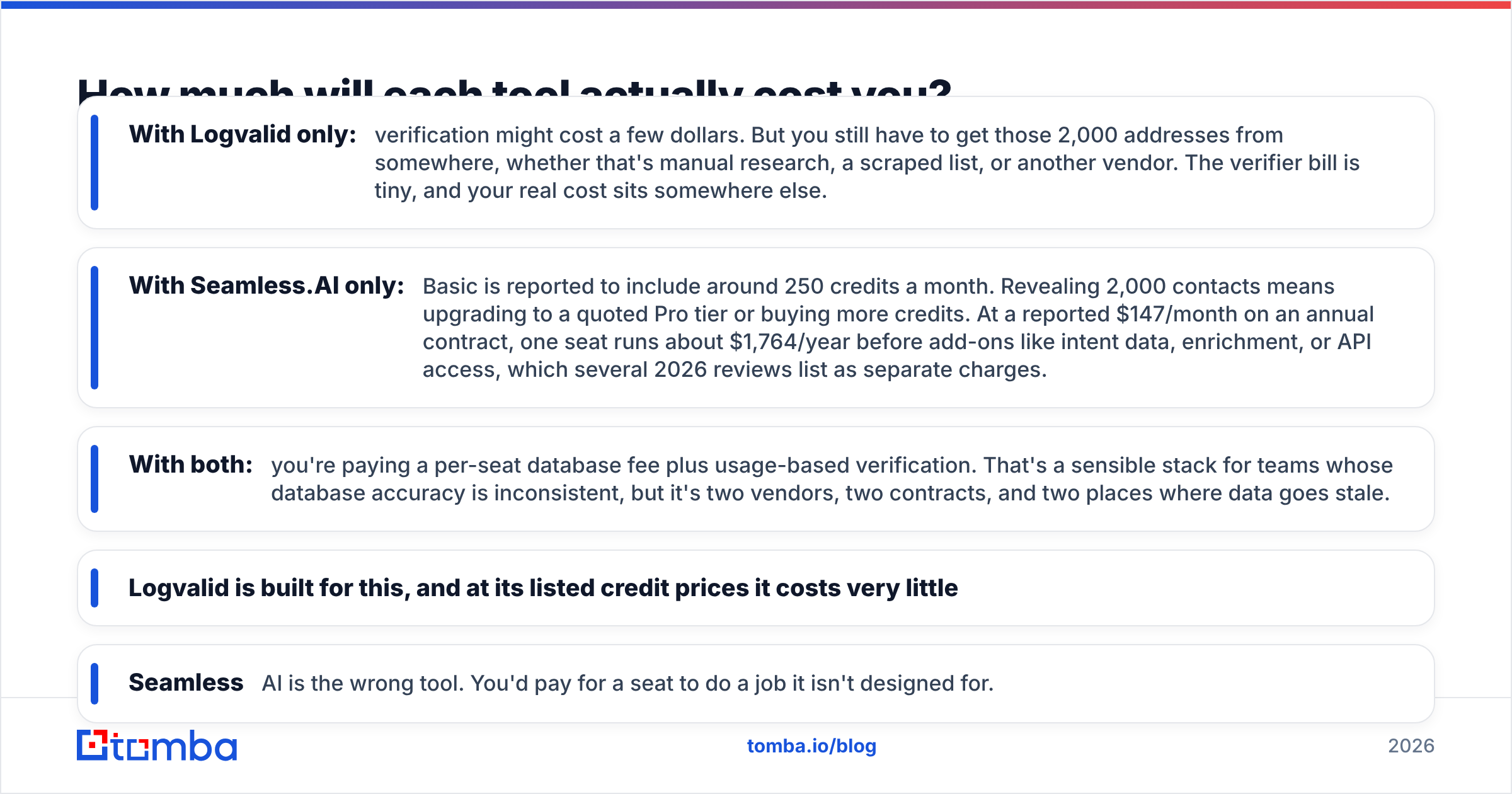
- With Logvalid only: verification might cost a few dollars. But you still have to get those 2,000 addresses from somewhere, whether that's manual research, a scraped list, or another vendor. The verifier bill is tiny, and your real cost sits somewhere else.
- With Seamless.AI only: Basic is reported to include around 250 credits a month. Revealing 2,000 contacts means upgrading to a quoted Pro tier or buying more credits. At a reported $147/month on an annual contract, one seat runs about $1,764/year before add-ons like intent data, enrichment, or API access, which several 2026 reviews list as separate charges.
- With both: you're paying a per-seat database fee plus usage-based verification. That's a sensible stack for teams whose database accuracy is inconsistent, but it's two vendors, two contracts, and two places where data goes stale.
Scenario: a marketing team cleaning a 50,000-address newsletter list.
- Logvalid is built for this, and at its listed credit prices it costs very little.
- Seamless.AI is the wrong tool. You'd pay for a seat to do a job it isn't designed for.
The pattern: Logvalid's cost scales with volume, and Seamless.AI's scales with headcount. If you're a five-person SDR team, Seamless.AI's per-seat model grows quickly. If you're a single ops person cleaning huge lists, Logvalid's model is very cheap.
Which is more accurate: Logvalid or Seamless.AI?#
The two tools measure accuracy differently, so you can't rank them head to head on one number.
For Logvalid, accuracy means verdict quality. When it marks an address "valid," does the email get delivered? The hard cases for every verifier are catch-all domains (servers that accept mail for any address), greylisting, and servers that rate-limit SMTP checks. Logvalid's public materials don't say much about how it handles catch-all domains. If a large share of your list is on corporate Microsoft 365 or Google Workspace domains configured as catch-all, test it on a sample before you commit. A dedicated catch-all verifier exists for exactly this gap.
For Seamless.AI, accuracy means data freshness. Is the contact still at that company, and is the email pattern right? Independent reviews of Seamless.AI are mixed here. The real-time search model helps with coverage, but users on review sites regularly report bounces and outdated job titles, especially outside the US and in smaller companies. That's why many Seamless.AI customers run exports through a separate verifier before sending, which brings you back to Logvalid-style tools.
A practical test you can run in one afternoon:
- Pull 200 contacts from whatever source you use today.
- Run them through the verifier you're evaluating and record valid / invalid / risky / unknown.
- Send a low-volume, plain-text campaign only to the "valid" bucket from a warmed inbox.
- Measure hard bounces after 48 hours.
A good verifier keeps hard bounces on the "valid" bucket under about 2%. If you see 5% or more, either the source data is stale or the verifier is too lenient. Compare results on the same list to separate the two causes.
When should you choose Logvalid?#
Logvalid is the right pick when:
- You already have your contacts. CRM exports, event lists, webinar signups, or purchased lists that need cleaning before a campaign.
- You need form validation. Its API can block typos and disposable addresses at signup, which keeps your marketing database clean at the source.
- Budget is the constraint. Usage-based pricing and a free tier make it easy to try with no contract.
- You run mostly marketing email. Newsletters and lifecycle campaigns care more about list hygiene than about finding new names.
It's the wrong pick when your bottleneck is "we don't know who to email." A verifier can't create pipeline.
When should you choose Seamless.AI?#
Seamless.AI makes sense when:
- You're building lists from zero. You have an ICP, not names, and you want to search by title, industry, and headcount.
- Your reps live on LinkedIn. The Chrome extension turns profile visits into contact reveals without context switching.
- You need phone numbers. If cold calling is part of your motion, email-only tools won't cover it.
- You can commit to an annual contract. The model works best when a team uses it every day and the per-seat cost spreads across a lot of activity.
It's the wrong pick when you have a small team, irregular prospecting volume, or a finance team that won't sign annual per-seat commitments. For those cases, it's worth looking at a Seamless.AI alternative with monthly billing and pooled credits.

Do you need both a finder and a verifier?#
If you do outbound, yes, you need both jobs done. The real question is whether you need two vendors to do them.
The typical two-tool stack looks like this: Seamless.AI (or another database) for sourcing, then Logvalid (or another verifier) for cleaning. It works, but it creates friction:
- Two billing models. Per-seat on one side, per-credit on the other, so forecasting spend gets messy.
- Double handling. Export from the database, upload to the verifier, download the results, and re-import to your sequencer or CRM.
- Stale verdicts. An address verified in January isn't guaranteed valid in April. Two disconnected tools make re-verifying on a schedule harder.
The alternative is a platform where finding and verifying are one step. You look up an address with an email finder, and it comes back already checked, with a confidence score and verification status attached. You still keep a standalone email verifier for lists you bring in from elsewhere. It's the same account and the same credit pool.
This isn't the right setup for everyone. If your reps need a large searchable people database with intent signals and direct dials, a full sales intelligence platform like Seamless.AI covers more ground. If your workflow is "I know the company and roughly who I want, get me a verified email," a combined finder and verifier is usually faster and cheaper.
What do real users say about each tool?#
Review-site sentiment lines up with each tool's role:
- Logvalid reviews on G2, Capterra, and Trustpilot are few but tend to praise its low price, simple interface, and quick bulk processing. The small number of reviews means you should run your own test instead of relying on aggregate scores.
- Seamless.AI has a much larger review footprint. Praise centers on ease of use, the extension, and database breadth. Complaints cluster around three themes: data accuracy on some segments, credit consumption, and contract terms (auto-renewal and notice periods come up often).
Neither pattern is surprising. Cheap single-purpose tools get fewer, happier reviews. Big platforms with annual contracts get more reviews and more friction about billing.
Logvalid vs Seamless.AI: which should you pick?#
The short version:
- Choose Logvalid if you already have contacts and want to cut bounces cheaply, or if you need real-time validation on your forms.
- Choose Seamless.AI if you need to source net-new contacts and phone numbers at scale, your reps prospect all day on LinkedIn, and you're comfortable with annual per-seat pricing.
- Choose a combined finder and verifier if you want verified emails without paying for a per-seat database and a separate verification vendor.
Before you sign anything, run the 200-contact bounce test above. It takes one afternoon and tells you more than any comparison table, including this one.
Where does Tomba fit if you need both jobs done?#
If your goal is verified B2B emails without per-seat pricing or annual lock-in, Tomba Email Finder covers both halves of the Logvalid vs Seamless.AI question. You can find professional addresses by name, domain, or company, and every result is checked before you export it. There's a free tier with 25 searches a month to test your own list. Paid plans start at $49/month on Starter, with Growth at $99 and Pro at $249. See the pricing details and run the same bounce test on Tomba before you commit to anything else.
Related guides#
// get started
Find, verify and enrich your first contacts today
Start on the free plan with 25 searches a month, then scale when your team is ready.
Free plan · No credit card required · GDPR & CCPA
// about the author