Mailfloss vs Seamless.AI (2026): Verifier or Contact Finder?
Mailfloss cleans the list you already have. Seamless.AI finds contacts you don't have yet. Here's how they compare on pricing, accuracy, contracts and use cases, and which one fits your team in 2026.
TL;DR
- Mailfloss and Seamless.AI solve different problems. Mailfloss is an email verification and list-hygiene tool that plugs into your ESP and cleans the list automatically. Seamless.AI is a B2B contact database and prospecting tool that finds new emails and phone numbers.
- Mailfloss publishes its pricing. In September 2026 its own pricing page listed Lite at $29/mo (10,000 verifications), Business at $59/mo (25,000) and Pro at $209/mo (125,000). There's a 7-day trial that needs a credit card.
- Seamless.AI doesn't publish paid pricing. Pro and Enterprise are sold through sales. Third-party estimates range from about $79 to $299+ per user per month, usually on annual contracts that auto-renew.
- Pick Mailfloss if your problem is bounces on a newsletter or marketing list. Pick Seamless.AI if your problem is not having enough contacts for outbound. Many teams need both: a finder, then a verifier.
- If you want both jobs in one tool on a monthly plan, an all-in-one finder plus verifier like Tomba (from $49/mo) is worth putting on your shortlist.
What is Mailfloss?#
Mailfloss is an automated email verification service built for marketers and ecommerce teams. You connect it to your email service provider (Mailchimp, Klaviyo, ActiveCampaign, HubSpot, Constant Contact and others). It then scans your list every day, removes or tags invalid, risky and disposable addresses, and fixes common typos like gmial.com to gmail.com.
The pitch is "set it and forget it." You don't upload CSVs each week. Mailfloss sits next to your ESP and keeps the list clean while new signups arrive.
What Mailfloss doesn't do: it won't find anyone's email address. If you give it nothing, you get nothing back. It is a hygiene layer, not a data source.
What is Seamless.AI?#
Seamless.AI is a sales intelligence platform. You search by company, title, industry or location, or you use the Chrome extension on LinkedIn. It returns contact details, mainly work emails, direct dials and mobile numbers. It markets itself as a "real-time search engine" for B2B contacts and adds features like buyer intent data, job-change alerts and an AI writing assistant (several of these are paid add-ons).
What Seamless.AI doesn't do: it isn't built to continuously monitor and clean an existing marketing list inside your ESP. It verifies the contacts it returns, but it isn't a list-hygiene service.
Is Mailfloss vs Seamless.AI even a fair comparison?#
Not exactly, and that's the most useful thing to know before you spend money. Searches for "mailfloss vs seamlessai" usually come from one of two people:
- A marketer with a bounce problem who has heard that Seamless.AI "verifies emails" and wonders whether one tool can do both jobs.
- A founder or SDR lead building an outbound stack who needs to know where verification fits once they buy a data provider.
Think of it like a fishing boat and a fish-cleaning station. Seamless.AI goes out and brings contacts back. Mailfloss makes sure what's already in your cooler is safe to use. You can run a business with only one, but you need to know which job you're hiring for.
Here's the core difference, laid out:
- Job to be done: Mailfloss protects deliverability on lists you already own. Seamless.AI creates new pipeline by finding contacts you don't have.
- Input: Mailfloss needs an existing list in an ESP or a CSV. Seamless.AI needs a search query, a LinkedIn profile or a company domain.
- Output: Mailfloss returns cleaned, tagged and deleted addresses. Seamless.AI returns new emails, phone numbers and firmographics.
- Buyer: Mailfloss is bought by email marketers, ecommerce and newsletter operators. Seamless.AI is bought by SDRs, AEs, recruiters and agency outbound teams.
- Billing: Mailfloss uses published monthly tiers based on verification volume. Seamless.AI uses sales-led, credit-based seats, usually on annual terms.
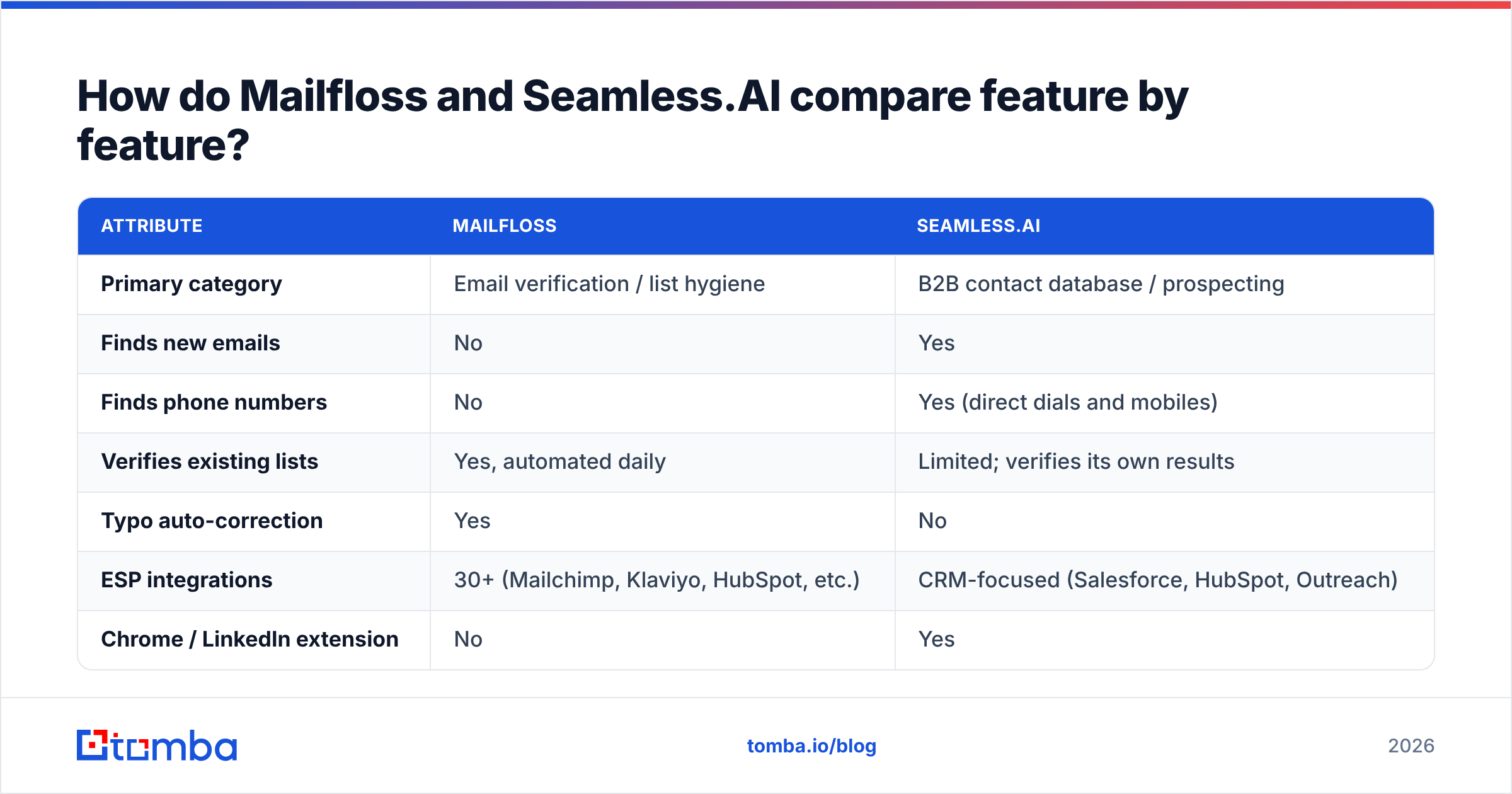
How do Mailfloss and Seamless.AI compare feature by feature?#
The table below uses public pricing pages and widely cited 2026 third-party reviews. Seamless.AI doesn't list paid prices, so treat those figures as estimates and confirm with their sales team.
| Attribute | Mailfloss | Seamless.AI |
|---|---|---|
| Primary category | Email verification / list hygiene | B2B contact database / prospecting |
| Finds new emails | No | Yes |
| Finds phone numbers | No | Yes (direct dials and mobiles) |
| Verifies existing lists | Yes, automated daily | Limited; verifies its own results |
| Typo auto-correction | Yes | No |
| ESP integrations | 30+ (Mailchimp, Klaviyo, HubSpot, etc.) | CRM-focused (Salesforce, HubSpot, Outreach) |
| Chrome / LinkedIn extension | No | Yes |
| Entry paid price | $29/mo (Lite, 10K verifications) | Not public; estimates ~$79–$299/user/mo |
| Top published tier | $209/mo (Pro, 125K verifications) | Enterprise, custom quote |
| Free option | 7-day trial (card required) | Free plan with limited credits |
| Contract | Monthly, with annual discounts of 10–20% | Usually annual, auto-renews |
| Overage | $0.005–$0.001 per email by tier | Buy more credits or upgrade |
| Best for | Marketing lists, newsletters, ecommerce | Outbound SDR teams, recruiting |
Two rows in that table deserve a closer look.
Free option. Seamless.AI's free plan is described differently across sources. Some say it's a one-time allotment of about 50 credits, others say around 1,000 credits per year handed out monthly. Either way, it's enough to test data quality on your ICP, not enough to run a campaign.
Contract. Several 2026 reviews report that Seamless.AI paid plans renew automatically unless you cancel about 60 days before the renewal date. That's normal for enterprise sales tools, but it catches small teams out. Put the date in your calendar the day you sign.
How much does each tool really cost?#
Mailfloss pricing#
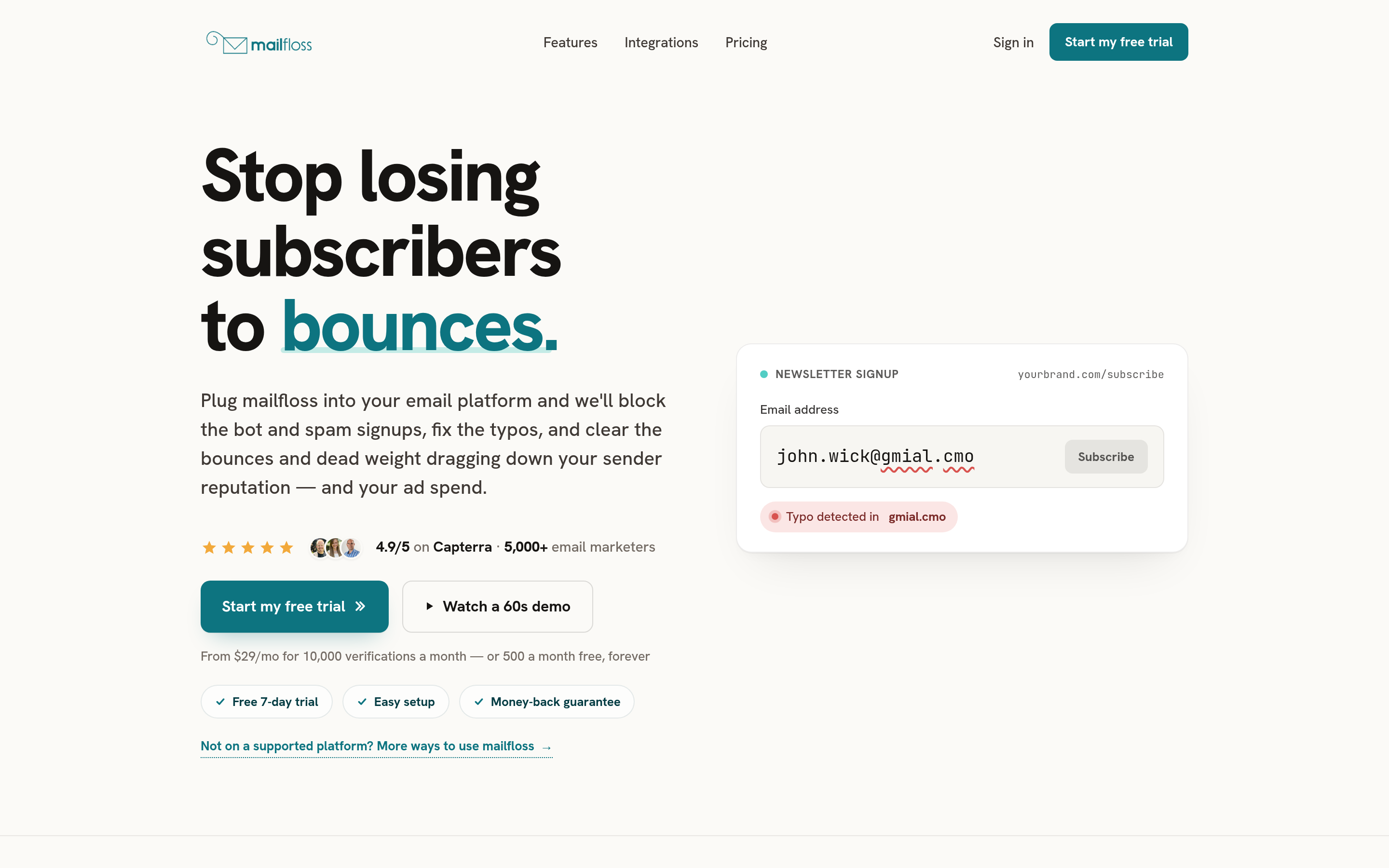
Mailfloss is simple and predictable. Its pricing page, as captured in September 2026, showed:
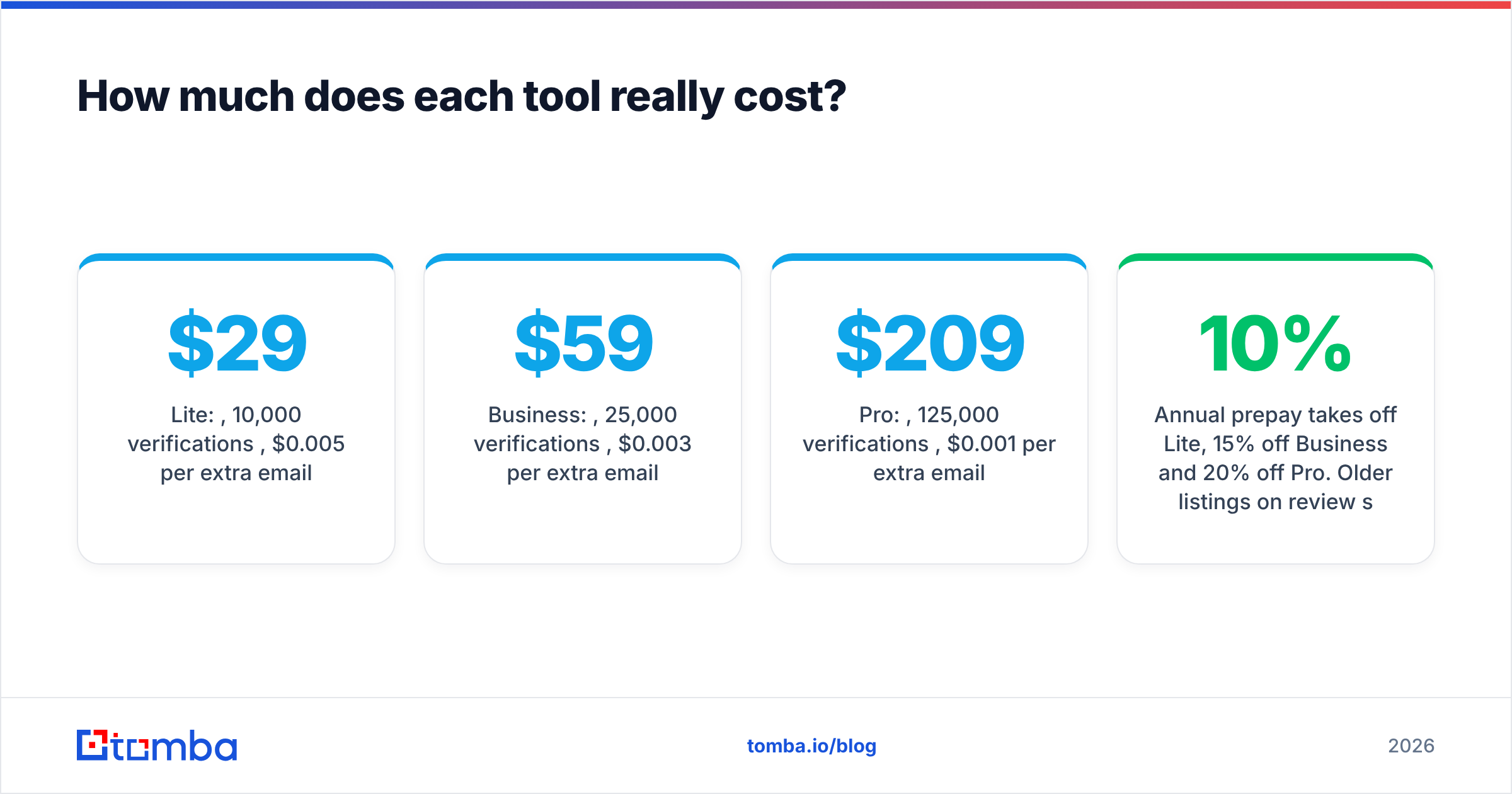
- Lite: $29/mo, 10,000 verifications per month, $0.005 per extra email
- Business: $59/mo, 25,000 verifications per month, $0.003 per extra email
- Pro: $209/mo, 125,000 verifications per month, $0.001 per extra email
Annual prepay takes 10% off Lite, 15% off Business and 20% off Pro. Older listings on review sites (for example Capterra) still show earlier prices, so check the live page before you budget.
For scale: a 40,000-subscriber newsletter that adds 2,000 signups a month fits on the Business plan, as long as you don't re-verify the full list every cycle.
Seamless.AI pricing#
Seamless.AI is harder to pin down. The free plan is real. Pro and Enterprise are quote-only, and the number you get depends on seats, credits and add-ons (intent data, API access and Autopilot are commonly sold separately). Third-party estimates put a single Pro seat at roughly $1,000–$3,500 per year. A five-seat SDR team can easily end up in five figures annually.
That isn't automatically a problem. If one closed deal pays for the contract, the math works. The risk is buying annual seats before you've proven the data matches your ICP.
Cost per useful contact#
A fairer way to compare is cost per usable record:
- With Mailfloss, you pay to protect contacts you've already earned (opt-ins, customers). The cost per verification is a fraction of a cent.
- With Seamless.AI, you pay to acquire contacts. Divide the annual contract by the number of contacts that are valid, in your ICP and reachable. That's your real unit cost.
Which is more accurate?#
They measure different things, so "accuracy" means something different for each.
Mailfloss accuracy is about classification: does it correctly label an address as valid, invalid, disposable or risky? Like every verifier, it struggles with catch-all domains. These are servers that accept every address at SMTP level, so no verifier can be fully certain. Mailfloss marks them as risky rather than guessing. That's the honest approach, but you still have to decide what to do with them.
Seamless.AI accuracy is about data freshness and match rate: when you search for a VP of Sales at a 200-person SaaS company, is the email it returns current and deliverable? User reviews on G2 are mixed in a familiar way. Coverage of North American tech and SaaS contacts is strong. Results are more uneven for smaller companies, non-US regions and fast-changing roles. Seamless.AI looks up some data in real time, which helps with freshness but can mean slower results and some guessed formats.
The practical rule, whatever data vendor you use: verify anything you didn't collect yourself before it enters a sequence. That's exactly why outbound teams often run a separate email verifier on exported lists, even when the data provider says its results are verified.
When should you choose Mailfloss?#
Choose Mailfloss if most of these are true:
- Your list is opt-in. Newsletter subscribers, customers, webinar registrants, lead-magnet downloads.
- You live in an ESP. Mailchimp, Klaviyo, ConvertKit, ActiveCampaign. Mailfloss's native integrations are its biggest advantage.
- Bounces are hurting you. Hard-bounce rates above roughly 2% start to damage sender reputation with Gmail and Microsoft, and both have tightened bulk-sender rules since 2024.
- You want zero manual work. No CSV exports, no weekly cleanup ritual.
- Typos are common. Ecommerce checkouts and mobile signups produce a lot of
@gmal.commistakes. Mailfloss's auto-correction recovers real customers.
Mailfloss is a poor fit if you do cold outbound at volume and need a verifier with an API built for prospect lists, or if you need to find contacts at all.
When should you choose Seamless.AI?#
Choose Seamless.AI if most of these are true:
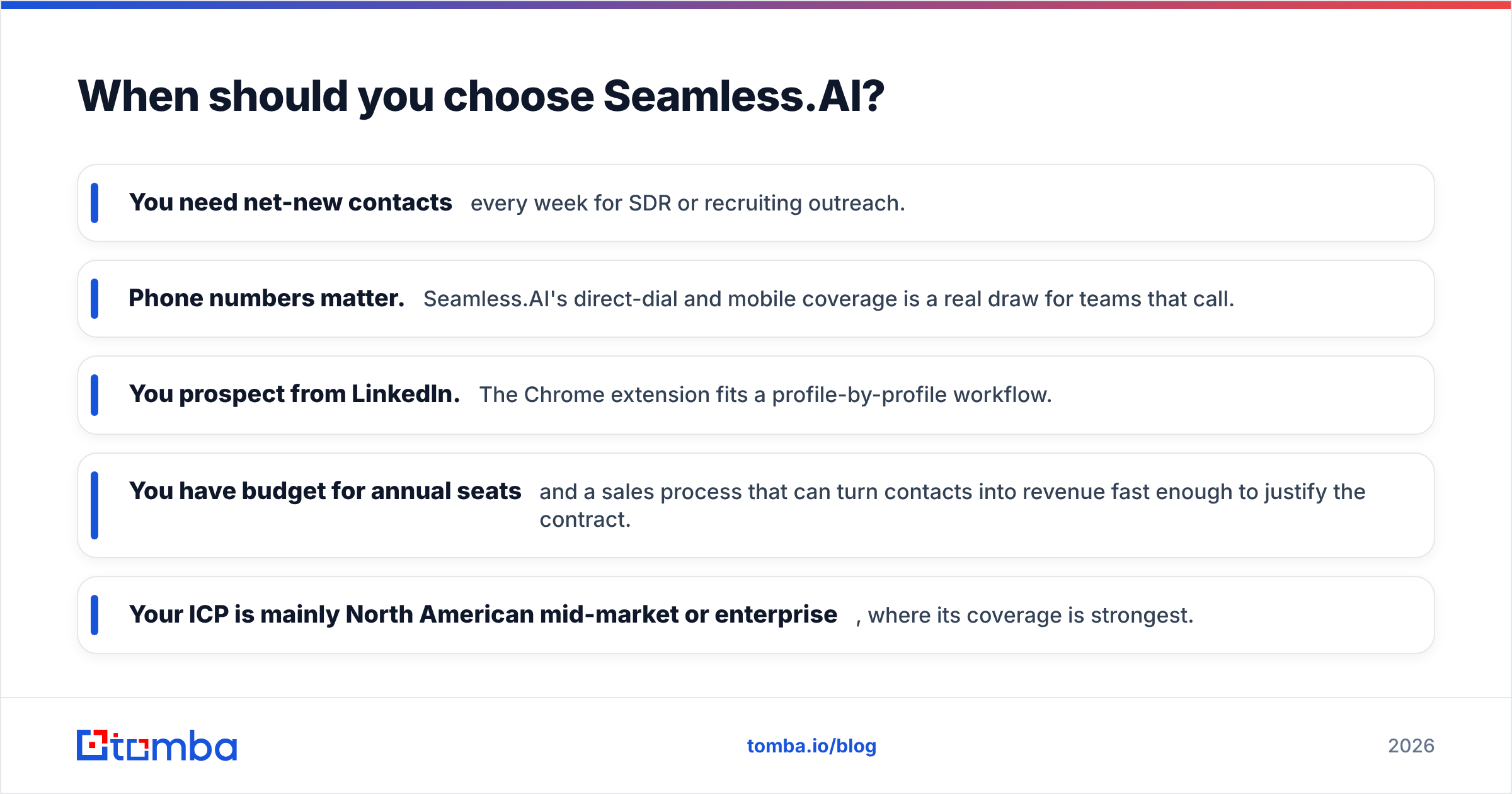
- You need net-new contacts every week for SDR or recruiting outreach.
- Phone numbers matter. Seamless.AI's direct-dial and mobile coverage is a real draw for teams that call.
- You prospect from LinkedIn. The Chrome extension fits a profile-by-profile workflow.
- You have budget for annual seats and a sales process that can turn contacts into revenue fast enough to justify the contract.
- Your ICP is mainly North American mid-market or enterprise, where its coverage is strongest.
Seamless.AI is a poor fit if you're a solo founder testing outbound on a small budget, if you sell mostly in EMEA or APAC SMB markets, or if you strongly prefer monthly billing. For a deeper look at options in that situation, see our Seamless.AI alternative breakdown.

Can you use Mailfloss and Seamless.AI together?#
Yes, and for some teams it's the right setup. A common workflow:
- Find prospects in Seamless.AI and export to your CRM or sequencer.
- Verify the export before the first send, especially catch-all and "risky" results.
- Nurture contacts who reply or opt in. Once they're in your marketing ESP, Mailfloss keeps that list clean over time.
The catch is cost and complexity: two vendors, two contracts, two places where data can drift. Mailfloss is also optimized for ESP-connected marketing lists, not for checking a 3,000-row prospect CSV before a cold campaign. Many outbound teams end up using a verifier built for prospect lists instead.
Is there a simpler option that does both?#
If you need finding and verifying but don't need Seamless.AI's phone-heavy enterprise feature set, consider an all-in-one tool. A few honest options:
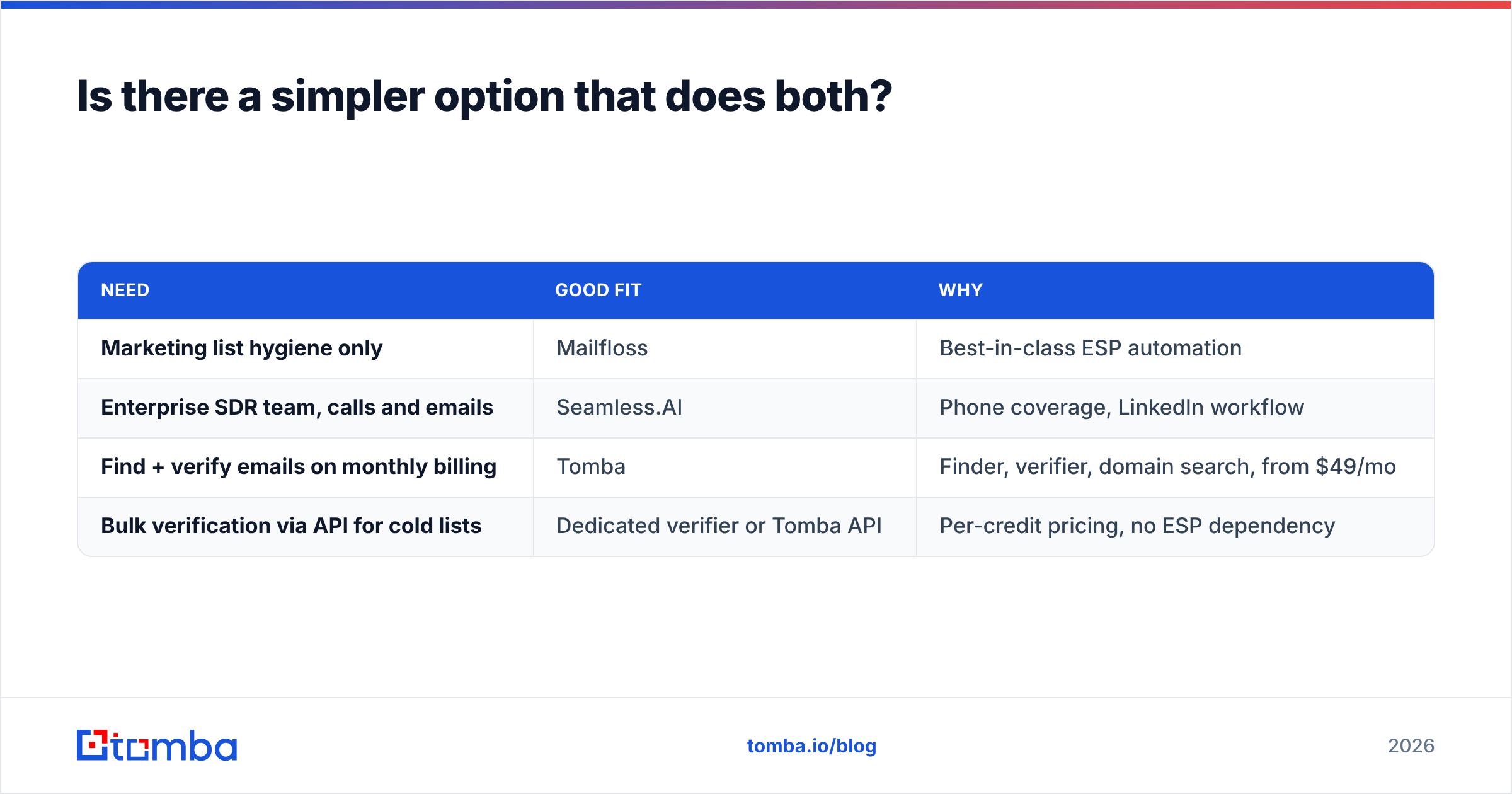
| Need | Good fit | Why |
|---|---|---|
| Marketing list hygiene only | Mailfloss | Best-in-class ESP automation |
| Enterprise SDR team, calls and emails | Seamless.AI | Phone coverage, LinkedIn workflow |
| Find + verify emails on monthly billing | Tomba | Finder, verifier, domain search, from $49/mo |
| Bulk verification via API for cold lists | Dedicated verifier or Tomba API | Per-credit pricing, no ESP dependency |
Tomba sits in the middle. You can find email addresses by name and domain, pull every public contact at a company with domain search, and verify results in the same account, including catch-all checks. Plans are published: a free tier with 25 searches a month, then Starter at $49/mo, Growth at $99/mo and Pro at $249/mo, with Enterprise on request. See Tomba pricing for credit limits.
It won't replace Mailfloss's daily ESP auto-cleaning, and it isn't trying to match Seamless.AI's direct-dial focus. But for a founder or small outbound team that mainly needs reliable work emails, one tool on a monthly plan is often easier than two contracts.
What's the verdict: Mailfloss or Seamless.AI?#
Mailfloss wins for list hygiene. If your inbox placement is suffering because of an aging or typo-filled marketing list, Mailfloss is cheaper, simpler and more automated than anything Seamless.AI offers for that job.
Seamless.AI wins for contact discovery, especially when phone numbers matter and you have the budget and the sales motion to justify annual seats.
Neither wins if you picked the wrong job. Buying Seamless.AI to fix bounces, or Mailfloss to fill a pipeline, wastes money. Start by naming the problem: "my list is dirty" or "my list is empty." Then pick the tool built for it.
Frequently asked questions#
Does Seamless.AI verify emails?#
It verifies the contacts it returns before showing them, but it isn't a list-cleaning service. Most teams still verify exported lists separately before sending cold campaigns.
Can Mailfloss find email addresses?#
No. Mailfloss only verifies and cleans addresses you already have. It has no prospecting database or finder.
Is Mailfloss cheaper than Seamless.AI?#
On paper, yes: Mailfloss starts at $29/mo, while Seamless.AI paid seats are quote-based and usually annual. But they do different jobs, so the right comparison is cost per outcome, not sticker price.
What should I use for cold email verification?#
Use a verifier that accepts CSV uploads or API calls and handles catch-all domains clearly. Mailfloss can work, but it's tuned for ESP-connected marketing lists. Tools built for outbound verification usually fit cold lists better.
Ready to find and verify in one place?#
If your real goal is getting accurate work emails into your sequences without signing an annual contract, try the Tomba Email Finder. Enter a name and company domain, get a verified address with a confidence score, and check it in the same account before you hit send. The free plan gives you 25 searches a month to test it on your own ICP, and paid plans start at $49/mo when you're ready to scale.
Related guides#
// start free
See who Tomba finds at any company
Type a company's domain to see its people, their roles and verified work emails, each with the pages it was found on. Free account, no card.
Free plan · No credit card required · GDPR & CCPA
// about the author