AI Email Outreach in 2026: Tools, Tactics, and ROI
AI email outreach turns cold email from a numbers game into a precision channel. Here's how the tools work, what they cost, and the workflow that actually lifts reply rates in 2026.
TL;DR
- AI email outreach uses large language models to research prospects, draft personalized messages, and adapt follow-ups — replacing the copy-paste "spray and pray" cold email of the last decade.
- The biggest gains come from personalization at scale and timing, not from sending more volume. Reply rates of 8-15% are realistic when data quality is high.
- Tooling splits into three layers: data (who to email), generation (what to say), and orchestration (when and how to send). You need all three to work together.
- Garbage data sinks even the best AI copy. Verified, enriched contact data is the foundation — an AI-written email to a bounced address still bounces.
- Budget $50-$300/month per seat for a functional stack. The cost of a bad sender reputation is far higher.
What is AI email outreach?#
AI email outreach is the practice of using machine learning — mostly large language models — to research prospects, write tailored email copy, and manage multi-step sequences with minimal manual effort. Instead of one SDR hand-writing 30 emails a day, an AI-assisted workflow drafts hundreds of context-aware messages while the rep focuses on replies and meetings.
Think of it like the difference between a short-order cook and a kitchen with prep stations. The old way, one person did everything: find the lead, look them up, write the email, schedule the follow-up. AI outreach splits that into stations — data enrichment, copy generation, send-time optimization — each handled faster and more consistently than a human juggling all four.
The important nuance: AI email outreach is not "AI writes spam faster." Done right, it's the opposite. It lets you send fewer, better emails because the model can reference a prospect's role, company news, tech stack, or recent post in a way that mass mail merge never could. That relevance is what protects your sender reputation and keeps you out of the spam folder.
Why does AI email outreach work better than mass cold email?#
Three reasons: relevance, consistency, and adaptation.
Relevance. A model with access to firmographic and contact data can open with a line that proves you did your homework. "Saw you're hiring three backend engineers" lands differently than "I hope this email finds you well." Buyers reward specificity with replies.
Consistency. Humans get tired and rush the 40th email. A model writes the 400th with the same care as the first. That matters when you're testing variants — your data isn't polluted by fatigue.
Adaptation. Modern sequencing tools branch based on behavior. Opened but didn't reply? Send a different angle. Clicked the case study? Trigger a meeting offer. The AI decides the next step from signals, not a rigid calendar.
The catch is that all three depend on input quality. Relevance needs accurate data. Adaptation needs clean deliverability so your signals (opens, clicks) are real and not eaten by spam filters. This is why teams that bolt AI copy onto a dirty list see no lift — the model is doing its job, but it's writing to the wrong people or addresses that don't resolve.
What are the core components of an AI outreach stack?#
You can think of a functioning stack as three layers stacked on top of each other. Skip one and the whole thing wobbles.
1. The data layer — who to email. This is where you find and verify contacts. An email finder turns a name and company into a deliverable address; an email verifier confirms it won't bounce before you send. Enrichment fills in title, seniority, location, and company signals the AI uses for personalization. Without this layer, you're guessing.
2. The generation layer — what to say. LLM-powered writers draft the opener, body, and follow-ups. The best ones ingest the enriched data and produce a message that references specifics. A cold email AI writer or a subject line generator lives here.
3. The orchestration layer — when and how. Sequencers handle send-time, throttling, inbox rotation, warmup, and branching logic. This is also where deliverability lives: SPF/DKIM/DMARC, warmup, and bounce handling.
Most "AI outreach platforms" you'll see advertised bundle layers 2 and 3 and assume you bring layer 1. That assumption is where pipelines quietly die.
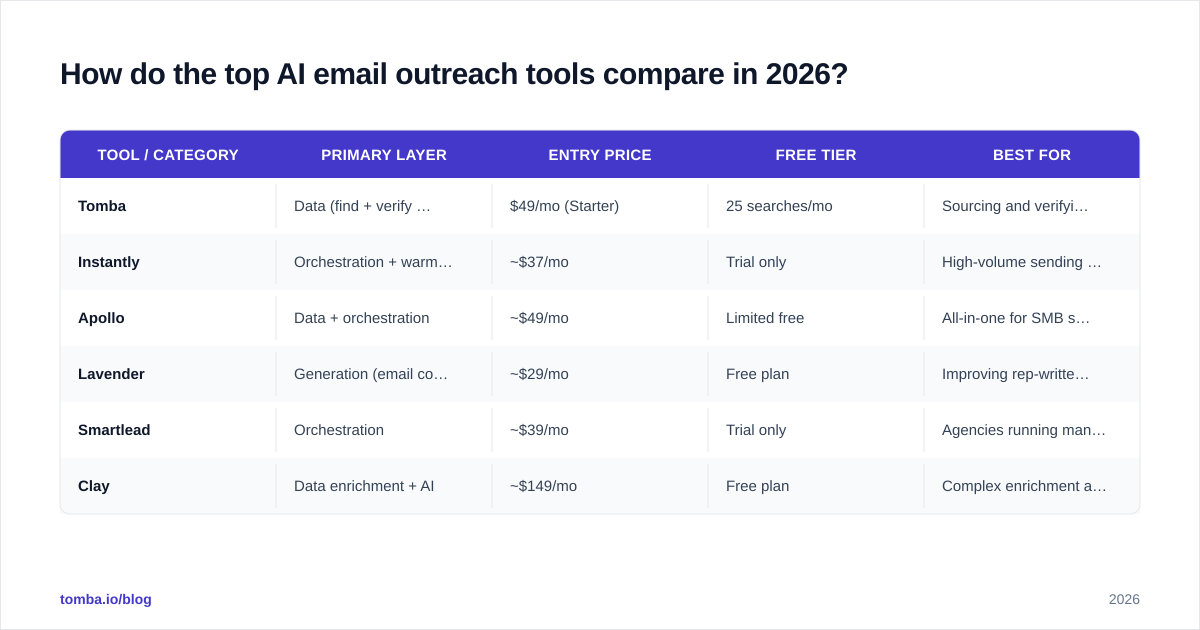
How do the top AI email outreach tools compare in 2026?#
Here's how the common categories stack up. Prices are entry-level published rates as of mid-2026 and shift often — always confirm on the vendor's own page.
| Tool / category | Primary layer | Entry price | Free tier | Best for |
|---|---|---|---|---|
| Tomba | Data (find + verify + enrich) | $49/mo (Starter) | 25 searches/mo | Sourcing and verifying the list AI writes to |
| Instantly | Orchestration + warmup | ~$37/mo | Trial only | High-volume sending with inbox rotation |
| Apollo | Data + orchestration | ~$49/mo | Limited free | All-in-one for SMB sales teams |
| Lavender | Generation (email coaching) | ~$29/mo | Free plan | Improving rep-written copy in real time |
| Smartlead | Orchestration | ~$39/mo | Trial only | Agencies running many client inboxes |
| Clay | Data enrichment + AI | ~$149/mo | Free plan | Complex enrichment and waterfall workflows |
Notice the pattern: no single tool owns all three layers well. The realistic 2026 stack is two or three tools — a strong data source feeding a generation/orchestration platform. For data accuracy specifically, you can compare options directly; see how vendors source contacts on Tomba's data sources page, and check independent reviews on G2 before committing.
What does an AI email outreach workflow look like end to end?#
Here's the sequence most high-performing teams run. It's deliberately data-first.
Step 1 — Build and verify the list. Pull target accounts, find decision-maker emails, and verify every address. Skipping verification is the single most common cause of bounce-driven reputation damage. Run a bulk verify pass and drop anything risky.
Step 2 — Enrich for context. Append title, seniority, company size, tech stack, funding, and recent triggers. This is the fuel for personalization. With data enrichment, the AI has something real to reference instead of inventing flattery.
Step 3 — Generate personalized copy. Feed the enriched record to your AI writer. Good prompts produce a one-line custom opener plus a tight value proposition. Keep the body under 90 words — AI is great at being concise if you tell it to be.
Step 4 — Set up the sequence. Three to five touches over two to three weeks, each a different angle: problem, proof, and a soft breakup. Branch on behavior.
Step 5 — Warm up and throttle. New domains and inboxes need warmup. Send 20-30 per inbox per day, not 500. Rotate across multiple inboxes if volume demands it.
Step 6 — Handle replies fast. AI can draft replies, but a human should approve anything past the first response. Use an AI email response assistant to cut drafting time, not to autopilot the relationship.
The order matters. Teams that start at Step 3 — buying a slick AI writer and pointing it at an unverified list — get high bounce rates, tanked deliverability, and a model that personalizes beautifully to dead inboxes.
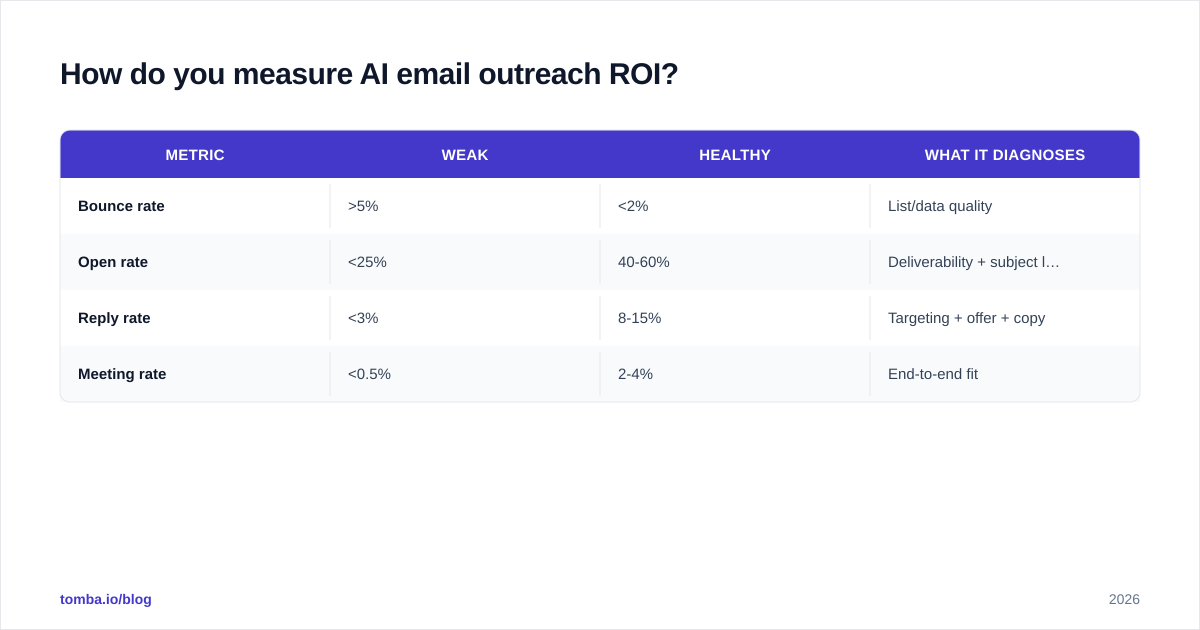
How do you measure AI email outreach ROI?#
Track four numbers, in this order:
- Bounce rate — keep it under 2-3%. Above that and mailbox providers start throttling you. This is a data quality metric, not a copy metric.
- Open rate — 40-60% is healthy for verified B2B lists with good subject lines. Low opens usually mean deliverability or subject-line problems, not body copy.
- Reply rate — the real signal. 8-15% is strong; under 3% means your targeting or offer is off. Compare against your baseline using the response rate definition so you're measuring consistently.
- Positive reply / meeting rate — replies that move toward a deal. This is the number your revenue team actually cares about.
A simple ROI frame: if AI tooling costs you $200/month and lets one rep book four extra meetings that convert one deal worth $6,000, the math is not close. The mistake teams make is measuring volume sent — that's an activity metric, and AI makes it cheap and meaningless. Measure outcomes.
| Metric | Weak | Healthy | What it diagnoses |
|---|---|---|---|
| Bounce rate | >5% | <2% | List/data quality |
| Open rate | <25% | 40-60% | Deliverability + subject line |
| Reply rate | <3% | 8-15% | Targeting + offer + copy |
| Meeting rate | <0.5% | 2-4% | End-to-end fit |
What mistakes kill AI email outreach campaigns?#
Over-automating the human moments. AI is excellent at the cold open and the follow-up nudge. It's poor at reading nuance in a warm reply. Let it draft; let a person decide.
Personalizing the wrong thing. "I saw your company was founded in 2009" is technically personalized and totally useless. Personalize around a trigger or pain, not a trivia fact. Garbage enrichment produces creepy-not-helpful openers.
Ignoring deliverability fundamentals. No amount of AI copy fixes a missing SPF record or a cold domain blasting 500 emails on day one. Get the email deliverability basics right first — authentication, warmup, throttling.
Treating AI output as final. Models hallucinate. They'll confidently reference a product feature you don't have or a "recent funding round" that never happened. Always have a human skim before send, especially at the start.
Buying generation before data. The most expensive lesson in cold email: a brilliant AI writer pointed at an unverified list is just an efficient way to burn your domain. Fix the foundation first.
For a broader perspective on how AI is reshaping the sales function, HubSpot's research on AI in sales and Gartner's sales technology coverage are both worth a read — they confirm the same theme: AI amplifies whatever process you feed it, good or bad.
Is AI email outreach worth it for small teams?#
Yes — arguably more so than for large ones. A two-person startup can't hire a research analyst, a copywriter, and an SDR. AI collapses those roles into a workflow one founder can run in a few hours a week. The leverage is real precisely because the team is small.
But the order of operations is non-negotiable for small teams with no margin for waste: data first, copy second, sending third. A founder who spends their first $50 on verified contact data and their second $50 on a sequencer will outperform one who spends $300 on the flashiest AI writer and feeds it a scraped, unverified list.
Start narrow. Pick one ideal-customer segment, build a list of 100 verified contacts, write five strong sequence steps with AI assistance, and measure. Scale what works. AI makes iteration cheap — use that to learn fast, not to send fast.
Where to start#
If you take one thing from this guide: AI email outreach lives or dies on data quality. The model can only personalize what you give it, and it can only reach inboxes that actually exist. That's the layer to nail first.
Start by building a verified, enriched list with the Tomba Email Finder — find decision-maker emails by domain, name, or company, verify them before you send, and hand your AI writer clean, accurate records to personalize against. The free tier gives you 25 searches a month to test the workflow, and paid plans start at $49/month when you're ready to scale. See full Tomba pricing to match a plan to your volume. Get the foundation right, and every AI email you send after that has a real shot at landing.
Ready to find emails that actually work?
Join 150,000+ professionals who stopped guessing and started sending. Free credits on signup — no credit card required.
Get the Tomba newsletter
Practical outbound tactics and product updates — once every two weeks.
About the author