B2B Data Intelligence Vendor Selection: 2026 Guide
A practical, scorecard-driven framework for choosing a B2B data intelligence vendor in 2026 — coverage, accuracy, compliance, pricing, and a POC checklist that exposes weak data before you sign.
B2B Data Intelligence Vendor Selection: 2026 Guide
Choosing a B2B data intelligence vendor is less like buying software and more like hiring a research team you will never meet. You are trusting their records to decide who your reps call, which accounts marketing prioritizes, and how your CRM stays clean. Pick wrong and the cost is not a refund — it is a quarter of misrouted pipeline.
This guide gives you a repeatable framework to evaluate vendors on what actually matters in 2026: coverage, accuracy, compliance, refresh cadence, and total cost. No vendor worship, no demo hypnosis.
TL;DR#
- Score, don't shop. Rank vendors on five weighted dimensions — coverage, accuracy, compliance, freshness, and cost — instead of reacting to the best demo.
- Accuracy beats record count. A 200M-contact database that is 70% deliverable is worse than a 40M database at 95%.
- Always run a paired proof of concept. Test two vendors on the same 1,000-row sample and measure verified hit rate yourself.
- Compliance is now table stakes. GDPR, CCPA, and documented data sourcing are non-negotiable for any vendor touching EU or California contacts.
- Budget for blended stacks. Most mature teams pair a broad database with a precision email finder like Tomba Email Finder for last-mile verification.
What is B2B data intelligence?#
B2B data intelligence is the practice of collecting, verifying, and enriching information about companies and the people inside them so your go-to-market team can target, reach, and prioritize accounts. Think of it as the difference between a phone book and a research analyst: the phone book lists names, but the analyst tells you who is hiring, who just raised funding, and which inbox is actually monitored.
A modern data intelligence stack usually covers four record types:
- Firmographics — company size, industry, revenue, tech stack, location.
- Contact data — names, titles, verified work emails, direct-dial phones.
- Intent and signals — hiring trends, funding events, technology adoption, web activity.
- Enrichment — appending missing fields to records you already own.
The vendors differ wildly in which of these they do well. Some are intent specialists, some are contact-data machines, some are enrichment APIs. Knowing which problem you are solving is step zero of vendor selection.
Why does vendor selection matter so much?#
Because bad data compounds silently. A single stale email does not just bounce — it dings your sender reputation, trains your reps to distrust the tool, and pollutes downstream reporting. Multiply that across a 50,000-record list and you have a deliverability problem masquerading as a "messaging problem."
Gartner has long estimated that poor data quality costs organizations millions annually in wasted effort and missed revenue. The fix is not buying more data — it is selecting a vendor whose accuracy and refresh cadence keep your records alive. You can read independent buyer reviews on G2 and analyst coverage on Gartner before you ever take a sales call.

What criteria should you evaluate vendors on?#
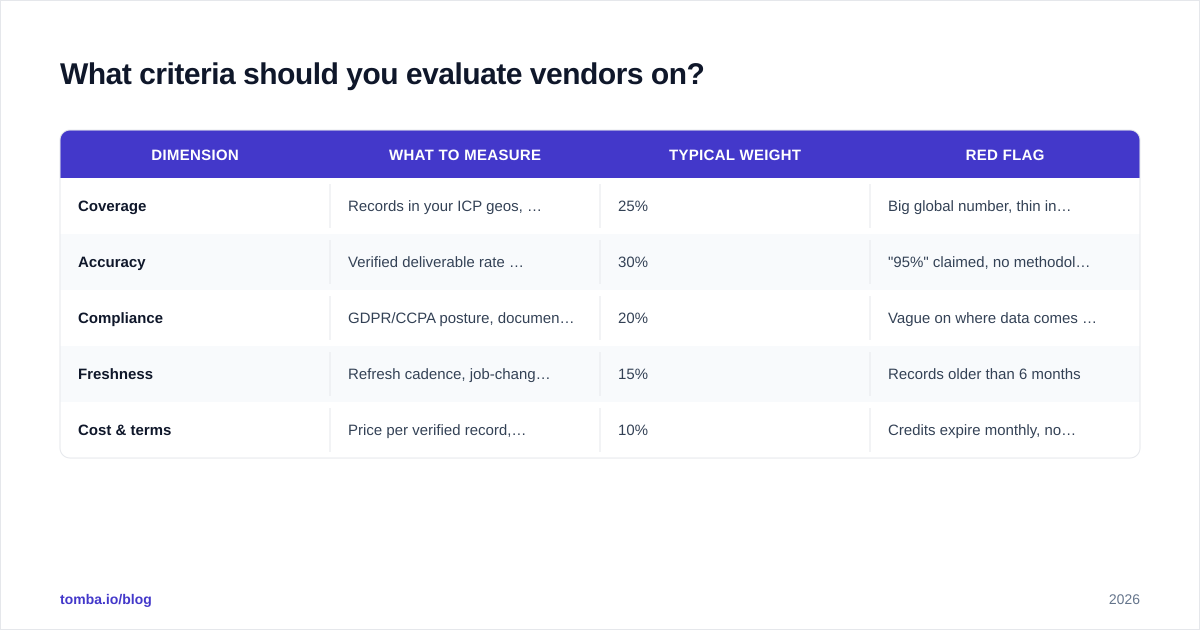
Use five weighted dimensions. Assign each a weight based on your use case, score every vendor 1–5, and multiply. The highest weighted total wins — not the smoothest sales engineer.
| Dimension | What to measure | Typical weight | Red flag |
|---|---|---|---|
| Coverage | Records in your ICP geos, industries, and seniority bands | 25% | Big global number, thin in your niche |
| Accuracy | Verified deliverable rate on a real sample | 30% | "95%" claimed, no methodology shared |
| Compliance | GDPR/CCPA posture, documented sourcing, opt-out handling | 20% | Vague on where data comes from |
| Freshness | Refresh cadence, job-change detection | 15% | Records older than 6 months |
| Cost & terms | Price per verified record, overage policy, lock-in | 10% | Credits expire monthly, no rollover |
Notice accuracy outweighs coverage. A larger database is meaningless if a third of it bounces. When you compare data sources and accuracy, ask vendors to define how they verify — SMTP checks, catch-all handling, and human review all behave differently at scale.
How do you weight the dimensions for your team?#
Adjust the weights to your motion:
- Outbound SDR teams — push accuracy and freshness higher; a wrong direct dial wastes a live conversation.
- ABM / marketing — raise coverage and intent weighting; you need depth in named accounts.
- RevOps enrichment — prioritize API reliability, match rate, and field completeness over raw record count.
How do the main vendor categories compare?#
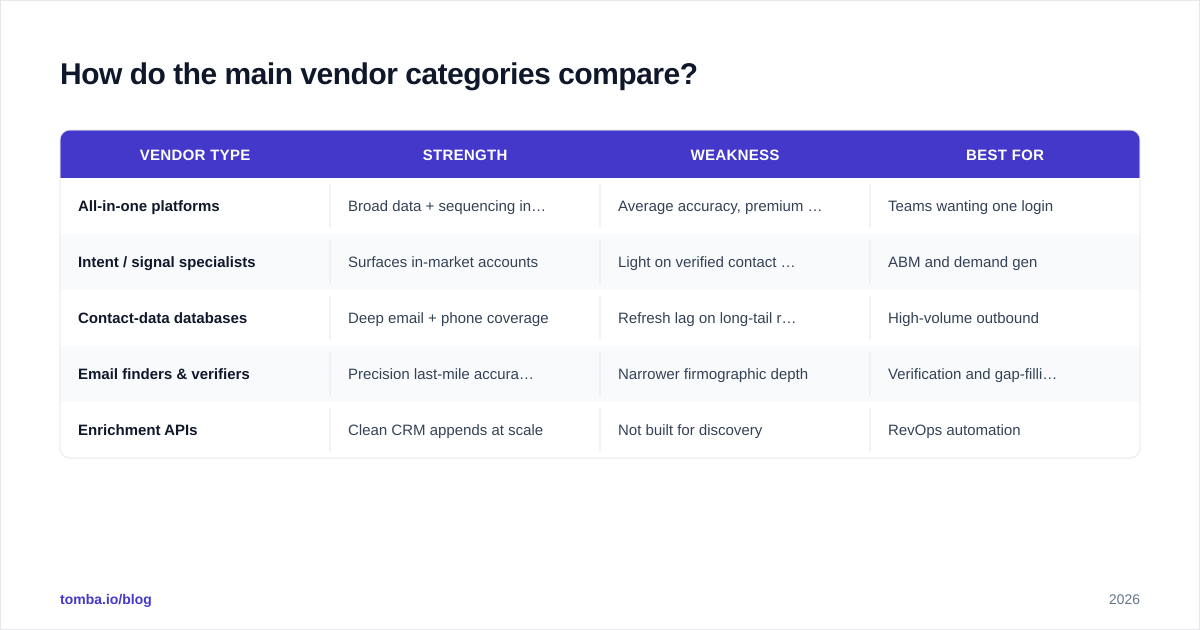
There is no single "best" vendor — there are categories optimized for different jobs. Here is how the landscape breaks down in 2026.
| Vendor type | Strength | Weakness | Best for |
|---|---|---|---|
| All-in-one platforms | Broad data + sequencing in one seat | Average accuracy, premium price | Teams wanting one login |
| Intent / signal specialists | Surfaces in-market accounts | Light on verified contact data | ABM and demand gen |
| Contact-data databases | Deep email + phone coverage | Refresh lag on long-tail records | High-volume outbound |
| Email finders & verifiers | Precision last-mile accuracy | Narrower firmographic depth | Verification and gap-filling |
| Enrichment APIs | Clean CRM appends at scale | Not built for discovery | RevOps automation |
Most teams that scale past their first year do not pick one — they blend. A common 2026 pattern is a broad database for discovery, an intent tool for prioritization, and a focused email verifier plus finder for the final accuracy pass before anything hits a sequence. If you are weighing a switch, the Apollo alternative and Clearbit alternative breakdowns walk through these trade-offs vendor by vendor.
How do you run a vendor proof of concept?#
This is where contracts are won and lost. A demo shows you the happy path; a proof of concept shows you the truth. Run it like a controlled experiment.
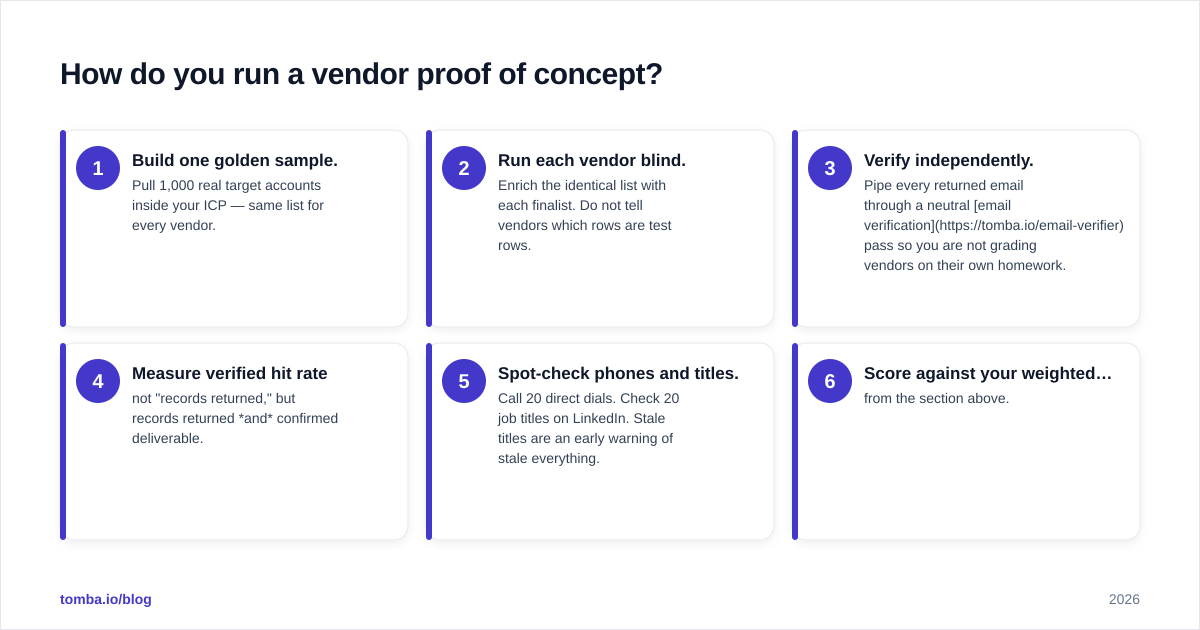
The paired POC method:
- Build one golden sample. Pull 1,000 real target accounts inside your ICP — same list for every vendor.
- Run each vendor blind. Enrich the identical list with each finalist. Do not tell vendors which rows are test rows.
- Verify independently. Pipe every returned email through a neutral email verification pass so you are not grading vendors on their own homework.
- Measure verified hit rate — not "records returned," but records returned and confirmed deliverable.
- Spot-check phones and titles. Call 20 direct dials. Check 20 job titles on LinkedIn. Stale titles are an early warning of stale everything.
- Score against your weighted matrix from the section above.
A vendor that claims 95% accuracy and delivers a 68% verified hit rate on your sample has told you everything you need to know. Trust your measurement over their marketing.
What questions should you ask in the sales call?#
- Where does your data come from, specifically, and how do you handle opt-outs?
- What is your refresh cadence, and do you detect job changes?
- Do unused credits roll over, and what happens on overage?
- Can I export and keep the data if I churn?
- What is your documented GDPR and CCPA posture?
If a rep dodges the sourcing question, treat it as a compliance risk, not a quirk.
What does B2B data intelligence cost in 2026?#
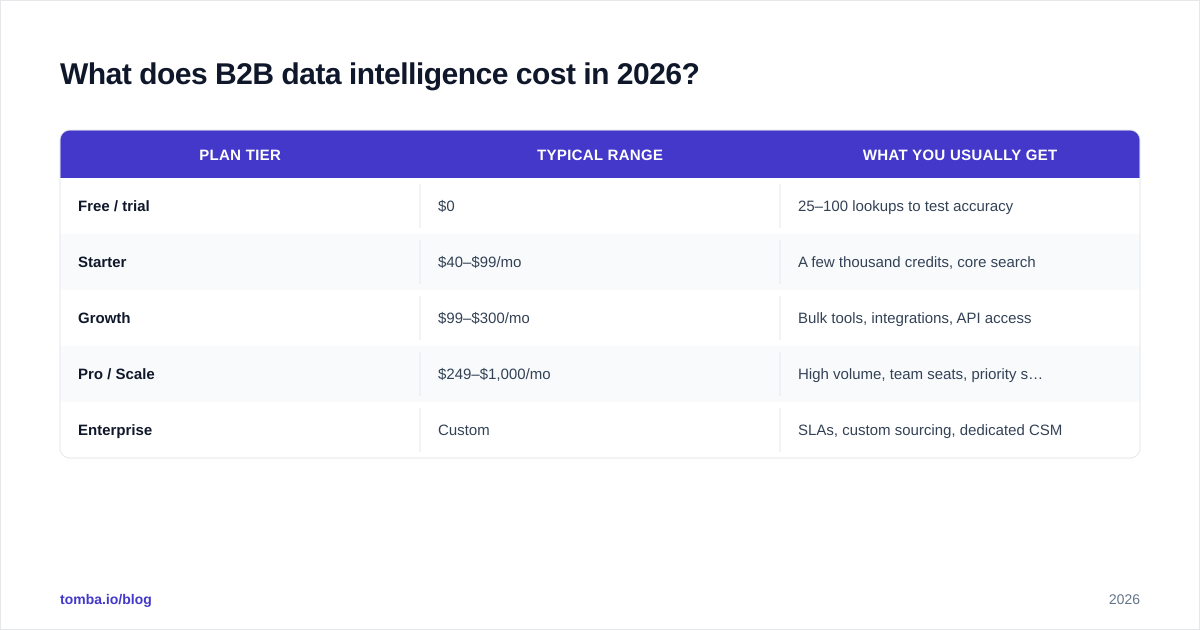
Pricing models vary, which makes apples-to-apples comparison hard. Normalize everything to cost per verified record so you are comparing outcomes, not list prices.
| Plan tier | Typical range | What you usually get |
|---|---|---|
| Free / trial | $0 | 25–100 lookups to test accuracy |
| Starter | $40–$99/mo | A few thousand credits, core search |
| Growth | $99–$300/mo | Bulk tools, integrations, API access |
| Pro / Scale | $249–$1,000/mo | High volume, team seats, priority support |
| Enterprise | Custom | SLAs, custom sourcing, dedicated CSM |
For reference, Tomba pricing runs a free tier at 25 searches per month, Starter at $49/mo, Growth at $99/mo, and Pro at $249/mo, with enterprise custom — a structure built so you can validate accuracy on the free tier before committing budget. Whatever vendor you choose, divide the monthly cost by the verified records you actually use, not the credits you are allotted.
What are the common vendor-selection mistakes?#
- Buying the biggest number. Record count is a vanity metric. Verified, in-ICP records are the only count that pays your salary.
- Skipping the POC. Demos are curated. Test on your own list or you are buying blind.
- Ignoring refresh cadence. A perfect database decays roughly 25–30% per year as people change jobs. Static data is dying data.
- Underrating compliance. A cheap vendor with murky sourcing is a legal liability, especially across EU contacts. HubSpot's overview of GDPR for marketers is a useful baseline.
- Forgetting the exit. If you cannot export your data on churn, you do not own your pipeline — your vendor does.
- Single-vendor lock-in. Blending a broad source with a precise email finder almost always beats one tool stretched past its strength.
How do you finalize the decision?#
Bring it back to the scorecard. Multiply each vendor's dimension scores by your weights, lay the totals next to your POC verified hit rates, and the winner is usually obvious — and defensible to your CFO. If two vendors tie, let total cost per verified record and contract flexibility break it.
Document the decision. Six months from now, when someone asks "why are we paying for this," your weighted matrix and POC results are the answer. Vendor selection done well is a record you can defend, not a hunch you have to apologize for.
Where Tomba fits#
If your weak spot is the last mile — turning a name and a domain into a verified, deliverable email — that is exactly what Tomba Email Finder is built for. Start on the free tier, run it through the paired POC above against your current vendor, and measure the verified hit rate yourself. Pair it with the built-in email verifier and data enrichment to keep your CRM accurate as records age. The best data intelligence stack is not the one with the loudest demo — it is the one that still passes your accuracy test in month six. Test it, score it, and let the numbers pick your vendor.
// get started
Find, verify and enrich your first contacts today
Start on the free plan with 25 searches a month, then scale when your team is ready.
Free plan · No credit card required · GDPR & CCPA
// about the author