Sales Hub for Sales Management: Enablement, Coaching, Training & Onboarding in 2026
A practical 2026 guide to running a sales hub that ties enablement, coaching, training, and onboarding into one ramp-and-retain system your reps actually use.
Most sales teams don't have a talent problem. They have a system problem. You hire capable reps, hand them a CRM login and a deck, then wonder why ramp drags past six months and only a third of the team hits quota. The fix isn't another tool — it's connecting enablement, coaching, training, and onboarding into a single sales hub that runs on a repeatable cadence.
This guide shows you how to build that hub in 2026: what each pillar does, how they reinforce each other, and which metrics tell you it's working.
TL;DR#
- Sales management enablement is the discipline of giving managers a repeatable system to ramp, coach, and retain reps — not a one-time training event.
- The four pillars — enablement, coaching, training, and onboarding — fail in isolation and compound when connected through one hub.
- Structured onboarding cuts time-to-first-deal; weekly coaching cadences are the single biggest lever on win rate.
- Pick tooling by the workflow it replaces, not the feature list. A CRM-native hub beats five disconnected point tools.
- Clean contact data is the quiet prerequisite: coaching call reviews and pipeline hygiene both collapse when reps chase bad leads.
What is sales management enablement?#
Sales management enablement is the practice of equipping front-line managers with the content, processes, coaching frameworks, and data they need to make every rep productive — fast and consistently. Think of it like a restaurant's prep system. A great chef alone doesn't scale; a documented line, station checklists, and a head chef who tastes every plate is what makes 40 covers a night repeatable. The chef is your top rep. The prep system is enablement.
Most teams confuse enablement with content. They build a Google Drive full of decks and call it done. Real enablement is the connective tissue between four pillars:
- Onboarding — how a new hire goes from signed offer to first closed deal.
- Training — ongoing skill-building after ramp, tied to specific gaps.
- Coaching — the manager-led, deal-by-deal feedback loop that turns training into behavior.
- Enablement content + ops — the playbooks, battlecards, and data that make the other three executable.
When these live in separate tools and separate calendars, reps feel the friction and managers default to firefighting. When they share one hub, a coaching note can spawn a training assignment, which references an onboarding module, which pulls from the same playbook the rep saw on day one.
Why do the four pillars fail in isolation?#
Each pillar has a predictable failure mode when it stands alone.
Onboarding without coaching front-loads everything into week one. The rep drinks from a firehose, retains 20%, and the manager assumes the content "stuck." By month two the rep is improvising.
Training without coaching is the classic "spray and pray." You run a workshop on discovery questions, everyone nods, and nothing changes on live calls because no one inspects whether reps actually use the new skill. Research from sales-effectiveness analysts has long shown most training content is forgotten within weeks unless reinforced.
Coaching without enablement content turns every 1:1 into the manager's personal opinion. Two managers coach two different motions, and your win rate becomes a coin flip depending on who a rep reports to.
Content without ops rots. Battlecards reference a competitor pricing tier that changed eight months ago, and reps quietly stop trusting the library.
The point: you don't get to pick one pillar. A sales hub exists precisely so a weakness in one is caught by the others.
How do you build an onboarding path that cuts ramp time?#
Ramp time — the weeks from start date to consistent quota attainment — is the most expensive number most teams don't measure. Every week of ramp is paid salary against zero or negative contribution.
Structure onboarding as a 30-60-90 with explicit, measurable exit criteria for each phase. Vague goals like "learn the product" guarantee slow ramp. Concrete ones like "pass a product certification quiz at 85%" create momentum.
| Phase | Focus | Exit criteria | Owner |
|---|---|---|---|
| Days 0–30 | Product, ICP, tooling | Certification quiz ≥85%, 5 mock calls passed | Enablement |
| Days 31–60 | Live pipeline, shadowing | 20 qualified discovery calls logged | Manager |
| Days 61–90 | Independent selling | First closed-won or 3 deals to proposal | Manager |
| Day 90+ | Full quota | Hits 70% of ramped quota | Manager |
A few non-negotiables that separate fast-ramp teams from slow ones:
- Assign a peer mentor, not just a manager. New reps ask peers the questions they're embarrassed to ask the boss.
- Have the rep sell back to you. The fastest signal of comprehension is watching a new hire run a mock discovery call in week two.
- Give them real, clean data on day one. Nothing kills early momentum like a new rep burning their first week on a list of bounced emails and disconnected numbers. This is where a reliable email finder and verified contact records earn their cost immediately — the rep practices the motion on prospects who actually exist.
For the metrics that anchor this phase, get familiar with how win rate and response rate are defined so onboarding goals map to numbers leadership already tracks.
What does a real coaching cadence look like?#
Coaching is the highest-leverage pillar and the most neglected, because it's the only one that demands recurring manager time. A documented cadence beats sporadic brilliance every time.
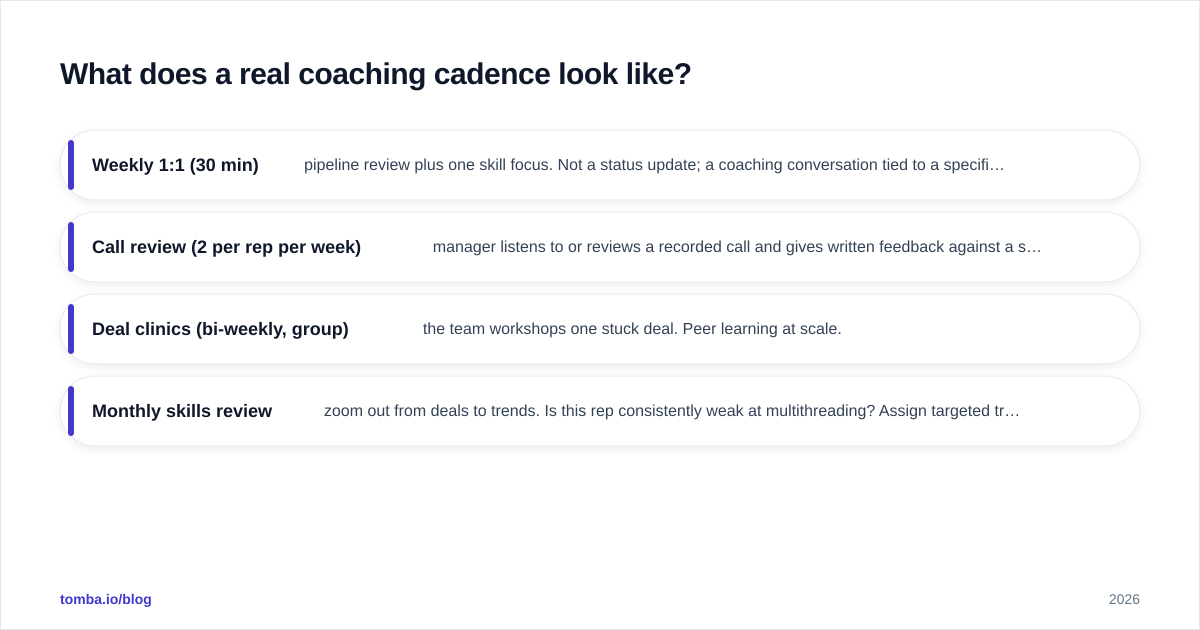
A workable weekly rhythm:
- Weekly 1:1 (30 min) — pipeline review plus one skill focus. Not a status update; a coaching conversation tied to a specific deal.
- Call review (2 per rep per week) — manager listens to or reviews a recorded call and gives written feedback against a scorecard.
- Deal clinics (bi-weekly, group) — the team workshops one stuck deal. Peer learning at scale.
- Monthly skills review — zoom out from deals to trends. Is this rep consistently weak at multithreading? Assign targeted training.
The scorecard is what keeps coaching from becoming opinion. Define 5–7 observable behaviors per call stage — "confirmed budget," "identified economic buyer," "set clear next step with a date" — and rate each on every reviewed call. Now coaching is evidence-based, two managers grade the same way, and you can spot patterns across the team.
This is also where sales automation and a well-maintained CRM pay off: if call recordings, notes, and scorecards don't auto-attach to the deal record, managers spend their coaching hour hunting for context instead of coaching.
How do training and enablement content stay alive?#
Training fails when it's an event. It works when it's a response to an observed gap. The coaching scorecard is your training trigger: if 60% of reps score low on "establishing next steps," that's next month's training topic — not whatever a vendor is selling.
Keep enablement content honest with three rules:
- Every asset has an owner and a review date. No orphan battlecards.
- Usage is tracked. If a playbook is never opened, kill or fix it — don't let dead weight erode trust in the library.
- Content references live data. Competitor pricing, ICP firmographics, and contact lists should pull from a maintained source, not a screenshot from last year.
That last point connects back to data quality. Enrichment and verification aren't glamorous, but a rep working from enriched, accurate lead records spends their training on selling skills instead of data cleanup. Garbage data doesn't just waste prospecting time — it pollutes every downstream coaching conversation, because you can't diagnose a rep's discovery skills when half their "no-shows" were never real contacts.
How do you choose a sales hub: all-in-one vs point tools?#
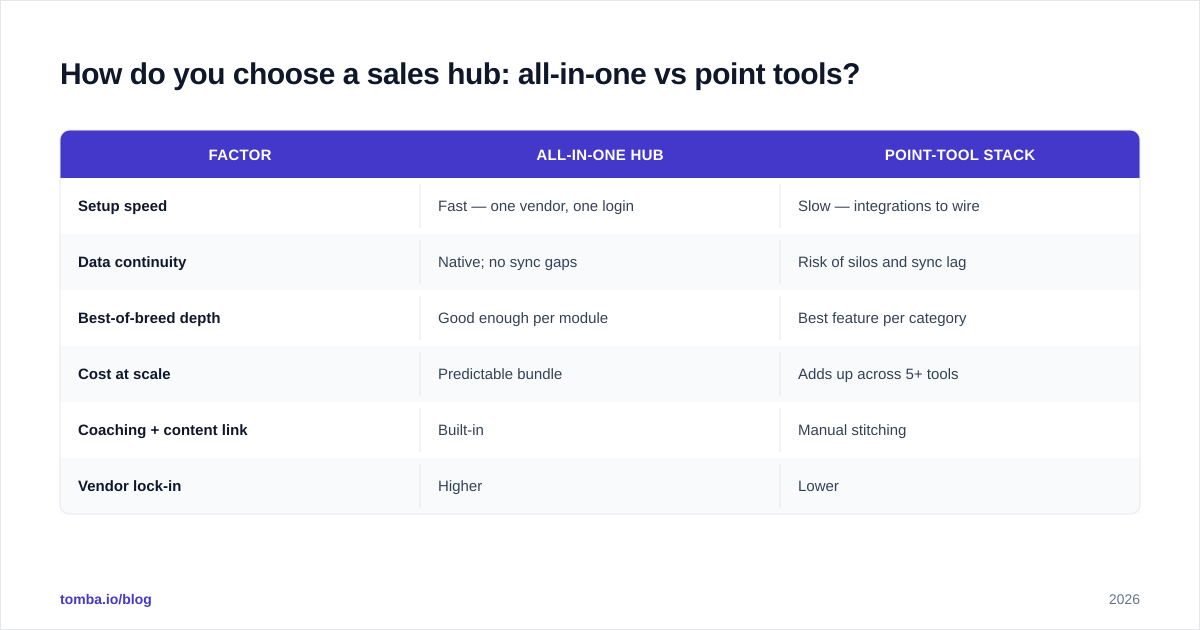
The market splits into two philosophies: one integrated hub versus a stack of best-of-breed point tools. Here's the honest trade-off.
| Factor | All-in-one hub | Point-tool stack |
|---|---|---|
| Setup speed | Fast — one vendor, one login | Slow — integrations to wire |
| Data continuity | Native; no sync gaps | Risk of silos and sync lag |
| Best-of-breed depth | Good enough per module | Best feature per category |
| Cost at scale | Predictable bundle | Adds up across 5+ tools |
| Coaching + content link | Built-in | Manual stitching |
| Vendor lock-in | Higher | Lower |
For most teams under ~50 reps, an integrated hub wins because the connective tissue between pillars is the whole point — and that tissue is exactly what breaks first in a stitched-together stack. Larger orgs with dedicated RevOps can justify best-of-breed depth because they have the people to maintain the integrations.
Whichever you choose, evaluate it on the workflow it removes, not its feature checklist. Read independent reviews on G2 and study how a mature platform like HubSpot Sales Hub structures coaching and content before committing. Analyst frameworks from firms like Gartner are useful for enterprise selection criteria.
One layer no hub replaces: the data feeding it. Whether you run all-in-one or a stack, you still need accurate contact and company records flowing in. Tools like a domain search for company-wide contact discovery and a bulk email finder for list building keep the top of your pipeline clean so the rest of the hub has real work to coach against.
What metrics prove the hub is working?#
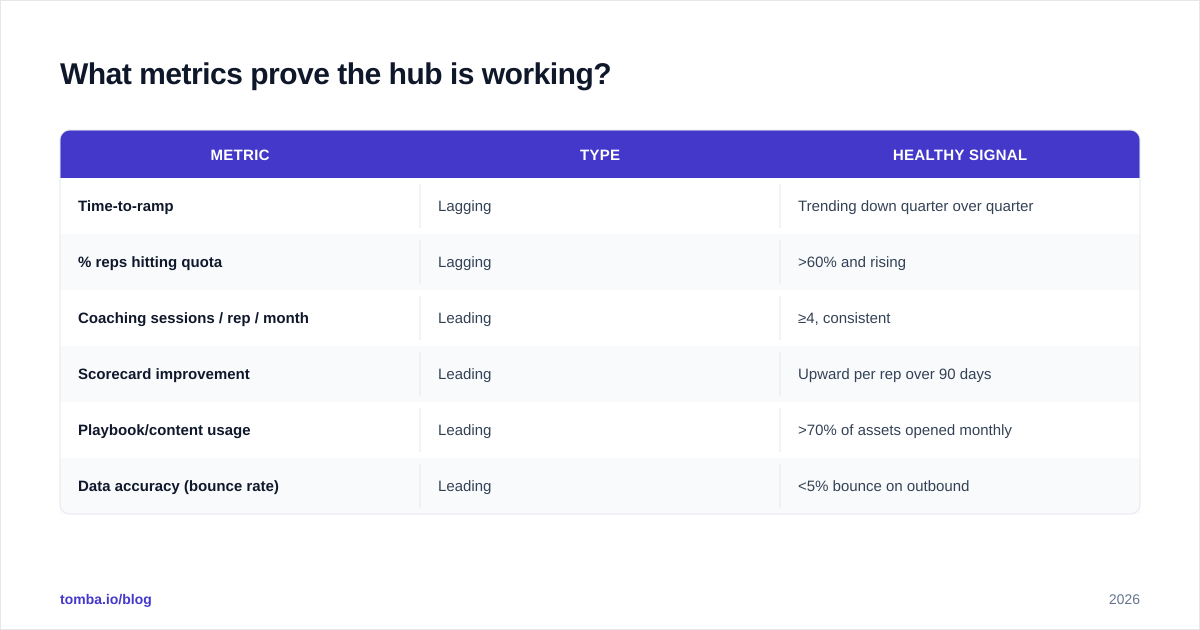
Track leading and lagging indicators together. Lagging metrics (quota attainment, win rate) tell you the outcome; leading ones tell you whether the system is healthy before the quarter closes.
| Metric | Type | Healthy signal |
|---|---|---|
| Time-to-ramp | Lagging | Trending down quarter over quarter |
| % reps hitting quota | Lagging | >60% and rising |
| Coaching sessions / rep / month | Leading | ≥4, consistent |
| Scorecard improvement | Leading | Upward per rep over 90 days |
| Playbook/content usage | Leading | >70% of assets opened monthly |
| Data accuracy (bounce rate) | Leading | <5% bounce on outbound |
If your coaching count is high but ramp isn't improving, your coaching quality — not quantity — is the problem; revisit the scorecard. If content usage is low, your library is bloated or outdated. The hub's job is to make these diagnoses obvious.
Common mistakes to avoid#
- Treating onboarding as a one-week event. Ramp is a 90-day system with checkpoints.
- Coaching only the bottom performers. Your middle 60% is where the biggest aggregate gain lives — small lifts across many reps beat heroic saves of a few.
- Buying tools before defining the cadence. A tool can't enforce a process you haven't designed.
- Ignoring data hygiene. You cannot coach a motion that runs on fake contacts.
- No single owner. If enablement, training, and coaching report to three people with no shared metric, the hub fragments by design.
Bringing it together#
A sales hub isn't software — it's the operating system that connects how you onboard, train, coach, and equip your team, with one set of metrics holding it accountable. Start with the cadence, then pick tools that enforce it, then feed the whole thing accurate data. Get those three right and ramp time falls, win rate climbs, and your best rep's instincts become a documented, teachable system instead of a lucky hire.
The unglamorous foundation under all of it is contact data your reps can trust from day one. If new hires are losing their first weeks to bounced emails and dead numbers, no coaching cadence will save the ramp. Tomba's Email Finder gives every rep verified, ready-to-work prospects from the moment they log in — so onboarding, training, and coaching run on real pipeline instead of cleanup. Start free with 25 searches a month, and check Tomba pricing when you're ready to equip the whole team.
// get started
Find, verify and enrich your first contacts today
Start on the free plan with 25 searches a month, then scale when your team is ready.
Free plan · No credit card required · GDPR & CCPA
// about the author