Sales Hub Hunter vs Farmer: 2026 Enablement Playbook
The hunter-farmer split decides whether your sales hub scales or stalls. Here is how to staff, comp, and enable each role in 2026 without losing pipeline.
TL;DR
- The hunter farmer sales model splits your team into closers who win net-new logos (hunters) and account managers who grow existing customers (farmers).
- A "sales hub" only works when management and enablement are tuned to each role separately — same playbook for both is the fastest way to burn out hunters and starve farmers.
- Hunters live on top-of-funnel volume and fresh contact data; farmers live on relationship depth and renewal signals.
- Comp, KPIs, coaching, and tooling all need to fork by role. The table below shows exactly where.
- Get the data layer right first: hunters waste 30%+ of their week prospecting when contact discovery is manual. Fix that before you touch quota.
What is the hunter farmer sales model?#
The hunter farmer sales model divides your sales force by motion, not just by seniority. Hunters chase net-new revenue: cold outreach, demos, new-logo closes. Farmers expand and retain: onboarding, upsells, renewals, relationship management.
Think of it like a restaurant. Hunters are the team out front bringing new diners through the door every night. Farmers are the kitchen and host staff who make sure those diners come back, bring friends, and order the tasting menu. Both matter. Neither replaces the other. And the moment you ask one person to do both jobs at full intensity, the quality of each drops.
Technically, the model maps to two distinct revenue functions: new business acquisition and net revenue retention (NRR). Most modern revenue orgs — the kind tracked by analysts at Gartner — now treat these as separate operating systems inside one "sales hub," with their own pipelines, dashboards, and enablement tracks.
The "sales hub" part matters. A hub is the shared infrastructure — CRM, data, content, routing rules — that both roles plug into. Platforms like HubSpot Sales Hub and Salesforce Sales Cloud are built around this idea: one system of record, multiple motions running on top. Your job as a sales leader is to configure that hub so hunters and farmers each get what they need without stepping on each other.
Why does the hunter vs farmer split matter in 2026?#
Because specialization compounds. The generalist rep who "does a bit of everything" was viable when deal cycles were simple and data was scarce. In 2026, buyers are more researched, cycles are longer, and the tooling stack is deep enough that mastering one motion is a full-time skill.
Three forces make the split non-optional:
- Buyer expectations diverged. A net-new prospect wants a crisp, problem-led pitch. An existing customer wants a partner who already knows their account. Those are opposite postures.
- Comp models punish blending. When you pay one rep on both new logos and renewals, they optimize for whichever is easier that quarter — usually renewals — and new-business growth quietly stalls.
- Data and AI raised the floor on prospecting. Hunters who automate contact discovery now run 3-4x the volume of those doing it manually. That gap is too big to ignore.
If your team is still 100% generalist, you are leaving the easiest revenue lever untouched. The fix is structural, not motivational — no amount of "hunt harder" Slack messages substitutes for a role design that lets people specialize.
Hunter vs farmer: how do the two roles actually differ?#
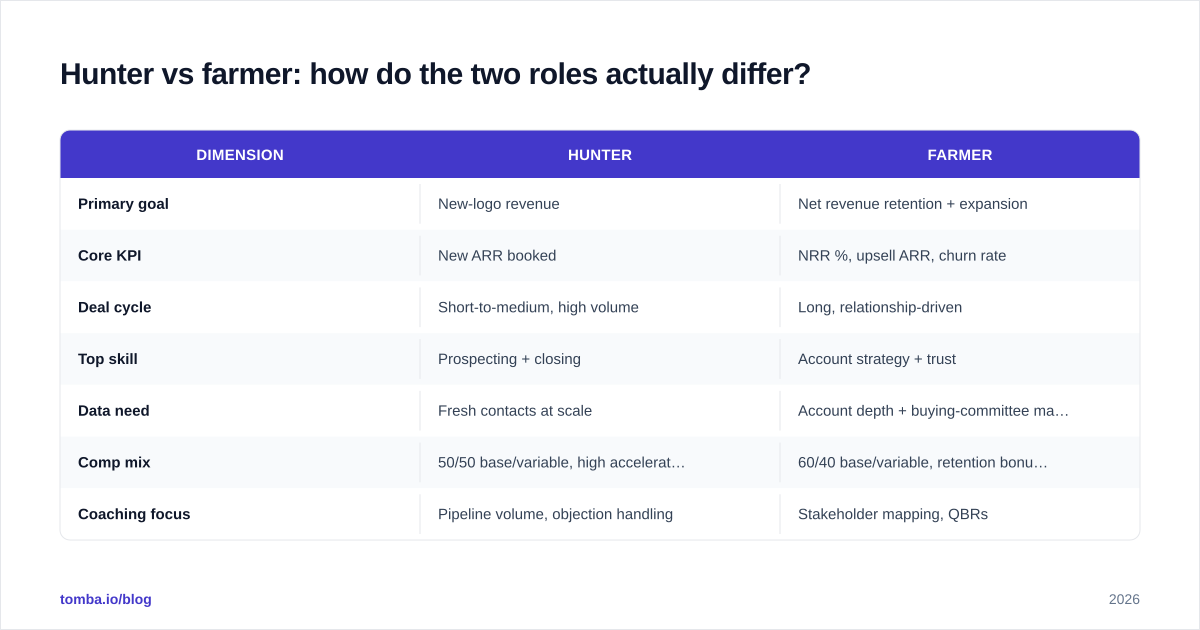
Here is the side-by-side that should drive every staffing, comp, and enablement decision you make.
| Dimension | Hunter | Farmer |
|---|---|---|
| Primary goal | New-logo revenue | Net revenue retention + expansion |
| Core KPI | New ARR booked | NRR %, upsell ARR, churn rate |
| Deal cycle | Short-to-medium, high volume | Long, relationship-driven |
| Top skill | Prospecting + closing | Account strategy + trust |
| Data need | Fresh contacts at scale | Account depth + buying-committee maps |
| Comp mix | 50/50 base/variable, high accelerators | 60/40 base/variable, retention bonuses |
| Coaching focus | Pipeline volume, objection handling | Stakeholder mapping, QBRs |
| Burnout risk | Rejection fatigue | Complacency / coasting |
| Best tooling | Email finder, dialer, sequencer | CRM health scores, usage analytics |
Notice the comp row. Hunters need uncapped accelerators because their output is volatile and front-loaded — a great month should pay disproportionately. Farmers need a higher base because retention is steady, defensive work that rarely produces a single hero quarter but quietly protects 70-80% of your revenue.
Notice the data row too. A hunter's productivity is gated by how fast they can turn a target account into reachable contacts. That is where a dedicated email finder earns its keep — it removes the single biggest time-sink in the hunter's day. Farmers, by contrast, rarely need net-new contact discovery; they need data enrichment on accounts they already own so they can map the full buying committee before a renewal.
How should sales management structure the sales hub?#
Conclusion first: one hub, two operating systems. Shared CRM and data layer; separate pipelines, dashboards, quotas, and rituals.
Here is the practical configuration:
Shared layer (the hub):
- Single CRM as system of record
- Unified contact and account data
- Common content library
- Lead routing rules that respect role boundaries
Hunter operating system:
- New-business pipeline with stages tuned for velocity
- Top-of-funnel dashboards (activity, meetings booked, pipeline created)
- SLA on speed-to-lead
- Prospecting tools wired directly into the CRM
Farmer operating system:
- Account pipeline organized by renewal date and expansion potential
- Health-score dashboards (product usage, support tickets, NPS)
- QBR cadence per tier
- Expansion-signal alerts
The hand-off between the two is where most teams leak revenue. A closed-won deal should transfer from hunter to farmer with a structured handoff: account context, key stakeholders, why they bought, and what success looks like. Skip this and your farmer starts every relationship cold — which defeats the entire model. Document the handoff as a required CRM step, not an optional courtesy.
One more management call: do not let farmers chase new logos and do not let hunters babysit renewals. It feels efficient in the moment and it quietly erodes both motions. The temptation is real — a farmer sees a shiny net-new opportunity and drifts off their renewal book.
When that drift happens at scale, your NRR slips a few points each quarter and nobody notices until the board deck. Guard the boundary.
How does sales enablement differ for hunters and farmers?#
Enablement is where the model lives or dies, because a generic onboarding track produces generic reps. Fork your enablement the same way you fork your pipeline.
Hunter enablement should obsess over the top and middle of the funnel:
- Prospecting frameworks and target-account research
- Cold-call and cold-email messaging (test, measure, iterate)
- Objection handling and competitive battlecards
- Demo certification before they touch a live prospect
- Data hygiene: how to find, verify, and load contacts fast
Farmer enablement should obsess over account expansion and trust:
- Stakeholder mapping and multithreading inside accounts
- Running QBRs that surface expansion, not just status
- Reading product-usage data to spot upsell and churn signals
- Renewal negotiation without discounting reflexively
- Cross-sell motions across your product line
Both tracks need ongoing coaching, not one-time onboarding. The best-run hubs run weekly skill drills split by role: hunters do call reviews and pipeline inspection; farmers do account-plan reviews and risk forecasting. Tools like Gong make conversation analysis role-specific, so a hunter's coaching is about discovery quality while a farmer's is about relationship signals.
A note on measurement: enablement only counts if it moves a number. For hunters, track win rate and pipeline-created-per-rep before and after a training. For farmers, track NRR and time-to-first-expansion. If the number doesn't move, the training was theater.
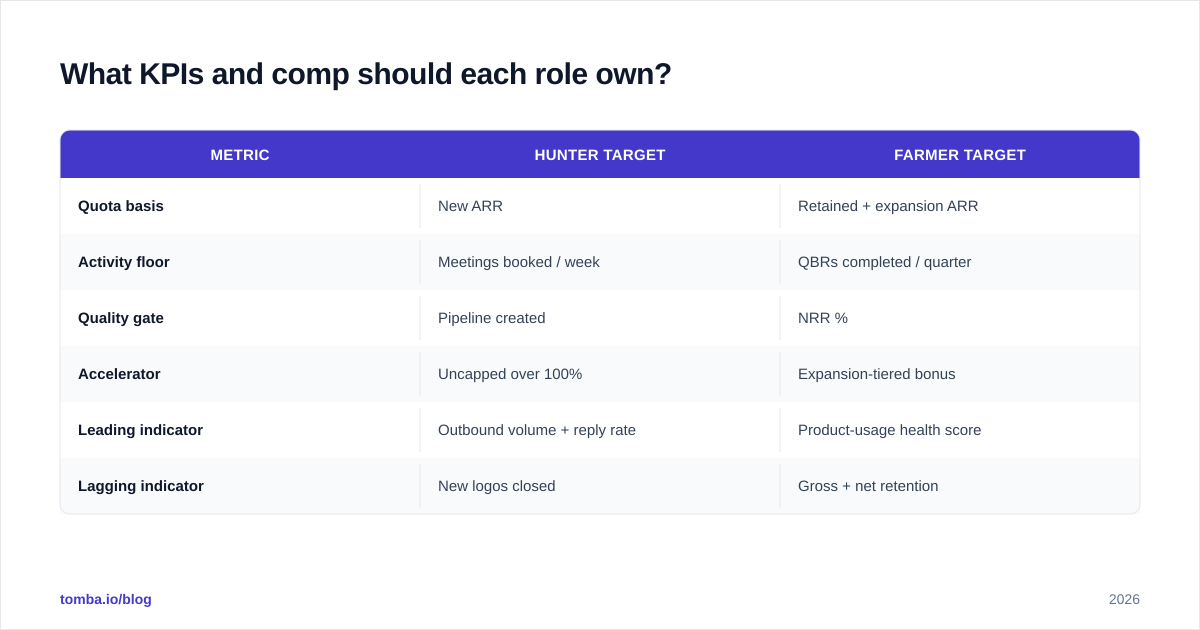
What KPIs and comp should each role own?#
Pay people for the motion you actually want.
| Metric | Hunter target | Farmer target |
|---|---|---|
| Quota basis | New ARR | Retained + expansion ARR |
| Activity floor | Meetings booked / week | QBRs completed / quarter |
| Quality gate | Pipeline created | NRR % |
| Accelerator | Uncapped over 100% | Expansion-tiered bonus |
| Leading indicator | Outbound volume + reply rate | Product-usage health score |
| Lagging indicator | New logos closed | Gross + net retention |
Two rules keep this honest:
First, never blend the quota. A combined "total ARR" number lets reps hide a weak motion behind a strong one. Split the targets and you instantly see which half of your hub is underperforming.
Second, pay hunters faster. New business is volatile, so the reward has to be immediate and uncapped or your best closers leave for someone who pays that way. Farmers value stability, so weight their package toward a higher base with retention and expansion kickers. Matching the comp shape to the personality the role attracts is half the retention battle.
What tooling does a hunter-farmer sales hub need?#
The stack forks by role, sitting on top of the shared hub.
For hunters — speed and volume tools:
- An email finder to turn target accounts into reachable contacts in seconds
- An email verifier so bounces don't wreck sender reputation
- A phone finder for multichannel outreach
- A sequencer/dialer for cadence at scale
For farmers — depth and signal tools:
- CRM health scoring and usage analytics
- Data enrichment to keep account records and org charts current
- Renewal and expansion alerting
- A QBR/account-planning workspace
The mistake leaders make is buying one "all-in-one" suite and assuming it serves both. It rarely does. Hunters need prospecting depth; farmers need account intelligence. A platform that nails one usually phones in the other. Buy for the motion, integrate into the hub, and check independent reviews on G2 before you commit budget — the category leaders for prospecting are not the same as the leaders for retention.
For the hunter side specifically, contact discovery is the highest-leverage fix. A hunter who spends three hours a day hunting for email addresses is a hunter doing the wrong job. Automate that, and you reclaim 15+ selling hours per rep per week — which is more capacity than most teams get from a new hire.
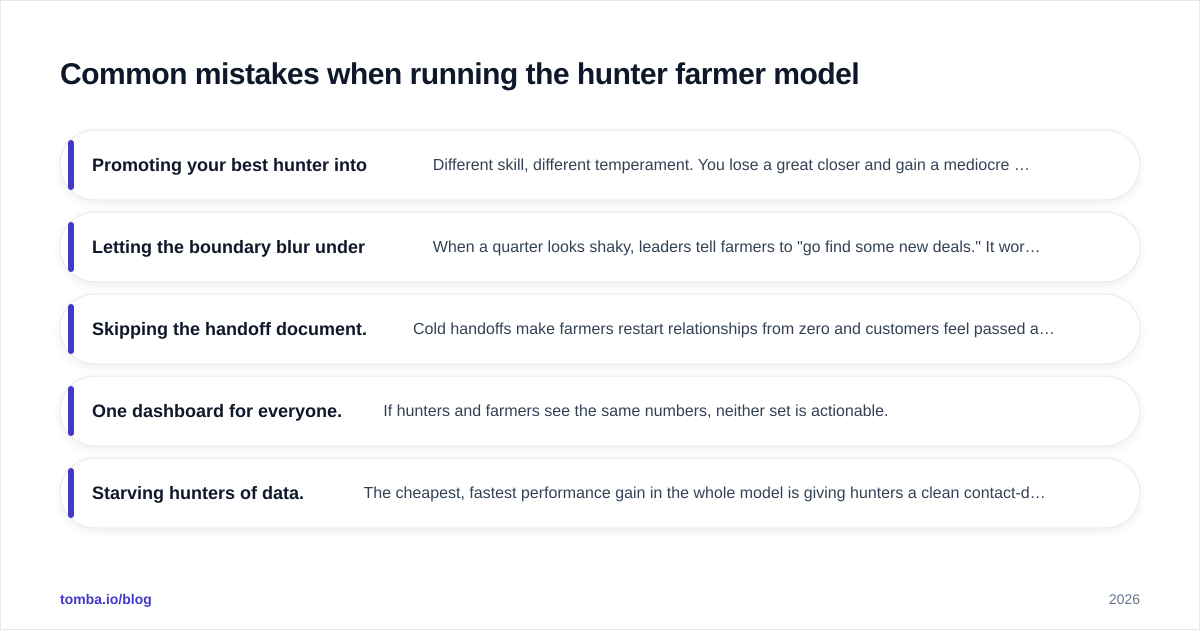
Common mistakes when running the hunter farmer model#
- Promoting your best hunter into a farmer "because they're senior." Different skill, different temperament. You lose a great closer and gain a mediocre account manager.
- Letting the boundary blur under pressure. When a quarter looks shaky, leaders tell farmers to "go find some new deals." It works once, then your retention motion is permanently distracted.
- Skipping the handoff document. Cold handoffs make farmers restart relationships from zero and customers feel passed around.
- One dashboard for everyone. If hunters and farmers see the same numbers, neither set is actionable.
- Starving hunters of data. The cheapest, fastest performance gain in the whole model is giving hunters a clean contact-discovery workflow. Teams skip it and then wonder why outbound volume is flat.
Get your hunters the data they need to actually hunt#
The hunter farmer sales model only pays off when each role can run its motion at full speed — and for hunters, that speed is capped by how fast they can reach the right people. Tomba's Email Finder turns a target-account list into verified, ready-to-contact emails by domain, name, or company, so your hunters spend their hours selling instead of searching. Pair it with the email verifier to protect deliverability, and your farmers can lean on data enrichment to keep every account record renewal-ready. Start on the free tier (25 searches/month), then scale on the Starter plan at $49/mo as your hub grows — see full Tomba pricing for Growth ($99/mo) and Pro ($249/mo) tiers. Build the data layer first; the quota takes care of itself.
// get started
Find, verify and enrich your first contacts today
Start on the free plan with 25 searches a month, then scale when your team is ready.
Free plan · No credit card required · GDPR & CCPA
// about the author