Sales Management Enablement: Quotas and Incentives in 2026
Quotas tell reps what to hit; incentives make them want to. Here's how to design both so your sales hub turns enablement into predictable revenue in 2026.
Quotas and incentives are the two levers every sales manager actually controls. Pipeline, win rates, and forecast accuracy are downstream effects — what you set as the target and what you pay for hitting it are the inputs. Get those two wrong and no amount of coaching, tooling, or motivational Slack messages will save the quarter.
This guide treats "sales hub sales management enablement quotas incentives" as one connected system, not five buzzwords. A sales hub is the operational center where targets, comp, coaching, and data live. Enablement is the process of making reps capable of hitting the number. Quotas define the number. Incentives decide whether reps want to chase it. When those pieces reinforce each other, you get predictable revenue. When they fight each other, you get sandbagging, churn, and a comp plan nobody understands.
TL;DR#
- Quotas set direction; incentives set intensity. A perfect quota with a broken comp plan still fails — and vice versa.
- Tie quota to capacity, not hope. Bottom-up territory math beats a top-down "grow 40%" mandate every time.
- Pay simply. Plans a rep can't calculate in their head don't change behavior; they create resentment.
- Enablement is what closes the gap between the quota you set and the quota reps can actually hit — content, coaching, and clean data.
- A sales hub is the connective tissue that keeps quota, attainment, and incentive data in one place so RevOps isn't reconciling spreadsheets at month-end.
What is a sales hub in management and enablement?#
A sales hub is the single operational surface where your revenue team plans, executes, and measures selling. Think of it like an airport control tower. Individual reps are the planes — each flying their own route — but someone needs altitude, weather, and traffic data in one screen to keep them from colliding and to land them on time. The hub is that tower: quota assignments, pipeline, activity data, coaching notes, and incentive payouts all visible in one place.
In practice, "sales hub" can mean a CRM-native suite (HubSpot Sales Hub, Salesforce Sales Cloud), a dedicated enablement platform, or a stack you assemble from a CRM, a sales engagement tool, and a commission engine. The label matters less than the function. The function is this: a manager should be able to answer "who is on track, who is behind, and why" without exporting four CSVs.
The framework above shows the loop most high-performing teams run: set quota → enable the rep → measure attainment → pay the incentive → feed results back into next period's quota. Break any arrow and the loop stalls. Set a quota with no enablement and reps flail. Enable without measuring and you can't prove ROI. Measure without paying fairly and your best reps leave.
How do you set sales quotas that are fair and achievable?#
Set quotas bottom-up from territory capacity, then sanity-check against the top-down revenue goal — never the reverse. The most common failure mode is starting with the board's number ("we need $20M") and dividing it by headcount. That math ignores territory quality, ramp time, and historical attainment, and it guarantees that some reps get an impossible number while others get a layup.
A defensible quota-setting process has four inputs:
- Territory potential — total addressable accounts and their realistic spend. This is where clean B2B data earns its keep; you can't size a territory you can't see. Tools like a domain search and data enrichment help quantify how many real, reachable accounts sit in each patch.
- Historical attainment — what reps in similar territories actually closed last year, not what they were assigned.
- Ramp status — a rep three months in should not carry the same number as a tenured closer. Prorate.
- Capacity math — working selling days × realistic deals per rep × average deal size.
Then you reconcile bottom-up capacity against the top-down goal. If capacity says $16M and the board wants $20M, that $4M gap is a staffing and enablement problem, not a quota problem. Closing it by inflating quotas just moves the failure from the spreadsheet to the field.
What quota model should you use?#
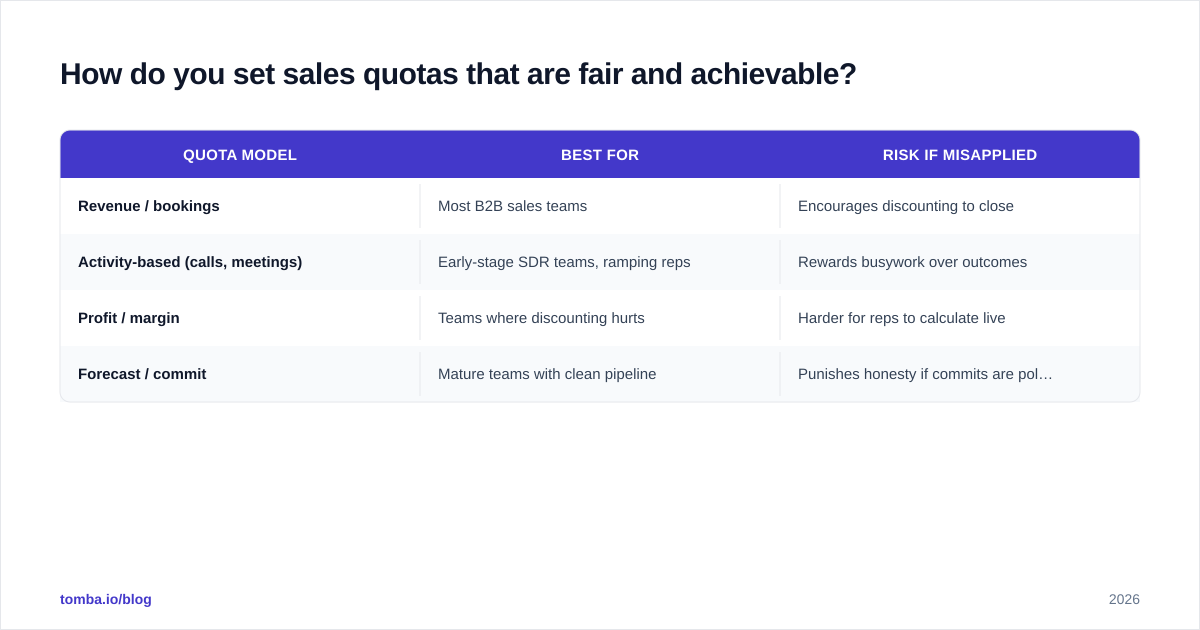
| Quota model | Best for | Risk if misapplied |
|---|---|---|
| Revenue / bookings | Most B2B sales teams | Encourages discounting to close |
| Activity-based (calls, meetings) | Early-stage SDR teams, ramping reps | Rewards busywork over outcomes |
| Profit / margin | Teams where discounting hurts | Harder for reps to calculate live |
| Forecast / commit | Mature teams with clean pipeline | Punishes honesty if commits are policed too hard |
Most teams blend two: a primary revenue quota for AEs and an activity floor so managers can coach leading indicators before the lagging number goes red. The mistake is stacking five metrics — at that point reps optimize for whatever pays best and ignore the rest.
What makes a sales incentive plan actually motivate reps?#
A good incentive plan is one a rep can calculate in their head and that pays more for the behavior you actually want. Those are the only two non-negotiables, and most plans violate both.
The "calculate in their head" rule sounds trivial. It isn't. If a rep can't tell you, mid-deal, how much an extra $10K of ACV puts in their pocket, the plan is not influencing behavior — it's just a surprise at payday. Complexity is where motivation goes to die. Tiered accelerators, multipliers, kickers, clawbacks, and SPIFFs can each be defensible alone, but bolt all five together and you've built a plan that only the comp analyst understands.

The "pay for what you want" rule is about alignment. Some patterns that consistently work:
- Accelerators above 100%. The marginal dollar after quota should pay more, not less. This is what separates a 105% attainment culture from a 95% one. Reps who know the back half of the year pays double will not coast in Q4.
- Capped plans are a tax on your best people. If you cap commissions, your top rep learns to stop selling in November and start next year's pipeline early. You paid for that behavior.
- SPIFFs for direction, not for base motivation. A short spiff to push a new product line for one quarter is fine. A permanent SPIFF on everything is just a confusing base plan.
How should base and variable pay split?#
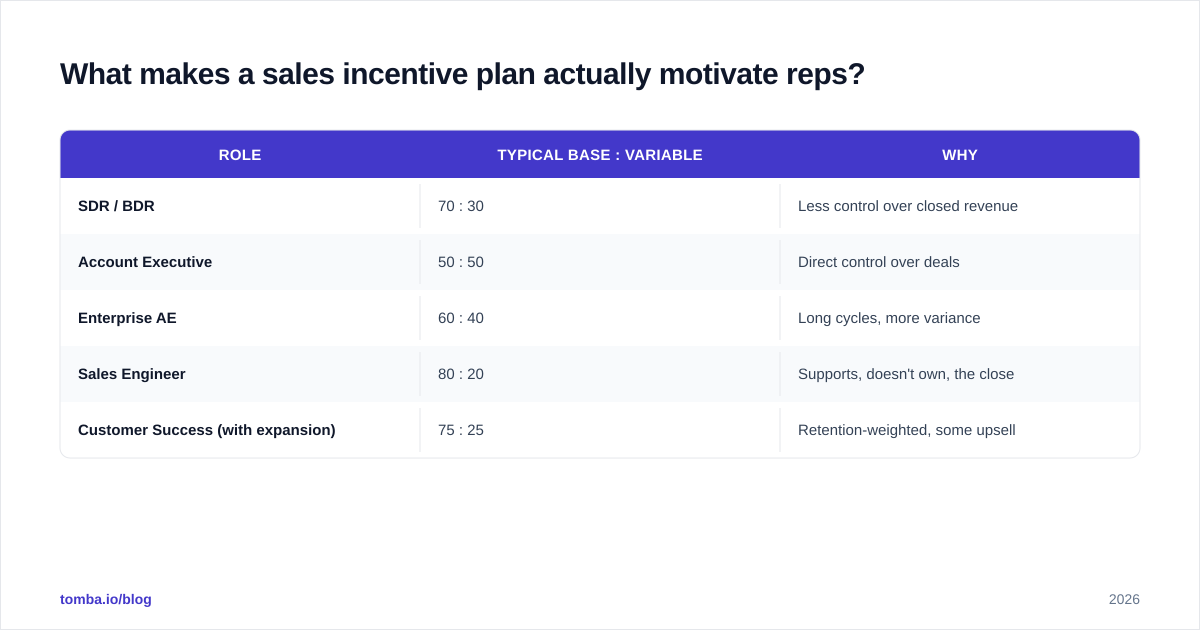
The on-target earnings (OTE) split signals how much risk you're asking the rep to carry. The more control a rep has over the outcome, the more aggressive the split can be.
| Role | Typical base : variable | Why |
|---|---|---|
| SDR / BDR | 70 : 30 | Less control over closed revenue |
| Account Executive | 50 : 50 | Direct control over deals |
| Enterprise AE | 60 : 40 | Long cycles, more variance |
| Sales Engineer | 80 : 20 | Supports, doesn't own, the close |
| Customer Success (with expansion) | 75 : 25 | Retention-weighted, some upsell |
There's no universal right answer, but there is an internal-consistency test: a role with little control over whether a deal closes should not have a 50:50 plan, and a closer with full control shouldn't be sitting at 80:20 — you're under-leveraging your strongest motivator.
How does enablement connect quotas to incentives?#
Enablement is the bridge that turns an assigned quota into an attainable one. You can set a fair number and pay a clean incentive, and reps will still miss if they don't have the content, the coaching, and the data to execute. Enablement is the work of closing that gap.
Concretely, enablement shows up in three places:
Content and messaging. Reps need objection-handling docs, case studies, and cold email templates that are current, not a SharePoint folder last touched in 2023. The test: can a new rep find the right asset for the right stage in under a minute?
Coaching cadence. Managers should coach the leading indicators that predict quota attainment — pipeline coverage, multithreading, discovery quality — not just inspect the lagging number in a Monday forecast call. A sales hub that surfaces per-rep activity makes this coaching specific instead of generic.
Clean data. This is the unglamorous foundation. Reps waste enormous time on bad contact data — bounced emails, wrong titles, dead phone numbers. Every hour spent hunting for a working email is an hour not spent selling against quota. Equipping reps with an email finder and an email verifier is one of the highest-leverage enablement moves available, because it directly reduces the friction between activity and pipeline. According to HubSpot's sales research, prospecting is consistently ranked the hardest part of the job — most of that difficulty is data quality, not effort.
When enablement works, the feedback loop tightens: better data → more qualified pipeline → higher attainment → bigger incentive payouts → reps who trust the system and stay. That trust is the real asset. Plans get gamed when reps believe the system is rigged against them; they get chased when reps believe effort converts to pay.
How do you measure whether the system is working?#
Track three numbers together — quota attainment distribution, comp plan ROI, and rep retention — because any one in isolation lies. High attainment with terrible retention means you're burning people. Great retention with low attainment means quotas are too soft and you're leaving revenue on the table.
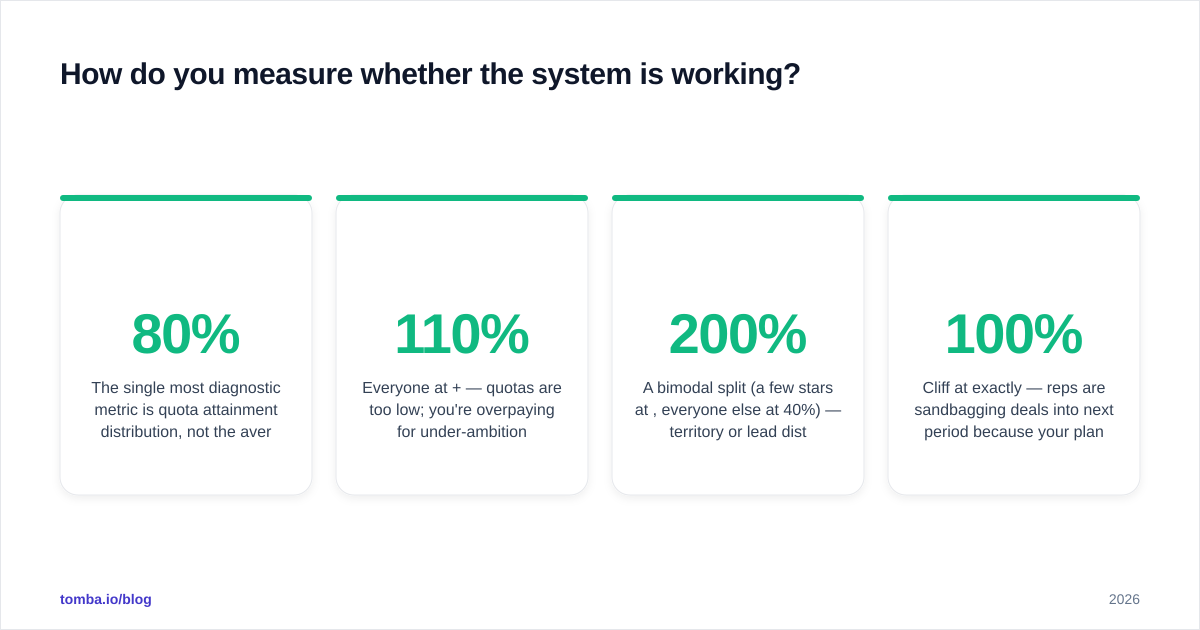
The single most diagnostic metric is quota attainment distribution, not the average. A healthy distribution has most reps clustered between 80% and 120% of quota. Warning signs:
- Everyone at 110%+ — quotas are too low; you're overpaying for under-ambition.
- A bimodal split (a few stars at 200%, everyone else at 40%) — territory or lead distribution is broken, not effort.
- Cliff at exactly 100% — reps are sandbagging deals into next period because your plan punishes overperformance (capped or decelerating).
Pair attainment with plan cost of sales (total comp ÷ revenue booked) to confirm the incentive is efficient, and with regretted attrition among top performers to confirm it's fair. If you're improving on all three over consecutive quarters, the quota-incentive-enablement loop is healthy. If you're trading one for another, you've optimized a single lever at the expense of the system.
For teams that want to benchmark their definitions and process, Gartner's sales research and peer reviews on G2 are useful neutral references before committing to a sales performance management platform.
Common mistakes to avoid#
- Changing the plan mid-period. Reps build their personal economics around the plan they were given. Move the goalposts and you destroy trust faster than any single quarter of missed numbers.
- Quota inflation to hit a board number. If capacity says $16M, assigning $20M doesn't create $4M — it creates demoralized reps and an inflated forecast you'll miss anyway.
- Paying for activity you don't actually value. If you SPIFF demos but care about closed revenue, you'll get a calendar full of unqualified demos.
- Treating enablement as a one-time onboarding event. Ramp is continuous. Markets shift, products ship, competitors move. The content and data that enabled last year's quota won't carry this year's.
- Letting data decay silently. A CRM full of stale contacts quietly raises everyone's effort-to-pipeline ratio, making fair quotas feel unfair. Periodic bulk verification of your contact base keeps the denominator honest.
Putting it together#
Quotas, incentives, and enablement are not three separate initiatives you run in parallel — they're one system with three control points. Set the quota from real capacity. Pay an incentive simple enough to calculate live and generous enough above 100% to reward your best people. Then enable reps with the content, coaching, and clean data that make the assigned number an achievable one. Wire all of it into a sales hub so the data tells one story instead of four, and measure attainment distribution, comp efficiency, and retention together so you never optimize one lever into another's failure.
The teams that compound quarter over quarter aren't the ones with the cleverest accelerators or the fanciest enablement platform. They're the ones where a rep can look at their quota, understand exactly what hitting it pays, and trust that the company gave them the tools to get there.
That trust starts with data reps can rely on. If your team is losing selling hours to bounced emails and dead-end contacts, fix the foundation first: Tomba's Email Finder turns a name and a domain into a verified, reachable email so reps spend their time selling against quota instead of hunting for a working address. Pair it with the email verifier to keep your pipeline clean, and check the full Tomba pricing — a free tier with 25 searches a month, Starter at $49/mo, Growth at $99/mo, and Pro at $249/mo — to enable your whole team without blowing the enablement budget.
// get started
Find, verify and enrich your first contacts today
Start on the free plan with 25 searches a month, then scale when your team is ready.
Free plan · No credit card required · GDPR & CCPA
// about the author