AI Email Follow-Up in 2026: Automate Replies That Convert
Most deals die in the follow-up, not the first email. Here's how AI email follow-up systems time, write, and personalize sequences that actually get replies in 2026.
TL;DR
- 80% of B2B replies happen after the first email, yet most reps send one message and quit — AI email follow-up exists to close that gap.
- AI handles three things humans do badly at scale: timing each send, rewriting copy per prospect, and stopping the sequence the moment someone replies.
- AI is a force multiplier, not a magic wand. Bad targeting and a dead inbox still kill follow-up — clean data and warm domains come first.
- The best stacks pair an AI sequence engine with accurate contact data so you follow up with real, reachable people.
- Use the framework and comparison table below to pick the right tool for your volume and budget.
What is AI email follow-up?#
AI email follow-up is software that automatically writes, schedules, and personalizes the messages you send after your first outreach email — and stops the moment a prospect replies or books a meeting.
Think of it like a thermostat for your outreach. You set the goal (a reply, a demo, a renewal), and the system constantly reads the room — opens, clicks, replies, time zones — and adjusts the next touch instead of blasting the same template on a fixed timer. A human rep follows up with maybe 10 prospects a day before fatigue sets in. An AI layer follows up with 1,000 and never forgets day five.
The mechanics break into three jobs:
- Timing — deciding when the next email fires, based on engagement signals and send-time optimization rather than a rigid "wait 3 days" rule.
- Copy — generating or adapting the message so touch #3 doesn't read like touch #1 with a guilt trip bolted on.
- Branching — routing the prospect down a different path when they open but don't reply, click a link, go cold, or bounce.
If you only automate timing, you have a scheduler. Real AI email follow-up does all three.
Why do follow-ups matter more than the first email?#
Because the first email is the one everyone ignores. Reply rates climb across a sequence, not down — the second and third touches routinely outperform the opener once you account for inbox noise and timing luck.
The problem is human. Reps love writing the first email and hate writing the fifth. Manual follow-up is repetitive, easy to forget, and emotionally draining ("am I being annoying?"). So the typical outbound motion looks like this:
- Touch 1: sent to 100 prospects.
- Touch 2: sent to maybe 40, because the rep got busy.
- Touch 3: sent to 12, on a random day, with a "just bumping this" line.
- Touches 4–7: never happen.
You paid for 100 prospects and worked 12 of them. AI email follow-up fixes the leak by guaranteeing every prospect gets the full sequence, on a sane cadence, until they reply or hit the stop rule. That's the entire ballgame: consistency at a volume no human sustains.
There's a quality angle too. Engagement-based response rate lifts come from relevance, and AI can weave a prospect's role, company news, or a triggered event into touch #4 in a way a tired rep copy-pasting a template never will.
How does AI actually write a good follow-up?#
It combines a prompt, your prospect's context, and guardrails. The model isn't inventing from nothing — it's filling a proven structure with personalized detail and keeping the length short.
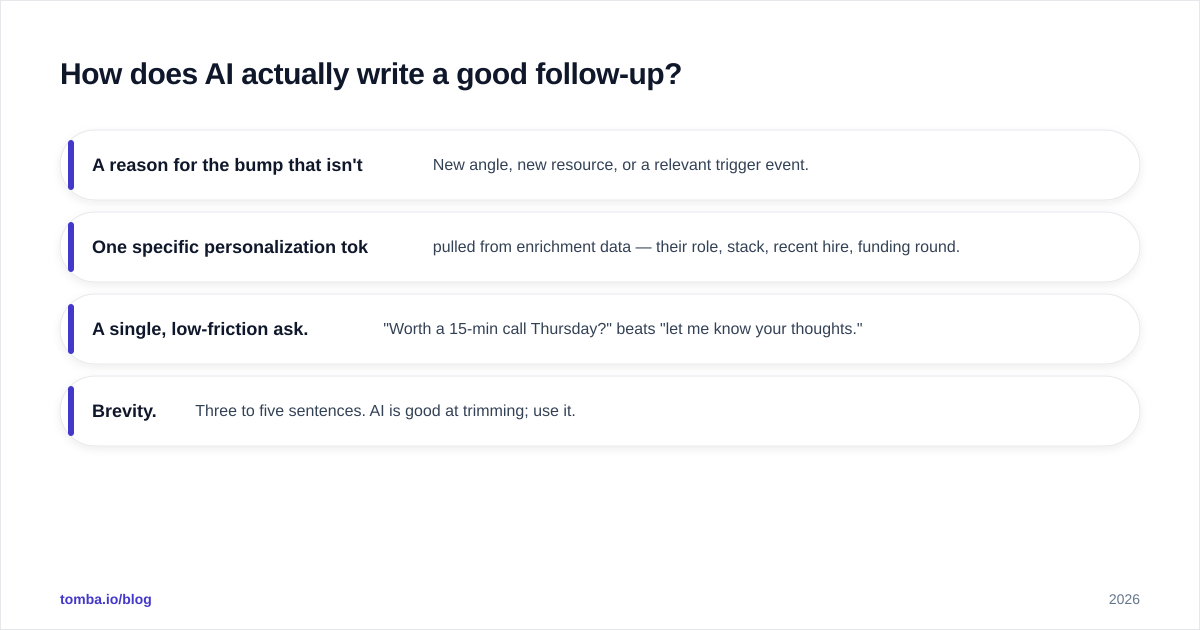
A strong AI follow-up follows the same skeleton a good rep uses:
- A reason for the bump that isn't "just following up." New angle, new resource, or a relevant trigger event.
- One specific personalization token pulled from enrichment data — their role, stack, recent hire, funding round.
- A single, low-friction ask. "Worth a 15-min call Thursday?" beats "let me know your thoughts."
- Brevity. Three to five sentences. AI is good at trimming; use it.
Here's the catch most teams miss: AI writes fluently, which is dangerous. Fluent and generic is still generic. The personalization is only as good as the data feeding it. If your AI doesn't know the prospect's title or company, it defaults to mush ("I wanted to reach out regarding your business needs"). That's why the data layer matters as much as the model — more on that below.
Tools like Tomba's cold email AI and AI email response generator handle the drafting, but you still set the voice, the offer, and the rules for when to back off.
Is AI email follow-up better than doing it manually?#
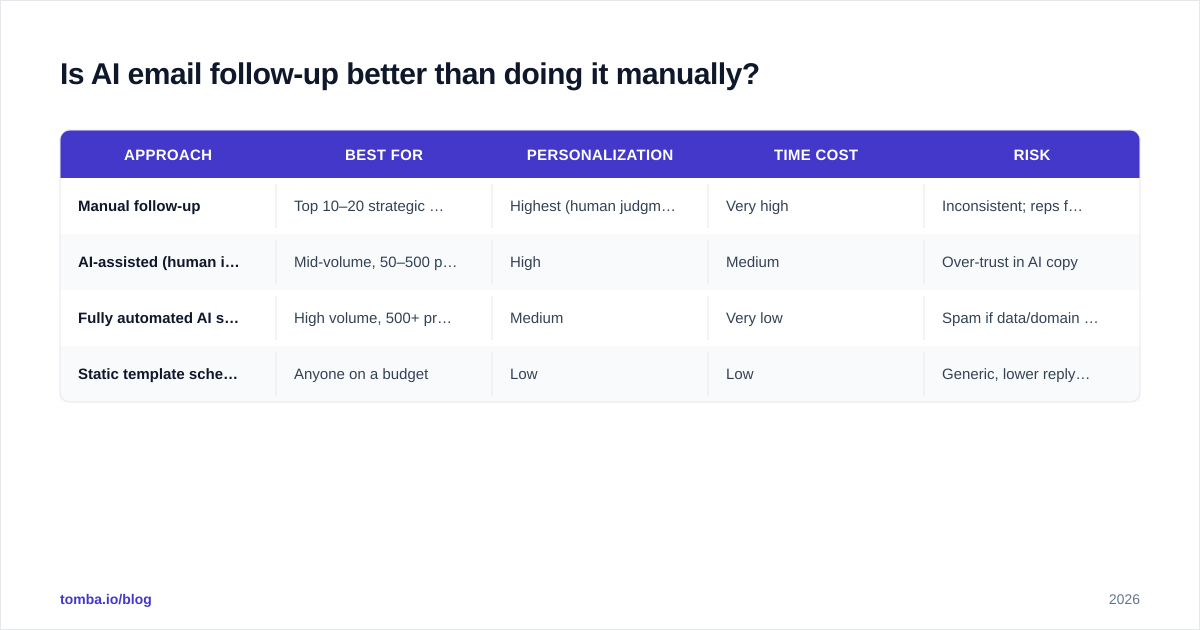
For volume, yes. For your ten highest-value accounts, no — those deserve a human. The smart play is a tiered approach, not all-or-nothing.
| Approach | Best for | Personalization | Time cost | Risk |
|---|---|---|---|---|
| Manual follow-up | Top 10–20 strategic accounts | Highest (human judgment) | Very high | Inconsistent; reps forget |
| AI-assisted (human in loop) | Mid-volume, 50–500 prospects | High | Medium | Over-trust in AI copy |
| Fully automated AI sequences | High volume, 500+ prospects | Medium | Very low | Spam if data/domain is weak |
| Static template scheduler | Anyone on a budget | Low | Low | Generic, lower reply rates |
The honest takeaway: AI email follow-up wins on coverage and consistency, which is where most pipeline actually leaks. It does not win on the kind of insight that closes a six-figure enterprise deal — keep a human on those. Use AI to make sure the other 480 prospects in your list never fall through the cracks.
A practical split many teams use: top 20 accounts get fully manual, hand-written touches; everyone else runs through an AI sequence with a human reviewing replies. You get scale without sounding like a robot to the people who matter most.
What should an AI email follow-up sequence look like?#
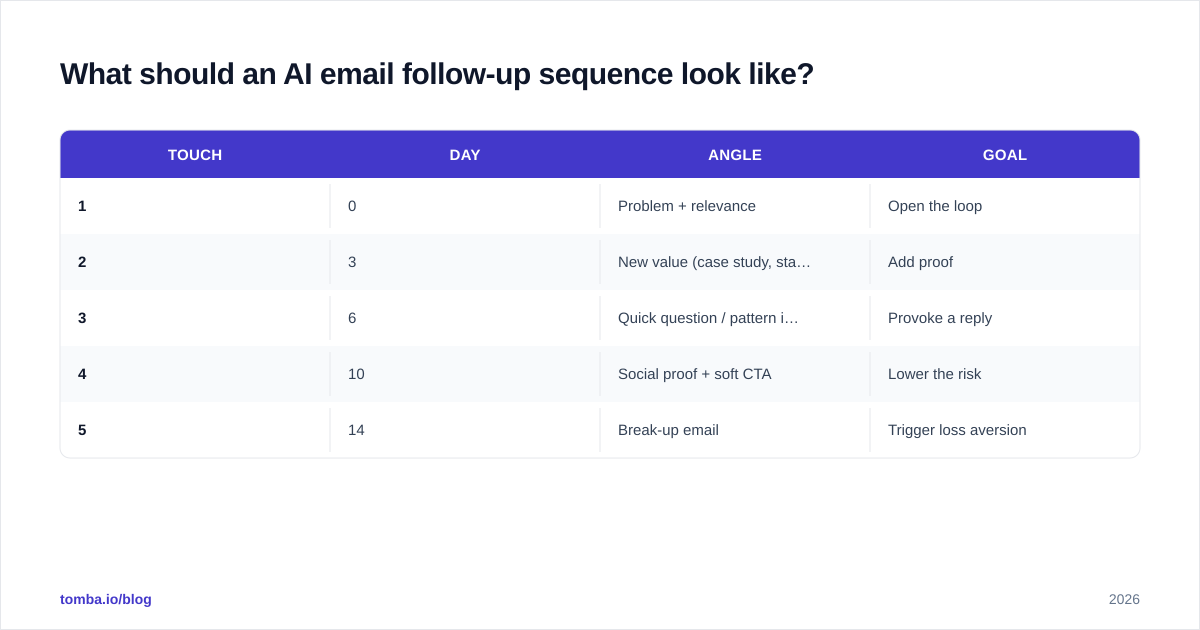
A 5-touch sequence over ~14 business days, each touch adding a new reason to respond — never just repeating "circling back."
Here's a battle-tested structure you can hand to an AI tool as the scaffold:
| Touch | Day | Angle | Goal |
|---|---|---|---|
| 1 | 0 | Problem + relevance | Open the loop |
| 2 | 3 | New value (case study, stat) | Add proof |
| 3 | 6 | Quick question / pattern interrupt | Provoke a reply |
| 4 | 10 | Social proof + soft CTA | Lower the risk |
| 5 | 14 | Break-up email | Trigger loss aversion |
The break-up email ("I'll close your file — bad timing?") is consistently one of the highest-reply messages in any sequence, because it flips the dynamic. AI is great at generating tasteful variants of it so you're not sending the identical line to everyone.
Rules to enforce in whatever tool you use:
- Hard stop on reply. The instant someone responds, the sequence pauses and a human takes over. Nothing kills trust faster than an automated "just bumping this" after the prospect already answered.
- Verify before you send. Run your list through an email verifier first. Bounces wreck your sender reputation and torch the whole sequence's deliverability.
- Cap the volume per domain. Spread sends; don't fire 500 emails at 9:00 a.m. sharp.
- Personalize touch #1 and #4 hardest. Those carry the most weight.
What about deliverability — won't automation get me flagged?#
It can, and this is where most AI follow-up programs quietly fail. Automation amplifies whatever you feed it: send to clean, verified, opted-in-adjacent prospects from a warm domain and you're fine; automate garbage and you'll automate your way into the spam folder faster.
Three non-negotiables before you scale any AI sequence:
- Warm the domain. A fresh domain blasting 300 cold emails looks exactly like a spammer to inbox providers. Ramp slowly.
- Authenticate. SPF, DKIM, and DMARC must pass. Check your SPF record with a tester before you start, and keep an eye on overall email deliverability signals.
- Verify every address. A 5% bounce rate is the difference between landing and getting filtered. This is non-optional at volume.
AI doesn't change the physics of deliverability — it just sends more, which makes good hygiene more important, not less. Google's own Postmaster Tools and guidance from vendors like HubSpot are worth reading before you turn the volume up.
Which AI email follow-up tools should you consider in 2026?#
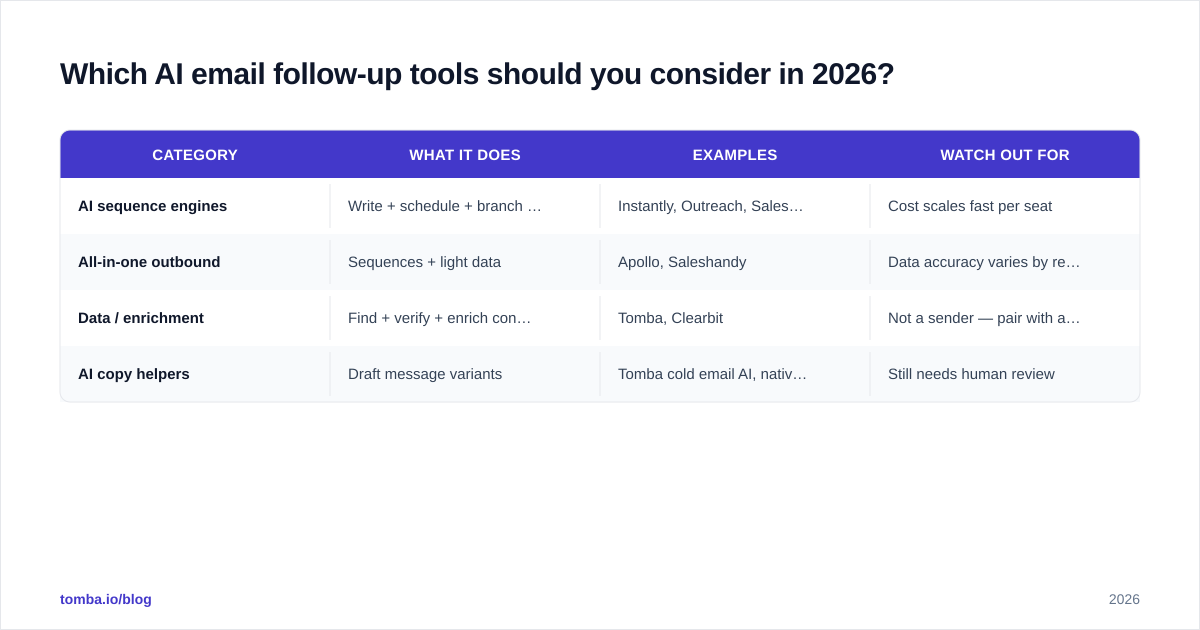
The market splits into sequence engines (they send and automate) and data/enrichment layers (they make sure you're sending to real people). You need both — and many teams overspend on the first while starving the second.
| Category | What it does | Examples | Watch out for |
|---|---|---|---|
| AI sequence engines | Write + schedule + branch follow-ups | Instantly, Outreach, Salesloft | Cost scales fast per seat |
| All-in-one outbound | Sequences + light data | Apollo, Saleshandy | Data accuracy varies by region |
| Data / enrichment | Find + verify + enrich contacts | Tomba, Clearbit | Not a sender — pair with an engine |
| AI copy helpers | Draft message variants | Tomba cold email AI, native AI add-ons | Still needs human review |
A quick reality check on cost and fit. Sequence engines bill per seat and per send; a five-rep team can spend thousands a month before a single reply lands. The data layer, by contrast, is usually credit-based and far cheaper — yet it's what determines whether your beautifully timed AI follow-up reaches a human at all. Tomba pricing starts with a free tier (25 searches/month), then Starter at $49/mo, Growth at $99/mo, and Pro at $249/mo — so verifying and enriching your list doesn't blow the budget.
Before committing to any sequence tool, read independent reviews on G2 rather than vendor landing pages. Look specifically for complaints about deliverability and data accuracy — those are the two things that quietly determine ROI.
If you're evaluating all-in-one platforms, our Apollo alternative and Instantly alternative breakdowns compare features and pricing in detail.
How do you measure if your AI follow-up is working?#
Track reply rate by touch, positive reply rate, and meetings booked — not opens. Open rates became nearly meaningless once Apple Mail Privacy Protection started pre-loading images, so a tool bragging about "92% open rates" is selling you noise.
The metrics that matter:
- Reply rate per touch. Shows which message in the sequence does the work. If touch #4 outperforms #1, double down on that angle.
- Positive reply rate. Replies that aren't "unsubscribe." This is your real signal.
- Meetings / qualified conversations booked. The only number your revenue team cares about.
- Bounce + spam complaint rate. Your early-warning system. If these creep up, pause and fix deliverability before sending another batch.
Set a baseline in week one, change one variable at a time (timing, subject, or the touch-4 angle), and let the AI's A/B testing surface the winner. The mistake is changing five things at once and never knowing what moved the needle.
The bottom line#
AI email follow-up is the cheapest pipeline you're not capturing. Most teams already pay to generate leads and then work a third of them because manual follow-up is tedious and easy to drop. Automating the second-through-seventh touch — with smart timing, fresh copy, and a hard stop on reply — recovers that lost pipeline without adding headcount.
But automation only works on a clean foundation. The AI can write a perfect day-10 break-up email, and it means nothing if the address bounces or the prospect's title is blank. Garbage in, garbage automated.
That's where your data layer earns its keep. Before you wire up any AI sequence, build your list with verified, enriched contacts so every follow-up reaches a real, reachable person. The Tomba Email Finder finds professional email addresses by name, domain, or company — and pairs with the email verifier so your sequences start with addresses that actually land. Start free with 25 searches a month, feed clean data into your AI follow-up engine, and let consistency do what your reps' memories can't.
// get started
Find, verify and enrich your first contacts today
Start on the free plan with 25 searches a month, then scale when your team is ready.
Free plan · No credit card required · GDPR & CCPA
// about the author