AI Email Outreach in 2026: Scale Personalization That Converts
AI email outreach lets you personalize at scale without sounding like a robot. Here's the 2026 playbook: tools, a step-by-step framework, and how to protect deliverability.
TL;DR
- AI email outreach uses large language models to research prospects, draft personalized messages, and adapt sequences at a scale no SDR team can match by hand.
- The win isn't writing faster emails. It's pairing accurate contact data with relevant personalization so the right message reaches the right inbox.
- Generic AI spam is worse than no outreach. The teams winning in 2026 feed AI real signals — job changes, tech stack, funding, content — not just
{{first_name}}. - Deliverability is the silent killer. AI lets you send more, which means more bounces, spam traps, and reputation damage unless you verify every address first.
- Your stack needs three layers: a data source (find + verify emails), a personalization engine (AI), and a sending system (warmup + sequencing).
What is AI email outreach?#
AI email outreach is the practice of using artificial intelligence — mostly large language models — to research prospects, write tailored messages, and manage follow-up sequences automatically. Instead of a rep manually drafting 30 emails a day, an AI system can draft hundreds, each referencing something specific about the recipient.
Think of it like the difference between a fast-food line cook and a private chef. The line cook makes the same burger for everyone, fast. A private chef asks what you like, checks what's in season, and plates something for you specifically. Old-school mail-merge outreach is the line cook. AI email outreach, done well, is the private chef — operating at line-cook speed.
Technically, the workflow chains three capabilities: data retrieval (who is this person and how do I reach them), generation (what should I say), and orchestration (when do I send and what happens if they don't reply). The AI is only as good as the data you feed it, which is why your email finder and verification layer matter just as much as the model writing the copy.
Why does AI email outreach matter in 2026?#
Conclusion first: inboxes are more crowded and more defended than ever, so relevance is the only thing that still earns a reply.
Three forces converged. First, every competitor now has access to the same AI writing tools, so the baseline quality of cold email went up — a mediocre "personalized" email no longer stands out. Second, Google and Microsoft tightened bulk-sender rules, so sloppy senders get filtered before a human ever sees the message. Third, buyers are exhausted by obviously automated outreach and pattern-match it in half a second.
AI matters because it solves the volume-versus-quality tradeoff that has limited outbound forever. Historically you could send 500 generic emails or 30 deeply researched ones. AI collapses that choice: you can now send 500 emails that each read like one of the 30. But — and this is the part most teams miss — that only works if the underlying personalization is real. Feeding an LLM a name and company and asking it to "make it personal" produces confident-sounding filler that buyers see through instantly.
How does AI email outreach actually work?#
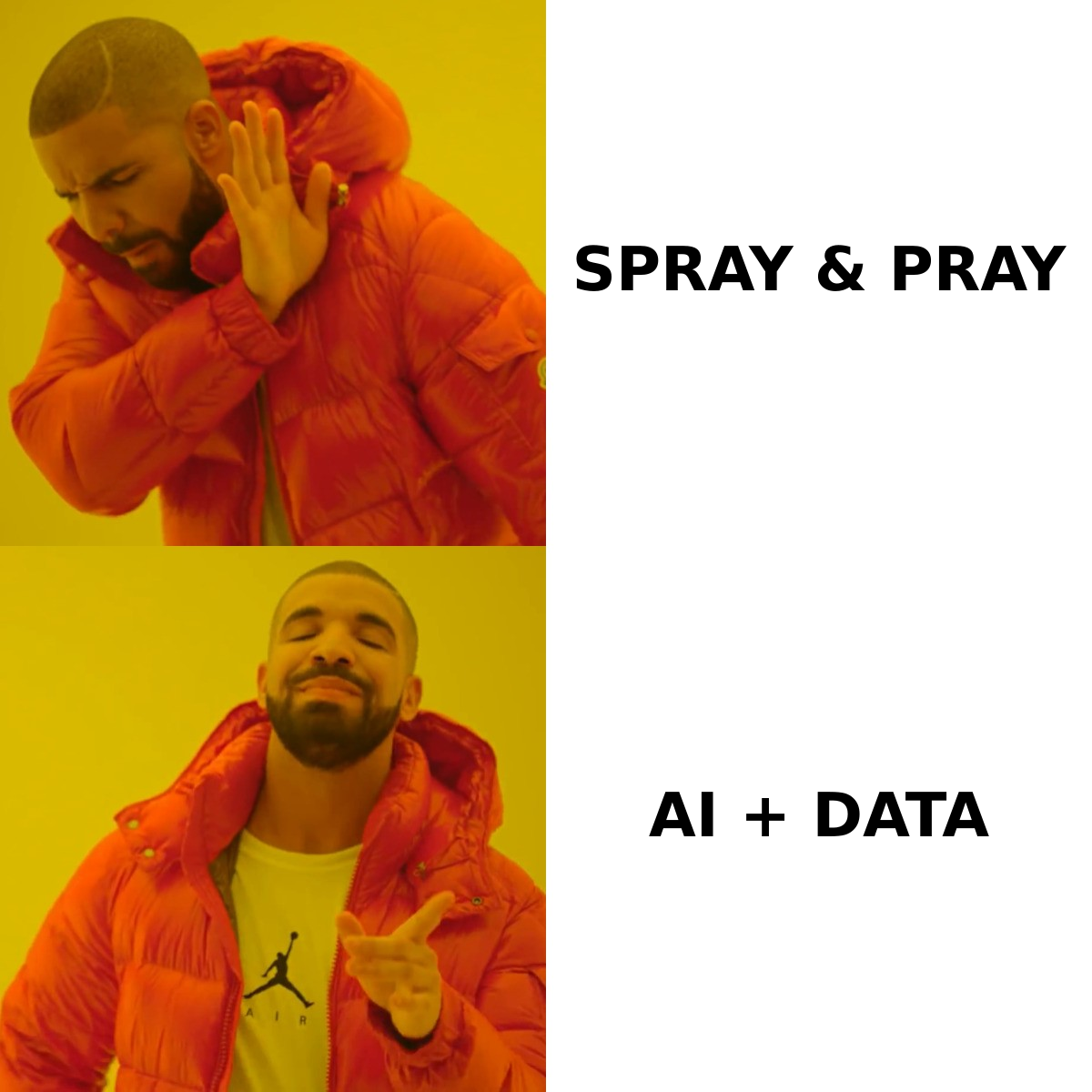
The pipeline has five stages. Each one can break the whole campaign if you skip it.
- Targeting. Define the ICP and pull a list — by industry, role, company size, or intent signals. Use domain search to map every relevant contact at a target company rather than guessing one address.
- Data enrichment. Attach the signals AI will personalize against: recent job change, funding round, tech stack, a LinkedIn post, a published article. This is the fuel.
- Verification. Run every address through an email verifier before sending. AI lets you send more, and more sends means more chances to hit a spam trap or invalid address that tanks your sender reputation.
- Generation. The LLM drafts the email using a tight prompt that includes the prospect's signals plus your offer and proof points. The best results come from giving the model specific facts, not adjectives.
- Orchestration. Send through a warmed-up domain, space messages out, branch follow-ups based on opens and replies, and stop the sequence the moment someone responds.
The order is deliberate. Generation sits at stage four because it depends on everything before it. A brilliant prompt over bad data still produces bad email.
What does a good AI-personalized email look like?#
The test is simple: could this email have been sent to anyone else on your list? If yes, it isn't personalized — it's templated with a name slot.
A strong AI-generated opener references something the recipient would recognize as true and specific: "Saw Acme just opened a second warehouse in Austin — congrats." A weak one says: "I noticed Acme is a leader in your industry." The first uses a real signal. The second is the kind of empty flattery LLMs default to when you don't give them facts.
Keep the structure human: one observation, one relevant problem, one low-friction ask. Cut the three-paragraph value monologue. If you want to see proven structures, our cold email templates library is a good starting point, and you can sanity-check your opening line with a subject line tester before you commit.
One discipline that separates pros from spammers: let AI draft, but always edit. Treat the model's output as a fast first draft from a junior rep, not a finished message. The 20 seconds you spend trimming a hallucinated claim is what keeps your reply rate honest.
Which AI email outreach tools should you compare?#
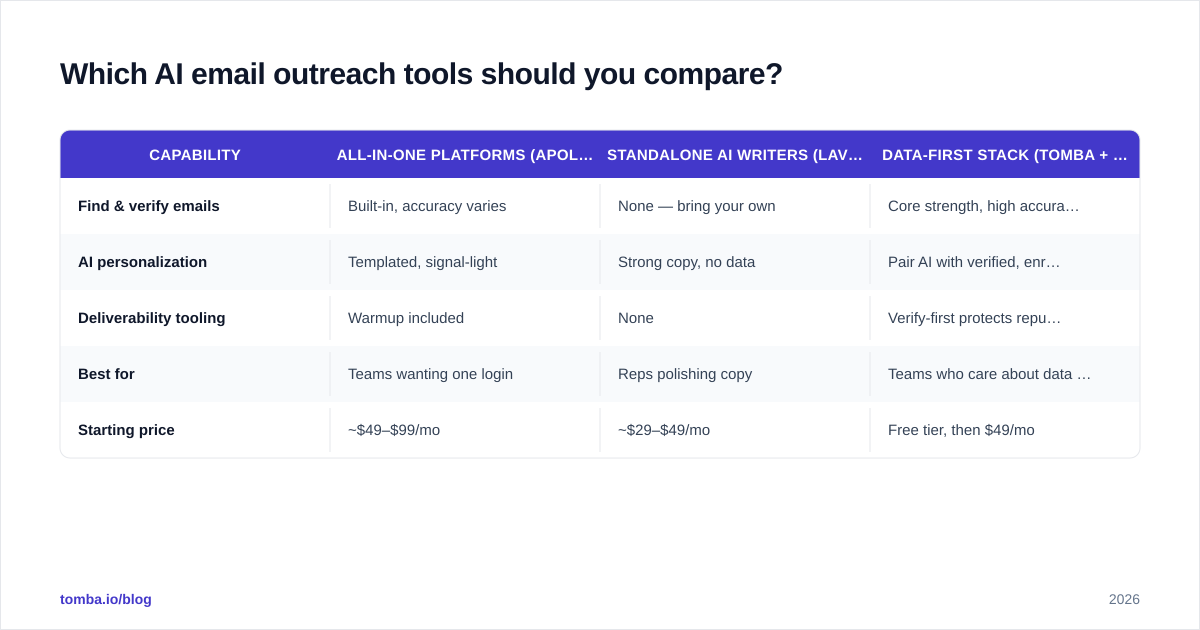
There's no single "AI outreach tool" — there are categories, and most teams stitch two or three together. Here's how the main options stack up on the jobs that matter.
| Capability | All-in-one platforms (Apollo, Instantly) | Standalone AI writers (Lavender, Jasper) | Data-first stack (Tomba + sender) |
|---|---|---|---|
| Find & verify emails | Built-in, accuracy varies | None — bring your own | Core strength, high accuracy |
| AI personalization | Templated, signal-light | Strong copy, no data | Pair AI with verified, enriched data |
| Deliverability tooling | Warmup included | None | Verify-first protects reputation |
| Best for | Teams wanting one login | Reps polishing copy | Teams who care about data quality |
| Starting price | ~$49–$99/mo | ~$29–$49/mo | Free tier, then $49/mo |
The tradeoff is real. All-in-one platforms are convenient but their data is often the weakest link — you're personalizing against stale or unverified contacts. Standalone writers produce great prose but can't tell you who to email. A data-first approach keeps accuracy high and lets you plug the AI writer and sender of your choice on top.
For a deeper feature-by-feature breakdown of the all-in-one category, see our Apollo alternative and Instantly alternative comparisons. If you want third-party validation, G2's sales engagement category is a useful neutral reference for reviews across all these tools.

How do you keep AI outreach out of the spam folder?#
Conclusion first: deliverability is won before you hit send, not after. AI amplifies whatever you're already doing — including your mistakes.
Because AI makes high volume trivial, it quietly raises your risk profile. Every extra send is another chance to hit an invalid address, a spam trap, or a recipient who marks you as junk. A handful of those and your domain reputation drops, at which point even your good emails land in spam. The fix is process, not luck.
Start with the fundamentals. Authenticate your domain with SPF, DKIM, and DMARC — non-negotiable under the current Gmail and Yahoo bulk-sender requirements (Google's official sender guidelines spell out the thresholds). Warm up any new sending domain for several weeks before scaling. Keep your bounce rate under 2% by verifying every address; you can model a safe ramp with a warmup calculator.
Then protect sender reputation on an ongoing basis:
- Verify the full list, including catch-all domains that need extra scrutiny.
- Cap daily volume per inbox — split across multiple mailboxes instead of blasting from one.
- Remove anyone who doesn't open after the full sequence; dead weight drags your metrics down.
- Watch email deliverability signals weekly and pull back the moment open rates dip.
The uncomfortable truth: the more powerful your AI gets at writing, the more your results depend on boring infrastructure work. A perfect email in the spam folder converts at zero.
What metrics tell you AI outreach is working?#
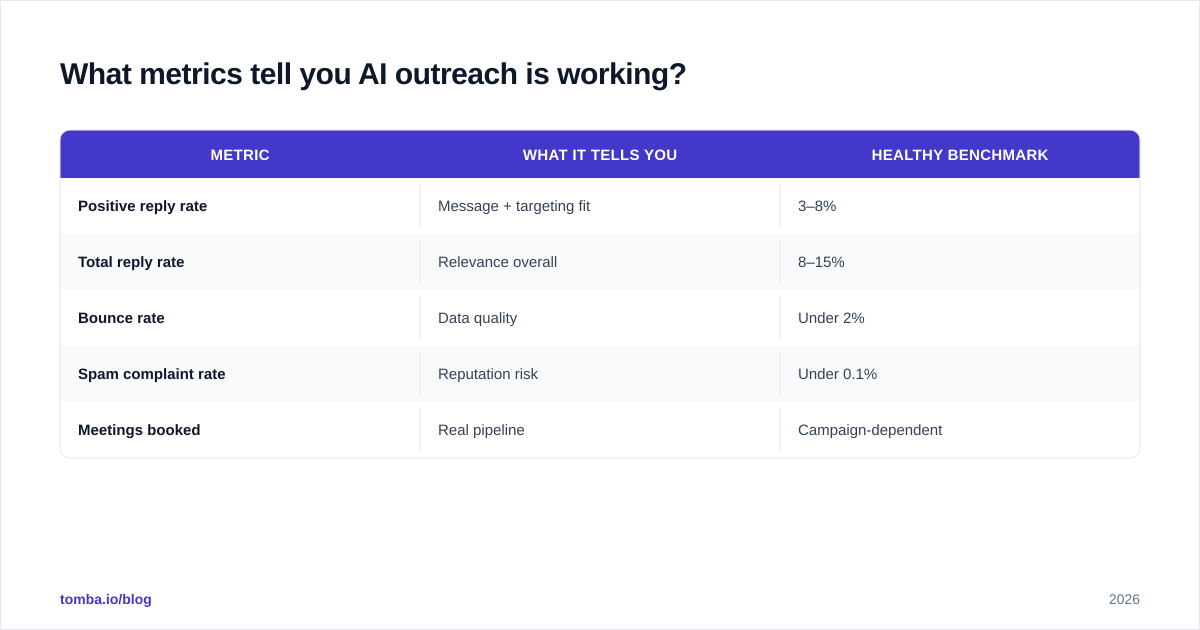
Reply rate and positive-reply rate are the only numbers that matter long term. Open rate became unreliable after Apple Mail Privacy Protection started pre-loading images, so don't optimize your campaign around it.
Track these instead, in order of importance:
| Metric | What it tells you | Healthy benchmark |
|---|---|---|
| Positive reply rate | Message + targeting fit | 3–8% |
| Total reply rate | Relevance overall | 8–15% |
| Bounce rate | Data quality | Under 2% |
| Spam complaint rate | Reputation risk | Under 0.1% |
| Meetings booked | Real pipeline | Campaign-dependent |
If positive replies are low but total replies are high, your targeting is off — you're reaching people who aren't buyers. If bounces are high, your data layer is broken and no amount of AI copy will save it. If complaints climb, slow down immediately; that's the metric that gets your domain blacklisted. Improving your response rate almost always traces back to better data and tighter targeting before it traces back to better copy.
How do you build an AI outreach stack from scratch?#
Keep it to three layers and resist the urge to over-tool.
Layer 1 — Data. This is your foundation. You need to find decision-makers, get their verified work emails, and enrich each contact with signals. A free tier is enough to test the workflow before you commit budget; you can scan Tomba pricing to see where the paid tiers kick in as you scale volume.
Layer 2 — Personalization. An LLM (or a writing tool built on one) turns enriched data into drafts. Prompt it with facts, not instructions to "be creative." Build a small library of proven angles and let AI fill in the specifics per prospect.
Layer 3 — Sending. A sequencer with warmup, multi-inbox rotation, and reply detection. This is where orchestration logic lives — branching, throttling, and auto-stopping on reply.
The mistake teams make is buying Layer 3 first because it's the flashiest, then bolting weak data underneath. Build bottom-up. If your data layer is solid, you can swap writers and senders freely as better tools appear. If your data is bad, nothing on top can fix it. For pulling decision-maker contacts at scale, a bulk email finder feeding verified addresses into your sequencer is the highest-leverage setup most teams overlook.
Is AI email outreach going to get cold email banned?#
No — but it will keep raising the bar, and the lazy version of it is already dying. Mailbox providers are getting better at detecting low-effort automation, and buyers tune it out. The senders who thrive treat AI as a research-and-drafting assistant attached to excellent data, not as a magic spam cannon.
The directional bet is clear: less volume, more relevance. AI makes both deep personalization and reckless blasting cheaper. The teams who use it for the former will quietly compound their pipeline. The teams who use it for the latter will burn through domains and wonder why nothing lands. Which one you become is decided at the data layer.
Getting started#
AI can write a thousand convincing emails an hour, but it can't tell you which thousand people to send them to — or whether those addresses are even real. That's the foundation everything else sits on. Start there: use the Tomba Email Finder to pull verified, accurate contacts for your target accounts, enrich them with the signals your AI needs, and only then turn on the sequencer. Spin up the free tier (25 searches a month), prove the workflow on one campaign, and scale the part that's actually working — your data — before you scale your send volume. Get the foundation right and your AI does the rest.
Ready to find emails that actually work?
Join 150,000+ professionals who stopped guessing and started sending. Free credits on signup — no credit card required.
Get the Tomba newsletter
Practical outbound tactics and product updates — once every two weeks.
About the author