AI Email Scraper: Best Tools, Accuracy & Pricing 2026
An AI email scraper can fill your pipeline fast — or torch your domain and your compliance posture. Here's how the top tools compare on accuracy, price, and legal risk in 2026.
TL;DR
- An AI email scraper collects email addresses from web pages, directories, and social profiles, then uses pattern-matching and verification models to guess and confirm the right address.
- Raw scraping is fast but legally risky and low-accuracy. Verified, source-attributed finders are slower per-record but safer and far more deliverable.
- The biggest hidden cost isn't price per email — it's bounce rate. A 30% bounce list will wreck your sender reputation before your first reply.
- Below: a comparison table of the leading approaches, an accuracy breakdown, and a compliance checklist so you don't end up on a blocklist.
- For most B2B teams, a verified email finder with documented data sources beats a blind scraper. Tomba's free tier (25 searches/mo) lets you test accuracy before paying.
What is an AI email scraper?#
An AI email scraper is a tool that automatically extracts email addresses from public sources — company websites, online directories, LinkedIn-style profiles, conference pages — and uses machine learning to fill the gaps the raw HTML doesn't give you.
Think of it like a metal detector at the beach. A plain scraper beeps at anything metallic and you dig up bottle caps half the time. An AI-driven scraper has learned what real treasure looks like: it knows that "first.last@company.com" is the dominant pattern at a given domain, it cross-references multiple pages, and it scores its own confidence before handing you the address.
In practice, "AI email scraper" is an umbrella term covering three different mechanisms:
- Page extraction — regex and DOM parsing that pull any
mailto:or visible address off a page. - Pattern inference — models that learn a company's email format from known examples, then generate the likely address for a new name.
- Verification — SMTP and catch-all checks that confirm whether the guessed address actually accepts mail.
The tools people call scrapers usually bundle all three. The quality gap between vendors comes down to how good each layer is — and whether they keep a record of where each address came from.
How does an AI email scraper actually find emails?#
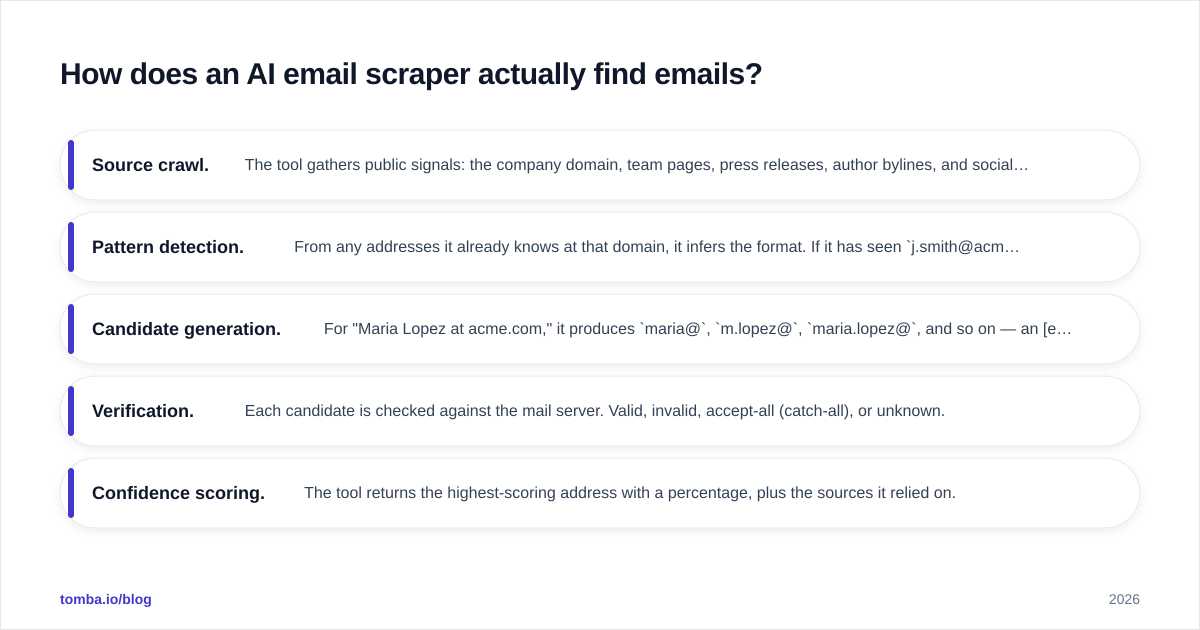
The pipeline matters more than the marketing. Here's the path a single contact takes from "name + company" to "verified address in your CRM."
- Source crawl. The tool gathers public signals: the company domain, team pages, press releases, author bylines, and social profiles.
- Pattern detection. From any addresses it already knows at that domain, it infers the format. If it has seen
j.smith@acme.com, it assumesf.lastnameand builds candidates for everyone else. - Candidate generation. For "Maria Lopez at acme.com," it produces
maria@,m.lopez@,maria.lopez@, and so on — an email permutator step under the hood. - Verification. Each candidate is checked against the mail server. Valid, invalid, accept-all (catch-all), or unknown.
- Confidence scoring. The tool returns the highest-scoring address with a percentage, plus the sources it relied on.
That last step is where an AI email scraper earns or loses your trust. A score with no sourcing is a guess wearing a lab coat. A score backed by "found on these two public pages" is something you can defend.
This is also why a standalone email verifier belongs in your stack even if you scrape elsewhere — verification is the layer that keeps your bounce rate survivable.
Is scraping emails legal in 2026?#
Short answer: scraping publicly available business emails is generally permissible, but using them is governed by privacy and anti-spam law — and that's where teams get burned.
The nuance:
- GDPR (EU/UK). A work email like
name@company.comis personal data. You can process it under "legitimate interest" for relevant B2B outreach, but you must be able to justify it, honor opt-outs, and disclose your source. See the official overview of the General Data Protection Regulation. - CAN-SPAM (US). Scraping itself isn't banned, but "harvesting" addresses combined with deceptive headers or no unsubscribe path is explicitly penalized.
- Platform terms. Scraping a social network in violation of its terms of service is a contractual problem even when it isn't a criminal one.
The practical takeaway: a compliant program needs source attribution (which most blind scrapers don't provide), a verification step, suppression of opt-outs, and a genuine business reason to contact each person. Tools that document where their data comes from make that paper trail much easier to keep.
AI email scraper vs. email finder: what's the difference?#
People use the terms interchangeably, but there's a meaningful distinction worth understanding before you buy.
A scraper is extraction-first: point it at a page or a list and it grabs whatever's there. Volume is the selling point. A finder is query-first: you give it a name and a domain, and it returns one best, verified address with a confidence score and sources. Precision is the selling point.
The strongest 2026 products blur the line — they scrape and verify and attribute. But if a vendor only does the extraction half, you're inheriting the bounce risk yourself. For ongoing prospecting, a verified finder with domain search for whole-company sweeps usually wins. For one-off list cleanup, a scraper plus a separate verifier can work.
Which AI email scraper is best? (Comparison table)#
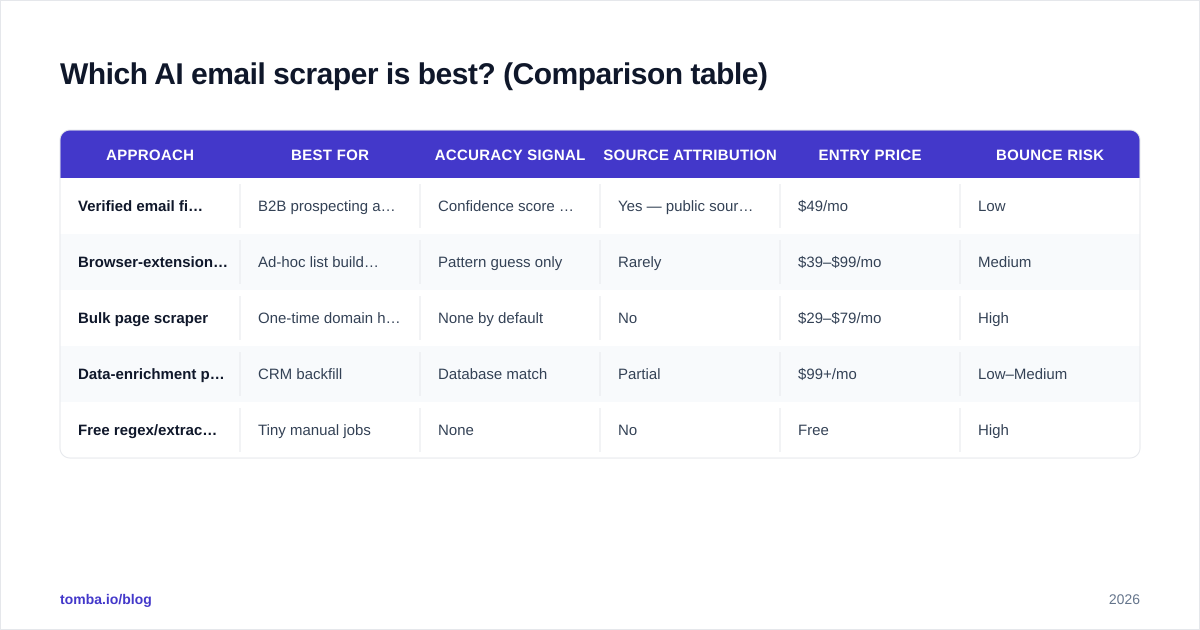
There's no single winner — the right pick depends on whether you optimize for volume, accuracy, or compliance. Here's how the common approaches stack up. Pricing reflects entry paid tiers as of 2026; always confirm on the vendor's own page.
| Approach | Best for | Accuracy signal | Source attribution | Entry price | Bounce risk |
|---|---|---|---|---|---|
| Verified email finder (e.g. Tomba) | B2B prospecting at scale | Confidence score + verification | Yes — public sources listed | $49/mo | Low |
| Browser-extension scraper | Ad-hoc list building | Pattern guess only | Rarely | $39–$99/mo | Medium |
| Bulk page scraper | One-time domain harvest | None by default | No | $29–$79/mo | High |
| Data-enrichment platform | CRM backfill | Database match | Partial | $99+/mo | Low–Medium |
| Free regex/extractor tool | Tiny manual jobs | None | No | Free | High |
A few things to read out of that table. "Bounce risk" tracks inversely with verification, not with price — a cheap tool with built-in SMTP checks can beat an expensive one without them. And "source attribution" is the column most buyers ignore and most legal teams care about most.
If your use case is "find verified emails for a known list of companies," the verified-finder row is almost always the right starting point. You can compare full Tomba pricing against the entry tiers above, and the free plan lets you benchmark accuracy on your own target accounts before committing.
How accurate are AI email scrapers really?#
Accuracy is the whole game, and vendor claims of "95%+" deserve scrutiny — because they rarely define the denominator.
Here's what actually moves the number:
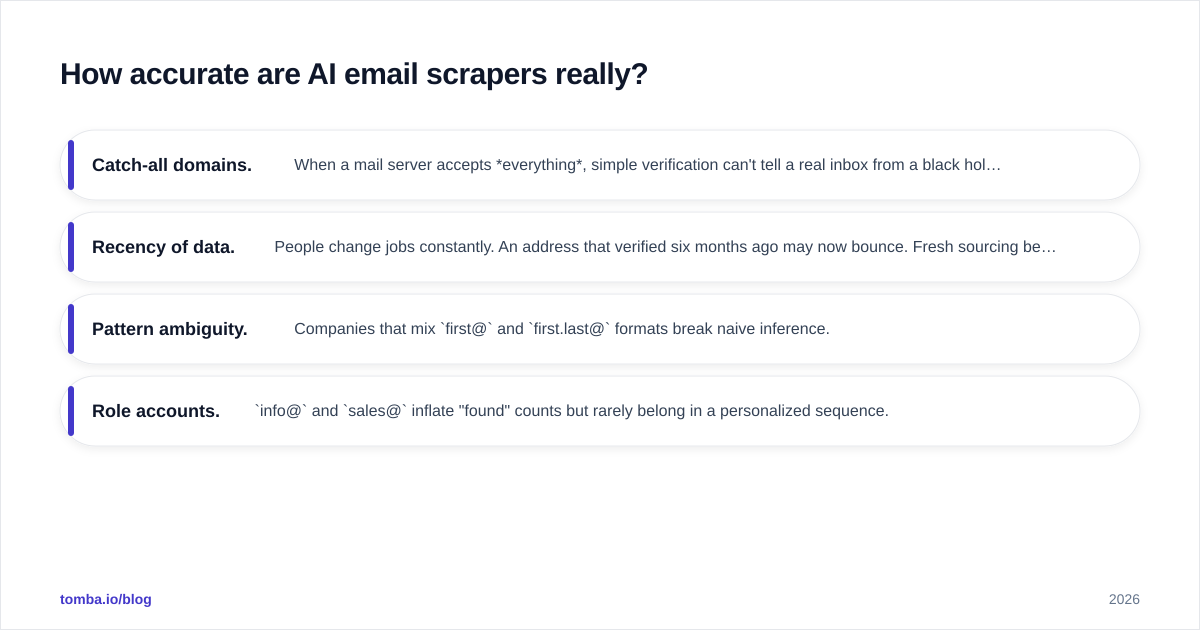
- Catch-all domains. When a mail server accepts everything, simple verification can't tell a real inbox from a black hole. You need a dedicated catch-all verifier to handle these instead of trusting a green checkmark.
- Recency of data. People change jobs constantly. An address that verified six months ago may now bounce. Fresh sourcing beats a stale database.
- Pattern ambiguity. Companies that mix
first@andfirst.last@formats break naive inference. - Role accounts.
info@andsales@inflate "found" counts but rarely belong in a personalized sequence.

The honest way to evaluate any AI email scraper is to run a sample of 100 contacts you can independently confirm, then measure two things: hit rate (how many it found) and bounce rate (how many of those actually deliver). A tool that finds 90 but bounces 25 is worse than one that finds 70 and bounces 2. Reputable third-party reviews on G2 can sanity-check vendor claims, but nothing replaces your own test on your own niche.

How do you scrape emails without destroying your sender reputation?#
The fastest way to learn deliverability is to skip verification once. Don't. Here's the workflow that keeps your domain healthy.
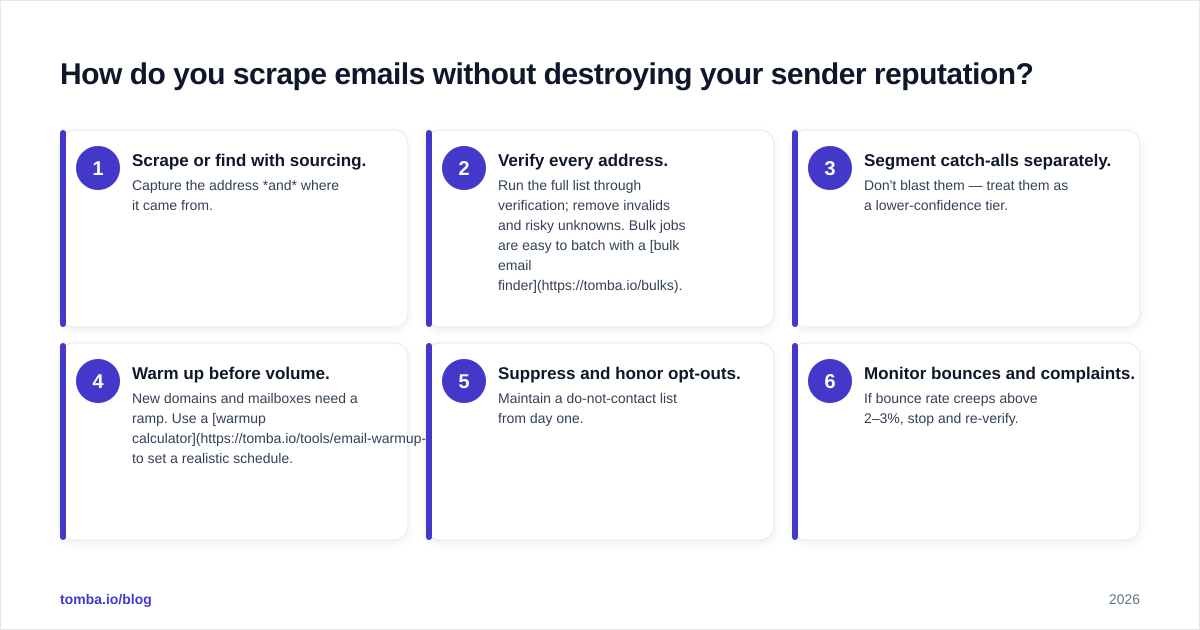
- Scrape or find with sourcing. Capture the address and where it came from.
- Verify every address. Run the full list through verification; remove invalids and risky unknowns. Bulk jobs are easy to batch with a bulk email finder.
- Segment catch-alls separately. Don't blast them — treat them as a lower-confidence tier.
- Warm up before volume. New domains and mailboxes need a ramp. Use a warmup calculator to set a realistic schedule.
- Suppress and honor opt-outs. Maintain a do-not-contact list from day one.
- Monitor bounces and complaints. If bounce rate creeps above 2–3%, stop and re-verify.
The unglamorous truth: list hygiene protects deliverability more than clever copy does. A perfectly written email to a dead inbox is a bounce; a plain email to a verified inbox is a conversation.
What should you look for when choosing a tool?#
Run any AI email scraper through this checklist before you pay for a year:
- Verification included? If you have to buy verification separately, factor that into the real price.
- Source attribution? Can it tell you where each address came from? Essential for GDPR defensibility.
- Catch-all handling? Does it flag accept-all domains instead of pretending they're verified?
- Free tier or trial? You should be able to test accuracy on your accounts before committing. Tomba's free tier gives 25 searches/mo for exactly this.
- Integrations and API. Will it push clean data into your CRM, or leave you exporting CSVs? Check for a documented email finder API and native CRM connectors.
- Credit model clarity. Understand whether you're charged per search, per valid result, or per verification — the difference can be 3x on your bill.
If you want a deeper teardown of specific competitors, the Apollo alternative and RocketReach alternative breakdowns walk through accuracy and pricing head to head.
Common mistakes that waste your scraping budget#
- Buying on volume, paying in bounces. A million scraped addresses at 40% deliverability is worth less than 50,000 verified ones.
- Skipping the catch-all tier. Sending to unverifiable accept-all domains at full volume is a classic reputation-killer.
- No source records. When a prospect asks "where did you get my email?", "I don't know" is the wrong answer in 2026.
- One-and-done lists. B2B data decays ~2–3% per month. A list you scraped last quarter is already meaningfully stale.
- Treating role inboxes as people.
support@doesn't have a job title or a pain point.
Avoiding these five is most of the difference between a campaign that books meetings and one that gets your domain blocklisted. For broader context on outbound data quality, HubSpot's sales prospecting resources are a solid neutral reference.
The bottom line#
An AI email scraper is a force multiplier or a foot-gun depending on one variable: verification with sourcing. Volume is cheap; deliverable, defensible volume is the actual product you're buying. Optimize for hit rate and bounce rate together, segment your catch-alls, warm up your domain, and keep a record of where every address came from.
If you'd rather skip the blind-scraping risk entirely, start with a verified finder. Tomba's Email Finder returns confidence-scored, source-attributed B2B emails by name or domain, with verification and catch-all detection built in — and the free tier (25 searches/mo) lets you benchmark accuracy on your own target accounts before you pay a cent. Find emails you can actually reach, not just emails you can collect.
// get started
Find, verify and enrich your first contacts today
Start on the free plan with 25 searches a month, then scale when your team is ready.
Free plan · No credit card required · GDPR & CCPA
// about the author