Allegrow vs Warpleads 2026: Deliverability vs Lead Gen
Allegrow optimizes inbox placement, Warpleads floods your pipeline with leads. Here's which one your cold outreach stack actually needs in 2026 — and where they overlap.
You found two tools that both promise to fix your cold email results, but they do almost opposite jobs. Allegrow works on whether your emails land in the inbox. Warpleads works on how many leads you can email in the first place. Picking between them without understanding that split is how teams waste a quarter and a budget.
This guide breaks down what each tool actually does, where they overlap, and which one belongs in your stack first.
TL;DR#
- Allegrow is a deliverability and inbox-placement platform. It monitors sender reputation, runs seed-list inbox testing, and automates positive engagement to keep you out of spam.
- Warpleads is a lead-generation and data export tool. It gives you large volumes of B2B contacts, an unlimited export model, and built-in email verification for outbound lists.
- They are not direct competitors — one fixes deliverability, the other fills the pipeline. Most teams eventually need both functions, not one or the other.
- For pure data accuracy and email-finding precision, a dedicated finder like the Tomba Email Finder often beats a volume-first lead tool.
- Choose Allegrow if your emails aren't landing; choose Warpleads if you've run out of people to email; choose a verifier-plus-finder combo if your bounce rate is the real problem.
What is Allegrow?#
Allegrow is a sender-reputation and inbox-placement tool built for outbound and lifecycle email teams. Instead of finding contacts, it focuses on the moment after you hit send: does the message reach the primary inbox, the promotions tab, or the spam folder?
Its core mechanics are familiar to anyone who has fought a deliverability problem. Allegrow maintains seed inboxes across major providers (Google Workspace, Outlook, Yahoo) and measures where your sends actually land. It tracks a reputation score over time, simulates positive engagement signals, and flags when your domain or IP reputation starts sliding before it tanks your reply rate.
If you've ever watched a campaign's open rate quietly collapse from 60% to 12% with no copy change, you've met the problem Allegrow is built to catch. It treats email deliverability as a measurable, continuously-monitored metric rather than something you only investigate after a campaign fails.
What Allegrow does not do is source contacts. It assumes you already have a list. That's the single most important fact in this comparison.
What is Warpleads?#
Warpleads is a B2B lead-generation platform built around volume and an unlimited export model. Its pitch is straightforward: stop paying per-contact and start exporting as many leads as your campaigns can consume.
The platform combines a large prospect database with filtering (industry, title, company size, geography), an unlimited-export pricing structure on higher tiers, and bulk email verification so the list you pull is at least nominally deliverable. For teams running high-volume cold email — agencies, SDR pods, founder-led outbound — the appeal is obvious: feed the sequencer without metering every credit.
Warpleads sits in the same mental category as Apollo, Seamless.AI, or other volume-first data tools. If you're weighing those, our breakdowns of an Apollo alternative and a Seamless.AI alternative cover the trade-offs of the high-volume data model in detail.
The catch with any volume-first database is the same everywhere: more rows rarely means more accurate rows. A million exported contacts with a 25% bounce rate will hurt your sender reputation faster than a small, clean list will help it — which is exactly the deliverability problem Allegrow tries to clean up downstream.

Allegrow vs Warpleads: how do they compare?#
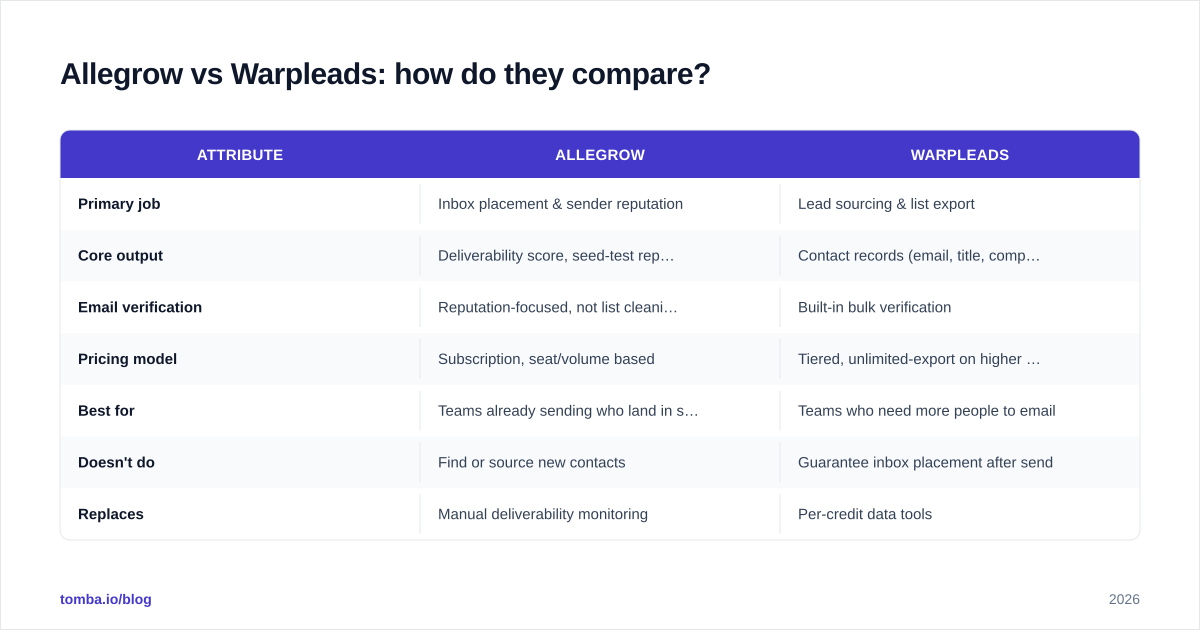
Because these tools solve different problems, a feature table only makes sense if you read it as "what each one is responsible for," not "who wins each row."
| Attribute | Allegrow | Warpleads |
|---|---|---|
| Primary job | Inbox placement & sender reputation | Lead sourcing & list export |
| Core output | Deliverability score, seed-test reports | Contact records (email, title, company) |
| Email verification | Reputation-focused, not list cleaning | Built-in bulk verification |
| Pricing model | Subscription, seat/volume based | Tiered, unlimited-export on higher plans |
| Best for | Teams already sending who land in spam | Teams who need more people to email |
| Doesn't do | Find or source new contacts | Guarantee inbox placement after send |
| Replaces | Manual deliverability monitoring | Per-credit data tools |
| Risk if used alone | Great list, but you'll still run dry | Big list, but bounces wreck reputation |
The honest read: Allegrow and Warpleads are at opposite ends of the same outbound assembly line. Warpleads is the front (raw material), Allegrow is the quality control near the end (does it arrive). Buying one and expecting it to do the other's job is the most common mistake we see.
Which problem are you actually solving?#
Conclusion first: diagnose your bottleneck before you buy either tool. The decision is almost entirely determined by which metric is broken.
Use this framework to place yourself.
If your open rates are low and falling, your problem is deliverability. You're landing in spam or promotions. Warpleads will not help — adding more contacts to a sending setup that doesn't reach inboxes just burns leads faster. This is Allegrow's lane (or a deliverability stack you build yourself).
If your open rates are healthy but you've exhausted your list, your problem is supply. You need more qualified contacts. This is Warpleads' lane — or any high-quality data source.
If your bounce rate is high, you have a data-quality problem disguised as a volume problem. Neither tool fully fixes this on its own. Allegrow monitors the result of bad data; Warpleads gives you more data but volume-first databases are exactly where high bounce rates come from. The real fix is verification at the source — clean every address before it enters the sequencer with a dedicated email verifier.
That last case is the one most teams get wrong. They blame the inbox provider when the root cause is a list full of stale, guessed, or catch-all addresses.
How does data accuracy factor in?#
Accuracy is where this comparison quietly turns into a three-way decision.
Warpleads optimizes for volume and unlimited export. That model is genuinely useful when you need scale, but the trade-off is well documented across the industry: the larger and cheaper-per-record a database is, the more likely it contains outdated roles, generic role-based addresses, and catch-all domains that pass a basic syntax check but bounce on send. Independent reviews on G2 consistently show that volume-first data tools trade precision for breadth.
Allegrow doesn't fix this either — it tells you after the fact that your reputation is dropping, which is often the symptom of a dirty list.
A dedicated email finder takes the opposite approach: it verifies each address against the live mail server at lookup time and reports a confidence score, so a guessed pattern never silently enters your CRM. If you're routinely emailing addresses on catch-all domains, pairing a finder with a catch-all verifier is the difference between a 2% and a 12% bounce rate.
For teams whose real pain is "too many bounces," accuracy-first sourcing beats both a volume tool and a deliverability monitor. You can compare verified-finder economics on the Tomba pricing page against Warpleads' unlimited model — the math flips fast once you weight it by deliverable contacts rather than raw rows.

Pricing: unlimited exports vs reputation monitoring#
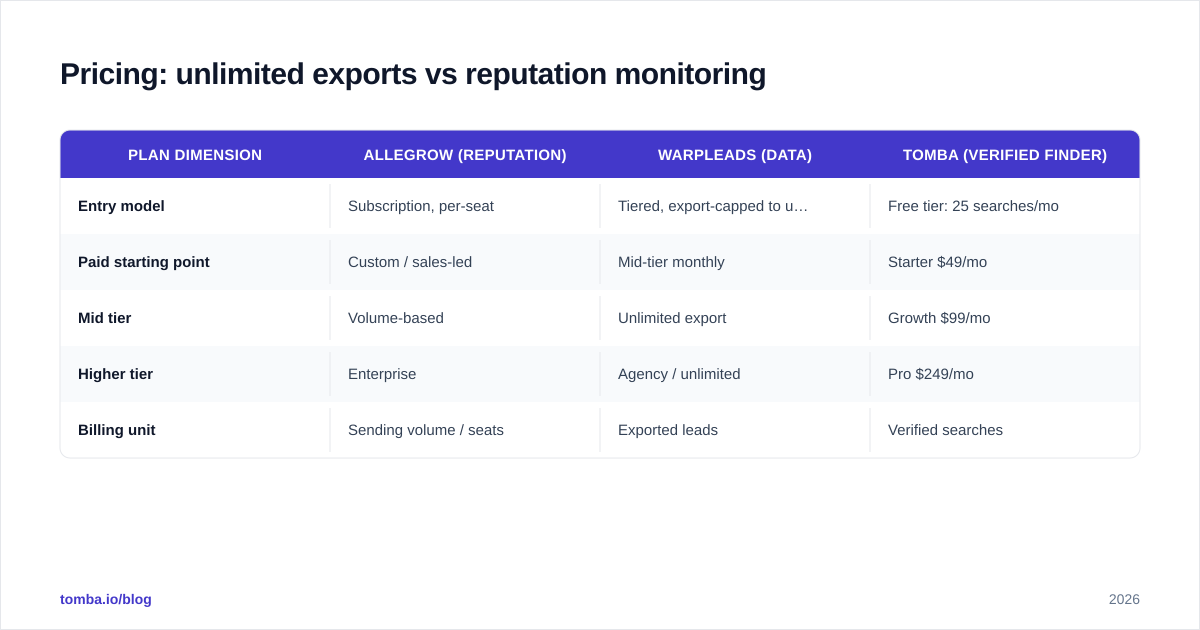
The two pricing models aren't comparable line-for-line, but understanding the shape of each helps you budget.
| Plan dimension | Allegrow (reputation) | Warpleads (data) | Tomba (verified finder) |
|---|---|---|---|
| Entry model | Subscription, per-seat | Tiered, export-capped to unlimited | Free tier: 25 searches/mo |
| Paid starting point | Custom / sales-led | Mid-tier monthly | Starter $49/mo |
| Mid tier | Volume-based | Unlimited export | Growth $99/mo |
| Higher tier | Enterprise | Agency / unlimited | Pro $249/mo |
| Billing unit | Sending volume / seats | Exported leads | Verified searches |
Two practical notes. First, "unlimited" export only saves money if those exported leads convert — an unlimited list of undeliverable contacts is an unlimited liability, not an asset. Second, deliverability monitoring is worth paying for only once your volume is high enough that a reputation drop costs real revenue; small senders often get 80% of the benefit from free tools like a spam checker and an SPF checker plus disciplined list hygiene.
Always confirm current numbers on each vendor's own site before committing — pricing pages change, and the official Allegrow site and Warpleads listings are the only authoritative sources.
Can you use them together?#
Yes — and for a mature outbound team, the "versus" framing eventually dissolves. A complete cold-email stack has three layers, and these tools occupy different ones:
- Sourcing layer — where contacts come from. Warpleads (volume) or a verified finder (accuracy) lives here.
- Hygiene layer — verification and de-duplication before send. A standalone verifier and a bulk email finder live here.
- Deliverability layer — reputation, warmup, and inbox monitoring. Allegrow lives here.
The mistake is treating a layer-1 tool and a layer-3 tool as substitutes. They're complements. If you only have budget for one tool right now, fix the layer that's actually broken — re-read the diagnosis framework above.
For more on the sending-side fundamentals that Allegrow monitors, HubSpot's deliverability guidance is a solid, vendor-neutral primer on the reputation signals that decide inbox placement.
What should most teams do first?#
Conclusion first: fix your data before you pay to monitor the damage it causes.
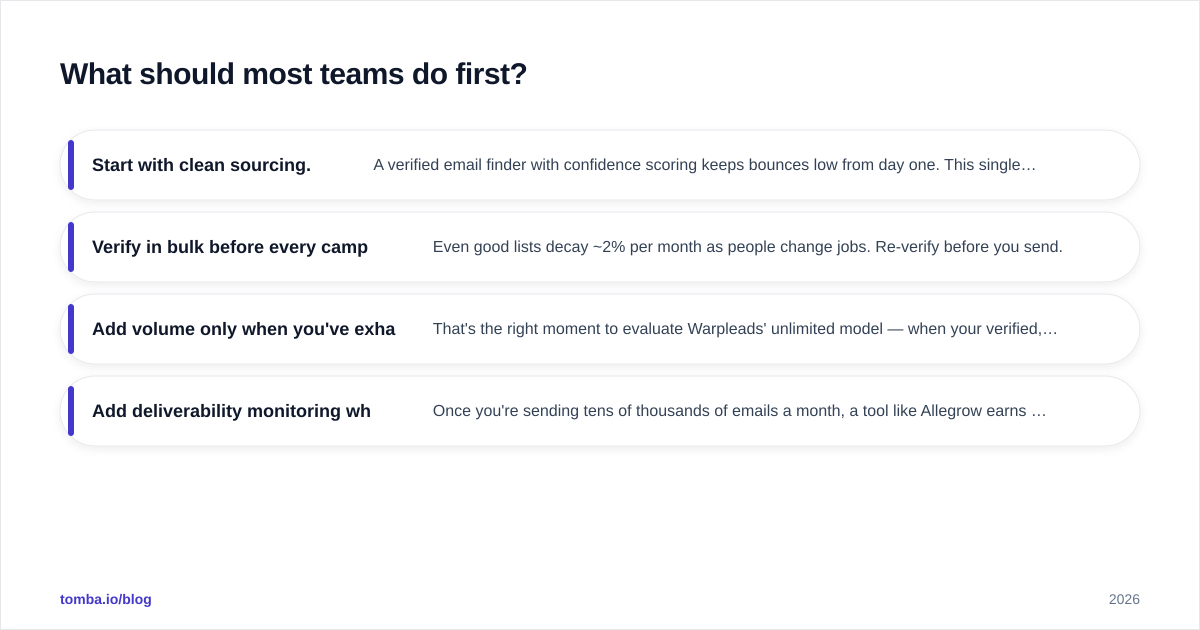
The sequence that works for the majority of outbound teams:
- Start with clean sourcing. A verified email finder with confidence scoring keeps bounces low from day one. This single step removes the most common cause of reputation decline.
- Verify in bulk before every campaign. Even good lists decay ~2% per month as people change jobs. Re-verify before you send.
- Add volume only when you've exhausted clean supply. That's the right moment to evaluate Warpleads' unlimited model — when your verified, ICP-matched list genuinely runs dry.
- Add deliverability monitoring when volume justifies it. Once you're sending tens of thousands of emails a month, a tool like Allegrow earns its cost by catching reputation drops early.
This order matters because most "deliverability problems" are actually data problems wearing a costume. Solve the cause, not the symptom.
Allegrow vs Warpleads: the verdict#
Neither tool is a loser — they're answers to different questions.
- Pick Allegrow if your messages are reaching the wrong folder and your open rates are sliding despite good copy. It's a deliverability instrument, not a contact source.
- Pick Warpleads if you have a working send setup, healthy inbox placement, and have simply run out of people to email at the volume you need.
- Pick an accuracy-first finder + verifier if your real pain is bounces, wasted credits, and a CRM full of dead addresses — which, for most teams, is the actual bottleneck.
The framing "Allegrow vs Warpleads" assumes you must choose between deliverability and data. You don't. You choose based on which one is breaking your numbers this quarter, and you add the others as you scale.
Build your list on accurate data, not guesses#
If you got here because your bounce rate is high or your "verified" list keeps disappointing, the fastest fix isn't a deliverability monitor or an unlimited data dump — it's sourcing addresses that are confirmed deliverable at the moment you find them. The Tomba Email Finder returns professional emails by name, domain, or company with a confidence score and live verification baked in, so a guessed pattern never reaches your sequencer. Start free with 25 searches a month, scale on the Starter plan at $49/mo, and let a clean list do the deliverability work for you — before you ever need a tool to monitor the damage.
Ready to find emails that actually work?
Join 150,000+ professionals who stopped guessing and started sending. Free credits on signup — no credit card required.
Get the Tomba newsletter
Practical outbound tactics and product updates — once every two weeks.
About the author