Amplemarket vs Apollo.io 2026: Which Sales Platform Wins?
Amplemarket bets on AI signals and done-for-you outbound; Apollo.io bets on a massive database and low seat prices. Here's which one fits your team in 2026.
You are choosing between two sales platforms. On a feature grid they look similar. In daily use they feel completely different. The Amplemarket vs Apolloio question matters because both promise data, sequencing, and AI. But each one is built for a different buyer, priced on different logic, and fails in different ways. This guide breaks down where each one wins, so you don't pay for the wrong fit.
TL;DR — Amplemarket vs Apolloio in 2026#
- Apollo.io is the volume play: a ~275M-contact database, the cheapest seats in the category, and an all-in-one engage + dial + enrich stack. Best for SMB and mid-market teams who want everything in one login at a low price.
- Amplemarket is the AI-first play: intent and "buying signal" data, copywriting, and a more done-for-you outbound engine. Best for funded SaaS teams who value reply rate over raw seat cost.
- Data accuracy is closer than the marketing suggests. Both rely on crowd-sourced and scraped data that needs verification before you send.
- Price gap is real: Apollo starts around $49/seat/mo billed annually. Amplemarket is quote-based and usually lands several times higher per seat.
- If your bottleneck is finding and verifying contacts rather than running sequences, a focused tool like the Tomba Email Finder often beats paying platform prices for data you barely use.
What is Amplemarket?#
Amplemarket is an AI-native sales engagement platform built for outbound SaaS teams. It does not lead with a database. Instead it leads with signals: job changes, hiring spikes, and technology adoption. These triggers suggest a prospect is in-market. On top of that it adds AI copywriting (its "Duo" assistant) and multichannel sequencing across email and LinkedIn. It also bundles a deliverability suite that monitors and warms your sending domains.
The pitch is simple. You spend less time deciding who to contact and what to say. The platform surfaces the account, drafts the message, and protects your inbox reputation. That appeals to teams who want fewer tools and more guidance. It also comes at a premium price that reflects the white-glove positioning. You can see how they frame it on the Amplemarket homepage.
What is Apollo.io?#
Apollo.io is an all-in-one go-to-market platform. It is built around one of the largest contact databases in the category: north of 275 million contacts and roughly 70 million companies, by their own count. On top of the database sit prospecting filters, email and call sequences, a dialer, a Chrome extension, and CRM enrichment. The defining trait is breadth at a low price. There is a free tier, then paid seats that start far below most competitors.
Apollo's gravity comes from that pricing. A founder or a five-person SDR team can self-serve, load a list, and start sending the same day. No sales call needed. You can review their current packaging on the Apollo.io pricing page. The trade-off is real, though. Breadth at volume means data quality varies, and you do more of the targeting and writing yourself.
Amplemarket vs Apolloio: how do they compare head to head?#
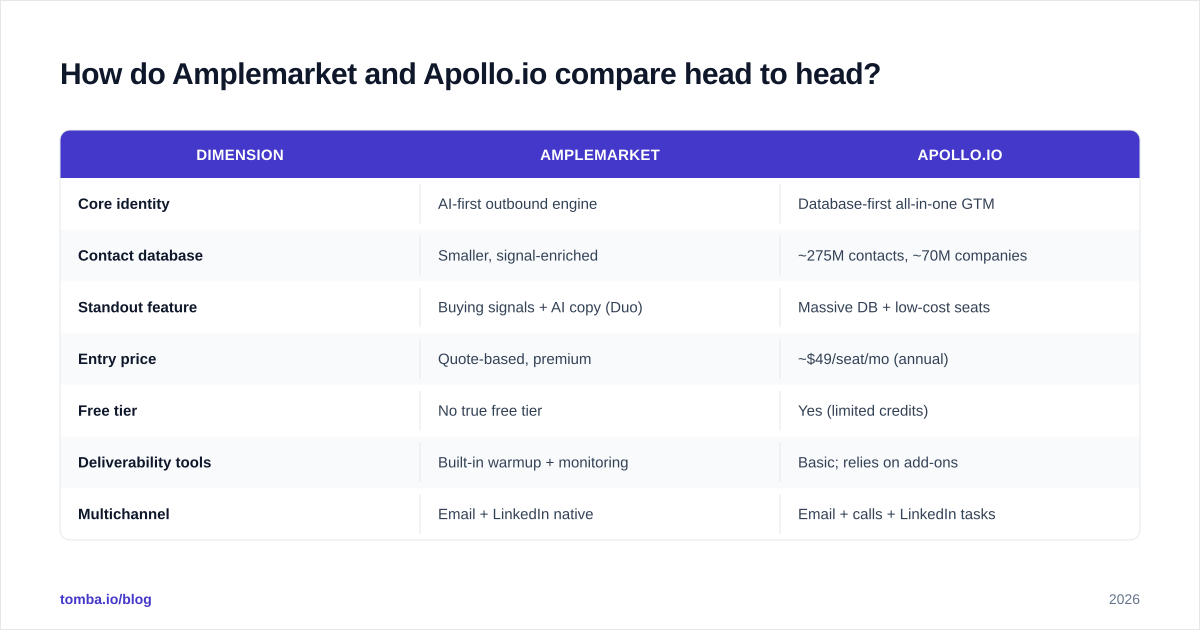
The fastest way to see the difference is to put the core dimensions side by side. The numbers below reflect publicly listed positioning as of 2026. Always confirm current pricing directly, since both vendors change packaging often.
| Dimension | Amplemarket | Apollo.io |
|---|---|---|
| Core identity | AI-first outbound engine | Database-first all-in-one GTM |
| Contact database | Smaller, signal-enriched | ~275M contacts, ~70M companies |
| Standout feature | Buying signals + AI copy (Duo) | Massive DB + low-cost seats |
| Entry price | Quote-based, premium | ~$49/seat/mo (annual) |
| Free tier | No true free tier | Yes (limited credits) |
| Deliverability tools | Built-in warmup + monitoring | Basic; relies on add-ons |
| Multichannel | Email + LinkedIn native | Email + calls + LinkedIn tasks |
| Best fit | Funded SaaS, reply-rate focus | SMB/mid-market, cost focus |
| Learning curve | Guided, lower | Broad, more self-serve |

The headline: Apollo wins on price and database size. Amplemarket wins on guidance, signals, and deliverability tooling. Neither is "better" in the abstract. They optimize for different bottlenecks.
Is Amplemarket's data better than Apollo's?#
It is closer than either side admits. Both platforms build contact data from public web sources, user contributions, and partnerships. So both ship a meaningful share of stale or guessed email addresses. Apollo's scale helps with coverage. You will find a record for almost anyone. But coverage is not the same as accuracy. A record existing is not the same as the email landing.
Amplemarket's smaller, signal-weighted dataset can feel cleaner. It surfaces fewer, more relevant contacts. Even so, it is not immune to decay. The lesson holds for both tools: verify before you send. Bounce rates above 3-5% damage your sender reputation. Once that happens, no amount of clever copy recovers your open rate.
This is why many teams pair either platform with a dedicated email verifier. They also check risky records with a catch-all verifier before a campaign goes live. The platform finds the lead. A focused verification layer keeps your domain healthy. For more on why this matters, the glossary entry on email deliverability is a useful primer.

Which has better deliverability and sending tools?#
Amplemarket, by design. Deliverability is one of its clearest strengths. It bundles inbox warmup, domain monitoring, spam-placement testing, and sending limits into the core product. For a team without a deliverability specialist, that safety net is genuinely valuable. It quietly prevents the reputation damage that kills outbound programs.
Apollo treats deliverability more lightly. You get basic sending controls. But serious warmup and inbox rotation usually means adding a third-party tool. That is fine if you already run a separate warmup stack. It is a gap if you expected the platform to protect you out of the box.
If you run cold email at any real volume, build your sending hygiene on purpose. Check your records with an SPF checker. Monitor blocklists with a blacklist checker. Plan a ramp with a warmup calculator before you scale send volume.
How does the AI compare?#
Both have AI. They aim it differently. Amplemarket's Duo is an end-to-end assistant. It reads the signal, suggests the account, and drafts personalized copy in your voice. The value is workflow compression. There are fewer manual steps between "this account looks hot" and "the email is in the queue."
Apollo's AI leans toward assistive writing and data tasks. It generates email drafts, summarizes accounts, and scores leads. But you still drive the targeting. It is capable and improving. It just assumes you are the one steering.
If you mainly want help writing, you may not need either platform's premium tier. Free utilities like a cold email AI writer and a subject line generator cover a lot of the same ground for top-of-funnel drafting.
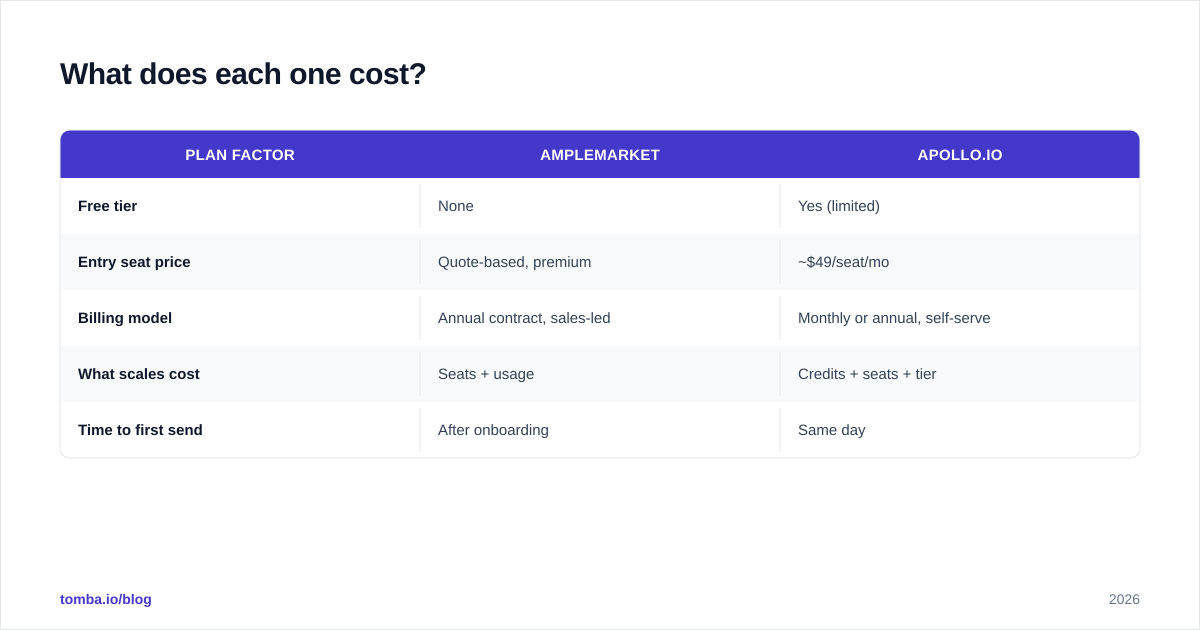
What does each one cost?#
This is where the decision often gets made. Apollo publishes transparent, self-serve pricing. There is a free tier with limited credits. Paid seats then start around $49/seat/month on annual billing, scaling up through higher tiers for more credits and features. You can start without talking to anyone.
Amplemarket is quote-based and premium. There is no public free tier and no self-serve $49 entry point. Expect a sales conversation and a per-seat cost well above Apollo's. The premium is justified by the signals, deliverability suite, and guided workflows. For a funded team that values reply rate and wants fewer tools, that premium can pay back. For a bootstrapped team counting every seat, it is a hard sell.
| Plan factor | Amplemarket | Apollo.io |
|---|---|---|
| Free tier | None | Yes (limited) |
| Entry seat price | Quote-based, premium | ~$49/seat/mo |
| Billing model | Annual contract, sales-led | Monthly or annual, self-serve |
| What scales cost | Seats + usage | Credits + seats + tier |
| Time to first send | After onboarding | Same day |
Here is the honest framing. You are not just buying software. You are buying a posture. Apollo sells you a low-cost engine and trusts you to drive. Amplemarket sells you a guided system and charges for the hand-holding.
When should you skip both and use a focused tool?#
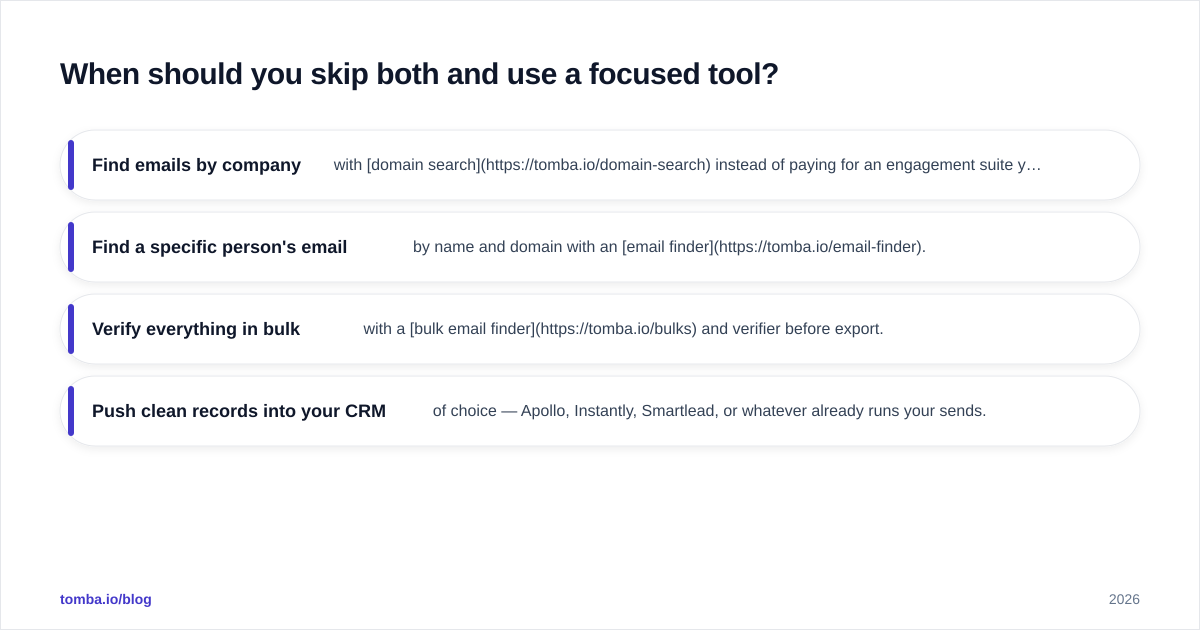
Skip both when your real bottleneck is finding and verifying contacts, not running multi-step sequences. Plenty of teams buy a full engagement platform, use 20% of it, and quietly overpay for data they could source more cheaply and accurately elsewhere.
If that sounds like you, a specialized stack is leaner:
- Find emails by company with domain search instead of paying for an engagement suite you won't use.
- Find a specific person's email by name and domain with an email finder.
- Verify everything in bulk with a bulk email finder and verifier before export.
- Push clean records into your CRM or sequencer of choice — Apollo, Instantly, Smartlead, or whatever already runs your sends.
This "find and verify here, send there" pattern keeps your data costs predictable. It also keeps your sender reputation intact, without locking you into one vendor's pricing. Compare current Tomba pricing against a per-seat platform contract. The math often favors decoupling.
Amplemarket vs Apolloio: which should you pick?#
Decide by your dominant constraint, not by the feature list.
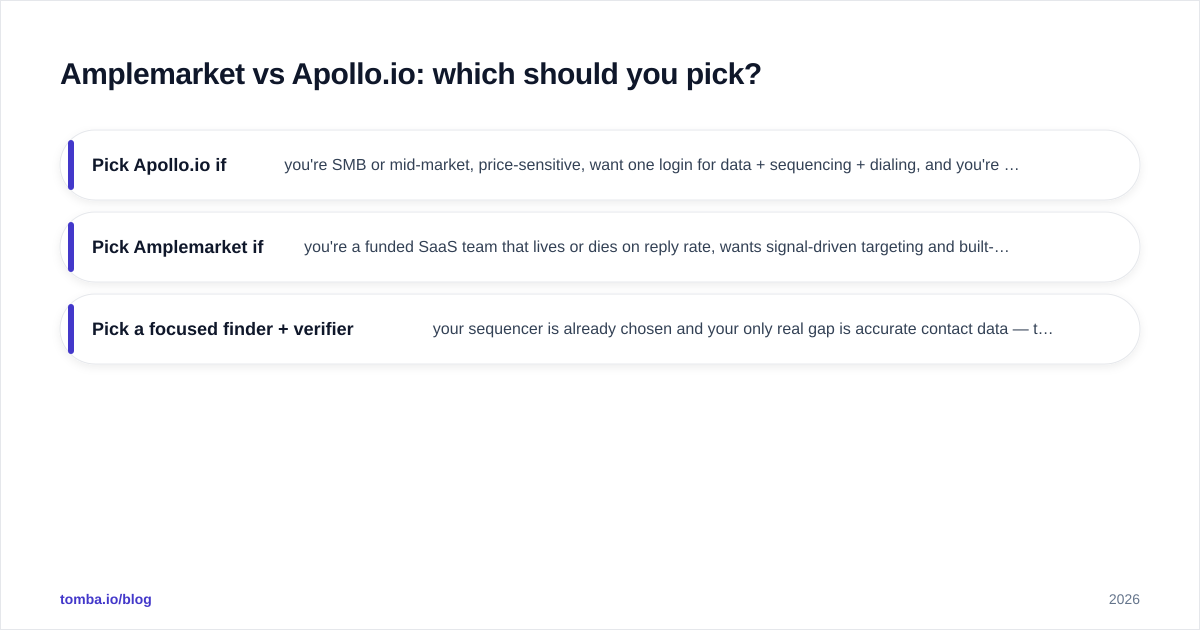
- Pick Apollo.io if you are SMB or mid-market, price-sensitive, and want one login for data, sequencing, and dialing. It fits if you are comfortable doing your own targeting and warmup. The free tier plus ~$49 seats make it the lowest-risk way to start outbound. Read more in our take on Apollo alternatives if you want to pressure-test the category.
- Pick Amplemarket if you are a funded SaaS team that lives or dies on reply rate. It fits if you want signal-driven targeting and built-in deliverability, and would rather pay a premium than babysit a tool stack. See the broader Amplemarket alternative landscape before committing to the contract.
- Pick a focused finder and verifier if your sequencer is already chosen and your only real gap is accurate contact data. That is the cheapest path to clean, deliverable lists.
There is no universal winner here. Apollo optimizes for cost and breadth. Amplemarket optimizes for guidance and signal quality. Match the tool to the bottleneck that is actually slowing your pipeline.
The bottom line#
Apollo.io and Amplemarket solve the same job from opposite ends. One uses a giant, cheap, self-serve database. The other uses a guided, premium, AI-and-signals engine. Map your constraint — budget, reply rate, or data accuracy — and the choice gets obvious.
Whichever platform you land on, the data layer underneath decides your fate. It is what sends your campaigns to the inbox or the spam folder. If you would rather not overpay a full platform just to source and clean contacts, start with the Tomba Email Finder. Find professional emails by domain, name, or company, verify them before you send, and feed clean lists into the sequencer you already trust. There is a free tier with 25 searches a month, so you can test it against your current data before you commit a cent.
// get started
Find, verify and enrich your first contacts today
Start on the free plan with 25 searches a month, then scale when your team is ready.
Free plan · No credit card required · GDPR & CCPA
// about the author