B2B Information Services in 2026: A Practical Buyer's Guide
What B2B information services actually deliver in 2026, how the categories differ, and how to choose a provider that keeps your pipeline data accurate without overpaying.
TL;DR
- B2B information services are the providers and tools that supply firmographic, contact, intent, and technographic data that powers your sales, marketing, and credit decisions.
- The market splits into five practical buckets: contact/email data, firmographic databases, intent and engagement signals, technographics, and risk/credit intelligence. Most teams need two or three, not one mega-suite.
- Accuracy decays fast — roughly 25-30% of B2B contact data goes stale every year — so refresh cadence and verification matter more than raw record counts.
- Pricing ranges from free tiers to six-figure enterprise contracts. Pay for coverage and freshness in your target segment, not a global database you'll never query.
- For contact discovery and verification specifically, a focused, API-first tool like Tomba Email Finder beats a bloated all-in-one when you care about accuracy and cost per record.
What are B2B information services?#
B2B information services are companies and platforms that collect, clean, and sell business data so other companies can find prospects, qualify accounts, assess risk, and make decisions. Think of them as the wholesale suppliers behind your go-to-market engine: you rarely build the data yourself, you buy it from someone whose entire job is keeping it current.
The category is old — Dun & Bradstreet has been doing this since the 1840s — but the modern version is software-delivered. Instead of mailing you a directory, providers expose a database, an API, browser extensions, and CRM integrations. You query a domain or a name and get back structured records: emails, phone numbers, job titles, company size, revenue, tech stack, funding, and increasingly, behavioral signals about who is in-market right now.
If you run revenue operations, these services are the raw material your whole motion sits on. Bad data here means bad routing, bad scoring, and reps emailing the wrong people.
What are the main categories of B2B information services?#
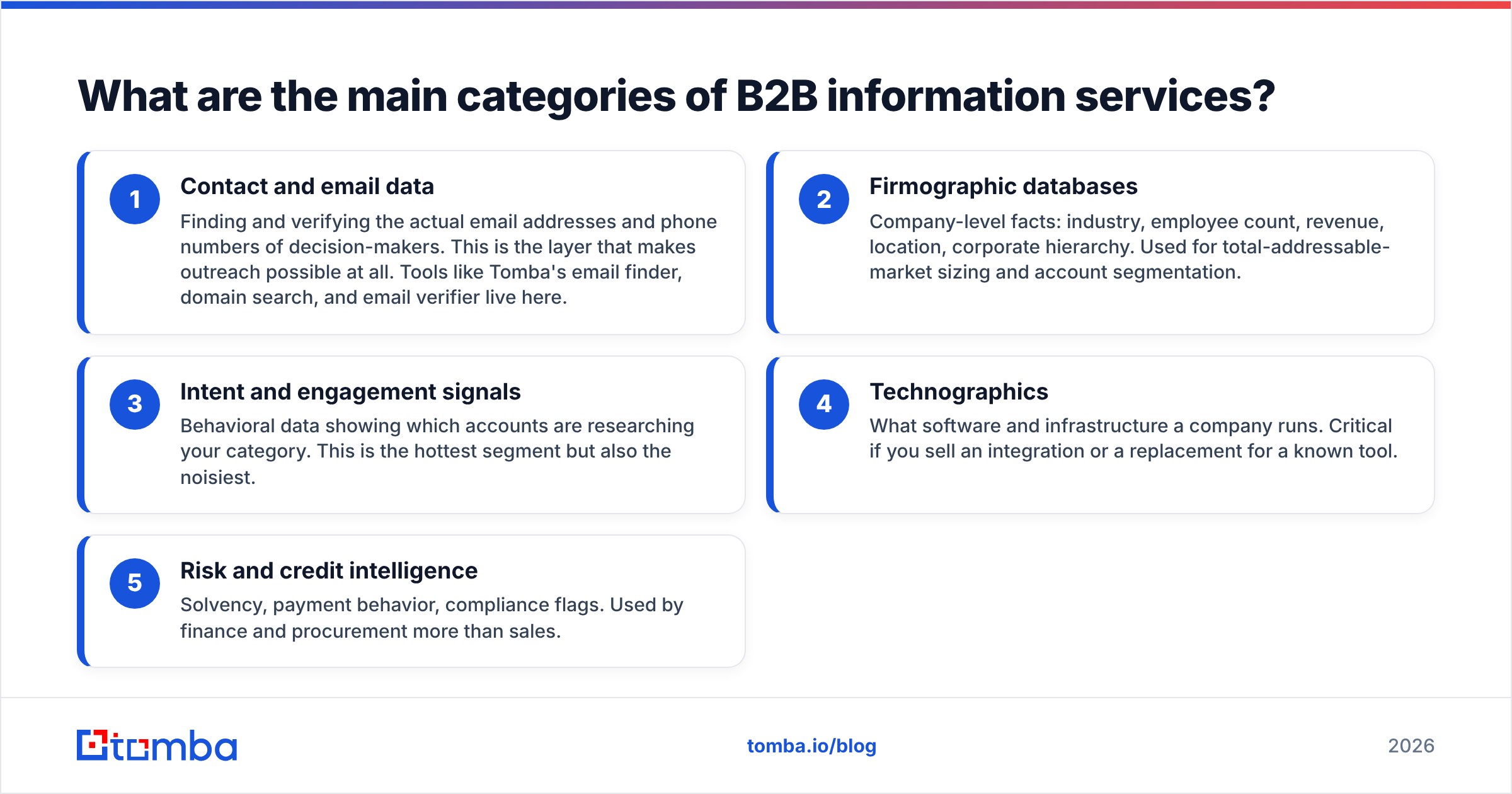
Lumping everything under "data vendor" is how teams overpay. There are five distinct jobs, and most providers are genuinely good at only one or two:
- Contact and email data — Finding and verifying the actual email addresses and phone numbers of decision-makers. This is the layer that makes outreach possible at all. Tools like Tomba's email finder, domain search, and email verifier live here.
- Firmographic databases — Company-level facts: industry, employee count, revenue, location, corporate hierarchy. Used for total-addressable-market sizing and account segmentation.
- Intent and engagement signals — Behavioral data showing which accounts are researching your category. This is the hottest segment but also the noisiest.
- Technographics — What software and infrastructure a company runs. Critical if you sell an integration or a replacement for a known tool.
- Risk and credit intelligence — Solvency, payment behavior, compliance flags. Used by finance and procurement more than sales.
A focused contact tool and a firmographic source will cover the needs of most outbound teams. You add intent and technographics when your motion matures, and risk data only if you extend credit.
How do the major B2B information services compare?#
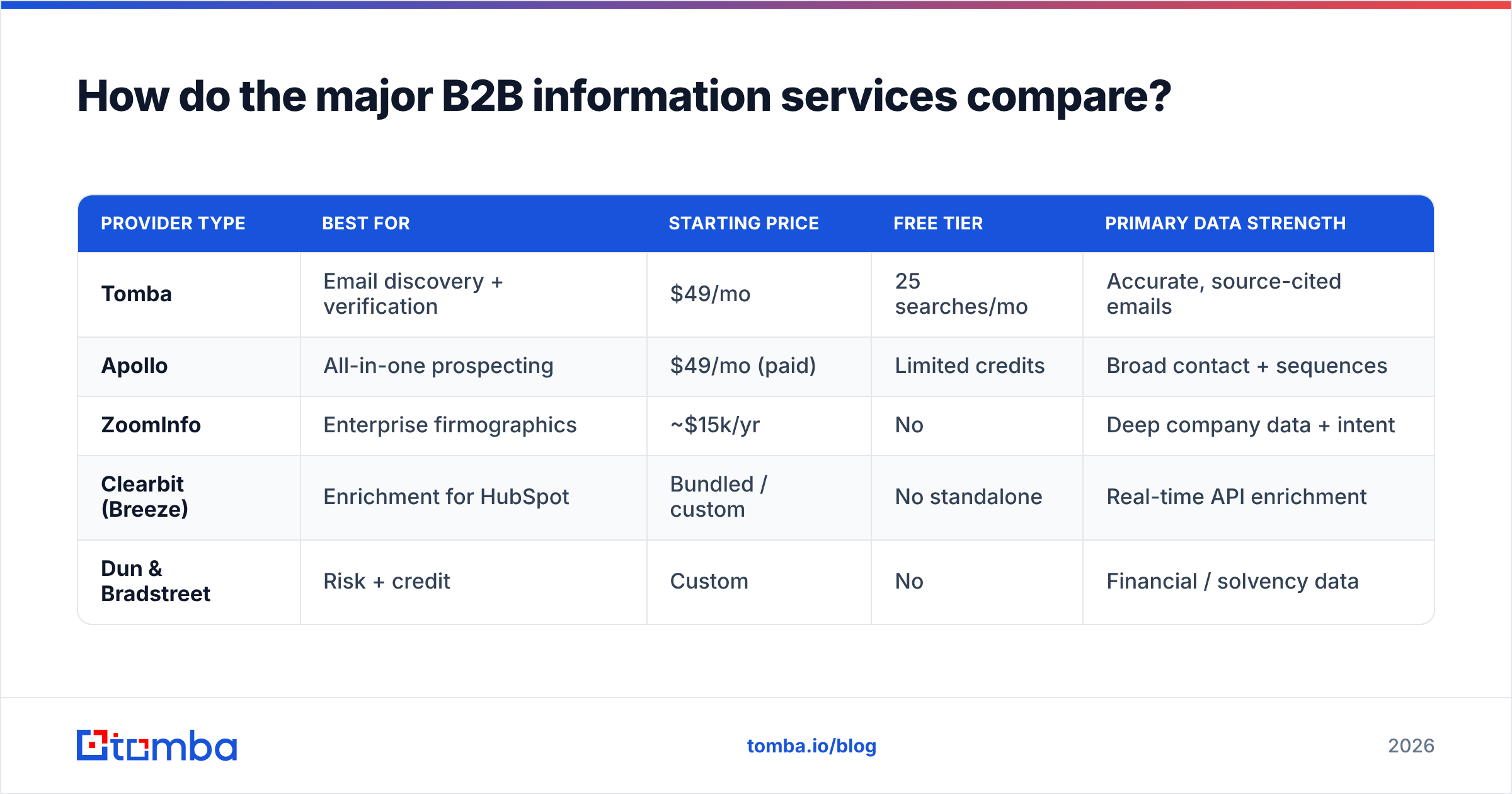
Here is a practical comparison across the dimensions that actually change your buying decision. Prices reflect entry points published in early 2026 and move frequently, so treat them as directional.
| Provider type | Best for | Starting price | Free tier | Primary data strength |
|---|---|---|---|---|
| Tomba | Email discovery + verification | $49/mo | 25 searches/mo | Accurate, source-cited emails |
| Apollo | All-in-one prospecting | $49/mo (paid) | Limited credits | Broad contact + sequences |
| ZoomInfo | Enterprise firmographics | ~$15k/yr | No | Deep company data + intent |
| Clearbit (Breeze) | Enrichment for HubSpot | Bundled / custom | No standalone | Real-time API enrichment |
| Dun & Bradstreet | Risk + credit | Custom | No | Financial / solvency data |
The pattern is clear: the enterprise suites win on breadth and intent depth but cost an order of magnitude more and lock you into annual contracts. Focused tools win on price, accuracy in their lane, and API access without a sales call. You can compare full Tomba pricing against any of these — the Starter plan is $49/mo, Growth is $99/mo, and Pro is $249/mo, with a genuine free tier to test accuracy before you commit.
For an outside view on how buyers rate these platforms, the review volume on G2 is the most honest signal you'll find — sort by your own company size, not the overall average.
How accurate is B2B data, really?#
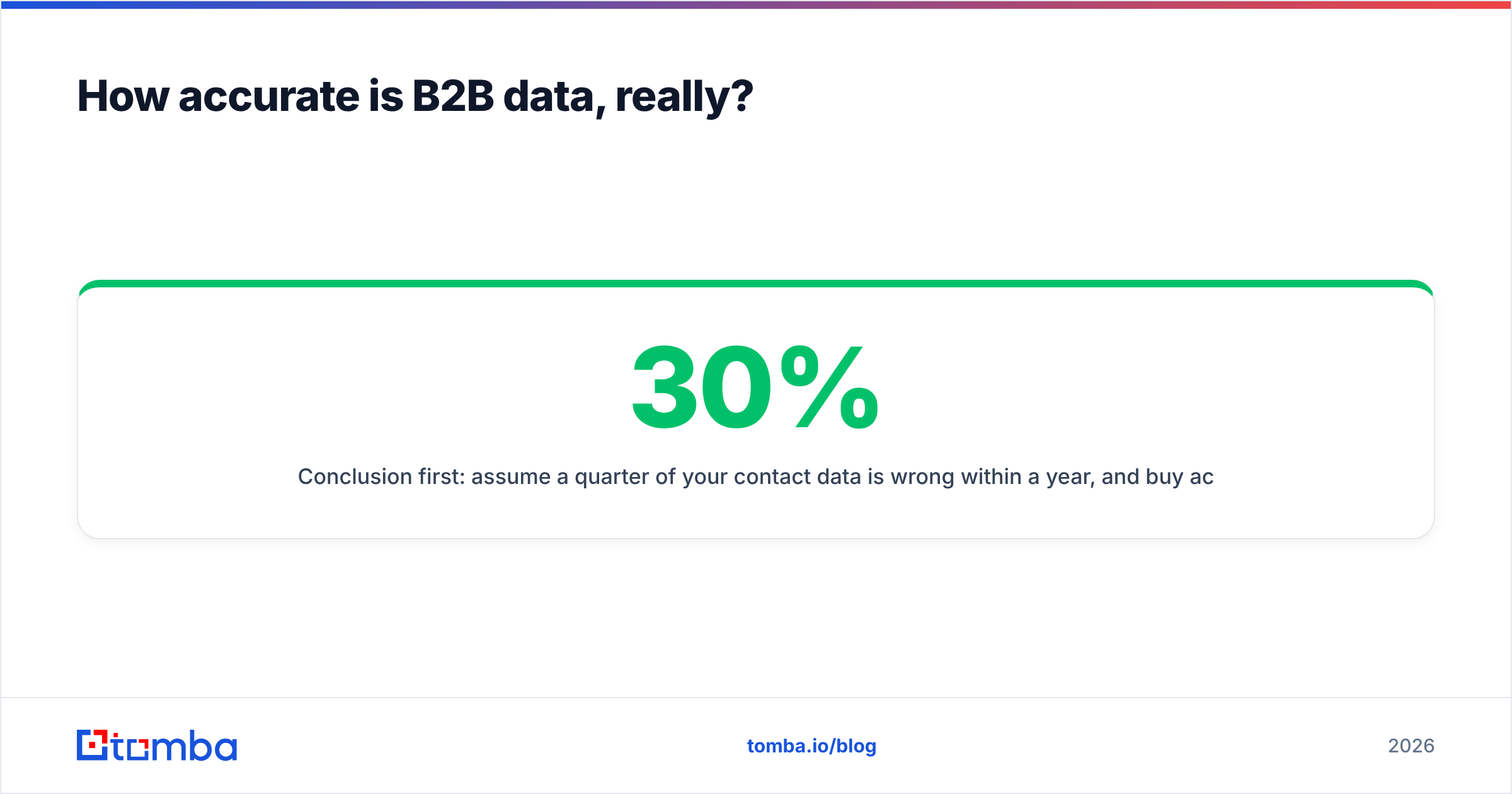
Conclusion first: assume a quarter of your contact data is wrong within a year, and buy accordingly. People change jobs, companies rebrand, domains migrate, and email formats shift. Industry estimates consistently put annual B2B contact decay around 25-30%, which means a database that was 95% accurate at purchase can drift below 70% in twelve months if nobody refreshes it.
This is why freshness beats raw record count. A vendor advertising "275 million contacts" tells you nothing about whether the 400 contacts in your niche are current. The questions that matter:
- When was this record last verified? Real-time verification at query time beats a quarterly batch refresh.
- What is the source? Crawled-and-guessed data is cheaper and worse than data confirmed against live mail servers. Tomba publishes where its data sources come from, which is rarer than it should be.
- Is there a catch-all problem? Many corporate domains accept every address, so a naive checker reports "valid" for emails that bounce. A dedicated catch-all verifier is the difference between a clean list and a damaged sender reputation.
If you skip verification, you pay twice — once for the data and again in deliverability damage when hard bounces tank your domain reputation.
How should you choose a B2B information service?#
Match the tool to the job instead of buying the biggest suite. Walk through these in order:
- Define your segment first. Test each vendor against 100 accounts in your actual ICP. Global coverage is irrelevant if your niche is thin.
- Demand a free trial or free tier. If a provider won't let you test accuracy before a contract, that's a signal about their accuracy.
- Check the delivery method. Do you need a UI, a bulk tool, a CRM sync, or an email finder API? A great database with no Salesforce integration creates manual work forever.
- Price by cost-per-usable-record, not headline subscription. A cheap plan that returns 40% bounces is more expensive than a pricier one at 95% deliverable.
- Confirm compliance. GDPR and CCPA exposure is real; ask how the vendor sources data and honors removal requests.

This is also where consolidation tempts you. A single mega-suite feels simpler, but you end up paying enterprise rates for an intent feature you use twice a quarter. A focused stack — a contact/verification tool plus one firmographic source plus your CRM — is usually cheaper, more accurate, and easier to swap when one piece underperforms.
What does a modern B2B data stack look like?#
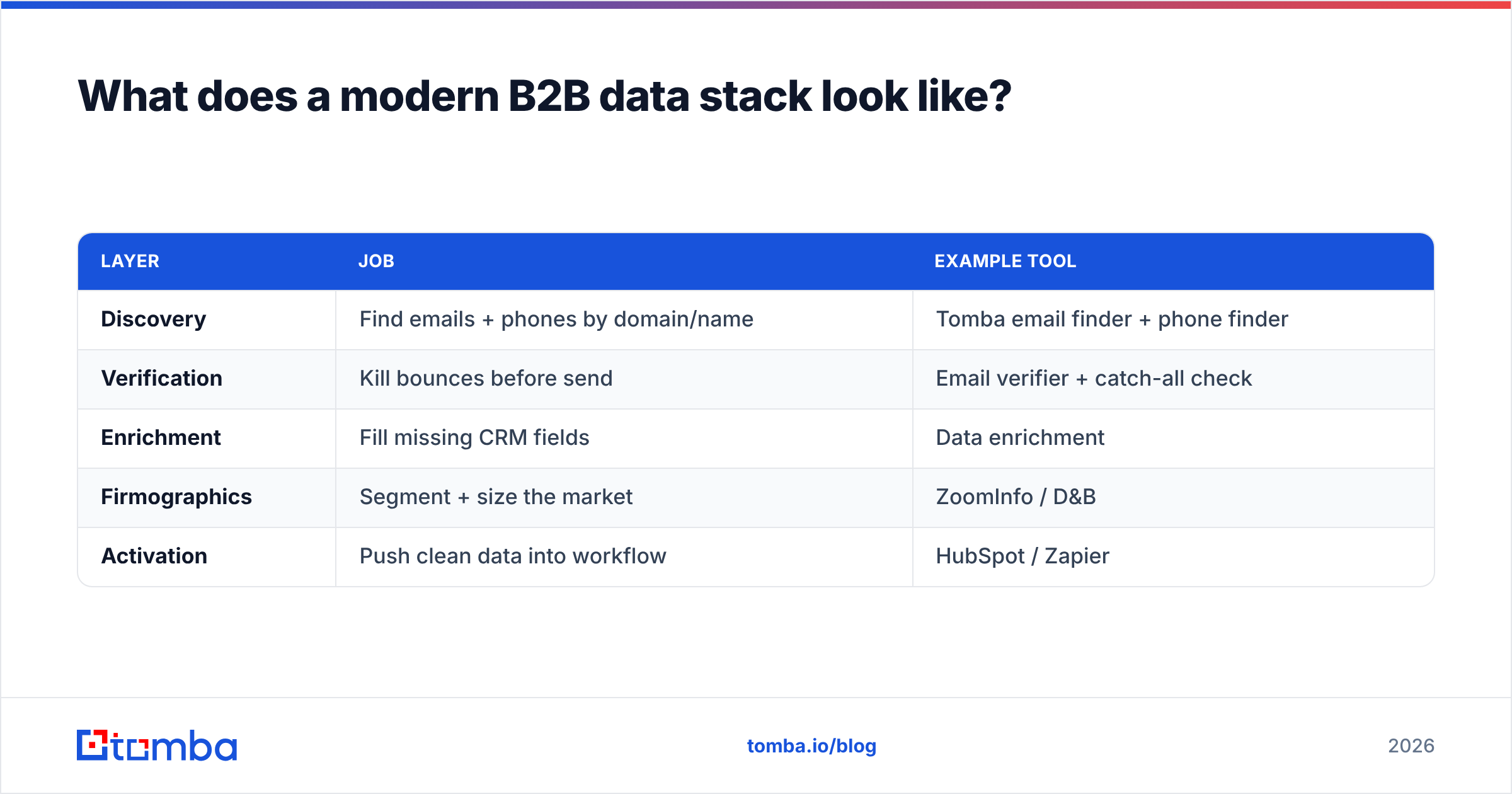
A practical 2026 stack for a mid-market outbound team looks like this:
| Layer | Job | Example tool |
|---|---|---|
| Discovery | Find emails + phones by domain/name | Tomba email finder + phone finder |
| Verification | Kill bounces before send | Email verifier + catch-all check |
| Enrichment | Fill missing CRM fields | Data enrichment |
| Firmographics | Segment + size the market | ZoomInfo / D&B |
| Activation | Push clean data into workflow | HubSpot / Zapier |
The discovery and verification layers are where most of your data quality is won or lost, and they're also the cheapest to get right. You can run them through a UI, a Chrome extension, a Google Sheets add-on, or the API depending on how your team works. The firmographic and intent layers are where you'll spend the most money, so add them deliberately once the foundation is clean.
Are all-in-one platforms worth it?#
It depends on your scale and how much of the suite you'll actually use. The honest trade-offs:
- Choose an all-in-one if you're a large enterprise, you need intent data deeply integrated with firmographics, and you have a RevOps team to administer it. The integration tax is real, and one throat to choke has value at scale.
- Choose focused tools if you're a startup or mid-market team, you care most about email accuracy and cost control, and you want API access without a procurement cycle. Most teams here use less than a third of a suite's features but pay for all of them.
A common middle path: keep your cheap, accurate contact and verification layer permanent, and treat the expensive firmographic/intent suite as a swappable add-on you re-evaluate annually. If you're specifically shopping suites, the Apollo alternative and Clearbit alternative breakdowns are a useful starting point for what you'd actually be giving up or gaining.
For neutral category definitions and vendor landscapes, analyst coverage from firms like Gartner is worth reading — just remember the Magic Quadrant skews toward enterprise budgets, not lean teams.
How do you keep B2B data clean over time?#
Buying good data is step one; the decay clock starts immediately. Build a maintenance loop:
- Verify before every send. Run lists through a verifier so hard bounces never reach your sending domain.
- Re-enrich quarterly. Refresh job titles and company fields on your active accounts; people move roles constantly.
- Deduplicate. Merge duplicate records before they pollute scoring and routing — a simple remove-duplicates pass catches most.
- Monitor sender reputation. Track your sender reputation so you catch deliverability slides before they cost you a quarter.
Automating this loop through an API or a Make.com integration turns data hygiene from a recurring fire drill into a background process.
The bottom line#
B2B information services are not one product — they're five jobs wearing a trench coat. Decide which jobs you actually have, test vendors against your real ICP, and weight freshness and verification over headline record counts. The teams that win don't buy the biggest database; they buy the most accurate one for their segment and keep it clean.
If your top priority is finding and verifying decision-maker emails without an enterprise contract, start with the Tomba Email Finder. The free tier gives you 25 searches a month to test accuracy on your own target accounts, Starter is $49/mo, and every result is source-cited so you can trust it before you press send. Pair it with the built-in verifier, plug it into your CRM, and you have the cleanest, cheapest layer of your B2B data stack handled — then add the expensive suites only where they earn their keep.
// get started
Find, verify and enrich your first contacts today
Start on the free plan with 25 searches a month, then scale when your team is ready.
Free plan · No credit card required · GDPR & CCPA
// about the author