B2B Marketing Tech Stack 2026: Tools, Layers & ROI
A practical 2026 guide to building a B2B marketing tech stack that actually drives pipeline — the core layers, what to buy, and how to keep data clean.
TL;DR
- A B2B marketing tech stack is the connected set of platforms you use to attract, capture, nurture, and convert demand — not a random pile of point tools.
- Most teams overspend on overlapping software and underspend on the data layer that makes everything else work.
- The five core layers are: data and identity, capture and engagement, automation and CRM, analytics and attribution, and orchestration/AI.
- Tool sprawl is the silent killer — the average B2B team runs dozens of apps, and integration debt eats the ROI.
- Start with clean contact data, pick one platform per layer, and only add tools when a measurable gap exists.
What is a B2B marketing tech stack?#
A B2B marketing tech stack is the collection of software your team uses to run demand generation end to end — from the first anonymous website visit to a closed-won deal feeding back into your reporting. Think of it like a kitchen, not a gadget drawer. A great kitchen has a few well-chosen, well-connected stations that work together; a gadget drawer is full of single-use tools you bought once and forgot.
The "tech" in marketing tech (martech) covers everything from your CRM and marketing automation platform to your enrichment data, ad tooling, and attribution dashboards. In 2026 the martech landscape has well over 14,000 products according to industry maps, which is exactly why most stacks are bloated. The skill is no longer finding tools — it's choosing the right five or six and wiring them together so data flows cleanly.
The difference between B2C and B2B martech matters here. B2B buying involves long cycles, multiple stakeholders, and account-level (not just person-level) targeting. That means your stack has to handle data enrichment, lead-to-account matching, and pipeline attribution — concerns a typical B2C email tool ignores.

What are the core layers of a B2B martech stack?#
Every effective stack maps to five functional layers. You can run a lean version with one tool per layer or scale up, but skipping a layer creates a blind spot somewhere in the funnel.
- Data and identity layer — Where you source, enrich, and verify contact and account data. This includes email finder tools, verification, firmographic enrichment, and website-visitor identification. Everything downstream inherits the quality of this layer.
- Capture and engagement layer — Forms, landing pages, chat, ads, SEO tooling, and cold outreach platforms that turn attention into known contacts.
- Automation and CRM layer — Marketing automation (nurture, scoring, workflows) plus the system of record where sales and marketing share the same truth.
- Analytics and attribution layer — Dashboards, multi-touch attribution, and revenue reporting that tie spend to pipeline.
- Orchestration and AI layer — The connective tissue: iPaaS tools, sales automation, and AI agents that route, summarize, and act across the other layers.
The most common mistake is investing heavily in layers 2 through 4 while treating layer 1 as an afterthought. Bad data doesn't stay contained — a 30% inaccurate contact list inflates your bounce rate, poisons your sender reputation, skews your scoring models, and corrupts your attribution. Garbage in, garbage everywhere.
How do the main B2B martech categories compare?#
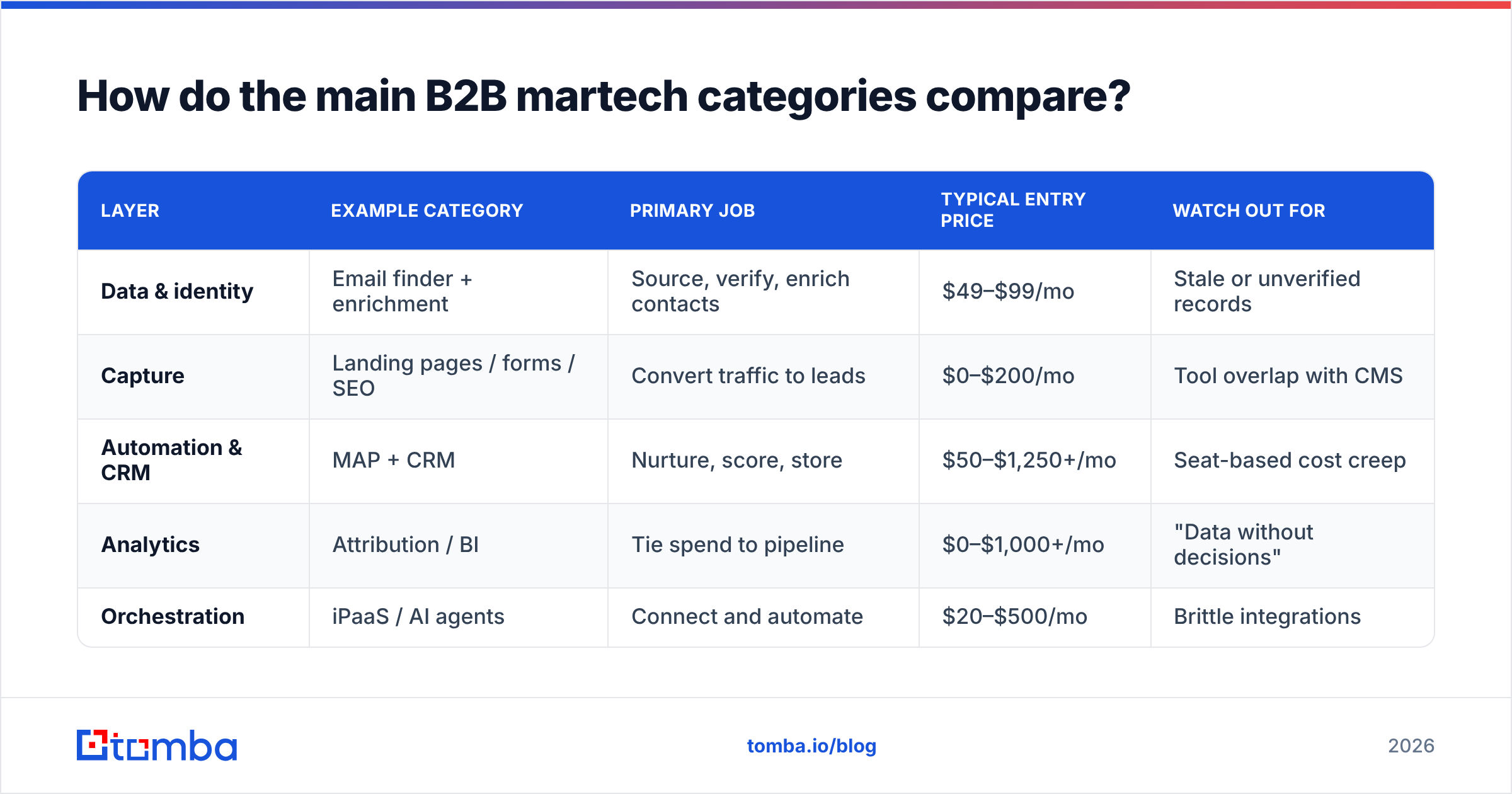
Here's how the core categories stack up on what actually matters for a B2B team: what they do, where they shine, and the rough monthly entry cost.
| Layer | Example category | Primary job | Typical entry price | Watch out for |
|---|---|---|---|---|
| Data & identity | Email finder + enrichment | Source, verify, enrich contacts | $49–$99/mo | Stale or unverified records |
| Capture | Landing pages / forms / SEO | Convert traffic to leads | $0–$200/mo | Tool overlap with CMS |
| Automation & CRM | MAP + CRM | Nurture, score, store | $50–$1,250+/mo | Seat-based cost creep |
| Analytics | Attribution / BI | Tie spend to pipeline | $0–$1,000+/mo | "Data without decisions" |
| Orchestration | iPaaS / AI agents | Connect and automate | $20–$500/mo | Brittle integrations |
A few takeaways. The data layer is the cheapest to get right and the most expensive to get wrong. The CRM/automation layer is where budgets balloon because pricing is seat- or contact-based, so it scales with your team and list whether or not you're using the seats. And the orchestration layer is small in cost but huge in leverage — a $40/month Zapier integration or HubSpot connection can save dozens of hours of manual data entry.
What does a lean vs. enterprise stack look like?#
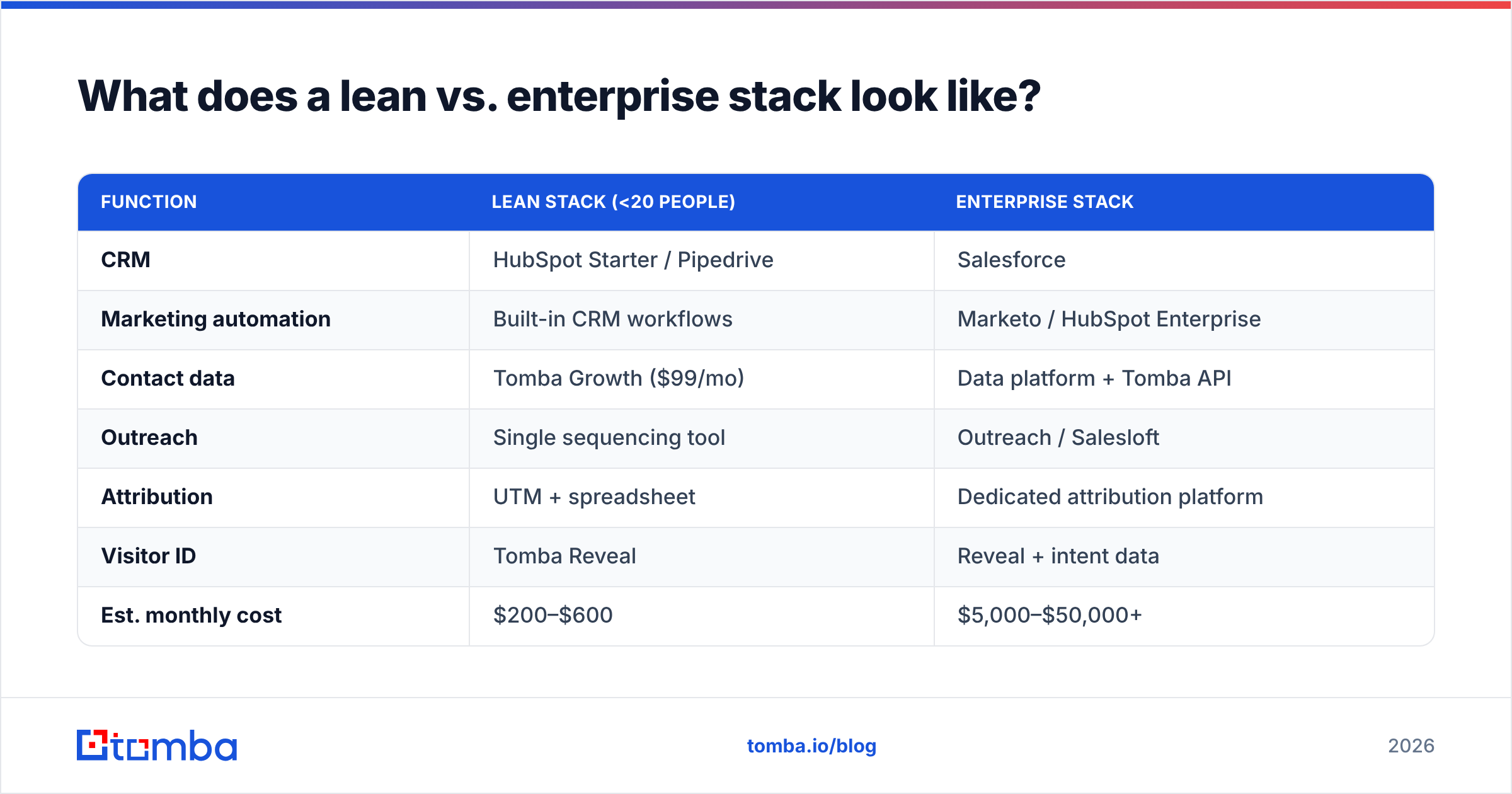
You don't need an enterprise stack to run effective B2B marketing. Here's a realistic comparison of a lean startup setup against a scaled enterprise one.
| Function | Lean stack (<20 people) | Enterprise stack |
|---|---|---|
| CRM | HubSpot Starter / Pipedrive | Salesforce |
| Marketing automation | Built-in CRM workflows | Marketo / HubSpot Enterprise |
| Contact data | Tomba Growth ($99/mo) | Data platform + Tomba API |
| Outreach | Single sequencing tool | Outreach / Salesloft |
| Attribution | UTM + spreadsheet | Dedicated attribution platform |
| Visitor ID | Tomba Reveal | Reveal + intent data |
| Est. monthly cost | $200–$600 | $5,000–$50,000+ |
The lean stack covers all five layers for a few hundred dollars a month. The enterprise version adds depth — dedicated attribution, intent data, multi-region compliance tooling — but the jobs are identical. If a vendor can't tell you which of the five layers their product owns, that's a sign you're buying a feature, not a tool.
For most teams under 50 people, the right move is one platform per layer plus a strong data source feeding the top of the funnel. You can always graduate to Marketo or Salesforce later; you can't un-poison a database that's been collecting bad contacts for two years.
Why is the data layer the foundation of B2B marketing tech?#
Because every other tool consumes the data layer's output. Your sequencing tool emails the addresses your data layer found. Your scoring model ranks the firmographics your data layer enriched. Your attribution dashboard reports on the leads your data layer captured. If the data is wrong, you're automating mistakes at scale.
This is where deliverability lives, too. Sending to unverified addresses spikes your bounce rate, and mailbox providers read high bounces as a spam signal — tanking your sender reputation and email deliverability for everyone in your domain. A clean list isn't a nice-to-have; it's the price of admission to the inbox.
Three data-layer jobs are non-negotiable for B2B:
- Find the right contacts — use an email finder or domain search to pull verified addresses by company, role, or domain rather than guessing patterns.
- Verify before you send — run addresses through an email verifier and a catch-all verifier so you're not paying with your reputation.
- Enrich for targeting — append firmographics, seniority, and tech stack so scoring and routing have something to work with.
Tools like Tomba sit squarely in this layer. With a Free tier (25 searches/mo), Starter at $49/mo, and Growth at $99/mo, you can plug verified contact data into the rest of your stack via the Tomba API, a Google Sheets add-on, or a Chrome extension without ripping out your CRM. Compared with all-in-one platforms like Apollo, a dedicated data layer keeps you flexible — you swap the engagement tools above it without losing your contact foundation.
How do you avoid tool sprawl and integration debt?#
Tool sprawl happens when teams solve every new problem by buying software instead of using what they have. The result: overlapping features, multiple sources of truth, and integrations that break every time a vendor ships an update. Research from martech analysts consistently shows companies use less than half the capabilities of the tools they already pay for.
Use this audit checklist quarterly:
- Map every tool to a layer. If two tools own the same layer, one is probably redundant.
- Check utilization. Pull login and feature-usage data. Anything under 30% adoption is a cancellation candidate.
- Trace the data flow. Draw how a lead moves from capture to closed-won. Every manual copy-paste step is integration debt.
- Count your sources of truth. You should have exactly one system of record. More than one means reconciliation pain.
- Price per outcome, not per feature. A cheaper tool that creates manual work is more expensive than it looks.
The fix for most sprawl is consolidation plus connection. Pick the platform that owns each layer, then connect them through native integrations or an iPaaS like Make. For B2B teams, a clean handoff between the data layer and CRM — verified contacts flowing straight into HubSpot or Pipedrive — eliminates the single biggest source of dirty-data complaints.
Where does AI fit in the 2026 B2B marketing stack?#
AI now spans every layer rather than sitting in its own box. In the data layer, AI improves match rates and predicts the most likely email pattern for a contact. In capture, it generates and tests landing-page copy and subject lines. In automation, AI agents route leads and draft follow-up replies. In analytics, it surfaces anomalies you'd never catch manually.
The trap is treating AI as a strategy instead of a feature. An AI cold email writer that sends beautifully written messages to unverified addresses still bounces. AI amplifies whatever you feed it — which loops back to the data layer being the foundation. The teams winning with AI in 2026 are the ones who got their data clean first, then layered automation on top.
Practically, the highest-ROI AI moves for a B2B team are: enrichment and verification at the top of the funnel, lead scoring and routing in the middle, and reply drafting plus meeting summaries at the bottom. Everything else is a nice demo. Tools like the Tomba MCP server let AI assistants pull verified contact data directly into your workflows, which is exactly the kind of narrow, high-value use that pays for itself.
How do you measure B2B marketing tech ROI?#
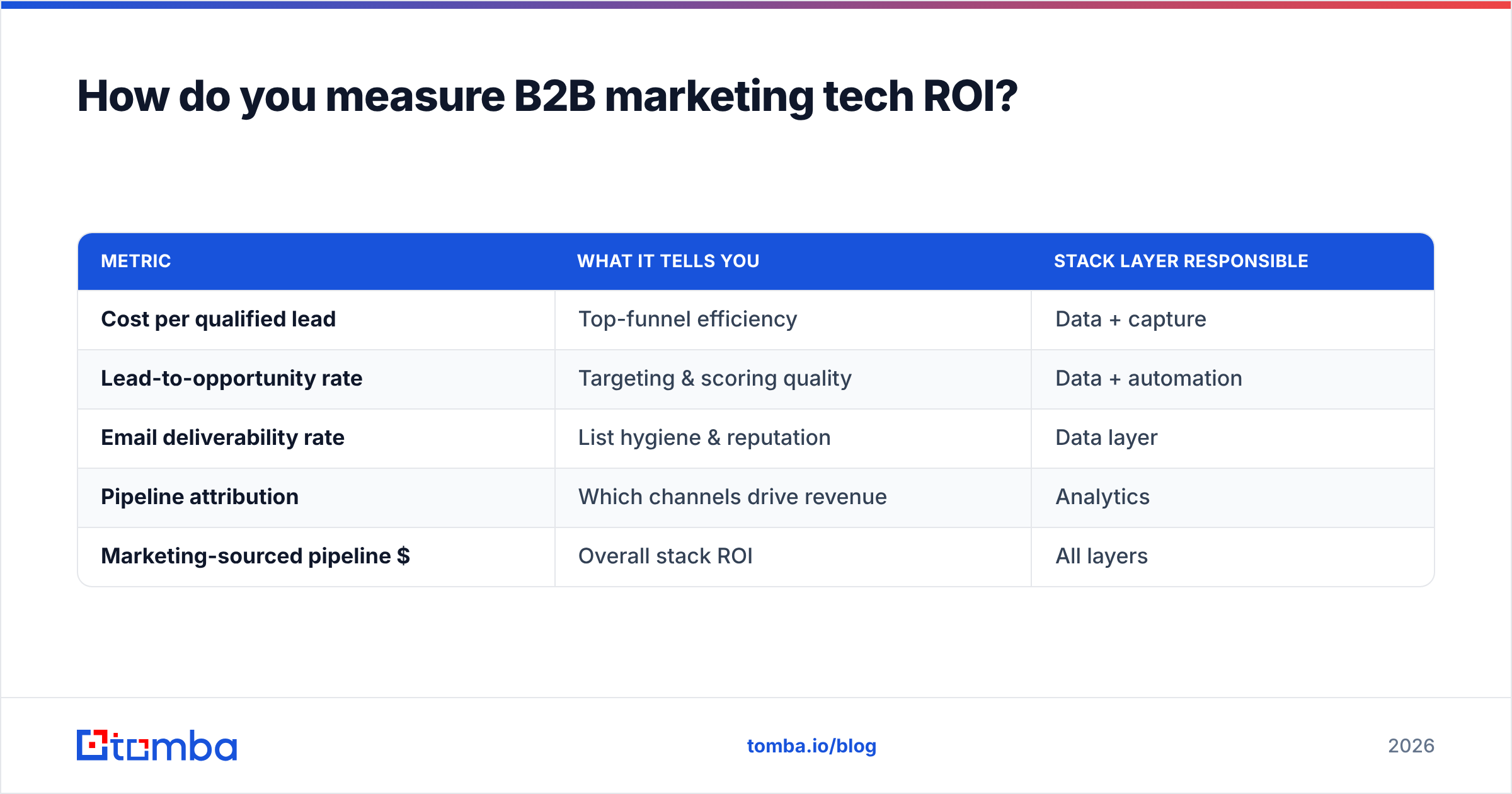
Tie every tool to a funnel metric it's supposed to move, then check whether it actually moved it. A martech stack should improve at least one of: pipeline volume, conversion rate between stages, cost per qualified lead, or sales cycle length. If a tool can't be connected to one of those, it's overhead.
| Metric | What it tells you | Stack layer responsible |
|---|---|---|
| Cost per qualified lead | Top-funnel efficiency | Data + capture |
| Lead-to-opportunity rate | Targeting & scoring quality | Data + automation |
| Email deliverability rate | List hygiene & reputation | Data layer |
| Pipeline attribution | Which channels drive revenue | Analytics |
| Marketing-sourced pipeline $ | Overall stack ROI | All layers |
The cleanest signal of a healthy stack is a low cost per qualified lead alongside a high lead-to-opportunity rate — it means you're reaching the right people with deliverable messages, and your scoring is honest. When those numbers slip, the cause is almost always upstream in the data layer, not the dashboard reporting on it. Track your response rate by data source and you'll quickly see which vendors are worth renewing.
Frequently asked questions#
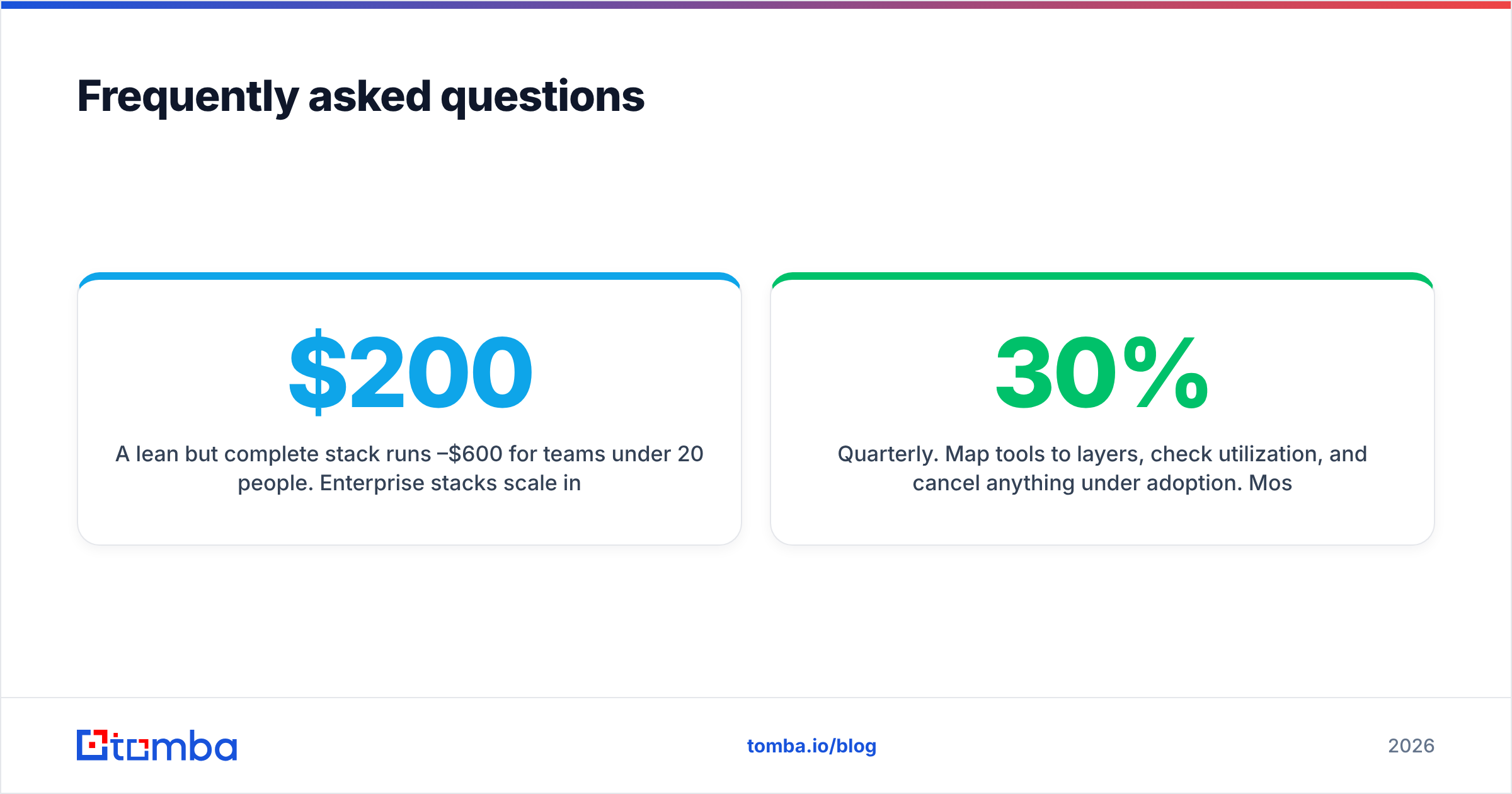
How much should a B2B marketing tech stack cost? A lean but complete stack runs $200–$600/month for teams under 20 people. Enterprise stacks scale into five and six figures, mostly driven by seat-based CRM and automation pricing. Spend proportionally — the data layer should be cheap and excellent.
What's the first tool I should buy? A reliable data and verification source. It feeds every other layer, and getting it right protects your deliverability from day one. You can run early outreach with a free CRM, but you can't run it with a dirty list.
Can I just use an all-in-one platform? You can, and it simplifies vendor management. The trade-off is flexibility and data ownership — when the all-in-one's data quality slips, you're stuck. Many teams pair a focused data layer with an all-in-one engagement platform to get both.
How often should I audit my stack? Quarterly. Map tools to layers, check utilization, and cancel anything under 30% adoption. Most teams find they can cut spend without losing capability.
Build your data layer first#
Your B2B marketing tech stack is only as good as the data flowing through it. Before you debate attribution models or AI agents, fix the foundation: verified, enriched, deliverable contact data feeding every layer above it. That's the unglamorous part that decides whether the rest of your stack earns its keep.
Start with the Tomba Email Finder — find professional email addresses by domain, name, or company, verify them before you send, and push them straight into your CRM via API, Sheets, or the Chrome extension. The Free tier gives you 25 searches a month to test it against your current data source; Starter ($49/mo) and Growth ($99/mo) scale with you. Get the data layer right, and every other tool in your stack starts pulling its weight.
Ready to find emails that actually work?
Join 150,000+ professionals who stopped guessing and started sending. Free credits on signup — no credit card required.
Get the Tomba newsletter
Practical outbound tactics and product updates — once every two weeks.
About the author