B2B Sales Enablement in 2026: A Complete Strategy Guide
Most B2B sales enablement programs fail because they bolt training onto bad data and call it a strategy. Here is how to build one that actually moves win rates in 2026.
TL;DR
- B2B sales enablement is the system of content, training, coaching, and data that lets reps sell more effectively — not a one-off onboarding deck or a tool you buy once.
- Most programs stall because they fund enablement content and training while ignoring the data layer underneath. A perfect pitch sent to a wrong email address still bounces.
- A working 2026 program has four pillars: enablement content, structured training and coaching, a connected tech stack, and clean prospect data feeding all of it.
- Measure enablement by ramp time, win rate, and content usage — not by how many assets you produced.
- Start with data accuracy, then layer process and content on top. Reps trust a program that puts them in front of real, reachable buyers.
What is B2B sales enablement?#
B2B sales enablement is the ongoing process of giving your sales team the content, training, coaching, technology, and data they need to engage buyers and close deals. Think of it like prepping a pit crew before a race: the driver is the rep, but the crew supplies the tuned car, the strategy, and the real-time information. Take any one of those away and the driver loses, no matter how talented they are.
Technically, enablement sits between marketing and sales. Marketing produces messaging and demand; sales executes deals; enablement translates between the two and equips reps to perform. In practice that means battlecards, call scripts, onboarding paths, deal coaching, and the systems that surface the right asset at the right moment.
The part teams under-invest in is the foundation: the contact data reps actually act on. You can run the best objection-handling workshop in the world, but if your reps are dialing disconnected numbers and emailing addresses that bounce, the program produces motion without results.
Why do most B2B sales enablement programs fail?#
The conclusion first: they fail because they treat enablement as a content factory instead of a performance system. Producing 200 slide decks feels productive. It rarely changes a single quota number.
Here are the failure patterns that show up again and again:
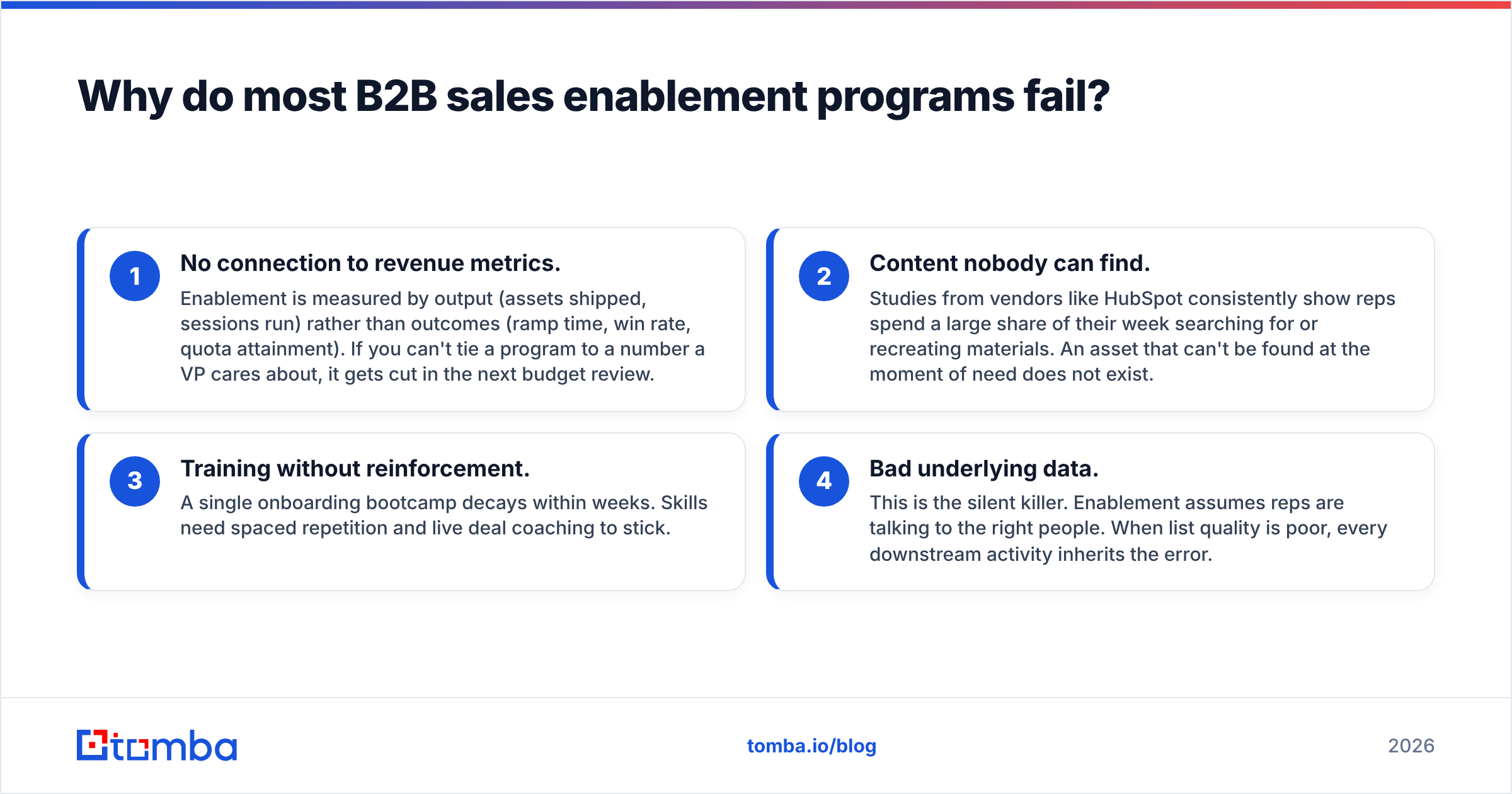
- No connection to revenue metrics. Enablement is measured by output (assets shipped, sessions run) rather than outcomes (ramp time, win rate, quota attainment). If you can't tie a program to a number a VP cares about, it gets cut in the next budget review.
- Content nobody can find. Studies from vendors like HubSpot consistently show reps spend a large share of their week searching for or recreating materials. An asset that can't be found at the moment of need does not exist.
- Training without reinforcement. A single onboarding bootcamp decays within weeks. Skills need spaced repetition and live deal coaching to stick.
- Bad underlying data. This is the silent killer. Enablement assumes reps are talking to the right people. When list quality is poor, every downstream activity inherits the error.
That last point is why a serious enablement strategy starts with the data layer. Clean, verified contact records make every other investment — content, coaching, automation — actually pay off.
What are the core pillars of a B2B sales enablement strategy?#
A complete program rests on four pillars. Skip any one and the structure wobbles.
- Enablement content. Battlecards, case studies, ROI calculators, email templates, and call scripts mapped to each buying stage. Content should be tagged by persona, industry, and funnel stage so reps surface it instantly.
- Training and coaching. Structured onboarding, ongoing skill development, and one-on-one deal coaching. The goal is shorter ramp time and consistent execution across the team, not a certificate on the wall.
- Technology stack. A CRM as the system of record, plus the layers that feed and act on it — engagement platforms, conversation intelligence, and the data enrichment tools that keep records current.
- Data and intelligence. Accurate firmographic and contact data is the fuel. This is where tools that find email addresses, verify them, and append phone numbers turn a target account list into a workable pipeline.
Notice the order. Content and training get the headlines, but data and technology determine whether any of it reaches a real human. A program that funds the first two and neglects the last two is the most common — and most expensive — mistake in the category.
How does sales enablement content actually drive deals?#
Content drives deals when it is mapped to buyer intent and delivered in context. A generic capabilities deck dropped into a shared drive does nothing. The same content, surfaced to a rep at the exact moment a prospect raises a pricing objection, closes gaps.
Map your content to the buying journey:
- Awareness: educational blog posts, industry benchmarks, problem-framing one-pagers.
- Consideration: comparison guides, case studies, and battlecards that position you against named competitors.
- Decision: ROI calculators, security and compliance documentation, reference customer intros, tailored proposals.
The operational trick is findability and feedback. Reps should locate any asset in seconds, and enablement should track which assets are used in won deals versus ignored. Kill the dead content. Double down on what correlates with revenue. According to analyst firms like Gartner, B2B buyers spend only a fraction of their time with sales reps during a purchase — so the content reps do deliver has to land.
What does a 2026 B2B sales enablement tech stack look like?#
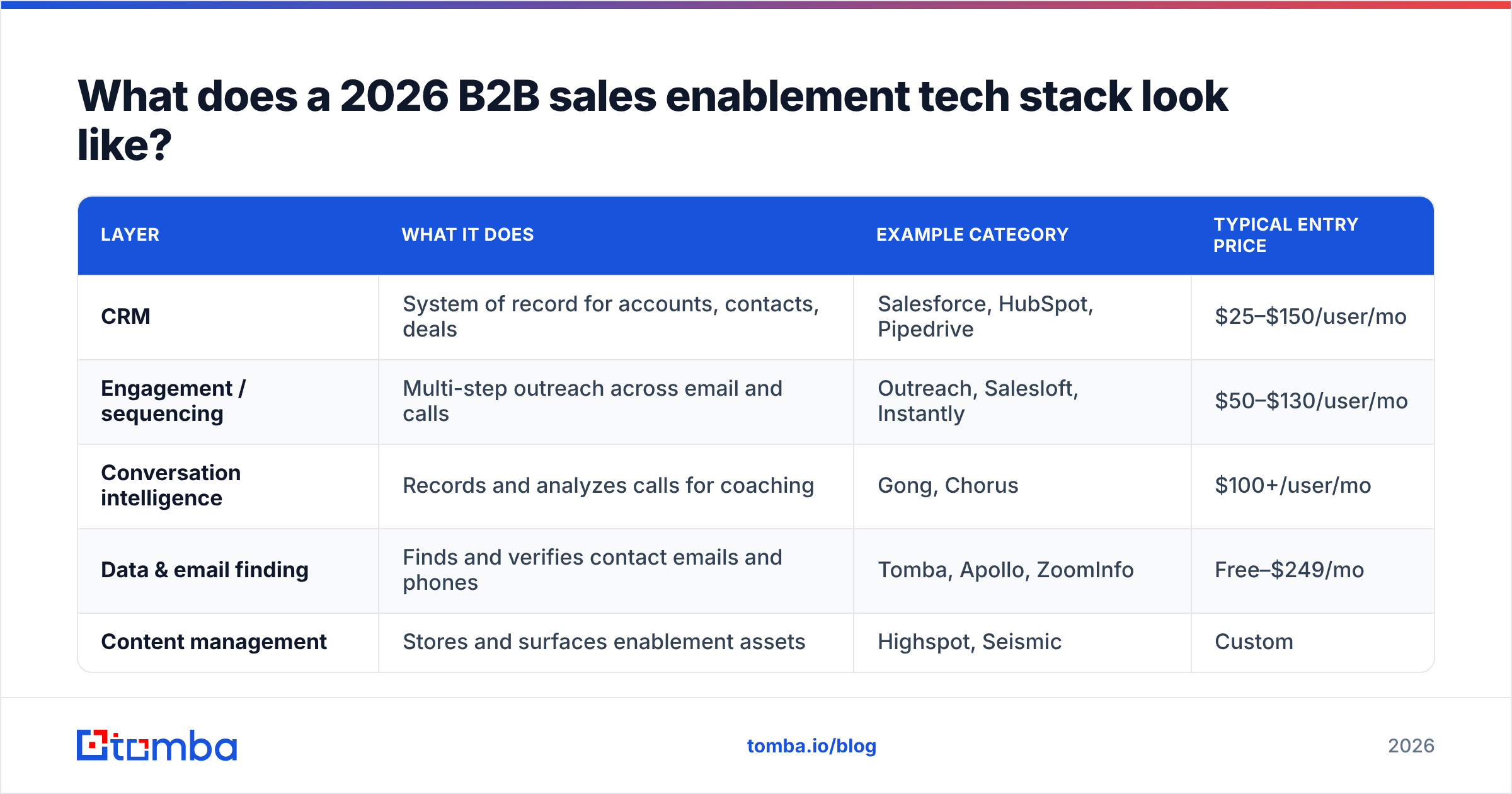
The 2026 stack is consolidating around a few layers. You don't need every category, but you need each function covered. Here is how the core layers compare on what they do and roughly what they cost.
| Layer | What it does | Example category | Typical entry price |
|---|---|---|---|
| CRM | System of record for accounts, contacts, deals | Salesforce, HubSpot, Pipedrive | $25–$150/user/mo |
| Engagement / sequencing | Multi-step outreach across email and calls | Outreach, Salesloft, Instantly | $50–$130/user/mo |
| Conversation intelligence | Records and analyzes calls for coaching | Gong, Chorus | $100+/user/mo |
| Data & email finding | Finds and verifies contact emails and phones | Tomba, Apollo, ZoomInfo | Free–$249/mo |
| Content management | Stores and surfaces enablement assets | Highspot, Seismic | Custom |
The data layer is where enablement programs get the most leverage for the least spend, because it improves the output of every other tool. Tomba pricing starts with a free tier of 25 searches per month, then Starter at $49/mo, Growth at $99/mo, and Pro at $249/mo — which makes it cheap to keep your CRM populated with verified, reachable contacts before reps ever start a sequence.
A note on consolidation: every tool you add is a tool reps must learn, log into, and trust. The discipline is fewer, better-integrated layers. A CRM, a sequencer, a data source, and a content hub will outperform a sprawling stack of fifteen half-adopted apps.
How do you measure B2B sales enablement success?#
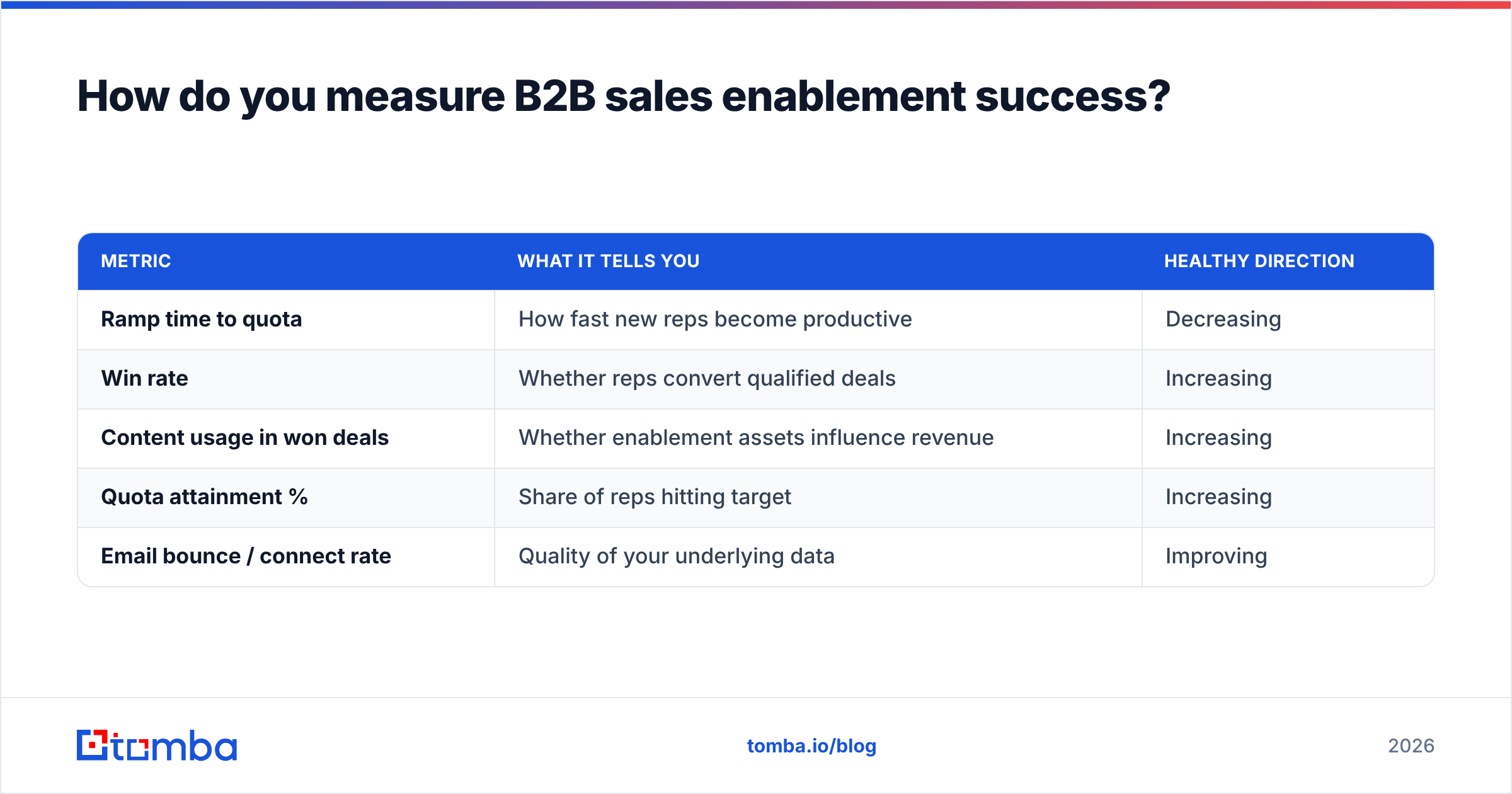
Measure outcomes, not activity. The metrics that survive scrutiny in a board meeting fall into three buckets.
| Metric | What it tells you | Healthy direction |
|---|---|---|
| Ramp time to quota | How fast new reps become productive | Decreasing |
| Win rate | Whether reps convert qualified deals | Increasing |
| Content usage in won deals | Whether enablement assets influence revenue | Increasing |
| Quota attainment % | Share of reps hitting target | Increasing |
| Email bounce / connect rate | Quality of your underlying data | Improving |
The last row matters more than teams expect. A high bounce rate or low connect rate is a flashing sign that your data layer — not your reps — is the bottleneck. Tracking the email response rate alongside bounce rate tells you whether the problem is the message or the list. Fix data quality and the downstream metrics move on their own.
Avoid vanity metrics: number of assets created, hours of training delivered, courses completed. They feel like progress and predict nothing. Tie every enablement initiative to one of the outcome metrics above before you fund it.
How does data quality underpin everything else?#
Here is the uncomfortable truth: enablement is only as good as the data reps act on. You can perfect messaging, coaching, and process, and still watch results flatline if the contact records are stale.
B2B data decays fast — people change jobs, companies rebrand, domains shift. A target list that was 95% accurate last year may be well below that today. That decay quietly poisons your enablement program: bounced emails hurt sender reputation, wasted dials kill rep morale, and skewed metrics lead to wrong conclusions about what's working.
The fix is to make data hygiene a continuous process, not a quarterly cleanup:
- Find verified emails with an email finder that returns a confidence score rather than a guess.
- Verify before you send so bounces never reach your sending domain — an email verifier catches dead addresses up front.
- Enrich records with current titles, company data, and phone numbers so reps personalize without manual research.
Compare this to competitor approaches. Many all-in-one platforms bundle data as a secondary feature and charge enterprise prices for it. A focused data tool like Tomba — or any Apollo alternative built around accuracy — keeps the foundation clean without forcing a six-figure contract. For teams evaluating options, the calculus is simple: pay a little to keep data fresh, or pay a lot in wasted rep hours and damaged deliverability.
How do you roll out a B2B sales enablement program?#
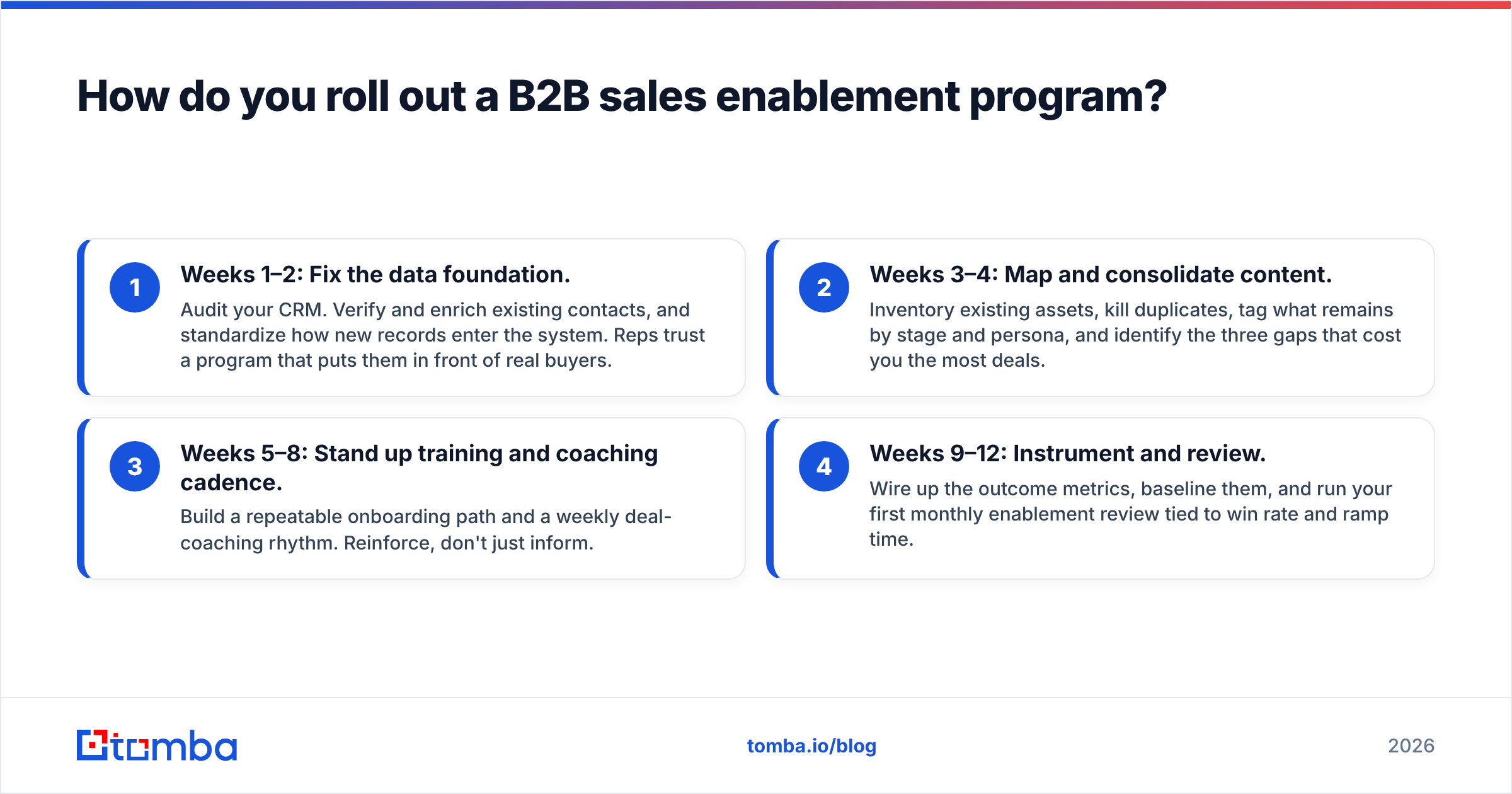
Start small and sequence it. A 90-day rollout beats a year-long platform implementation that never ships.
- Weeks 1–2: Fix the data foundation. Audit your CRM. Verify and enrich existing contacts, and standardize how new records enter the system. Reps trust a program that puts them in front of real buyers.
- Weeks 3–4: Map and consolidate content. Inventory existing assets, kill duplicates, tag what remains by stage and persona, and identify the three gaps that cost you the most deals.
- Weeks 5–8: Stand up training and coaching cadence. Build a repeatable onboarding path and a weekly deal-coaching rhythm. Reinforce, don't just inform.
- Weeks 9–12: Instrument and review. Wire up the outcome metrics, baseline them, and run your first monthly enablement review tied to win rate and ramp time.
Keep the scope tight. One persona, one product line, one region to start. Prove the model moves a number, then expand. Enablement that demonstrates a measurable lift in win rate earns the budget to scale; enablement that ships assets earns a line-item cut.
The bottom line on B2B sales enablement in 2026#
B2B sales enablement works when it is a performance system built on accurate data — not a content library or a training event. Get the four pillars right, measure outcomes instead of activity, and treat data quality as the foundation everything else stands on.
The cheapest, highest-leverage place to start is the data layer. Before you commission another battlecard or book another workshop, make sure your reps are actually reaching real, verified buyers. The Tomba Email Finder finds professional email addresses by name, domain, or company and returns a confidence score, so the contacts feeding your enablement program are reachable from day one. Start free with 25 searches a month, verify your existing list, and give your team a foundation worth building on.
// get started
Find, verify and enrich your first contacts today
Start on the free plan with 25 searches a month, then scale when your team is ready.
Free plan · No credit card required · GDPR & CCPA
// about the author