B2B Sales Management in 2026: The Complete Operating Playbook
B2B sales management in 2026 is part coaching, part data ops, part forecasting. Here is the operating playbook for building a team that hits quota predictably.
TL;DR
- B2B sales management in 2026 is three jobs in one: coaching people, running a data-clean pipeline, and forecasting revenue you can defend to the board.
- The managers who hit number consistently obsess over a small set of leading indicators, not just the closed-won total at quarter end.
- A modern stack — clean contact data, a disciplined CRM, and tight forecasting — beats raw headcount almost every time.
- Coaching cadence (weekly 1:1s, deal reviews, call reviews) is the single highest-leverage activity a manager controls.
- Bad data quietly taxes every other decision; fixing it at the top of the funnel pays back across the whole team.
What is B2B sales management?#
B2B sales management is the practice of running a team that sells to other businesses — hiring and coaching reps, designing the pipeline and process, setting quotas, forecasting revenue, and owning the tools that make all of it repeatable. Think of it like managing a restaurant kitchen: you are not personally plating every dish, but you own the recipes, the station layout, the timing, and whether the line cooks improve week over week.
The B2B part matters. Deals are larger, sales cycles are longer, multiple stakeholders sign off, and a single lost deal can swing a quarter. That changes the manager's job from "close more, faster" to "build a system that produces predictable revenue even when any single rep has a slow month."
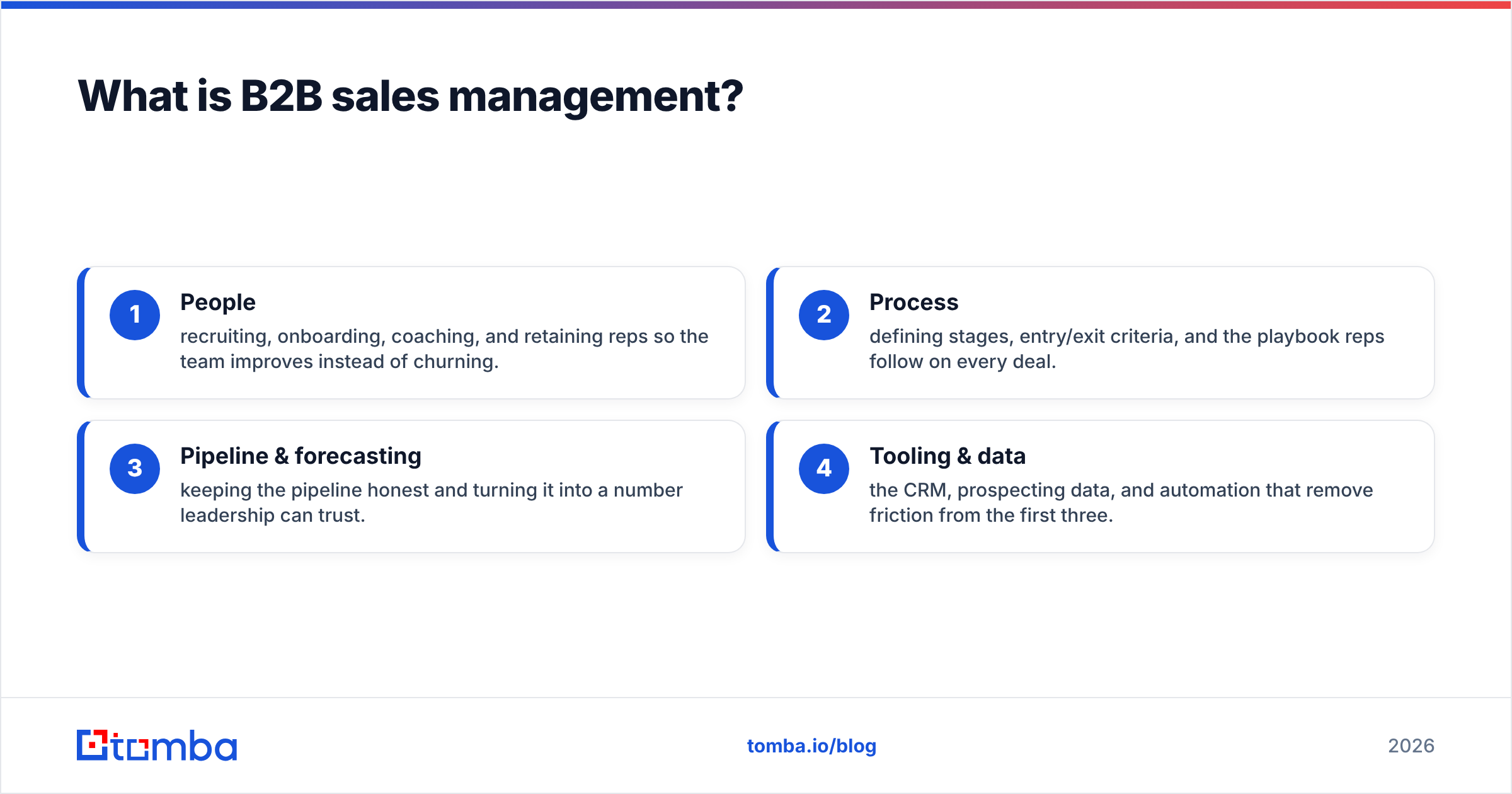
In practice, the role splits into four recurring responsibilities:
- People — recruiting, onboarding, coaching, and retaining reps so the team improves instead of churning.
- Process — defining stages, entry/exit criteria, and the playbook reps follow on every deal.
- Pipeline & forecasting — keeping the pipeline honest and turning it into a number leadership can trust.
- Tooling & data — the CRM, prospecting data, and automation that remove friction from the first three.

Wait — ignore that. Here is the meme:
How is B2B sales management different from B2C?#
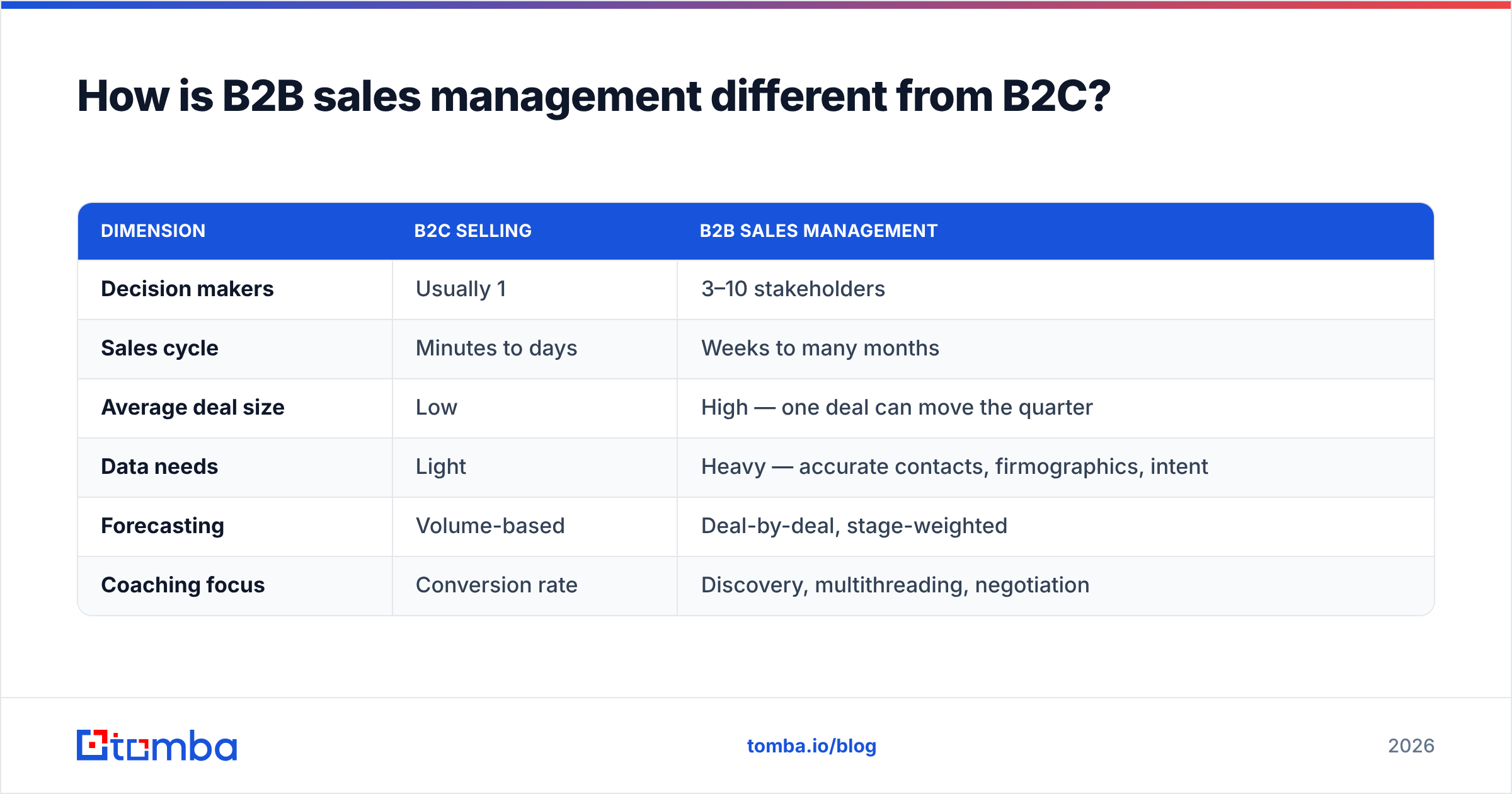
The core difference is the buying committee. In B2C, you persuade one person. In B2B, you persuade a group — an economic buyer, a technical evaluator, an end user, and often a procurement gatekeeper — each with different incentives. Your manager's job is to make sure reps map that committee on every deal instead of selling to a single friendly contact who can't actually sign.
| Dimension | B2C selling | B2B sales management |
|---|---|---|
| Decision makers | Usually 1 | 3–10 stakeholders |
| Sales cycle | Minutes to days | Weeks to many months |
| Average deal size | Low | High — one deal can move the quarter |
| Data needs | Light | Heavy — accurate contacts, firmographics, intent |
| Forecasting | Volume-based | Deal-by-deal, stage-weighted |
| Coaching focus | Conversion rate | Discovery, multithreading, negotiation |
Because each B2B deal is expensive to win, the manager's leverage shifts toward quality: better targeting, better discovery, and better multithreading. A team that books 30 well-qualified meetings with the right accounts will usually out-earn a team that blasts 300 cold contacts at the wrong ones. That is why clean targeting data — verified B2B database records and accurate contacts — is a management concern, not just a rep's chore.
What metrics should a B2B sales manager track?#
Track leading indicators you can change this week, not just lagging outcomes you can only explain after the fact. Closed-won revenue tells you what already happened. Pipeline coverage, conversion by stage, and activity quality tell you what is about to happen — while you still have time to act.
A focused dashboard beats a sprawling one. Here are the metrics that consistently earn their place:
- Pipeline coverage — open pipeline divided by quota for the period. Below ~3x and you likely miss; this is your earliest warning.
- Stage conversion rates — the percentage of deals that move from each stage to the next. A sudden drop pinpoints where deals stall.
- Average sales cycle length — creeping longer means qualification or multithreading is slipping.
- Win rate — closed-won divided by all closed deals. Track it by segment to find where you actually compete well. (See the win rate definition for nuance.)
- Activity quality, not just volume — meetings booked with verified decision-makers beats raw dials. Volume without targeting is noise.
- Ramp time — how long new reps take to hit full quota. This predicts whether you can scale headcount profitably.
The trap is vanity metrics. "We sent 10,000 emails" feels productive, but if half bounced because the list was stale, you damaged sender reputation and reached nobody. Tie every activity metric back to a downstream outcome, and audit the data feeding it.
How do you build a repeatable B2B sales process?#
Define stages by buyer behavior, not by rep optimism. A deal isn't in "Negotiation" because a rep feels good about it — it's there because the buyer has confirmed budget and is reviewing terms. When stages have objective entry and exit criteria, your pipeline stops lying to you and your forecast gets trustworthy.
A clean B2B process usually looks like this:
- Prospecting — identify and reach target accounts. Exit criteria: a verified contact responds and agrees to a conversation.
- Discovery — map the problem, stakeholders, and timeline. Exit: you can name the economic buyer and the compelling event.
- Evaluation — demo, proof, technical validation. Exit: the buyer confirms you meet their must-haves.
- Proposal & negotiation — pricing and terms. Exit: verbal yes, paper in motion.
- Closed-won / closed-lost — and a real reason captured either way.
Two things make this repeatable. First, written exit criteria so every rep grades deals the same way. Second, clean inputs at the top — if prospecting starts with bad emails and wrong titles, every later stage inherits the rot. This is where a tool like the Tomba Email Finder and an email verifier earn their keep: reps spend time selling to real people instead of chasing bounces. Pairing that with your HubSpot integration or Salesforce integration keeps the CRM the single source of truth.
How should B2B sales managers coach reps?#
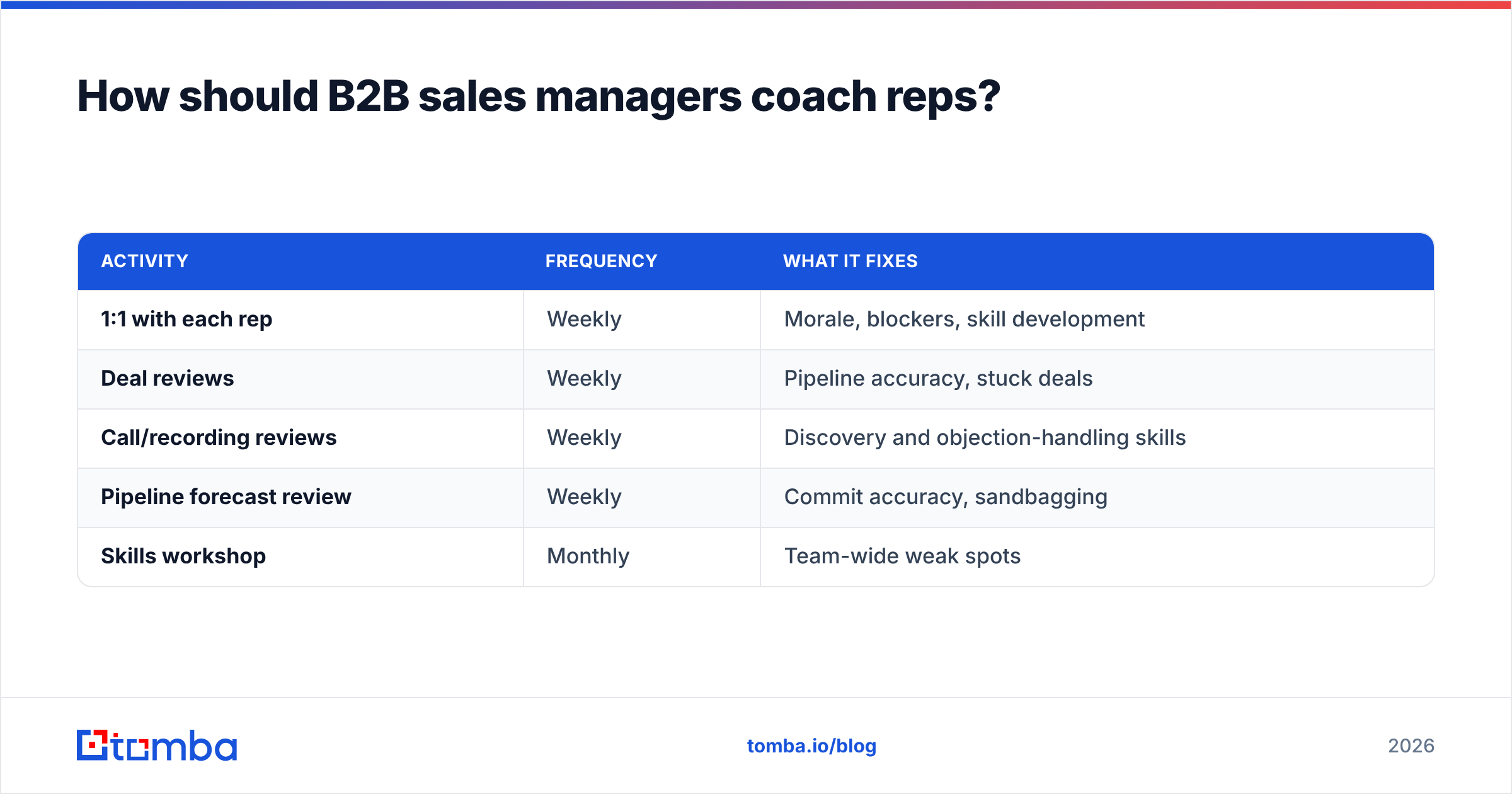
Coaching is the highest-leverage thing a manager does, and it has to be a cadence, not a vibe. A great quarterly off-site won't fix a rep who's mishandling discovery every single week. The managers who develop talent fastest run a predictable rhythm and coach to specific, observable skills.
A practical weekly cadence:
| Activity | Frequency | What it fixes |
|---|---|---|
| 1:1 with each rep | Weekly | Morale, blockers, skill development |
| Deal reviews | Weekly | Pipeline accuracy, stuck deals |
| Call/recording reviews | Weekly | Discovery and objection-handling skills |
| Pipeline forecast review | Weekly | Commit accuracy, sandbagging |
| Skills workshop | Monthly | Team-wide weak spots |
The mistake is coaching only the deals, never the skills. If a rep loses three deals at the negotiation stage, telling them "close harder" does nothing. Reviewing the actual call recordings, finding where they conceded on price without trading for anything, and role-playing the next one — that changes behavior. Coach the input (the rep's behavior on a call), and the output (win rate) follows. For more structured outreach skills, point reps at proven cold email templates and LinkedIn outreach habits they can reuse.
Industry research backs the cadence over heroics. Sales-effectiveness studies from firms like Gartner consistently find that consistent manager coaching, not raw talent, separates the teams that hit quota from the ones that don't.
How do you forecast B2B revenue accurately?#
Forecast by weighting deals by stage and inspecting the assumptions, not by averaging rep optimism. A forecast is a promise to the business, so it has to survive scrutiny. The two failure modes are sandbagging (reps lowball to look good when they beat it) and happy ears (reps commit deals that have no real timeline). Both come from a pipeline that isn't graded against objective criteria.
Three layers make a forecast defensible:
- Stage-weighted pipeline — assign a historical conversion probability to each stage and sum the weighted values. This is your math-based baseline.
- Rep commit — what each rep will personally stand behind. Compare it to the weighted number and interrogate the gap.
- Manager judgment — adjust for known risk (a champion just left, procurement is slow in Q4) using documented reasons, not gut feel.
The data quality underneath all of this is what most teams underestimate. If 20% of your "contacted" accounts have wrong or unreachable contacts, your top-of-funnel numbers are inflated and the error compounds down the funnel. Keeping records fresh with ongoing data enrichment and routine bulk verify runs is unglamorous, but it's the difference between a forecast you defend and one you apologize for. Strong revenue operations practices exist largely to protect this layer.
What does the modern B2B sales tech stack look like?#
The stack should remove friction from prospecting, keep the CRM honest, and surface coaching moments — not add dashboards nobody opens. A bloated stack is its own tax: reps waste time switching tools and data fragments across systems. Start from the workflow and add tools only where they remove real friction.
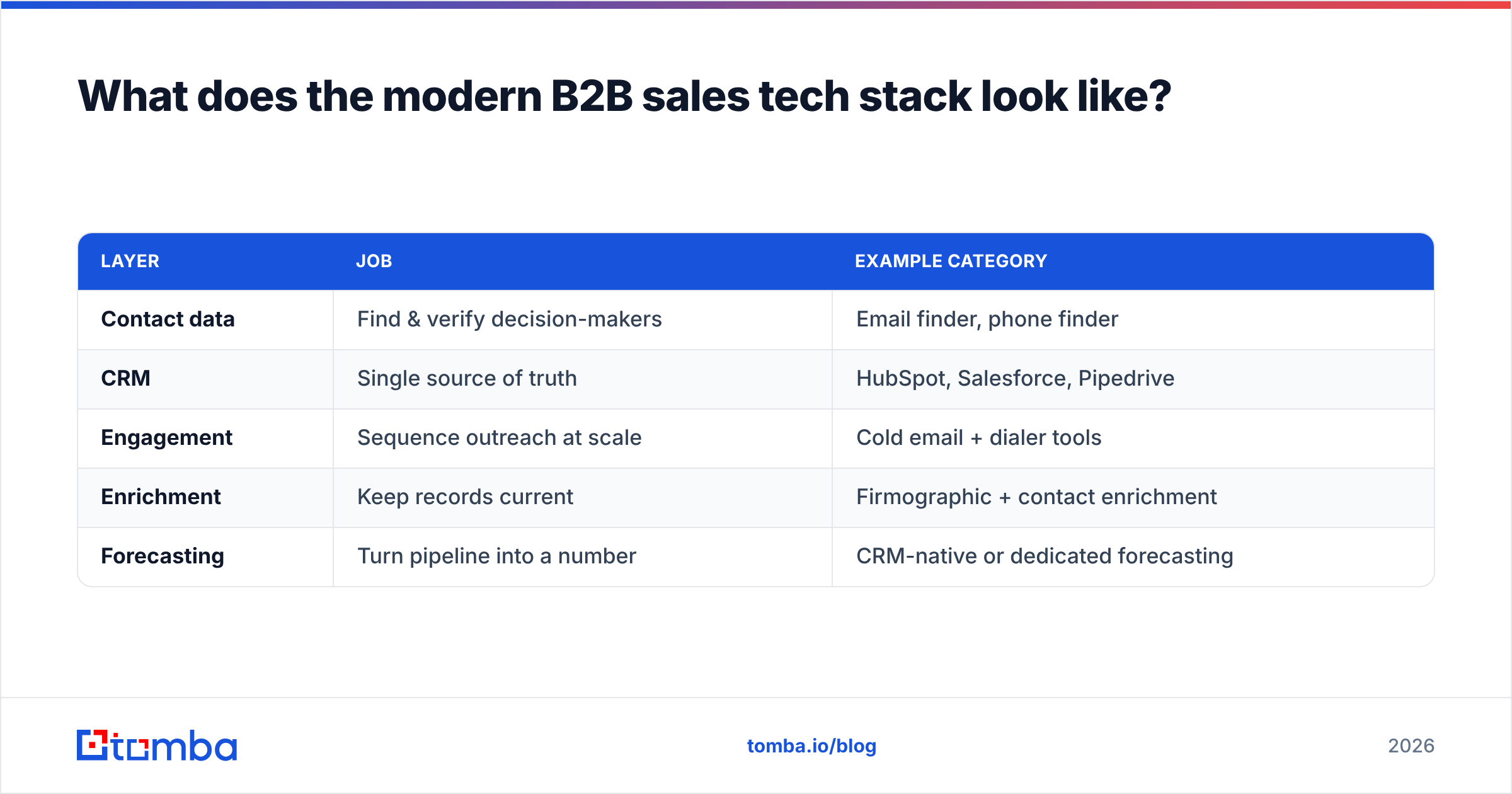
A lean, effective 2026 stack covers five layers:
| Layer | Job | Example category |
|---|---|---|
| Contact data | Find & verify decision-makers | Email finder, phone finder |
| CRM | Single source of truth | HubSpot, Salesforce, Pipedrive |
| Engagement | Sequence outreach at scale | Cold email + dialer tools |
| Enrichment | Keep records current | Firmographic + contact enrichment |
| Forecasting | Turn pipeline into a number | CRM-native or dedicated forecasting |
Data is the foundation, and it's the layer teams most often get wrong. Compare the real cost: a rep paid for selling time who spends a third of the week hunting for and guessing email addresses is expensive guesswork. A focused tool that returns verified contacts — by name, company, or domain search — pays for itself in recovered selling hours. You can review Tomba pricing against that math: the Free tier covers 25 searches a month, Starter is $49/mo, Growth $99/mo, and Pro $249/mo, which is a rounding error against one rep's loaded cost.
Before you add yet another tool, pressure-test it against vendor-neutral reviews on G2 or Capterra. The best stack is the smallest one that lets reps spend the most time in front of qualified buyers.
What mistakes derail B2B sales managers?#
The recurring failures are predictable, which is good news — you can design around them. Most struggling teams aren't short on effort; they're leaking value in a few specific places.
- Managing the number, not the inputs. Staring at the quota total changes nothing. Coaching the weekly behaviors that produce it does.
- Tolerating dirty data. Stale lists, duplicate records, and unverified emails quietly inflate activity metrics and wreck deliverability. Run periodic cleanups and remove duplicates before they spread.
- Inconsistent process. When every rep grades deals differently, the pipeline becomes fiction and the forecast follows.
- Coaching deals instead of skills. Saving one deal is worth less than fixing the skill that loses ten.
- Over-tooling. More software is not more productivity. Each tool must remove friction or it adds it.
- No ramp plan. Hiring without a structured onboarding means long, expensive ramps and high early churn.
Fix these in order of leverage: data and process first (they affect everyone), then coaching cadence, then tooling. A manager who gets the first two right rarely needs heroics from the third.
Putting it together#
Strong B2B sales management is a system, not a personality. Define stages by buyer behavior, coach to observable skills on a weekly cadence, forecast off a pipeline you've graded honestly, and feed the whole machine with clean, verified data. Do those four things consistently and the quarter-end number stops being a surprise.
If your team is losing selling hours to bad contacts and bounced outreach, start at the foundation. The Tomba Email Finder gives reps verified, ready-to-use emails by name, company, or domain — and it plugs straight into your CRM so the data stays clean where it matters. Try it on the free tier, point it at your top target accounts, and measure the recovered hours. That's the kind of input improvement that shows up in next quarter's forecast.
// get started
Find, verify and enrich your first contacts today
Start on the free plan with 25 searches a month, then scale when your team is ready.
Free plan · No credit card required · GDPR & CCPA
// about the author