9 Best Email APIs in 2026: Sending, Verifying & Finding
A neutral, developer-first breakdown of the best email APIs in 2026 — transactional sending, verification, and email-finding — with pricing, deliverability, and real trade-offs compared side by side.

"Email API" is one of the most overloaded terms in B2B software. Ask three engineers what it means and you will get three answers: one is thinking about sending transactional mail, one is thinking about validating addresses before they bounce, and one is thinking about programmatically discovering who to email in the first place. All three are "email APIs," and the best stack usually uses one from each bucket.
This guide compares the best email APIs in 2026 across those three jobs, with concrete pricing, deliverability notes, and the trade-offs that actually matter when you wire them into production.
TL;DR#
- There is no single "best" email API — there are three jobs (send, verify, find) and the winners differ for each.
- For transactional sending, Postmark and Amazon SES lead on speed and price; SendGrid and Resend lead on developer experience.
- For verification, look for catch-all detection, SMTP checks, and sub-second response times — not just syntax validation.
- For finding contacts, the Tomba API covers email finder, domain search, and enrichment behind one key.
- Budget realistically: a real outbound or product stack usually pays for two APIs (sending + data), not one.
What is an email API, really?#
An email API is a programmatic interface (usually REST or SDK) that lets your code do something with email without a human in the loop. Think of it like a kitchen with three specialist stations: the line cook sends out finished plates (transactional sending), the quality inspector checks every ingredient before it goes out (verification), and the sourcing manager finds new suppliers (email finding and enrichment).
Technically, the three categories expose very different endpoints and bill very differently:
- Transactional / marketing sending APIs —
POST /sendwith a payload (to, from, subject, body). Billed per email sent. Examples: SendGrid, Postmark, Amazon SES, Resend, Mailgun. - Verification APIs —
GET /verify?email=returns deliverable / risky / invalid plus signals like catch-all and disposable. Billed per check. Examples: Tomba, ZeroBounce, NeverBounce. - Email finder / data APIs —
GET /email-finder?domain=&name=returns a discovered address with a confidence score and sources. Billed per credit/lookup. Examples: Tomba, Hunter, Apollo.
Most teams conflate these because the word "email" sits in all of them. Keep them separate in your head and the buying decision gets much easier.
What makes an email API "the best"?#
Ignore the marketing copy and grade every email API on the same five axes:
- Reliability & latency — p95 response time, documented uptime SLA, and whether the API degrades gracefully under load.
- Deliverability or accuracy — for senders, inbox placement and reputation tooling; for finders/verifiers, the false-positive rate on real addresses.
- Pricing model — per-email, per-credit, or per-seat, plus whether there is a usable free tier for testing.
- Developer experience — SDK quality, clear docs, webhooks, sandbox keys, and predictable error codes.
- Compliance — GDPR posture, data residency, and how the vendor sources data (critical for finder APIs).
A tool can win one axis and lose another. Amazon SES is unbeatable on price but ships almost no UX; Postmark costs more per email but gives you the cleanest analytics in the category. Name your priority before you compare.
Which are the best email APIs in 2026?#
Here is a side-by-side of nine widely used email APIs grouped by job. Prices are entry-level published rates and move over time — treat them as direction, not gospel, and confirm on each vendor's pricing page.
| API | Primary job | Entry price | Free tier | Best for |
|---|---|---|---|---|
| Amazon SES | Sending | ~$0.10 / 1k emails | Limited (in-AWS) | High-volume, cost-sensitive sending |
| Postmark | Sending | ~$15/mo (10k) | 100 test emails | Transactional speed + analytics |
| SendGrid | Sending | $19.95/mo | 100/day | All-in-one marketing + transactional |
| Resend | Sending | $20/mo | 3k/mo | Modern DX, React email templates |
| Mailgun | Sending | $15/mo | Trial only | EU routing, validation add-on |
| Tomba | Find + verify | $49/mo (Starter) | 25 searches/mo | Email finder + verification API |
| Hunter | Find + verify | $34/mo | 25/mo | Lightweight domain search |
| ZeroBounce | Verify | Pay-as-you-go | 100 credits | Bulk list cleaning |
| Apollo | Find + data | $49/mo | Limited | Prospecting + CRM data |
The pattern is clear: sending APIs and data APIs are not competitors. A typical outbound or SaaS team pairs one sending API with one finder/verification API. For the data side, compare Tomba pricing against Hunter and Apollo on credits-per-dollar and accuracy, not just headline price.
Which is the best email API for sending?#
For pure transactional sending, Postmark and Amazon SES are the two endpoints I reach for first, for opposite reasons.
Postmark is the choice when delivery speed and visibility matter more than cost. Separate message streams keep your password-reset emails away from your newsletters, time-to-inbox is consistently fast, and the activity dashboard tells you exactly why something bounced. You pay a premium per email, but you spend almost no engineering time debugging deliverability.
Amazon SES wins on raw economics — roughly ten cents per thousand emails. The trade-off is that you assemble the rest yourself: bounce handling via SNS, your own templates, your own analytics. If you already live in AWS and have the engineering bandwidth, nothing is cheaper at scale.
SendGrid and Resend sit in the middle. SendGrid bundles marketing campaigns, templates, and transactional sending under one roof, which is convenient but heavier. Resend has won developer affection with a clean modern SDK and first-class React email components — a great fit for product teams shipping fast.
Whichever you pick, deliverability is a function of your domain setup, not just the vendor. Get your authentication right before you blame the API: validate your records with an SPF checker and keep an eye on sender reputation, because the best sending API in the world cannot rescue a misconfigured domain.

Which is the best email API for verification?#
Verification APIs exist to answer one question before you hit send: will this address bounce? Bounces wreck email deliverability by dragging down your sender reputation, so cleaning addresses at the point of capture (signup forms, imports, API ingest) is one of the highest-ROI integrations you can ship.
A serious verification API does more than regex the syntax. Grade them on:
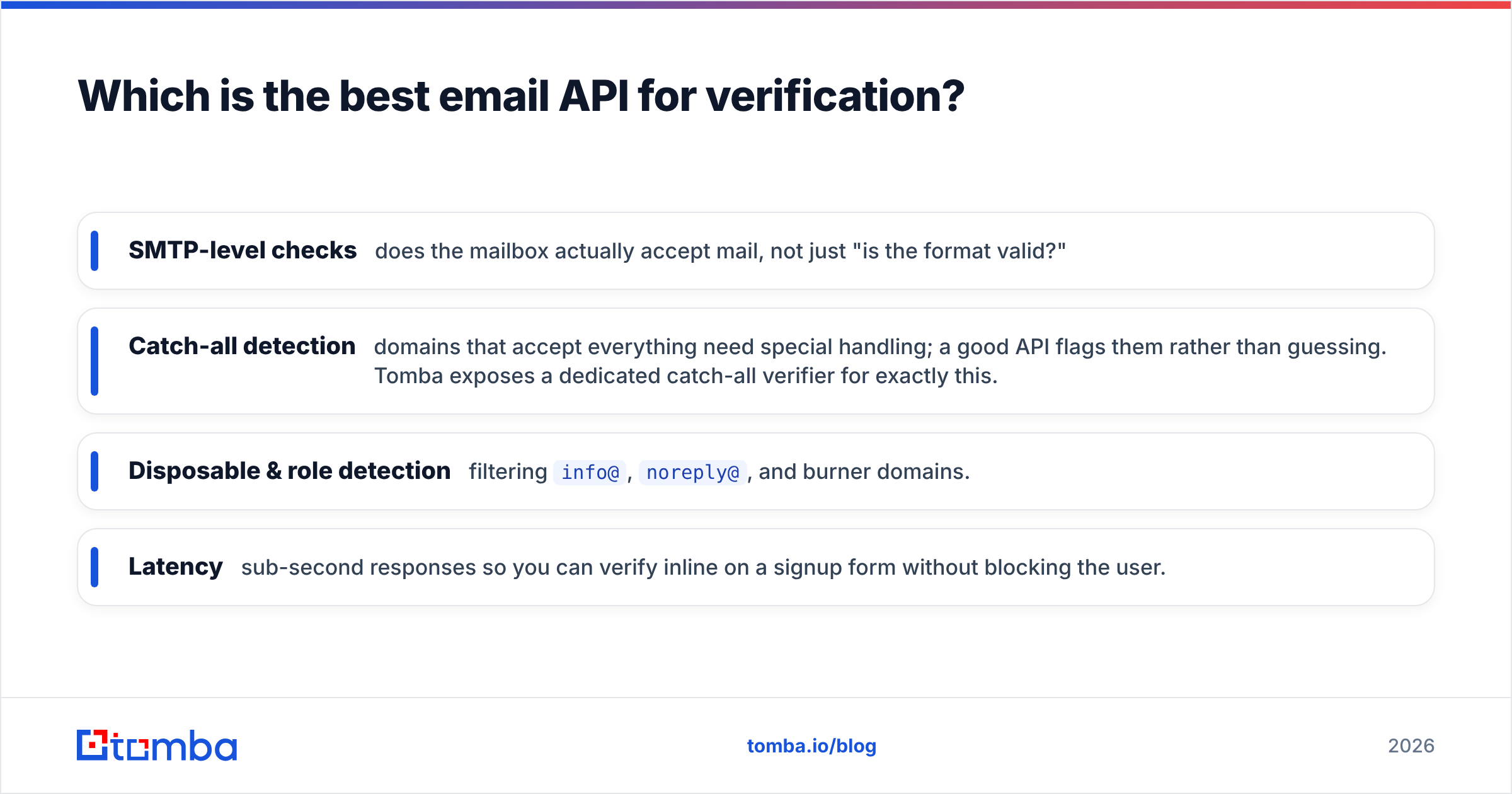
- SMTP-level checks — does the mailbox actually accept mail, not just "is the format valid?"
- Catch-all detection — domains that accept everything need special handling; a good API flags them rather than guessing. Tomba exposes a dedicated catch-all verifier for exactly this.
- Disposable & role detection — filtering
info@,noreply@, and burner domains. - Latency — sub-second responses so you can verify inline on a signup form without blocking the user.
The Tomba email verification API returns deliverability status plus catch-all and disposable signals in a single call, and shares the same key as the finder endpoints — so you can find and verify in one pipeline instead of stitching two vendors together. ZeroBounce and NeverBounce are strong dedicated alternatives, especially for one-off bulk list cleaning, but they do not find addresses, so you end up paying two bills.
Which is the best email API for finding contacts?#
This is the category most "best email API" roundups forget — and it is where Tomba is purpose-built. A finder API turns what you know (a domain, a company, a person's name) into a verified, reachable email address with a confidence score and source citations.
The core endpoints in a good finder API:
- Email finder — name + domain in, verified email out, with confidence scoring.
- Domain search — give it a company domain, get back the known email pattern and every public address.
- Enrichment — hydrate a thin lead (just an email or company) into a full contact record for your CRM.
Tomba covers all three behind one REST API plus official SDKs, a CLI, and an MCP server for AI agents. The published accuracy and source transparency matter here: unlike a sending API where a "wrong" result just bounces, a finder API that hallucinates addresses quietly poisons your whole funnel. Tomba documents where its data comes from, which is the right thing to scrutinize before you trust any data vendor. Compare it head-to-head against Hunter and the broader prospecting platforms — see how the data stacks up as an Apollo alternative if you want enrichment plus finding under one key.
How do you choose between them?#
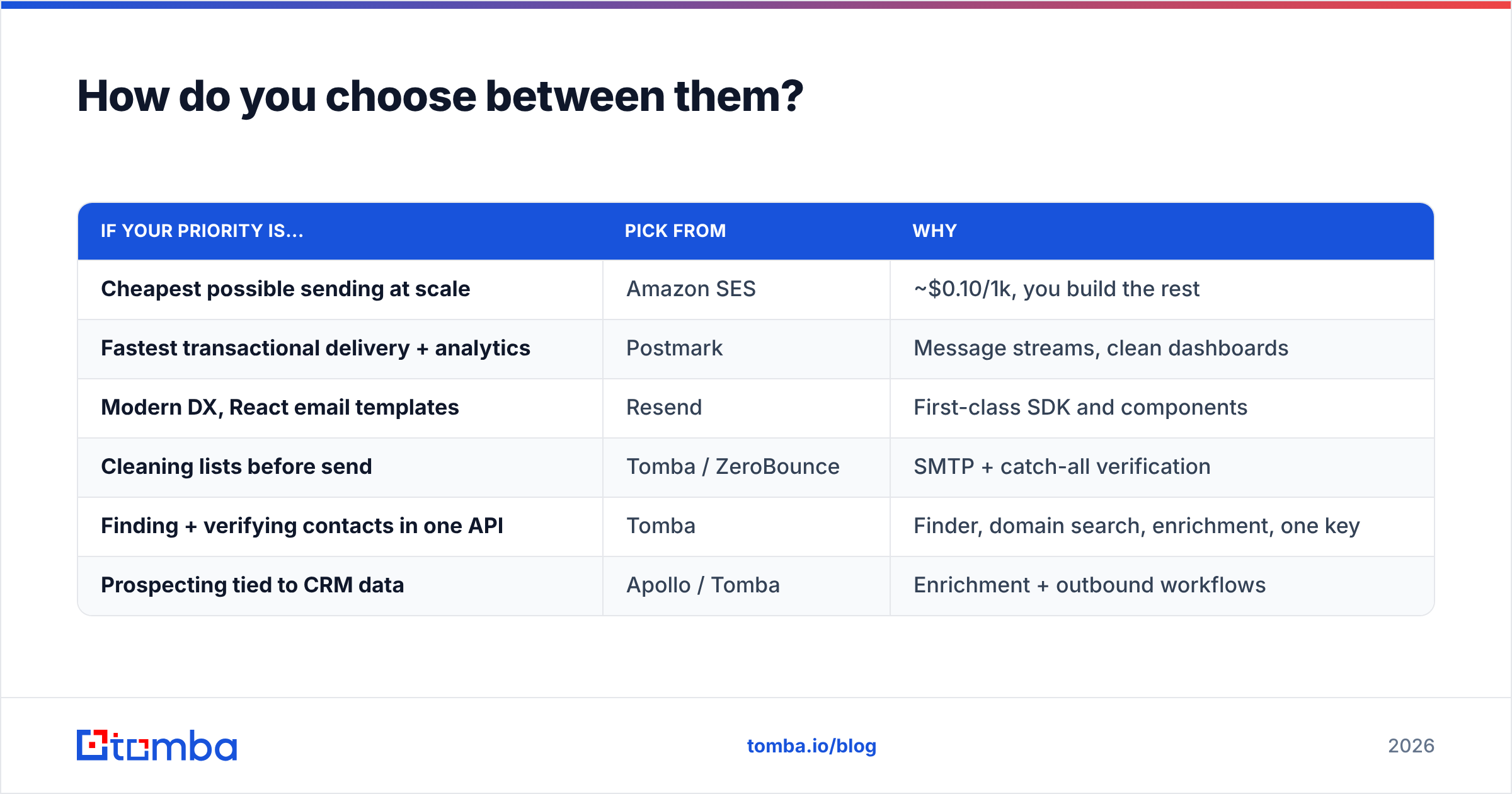
Match the API to the job, then to your constraints. Use this quick decision frame:
| If your priority is... | Pick from | Why |
|---|---|---|
| Cheapest possible sending at scale | Amazon SES | ~$0.10/1k, you build the rest |
| Fastest transactional delivery + analytics | Postmark | Message streams, clean dashboards |
| Modern DX, React email templates | Resend | First-class SDK and components |
| Cleaning lists before send | Tomba / ZeroBounce | SMTP + catch-all verification |
| Finding + verifying contacts in one API | Tomba | Finder, domain search, enrichment, one key |
| Prospecting tied to CRM data | Apollo / Tomba | Enrichment + outbound workflows |
Two practical rules close it out. First, never confuse a sending API with a data API — you almost certainly need both, and budgeting for one while forgetting the other is the most common stack mistake. Second, test on your own data before you commit. Free tiers exist for this: Tomba's free plan gives you 25 searches a month, SendGrid offers 100 emails a day, and Postmark gives 100 test sends. Run your real addresses and domains through each and measure the false-positive rate yourself instead of trusting a vendor's published number.
For a deeper buyer's reference on the data side, G2's grid is a reasonable starting point for verified reviews across the email-finder and verification categories — just weight reviews from companies your size.
Frequently asked questions#
Is one email API enough for a full stack? Rarely. Sending and data are different jobs with different billing. Most production stacks pair a sending API (Postmark, SES) with a finder/verification API like Tomba.
What is the difference between an email finder and an email verifier? A finder discovers an address you do not have; a verifier confirms an address you already have will not bounce. Tomba offers both, which is why teams use it to find and validate in a single pipeline.
Do email APIs handle compliance for me? Partially. Sending APIs help with unsubscribe and authentication; data APIs should document GDPR posture and sourcing. You still own consent and suppression logic on your side.
How much should I budget? For a small outbound team: roughly $15–$50/mo for sending plus $34–$99/mo for data. Scale both with volume.
The bottom line#
The best email API in 2026 depends entirely on which of the three jobs you are solving — and a healthy stack usually buys two: one to send, one to find and verify. Lock down deliverability on the sending side, then make sure every address entering your funnel is real and reachable on the data side.
If the data side is your gap, start with the Tomba Email Finder and its API. One key gives you email finding, domain search, catch-all verification, and enrichment, with a free tier to test against your own list before you spend a credit. Wire it in front of your sending API and you stop paying — in bounces and reputation — for addresses that were never going to land. Grab a free key, run 25 searches, and see the accuracy on your own data.
// get started
Find, verify and enrich your first contacts today
Start on the free plan with 25 searches a month, then scale when your team is ready.
Free plan · No credit card required · GDPR & CCPA
// about the author