Biotechnology Email Outreach in 2026: A Practical Playbook
Selling into biotech means reaching PhDs, regulatory gatekeepers, and procurement teams who delete generic pitches. Here's how to run biotechnology email outreach that actually books meetings in 2026.
Selling into biotechnology is not like selling into SaaS. Your buyers hold PhDs, your claims get fact-checked against published literature, and a single sloppy email can quietly burn a brand inside a tight scientific community. Yet email is still the channel that books the meeting — if you run it with the precision the audience expects.
This guide breaks down how to run biotechnology email outreach in 2026: who you're actually emailing, how to find and verify their addresses, how to write something a scientist won't delete, and how to measure whether any of it is working.
TL;DR#
- Biotech buyers are segmented and skeptical. Bench scientists, principal investigators, procurement, and regulatory/quality leads each need a different message — one generic email reaches none of them.
- Data quality beats volume. A list of 200 verified, role-matched contacts outperforms 5,000 scraped guesses, especially when academic and corporate domains mix.
- Credibility is the conversion lever. Cite specifics — assay, throughput, compliance standard, peer-reviewed result — not adjectives like "innovative" or "cutting-edge."
- Deliverability is non-negotiable. Verify addresses, warm the domain, and authenticate with SPF/DKIM/DMARC before you scale.
- Tooling that fits: use a real email finder and verifier to build clean lists, then track replies by segment rather than raw open rates.
Who are you actually emailing in biotech?#
The fastest way to waste a biotech campaign is to treat "biotech" as one persona. In reality you're selling reagents, instruments, software, CRO services, or consumables to several very different humans who happen to share a building.
Here's how the core buyer types differ, and what each one cares about:
- Bench scientists / research associates — They run the experiments and influence which tools get bought. They respond to technical specificity: protocols, compatibility, throughput, and whether your product saves them a tedious step.
- Principal investigators (PIs) / lab heads — They control budgets and grants. They care about validity, citations, and whether your solution helps them publish or hit a milestone.
- Procurement & lab operations — They optimize cost, vendor consolidation, and lead times. Pricing transparency and supply reliability matter more than novelty.
- Regulatory, quality & manufacturing (GxP) leads — In clinical-stage and commercial biotech, these gatekeepers care about compliance (FDA, GMP, ISO), validation documentation, and audit trails.
- Executive / BD (CSO, VP R&D, business development) — They think in pipeline, partnerships, and platform fit. Reach them with strategic outcomes, not feature lists.
If your email doesn't obviously belong to one of these inboxes, it reads as spam. Segment first; write second.
How is biotech email outreach different from generic B2B?#
Three structural differences change how you build campaigns.
Mixed domain types. Your prospects live on corporate domains (genentech.com), academic domains (stanford.edu), and hospital/institute domains — often the same person across two affiliations. Email patterns vary wildly, and academic addresses are more likely to be role-based or catch-all. You need verification that handles catch-all email domains gracefully instead of guessing.
Longer, evidence-driven sales cycles. A reagent might sell in a week; an instrument or platform deal can take 9–18 months and involve grant timing. Your sequence has to nurture, not just pitch once and quit.
Reputation travels fast. Scientific niches are small and well-connected. A spammy blast to one institute gets discussed on Slack channels, subreddits, and at conferences. Precision protects your brand.
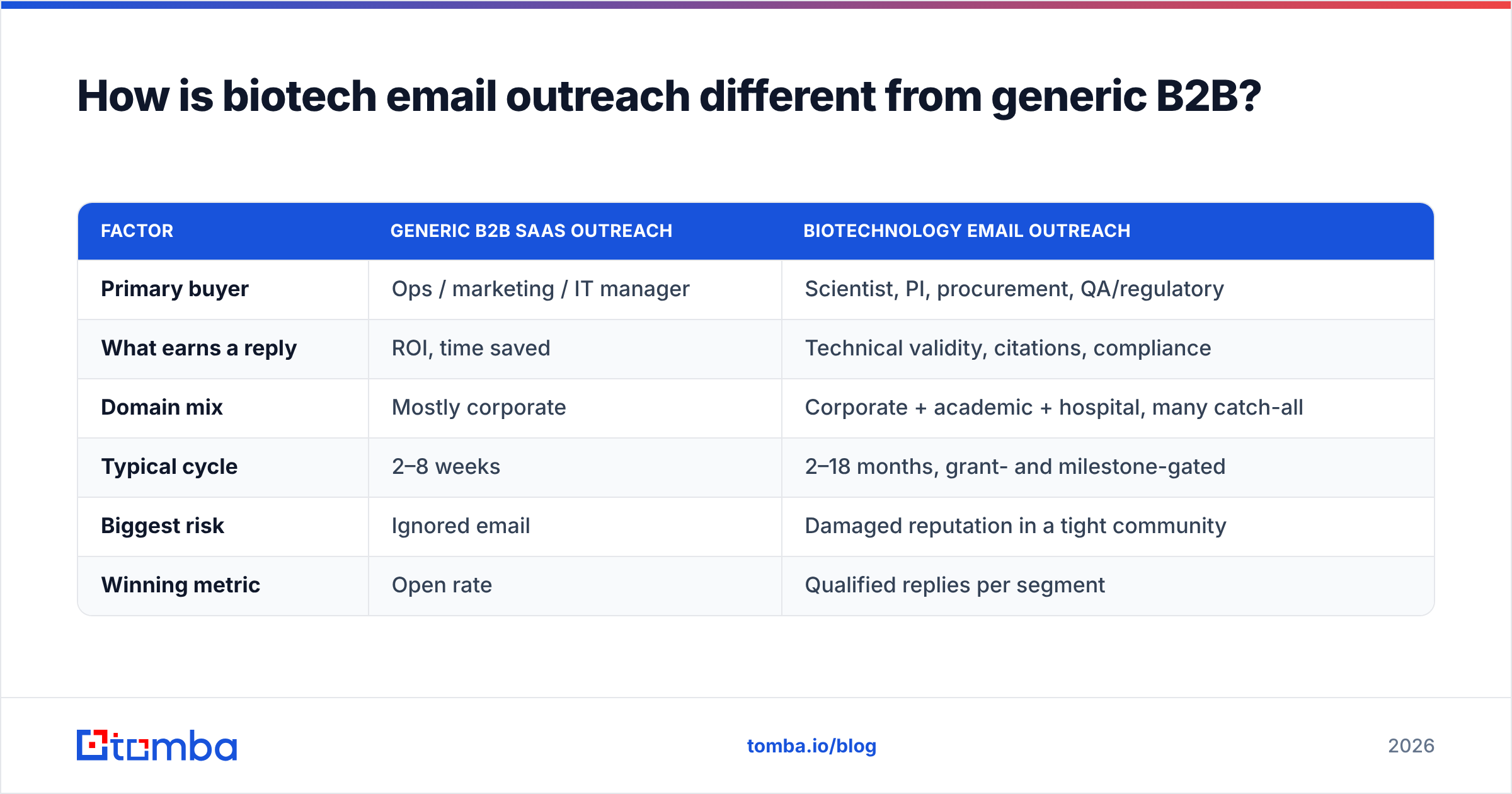
| Factor | Generic B2B SaaS outreach | Biotechnology email outreach |
|---|---|---|
| Primary buyer | Ops / marketing / IT manager | Scientist, PI, procurement, QA/regulatory |
| What earns a reply | ROI, time saved | Technical validity, citations, compliance |
| Domain mix | Mostly corporate | Corporate + academic + hospital, many catch-all |
| Typical cycle | 2–8 weeks | 2–18 months, grant- and milestone-gated |
| Biggest risk | Ignored email | Damaged reputation in a tight community |
| Winning metric | Open rate | Qualified replies per segment |
How do you build an accurate biotech contact list?#
Conclusion first: build the list from verified, role-matched data — never from a single scraped export you didn't check.
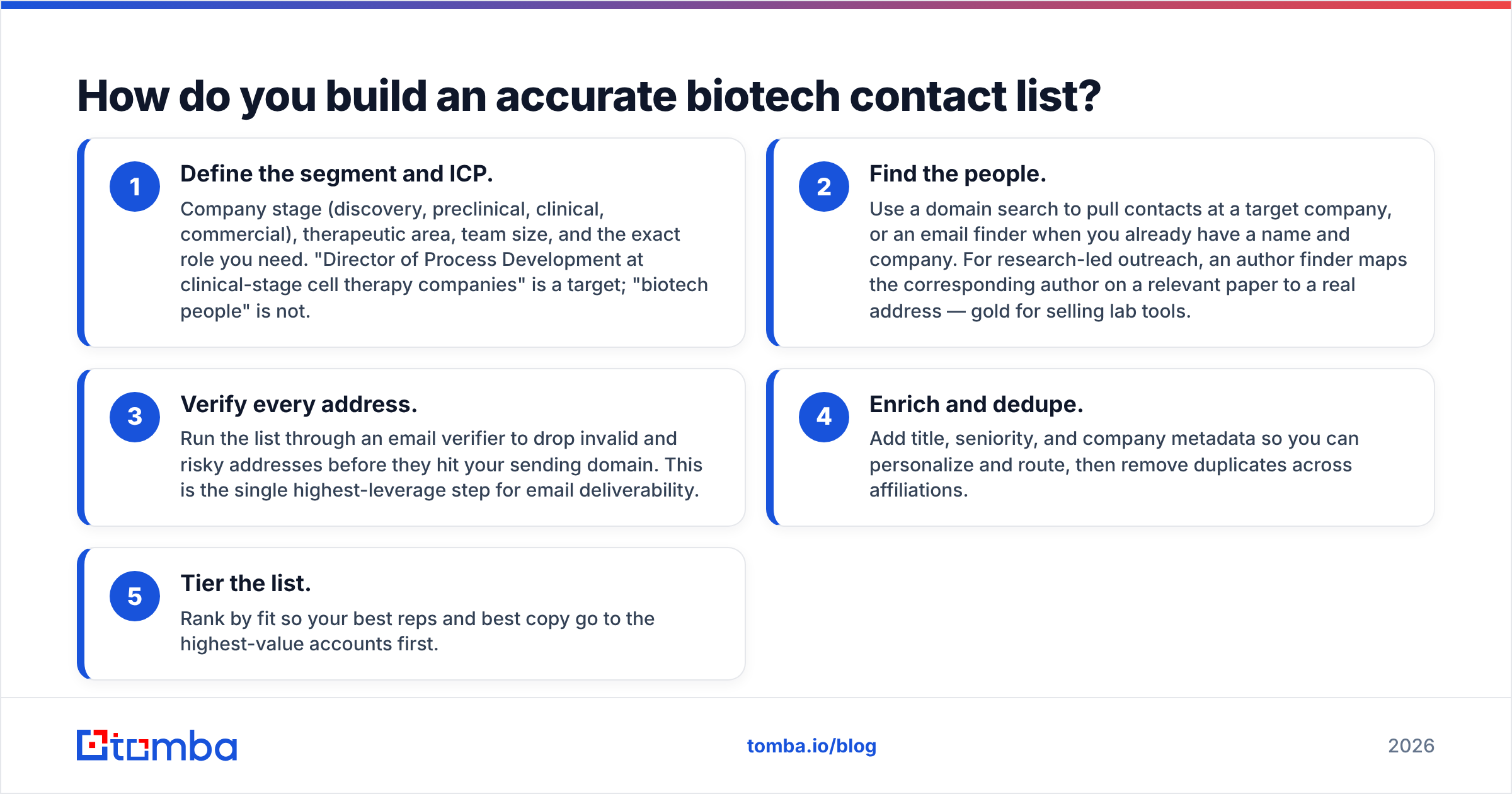
A repeatable workflow:
- Define the segment and ICP. Company stage (discovery, preclinical, clinical, commercial), therapeutic area, team size, and the exact role you need. "Director of Process Development at clinical-stage cell therapy companies" is a target; "biotech people" is not.
- Find the people. Use a domain search to pull contacts at a target company, or an email finder when you already have a name and company. For research-led outreach, an author finder maps the corresponding author on a relevant paper to a real address — gold for selling lab tools.
- Verify every address. Run the list through an email verifier to drop invalid and risky addresses before they hit your sending domain. This is the single highest-leverage step for email deliverability.
- Enrich and dedupe. Add title, seniority, and company metadata so you can personalize and route, then remove duplicates across affiliations.
- Tier the list. Rank by fit so your best reps and best copy go to the highest-value accounts first.
The reason verification matters so much in biotech: academic and institutional domains push your bounce rate up faster than corporate-only lists. A 5% bounce rate can throttle an entire domain's reputation. Clean data is cheaper than a burned domain.
What should a biotech cold email actually say?#
The message has to pass a scientist's skepticism filter in about five seconds. Lead with relevance, prove it with a specific, and ask for one small thing.
A structure that works:
- Subject line: concrete and non-salesy. "Cutting your ddPCR setup from 3 hours to 40 minutes" beats "Revolutionary PCR solution." Test variants with a subject line tester.
- Opening line: reference their work — a publication, a pipeline milestone, a recent funding round, a job posting that signals scaling. This proves you didn't mass-blast.
- The claim + proof: one outcome, backed by a number, a peer-reviewed result, or a named comparable customer. Avoid "innovative," "best-in-class," "synergistic."
- The ask: low friction. "Worth a 15-minute call?" or "Want the validation data sheet?" — not "Let's schedule a demo to walk through our platform."
- Signature: a real human, a real title, and a credibility signal (a relevant logo, a publication, or a compliance certification).
Example opener that respects the reader:
"Saw your group's recent paper on AAV capsid optimization — the titer numbers were impressive. We help cell & gene therapy teams cut endotoxin testing turnaround by ~60%. One question: is QC throughput a current bottleneck for you, or solved?"
That's specific, humble, and asks a real question. Compare it to "I'd love to show you our cutting-edge platform" and you can feel the difference.
How many follow-ups, and how should you space them?#
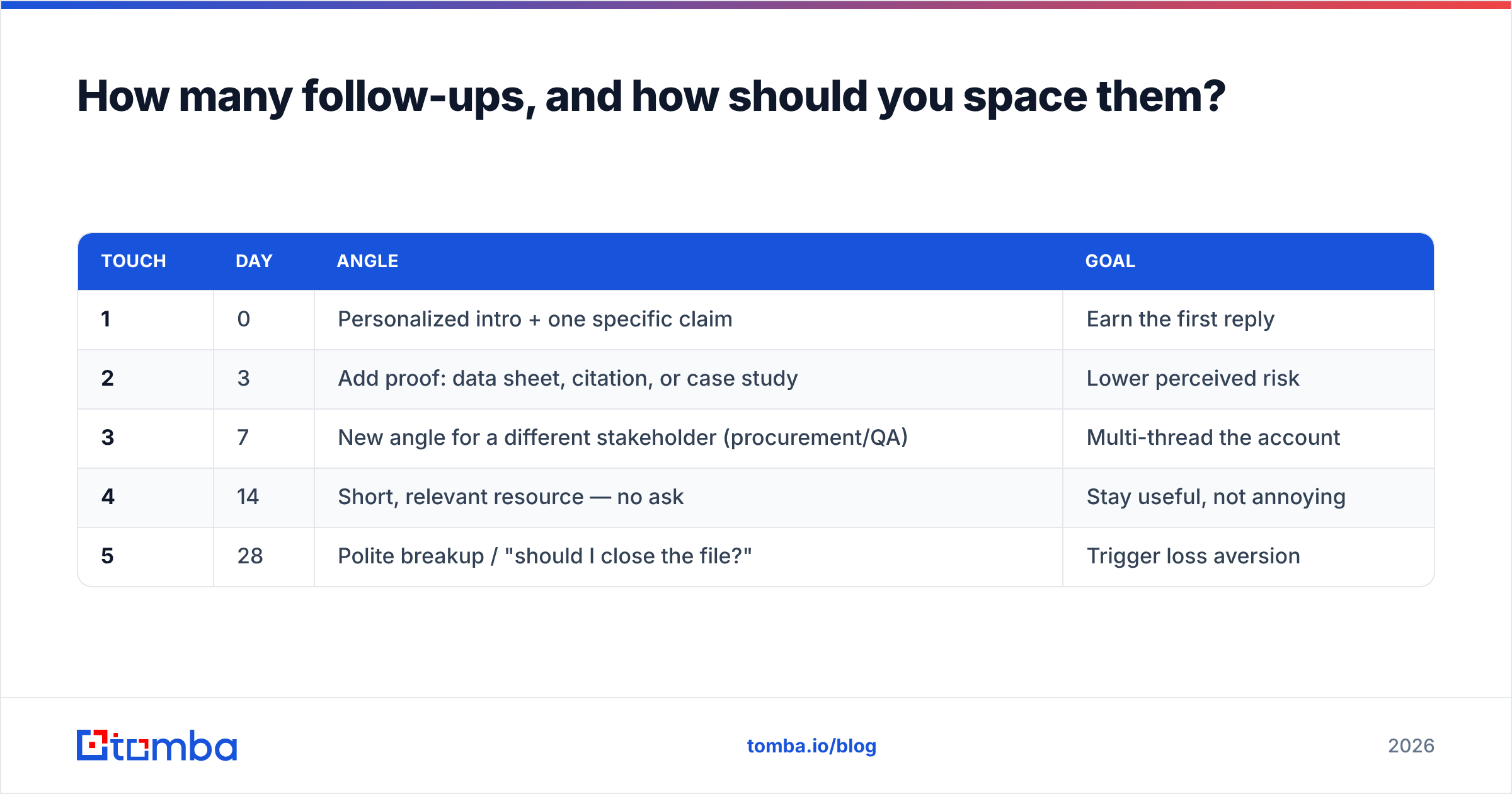
Most biotech deals are lost to silence, not rejection. A patient, value-adding sequence wins.
| Touch | Day | Angle | Goal |
|---|---|---|---|
| 1 | 0 | Personalized intro + one specific claim | Earn the first reply |
| 2 | 3 | Add proof: data sheet, citation, or case study | Lower perceived risk |
| 3 | 7 | New angle for a different stakeholder (procurement/QA) | Multi-thread the account |
| 4 | 14 | Short, relevant resource — no ask | Stay useful, not annoying |
| 5 | 28 | Polite breakup / "should I close the file?" | Trigger loss aversion |
Keep follow-ups short and each one independently valuable. Never send "just bumping this to the top of your inbox" — it adds nothing and trains the reader to ignore you. And always multi-thread: in a 12-month instrument cycle, the bench scientist who replies isn't the one who signs the PO.
What's the right tech stack for biotechnology email outreach?#
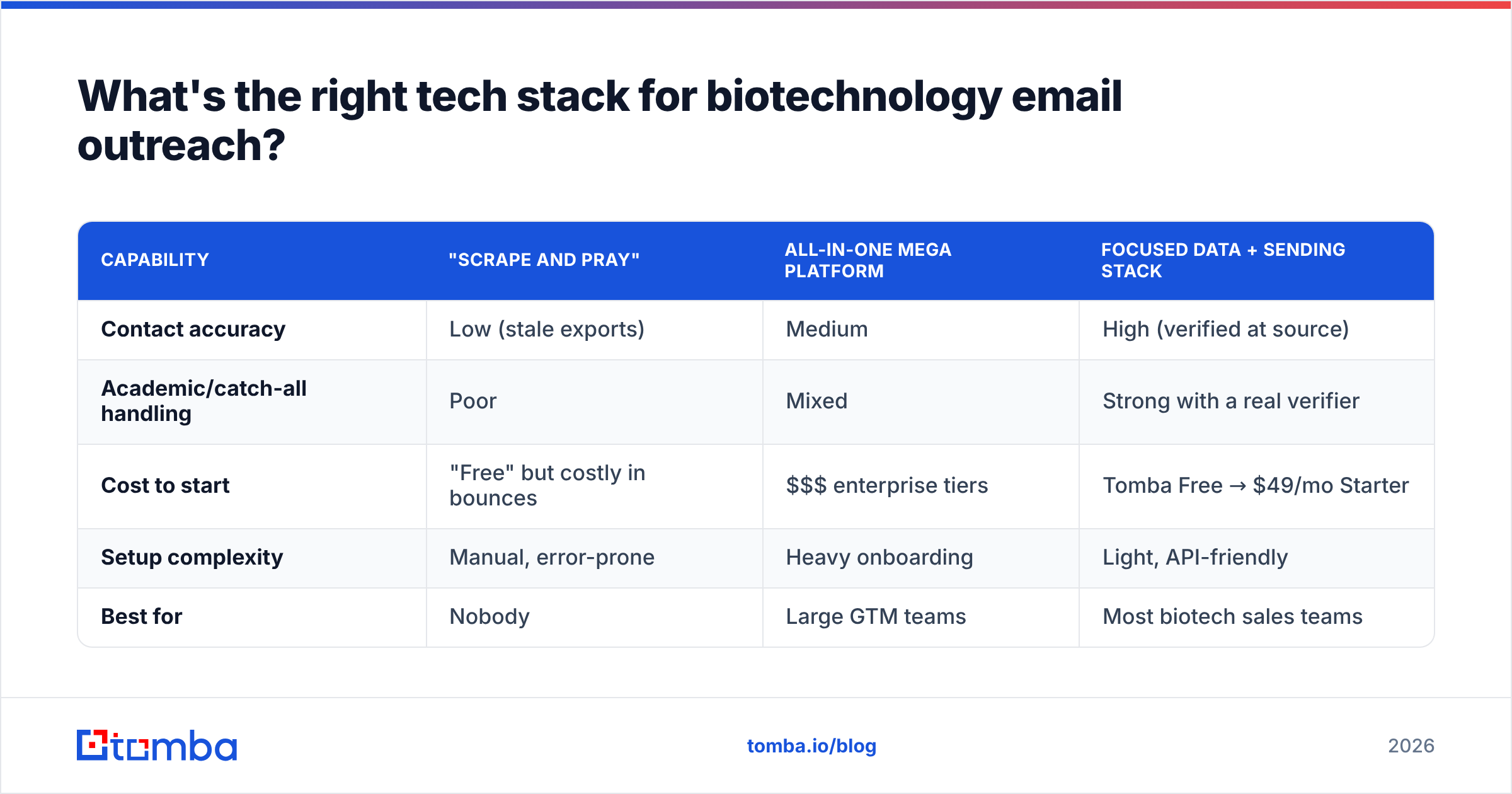
You need four capabilities: find, verify, send/sequence, and measure. Here's how a focused stack compares to the two common failure modes.
| Capability | "Scrape and pray" | All-in-one mega platform | Focused data + sending stack |
|---|---|---|---|
| Contact accuracy | Low (stale exports) | Medium | High (verified at source) |
| Academic/catch-all handling | Poor | Mixed | Strong with a real verifier |
| Cost to start | "Free" but costly in bounces | $$$ enterprise tiers | Tomba Free → $49/mo Starter |
| Setup complexity | Manual, error-prone | Heavy onboarding | Light, API-friendly |
| Best for | Nobody | Large GTM teams | Most biotech sales teams |
For the data layer specifically, a tool like Tomba covers the find-and-verify steps with biotech-relevant features: domain search across corporate and institutional domains, an author finder for publication-led outreach, a catch-all verifier for .edu and institute domains, and bulk lead generation for scaling once a segment proves out. Pricing runs Free (25 searches/mo), Starter at $49/mo, Growth at $99/mo, and Pro at $249/mo — see full Tomba pricing for credit details.
For sending and sequencing, pair your verified list with a dedicated outbound platform. Validate the platform choice against independent reviews on G2 rather than vendor claims, and lean on established CRM guidance from sources like HubSpot's sales resources when designing your follow-up cadence.
How do you protect deliverability when selling into biotech?#
Conclusion first: deliverability fails before your copy ever gets read, so fix the plumbing first.
A pre-launch checklist:
- Authenticate your domain. Set up SPF, DKIM, and DMARC. Use a free SPF checker to confirm your record resolves correctly.
- Warm the sending domain. Ramp volume gradually over 2–4 weeks instead of blasting 1,000 emails on day one. A warmup calculator helps you plan the ramp.
- Verify before every send. Re-verify lists older than 30–60 days; biotech staff turnover and lab moves invalidate addresses quickly.
- Watch your reputation. Monitor sender reputation and check whether your IP or domain landed on a blocklist with a blacklist checker.
- Keep volume sane per domain. Spreading sends across the day and capping per-recipient-domain volume avoids tripping institutional spam filters, which are often stricter than Gmail.
Healthy sender reputation compounds. Each clean send earns you more inbox placement on the next; each spam complaint or hard bounce costs you several future deliveries.
How do you measure success?#
Open rate is increasingly unreliable thanks to privacy proxies, and it tells you nothing about pipeline. Track outcomes that map to revenue:
- Qualified reply rate by segment. Are PIs replying but procurement isn't? Rewrite the procurement track.
- Meetings booked per 100 verified contacts. This normalizes for list size and quality.
- Bounce and complaint rate. Keep bounces under ~3% and complaints under 0.1%, or pause and re-verify.
- Cycle progression. In long biotech cycles, track movement to the next stage, not just the first reply.
- Cost per meeting. Verified-list campaigns usually win here even at a higher data cost, because they waste fewer sends and protect the domain.
If a segment underperforms, change one variable at a time — usually the targeting or the proof point, not the whole template.
Common mistakes that kill biotech campaigns#
- Overclaiming. Scientists verify. One unsupported claim and you've lost the inbox permanently.
- Wrong persona, right company. Pitching assay throughput to a CFO, or pricing to a bench scientist with no budget authority.
- Skipping verification. The fastest way to a blocklisted domain.
- Jargon mismatch. Using marketing buzzwords with people who speak in p-values and protocols.
- One-and-done. Quitting after a single email in a market that takes months to convert.
Putting it together#
Strong biotechnology email outreach is mostly discipline: tight segmentation, verified data, credible and specific copy, patient follow-up, and clean deliverability. Volume is the enemy; relevance is the lever. Get the list right and the rest of the campaign gets dramatically easier — your reps spend their time on real conversations instead of chasing bounces.
Start with the data layer, because everything downstream depends on it. Use the Tomba Email Finder to build verified, role-matched lists across corporate and academic domains, then verify before you send. Spin up a free account (25 searches to test it on your real target accounts), confirm the accuracy on contacts you can independently check, and scale the segments that reply. Your domain reputation — and your standing in a small scientific community — will thank you.
// get started
Find, verify and enrich your first contacts today
Start on the free plan with 25 searches a month, then scale when your team is ready.
Free plan · No credit card required · GDPR & CCPA
// about the author