ChatGPT Email Outreach in 2026: A Practical Playbook
ChatGPT can draft cold emails in seconds, but raw output tanks reply rates. Here's how to use ChatGPT email outreach the right way in 2026 — with prompts, guardrails, and the data layer it can't replace.
ChatGPT Email Outreach in 2026: A Practical Playbook
TL;DR
- ChatGPT writes cold emails fast, but generic prompts produce generic copy that prospects ignore. The win comes from feeding it real research, not from asking it to "write a sales email."
- Personalization at scale only works when ChatGPT has accurate inputs — verified addresses, job titles, and company signals. Garbage in, garbage in your spam folder.
- Deliverability is the silent killer. AI-drafted volume means nothing if your domain reputation is shot. Warmup, SPF/DKIM, and list hygiene still decide whether you land in the inbox.
- The highest-leverage workflow is a pipeline: pull clean contact data → enrich → prompt ChatGPT with that context → verify before send → measure replies.
- ChatGPT is a drafting engine, not a data source. Pair it with a real email finder and verifier and your reply rates climb; skip that step and you're automating noise.
What is ChatGPT email outreach?#
ChatGPT email outreach is the practice of using OpenAI's language model to draft, personalize, and iterate on cold and warm outreach emails at speed. Instead of staring at a blank template, you hand ChatGPT a prospect's role, company, and a trigger event, and it returns a first draft in seconds.
Think of ChatGPT like a fast junior copywriter. It types quickly and never gets tired, but it only knows what you tell it. Hand it a vague brief and you get vague copy. Hand it a tight, factual brief — the prospect's title, their recent product launch, the specific pain your product solves — and it produces something a human SDR would be proud of.
The mistake most teams make in 2026 is treating ChatGPT as the whole system. It isn't. It's one stage in a longer chain that starts with finding the right person and ends with a measurable reply. Get the data wrong and the most elegant prompt in the world won't save you.
)
How does ChatGPT fit into a cold email workflow?#
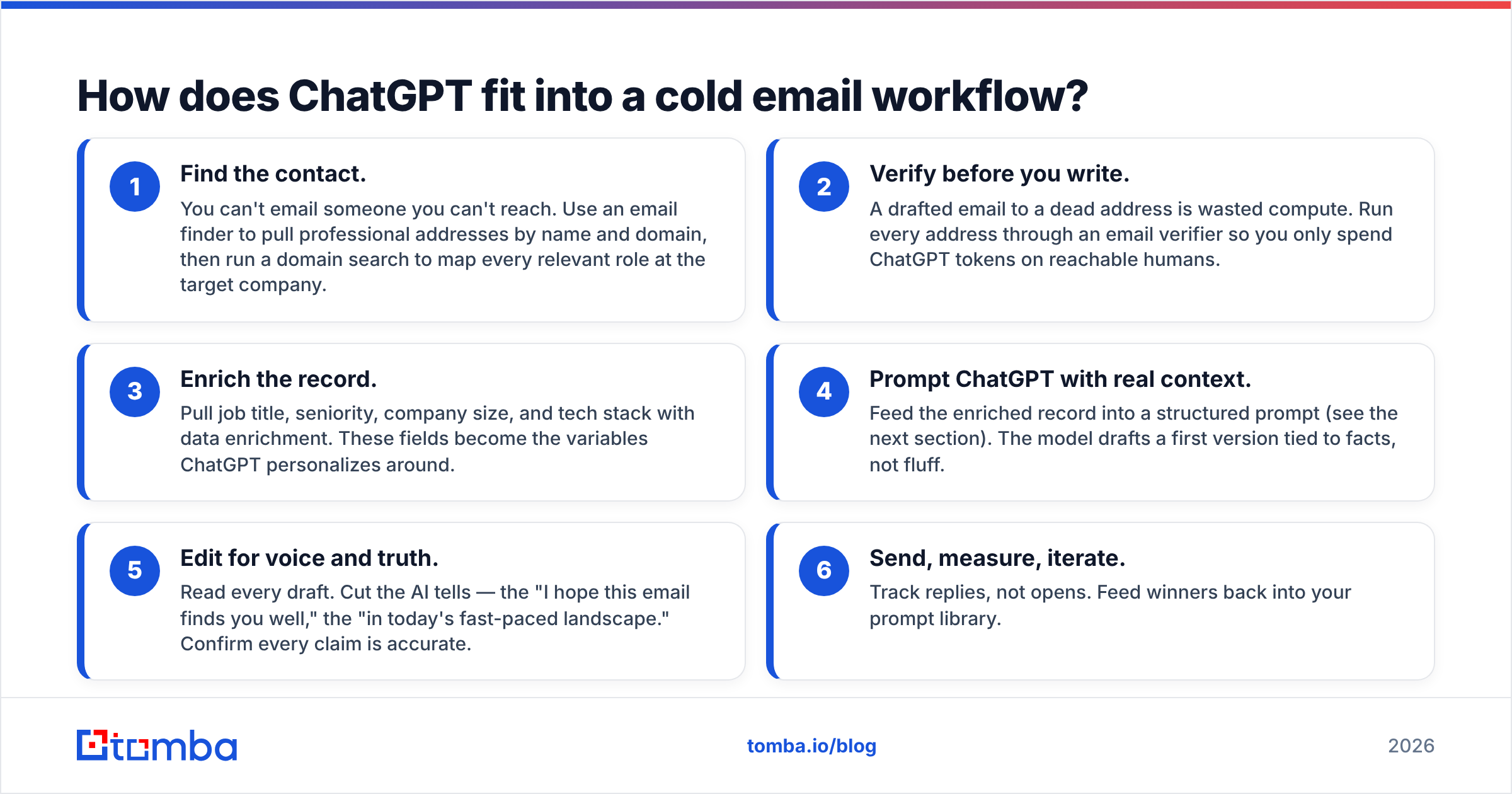
Here's the workflow that actually moves numbers, broken into stages. Each one feeds the next.
- Find the contact. You can't email someone you can't reach. Use an email finder to pull professional addresses by name and domain, then run a domain search to map every relevant role at the target company.
- Verify before you write. A drafted email to a dead address is wasted compute. Run every address through an email verifier so you only spend ChatGPT tokens on reachable humans.
- Enrich the record. Pull job title, seniority, company size, and tech stack with data enrichment. These fields become the variables ChatGPT personalizes around.
- Prompt ChatGPT with real context. Feed the enriched record into a structured prompt (see the next section). The model drafts a first version tied to facts, not fluff.
- Edit for voice and truth. Read every draft. Cut the AI tells — the "I hope this email finds you well," the "in today's fast-paced landscape." Confirm every claim is accurate.
- Send, measure, iterate. Track replies, not opens. Feed winners back into your prompt library.
Notice that ChatGPT only enters at stage four. The first three stages are pure data work — and they determine whether stages four through six produce revenue or noise.
What does a good ChatGPT outreach prompt look like?#
A weak prompt says: "Write a cold email to a marketing director." A strong prompt gives the model everything a human would need.
Here's a template you can adapt:
You are an SDR writing a cold email. Keep it under 90 words.
Goal: book a 15-minute call.

Prospect: {first_name}, {title} at {company} ({employee_count} employees).
Trigger: {recent_event — funding, hire, product launch, job posting}.
Our product: {one-sentence value prop}.
Pain we solve for this role: {specific pain}.

Rules:
- No greeting clichés. No "I hope this finds you well."
- Lead with the trigger, not with us.
- One clear ask. One sentence of social proof max.
- Plain language. No buzzwords. No exclamation marks.
Fill the curly-brace variables from your enriched data, and ChatGPT produces drafts that read like a person wrote them after doing homework. The difference between this and a generic prompt is the difference between a 1% and a 9% reply rate.
A few prompting principles that hold up in 2026:
- Constrain length. Models ramble. A 90-word cap forces signal over filler.
- Give it a trigger. The single biggest lift in cold email is relevance. A real, recent reason to reach out beats any clever line.
- Ban the tells. Explicitly forbid the phrases that scream "AI wrote this." Recipients have learned to spot them, and they trigger instant deletion.
- Ask for variants. Request three subject lines and two body angles so you can A/B test instead of guessing. Tomba's subject line generator is useful here when you want a second opinion fast.
Can ChatGPT personalize outreach at scale?#
Yes — but only as well as the data you feed it. This is the part teams get wrong.
ChatGPT will happily invent a "recent achievement" if you don't give it one. That's a hallucination, and prospects notice immediately when you congratulate them on a milestone that never happened. The fix is not a better prompt. The fix is real data: a verified address, a confirmed title, and a true company signal pulled from a reliable source.
When you connect a clean data layer to ChatGPT, scaled personalization stops being a contradiction. You can generate 500 genuinely tailored emails in an afternoon because each one is built on 500 accurate records. Pull those records in bulk with a bulk email finder, enrich them, then batch-prompt the model with one record per row.
)
The trap is the reverse: scaling junk. If your list is full of guessed addresses and stale titles, ChatGPT amplifies the errors. You're not personalizing at scale — you're broadcasting wrong information at scale, and your domain pays the price.
ChatGPT alone vs. ChatGPT plus a data layer: what's the difference?#
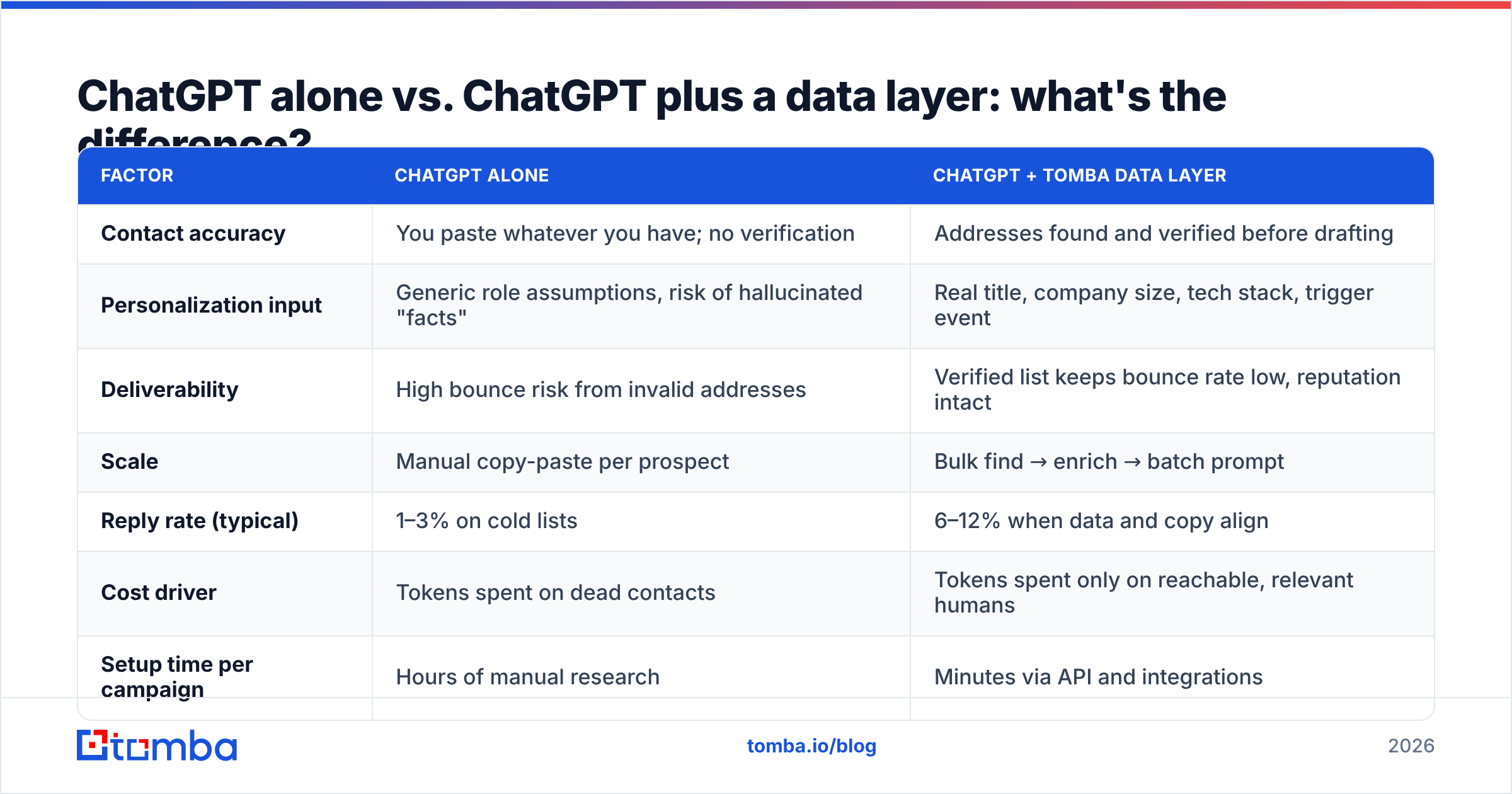
This is the core comparison that decides whether AI outreach works for you. ChatGPT is the same model either way; what changes is what surrounds it.
| Factor | ChatGPT alone | ChatGPT + Tomba data layer |
|---|---|---|
| Contact accuracy | You paste whatever you have; no verification | Addresses found and verified before drafting |
| Personalization input | Generic role assumptions, risk of hallucinated "facts" | Real title, company size, tech stack, trigger event |
| Deliverability | High bounce risk from invalid addresses | Verified list keeps bounce rate low, reputation intact |
| Scale | Manual copy-paste per prospect | Bulk find → enrich → batch prompt |
| Reply rate (typical) | 1–3% on cold lists | 6–12% when data and copy align |
| Cost driver | Tokens spent on dead contacts | Tokens spent only on reachable, relevant humans |
| Setup time per campaign | Hours of manual research | Minutes via API and integrations |
The pattern is consistent: ChatGPT is necessary but not sufficient. The data layer is what turns a drafting toy into an outbound engine. For context on how data sourcing affects accuracy, Tomba documents where its data comes from, which matters more than any prompt tweak.
How do you keep AI-drafted emails out of spam?#
Deliverability is where most ChatGPT outreach quietly dies. You can write the perfect email and still never reach the inbox if your technical setup and list hygiene are weak.
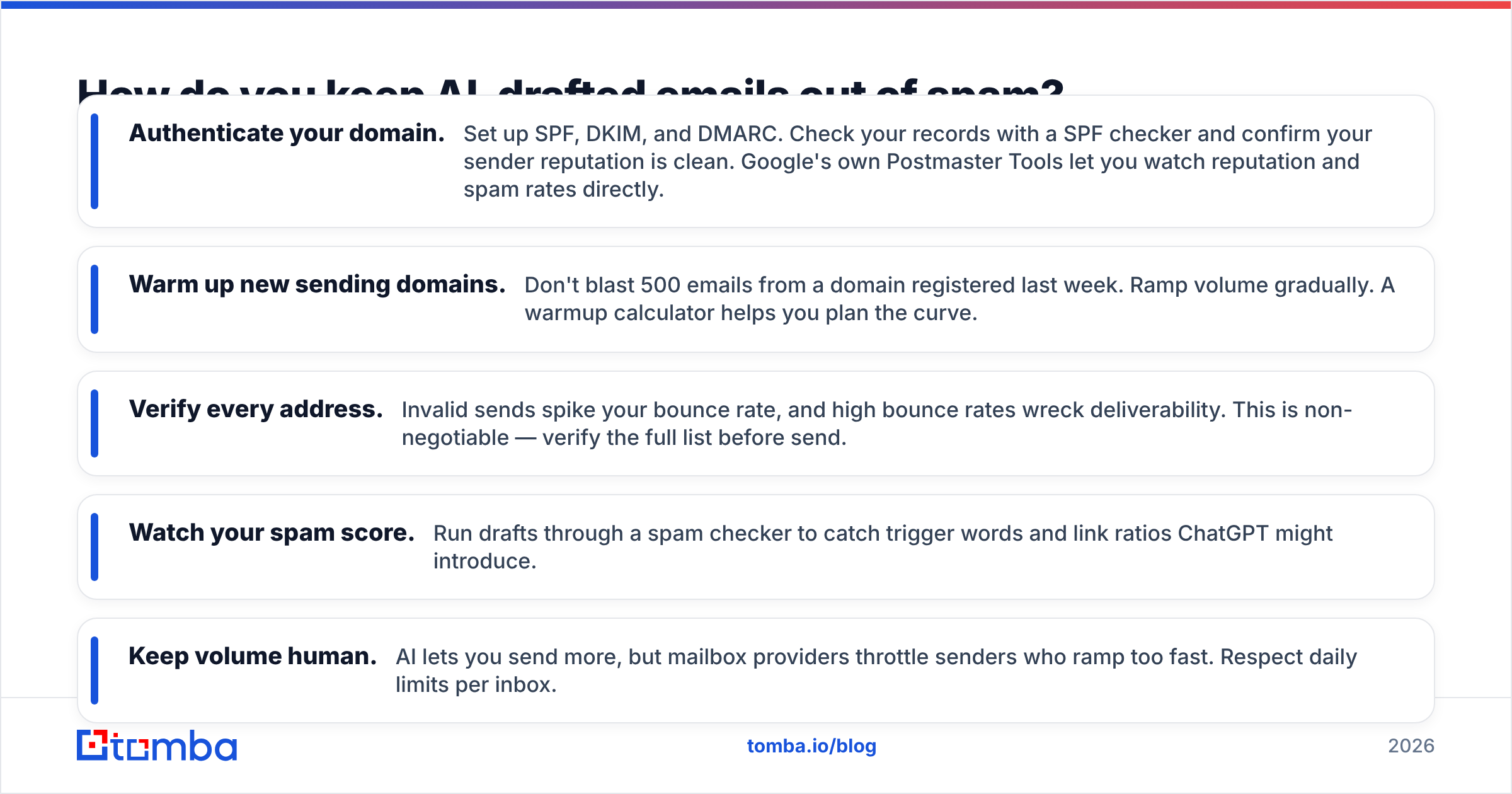
Treat deliverability like a restaurant health inspection — you can serve the best dish in town, but if the kitchen fails inspection, nobody eats. Cover these basics before you scale volume:
- Authenticate your domain. Set up SPF, DKIM, and DMARC. Check your records with a SPF checker and confirm your sender reputation is clean. Google's own Postmaster Tools let you watch reputation and spam rates directly.
- Warm up new sending domains. Don't blast 500 emails from a domain registered last week. Ramp volume gradually. A warmup calculator helps you plan the curve.
- Verify every address. Invalid sends spike your bounce rate, and high bounce rates wreck deliverability. This is non-negotiable — verify the full list before send.
- Watch your spam score. Run drafts through a spam checker to catch trigger words and link ratios ChatGPT might introduce.
- Keep volume human. AI lets you send more, but mailbox providers throttle senders who ramp too fast. Respect daily limits per inbox.
The uncomfortable truth: ChatGPT makes it easier to send bad volume faster. Discipline on deliverability is what separates teams that book meetings from teams that get blacklisted. For a deeper primer, the concept of email deliverability in Tomba's glossary is a solid starting point.
What are the best ChatGPT outreach use cases in 2026?#
Not every email should be AI-drafted, and not every AI draft should ship unedited. Here are the use cases where ChatGPT email outreach earns its keep:
- First-draft cold emails. ChatGPT excels at getting you from blank page to editable draft. The 80% it nails saves real time; you supply the final 20% of voice and truth.
- Follow-up sequences. Writing five distinct follow-ups by hand is tedious. ChatGPT spins variations that don't sound copy-pasted, as long as each references the prior touch.
- Subject line testing. Generate 10 angles, test the top three. Cheap, fast, measurable.
- Reply handling. When a prospect responds, ChatGPT drafts a context-aware reply you can refine. Tomba's AI email response tool is built for exactly this.
- Localization. Translating outreach into another market's language and tone is a genuine strength — with a native speaker reviewing before send.
And the cases where you should be cautious: anything where a hallucinated fact would embarrass you, anything legally sensitive, and any email to a high-value account where a human-written note will out-convert a machine draft every time. Use judgment. AI is a force multiplier, not an autopilot.
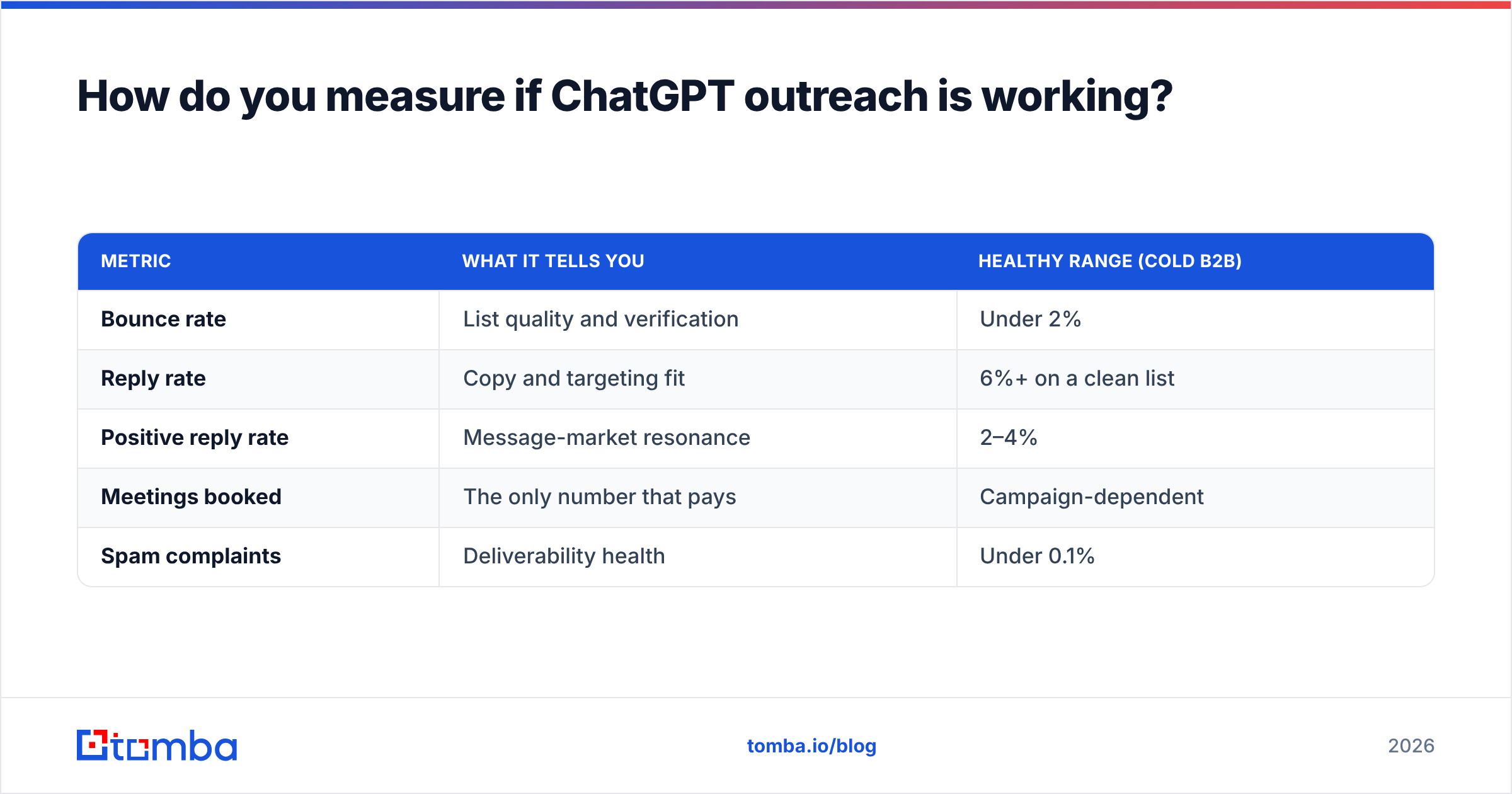
How do you measure if ChatGPT outreach is working?#
Measure replies and meetings booked — not opens, and definitely not "emails sent." Open tracking is increasingly unreliable thanks to privacy protections, and volume is a vanity metric that often correlates negatively with results.
Build a simple scoreboard per campaign:
| Metric | What it tells you | Healthy range (cold B2B) |
|---|---|---|
| Bounce rate | List quality and verification | Under 2% |
| Reply rate | Copy and targeting fit | 6%+ on a clean list |
| Positive reply rate | Message-market resonance | 2–4% |
| Meetings booked | The only number that pays | Campaign-dependent |
| Spam complaints | Deliverability health | Under 0.1% |
If your bounce rate is high, the problem is data, not copy — go back and verify. If your reply rate is low but bounces are clean, the problem is the message or the targeting, and that's where ChatGPT iteration helps. Diagnosing which layer is broken saves you from rewriting emails when the real issue is the list.
For teams running this at volume, pushing the whole loop through the Tomba API lets you find, verify, and enrich programmatically, then hand clean records to ChatGPT — no manual copy-paste, no guesswork.
The bottom line: drafting engine, not data source#
ChatGPT changed how fast you can write outreach. It did not change what makes outreach work: reaching the right person, with a relevant message, at a deliverable address. The model handles the writing. It does not — and cannot — find or verify your contacts.
That's the division of labor to internalize. Let ChatGPT do what it's great at: turning a structured brief into clean, human-sounding copy in seconds. Let a real data platform do what ChatGPT can't: surface verified, enriched, deliverable contacts so every draft is built on fact.
If you're ready to stop feeding ChatGPT guesswork, start with the Tomba Email Finder. Find professional email addresses by domain, name, or company, verify them in the same workflow, and enrich each record with the title and company signals your prompts need. Pair clean data with smart prompting and your AI outreach finally does what it promised — book meetings instead of bounce. Check the Tomba pricing plans, including a free tier to test the workflow before you scale.
// get started
Find, verify and enrich your first contacts today
Start on the free plan with 25 searches a month, then scale when your team is ready.
Free plan · No credit card required · GDPR & CCPA
// about the author